
Tags
One of the benefits of being an author with a publisher like Manning is being given early access to books in development and being invited to share my thoughts. Recently, I was asked if I’d have a look at Think Distributed Systems by Dominik Tornow.
Systems have become increasingly distributed for years, but the growth has been accelerating fast, enabled by technologies like CORBA, SOAP, REST frameworks, and microservices. However, some distribution challenges even manifest themselves when using multithreading applications. So, I was very interested in seeing what new perspectives could be offered that may help people, and Dominik has given us a valuable perspective.
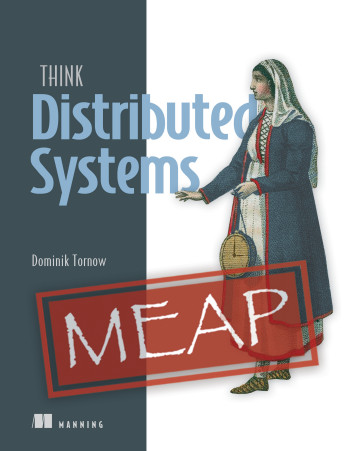
I’ve been fortunate enough that my career started with working on large multi-server, multithreaded mission-critical systems. Using Ada and working with a mentor who challenged me to work through such issues. How does this relate to the book? This work and the mentor meant I built some good mental models of distributed development early in my career. Dominik calls out that having good mental models to understand distributed systems and the challenges they can bring is key to success. It’s this understanding that equips you to understand challenges such as resource locking, contending with mutual deadlock, transaction ordering, the pros and cons of optimistic locking, and so on.
As highlighted early on in this book, most technical books come from the perspective of explaining tools, languages, or patterns and to make the examples easy to follow, the examples tend to be fairly simplistic. This is completely understandable; these books aim to teach the features of the language. Not how to bring these things to bear in complex real-world use cases. As a result, we don’t necessarily get the fullest insight and understanding of the problems that can come with optimistic locking.
Given the constraints of explaining through the use of programming features, the book takes a language-agnostic approach to explaining the ideas, and complexities of distributed solutions. Instead, the book favors using examples, analogies, and mathematics to illustrate its points. The mathematics is great at showing the implications of different aspects of distributed systems. But, for readers like me who are more visual and less comfortable with numeric abstraction, this does mean some parts of the book require more effort – but it is worth it. You can’t deny hard numeric proofs can really land a message, and if you know what the variables are that can change a result, you’re well on your way.
For anyone starting to design and implement distributed and multi-threaded applications for the first time, I’d recommend looking at this book. From what I’ve seen so far, the lessons you’ll take away will help keep you from walking into some situations that can be very difficult to overcome later or, worse, only manifest themselves when your system starts to experience a lot of load.
 Phil (aka MP3Monster)'s Blog
You must be logged in to post a comment.