
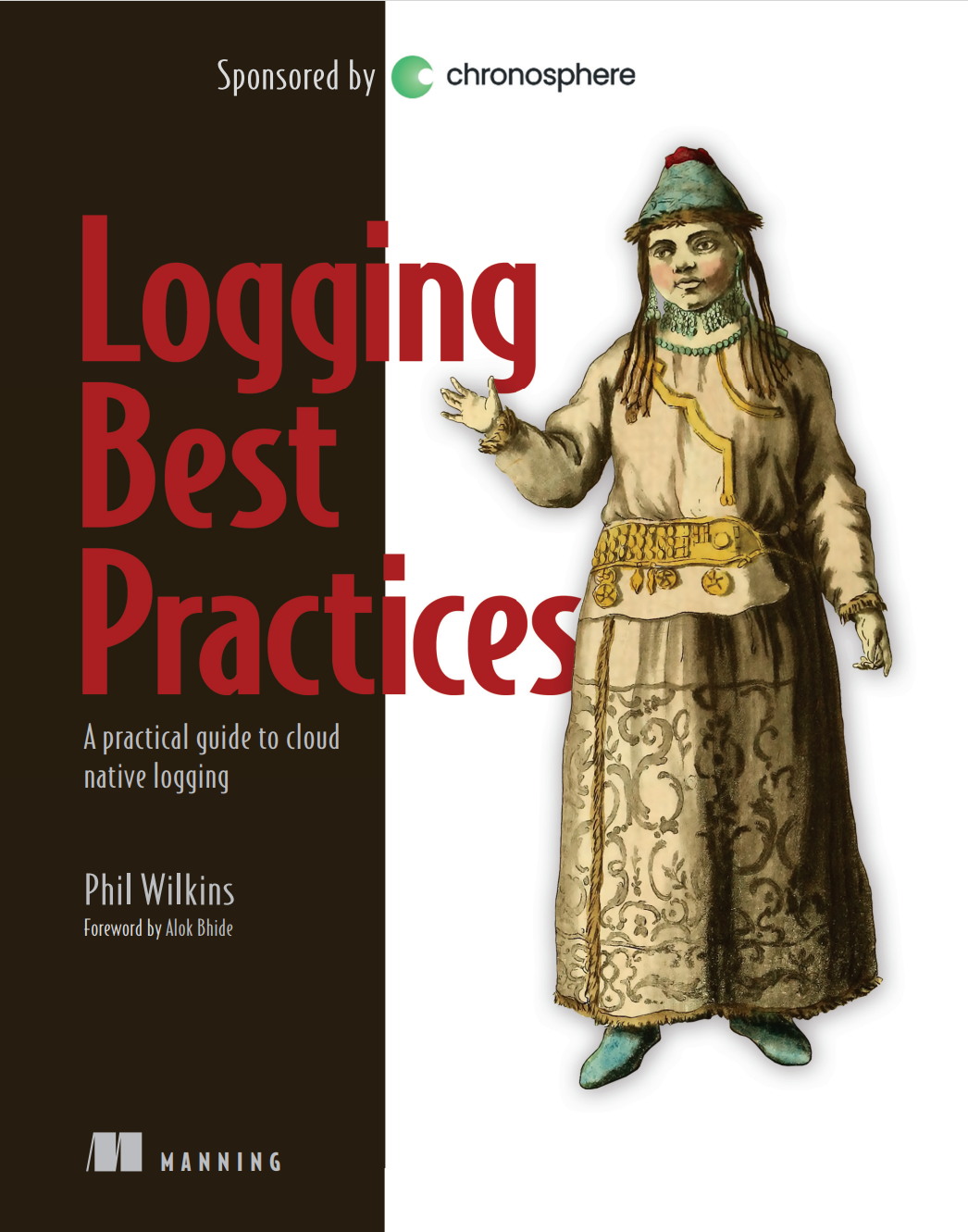
So, there is a new book title published with me as the author (Logging Best Practices) published by Manning, and yes, the core content has been written by me. But was I involved with the book? Sadly, not. So what has happened?
Background
To introduce the book, I need to share some background. A tech author’s relationship with their publisher can be a little odd and potentially challenging (the editors are looking at the commerciality – what will ensure people will consider your book, as well as readability; as an author, you’re looking at what you think is important from a technical practitioner).
It is becoming increasingly common for software vendors to sponsor books. Book sponsorship involves the sponsor’s name on the cover and the option to give away ebook copies of the book for a period of time, typically during the development phase, and for 6-12 months afterwards.
This, of course, comes with a price tag for the sponsor and guarantees the publisher an immediate return. Of course, there is a gamble for the publisher as you’re risking possible sales revenue against an upfront guaranteed fee. However, for a title that isn’t guaranteed to be a best seller, as it focuses on a more specialized area, a sponsor is effectively taking the majority investment risk from the publisher (yes, the publisher still has some risk, but it is a lot smaller).
When I started on the Fluent Bit book (Logs and Telemetry), I introduced friends at Calyptia to Manning, and they struck a deal. Subsequently, Calyptia was acquired by Chronosphere (Chronosphere acquires Calyptia), so they inherited the sponsorship. An agreement I had no issue with, as I’ve written before, I write as it is a means to share what I know with the broader community. It meant my advance would be immediately settled (the advance, which comes pretty late in the process, is a payment that the publisher recovers by keeping the author’s share of a book sale).
The new book…
How does this relate to the new book? Well, the sponsorship of Logs and Telemetry is coming to an end. As a result, it appears that the commercial marketing relationship between Chronosphere and Manning has reached an agreement. Unfortunately, in this case, the agreement over publishing content wasn’t shared with the author or me, or the commissioning editor at Manning I have worked with. So we had no input on the content, who would contribute a foreword (usually someone the author knows).
Manning is allowed to do this; it is the most extreme application of the agreement with me as an author. But that isn’t the issue. The disappointing aspect is the lack of communication – discovering a new title while looking at the Chronosphere website (and then on Manning’s own website) and having to contact the commissioning editor to clarify the situation isn’t ideal.
Reading between the lines (and possibly coming to 2 + 2 = 5), Chronosphere’s new log management product launch, and presumably being interested in sponsoring content that ties in. My first book with Manning (Logging in Action), which focused on Fluentd, includes chapters on logging best practices and using logging frameworks. As a result, a decision was made to combine chapters from both books to create the new title.
Had we been in the loop during the discussion, we could have looked at tweaking the content to make it more cohesive and perhaps incorporated some new content – a missed opportunity.
If you already have the Logging in Action and Logs and Telemetry titles, then you already have all the material in Logging Best Practices. While the book is on the Manning site, if you follow the link or search for it, you’ll see it isn’t available. Today, the only way to get a copy is to go to Chronosphere and give them your details. Of course, suppose you only have one of the books. In that case, I’d recommend considering buying the other one (yes, I’ll get a small single-digit percentage of the money you spend), but more importantly, you’ll have details relating to the entire Fluent ecosystem, and plenty of insights that will help even if you’re currently only focused on one of the Fluent tools.
Going forward
While I’m disappointed by how this played out, it doesn’t mean I won’t work with Manning again. But we’ll probably approach things a little differently. At the end of the day, the relationship with Manning extends beyond commercial marketing.
- Manning has a tremendous group of authors, and aside from writing, the relationship allows me to see new titles in development.
- Working with the development team is an enriching experience.
- It is a brand with a recognized quality.
- The social/online marketing team(s) are great to interact with – not just to help with my book, but with opportunities to help other authors.
As to another book, if there was an ask or need for an update on the original books, we’d certainly consider it. If we identify an area that warrants a book and I possess the necessary knowledge to write it, then maybe. However, I tend to focus on more specialized domains, so the books won’t be best-selling titles. It is this sort of content that is most at risk of being disrupted by AI, and things like vibe coding will have the most significant impact, making it the riskiest area for publishers. Oh, and this has to be worked around the day job and family.
 Phil (aka MP3Monster)'s Blog
You must be logged in to post a comment.