
• Home
  • Site Aliases
    • www.cloud-native.info
  • About
    • Background
    • Presenting Activities
    • Internet Profile
      • LinkedIn
    • About
  • Books & Publications
    • Log Generator
    • Logs and Telemetry using Fluent Bit
      • Fluent Bit book
      • Book Resources in GitHub
      • Fluent Bit Classic to YAML Format configurations
    • Logging in Action with Fluentd, Kubernetes and More
      • Logging in Action with Fluentd – Book
      • Fluentd Book Resources
      • Fluentd & Fluent Bit Additional stuff
    • API & API Platform
      • API Useful Resources
    • Oracle Integration
      • Book Website
      • Useful Reading Sources
    • Publication Contributions
  • Resources
    • GitHub
    • Oracle Integration Site
    • Oracle Resources
    • Mindmaps Index
    • Useful Tech Resources
      • Fluentd & Fluent Bit Additional stuff
      • Recommended Tech Podcasts
      • Official Sources for Product Logos
      • Java and Graal Useful Links
      • Python Setup & related stuff
  • Music
    • Monster On Music
    • Music Listening
    • Music Reading

Phil (aka MP3Monster)'s Blog

~ from Technology to Music

Phil (aka MP3Monster)'s Blog

Tag Archives: app

Sending Push Notifications Without Your Own App

24 Wednesday Dec 2014

Posted by mp3monster in General, Java Cloud, NodeJS Cloud, Oracle, Technology

≈ 2 Comments

Tags

android, API, app, growl, ios, NMA, prowl, Prowl App, push notifications

So in my opening blog entry I talked about creating mobile push notifications. So before we start playing with cloud solutions and developing anything, the best place to start is be able to push a notification.

We’re going to do this with the use of Prowl. Prowl offers both a mobile application and a cloud service with an API. So setting up an account on Prowl you can connect you mobile Prowl App to then through another app – for example Growl (which is how I came across Prowl) which can be extended by a plugin framework to use Prowl so potentially all your desktop alert can become push notifications if you want.

So if you hadn’t already noticed Prowl is presently an IOS only solution – however there is an Android equivalent called Notify My Android (NMA). I should also be upfront the Prowl App does cost a couple of pounds or dollars (depending upon your App Store).  But this is a small price to pay to avoid having to build an app (which needs to you to be a fully paid up IOS Developer Account holder to play with push notifications as we do).

So I will concentrate primarily on working from a Windows platform to an Apple device – but I will loop back to Android at points as well.  For those who bulk at the idea of Windows and swear only to live with Mac or a proper OS as many Linux fans will say – I will point out where to get the info you need and hack your Linux flavour into appropriate shape. Our goal is to see Oracle cloud in use.

Just as an aside quick detour – Growl is a Mac based notification consolidation tool, which has a Windows implementation as well called Growl For Windows.  The idea is all your applications and system notifications go via Growl which allows your to customise the notifications and route them to lots of different channels such as to browser plugin, push notifications and so on.

So lets get the first steps called out:

  1. Create an account on Prowl or NMA
  2. Install the Prowl App on your IOS device
  3. From the Prowl web app or NMA web send a message to your device

So we have proven notifications to our device from a central device. We are going to go one step further and use a local client to prove we can safely send events to the Prowl or NMA servers. We can do this several different ways – on the Prowl site are several browser plugins that you could use or combine prowl with Growl or Growl for Windows plus the Growl notifier.

So I assume that you have installed Growl or Growl for Windows as previously mentioned. Then the Growl notifier extension needs to be installed from http://www.growlforwindows.com/gfw/help/growlnotify.aspx. With the extension installed we need to make sure Growl sends its notifications to Prowl and send the notifications from a command line.

To do this you need to create a API Key on the Prowl website. Then in settings part of the app setup the key details as shown below (note I’ve hidden my account and key):
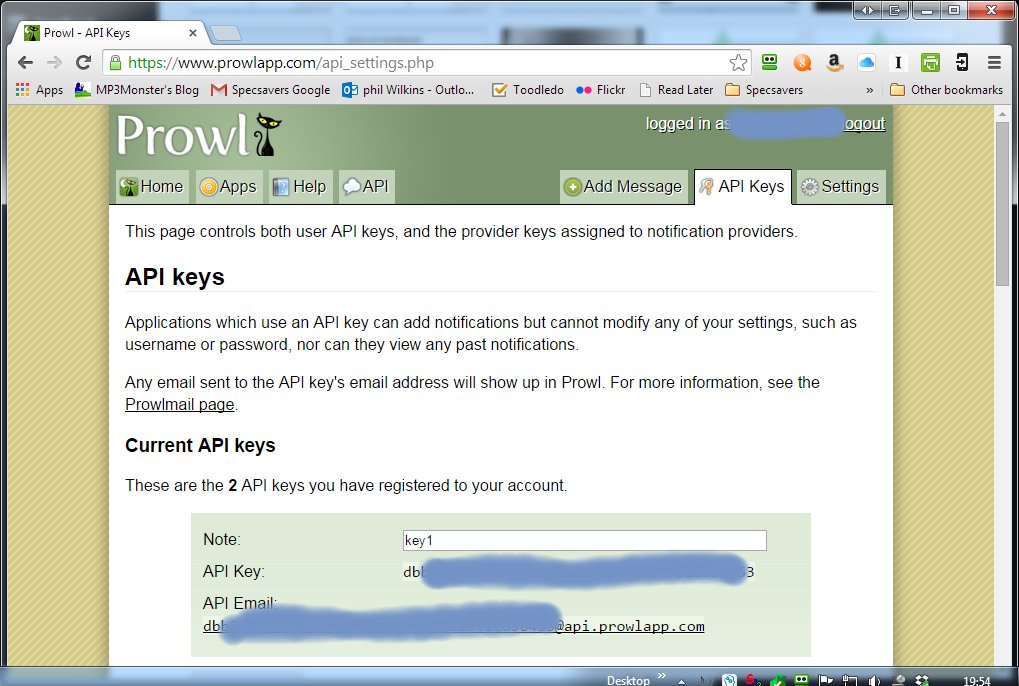
Prowl API Config
So this links the credentials of the account. You could impose local security constraints so the local notification is only accepted by Growl with good credentials.

Then you you need to configure the notifier to use the configured key as you can see below:

In The Network part of Growl's configuration you need to establish the Key

In The Network part of Growl’s configuration you need to establish the Key

The Plus key you can see provides a dialogue like the following where you select the type of notification and then complete the necessary details i.e.  copy in the API Key from the website:

In The Network part of Growl's configuration you need to establish the Key

In The Network part of Growl’s configuration you need to establish the Key

GrowlConfig- forward NotificationsGrowl-setKey

You’ll may have noticed – that the key name carries through from the website – this is more to make it convenient to track the key rather than a necessity.

With the API Key setup we can link the notification side of things via the Notifications section.  You’ll note the App extension is selected and in the notification type I have gone to the Choices menu which provides a popup

Selecting Notification


Selecting the key:

Selecting the Destination KeyThe final step is to then run a command line, which would look something like:


Growl Notifier Script

You’ll notice the command line is very simple as we’ve not setup an security in Growl the only security is around the API Key.

Then we get the pay off of the pushed notification and you can see your notification history as well in the Prowl app – as this shows:

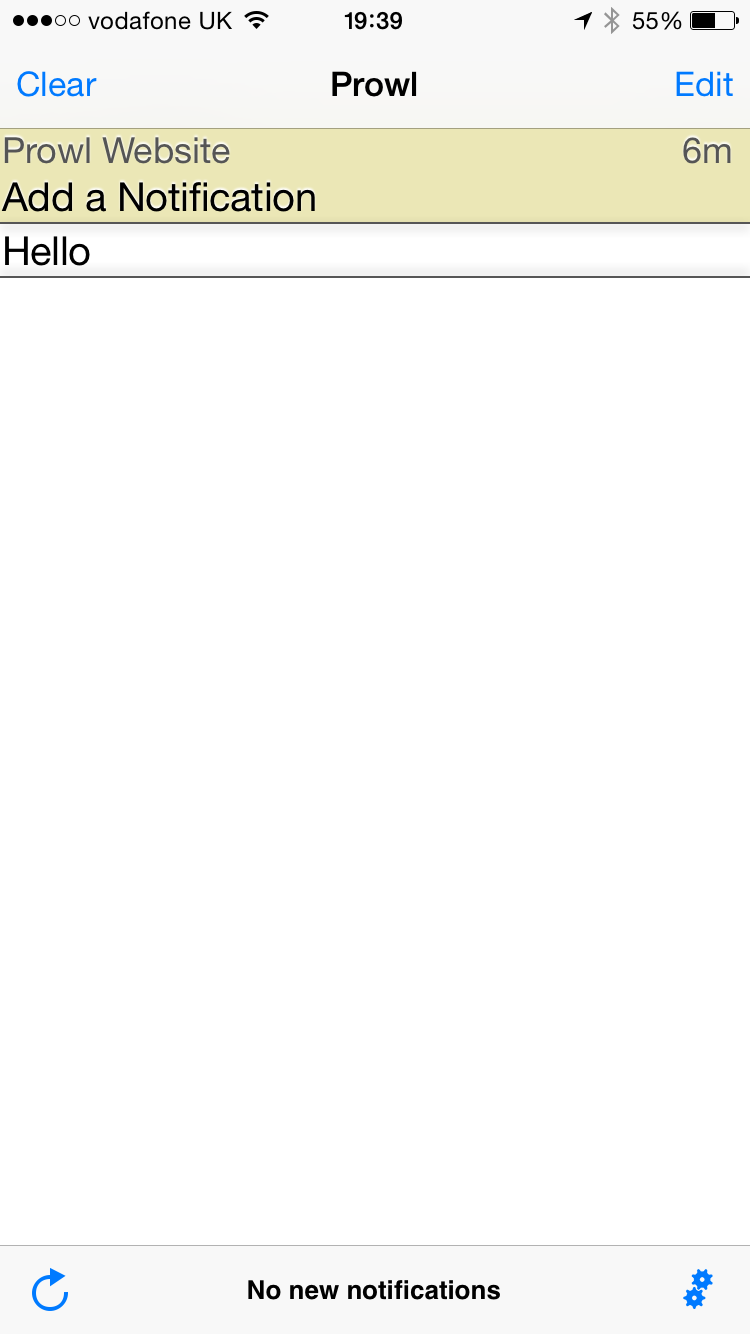
IMG_1944

Prowl App View


So the steps just performed:

  • Created the API key on the ProwlAPI site
  • made sure we’ve got Growl and Growl Notifier installed
  • Established the link from Growl to Growl Web App via the API Key
  • Configured the notifications for GrowlNotifier to go through Growl and get pushed onto the Prowl API
  • Run the command line script
  • Seen the command line message go from the desktop shell through Growl onto the Prowl API and arrive on your smart phone.


Summary
So we have shown we can create push notifications without the distraction of building our own app. Not very exciting as we haven’t created anything but does show the art of the possible.

Next post we’ll cut some code to perform the same process using the Prowl API directly.

Share this:

  • Click to share on Facebook (Opens in new window) Facebook
  • Click to share on X (Opens in new window) X
  • Click to share on Pocket (Opens in new window) Pocket
  • Click to share on Reddit (Opens in new window) Reddit
  • Click to email a link to a friend (Opens in new window) Email
  • Click to share on WhatsApp (Opens in new window) WhatsApp
  • Click to print (Opens in new window) Print
  • Click to share on Tumblr (Opens in new window) Tumblr
  • Click to share on Mastodon (Opens in new window) Mastodon
  • Click to share on Pinterest (Opens in new window) Pinterest
  • More
  • Click to share on Bluesky (Opens in new window) Bluesky
  • Click to share on LinkedIn (Opens in new window) LinkedIn
Like Loading...

Thinking about a COTs Mobile Strategy

28 Tuesday Oct 2014

Posted by mp3monster in General, Technology

≈ 1 Comment

Tags

app, authentication, Facebook Connect, LDAP, mobile, OID, OpenID, Oracle, white label

More and more software capability is becoming commoditised and off the shelf either in the form of COTS packages or SaaS solutions new considerations and challenges arrive for customer businesses.

Recently we had an initial conversation at the architectural level with a vendor who have a well thought out end to end offering which includes mobile apps for our customers (white label offering). This is great in many respects as we can depend on our vendor to deal with the challenges of keeping mobile apps upto date and contend with the ever changing mobile landscape.

If a business you don’t fit into classic solution stacks for example Boots (now part of Walgreens) isn’t just a retailer but also a prescription pharmacist you’re likely to be sourcing solutions from different suppliers. The challenge comes from the fact you’re likely want to leverage different white label apps for different offerings e.g. prescriptions, eye test related etc (which are potentially going to come from different vendors, particularly if you want to adopt a best of breed set of solutions). It is however important that you get a consistency in look and feel, and unified authentication to the different apps is essential when presenting solutions to end customers. The worst thing in the world would be have different authentications which means the customer has to remember multiple passwords to engage with your business.

The look and feel can be to an extend dealt with by the fact a lot of contemporary mobile applications are built on a hybrid framework so you can use CSS3 to drive standardisation or atleast colour and branding; which plays to a white label strategy.

As to authentication that could be more challenging, you need consistency in approach between all of the applications, there are standards out there such as OpenId but you the different apps to offer the same authentication sources. Even OpenId has issues, and the support for the latest version of the standard looks somewhat mixed. But in addition to that there is the fact there is a degree of fragmentation for example Facebook used to support OpenId but now has Facebook Connect.

So if you wanted to offer a voucher system from your POS (Point of Sale) provider and perhaps an app for an ordering capability built around your ERP from a different vendor what are the chances of having consistency?

If you know all your vendors and launching your mobile solutions you can look for common denominators and drive in that direction. But this is a rare situation. All of this is ideally linked to your normal website as well which may well be linked to a different solution such as Oracle’s OID.

If the apps offer their own LDAP authentication service then you have the possibility of synchronising these repositories so if the user interacts with one app then the details can be pushed to the other apps’ repository through your own integration layer.

In a perfect world your white label apps will have the means to configure to connect to a single LDAP server, in this case you can get things aligned at-least for authentication.

Without this then there is going to be a pretty challenging situation, to the point the ROI on consistent user experience needs to be seriously examined ad it maybe time to think about building the solutions yourself.

Share this:

  • Click to share on Facebook (Opens in new window) Facebook
  • Click to share on X (Opens in new window) X
  • Click to share on Pocket (Opens in new window) Pocket
  • Click to share on Reddit (Opens in new window) Reddit
  • Click to email a link to a friend (Opens in new window) Email
  • Click to share on WhatsApp (Opens in new window) WhatsApp
  • Click to print (Opens in new window) Print
  • Click to share on Tumblr (Opens in new window) Tumblr
  • Click to share on Mastodon (Opens in new window) Mastodon
  • Click to share on Pinterest (Opens in new window) Pinterest
  • More
  • Click to share on Bluesky (Opens in new window) Bluesky
  • Click to share on LinkedIn (Opens in new window) LinkedIn
Like Loading...

SQL Static Code analysis for MySQL

05 Thursday Sep 2013

Posted by mp3monster in General, Technology

≈ Leave a comment

Tags

analysis, app, code, MySQL, sql

With MySQL now capable of features such as stored procedures and functions the need for tooling to support SQL code quality is greater than ever. A number of tools provide editors with syntax support and all the fancy features you’d expect from a modern IDE (see Toad as a leading product).

However the means to assess the quality of the procedures or scripts written for MySQL or the divergence from ISO standards doesn’t exist, although plenty of options exist for T-SQL (MS SQL Server), PL/SQL (Oracle) and even some tooling for DB2 and Informix.

The value of the static analysis tool means you can implement quality measures, controls and reporting through Continuous Integration tooling such as Jenkins, Sonar etc. All of which is a little ironic when you consider a lot of energy in CI (and Continuous Delivery appears to come from the open source community) which usually supports MySQL as one of the 1st options for databases.

Does this mean there is a gap in the market? Such capabilities dont seem to be in the MySQL WorkBench roadmap. Would love to know what people think?

Of course if you can support MySQL, then the offshoots such as MariaDB wouldn’t be too difficult.

Share this:

  • Click to share on Facebook (Opens in new window) Facebook
  • Click to share on X (Opens in new window) X
  • Click to share on Pocket (Opens in new window) Pocket
  • Click to share on Reddit (Opens in new window) Reddit
  • Click to email a link to a friend (Opens in new window) Email
  • Click to share on WhatsApp (Opens in new window) WhatsApp
  • Click to print (Opens in new window) Print
  • Click to share on Tumblr (Opens in new window) Tumblr
  • Click to share on Mastodon (Opens in new window) Mastodon
  • Click to share on Pinterest (Opens in new window) Pinterest
  • More
  • Click to share on Bluesky (Opens in new window) Bluesky
  • Click to share on LinkedIn (Opens in new window) LinkedIn
Like Loading...

Wikihood – iphone app

17 Sunday Jan 2010

Posted by mp3monster in General

≈ Leave a comment

Tags

app, iphone, location

I came across a great use of the iPhone and it’s location capabilities. Essentially it uses your location to query a wiki. The information it retrieved and the way it presented it was great.

I would recommend giving it a go.

Share this:

  • Click to share on Facebook (Opens in new window) Facebook
  • Click to share on X (Opens in new window) X
  • Click to share on Pocket (Opens in new window) Pocket
  • Click to share on Reddit (Opens in new window) Reddit
  • Click to email a link to a friend (Opens in new window) Email
  • Click to share on WhatsApp (Opens in new window) WhatsApp
  • Click to print (Opens in new window) Print
  • Click to share on Tumblr (Opens in new window) Tumblr
  • Click to share on Mastodon (Opens in new window) Mastodon
  • Click to share on Pinterest (Opens in new window) Pinterest
  • More
  • Click to share on Bluesky (Opens in new window) Bluesky
  • Click to share on LinkedIn (Opens in new window) LinkedIn
Like Loading...

The Killer App for CEP

20 Wednesday Feb 2008

Posted by mp3monster in General, Technology

≈ Leave a comment

Tags

app, CEP, Complex Event Processing

The online journal ebizQ are providing a webinar on ‘BAM:The Killer App for CEP’. Although SeeWhy would suggest that this is not exclusively the domain of Complex Event Processing, but any tool around Event Processing with a real-time capacity.  It would seem that SeeWhy is not the only organisation that sees how BAM (Business Activity Monitoring) is a natural partner for Event Processing as SeeWhy has produced an extension to its real-time Business Intelligence platform called ‘SeeWhy for JBoss jBPM’.

The webinar is sponsored by SL who provide a real-time style dashboard so will give some basic visibility of business activity, but doesn’t have the richness of SeeWhy’s intelligence or ability to feedback into the source system such as jBPM or event a third party.


del.icio.us tags: CEP, EP, BAMbino, Business Activity Monitoring, Complex Event Processing, SeeWhy, SL, ebizQ, webinar

Share this:

  • Click to share on Facebook (Opens in new window) Facebook
  • Click to share on X (Opens in new window) X
  • Click to share on Pocket (Opens in new window) Pocket
  • Click to share on Reddit (Opens in new window) Reddit
  • Click to email a link to a friend (Opens in new window) Email
  • Click to share on WhatsApp (Opens in new window) WhatsApp
  • Click to print (Opens in new window) Print
  • Click to share on Tumblr (Opens in new window) Tumblr
  • Click to share on Mastodon (Opens in new window) Mastodon
  • Click to share on Pinterest (Opens in new window) Pinterest
  • More
  • Click to share on Bluesky (Opens in new window) Bluesky
  • Click to share on LinkedIn (Opens in new window) LinkedIn
Like Loading...

    I work for Oracle, all opinions here are my own & do not necessarily reflect the views of Oracle

    • About
      • Internet Profile
      • Music Buying
      • Presenting Activities
    • Books & Publications
      • Logging in Action with Fluentd, Kubernetes and More
      • Logs and Telemetry using Fluent Bit
      • Oracle Integration
      • API & API Platform
        • API Useful Resources
        • Useful Reading Sources
    • Mindmaps Index
    • Monster On Music
      • Music Listening
      • Music Reading
    • Oracle Resources
    • Useful Tech Resources
      • Fluentd & Fluent Bit Additional stuff
        • Logging Frameworks and Fluent Bit and Fluentd connectivity
        • REGEX for BIC and IBAN processing
      • Java and Graal Useful Links
      • Official Sources for Product Logos
      • Python Setup & related tips
      • Recommended Tech Podcasts

    Oracle Ace Director Alumni

    TOGAF 9

    Logs and Telemetry using Fluent Bit


    Logging in Action — Fluentd

    Logging in Action with Fluentd


    Oracle Cloud Integration Book


    API Platform Book


    Oracle Dev Meetup London

    Blog Categories

    • App Ideas
    • Books
      • Book Reviews
      • manning
      • Oracle Press
      • Packt
    • Enterprise architecture
    • General
      • economy
      • ExternalWebPublications
      • LinkedIn
      • Website
    • Music
      • Music Resources
      • Music Reviews
    • Photography
    • Podcasts
    • Technology
      • AI
      • APIs & microservices
      • chatbots
      • Cloud
      • Cloud Native
      • Dev Meetup
      • development
        • languages
          • java
          • node.js
      • drone
      • Fluentbit
      • Fluentd
      • logsimulator
      • mindmap
      • OMESA
      • Oracle
        • API Platform CS
          • tools
        • Helidon
        • ITSO & OEAF
        • Java Cloud
        • NodeJS Cloud
        • OIC – ICS
        • Oracle Cloud Native
        • OUG
      • railroad diagrams
      • TOGAF
    • xxRetired
    • AI
    • API Platform CS
    • APIs & microservices
    • App Ideas
    • Book Reviews
    • Books
    • chatbots
    • Cloud
    • Cloud Native
    • Dev Meetup
    • development
    • drone
    • economy
    • Enterprise architecture
    • ExternalWebPublications
    • Fluentbit
    • Fluentd
    • General
    • Helidon
    • ITSO & OEAF
    • java
    • Java Cloud
    • languages
    • LinkedIn
    • logsimulator
    • manning
    • mindmap
    • Music
    • Music Resources
    • Music Reviews
    • node.js
    • NodeJS Cloud
    • OIC – ICS
    • OMESA
    • Oracle
    • Oracle Cloud Native
    • Oracle Press
    • OUG
    • Packt
    • Photography
    • Podcasts
    • railroad diagrams
    • Technology
    • TOGAF
    • tools
    • Website
    • xxRetired

    Enter your email address to subscribe to this blog and receive notifications of new posts by email.

    Join 2,555 other subscribers

    RSS

    RSS Feed RSS - Posts

    RSS Feed RSS - Comments

    December 2025
    M T W T F S S
    1234567
    891011121314
    15161718192021
    22232425262728
    293031  
    « Nov    

    Twitter

    Tweets by mp3monster

    History

    Speaker Recognition

    Open Source Summit Speaker

    Flickr Pics

    Turin Brakes Acoustic Tour 24 @ The Maltings FarnhamTurin Brakes Acoustic Tour 24 @ The Maltings FarnhamTurin Brakes Acoustic Tour 24 @ The Maltings FarnhamTurin Brakes Acoustic Tour 24 @ The Maltings Farnham
    More Photos

    Social

    • View @mp3monster’s profile on Twitter
    • View philwilkins’s profile on LinkedIn
    • View mp3monster’s profile on GitHub
    • View mp3monster’s profile on Flickr
    • View mp3muncher’s profile on WordPress.org
    • View philmp3monster’s profile on Twitch
    Follow Phil (aka MP3Monster)'s Blog on WordPress.com

    Blog at WordPress.com.

    • Subscribe Subscribed
      • Phil (aka MP3Monster)'s Blog
      • Join 233 other subscribers
      • Already have a WordPress.com account? Log in now.
      • Phil (aka MP3Monster)'s Blog
      • Subscribe Subscribed
      • Sign up
      • Log in
      • Report this content
      • View site in Reader
      • Manage subscriptions
      • Collapse this bar
     

    Loading Comments...
     

    You must be logged in to post a comment.

      Privacy & Cookies: This site uses cookies. By continuing to use this website, you agree to their use.
      To find out more, including how to control cookies, see here: Our Cookie Policy
      %d