• Home
  • Site Aliases
    • www.cloud-native.info
  • About
    • Background
    • Presenting Activities
    • Internet Profile
      • LinkedIn
    • About
  • Books & Publications
    • Log Generator
    • Logs and Telemetry using Fluent Bit
      • Fluent Bit book
      • Book Resources in GitHub
      • Fluent Bit Classic to YAML Format configurations
    • Logging in Action with Fluentd, Kubernetes and More
      • Logging in Action with Fluentd – Book
      • Fluentd Book Resources
      • Fluentd & Fluent Bit Additional stuff
    • API & API Platform
      • API Useful Resources
    • Oracle Integration
      • Book Website
      • Useful Reading Sources
    • Publication Contributions
  • Resources
    • GitHub
    • Oracle Integration Site
    • Oracle Resources
    • Mindmaps Index
    • Useful Tech Resources
      • Fluentd & Fluent Bit Additional stuff
      • Recommended Tech Podcasts
      • Official Sources for Product Logos
      • Java and Graal Useful Links
      • Python Setup & related stuff
  • Music
    • Monster On Music
    • Music Listening
    • Music Reading

Phil (aka MP3Monster)'s Blog

~ from Technology to Music

Phil (aka MP3Monster)'s Blog

Tag Archives: push notifications

Push Notifications with a bit of Node.js

16 Thursday Apr 2015

Posted by mp3monster in General, NodeJS Cloud, Oracle, Technology

≈ 1 Comment

Tags

API library, HelloWorld, javascript, JDeveloper, Node, node.js, npm, Oracle, prowl, push notifications

So I have written a couple of blogs about Push Notifications with a bit of Java (see here as the post that pulls all of this together). But this time we’re going to do something similar with Node.js. This blog entry is going to position us so we can then take a simple solution and push up to the cloud – as I use Oracle a lot then we’ll be looking at the Oracle cloud as a final step.

To start we need a local instance of node.js.  Given the fact it is a small footprint we can pretty much install anywhere.  So you’ll need to download Node.JS from the official site, and install it. I’m not going to walk through the installation guidance as it is well documented elsewhere (http://blog.teamtreehouse.com/install-node-js-npm-windows for example). You do want ensure you include the NPM capability (node.js packaging & deployment tool). Make sure that Node is on your path so we can reference the binary without a lots of file paths. You also want to ensure that node.js is up and running.

Next up is to the the Prowl API library that makes interacting with prowl simple and helps illustrate the deployment framework (NPM) used by node.js. So following the link from the Prowl website or go directly here  and download the library.  If you download the zip file as I did,  you’ll find it has a folder called node-prowl-master. You need to unpack this and rename to node-prowl.  and run the command

npm install node-prowl

When I first tried to deploy the Prowl API library then I did see an error. This isn’t the API but actually the Node.js installation (atleast on my Windows platform) as you can see:

installErrorI found googling using node.js and ENOENT showed up plenty of help to solve errors. In this situation the solution was purely to create the folder. Then re-running the action without problem.

When the npm command works you’ll see something like:

npm-install

So hopefully in addition to the prerequisites described in this earlier post we should have everything ready to progress.  So I’ve continued to use JDeveloper 12c, but using the general profile and set up a web solution project.  This does create a large directory structure given we’re producing some simple Javascript. But the structure is right for a proper development effort, and lazy habits form poor practises – so lets work with it.

With the project setup, we need craft a little JavaScript.  To we’re good to go – lets just try hello world, with a tiny twist, we’ll get the hostname using a Node library with this code:


// our very first node program

// get info about the OS
var os = require(‘os’);

// say hello world and include the hostname
console.log(“Hello world, we’re running on ” + os.hostname());

Before we do anything else, lets be a bit clever, to allow us to run our Node script within JDeveloper.  This can be done by adding a new Tool through the Tools –> External Tools … menu. Which will display the following screen:

external-tool-setup-0


Asa you can see in this image I have already selected New… and walked through the configuration screens, you’ll probably want to use a configuration similar to what I have in the following steps:

external-tool-setup-1

external-tool-setup-2 external-tool-setup-3

external-tool-setup-4

With this setup in JDeveloper with the Editor focus on our JavaScript, goto the Tools menu and you’ll see your Node entry. Just click on it. We’ll then see the results in the message window, as you can see here:

Hello World in JDeveloper

Alternatively in a command window you just need to run the command from the folder with the JavaScript (or include the path):

node helloworld.js

So lets take things up a notch and send our mobile device a message.  So using the following code, we can use the prowl-api and initiate a message:

var Prowl = require(‘node-prowl’); // pull in the prowl API we deployed with NPM earlier

var prowl = new Prowl(‘your-prowl-key-here‘); //setup your API key

var now = new Date();

// ready to send the message, passing a function reference to handle the response

var message = ‘hello mobile device, the time is ‘+ now.toUTCString();
prowl.push(message, ‘NodeJS App’, prowlReplyHandler);

//function to handle the response from the prowl API lib
function prowlReplyHandler ( err, remaining )
{

if( err )
{
var errorStr = err.message;
console.log( ‘I have an error ‘ + errorStr);
}
else
{
console.log( ‘I said:’ + message+ ‘; I have ‘ + remaining + ‘ calls available’ );
}

}

Note you’ll need to replace your-prowl-key-here in the above code with you genuine API key registered with the Prowl web app. Then we can run the application, and should see:

Node JS Calling Prowl

Our mobile device will show:

prowl-node-js-mobile


Next steps, in the next post – run through through a cloud hosting of node.js and extend the capability to be a simple service, which will mean packaging ourselves up and other exciting things.

Share this:

  • Click to share on Facebook (Opens in new window) Facebook
  • Click to share on X (Opens in new window) X
  • Click to share on Pocket (Opens in new window) Pocket
  • Click to share on Reddit (Opens in new window) Reddit
  • Click to email a link to a friend (Opens in new window) Email
  • Click to share on WhatsApp (Opens in new window) WhatsApp
  • Click to print (Opens in new window) Print
  • Click to share on Tumblr (Opens in new window) Tumblr
  • Click to share on Mastodon (Opens in new window) Mastodon
  • Click to share on Pinterest (Opens in new window) Pinterest
  • More
  • Click to share on Bluesky (Opens in new window) Bluesky
  • Click to share on LinkedIn (Opens in new window) LinkedIn
Like Loading...

Sending Push Notifications Without Your Own App

24 Wednesday Dec 2014

Posted by mp3monster in General, Java Cloud, NodeJS Cloud, Oracle, Technology

≈ 2 Comments

Tags

android, API, app, growl, ios, NMA, prowl, Prowl App, push notifications

So in my opening blog entry I talked about creating mobile push notifications. So before we start playing with cloud solutions and developing anything, the best place to start is be able to push a notification.

We’re going to do this with the use of Prowl. Prowl offers both a mobile application and a cloud service with an API. So setting up an account on Prowl you can connect you mobile Prowl App to then through another app – for example Growl (which is how I came across Prowl) which can be extended by a plugin framework to use Prowl so potentially all your desktop alert can become push notifications if you want.

So if you hadn’t already noticed Prowl is presently an IOS only solution – however there is an Android equivalent called Notify My Android (NMA). I should also be upfront the Prowl App does cost a couple of pounds or dollars (depending upon your App Store).  But this is a small price to pay to avoid having to build an app (which needs to you to be a fully paid up IOS Developer Account holder to play with push notifications as we do).

So I will concentrate primarily on working from a Windows platform to an Apple device – but I will loop back to Android at points as well.  For those who bulk at the idea of Windows and swear only to live with Mac or a proper OS as many Linux fans will say – I will point out where to get the info you need and hack your Linux flavour into appropriate shape. Our goal is to see Oracle cloud in use.

Just as an aside quick detour – Growl is a Mac based notification consolidation tool, which has a Windows implementation as well called Growl For Windows.  The idea is all your applications and system notifications go via Growl which allows your to customise the notifications and route them to lots of different channels such as to browser plugin, push notifications and so on.

So lets get the first steps called out:

  1. Create an account on Prowl or NMA
  2. Install the Prowl App on your IOS device
  3. From the Prowl web app or NMA web send a message to your device

So we have proven notifications to our device from a central device. We are going to go one step further and use a local client to prove we can safely send events to the Prowl or NMA servers. We can do this several different ways – on the Prowl site are several browser plugins that you could use or combine prowl with Growl or Growl for Windows plus the Growl notifier.

So I assume that you have installed Growl or Growl for Windows as previously mentioned. Then the Growl notifier extension needs to be installed from http://www.growlforwindows.com/gfw/help/growlnotify.aspx. With the extension installed we need to make sure Growl sends its notifications to Prowl and send the notifications from a command line.

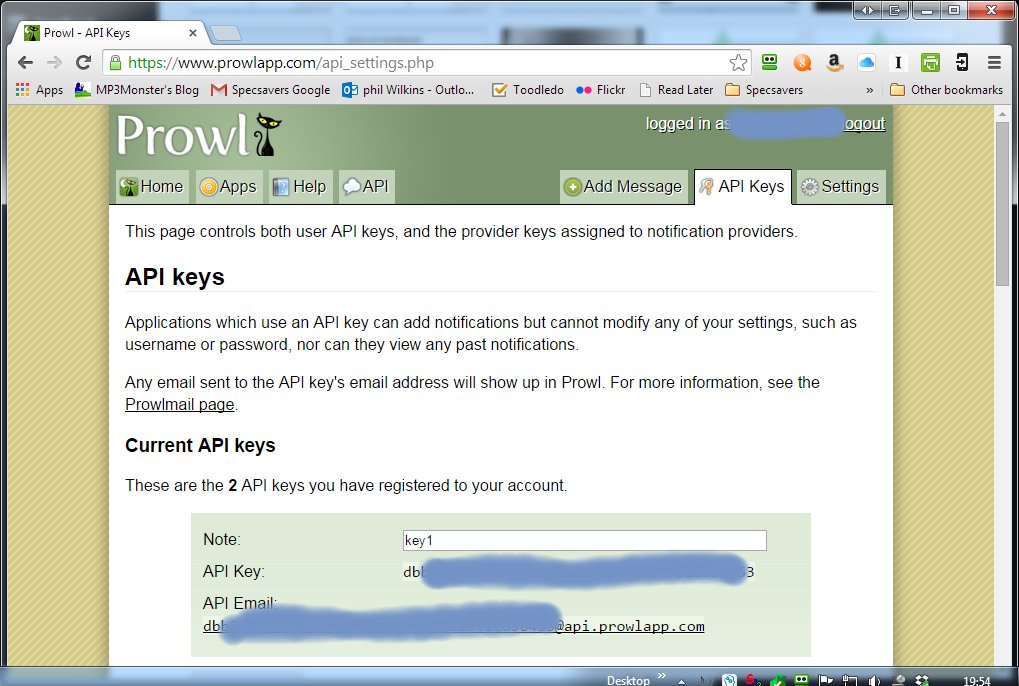
To do this you need to create a API Key on the Prowl website. Then in settings part of the app setup the key details as shown below (note I’ve hidden my account and key):
Prowl API Config
So this links the credentials of the account. You could impose local security constraints so the local notification is only accepted by Growl with good credentials.

Then you you need to configure the notifier to use the configured key as you can see below:

In The Network part of Growl's configuration you need to establish the Key

In The Network part of Growl’s configuration you need to establish the Key

The Plus key you can see provides a dialogue like the following where you select the type of notification and then complete the necessary details i.e.  copy in the API Key from the website:

In The Network part of Growl's configuration you need to establish the Key

In The Network part of Growl’s configuration you need to establish the Key

GrowlConfig- forward NotificationsGrowl-setKey

You’ll may have noticed – that the key name carries through from the website – this is more to make it convenient to track the key rather than a necessity.

With the API Key setup we can link the notification side of things via the Notifications section.  You’ll note the App extension is selected and in the notification type I have gone to the Choices menu which provides a popup

Selecting Notification


Selecting the key:

Selecting the Destination KeyThe final step is to then run a command line, which would look something like:


Growl Notifier Script

You’ll notice the command line is very simple as we’ve not setup an security in Growl the only security is around the API Key.

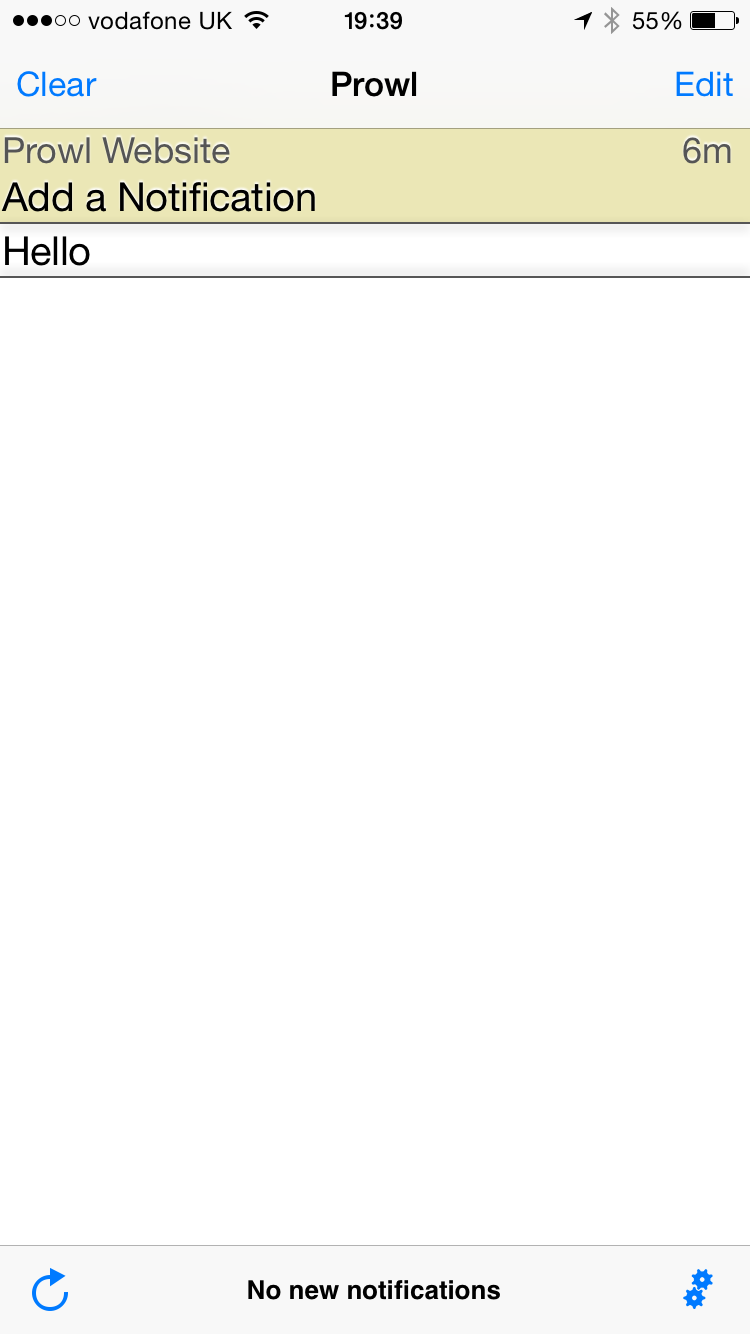
Then we get the pay off of the pushed notification and you can see your notification history as well in the Prowl app – as this shows:

IMG_1944

Prowl App View


So the steps just performed:

  • Created the API key on the ProwlAPI site
  • made sure we’ve got Growl and Growl Notifier installed
  • Established the link from Growl to Growl Web App via the API Key
  • Configured the notifications for GrowlNotifier to go through Growl and get pushed onto the Prowl API
  • Run the command line script
  • Seen the command line message go from the desktop shell through Growl onto the Prowl API and arrive on your smart phone.


Summary
So we have shown we can create push notifications without the distraction of building our own app. Not very exciting as we haven’t created anything but does show the art of the possible.

Next post we’ll cut some code to perform the same process using the Prowl API directly.

Share this:

  • Click to share on Facebook (Opens in new window) Facebook
  • Click to share on X (Opens in new window) X
  • Click to share on Pocket (Opens in new window) Pocket
  • Click to share on Reddit (Opens in new window) Reddit
  • Click to email a link to a friend (Opens in new window) Email
  • Click to share on WhatsApp (Opens in new window) WhatsApp
  • Click to print (Opens in new window) Print
  • Click to share on Tumblr (Opens in new window) Tumblr
  • Click to share on Mastodon (Opens in new window) Mastodon
  • Click to share on Pinterest (Opens in new window) Pinterest
  • More
  • Click to share on Bluesky (Opens in new window) Bluesky
  • Click to share on LinkedIn (Opens in new window) LinkedIn
Like Loading...

    I work for Oracle, all opinions here are my own & do not necessarily reflect the views of Oracle

    • About
      • Internet Profile
      • Music Buying
      • Presenting Activities
    • Books & Publications
      • Logging in Action with Fluentd, Kubernetes and More
      • Logs and Telemetry using Fluent Bit
      • Oracle Integration
      • API & API Platform
        • API Useful Resources
        • Useful Reading Sources
    • Mindmaps Index
    • Monster On Music
      • Music Listening
      • Music Reading
    • Oracle Resources
    • Useful Tech Resources
      • Fluentd & Fluent Bit Additional stuff
        • Logging Frameworks and Fluent Bit and Fluentd connectivity
        • REGEX for BIC and IBAN processing
      • Java and Graal Useful Links
      • Official Sources for Product Logos
      • Python Setup & related tips
      • Recommended Tech Podcasts

    Oracle Ace Director Alumni

    TOGAF 9

    Logs and Telemetry using Fluent Bit


    Logging in Action — Fluentd

    Logging in Action with Fluentd


    Oracle Cloud Integration Book


    API Platform Book


    Oracle Dev Meetup London

    Blog Categories

    • App Ideas
    • Books
      • Book Reviews
      • manning
      • Oracle Press
      • Packt
    • Enterprise architecture
    • General
      • economy
      • ExternalWebPublications
      • LinkedIn
      • Website
    • Music
      • Music Resources
      • Music Reviews
    • Photography
    • Podcasts
    • Technology
      • AI
      • APIs & microservices
      • chatbots
      • Cloud
      • Cloud Native
      • Dev Meetup
      • development
        • languages
          • java
          • node.js
      • drone
      • Fluentbit
      • Fluentd
      • logsimulator
      • mindmap
      • OMESA
      • Oracle
        • API Platform CS
          • tools
        • Helidon
        • ITSO & OEAF
        • Java Cloud
        • NodeJS Cloud
        • OIC – ICS
        • Oracle Cloud Native
        • OUG
      • railroad diagrams
      • TOGAF
    • xxRetired
    • AI
    • API Platform CS
    • APIs & microservices
    • App Ideas
    • Book Reviews
    • Books
    • chatbots
    • Cloud
    • Cloud Native
    • Dev Meetup
    • development
    • drone
    • economy
    • Enterprise architecture
    • ExternalWebPublications
    • Fluentbit
    • Fluentd
    • General
    • Helidon
    • ITSO & OEAF
    • java
    • Java Cloud
    • languages
    • LinkedIn
    • logsimulator
    • manning
    • mindmap
    • Music
    • Music Resources
    • Music Reviews
    • node.js
    • NodeJS Cloud
    • OIC – ICS
    • OMESA
    • Oracle
    • Oracle Cloud Native
    • Oracle Press
    • OUG
    • Packt
    • Photography
    • Podcasts
    • railroad diagrams
    • Technology
    • TOGAF
    • tools
    • Website
    • xxRetired

    Enter your email address to subscribe to this blog and receive notifications of new posts by email.

    Join 2,555 other subscribers

    RSS

    RSS Feed RSS - Posts

    RSS Feed RSS - Comments

    January 2026
    M T W T F S S
     1234
    567891011
    12131415161718
    19202122232425
    262728293031  
    « Nov    

    Twitter

    Tweets by mp3monster

    History

    Speaker Recognition

    Open Source Summit Speaker

    Flickr Pics

    Gogo Penguin at the BarbicanGogo Penguin at the BarbicanGogo Penguin at the BarbicanGogo Penguin at the Barbican
    More Photos

    Social

    • View @mp3monster’s profile on Twitter
    • View philwilkins’s profile on LinkedIn
    • View mp3monster’s profile on GitHub
    • View mp3monster’s profile on Flickr
    • View mp3muncher’s profile on WordPress.org
    • View philmp3monster’s profile on Twitch
    Follow Phil (aka MP3Monster)'s Blog on WordPress.com

    Blog at WordPress.com.

    • Subscribe Subscribed
      • Phil (aka MP3Monster)'s Blog
      • Join 233 other subscribers
      • Already have a WordPress.com account? Log in now.
      • Phil (aka MP3Monster)'s Blog
      • Subscribe Subscribed
      • Sign up
      • Log in
      • Report this content
      • View site in Reader
      • Manage subscriptions
      • Collapse this bar
     

    Loading Comments...
     

    You must be logged in to post a comment.

      Privacy & Cookies: This site uses cookies. By continuing to use this website, you agree to their use.
      To find out more, including how to control cookies, see here: Our Cookie Policy
      %d