
• Home
  • Site Aliases
    • www.cloud-native.info
  • About
    • Background
    • Presenting Activities
    • Internet Profile
      • LinkedIn
    • About
  • Books & Publications
    • Log Generator
    • Logs and Telemetry using Fluent Bit
      • Fluent Bit book
      • Book Resources in GitHub
      • Fluent Bit Classic to YAML Format configurations
    • Logging in Action with Fluentd, Kubernetes and More
      • Logging in Action with Fluentd – Book
      • Fluentd Book Resources
      • Fluentd & Fluent Bit Additional stuff
    • API & API Platform
      • API Useful Resources
    • Oracle Integration
      • Book Website
      • Useful Reading Sources
    • Publication Contributions
  • Resources
    • GitHub
    • Oracle Integration Site
    • Oracle Resources
    • Mindmaps Index
    • Useful Tech Resources
      • Fluentd & Fluent Bit Additional stuff
      • Recommended Tech Podcasts
      • Official Sources for Product Logos
      • Java and Graal Useful Links
      • Python Setup & related stuff
  • Music
    • Monster On Music
    • Music Listening
    • Music Reading

Phil (aka MP3Monster)'s Blog

~ from Technology to Music

Phil (aka MP3Monster)'s Blog

Daily Archives: May 30, 2016

Maintenance & Patching For SOA CS

30 Monday May 2016

Posted by mp3monster in Cloud, General, Oracle, Technology

≈ 1 Comment

Tags

Cloud, HA, Maintenance, Oracle, PaaS, patching, SOA, SOACS

When you’re using SOA Suite to run round the clock services you need to give a fair bit of thought to your deployment configuration so it becomes possible to perform rolling patches and other maintenance tasks not only to SOA itself but all the way down to the hardware – and at the low levels you have no control on the maintenance process.  Although it is very easy to think that the moment you’re using PaaS that these problems are taken care for you, life isn’t as simple as that.

Oracle cloud services typically go through a patching process once a month and usually within a defined 8 hour period on a Friday night. During this period you may lose the use of your servers as the maintenance is performed within a particular availability zone. In an ideal world this would be a rolling process so you don’t lose everything at once. If the maintenance window is used to to deploy SOA Suite patches then although you will be told of the maintenance window you actually wont have an outage, but post the maintenance window your cloud dashboard will have the option to apply the patches at a time that best suits you. Not only that the patch application process is smart enough to apply it in a rolling manner as the Weblogic nodes in the cluster will have information on each other which the patch mechanism can utilise.

So where is the problem.  It is very easy to forget that the PaaS platform is virtual, this means the virtualization platform being software will inevitably need patching whether that is for bug fixing,  addressing security requirements or adding new capabilities. These kinds of changes today will trigger a service shutdown. Let’s be honest when trying to balance a rolling change and maximise PaaS client density is going to create a monumentally complex problem, so simplicity and and speed of roll-out suggests a small outage is easier. So how do I therefore assure I can maintain a quality of service if I accept this as a necessity?
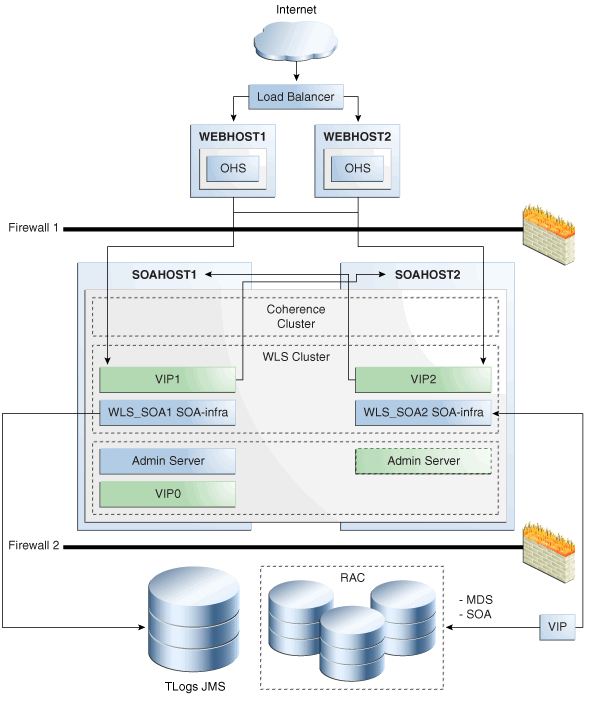

Well the answer is pretty much the same as  an on premise reference architecture.  Have SOA with its supporting databases running in a second availability zone that will have a different patch time. This is going to push up the cost as you’ll need a database with Dataguard. Assuming an active-passive model across your centres, as you approach the maintenance window you’ll get your load balancer to route work load to the second location and let the existing workload run dry on the servers due to go through the maintenance process. Then after the maintenance window you’ll reverse the process.

The current gotchya with this is that you pay for SOA by the month so you in effect have to run two clusters, although hour and daily models are coming.With the hourly model you can have the second availability zone ready for use by keeping the DB alive there, but only startup the SOA instances on the hourly rate when you know the maintenance window is going to occur and it is clear there will be an infrastructure impact.

The other sticky point, is presently as the period allocated is upto eight hours, your second centre needs to be running in a timezone with atleast 8 hours difference (allowing time to fail back). This would mean if you are using the Amsterdam or Slough locations your second location is going to West coast US or Asia Pacific once live later this year or Japan. All of which will present serious issues regarding personal data.

I have been told that some signficiant customers have accepted the situation on the basis the downtime in reality isn’t frequent and correlates to low business periods. But I suspect competition and customer demand will force this to change.

Share this:

  • Click to share on Facebook (Opens in new window) Facebook
  • Click to share on X (Opens in new window) X
  • Click to share on Pocket (Opens in new window) Pocket
  • Click to share on Reddit (Opens in new window) Reddit
  • Click to email a link to a friend (Opens in new window) Email
  • Click to share on WhatsApp (Opens in new window) WhatsApp
  • Click to print (Opens in new window) Print
  • Click to share on Tumblr (Opens in new window) Tumblr
  • Click to share on Mastodon (Opens in new window) Mastodon
  • Click to share on Pinterest (Opens in new window) Pinterest
  • More
  • Click to share on Bluesky (Opens in new window) Bluesky
  • Click to share on LinkedIn (Opens in new window) LinkedIn
Like Loading...

    I work for Oracle, all opinions here are my own & do not necessarily reflect the views of Oracle

    • About
      • Internet Profile
      • Music Buying
      • Presenting Activities
    • Books & Publications
      • Logging in Action with Fluentd, Kubernetes and More
      • Logs and Telemetry using Fluent Bit
      • Oracle Integration
      • API & API Platform
        • API Useful Resources
        • Useful Reading Sources
    • Mindmaps Index
    • Monster On Music
      • Music Listening
      • Music Reading
    • Oracle Resources
    • Useful Tech Resources
      • Fluentd & Fluent Bit Additional stuff
        • Logging Frameworks and Fluent Bit and Fluentd connectivity
        • REGEX for BIC and IBAN processing
      • Java and Graal Useful Links
      • Official Sources for Product Logos
      • Python Setup & related tips
      • Recommended Tech Podcasts

    Oracle Ace Director Alumni

    TOGAF 9

    Logs and Telemetry using Fluent Bit


    Logging in Action — Fluentd

    Logging in Action with Fluentd


    Oracle Cloud Integration Book


    API Platform Book


    Oracle Dev Meetup London

    Blog Categories

    • App Ideas
    • Books
      • Book Reviews
      • manning
      • Oracle Press
      • Packt
    • Enterprise architecture
    • General
      • economy
      • ExternalWebPublications
      • LinkedIn
      • Website
    • Music
      • Music Resources
      • Music Reviews
    • Photography
    • Podcasts
    • Technology
      • AI
      • APIs & microservices
      • chatbots
      • Cloud
      • Cloud Native
      • Dev Meetup
      • development
        • languages
          • java
          • node.js
      • drone
      • Fluentbit
      • Fluentd
      • logsimulator
      • mindmap
      • OMESA
      • Oracle
        • API Platform CS
          • tools
        • Helidon
        • ITSO & OEAF
        • Java Cloud
        • NodeJS Cloud
        • OIC – ICS
        • Oracle Cloud Native
        • OUG
      • railroad diagrams
      • TOGAF
    • xxRetired
    • AI
    • API Platform CS
    • APIs & microservices
    • App Ideas
    • Book Reviews
    • Books
    • chatbots
    • Cloud
    • Cloud Native
    • Dev Meetup
    • development
    • drone
    • economy
    • Enterprise architecture
    • ExternalWebPublications
    • Fluentbit
    • Fluentd
    • General
    • Helidon
    • ITSO & OEAF
    • java
    • Java Cloud
    • languages
    • LinkedIn
    • logsimulator
    • manning
    • mindmap
    • Music
    • Music Resources
    • Music Reviews
    • node.js
    • NodeJS Cloud
    • OIC – ICS
    • OMESA
    • Oracle
    • Oracle Cloud Native
    • Oracle Press
    • OUG
    • Packt
    • Photography
    • Podcasts
    • railroad diagrams
    • Technology
    • TOGAF
    • tools
    • Website
    • xxRetired

    Enter your email address to subscribe to this blog and receive notifications of new posts by email.

    Join 2,555 other subscribers

    RSS

    RSS Feed RSS - Posts

    RSS Feed RSS - Comments

    May 2016
    M T W T F S S
     1
    2345678
    9101112131415
    16171819202122
    23242526272829
    3031  
    « Apr   Jun »

    Twitter

    Tweets by mp3monster

    History

    Speaker Recognition

    Open Source Summit Speaker

    Flickr Pics

    Turin Brakes Acoustic Tour 24 @ The Maltings FarnhamTurin Brakes Acoustic Tour 24 @ The Maltings FarnhamTurin Brakes Acoustic Tour 24 @ The Maltings FarnhamTurin Brakes Acoustic Tour 24 @ The Maltings Farnham
    More Photos

    Social

    • View @mp3monster’s profile on Twitter
    • View philwilkins’s profile on LinkedIn
    • View mp3monster’s profile on GitHub
    • View mp3monster’s profile on Flickr
    • View mp3muncher’s profile on WordPress.org
    • View philmp3monster’s profile on Twitch
    Follow Phil (aka MP3Monster)'s Blog on WordPress.com

    Blog at WordPress.com.

    • Subscribe Subscribed
      • Phil (aka MP3Monster)'s Blog
      • Join 233 other subscribers
      • Already have a WordPress.com account? Log in now.
      • Phil (aka MP3Monster)'s Blog
      • Subscribe Subscribed
      • Sign up
      • Log in
      • Report this content
      • View site in Reader
      • Manage subscriptions
      • Collapse this bar
     

    Loading Comments...
     

    You must be logged in to post a comment.

      Privacy & Cookies: This site uses cookies. By continuing to use this website, you agree to their use.
      To find out more, including how to control cookies, see here: Our Cookie Policy
      %d