
• Home
  • Site Aliases
    • www.cloud-native.info
  • About
    • Background
    • Presenting Activities
    • Internet Profile
      • LinkedIn
    • About
  • Books & Publications
    • Log Generator
    • Logs and Telemetry using Fluent Bit
      • Fluent Bit book
      • Book Resources in GitHub
      • Fluent Bit Classic to YAML Format configurations
    • Logging in Action with Fluentd, Kubernetes and More
      • Logging in Action with Fluentd – Book
      • Fluentd Book Resources
      • Fluentd & Fluent Bit Additional stuff
    • API & API Platform
      • API Useful Resources
    • Oracle Integration
      • Book Website
      • Useful Reading Sources
    • Publication Contributions
  • Resources
    • GitHub
    • Oracle Integration Site
    • Oracle Resources
    • Mindmaps Index
    • Useful Tech Resources
      • Fluentd & Fluent Bit Additional stuff
      • Recommended Tech Podcasts
      • Official Sources for Product Logos
      • Java and Graal Useful Links
      • Python Setup & related stuff
      • DevTips
  • Music
    • Monster On Music
    • Music Listening
    • Music Reading

Phil (aka MP3Monster)'s Blog

~ from Technology to Music

Phil (aka MP3Monster)'s Blog

Daily Archives: May 7, 2026

Enterprise RAG book review

07 Thursday May 2026

Posted by mp3monster in AI, Books, General, manning, Technology

≈ Leave a comment

Tags

AI, artificial-intelligence, LLM, rag, Technology

As a Manning author, I am fortunate to see the books in their MEAP (early-release state). If you have a Manning online subscription or have already ordered a copy, you’ll have this privilege as well.

I’ve been reading the MEAP copy of Enterprise RAG by Tyler Suard. At the point of writing, there are still 4 more chapters to come. But, of the first 6 chapters, I have to say, I’ve been impressed. With an open, conversational writing style, it makes for an engaging read (I may be biased here, as this is the writing style I prefer).

The book also challenges assumptions and preconceptions about what RAG needs to be. This starts with differentiation between how RAG is typically described and the needs of an enterprise-grade implementation.

While the book leans into Microsoft Azure to illustrate the development of an enterprise-class solution, much of what has been demonstrated could be implemented with any cloud vendor, and if you’re prepared to put in the effort, then completely open-source.

My recommendation: unless you already have business-wide RAG solutions that are well adopted in production, this book is worth taking a look at. Even for the more knowledgeable/experienced, there are some nicely teased out nuggets of insight.
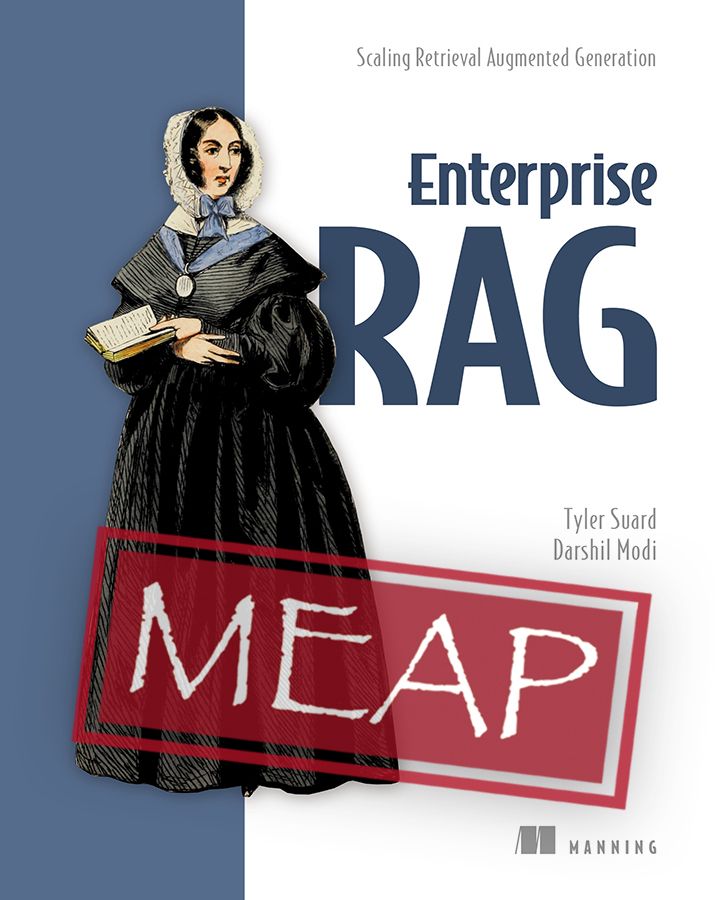
Enterprise RAG MEAP Cover

RAG vs Enterprise RAG?

Within the first couple of pages, Tyler addresses the immediate question of what distinguishes Enterprise RAG from a normal RAG. Here, the issue is elegantly laid out in the classic challenge in engineering books: do you focus on the technical functions and ideas, or on the broader challenges of using these technologies? The key here is to separate Enterprise RAG and what Tyler refers to as Naive RAG. He is tackling the difference between the basic technical mechanics of RAG and how to make RAG work at scale within enterprises, as well as the risks, challenges, and benefits of doing so. This is not to say that one approach or another is right or wrong.

In many respects, as you read through, you want to say, ‘duh, that’s obvious‘, and it is once called out. But so many AI-related projects don’t succeed because we overlook these ‘obvious’ things. AI interaction is often embodied in free text interactions, so we can’t configure the UI into showing English, Spanish, French … UI elements- but not everyone has the same native language as the developers, so we forget to allow for this. This is just one of the multitude of things that get called out.

Walking through the chapters

After setting the scene, the book’s chapters are structured to follow the development process, starting with the AI equivalent of test-driven development (TDD) for Chapter 2. The ‘evals’, the evaluation of defined questions and expected results, and how this can be done given LLMs’ non-deterministic outcomes. This, of course, gives us a framework against which we can validate the RAG and prompting process.

Chapter 3 focuses on preparing the data so it can be retrieved and fed to the LLM to answer the question; here, Tyler challenges the working assumption that the data must come from a vector database. The argument made is that for the most effective RAG process, the most effective (relevant and accurate) data is needed; how the data is obtained is secondary to the effectiveness of the data. A vector database may be the right way to source data, but don’t get locked into that thinking. Having made this point, the book does adopt Azure AI Search, which combines vector search with other techniques to deliver the best results (such as using semantic, keyword and ranking techniques). In open source terms, this is like creating a hybridisation of OpenSearch and Vector search.

Chapter 4 takes us into the data retrieval logic and prompt augmentation, now that we have searchable data. This focuses on the use of the Autogen open source framework (sponsored by Microsoft). In many respects, this is the key chapter in terms of logic, as it shows how the framework is used, with multiple agents working in a swarm.

Chapter 5 moves into the non-functional considerations of deployment and scaling, and ensuring that the solution will work under pressure. Such considerations are as important to an enterprise-scale use case as the functional behaviour. While the chapter covers approaches to automation and testing, I was hoping for more. The approaches described are good for getting things moving, but there are enterprise strategy considerations that could at least be called out, such as PII and more advanced credential management. The last point, which I think is a more significant gap, is Observability; the book talks only of logging. No mention of tracing, the measuring of token consumption, etc.

Chapter 6, the last one currently available, is definitely back on track, addressing one of the key considerations: how do we set and manage user expectations? Is my solution addressing expectations? How well is the solution performing? With conventional apps, the very UI layout and labels, as well as menus, help set expectations. If a search doesn’t give you a means to filter by an attribute, you know the result will include things with values for that attribute that aren’t relevant. But AI use cases are typically textual conversations, with no visual cues indicating the limits of an interaction. There are products that can be integrated into web apps that make it easy to track and measure user actions. But with a simple chat panel, that won’t yield much insight. This means we should provide the means to indicate satisfaction (or lack of, and why). This is what the chapter goes into, illustrating how you could shape expectations,

There are some areas I’d like to see addressed, but it is possible, and based on the chapter titles, they will likely be addressed.

Useful Links

  • Tech Talk with Tyler
  • Manning page for Enterprise RAG

Share this:

  • Share on Facebook (Opens in new window) Facebook
  • Share on X (Opens in new window) X
  • Share on Reddit (Opens in new window) Reddit
  • Email a link to a friend (Opens in new window) Email
  • Share on WhatsApp (Opens in new window) WhatsApp
  • Print (Opens in new window) Print
  • Share on Tumblr (Opens in new window) Tumblr
  • Share on Mastodon (Opens in new window) Mastodon
  • Share on Pinterest (Opens in new window) Pinterest
  • More
  • Share on Bluesky (Opens in new window) Bluesky
  • Share on LinkedIn (Opens in new window) LinkedIn
Like Loading...

    I work for Oracle, all opinions here are my own & do not necessarily reflect the views of Oracle

    • About
      • Internet Profile
      • Music Buying
      • Presenting Activities
    • Books & Publications
      • Logging in Action with Fluentd, Kubernetes and More
      • Logs and Telemetry using Fluent Bit
      • Oracle Integration
      • API & API Platform
        • API Useful Resources
        • Useful Reading Sources
    • Mindmaps Index
    • Monster On Music
      • Music Listening
      • Music Reading
    • Oracle Resources
    • Useful Tech Resources
      • Fluentd & Fluent Bit Additional stuff
        • Logging Frameworks and Fluent Bit and Fluentd connectivity
        • REGEX for BIC and IBAN processing
      • Formatting etc
      • Java and Graal Useful Links
      • Official Sources for Product Logos
      • Python Setup & related tips
      • Recommended Tech Podcasts

    Oracle Ace Director Alumni

    TOGAF 9

    Logs and Telemetry using Fluent Bit


    Logging in Action — Fluentd

    Logging in Action with Fluentd


    Oracle Cloud Integration Book


    API Platform Book


    Oracle Dev Meetup London

    Blog Categories

    • App Ideas
    • Books
      • Book Reviews
      • manning
      • Oracle Press
      • Packt
    • Enterprise architecture
    • General
      • economy
      • ExternalWebPublications
      • LinkedIn
      • Website
    • Music
      • Music Resources
      • Music Reviews
    • Photography
    • Podcasts
    • Technology
      • AI
      • APIs & microservices
      • chatbots
      • Cloud
      • Cloud Native
      • Dev Meetup
      • development
        • languages
          • java
          • node.js
          • python
      • drone
      • Fluent Observability
        • Fluentbit
        • Fluentd
        • OpAMP
      • logsimulator
      • mindmap
      • OMESA
      • Oracle
        • API Platform CS
          • tools
        • Helidon
        • ITSO & OEAF
        • Java Cloud
        • NodeJS Cloud
        • OIC – ICS
        • Oracle Cloud Native
        • OUG
      • railroad diagrams
      • TOGAF
    • xxRetired
    • AI
    • API Platform CS
    • APIs & microservices
    • App Ideas
    • Book Reviews
    • Books
    • chatbots
    • Cloud
    • Cloud Native
    • Dev Meetup
    • development
    • drone
    • economy
    • Enterprise architecture
    • ExternalWebPublications
    • Fluent Observability
    • Fluentbit
    • Fluentd
    • General
    • Helidon
    • ITSO & OEAF
    • java
    • Java Cloud
    • languages
    • LinkedIn
    • logsimulator
    • manning
    • mindmap
    • Music
    • Music Resources
    • Music Reviews
    • node.js
    • NodeJS Cloud
    • OIC – ICS
    • OMESA
    • OpAMP
    • Oracle
    • Oracle Cloud Native
    • Oracle Press
    • OUG
    • Packt
    • Photography
    • Podcasts
    • python
    • railroad diagrams
    • Technology
    • TOGAF
    • tools
    • Website
    • xxRetired

    Enter your email address to subscribe to this blog and receive notifications of new posts by email.

    Join 2,617 other subscribers

    RSS

    RSS Feed RSS - Posts

    RSS Feed RSS - Comments

    May 2026
    M T W T F S S
     123
    45678910
    11121314151617
    18192021222324
    25262728293031
    « Apr    

    Twitter

    Tweets by mp3monster

    History

    Speaker Recognition

    Open Source Summit Speaker

    Flickr Pics

    Boxer Rebellion @ Brixton ElectricBoxer Rebellion @ Brixton ElectricBoxer Rebellion @ Brixton ElectricBoxer Rebellion @ Brixton Electric
    More Photos

    Social

    • View @mp3monster’s profile on Twitter
    • View philwilkins’s profile on LinkedIn
    • View mp3monster’s profile on GitHub
    • View mp3monster’s profile on Flickr
    • View mp3muncher’s profile on WordPress.org
    • View philmp3monster’s profile on Twitch
    Follow Phil (aka MP3Monster)'s Blog on WordPress.com

    Blog at WordPress.com.

    • Subscribe Subscribed
      • Phil (aka MP3Monster)'s Blog
      • Join 229 other subscribers
      • Already have a WordPress.com account? Log in now.
      • Phil (aka MP3Monster)'s Blog
      • Subscribe Subscribed
      • Sign up
      • Log in
      • Report this content
      • View site in Reader
      • Manage subscriptions
      • Collapse this bar

    Loading Comments...

    You must be logged in to post a comment.

      Privacy & Cookies: This site uses cookies. By continuing to use this website, you agree to their use.
      To find out more, including how to control cookies, see here: Our Cookie Policy
      %d