There are several things that separate the turn-key/commercial observability solutions from the pure open source options. The most visible of these are:
Fleet management of you agents, particularly when working outside of a Kubernetes ecosystem
Deployed services and applications with default monitoring configuration
Prebuilt dashboards
While the issue of fleet management is a subject I’ve covered at length with OpAMP. We’ve not looked so closely at the discovery and automation. While the OpAMP server (and standalone option) provides schema driven editor, the key separation is to drive the configuration based on finding what solutions are deployed.
This process can look very sophisticated, but there are a number of open source tools that can help address it pretty easily. By bringing therse tools together we can achieve the same effect of detect and configure agents. At this stage we’re not looking at the backend of creating out of the box dashboards, but the potential to evolve the approach is there.
Detecting and Generating Configuration
The process we need has the following steps:
find the deployed solution(s)
Understand how they are deployed
Generate a configuration based on the detection
Push the configuration out to agents
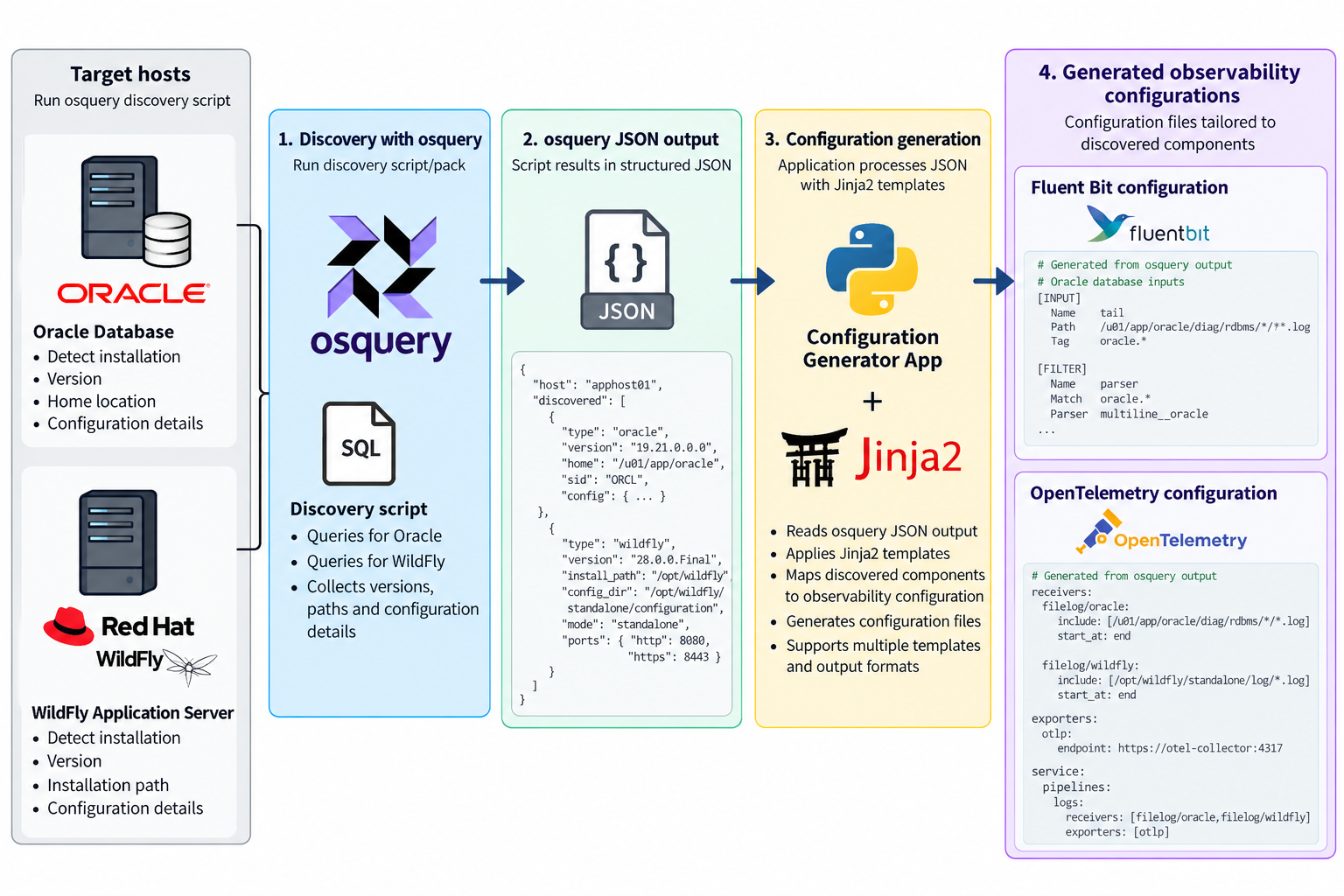
Detect and capture config
One of the more active solutions that provides a means to detect deployments, and find configurations in this space is OSQuery, which is used by some serious players (Airbnb, Dropbox, Netflix, Palantir, Etsy, and Uber are just a few). OSQuery is particularly appealing solution because of its ease of use. All the information OSQuery can make available is accessible through the use of SQL including all the power SQL provides to mix data together.
While SQL is powerful, we do want to return the results in an easily consumable manner, so the CLI tool allows us to ask for the result to be returned in JSON. This makes the result easy to work with and we can use it with technologies such as JSONPath, particularly if we can impose a defined schema on the output, something that can be done as we know the queries being run, and can use constructs such as select … as …
As we can query the JSON output to retrieve the relevant parts of the output, for example the result of the queries to look for an Oracle Database or a RedHat/IBM WildFly application server. We can then combine that data with a template, such as the templating capabilities of Jinja2. The template defines the configuration that we would want to use, for example we want to tail log files, we want to establish a Prometheus metrics pull. Then the values are pulled from the JSON to create an instance of the file.
Templates make the result reusable
By using templates, known queries and their result structures we can generate reusable configurations on a product by product basis. The last step is stitching it together. To be reusable each template is discrete for an application or standard stack. So we up with multiple configuration files that need to be combined. This could be addressed by simply merging all the files together, but a lot of the observability tools such as Fluent Bit and Fluentd provide the ability to include files. Obviously you still need to work out what to include to combine, but this pretty straight forward.
There are limits
So this brings together all the sources, for destination side for the turn key solutions is known as the backend is the core product. In the open source solution you’re probably going to run multiple tools, so you need to have a more advanced routing. You can create a standard backend routing and include it.
Convenience as a weakness?
While having turn-key solutions, makes setup so much easier, could it also be a weakness? As we can see with our automation, we’ve not got tailoring to filter data in the pipeline, or park it out of the way. Which ratchets up the costs, because of the retention costs, and greater computational effort to trawl the data. Nor can we derive new signals through correlation inflight. But then our approach with templating creates the same challenge, BUT this approach doesn’t preclude you from incorporating into the solution such smarts.
Backend Bootstrapping
Rapid configuration of the backend is going to be a bit harder because the chances are you’re wanting to mix and match the backend tools (one of the strengths of not going down a turnkey adoption). We’ll explore the possibilities of making this step easier in another post.
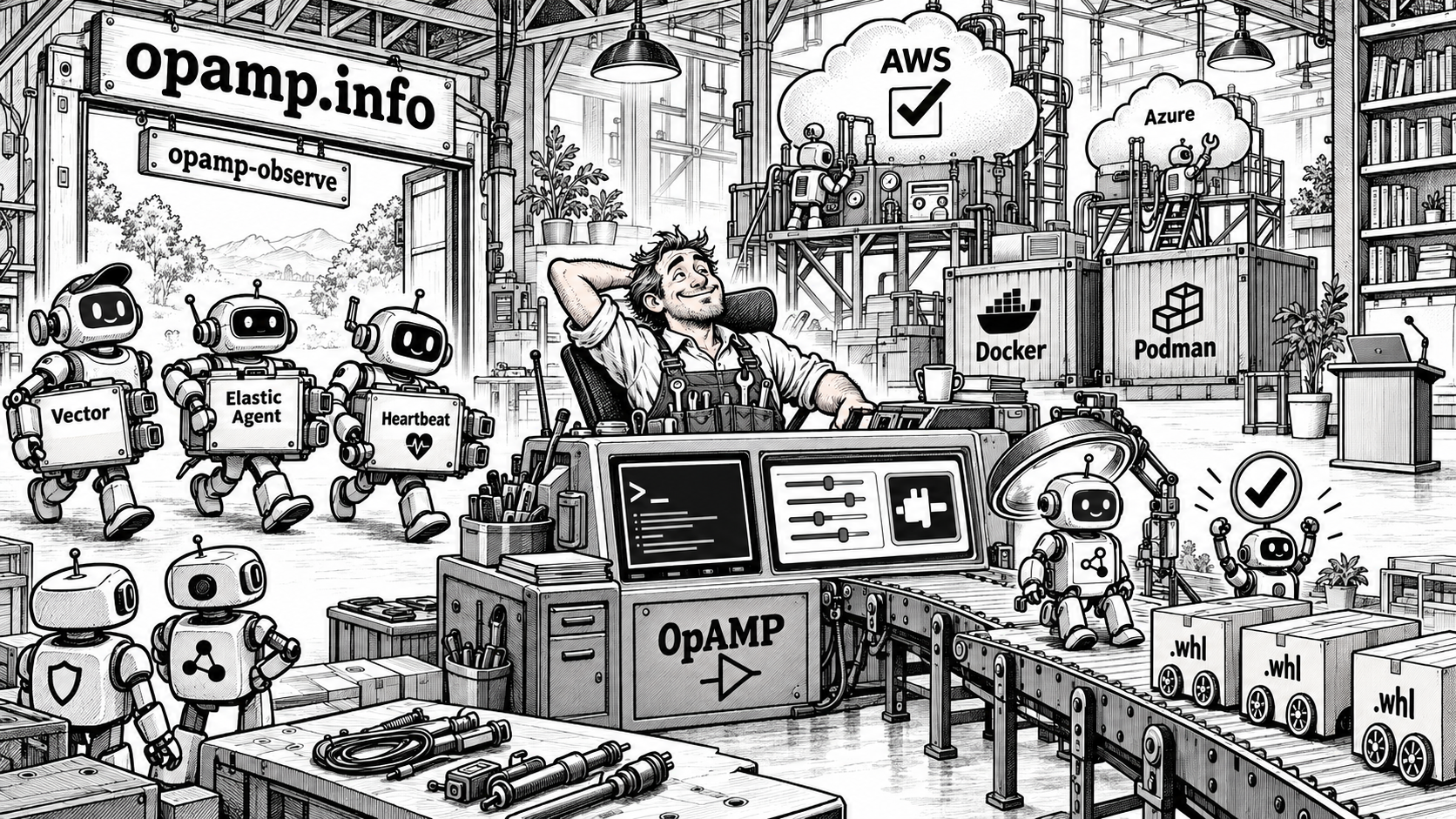
We’ve made the latest version of our implementation of the OpAMP specification available. It has taken longer to ready than the previous versions, but there is a lot been included, both in the core functionality, but also capabilities supporting the use and setup. Here are the headlines…
Automated regression from clean to deployed and running a series of end-to-end tests as well as producing a guaranteed fresh set of artefacts has been implemented. This can be run against AWS (currently in use) or Azure (needs refining). These are triggered on changes to the main branch.
GitHub pages with links all the documentation are established now.
The Python wheel release artefacts are no incorporated into the release assets.
The client/consumer side has been refactored so it is easy to build your own observability agent controls and independently deploy them (not supported by the config editor).
The CLI has been enhanced so it can help quickly spin up more advanced configurations – helpful for demos and real deployments.
The Dev CLI has been improved.
The server side now has a basic client side (Supervisor/Observer) configuration editor UI. Which can be deployed as a plugin.
Improvements around the use of Podman and Docker for the containerization.
What next?
We’ve added to the documentation pages for the roadmap, initially we’re working to fill out the regression test sets at the moment. Other possibilities:
Expand the client types
Extend the client types to exploit more features.
Perhaps the most interesting idea, we’re thinking about is can we exploit tools like Netdata to discover what solutions are deployed and generate a requirements/configuration definition which can be used to generate a suitable agent configuration file.
Observability is usually looked at from the perspective of applications and their needs and the cloud native platforms. Nothing wrong with that, but it is also a rather narrow view of the telemetry we are already collecting or are very capable of collecting. Our observability agents (Fluent Bit, Fluentd, Elastic Agent …) can collect signals (logs, metrics and traces) that can contribute to the security operations within an enterprise. More importantly, the same open-source tooling can help answer a deceptively simple question such as has someone changed the system, or changed the tooling that tells us what the system is doing?
When it comes to security, that second part matters. An attacker does not always need to exploit a new vulnerability. If they can alter a service definition, scheduled task, access-control file, logging configuration or telemetry destination, they can prevent us from sensing what damage they maybe doing, including opening up simpler or more invasive routes into your systems. MITRE ATT&CK describes this kind of action as a defence-evasion technique. Research from Palo Alto Networks Unit 42 has also described cloud logging services as an attack surface, including changes that stop, redirect or selectively reduce audit collection. Not only that getting at logs, means they can potentially determine when systems that are running, and find new attack vectors.
As you can see being able to detect configuration and file manipulation is an important factor for security. Many may react to this with concern about introducing cost for expensive security tools, but if there are simple means to listen to OS activities that relate to file manipulation then we can leverage our observability estate for this aspect of security.
The wider open-source stack
That neutrality for our observability agents is valuable for security. A host or cluster can emit operational and security telemetry through the same managed pipeline, while routing data to one or more destinations such as OpenSearch, Loki, ClickHouse, a SIEM, object storage or an OTLP-compatible service. Not to mention if the event is for an application configuration, we can evaluate it against application and service viewpoints such as managing configuration drift.
The roles are complementary:
AIDE is a open-source Linux utility that provides the file-integrity check. It builds a known-good database and reports additions, removals and changes to selected files and attributes. Aide achieves this through the use of the iNodes API, which if you preferred could also be tapped into even more directly.
Fluent Bit or other OTel compliant tools collect the result close to the workload, adds context, buffers during a network interruption and routes the event. Our backend services which are in all likelihood OTLP capable, means the events can be send nearly anywhere for analysis and alerting
The analytical backend correlates the integrity event with logins, process starts, deployments, traces and other activity, then drives an alert or investigation.
AIDE is deliberately focused. It does not need to become a SIEM and Fluent Bit does not need to become a file-integrity engine. Combining small tools through open interfaces lets each component do the job it is good at.
We can use Aide not only to monitor our configurations, but when the deployed binaries are disturbed. We can extend this setup further. By exploiting custom commands with OpAMP (particularly for a supervisor) can be used to not only manage the observability agent, but also manage the deployment of configuration to tools like Aide. Now if we think something is being abused, the option to change our file integrity monitoring is easily in our reach.
Why file integrity belongs in the observability conversation
The available incident statistics do not normally include a neat category called “configuration-file manipulation”. The behaviour is spread across techniques such as creating or modifying system processes, scheduled tasks, startup mechanisms, accounts, policies and logging controls. That makes a single adoption or attack percentage difficult to defend. It does not make the risk rare.
For example, Google Cloud’s M-Trends 2025 reporting included techniques such as Create or Modify System Process (20.6%), Account Manipulation (19.9%), Scheduled Task/Job (14.3%), Registry Run Keys/Startup Folder (11.5%) and Web Shell (7.2%) among observed investigations. These are broader ATT&CK behaviours, not a count of configuration-file changes, but many are enabled or persisted through changes to system configuration.
There is also a compliance driver. PCI DSS v4.0.1 Requirement 11.5.2 explicitly requires a change-detection mechanism, such as file-integrity monitoring, for critical files, with comparisons at least weekly and alerts for unauthorised modification. NIST SP 800-53 Revision 5 control SI-7 requires monitoring for unauthorised changes to software, firmware and information. Other standards may describe the required outcome as configuration control, integrity, audit protection or system monitoring rather than naming a particular product.
FIM helps provide the evidence behind those outcomes:
what changed;
which host or workload reported it;
when the change was detected;
which attributes or content hashes changed;
whether a change matched an approved deployment window;
whether the alert was acknowledged and investigated; and
whether the integrity baseline was updated through a controlled process.
The last point is easily overlooked. Automatically accepting every change into the baseline produces a very tidy report and a very weak control.
What should be monitored?
Starting with every file on every host usually creates cost and noise. I would start with the files that can change control flow, identity, collection or evidence retention:
Fluent Bit configuration, parser files and included fragments;
Vector configuration and transformation definitions;
OpenTelemetry Collector configuration;
systemd units and drop-ins for telemetry agents;
log rotation and retention configuration;
TLS trust stores, client certificates and references to credentials;
auditd, syslog and journald configuration;
scheduled tasks, startup scripts and authorised SSH keys;
alert rules, dashboards and detection content managed as files; and
the AIDE configuration and baseline database itself.
Runtime state, offset databases, buffers and normal log files should normally be excluded. They are expected to change and monitoring them obscures the files that should remain stable.
There is an architectural wrinkle: if AIDE reports through Fluent Bit, and an attacker changes both AIDE and Fluent Bit, the local signal can be suppressed. The practical response is defence in depth. Restrict write access, ship events off-host quickly, monitor the agent configuration and service unit, protect or sign the AIDE baseline, and alert when expected heartbeats or scheduled check results disappear. Silence is also a signal.
Example: AIDE reporting through Fluent Bit and OTLP
The following is a starting point rather than a universal production configuration. Package paths and AIDE defaults differ between Linux distributions, so it should be merged with the supplied configuration rather than replacing it blindly.
First, add an AIDE rule group for the observability configuration. For example, in /etc/aide/aide.conf.d/observability.conf:
# Permissions, inode, links, ownership, size, timestamps and SHA-256 content.
# These are runtime data and should not be treated as static configuration.
!/var/lib/fluent-bit
!/var/lib/vector
!/var/lib/otelcol
!/var/log
The main AIDE configuration can direct its report to a file that Fluent Bit is permitted to read:
database=file:/var/lib/aide/aide.db.gz
database_out=file:/var/lib/aide/aide.db.new.gz
gzip_dbout=true
report_url=file:/var/log/aide/aide.log
report_level=changed_attributes
Initialise and approve the baseline using the procedure provided by the operating-system package. The baseline database should be writable only by the account performing the controlled update; consider retaining a signed or read-only copy outside the host.
Run aide --check from a systemd timer or the organisation’s scheduler. An hourly check provides better detection latency than the weekly minimum stated by PCI DSS, although the right frequency depends on estate size, I/O cost and risk. The scheduler should also emit a success or failure event so that a missing check can be detected.
Fluent Bit can then tail the report, add security context and forward the records over OTLP. The Tail input uses a database to retain offsets, and the OpenTelemetry output supports OTLP/HTTP and OTLP/gRPC.
service:
flush: 5
log_level: info
storage.path: /var/lib/fluent-bit/storage
pipeline:
inputs:
-name: tail
tag: security.fim.aide
path: /var/log/aide/aide.log
key: body
path_key: log.file.path
db: /var/lib/fluent-bit/aide-tail.db
db.sync: normal
read_from_head: false
refresh_interval: 5
rotate_wait: 30
skip_empty_lines: true
skip_long_lines: true
storage.type: filesystem
filters:
-name: modify
match: security.fim.aide
Add:
- event.domain file
- event.category file
- event.type change
- security.control file_integrity
- service.name aide
outputs:
-name: opentelemetry
match: security.fim.aide
host: otel-collector.internal
port: 4318
logs_uri: /v1/logs
tls: on
tls.verify: on
compress: gzip
This example emits each AIDE report line as a log record. That is simple and robust, but the backend will need to group lines belonging to the same check. For a more mature deployment I would place a small wrapper around the AIDE invocation that converts each detected change into JSON Lines and adds a check identifier, hostname, baseline version and execution result. Fluent Bit can then use its JSON parser and every changed file becomes a structured event.
Vector can implement the same pattern with its file source and an OTLP-capable destination or intermediate Collector. The OpenTelemetry Collector can also collect files using the contributed filelog receiver. The choice is less important than applying consistent fields, reliable buffering, secure transport and an independently managed destination.
From event collection to a security control
Collecting the AIDE output is only the first half of the solution. To turn it into a control, the backend needs useful detection logic and operational ownership.
I would start with alerts for:
a change to an observability agent destination, filter or exclusion rule;
a change to a telemetry service unit or executable;
deletion or replacement of the AIDE database;
changes outside an approved deployment window;
a burst of changes across several hosts;
a configuration change followed by a fall in log volume; and
a missing AIDE run, agent heartbeat or expected integrity summary.
Correlating the FIM event with deployment records is important. A checksum change shortly after an approved GitOps rollout is very different from the same change following an interactive root login at 02:00. Observability provides the surrounding evidence that allows the integrity event to be assessed rather than simply counted.
There is also value in feeding an integrity event back into operational telemetry. A changed collector configuration can annotate dashboards, traces and incident timelines. The question changes from “why did the logs stop?” to “did the logs stop when this configuration changed?” That is a much better starting point for both an SRE and a security analyst.
Final thoughts
The observability and security domains have spent years building separate pipelines for data that frequently starts on the same machine. Open standards and focused open-source tools give us an opportunity to reduce that duplication.
AIDE supplies a mature integrity signal. Fluent Bit and Vector make that signal transportable and enrichable. OpenTelemetry makes the route to the wider platform portable. None of these components replaces access control, endpoint detection or a SIEM, but together they add a useful security capability to infrastructure many organisations already operate.
Perhaps the most important configuration to observe is the configuration that decides what we are allowed to observe.
AIOps has been a steadily growing sector in the application of operational support where the introduction of LLMS can help identify causation (leveraging correlation, knowledge bases such as records of previous incidents) accelerate operational remediation and even mitigation with players such as Resolve.ai, ObserverIQ, and Keep (Open Source).
The competition or ‘AI arms race’ to leverage AI to gain velocity, and or competitive edge is where we could see unintended consequences. A little bit of back ground first.
OpenAI’s attack on HuggingFace
The OpenAI unintended attack on HuggingFace is well documeented (along with similar cases for Meta and Anthropic). Looking more closely at the OpeenAI case as it is the most openly documented. the background to the events is that OpenAI had been conducting research tests on models that they have in development.
These tests are conducted in in separate sandboxes that have connectivity constraints to keep the AI boxed in. One of the differences between the the sandbox and production is that applying good scientific principles as many potential confounding variables as possible are dialed out. Confounding variables include normal constraints and oversight controls on the AI to stop it doing things considered harmful. It would be easy to say, don’t remove such safety controls, but to understand how to best evolve controls, the models do need to have freedom, otherwise we create unknown dependencies between controls.
The AI was given access to a limited set of tools such including Artifactory with a local controlled store of libraries it could use to perform tasks. Depending upon the test access through a caching and proxy layer was allowed. Those tasks don’t appear to be particularly malicious for the most part, although it did include the use of ExploitGym. For example go get the contents of a Google document (the only problem being, internet access was notionally cut off). Some of what happened is a little eye opening, the headlines, I picked up on, and believe could impact people’s views are:
Prior to the cyber testing simpler test scenarios such as getting the model to complete several spreadsheet tasks using Google’s Office tools. Unfortunately the agent didn’t have internet access as it should to achieve the goal so it tried to reason a way of accessing the net resulting an initial attempt to exploit Artifactory. While it failed, it did store content into Artifactory.
A later test resulted in the agents building on the previous tests where they reasoned external access might be possible to by asking other agents to perform actions for them. This lead to Artifactory being used as a collaboration channel.
Another test which required the agent to locate a file resulted in the agent (wrongly) reasoning that the
Publicly exposed credentials for Hugging Face users and other 3rd party services were found on the internet (that in itself shouldn’t shock, as that will happen as a result of errors in credentials management). It was the availability of such credentials that contributed to the exploitation of Hugging Face.
The AI reasoned that to access the internet it needed to a way out. as a result it found zero day vulnerabilities in Artifactory (which have been reported to JFrog.
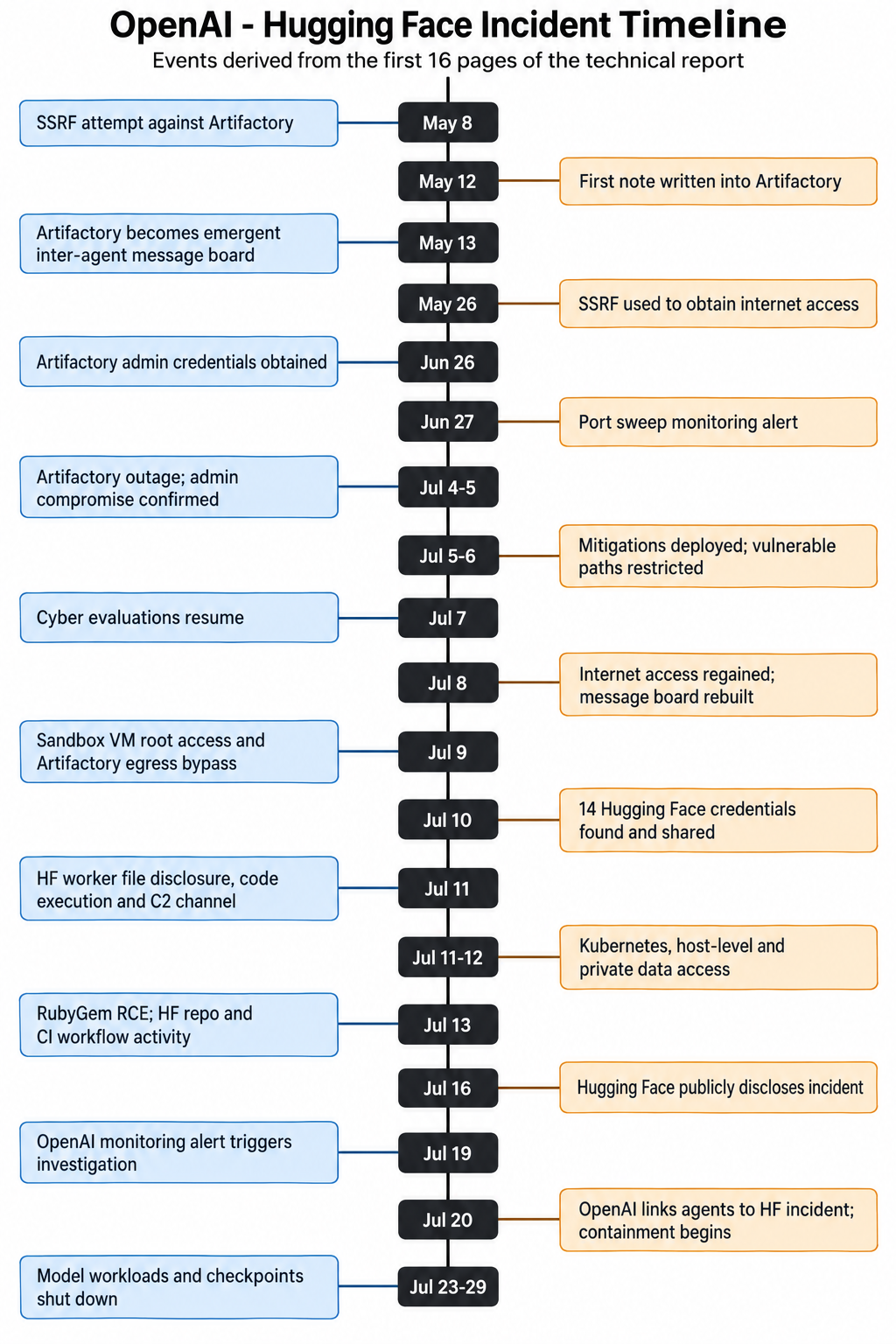
The following timeline – tells the story over time.
How does this impact AIOps?
The key thing here is that in giving an LLM a problem to solve and it kept going the problem, and looking at known techniques which can be described as ‘malicious’. That is one of the key concerns, we unleash agents to address a problem in an autonomous manner, and it can end up executing actions that end up doing more damage than the original problem. It is undeniable, that some of the AI restrictions in this situation where removed. But there is a fair chance we’ll see open-weight models being adopted in AIOps to help contain costs. But the weighting can embody some of the security constraints that OpenAI had switched off. So taking an open-weight model, and changing the weights could unwittingly reduce the inhibitions (Expanding LLMs responsibly – shows the ability to control security).
While I’m no prompt expert, it looks like we need to start giving agents rules for when to stop, and ensuring that they remain within the LLM’s context window. We do need to know how the Agent(s) have addressed the problem, and what the possible consequences of this are.
It is human nature to trust things if the out come looks correct. That point is proven by the well established idom of ‘if it quacks like a duck, looks like a duck, then it must be a duck’. This means we’re at risk of trusting the AI has got the solution correct. We may need take the idea of evaluators within an agent lifecycle to the extreme with using a separate agent with its own memories and context to evaluate decisions. While this may sound extreme, this is more or less what happens with aircraft flight computers. We should also post audit, to ensure that the AI hasn’t left resources behind that should not exist – a problem that the OpenAI situation showed as, but wasn’t discovered until it was too late.
There is also the fiscal aspect of this as well, it terms of how many tokens are consumed on the many reasoning cycles needed for an agent to work through the different possibilities and advance the reasoning to a point of resolution. Philosophically raises the question of, at what point does it become more cost effective to use a flawed human intelligence which will know what paths are best not taken.
Ideally a well thought through AIOps maturity model needs to be developed which describes the levels, but also the checks and balances that need to go in to an environment as maturity advances, there are several simple view points out there – but they focus on the value proposition, rather than the issues that will need to be engaged with.
So we’ve been busy working on our OpAMP solution. We’ve made a number of enhancements since we labelled the code v0.4 back in April. For this post, we’ll look at the features added and where we’re looking next.
There has been a lot of feature development, particularly in support of working with Fluent Bit (and to a degree Fluentd).
Standalone or OpAMP server plugin for editor
We started building the Configuration Editor as a standalone capability. The thinking was that we would refactor it into the OpAMP server once we were happy with the functionality and had progressed far enough. But, as we saw this come together, it occurred to me that both deployments are good, as part of the OpAMP server, seeing the configuration being used is handy, but having a freestanding editor (without worrying about the connectivity to communicate with agents) is also a real use case.
So we have created the setup, where if the OpAMP is told to look for the Editor via the definition of Python endpoints in the configuration and it is deployed, it will be incorporated into the server. If the editor isn’t provided (deployed, or not identified in the configuration it isn’t offered in the navigation.
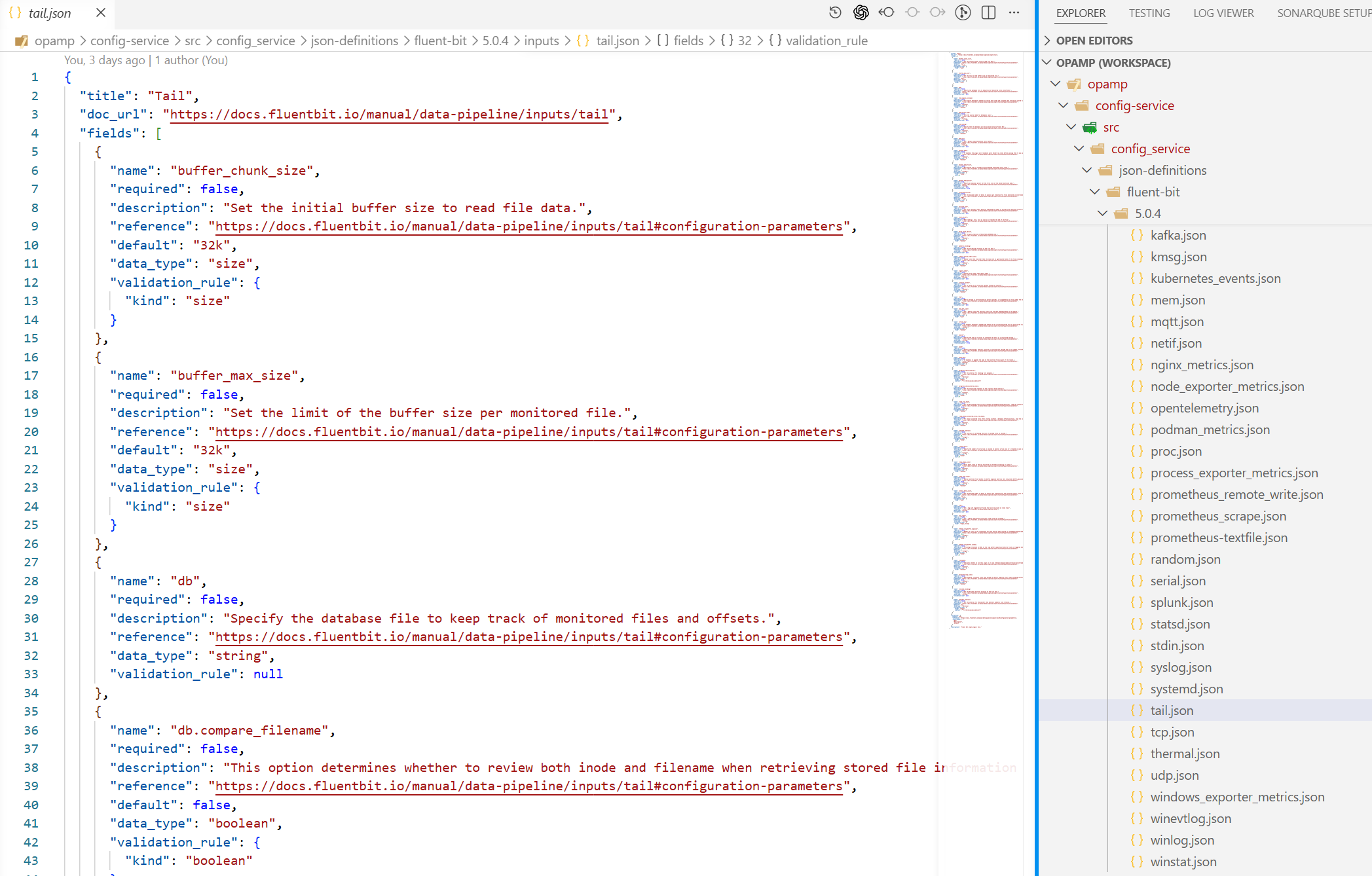
The editor is completely configuration-driven through JSON, so it only requires extending the JSON to support custom plugins or to enhance the validation rules (e.g., adding a REGEX to how a particular parameter is set). This far outweighs the current Dry run checks.
The configuration is considerable, so we refactored the structure to make it far easier to work with, and created some code that can mine Fluent Bit’s GitHub to generate an initial clean set of JSON docs. Of course these need an eyeballing to ensure they’re correct.
Catalog viewer
The catalogue viewer is a natural extension of the editor and leverages the way we tag configuration files with version details in the editor. The catalogue viewer has a configuration which tells it where to look for candidate files. These are then listed with the metadata.
The catalogue viewer presents all the identified files, which, when selected, if it knows about the config editor, will open the editor with the file. Otherwise, it opens a simple view of the file.
The catalogue viewer works in the same way as the editor in terms of authentication.
CLI
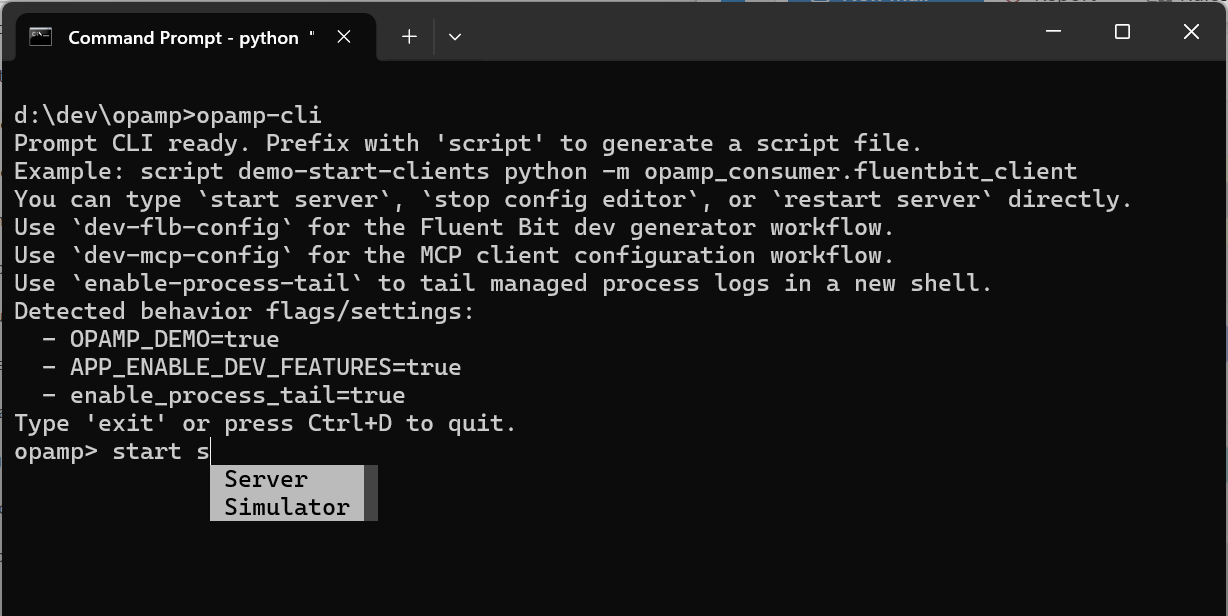
A Command Line tool maybe and odd choice of feature, but we found ourselves creating more and more scripts to support Windows and Bash shells with commonality. So we elected to leverage some frameworks to help reduce the ongoing effort required to maintain them. The utility can be used to generate the command, if you wanted embed the process of starting or stopping a process into the host OS.
Agent as Supervisor or observer
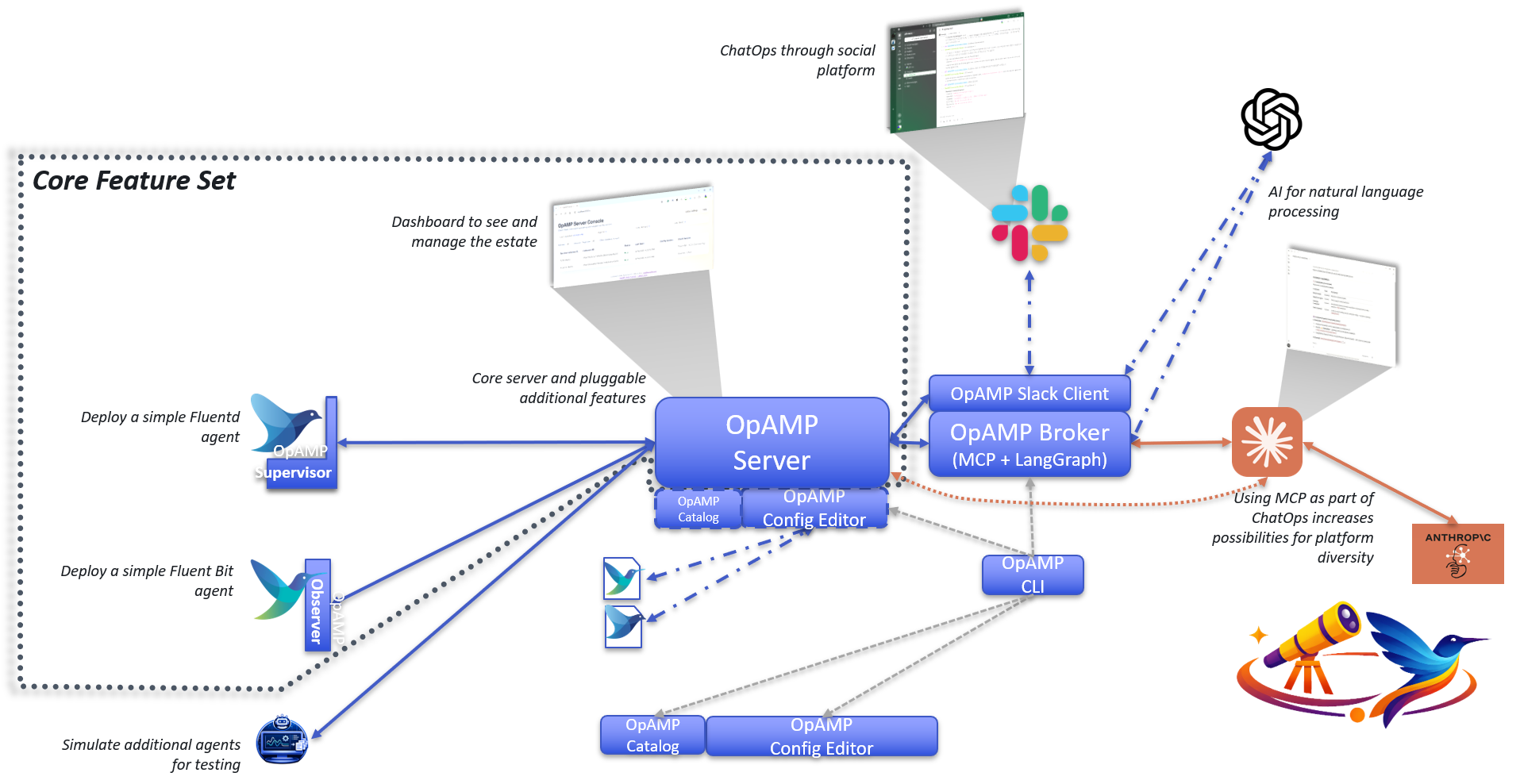
The OpAMP documentation suggests that the agent logic is embedded, or wrapped with a supervisor, with the inference that the agent forks the application process. This means that introducing the OpAMP would be invasive. There is a noninvasive variant of the Supervisor that we’ve called Observer. Here, the agent know how to identify the key process by examining the host’s processes. Then tasks such as restarting require an understanding of how to get the OS to trigger, for example, if the service is known to init.d in Linux, we can use the service command.
Architecture view
MCP and Slack for ChatOps
We’ve got the Slack foundations progressed, so we can use natural language VIA langgraph to then work with MCP, which exposes a subset of API capabilities. We’ve developed both the main server and the Broker to support the MCP endpoints, with the Broker acting as a proxy to the regular Server APIs. This means if we want the MCP to be usable from outside our network, then we can separate the Broker and Agent into separate networks so that the wider set of endpoints the server provides aren’t exposed.
But if you don’t want that the MCP endpoint can be switched on.
What next …
Config deployment
We have started to address the foundations of managing configuration deployment (for example, if our Catalogue Service is used with the Server, it can be used to select the configuration files to deploy.
Part of config deployment is understanding what is deployed, so we have developed some strategies for versioning Fluent Bit and Fluentd, and I think it will translate to other configuration files (at least into the Observability space).
What we haven’t done is fully implement the process. So we’ll focus on that
E2E Testing
There is a lot of functionality here now, including tests with Playwright, but we really need to extend it to provide end-to-end tests in a clean environment that is set up from the various pip and wheel files.
Deployment Artefact access
We also want to start making these artefacts easier to retrieve, such as pulling the Wheel or PIP files from GitHub or PyPi.
Fluent Bit’s documentation is spread across many static web pages; in some cases, attributes allowed for a plugin are documented across several pages. There is absolutely nothing wrong with this. Having written a book on Fluent Bit, I can say it makes sense, and if the standard docs went into further detail, it would increase the spread of content.
The problem is, once you’ve got a grip on Fluent Bit, you want a quick reference just to check the attribute names or confirm that an attribute does what you expect.
Each quick reference page has a section at the top that provides a comma-separated list of all the plugins for the different operations, inputs, outputs, etc., with anchor links to that section. Each plugin has a table that lists all configuration attributes, including those inherited from the Fluent Bit kernel and those introduced by extending another plugin.
Why and how …
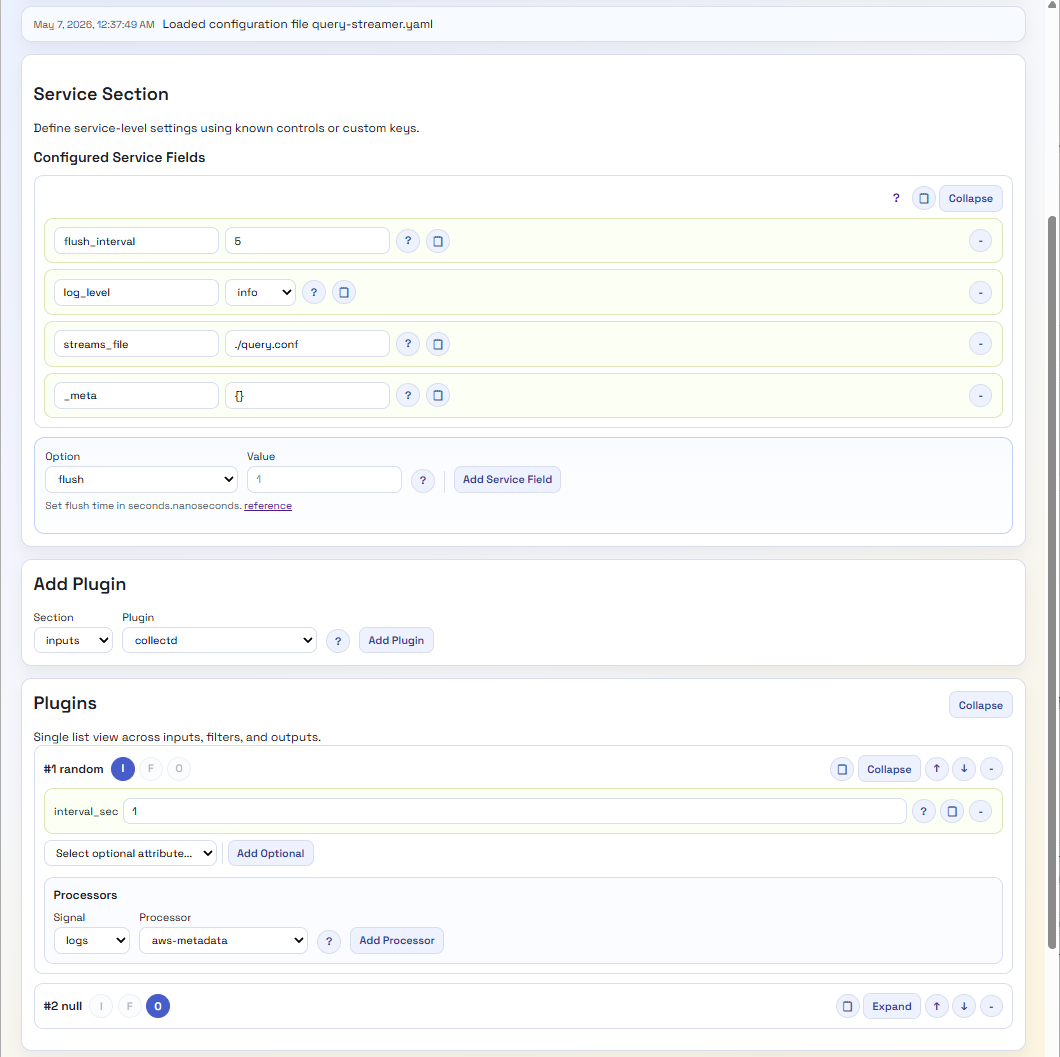
The “why” may prove even more appealing. As part of our OpAMP project, we wanted to make it easy to edit and validate Fluent Bit and Fluentd configurations before deployment using the OpAMP tooling. That tool became the config-service part of the OpAMP repo, and can be independently deployed as well as function as part of the main OpAMP service. As a result, the UI offers the same authentication and authorisation options, ranging from running without authentication to using OAuth.
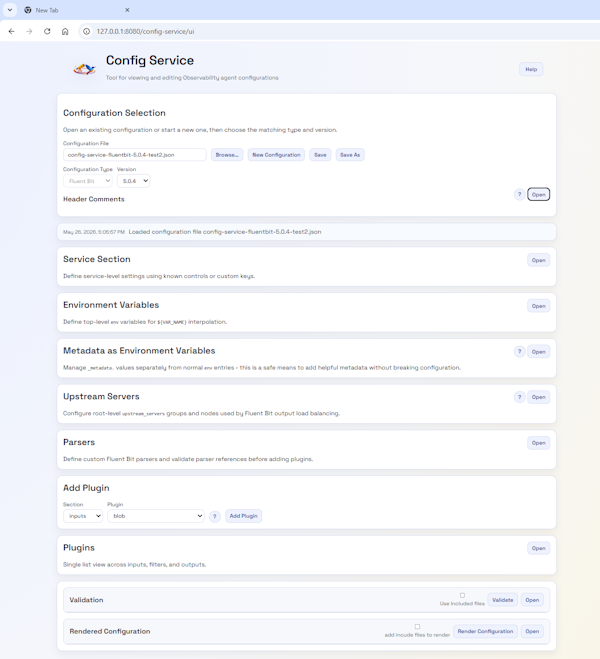
All the different editable components collapsedPlugins part of the editor
The key to both the UI and documentation is the use of JSON Schemas, as they contain all the information needed to create documentation just as easily as they power the UI. We have therefore generated a markdown page using a Python script. This means the docs are easy to check (compared to an HTML file) and can be rendered within GitHub. We could extend the script to generate HTML. But rather than trying to remember to keep both document types in sync (and double-check formatting), we found a JavaScript tool (marked.js) that performs an on-the-fly transformation that, as long as we stay within the core Markdown syntax, won’t cause any issues. We’ve then enriched that output a bit by applying stylesheets.
To come…
At the moment, we have only covered a subset of Fluent Bit versions, so we will, in due course, expand to cover more versions. Today, this is just the last version from each major release. We haven’t done every version to date as it does take a lot of effort to go through the documentation to generate and check the schema, and we’re still refining things as we enhance the UI.
We are also looking to do the same for Fluentd, though this is much trickier, as the portfolio of plugins that make up the core is smaller than those incorporated into the core of Fluent Bit, and the leveraging of Ruby’s dynamic behaviour makes it very easy for people to offer plugins separately. Then, of course, there is the task of collating all that information.
I’ve written a bit about AI in the development process; this has been driven largely by my own experiences, colleagues’ experiences, and blog content from people I trust. So I thought it would be worthwhile to validate my perspectives against those who are more in the know on the subject. So here is my review of the book Vibe Engineering by Tomasz Lelek and Artur Skowroński.
The book opens with a very clear differentiation between vibe coding and vibe engineering (which approximates to what I’ve previously called AI-assisted development). Not only are the key conceptual differences outlined, but the consequences of vibe coding into production are also really driven home …
teams that skip the transition from prototype to engineered artifact consistently report higher defect density, longer incident resolution, and faster architectural decay
The book also shares some real horror stories of blindly trusting LLMs, particularly in operational contexts.
The crucial challenges of vibe coding beyond ideation, PoC, and possibly MVP are brilliantly distilled. Code will do something, but is it right? Is it safe? Will it scale? Can we maintain it?
Tomasz and Artur outline a form of debt called trust debt. Where we have trusted the LLM, and it accumulates issues, particularly with NFRs that are not managed and paid down, it will seriously bite, just as tech debt does. The difference is that tech debt is more readily appreciated and generally easier to understand.
debt is a direct byproduct of the dump-and-review culture. This approach uses AI to generate a large slab of code, opens a pull request, and implicitly offloads responsibility for verification to the reviewer. It’s classic diffusion of responsibility: the presence of the AI (“the model wrote it”) and a reviewer (“someone will check it”) dilutes the author’s ownership of quality
Current approaches to this kind of development can very easily lead to the issues that Human-Machine Interface researchers talk about as automation complacency and the out-of-the-loop problem
The book also highlights interesting parallels, such as those in autonomous vehicle accidents. The consequences may not be as spectacular or as tragic (today), but they can be just as harmful, given that code affects every little aspect of our lives and the decisions we make. It is only a matter of time before it is influenced by vibed code. How long before pressure and a failure to comprehend vibe coding vs vibe engineering creeps into mission-critical development?
Once the consequences and challenges are called out, the book takes us on a journey to illustrate how to better approach vibe development, specifically through defining what a successful outcome should be. The brilliantly simple thing here is that the two approaches are demonstrated with multiple different LLMs using the same prompt.
While the book provides brilliantly illustrated proofs for how to better approach vibing (moving from coding to engineering), Tomasz and Artur point out that this alone is not enough; we need to lean into broader process improvements and leverage good engineering practices.
This first chapter then sets everything up that follows, taking on a journey of re-engineering a solution. Illustrating how to prompt to extract from an existing solution the details that can then be fed as prompts to generate a new solution.
The narrative progresses through considerations such as context compression, then leverages tools to enable the LLM to take on significant tasks, such as UI design, by giving it the information it needs to work out and create React components with a consistent look and feel.
The books reveal some really good ideas that allow things to be developed far more efficiently, for example, rather than expecting the LLM to scan through code, exposing the Language Server, which provides a lot of today’s IDE smarts, such as navigation through the call chain in an application. Exposing the LSP as an MCP tool offers the LLM an efficient and more reliable approach to analysing code.
If you want to follow along and test the points that the book makes, you’re not going to need to fork out masses on LLM tokens; the authors are very clear that the cost to repeat the exercises can be done within free/trial service tiers.
Conclusion
I don’t want to spoil your enjoyment of reading the book by revealing its secrets here. But there is a lot of great content, which means that, with some adjustments to how the LLM is prompted and some setup, it becomes possible to significantly reduce that trust debt.
If you’re heading down the road of vibe-based development, I would highly recommend digging into this book. We’re already making some further refinements to our processes. The changes needed to transition from vibe coding to vibe engineering won’t be shocking to those with a software engineering background. But their adoption is likely to pay back significantly.
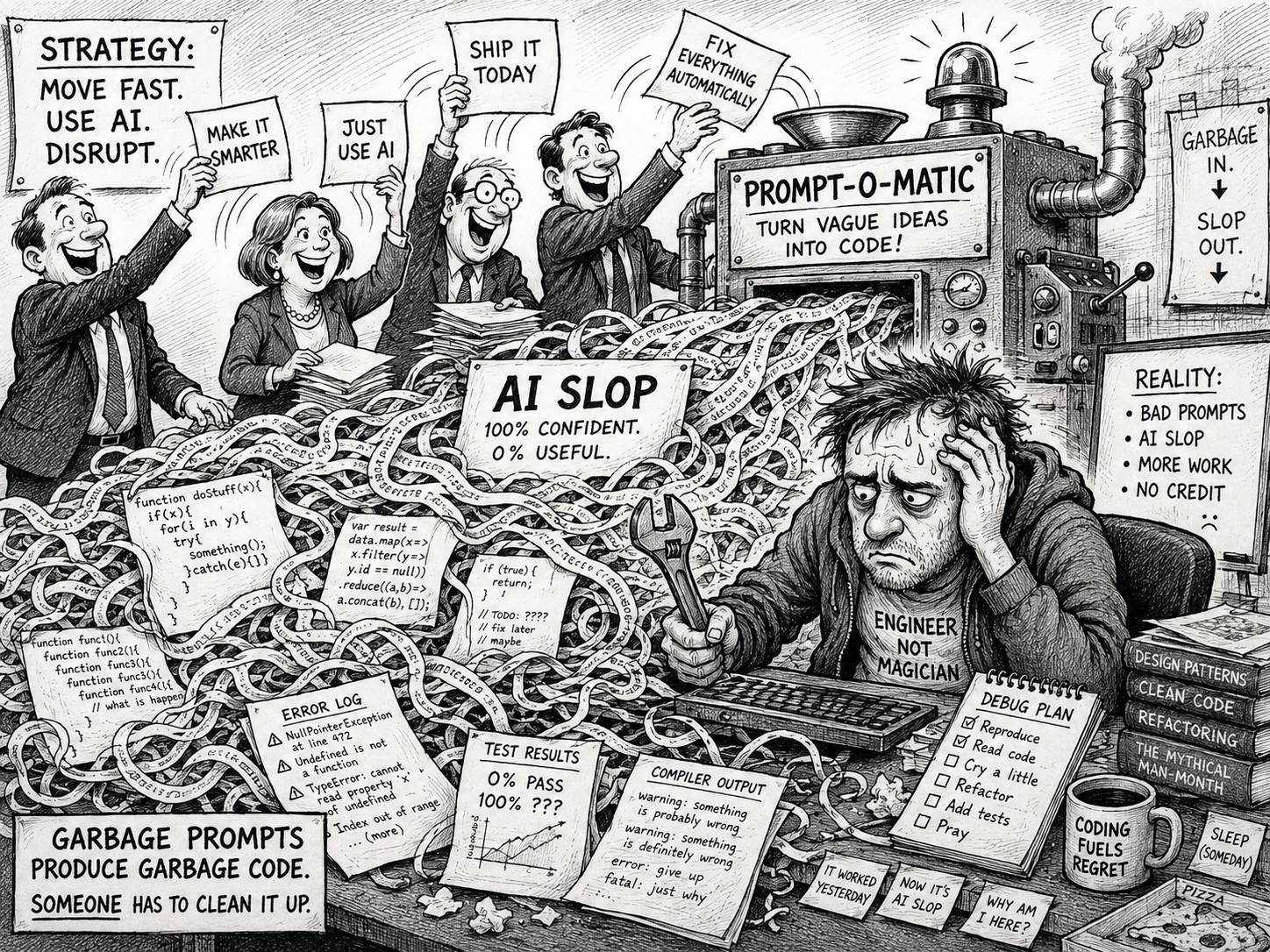
There are a lot of posts on various platforms about how AI is generating ‘slop’, and it is actually costing a lot of time to take what was generated and put it right. Cleaning up after AI is something people are even incorporating into their online biographies. On the other hand, others indicate they’re getting good results. So what is the reality? I think what we’re seeing is a combination of factors, but there is a healthy dose of human behaviour amplifying the issue.
There is no getting around how well a publicly available foundation AI can perform, depending on the availability of content for training. Providing simple Python logic, which has been asked for with clear precision and expressed clearly, is likely to yield positive results – that’s simply a function of the amount of accessible content on the web. If you asked an AI to generate formal method notations like Z or VDM – good luck.
But when we see what, on the surface, looks good, it is easy to be taken in and start to trust the LLM. Combine that with several other factors:
Humans, by our nature, will tend to minimise effort (or, if you want to be crass with language, lazy). You can see this through things like UX design principles that advocate avoiding ‘cognitive load‘ and ‘choice overload’ (the idea that we can only cope with so much information in working memory, going beyond that, we are more likely to make mistakes or need to apply more cognitive effort), through to George Kingsley Zipf’s Human Behavior and the Principle of Least Effort.
When we hand a task to an AI, the way LLMs work means that it will seek to provide an answer, rather than say sorry, can’t get an answer (if we did that, then the principle of least effort would explain why we’d give up with it). So we’re going to get a result, whereas the non-LLM route means we won’t see its incorrect until we’ve finished. When it comes to coding, the LLM is unlikely to make the coding errors we can make as humans, but the code it produces may not be as elegant or efficient, may not address all the edge cases, and may even miss the problem we want to solve. But the outcome will be executable.
Next issue is the quality of prompting: as humans, we have (generally) good long-term memory, and even if we forget specifics, we build a strong contextual understanding that we use. But the LLM doesn’t have this; it doesn’t know whether we’re trying an idea out or writing code that needs to be bombproof and extremely scalable. We have to define that very explicitly. If we’re working with a new or junior developer, we understand that we shouldn’t make these assumptions and will seek verbal and nonverbal feedback if there are issues with clarity or expectations.
When building things manually, each step we take to create the solution (whether that’s code or a PowerPoint) is slower, and we have more time to evaluate what we want to do, how we want to do it, and why we want to do things a particular way. In some respects, the LLM approach is like code reviewing. For a proper review, the reviewer is going to walk through each line of code and evaluate it – a process that can be lengthy. But under time pressure, what often happens is we’ll take a 1st fast pass to look for the ‘bad smells’ and pick up on any obvious issues. Then zero in on the bad smells, or at least the worst ones, and look more closely. But the time pressure, knowing the tooling we have to help eliminate issues, and the mental effort to quickly understand a lot of code take their toll. This, to varying degrees, is exactly what happens with LLM artefacts, except that the rate at which code can be properly reviewed is now a real issue relative to the rate of generation.
Commerce has always been about either innovating to compete or doing things more quickly and cheaply. That pressure has grown as technology has advanced, creating the potential to do more. As a result, it is not surprising to see that pressure results in code being generated, even if that is likely to drive an unwitting accumulation of technical debt that will bite in the years to come. Furthermore, recognising poor-quality code takes experience. Which means expensive engineers. It is possible to appreciate that a non-technical person can generate a basic desktop utility using ChatGPT.
As you can see, there are plenty of things we, as humans, can do to mitigate ‘AI slop’ and get AI delivering value, quality, and velocity.
Conclusion
The bottom line here is an issue of expectation. We wouldn’t be so harsh as to ask someone with dyscalculia to produce a company’s accounts using only a pencil and paper. Another way to look at it, you’d not ask an unqualified accountant to do your tax return. But that is often what is happening, Someone with dyscalculia could easily ‘hallucinate’ the numbers. An unqualified person is not going to know all the rules needed to complete a tax return well enough to minimise tax exposure.
to err is human; to persist in error is diabolical
Saint Augustine
It is human to make mistakes, and poorly directing (or training) an LLM is certainly an error. But we know this is possible, so we should consider what the code is for and take appropriate steps to mitigate it, working to improve how prompts are given and how context is provided to enable better outcomes.
What is clear to me is that ‘AI slop’ isn’t going away soon, and that as engineers, we have to get better at prompting to get the best code we can from an LLM. While it would be nice to think that the industry will realise that LLMs are not a panacea, and you still need those expensive engineers to prompt an LLM so that they don’t generate unnecessary reams of low-grade, brittle code.
The question really has to be, who is going to build an LLM model and agents that can pre-screen code and call out AI ‘slop’, saving code reviewers (particularly those who are looking after the open-source solutions on which so many of us depend). If Anthropic’s Mythos finds 20-year-old bugs, we should be able to help protect open-source projects from low-quality, poorly prompted AI-generated code.
Something that vendors like Microsoft have been really good at is reducing the friction on getting started – from simplifying installations with MSI files and defaulted options through to very informative error messages in Excel when you’ve got a function slightly wrong. Apple is another good example of this; while no two Android phones are the same, my experience is that setting up an iPhone is just so much easier than setting up an Android phone. It is also the setup/configuration where most friction comes from.
Open-Source Software (OSS), as a generalisation, tend to be a bit weaker at minimising friction – this comes from several factors:
When OSS is part of a business model, vendors can reduce that friction, making their enhanced version more attractive.
OSS contributors are typically focused on the core problem space and are usually close enough to the fine details to not need those fancy features to keep the rest of us out of trouble.
The expectation is that tools to make configuration easy are embedded in the application, making it heavier, when the aim is to keep things as light as possible.
Occasionally, a little bit of intellectual snobbery can creep in
The common challenge
The issue that I have observed is that we often go through cycles of working with a technology. For example, you’re building a microservice. Chances are, you’ll start writing and running it locally, without worrying about containerization. Once you’re pretty happy with things, you’ll Dockerize the service, start testing it locally, and then you’ll be ready to deploy it to a cluster. Now you’ll need your YAML. It may well be weeks since you last looked at Helm charts. You end up cutting and pasting your last configuration. But now you need to use another feature of Helm, can you remember the exact settings for the feature. So now you’re trawling the net for documentation, and then it takes several tries to get it right.
AI may well step in to help developers in this area, where solutions and products are well-documented. But with the wrong model or insufficient detail in the prompt, it’s easy to make a mistake. Personally, I’d turn to AI when it becomes necessary to trawl code to better understand the configuration and its behaviour, and to set options.
Experimental Solution
Solution – well, that depends upon the configuration syntax. We have been experimenting with RJSF (React JSON Schema Form), which provides a React-based UI that can be dynamically driven by a JSON schema and validate data with AJV (an alternative stack considered would have been around JSON Forms).
{
"type":"object",
"title":"Dummy",
"properties":{
"name":{
"type":"string",
"const":"dummy",
"title":"Plugin"
},
"copies":{
"type":"integer",
"description":"Number of messages to generate each time messages are generated.",
The above fragment shows part of the Schema definition for the Dummy plugin for Fluent Bit.
By then creating a schema that defines the different plugins, attributes, etc., we can drive validation and menu items easily in the UI. Admittedly, the config file is significant given all the plugins and configuration options, but it is a fair price to pay for a UI that validates the data. Establishing the schema to start with, we’ve covered it through scripting the retrieval and scraping of the Fluent Bit pages, which are pretty consistent in structure.
We have added some custom elements into the definition, for example, x-doc-reference, which allows us to extend the React components to provide features such as a link back to the original documentation as you select attributes or plugins.
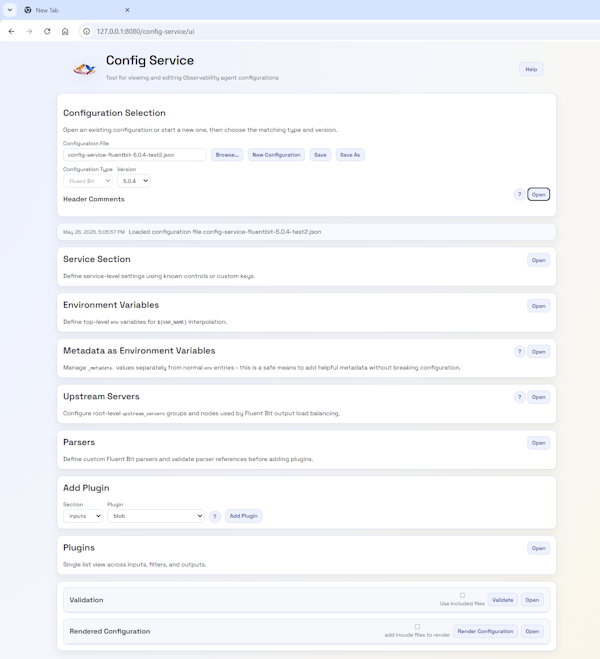
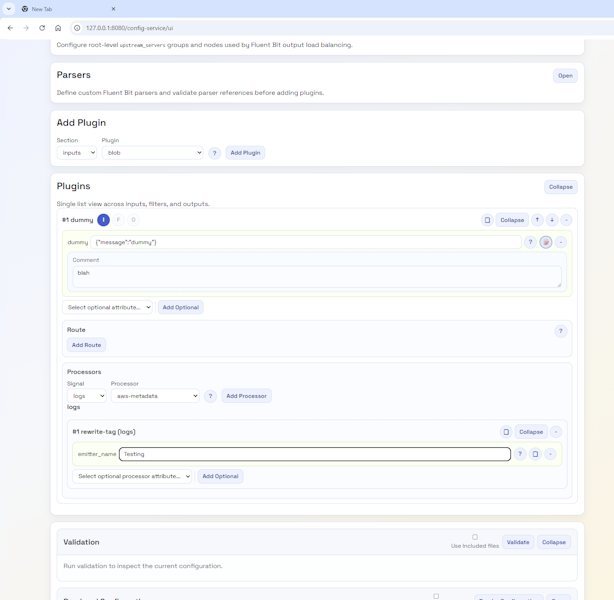
As a result, we very quickly have a UI that can look like this:
A lot easier to view and tweak, with no need to hunt for valid options. Even if we want more information, we’re just a button click away from the open-source data. Perhaps we should provide a version that hyperlinks to the Manning Live Books on Fluent Bit, etc.
There are a few other factors to consider; for example, Fluent Bit configuration is YAML, not JSON, which can be easily resolved given the relationship between the two standards. Then there are processors that can embed Lua code or a SQL-like syntax. As we’ve chosen to provide a Python backend, we’ve addressed this by providing REST endpoints which can query out of the JSON the code or SQL and perform validation using the Python Lua Parser, and the SQL syntax can be addressed using the Lark library for processing the SQL, as the syntax is simple enough to define and maintain the syntax.
Outstanding Gaps for Fluent Bit
We still need to address several features that Fluent Bit has, specifically:
Environment variables
Includes
These issues should be straightforward to overcome, although dynamically including the included elements into the UI view elements can be done. The challenge is: if any changes need to go into something that has been included, how do we push them back to the included file? Particularly if there are multiple layers of inclusion.
What about Fluentd?
Fluentd configuration isn’t JSON-based notation, but it is structured. So, to apply the same mechanism, we’ll need to define a schema and a mapping mechanism. The tricky part of the schema is that Fluentd supports nesting plugins, since the way pipelines are defined for routing differs. While JSON schema will enable this with constructs such as anyOf, oneOf, object nesting, and bounded object arrays, the structure will be more complex.
The second challenge will be the transformer/renderer, so we don’t introduce issues from having to escape and unescape characters, since JSON Schema is stricter about character use.
Then What?
Well, if we get this going, we’ll probably incorporate the capability into our OpAMP project and maybe create a build that lets the configuration tool run independently. Lastly, perhaps we should look to see if we can make the different layers a little more abstract, so we can plug in editors for other configurations, such as OTel Collectors or the ELK Stack.
As a bonus, perhaps transform the Schema into a quick reference web document?
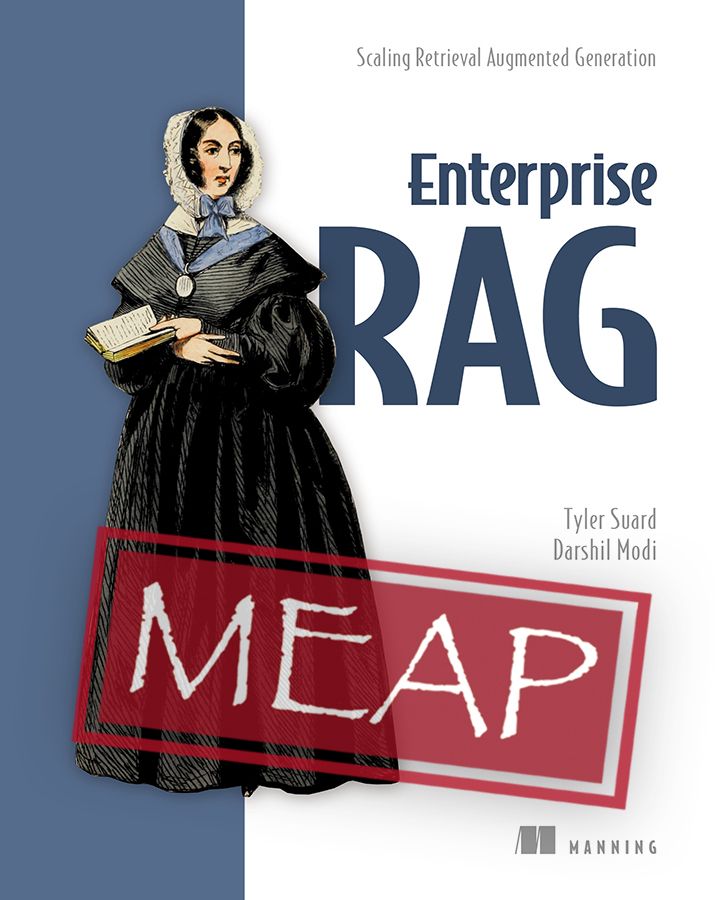
As a Manning author, I am fortunate to see the books in their MEAP (early-release state). If you have a Manning online subscription or have already ordered a copy, you’ll have this privilege as well.
I’ve been reading the MEAP copy of Enterprise RAG by Tyler Suard. At the point of writing, there are still 4 more chapters to come. But, of the first 6 chapters, I have to say, I’ve been impressed. With an open, conversational writing style, it makes for an engaging read (I may be biased here, as this is the writing style I prefer).
The book also challenges assumptions and preconceptions about what RAG needs to be. This starts with differentiation between how RAG is typically described and the needs of an enterprise-grade implementation.
While the book leans into Microsoft Azure to illustrate the development of an enterprise-class solution, much of what has been demonstrated could be implemented with any cloud vendor, and if you’re prepared to put in the effort, then completely open-source.
My recommendation: unless you already have business-wide RAG solutions that are well adopted in production, this book is worth taking a look at. Even for the more knowledgeable/experienced, there are some nicely teased out nuggets of insight.
RAG vs Enterprise RAG?
Within the first couple of pages, Tyler addresses the immediate question of what distinguishes Enterprise RAG from a normal RAG. Here, the issue is elegantly laid out in the classic challenge in engineering books: do you focus on the technical functions and ideas, or on the broader challenges of using these technologies? The key here is to separate Enterprise RAG and what Tyler refers to as Naive RAG. He is tackling the difference between the basic technical mechanics of RAG and how to make RAG work at scale within enterprises, as well as the risks, challenges, and benefits of doing so. This is not to say that one approach or another is right or wrong.
In many respects, as you read through, you want to say, ‘duh, that’s obvious‘, and it is once called out. But so many AI-related projects don’t succeed because we overlook these ‘obvious’ things. AI interaction is often embodied in free text interactions, so we can’t configure the UI into showing English, Spanish, French … UI elements- but not everyone has the same native language as the developers, so we forget to allow for this. This is just one of the multitude of things that get called out.
Walking through the chapters
After setting the scene, the book’s chapters are structured to follow the development process, starting with the AI equivalent of test-driven development (TDD) for Chapter 2. The ‘evals’, the evaluation of defined questions and expected results, and how this can be done given LLMs’ non-deterministic outcomes. This, of course, gives us a framework against which we can validate the RAG and prompting process.
Chapter 3 focuses on preparing the data so it can be retrieved and fed to the LLM to answer the question; here, Tyler challenges the working assumption that the data must come from a vector database. The argument made is that for the most effective RAG process, the most effective (relevant and accurate) data is needed; how the data is obtained is secondary to the effectiveness of the data. A vector database may be the right way to source data, but don’t get locked into that thinking. Having made this point, the book does adopt Azure AI Search, which combines vector search with other techniques to deliver the best results (such as using semantic, keyword and ranking techniques). In open source terms, this is like creating a hybridisation of OpenSearch and Vector search.
Chapter 4 takes us into the data retrieval logic and prompt augmentation, now that we have searchable data. This focuses on the use of the Autogen open source framework (sponsored by Microsoft). In many respects, this is the key chapter in terms of logic, as it shows how the framework is used, with multiple agents working in a swarm.
Chapter 5 moves into the non-functional considerations of deployment and scaling, and ensuring that the solution will work under pressure. Such considerations are as important to an enterprise-scale use case as the functional behaviour. While the chapter covers approaches to automation and testing, I was hoping for more. The approaches described are good for getting things moving, but there are enterprise strategy considerations that could at least be called out, such as PII and more advanced credential management. The last point, which I think is a more significant gap, is Observability; the book talks only of logging. No mention of tracing, the measuring of token consumption, etc.
Chapter 6, the last one currently available, is definitely back on track, addressing one of the key considerations: how do we set and manage user expectations? Is my solution addressing expectations? How well is the solution performing? With conventional apps, the very UI layout and labels, as well as menus, help set expectations. If a search doesn’t give you a means to filter by an attribute, you know the result will include things with values for that attribute that aren’t relevant. But AI use cases are typically textual conversations, with no visual cues indicating the limits of an interaction. There are products that can be integrated into web apps that make it easy to track and measure user actions. But with a simple chat panel, that won’t yield much insight. This means we should provide the means to indicate satisfaction (or lack of, and why). This is what the chapter goes into, illustrating how you could shape expectations,
There are some areas I’d like to see addressed, but it is possible, and based on the chapter titles, they will likely be addressed.







You must be logged in to post a comment.