• Home
  • Site Aliases
    • www.cloud-native.info
  • About
    • Background
    • Presenting Activities
    • Internet Profile
      • LinkedIn
    • About
  • Books & Publications
    • Log Generator
    • Logs and Telemetry using Fluent Bit
      • Fluent Bit book
      • Book Resources in GitHub
      • Fluent Bit Classic to YAML Format configurations
    • Logging in Action with Fluentd, Kubernetes and More
      • Logging in Action with Fluentd – Book
      • Fluentd Book Resources
      • Fluentd & Fluent Bit Additional stuff
    • API & API Platform
      • API Useful Resources
    • Oracle Integration
      • Book Website
      • Useful Reading Sources
    • Publication Contributions
  • Resources
    • GitHub
    • Oracle Integration Site
    • Oracle Resources
    • Mindmaps Index
    • Useful Tech Resources
      • Fluentd & Fluent Bit Additional stuff
      • Recommended Tech Podcasts
      • Official Sources for Product Logos
      • Java and Graal Useful Links
      • Python Setup & related stuff
  • Music
    • Monster On Music
    • Music Listening
    • Music Reading

Phil (aka MP3Monster)'s Blog

~ from Technology to Music

Phil (aka MP3Monster)'s Blog

Tag Archives: SOA

Next Generation SOA book

12 Wednesday Nov 2014

Posted by mp3monster in Books, General, Technology

≈ Leave a comment

Tags

Arciture, book, reviewer, SOA

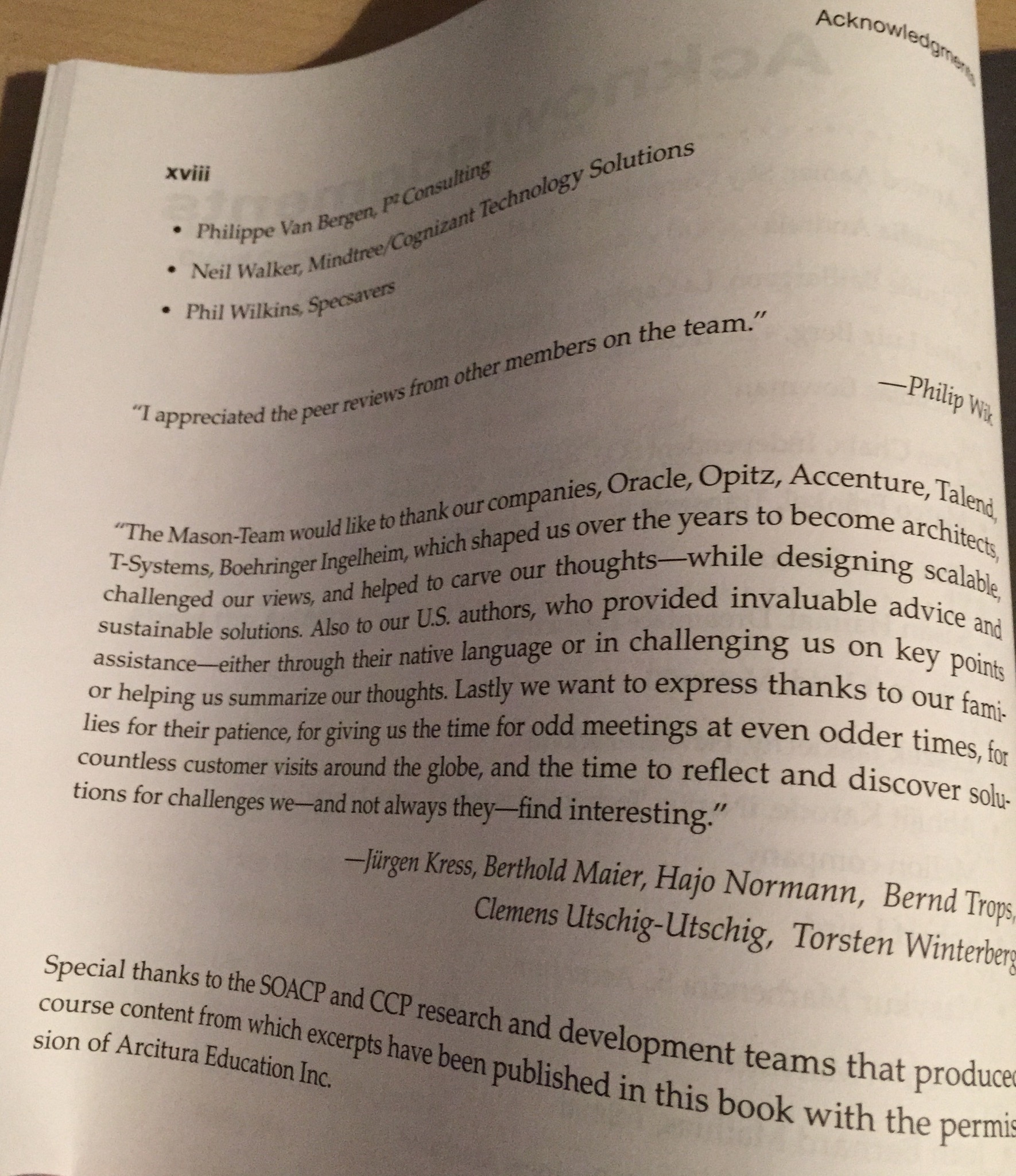
My copy of the Next Generation SOA on the Service Tech Press /Prentice Hall arrived today. This is first Prentice Hall book I have contributed to as a pre publication reviewer. It is always nice to see a recognition in the book, particularly when the draft of the book is of such a high standing your feedback is more helping finesse things.

Acknowledgements

Next Generation SOA

I have previously blogged that this is a book I would highly recommend, it isn’t a vast heavyweight text, but provides a great broad view of SOA in the current IT landscape.  If you’re not adverse to eBooks you might consider getting the ebook version as the diagrams look far better in colour than in the grayscale of the print edition.

Next Generation SOA

Share this:

  • Share on Facebook (Opens in new window) Facebook
  • Share on X (Opens in new window) X
  • Share on Pocket (Opens in new window) Pocket
  • Share on Reddit (Opens in new window) Reddit
  • Email a link to a friend (Opens in new window) Email
  • Share on WhatsApp (Opens in new window) WhatsApp
  • Print (Opens in new window) Print
  • Share on Tumblr (Opens in new window) Tumblr
  • Share on Mastodon (Opens in new window) Mastodon
  • Share on Pinterest (Opens in new window) Pinterest
  • More
  • Share on Bluesky (Opens in new window) Bluesky
  • Share on LinkedIn (Opens in new window) LinkedIn
Like Loading...

Hierarchy of Data Assurance

19 Sunday Oct 2014

Posted by mp3monster in General, Oracle, Technology

≈ Leave a comment

Tags

AIA, data, integrity, maslow, Oracle, reconciliation, SOA

I was discussing the challenges of ensuring that data is protected and proven to to have integrity and that as the data moves through systems that there isn’t data loss. This sort of thing starts at the simplest level with data validation and with the most advanced and greatest investment you have some end to end reconciliation framework.

Obviously this thinking doesn’t work in every environment, for example complex event processing (CEP) your going to just accept the data coming through and if it’s incomplete or data has been lost along the way you just accept it as it is – these conditions will create outliers which will get smoothed out in trends. It is possible you will have created he gaps by dropping data slow to arrive. But for the majority of your run of the mill solutions such as accounting, HR and so on the thinking stands up.

To communicate the idea effectively to senior management on the risks of just focusing on functional delivery and whether there is maturity in the delivery capability we hit on the idea of using a variant of Maslow’s triangle of needs – something I think everyone gets. You can see our representation here:

hierarchy of Data Assurance

The interesting thing is that you could look at the triangle and suggest that typically the more pressed a project is on factors such as volume of functionality, cost and/or time the more likely a project will remain at the bottom of the triangle. But as the width of the triangle at the point of the capabilities realised also reflects on the operational costs. So if you’re at the bottom of the triangle then you’re likely to incur more costs dealing with data issues as the means to detect and then resolve are a lot more restricted.

With frameworks such as those in Oracle’s SOA Suite and AIA it should make it easier to move up atleast part of the triangle, although full end to end reconciliation is more likely to demand more data centric tools, as you probably want to perform by doing batch like assessments.

Share this:

  • Share on Facebook (Opens in new window) Facebook
  • Share on X (Opens in new window) X
  • Share on Pocket (Opens in new window) Pocket
  • Share on Reddit (Opens in new window) Reddit
  • Email a link to a friend (Opens in new window) Email
  • Share on WhatsApp (Opens in new window) WhatsApp
  • Print (Opens in new window) Print
  • Share on Tumblr (Opens in new window) Tumblr
  • Share on Mastodon (Opens in new window) Mastodon
  • Share on Pinterest (Opens in new window) Pinterest
  • More
  • Share on Bluesky (Opens in new window) Bluesky
  • Share on LinkedIn (Opens in new window) LinkedIn
Like Loading...

Oracle middleware cloud – what does it mean to Mulesoft and Apigee?

10 Friday Oct 2014

Posted by mp3monster in Oracle

≈ Leave a comment

Tags

Apigee, Mulesoft, Oracle, OSB, SOA

Oracle will soon be launching 2 cloud offerings – a hosted approach to their heavy weight SOA Suite middleware. But more importantly potentially for some of the cloud integration players like Mulesoft and Apigee is a lighter, web interface IDE solution. This lighter solution is clearly aiming (and statements made to the effective of) the Gartner pace layering ethos where you want to quickly link existing services together to offer new capabilities. This new cloud integration service will be aware of all the other cloud service APIs from Oracle you have and provide smart prebuilt transformations, which you can extend or change if you want. For non Oracle integrations the service is meant to use some intelligence and heuristics built through how other customers have realised mappings to make suggestions. With control frameworks for security, access and errors etc based policy mechanisms.

The solution includes access to prebuilt connectors to obviously Oracle products, but also the likes of Salesforce, Workday and more coming like Successfactors. When combined with other new cloud offerings such as their new mobile apps then the pacing message becomes a lot stronger. Add to this the cloud adoption of the CEP (Complex Event Processing) engine (which looks very good) and the addition of several API tools next year for catalog and realtime discovery and they will have a pretty solid suite.

With this lighter weight cloud solution there is meant to be means to pull the integrations out of the cloud and into on-premise middleware deployments. This makes sense as a lot of the capability looks to be built on top of OSB.

Add to all of this the other service offerings being launched such as Dropbox like distributed document with google doc like collaboration and there is a very potent story for the Oracle one stop shop. So you could use Oracle for best of breed integration but convenience and who got fired for buying Oracle is likely to be ruling story.

I suspect you will see Oracle appear strongly in the iPaaS assessments by Gartner soon.

Given Ellison has indicated that the new cloud services from Oracle will be aggressively priced it will be interesting to see how the smaller players differentiate themselves. I suspect one of the keys will be the speed of offering new capabilities by their cloud solutions both at the product core and through connectors. Prior to the 12c launch the rate of change in the middleware space didn’t appear to be rapid.

Share this:

  • Share on Facebook (Opens in new window) Facebook
  • Share on X (Opens in new window) X
  • Share on Pocket (Opens in new window) Pocket
  • Share on Reddit (Opens in new window) Reddit
  • Email a link to a friend (Opens in new window) Email
  • Share on WhatsApp (Opens in new window) WhatsApp
  • Print (Opens in new window) Print
  • Share on Tumblr (Opens in new window) Tumblr
  • Share on Mastodon (Opens in new window) Mastodon
  • Share on Pinterest (Opens in new window) Pinterest
  • More
  • Share on Bluesky (Opens in new window) Bluesky
  • Share on LinkedIn (Opens in new window) LinkedIn
Like Loading...

Next Generation SOA book – part of the Thomas Erl Series

14 Sunday Sep 2014

Posted by mp3monster in Book Reviews, Books, General

≈ 1 Comment

Tags

book, erl, next gen, praise, review, SOA

I recently contributed to the prepublication review of the Next Generation SOA book. Aside from offering feedback, I also provided some praise for the book which has been published at servicetechbooks.com/nextgen and quoted below …

“This is the perfect book for anyone who wants to refresh, or get a handle on the foundations of SOA without delving into the deep technical details & implementation specifics. By working from the principles, the book shows how the SOA concepts and goals have matured, influenced and grown with technologies such as Master Data, Virtualization and Cloud. The book points to other volumes in the series for the depth of detail and technicalities, allowing you to get the broad picture view and without any vendor colouration.”

– Phil Wilkins, Enterprise Integration Architect

I would actively recommend the book to anyone who has an IT leadership role.

IMG_0099.JPG

Share this:

  • Share on Facebook (Opens in new window) Facebook
  • Share on X (Opens in new window) X
  • Share on Pocket (Opens in new window) Pocket
  • Share on Reddit (Opens in new window) Reddit
  • Email a link to a friend (Opens in new window) Email
  • Share on WhatsApp (Opens in new window) WhatsApp
  • Print (Opens in new window) Print
  • Share on Tumblr (Opens in new window) Tumblr
  • Share on Mastodon (Opens in new window) Mastodon
  • Share on Pinterest (Opens in new window) Pinterest
  • More
  • Share on Bluesky (Opens in new window) Bluesky
  • Share on LinkedIn (Opens in new window) LinkedIn
Like Loading...

Booking Puppet and SOA

21 Thursday Aug 2014

Posted by mp3monster in Books, General, Technology

≈ Leave a comment

Tags

Archtura, book, books, Packt, Patterns, Puppet, review, SOA, Thomas Erl

So having been a little quiet on the book review side of things, having had a bit of time away with the family Packt have asked me to take a look at their book Mastering Puppet  (Packt site, Amazon); and excitingly I have been talking with people at Architura (the people behind the Thomas ERL SOA books published by Prentice Hall (Amazon)) and the architecture resources such as SOA Patterns with the possibility of contributing to the pre-publication reviewing of a new book in the series in the next month or so – should be interesting.

Talking of pre-publication reviews Applied SOA Patterns on the Oracle Platform which I contributed reviews to is now publisher on the Packt Site and Amazon.


Share this:

  • Share on Facebook (Opens in new window) Facebook
  • Share on X (Opens in new window) X
  • Share on Pocket (Opens in new window) Pocket
  • Share on Reddit (Opens in new window) Reddit
  • Email a link to a friend (Opens in new window) Email
  • Share on WhatsApp (Opens in new window) WhatsApp
  • Print (Opens in new window) Print
  • Share on Tumblr (Opens in new window) Tumblr
  • Share on Mastodon (Opens in new window) Mastodon
  • Share on Pinterest (Opens in new window) Pinterest
  • More
  • Share on Bluesky (Opens in new window) Bluesky
  • Share on LinkedIn (Opens in new window) LinkedIn
Like Loading...

Oracle SOA Suite, AIA, PIPs and Fusion apps

23 Monday Jun 2014

Posted by mp3monster in General, Oracle, Technology

≈ 1 Comment

Tags

AIA, Application Integration Architecture, FMW, fusion, middleware, Oracle, PIP, PIPs, Presentation, Process Integration Pack, slides, SOA, SOA Suite

I recently presented on the subject of Oracle middleware (FMW) with an emphasis on  SOA Suite, Application Integration Architecture (AIA), Process Integration Packs (PIPs) and Oracle Fusion Applications.  Below is a derivative of the presentation.  I’ve sought to identify how the technologies relate, and how Fusion applications relate to the non Fusion products.

For those trying to get to grips with this technology stack – you might find the notes useful as I’ve included plenty of links to associated information.

Share this:

  • Share on Facebook (Opens in new window) Facebook
  • Share on X (Opens in new window) X
  • Share on Pocket (Opens in new window) Pocket
  • Share on Reddit (Opens in new window) Reddit
  • Email a link to a friend (Opens in new window) Email
  • Share on WhatsApp (Opens in new window) WhatsApp
  • Print (Opens in new window) Print
  • Share on Tumblr (Opens in new window) Tumblr
  • Share on Mastodon (Opens in new window) Mastodon
  • Share on Pinterest (Opens in new window) Pinterest
  • More
  • Share on Bluesky (Opens in new window) Bluesky
  • Share on LinkedIn (Opens in new window) LinkedIn
Like Loading...

Impact on Integration when Moving to Fusion Apps

17 Tuesday Jun 2014

Posted by mp3monster in General, Oracle, Technology

≈ Leave a comment

Tags

ABCS, AIA, EBO, EBusiness, Foundation Pack, fusion, integration, master data management, MDM, middleware, OER, Oracle, PDH, PIP, product data hub, R12, Siebel, SOA

So as a road mapping question I have been thinking about the migration to using Fusion Apps so we have a road map and more importantly design patterns that will support a transitions from the likes of Ebiz R12, Siebel etc to their Fusion successors.

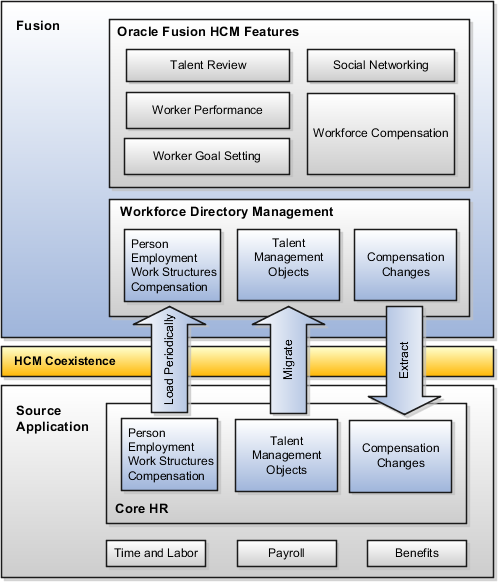
Example of Coexistance

Example of Coexistance

In broad terms the application level transition through the principles of co-existence are well established. What is currently exercising the grey matter is the middle migration. Perhaps the best way to explain this is through an example. The Product Data Hub (PDH) solution exists to provide a Master Data Management capability for your widest and gadgets.

You will want to share that master data with other apps such as Ebiz so you can deal with say order management. All fairly obvious, and in Fusion Apps world the different components should inherently work together. Back in R12 world though you are probably going to be using the Product MDM PIP (Process Integration Pack) with the Ebiz extension pack. When using the PIP like this then it’s just a case of retiring the PIP. But this PIP is designed so that you can extend the process to publish Master Data to your own apps for example you also push the data to your design systems as you maybe sharing available parts data.

So now we have an extended PIP whic in a simple Fusion apps migration you’d leave behind. But leaving the PIP behind also means an integration gap. So what is the answer.

Well on the early days of Fusion Apps the suggestion was that AIA and PIPs would be part of the ongoing story. but the reality is little has moved in this space. Understandable, Fusion Apps development had been far bigger than anyone expected, if fusion Apps are directly conversant then how much real demand exists for the PIP transformation. So what is the answer, well at this stage I’m not sure. I can say I have seen ABCS’ mentioned in the public FusionAppsOER. We know that AIA Foundation Pack EBOs are realised in Fusion Apps albeit via ADF BCs.

Given Fusion Apps underpinnings are the same as AIA so it should be possible to drop the AIA Foundation Pack (FP) into your Fusion Apps environment (setting aside all the licensing questions it would raise). Can you therefore drop in the PIP and disable the legacy Oracle app elements leaving your custom extensions? Do you accept a rewrite of your integration all be it you should just need to redevelop the orchestration layer (ABCS’ for Fusion App exist and you can carry forward your own ABCS’ for your app such as the design system in our illustration)?

Deployment of Fusion Apps with Non Fusion Apps

Deployment of Fusion Apps with Non Fusion Apps

Hopefully in the coming weeks we will get the opportunity to uncover answers with Oracle.

Share this:

  • Share on Facebook (Opens in new window) Facebook
  • Share on X (Opens in new window) X
  • Share on Pocket (Opens in new window) Pocket
  • Share on Reddit (Opens in new window) Reddit
  • Email a link to a friend (Opens in new window) Email
  • Share on WhatsApp (Opens in new window) WhatsApp
  • Print (Opens in new window) Print
  • Share on Tumblr (Opens in new window) Tumblr
  • Share on Mastodon (Opens in new window) Mastodon
  • Share on Pinterest (Opens in new window) Pinterest
  • More
  • Share on Bluesky (Opens in new window) Bluesky
  • Share on LinkedIn (Opens in new window) LinkedIn
Like Loading...

SOA Patterns on the Oracle Platform

12 Thursday Jun 2014

Posted by mp3monster in Books, General, Technology

≈ Leave a comment

Tags

book, Oracle, Packt, Patterns, review, SOA

The last Packt book I contributed to as a technical reviewer is due for release this month according to the Packt site (go here).  Looking forward to seeing the final result.


Share this:

  • Share on Facebook (Opens in new window) Facebook
  • Share on X (Opens in new window) X
  • Share on Pocket (Opens in new window) Pocket
  • Share on Reddit (Opens in new window) Reddit
  • Email a link to a friend (Opens in new window) Email
  • Share on WhatsApp (Opens in new window) WhatsApp
  • Print (Opens in new window) Print
  • Share on Tumblr (Opens in new window) Tumblr
  • Share on Mastodon (Opens in new window) Mastodon
  • Share on Pinterest (Opens in new window) Pinterest
  • More
  • Share on Bluesky (Opens in new window) Bluesky
  • Share on LinkedIn (Opens in new window) LinkedIn
Like Loading...

True SOA and the Organisation

28 Wednesday May 2014

Posted by mp3monster in General, Technology

≈ Leave a comment

Tags

HTTP, organisation, project, RPC, Service Orientated Architecture, SOA, SOAP, Thomas Erl, WSDL

SOA has become probably one of the most used and abused terms in IT in the last decade from assuming that implementing RPC over HTTP (rather than true REST) to the adoption of SOAP and WSDL equates to SOA, but this has been greatly written about. If you read texts such as the tombs from Thomas Erl & co (they are very substantial books and require a strong book case) then you will appreciate the goal to align services to more business centric thinking.

The point I wanted to really home in on is not the business process thinking but actually the organisational challenges of realising SOA. In software houses or end user businesses design and development is aligned to projects or a proxy to that such as a product release. Understandable given the wealth of experience both technical and non-technical for managing projects. But projects line up behind delivering specific goals. In an organisation that is particularly delivery or time aggressive (some might say entrepreneurial) this project drive can, and istypically at the expensive of the wider software ecosystem. Building proper services requires input beyond the singular goal of a project in most cases.

This organisation and possibly cultural consideration is where most SOA texts don’t go, but probably where most help is needed to effect true SOA.  Why do I say this, well consider statistics around failed projects, the amount of up front investment SOA demands – getting a handle on design patterns and technology is managable, but how do you know that the organisation and non technical aspects are not distorting or undermining your ability to deliver SOA properly.

From my personal experience I can see several things that can help (but not certainty) achieve the goal, namely:

  • management at all levels who recognise the benefits of SOA and particularly the upfront investment in time (and delivery impact) and are prepared to allow projects to factor this into their goals
  • architects have the authority and tools to design in a style but also the ability to define the potential value of SOA, this has to be tempered with pragmatism  (this means that the architects need to be highly collaborative and cohesive as a function if not a team)
  • design governance to support the process – with the teeth to impact a project

But this is an approach is likely to create tensions between the project and its pressures and the desire to achieve a SOA goals. The question is can an alternate organisational model exist which allows for a more effective realisation of SOA ideals without the tensions as the stronger the personalities involved between architecture and project pulling to meet their goal.

It is worth also considering the additional complexity that offshoring the implementation can add in terms of organisational challenge; as an offshore 3rd party’s focus is revenue within in an engagement (offshore vendors aren’t charieties they need to make a profit as well) so they will work to be as efficient as possible; and not likely to be focused on your total SOA ecosystem of services  (they may not even see the big picture you’re seeking to achieve) so building appropriate layers of decoupling and abstraction are not likely to be in their natural interests unless such sensitivities are built into the agreement and backed up by governance with appropriate levels of impact (which could be as extreme as rejecting the solution as it doesn’t match the service designs identified).

Further in some organisations the challenge can run deeper beyond IT and into the sponsoring side of the business. Let me illustrate this, organisations are ultimately broken into functions who can look at systems as belonging to a specific function ie system A is for marketing, that system B for eCommerce and so on. With that kind of system thinking and each department driving against its own goals (sounds like a project again) the overlap of services against software products is going to be challenging. For example services such as a service for ‘Customer’  information is likely to cross software solutions such as CRM (Marketing) and eCommerce can be subject to different demands as the different parts of the organisation pull in their desireddirection resulting in potential clashes (and likely blame IT for the issues that arise).

One of the few diagrams that makes reference to organisation in the context of SOA

So what is the answer? I can only offer up my experiences above, point to the fact that some organisations perhaps just are not ready for realising true SOA. I would certainly love to read a SOA book that approaches the question not from a technology perspective but that of a organisational and process view point.

Share this:

  • Share on Facebook (Opens in new window) Facebook
  • Share on X (Opens in new window) X
  • Share on Pocket (Opens in new window) Pocket
  • Share on Reddit (Opens in new window) Reddit
  • Email a link to a friend (Opens in new window) Email
  • Share on WhatsApp (Opens in new window) WhatsApp
  • Print (Opens in new window) Print
  • Share on Tumblr (Opens in new window) Tumblr
  • Share on Mastodon (Opens in new window) Mastodon
  • Share on Pinterest (Opens in new window) Pinterest
  • More
  • Share on Bluesky (Opens in new window) Bluesky
  • Share on LinkedIn (Opens in new window) LinkedIn
Like Loading...

SOAPatterns Mind map

17 Monday Aug 2009

Posted by mp3monster in General, mindmap, Technology

≈ Leave a comment

Tags

Design, freemind, mindmap, Patterns, Service Orientated Architecture, SOA, software

My SOA Patterns mind map can be viewed in more detail here.

SOA Patterns

SOA Patterns

Share this:

  • Share on Facebook (Opens in new window) Facebook
  • Share on X (Opens in new window) X
  • Share on Pocket (Opens in new window) Pocket
  • Share on Reddit (Opens in new window) Reddit
  • Email a link to a friend (Opens in new window) Email
  • Share on WhatsApp (Opens in new window) WhatsApp
  • Print (Opens in new window) Print
  • Share on Tumblr (Opens in new window) Tumblr
  • Share on Mastodon (Opens in new window) Mastodon
  • Share on Pinterest (Opens in new window) Pinterest
  • More
  • Share on Bluesky (Opens in new window) Bluesky
  • Share on LinkedIn (Opens in new window) LinkedIn
Like Loading...
Newer posts →

    I work for Oracle, all opinions here are my own & do not necessarily reflect the views of Oracle

    • About
      • Internet Profile
      • Music Buying
      • Presenting Activities
    • Books & Publications
      • Logging in Action with Fluentd, Kubernetes and More
      • Logs and Telemetry using Fluent Bit
      • Oracle Integration
      • API & API Platform
        • API Useful Resources
        • Useful Reading Sources
    • Mindmaps Index
    • Monster On Music
      • Music Listening
      • Music Reading
    • Oracle Resources
    • Useful Tech Resources
      • Fluentd & Fluent Bit Additional stuff
        • Logging Frameworks and Fluent Bit and Fluentd connectivity
        • REGEX for BIC and IBAN processing
      • Java and Graal Useful Links
      • Official Sources for Product Logos
      • Python Setup & related tips
      • Recommended Tech Podcasts

    Oracle Ace Director Alumni

    TOGAF 9

    Logs and Telemetry using Fluent Bit


    Logging in Action — Fluentd

    Logging in Action with Fluentd


    Oracle Cloud Integration Book


    API Platform Book


    Oracle Dev Meetup London

    Blog Categories

    • App Ideas
    • Books
      • Book Reviews
      • manning
      • Oracle Press
      • Packt
    • Enterprise architecture
    • General
      • economy
      • ExternalWebPublications
      • LinkedIn
      • Website
    • Music
      • Music Resources
      • Music Reviews
    • Photography
    • Podcasts
    • Technology
      • AI
      • APIs & microservices
      • chatbots
      • Cloud
      • Cloud Native
      • Dev Meetup
      • development
        • languages
          • java
          • node.js
          • python
      • drone
      • Fluentbit
      • Fluentd
      • logsimulator
      • mindmap
      • OMESA
      • Oracle
        • API Platform CS
          • tools
        • Helidon
        • ITSO & OEAF
        • Java Cloud
        • NodeJS Cloud
        • OIC – ICS
        • Oracle Cloud Native
        • OUG
      • railroad diagrams
      • TOGAF
    • xxRetired
    • AI
    • API Platform CS
    • APIs & microservices
    • App Ideas
    • Book Reviews
    • Books
    • chatbots
    • Cloud
    • Cloud Native
    • Dev Meetup
    • development
    • drone
    • economy
    • Enterprise architecture
    • ExternalWebPublications
    • Fluentbit
    • Fluentd
    • General
    • Helidon
    • ITSO & OEAF
    • java
    • Java Cloud
    • languages
    • LinkedIn
    • logsimulator
    • manning
    • mindmap
    • Music
    • Music Resources
    • Music Reviews
    • node.js
    • NodeJS Cloud
    • OIC – ICS
    • OMESA
    • Oracle
    • Oracle Cloud Native
    • Oracle Press
    • OUG
    • Packt
    • Photography
    • Podcasts
    • python
    • railroad diagrams
    • Technology
    • TOGAF
    • tools
    • Website
    • xxRetired

    Enter your email address to subscribe to this blog and receive notifications of new posts by email.

    Join 2,555 other subscribers

    RSS

    RSS Feed RSS - Posts

    RSS Feed RSS - Comments

    February 2026
    M T W T F S S
     1
    2345678
    9101112131415
    16171819202122
    232425262728  
    « Jan    

    Twitter

    Tweets by mp3monster

    History

    Speaker Recognition

    Open Source Summit Speaker

    Flickr Pics

    Gogo Penguin at the BarbicanGogo Penguin at the BarbicanGogo Penguin at the BarbicanGogo Penguin at the Barbican
    More Photos

    Social

    • View @mp3monster’s profile on Twitter
    • View philwilkins’s profile on LinkedIn
    • View mp3monster’s profile on GitHub
    • View mp3monster’s profile on Flickr
    • View mp3muncher’s profile on WordPress.org
    • View philmp3monster’s profile on Twitch
    Follow Phil (aka MP3Monster)'s Blog on WordPress.com

    Blog at WordPress.com.

    • Subscribe Subscribed
      • Phil (aka MP3Monster)'s Blog
      • Join 233 other subscribers
      • Already have a WordPress.com account? Log in now.
      • Phil (aka MP3Monster)'s Blog
      • Subscribe Subscribed
      • Sign up
      • Log in
      • Report this content
      • View site in Reader
      • Manage subscriptions
      • Collapse this bar
     

    Loading Comments...
     

    You must be logged in to post a comment.

      Privacy & Cookies: This site uses cookies. By continuing to use this website, you agree to their use.
      To find out more, including how to control cookies, see here: Our Cookie Policy
      %d