• Home
  • Site Aliases
    • www.cloud-native.info
  • About
    • Background
    • Presenting Activities
    • Internet Profile
      • LinkedIn
    • About
  • Books & Publications
    • Log Generator
    • Logs and Telemetry using Fluent Bit
      • Fluent Bit book
      • Book Resources in GitHub
      • Fluent Bit Classic to YAML Format configurations
    • Logging in Action with Fluentd, Kubernetes and More
      • Logging in Action with Fluentd – Book
      • Fluentd Book Resources
      • Fluentd & Fluent Bit Additional stuff
    • API & API Platform
      • API Useful Resources
    • Oracle Integration
      • Book Website
      • Useful Reading Sources
    • Publication Contributions
  • Resources
    • GitHub
    • Oracle Integration Site
    • Oracle Resources
    • Mindmaps Index
    • Useful Tech Resources
      • Fluentd & Fluent Bit Additional stuff
      • Recommended Tech Podcasts
      • Official Sources for Product Logos
      • Java and Graal Useful Links
      • Python Setup & related stuff
      • DevTips
  • Music
    • Monster On Music
    • Music Listening
    • Music Reading

Phil (aka MP3Monster)'s Blog

~ from Technology to Music

Phil (aka MP3Monster)'s Blog

Tag Archives: book

Domain Driven Design

05 Thursday Apr 2018

Posted by mp3monster in APIs & microservices, General, mindmap, Technology

≈ Leave a comment

Tags

book, Design, mindmap, Patterns

I have been wading through Eric Evan’s Domain Driven Design Book. As with many design and architecture focussed books I try to mindmap as I go so I have a quick reference resource. The mindmap for this book can be seen below and is linked to the WiseMap version which is dynamic.

In terms of of a review of the book, it contains lots of nuggets of helpful ideas and information but it is a rather heavy going to read. Some points feel over laboured such as the use of consistent language, at times it feels like half the book is dedicated to this one point. Whilst Chapter 14 – Maintaining Model Integrity sounds unadventurous as a chapter, I found this to have a lot of really helpful content such as going into the details Bounded Contexts and so on which is highly relevant to the world of microservices.

design book.png

Share this:

  • Share on Facebook (Opens in new window) Facebook
  • Share on X (Opens in new window) X
  • Share on Reddit (Opens in new window) Reddit
  • Email a link to a friend (Opens in new window) Email
  • Share on WhatsApp (Opens in new window) WhatsApp
  • Print (Opens in new window) Print
  • Share on Tumblr (Opens in new window) Tumblr
  • Share on Mastodon (Opens in new window) Mastodon
  • Share on Pinterest (Opens in new window) Pinterest
  • More
  • Share on Bluesky (Opens in new window) Bluesky
  • Share on LinkedIn (Opens in new window) LinkedIn
Like Loading...

API Design

05 Monday Feb 2018

Posted by mp3monster in API Platform CS, APIs & microservices, Books, General, mindmap

≈ Leave a comment

Tags

"best practise", API, apiary, book, mindmap

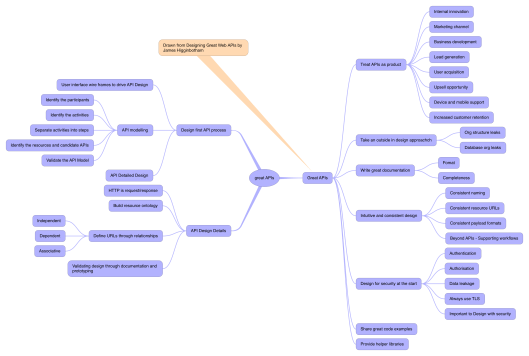
When it comes to ensuring I keep up good practises, I try to look at books  in areas I think I have a good handle on such as APIs.  Why?  well it confirms and validates I’m upto date; sometimes another view point can spark ideas on how to make something better, improve an approach or simply understand another way of explaining an idea.  The later is important as the key benefit of knowing something is the opportunity to help someone else. Not everyone communicates or understands ideas in the same so this is always helpful.

Designing Great Web APIsSo recently I ran through James Higginbotham’s Designing Great Web API’s book(let).  Often when goping through a book I mindmap it so that I can share it, and refer to it as a lit of prompts reminders if necessary.  Whilst’s James’ book doesnt  reveal anything new or relevatory for anyone working with APIs it does provide a good succinct explination to  basic practises. So here is the mindmap:

great APIs

You can also access my MapWise view here. James’ book can be obtained freely from O’Reilly here.

The book doesn’t go into the depth of details for practises that Apiary (Pro Edition) offers with style guidelines which will describe morec detailed recommended practises (more here).

Share this:

  • Share on Facebook (Opens in new window) Facebook
  • Share on X (Opens in new window) X
  • Share on Reddit (Opens in new window) Reddit
  • Email a link to a friend (Opens in new window) Email
  • Share on WhatsApp (Opens in new window) WhatsApp
  • Print (Opens in new window) Print
  • Share on Tumblr (Opens in new window) Tumblr
  • Share on Mastodon (Opens in new window) Mastodon
  • Share on Pinterest (Opens in new window) Pinterest
  • More
  • Share on Bluesky (Opens in new window) Bluesky
  • Share on LinkedIn (Opens in new window) LinkedIn
Like Loading...

New book project

18 Sunday Jun 2017

Posted by mp3monster in Books, General, Packt

≈ Leave a comment

Tags

API, book, Cloud Service, OMESA, Oracle, Packt

Now the big news, we have just agreed with Packt Publishing to write a book around Oracle’s new API Platform Cloud Service (APIP CS). This is going to be more of a team effort with 4 of us working on the book. With all the authors working for Capgemini as well it should be a lot easier in terms of effort The book is being targeted for late this year to be published so that we can cover the major features being released this summer which will make the product a lot more rounded and complete.
The book will also bring in another initiative that has been running in a fairly low profile manner, but starting to shape up in the form of something called OMESA (OMESA.io). This initiative is a cross party approach to define a reusable reference architecture that engages both the legacy landscape along with API driven / microservices based contemporary solution delivery.

We will of course continue to blog about ICS at https://oracle-integration.cloud

Share this:

  • Share on Facebook (Opens in new window) Facebook
  • Share on X (Opens in new window) X
  • Share on Reddit (Opens in new window) Reddit
  • Email a link to a friend (Opens in new window) Email
  • Share on WhatsApp (Opens in new window) WhatsApp
  • Print (Opens in new window) Print
  • Share on Tumblr (Opens in new window) Tumblr
  • Share on Mastodon (Opens in new window) Mastodon
  • Share on Pinterest (Opens in new window) Pinterest
  • More
  • Share on Bluesky (Opens in new window) Bluesky
  • Share on LinkedIn (Opens in new window) LinkedIn
Like Loading...

Innovators

24 Friday Mar 2017

Posted by mp3monster in Books, General

≈ Leave a comment

Tags

Baarden, Babbage, book, Brattian, innovators, John Baarden, Lovelace, review, Technology, Vint Cerf, von Nuemann, Walter Brattain, Walter Isaacson

Recently I’ve given some time over to catching up on some reading. Which has included Walter Isaacson’s tremendous book Innovators. I picked this up  more because I liked Walter’s approach to the Steve Job’s biography. I thought this was going to be more focused on individuals and how they brought through new technology innovations. But actually it is a very good potted history of the development of modern computing.  Whilst I work in IT and thought I knew key contributors, from Babbage, Lovelace to von Neumann and Turing.  I was rather surprised at how many signficiant contributors I didnt know, or only vaguely aware of.  For example the work of Douglas Engelbart who pretty much lead the design for the mouse.  What about Vint Cerf who made key contributions to TCP/IP? Stephen Crocker who was responsible for the RFC that we all associate with the IETF now?

Not only is the history interesting, the book looks at the dynamics of innovation and how much innovation comes from the individuals working away on their own and having a eureka moment compared to that constant dialogue between people which sounding off each other lead to new ideas? The later is beautifully illustrated with the development of the transistor and the work of John Baarden and Walter Brattain. It’s interesting that as the history moves into the pre-internet era that more and more of advancements are a result of collective effort, but also recognised as such. I wonder whether that is because technologies made collaboration easier, or the effects of socio-cultural developments that meant people recognised the collaborative efforts?

I’d recommend this book to anyone who is interested in IT has developed or even just interested in the interplay of personalities and events such as World war II that influenced scientific advancement.

Share this:

  • Share on Facebook (Opens in new window) Facebook
  • Share on X (Opens in new window) X
  • Share on Reddit (Opens in new window) Reddit
  • Email a link to a friend (Opens in new window) Email
  • Share on WhatsApp (Opens in new window) WhatsApp
  • Print (Opens in new window) Print
  • Share on Tumblr (Opens in new window) Tumblr
  • Share on Mastodon (Opens in new window) Mastodon
  • Share on Pinterest (Opens in new window) Pinterest
  • More
  • Share on Bluesky (Opens in new window) Bluesky
  • Share on LinkedIn (Opens in new window) LinkedIn
Like Loading...

Building Microservices

18 Wednesday Jan 2017

Posted by mp3monster in Books, General, mindmap, Technology

≈ Leave a comment

Tags

book, Microservices, mindmap, notes, Technology

When I read a technical book from cover to cover I usually build a mind map so that I can use it as a memory jogger in the future if I need to return to get key points such as arguments or facts. With the ferstive break I have had time to finish reading Sam Newman’s Building Microservices. The following is a static image, but clicking on it can take you the dynamic site provided through WiseMapping, it does take a moment or two as the map is large (or click here).

microservices

Many of the points made in this excellent book are true to software design and development generally, but given a Microservices spin. For example, monitoring and security should be incorporated into any good design.


Share this:

  • Share on Facebook (Opens in new window) Facebook
  • Share on X (Opens in new window) X
  • Share on Reddit (Opens in new window) Reddit
  • Email a link to a friend (Opens in new window) Email
  • Share on WhatsApp (Opens in new window) WhatsApp
  • Print (Opens in new window) Print
  • Share on Tumblr (Opens in new window) Tumblr
  • Share on Mastodon (Opens in new window) Mastodon
  • Share on Pinterest (Opens in new window) Pinterest
  • More
  • Share on Bluesky (Opens in new window) Bluesky
  • Share on LinkedIn (Opens in new window) LinkedIn
Like Loading...

My experience writing a technical book

26 Monday Dec 2016

Posted by mp3monster in Books, General, Packt

≈ 2 Comments

Tags

AMIS, book, ebook, integration, OIC - ICS, Oracle, Packt, press, publishing, writing

We have just supplied our publisher with the final draft of the final chapter in our book about Oracle Integration Cloud Service (ICS). Before we get too chilled out waiting to see the printed article as Packt Sort out the final publishing I thought it might be helpful to share some observations from our experiences.

Let’s start with some background. I have been acting as a peer reviewer for Packt for some years now, and in fact Packt had approached me in the past to write a book, however I had declined their proposals as I didn’t want to write on a subject that people had already written about. So when I was introduced to ICS, this felt like a good subject to write a book on, certainly represents something that it is going to have a significant future and deserved a book to help people get beyond a basic user guide.

Choosing to write a book is not a small undertaking, so make sure you’re going to do this for the right reasons. Let’s be honest, very few books make much money. You have to be  lucky, writing a subject you know us going to be game changing (think Gang of Four and Thomas Erl) or have a definitive text on the next big thing that everyone will use. Publishers also run promotions, discounts and give aways, some more than others, but that will all eat into you share, not to mention unless you self publish or you’re a rock star author you will not see big percentage royalty rates coming your way.

So first steps, for us was to get a publisher on board, given it was an Oracle product I wanted to talk to Oracle Press (or here) first which is run by McGraw-Hill. They weren’t too sure about the idea, having not been successful with previous cloud books. So we went back to Packt, they do have Oracle based books, and I had a relationship there.

With some initial positive feedback, I needed to get things moving. Thinking through this I concluded that the entire book alone could be a lot of very hard graft when working with a new product and I didn’t have the access to the same level of resources working for a customer organisation as you can with an Oracle partner company. So I needed a co-author who was involved with ICS, and ideally working for an Oracle partner. I had seen Robert van Mölken blogging about ICS, and working for AMIS suggested he would be a very capable person, not to mention AMIS is a respected partner. Robert has shown himself to be more than capable, and getting him signed up to the idea was a good call.

Next, was to start properly developing the idea, which means chapters, subheadings, and  book introduction.  Very quickly the chapters and subsections where finalised, along with our approach to the examples. I was very keen that the examples where routed in plausible scenarios and that would help the ideas without getting caught up explaining the detail.  Not to mention the examples should feel less superficial. Additionally, we have recognised that a book about a cloud solution means that things will move far faster than something that is deployed on-premises, so how we approach this book needs to hold true and relevant even if there are new features and aesthetic changes for a good while.

We divided the work up between us, I think Robert in hindsight took on the more troublesome chapters, in so far needing to understand more social APIs. So when plotting out the division of work, also think about the technical challenges you might have and need to explain. Whilst you won’t have this in perhaps a ‘hello world’ level of functionality when you past this effort builds up, if you’re working on a cookbook it may we’ll be an important factor.

Our original goal had been to publish in time for Open World. But the realities of a job, both of us being active with events such as user groups meant these things would eat into the available writing time as demos, presentations would also need to be written. We also uncovered a couple of bugs that delayed things, both in waiting for the patch, but also confirming that what we where seeing was a bug, and not an issue of understanding.

In hindsight I think perhaps we should have done more work during the planning to  build the example scenarios. There is no doubt that planning before actually writing makes a significant difference. It would have given us more time in working through the questions and challenges. The risk would have been that it would have been a lot longer before we actually produced some content, and there is certainly something psychological about getting those initial chapters written.

1905356542-video-conferencing-webmarketing-inner-blog-umr8sp-clipartDuring the core writing phase Robert and I would gave weekly call to catchup, it meant that we could discuss the chapter scenarios, details, and assumptions that meant we were aligned. Whilst not necessary, and this could be done be email, a short conversation was a lot easier and it helped keep focus. Not to mention probably reduced the differences in writing that can occur with different authors.

When comes to the writing itself I found the clearer my thinking was on the specific  points I wanted to convey the easier the writing became and the writing of the chapter just flowed. The question I still haven’t really answered in my own mind is whether I should have been a lot more attentive to the formatting the publishers wanted us to adopt, applying it retrospectively took a couple of passes as you would spot something that had omitted the correct style. But diligently applying the right styles would have been disruptive to the writing style.

153493174We found that most chapters overran the page count by about 10%-15% the publisher was pretty cool about this – they definitely agreed a good book over a book that was edited to a specific length was most important. We can put the over run down largely to the fact we didn’t allow for the formatting of the page, which meant more white space that we had anticipated, plus in the drafts we needed to put additional publication notes in such as references to the images being used. It is worth looking at this before finalising your chapter lengths.

The last thing we did during the writing of the 1st drafts was reviewing each other’s work before submitting the chapters. This probably helped a lot in so far as Robert would often pickup on issues with my screenshots and I would tend to finesse wording – when you write in a more conversational style those little quirks of speaking can come through.

thumb_colourbox10196464Completing all the chapters in 1st draft felt pretty satisfying, and certainly a morale boost as we had overrun our original estimates, as it meant we where we we’re well over 50% complete, probably nearer to 75% complete in terms of effort. In the contract with Packt this was also the 1st milestone for the advance, which is a long way into the process and the payment has yet to be received. Some of this delay has been organisational, but things don’t happen quickly on that front.

Before we started the project one of the Oracle Ace Directors we knew provided some observations, suggesting that each page will probably take a couple of hours to write. I have to admit to being a little sceptical of this as it would mean roughly a year of writing every evening for both of us if you look at it from an elapsed time it isn’t so far from the truth. If you look at the actual effort, those weeks where I was just working on the book rather than presentations or work demands. I think it would have been fair to suggest about 8-12 hours of effort went into the book each week which is about 450 pages in length. In the end I think we probably where writing at twice that speed if you measure effort from 1st to last draft.

Colorful letters background. 3d rendered illustrationSecond draft is about addressing the review feedback from the peer reviewers. For us that was pretty straight forward,the feedback we received was very positive and making suggestions on how to improve things. As we wrote about a cloud product that is developing and improving quickly we needed to double check the screens hadn’t changed. We did see 1 challenge in the reviewing.  We wrote the Preface to help provide context to the book, but I didn’t get sent before the 1st chapters went to review some comments as a result perhaps weren’t so intune with the books underpinning goals.  Should the reviewer need to have had the preface first, debatable. We took advantage of this lesson, to reduce the dependency on having read the preface.

Most changes where about fixing formatting, then adding a couple of additional screenshots and some clarifying text. Each chapter probably only needed 1 additional paragraph per chapter. So working through this was pretty quick. Then it has been over to the publisher to finishing things off and assemble the book.

Going forward, we will continue to write additional material, initially for the blog (oracle-integration.cloud) but we are exploring the idea of a living book where the book version will undergo quarterly updates. But time will tell as to whether this makes a difference.

The book can be found at:

  • Packt
  • Amazon

Share this:

  • Share on Facebook (Opens in new window) Facebook
  • Share on X (Opens in new window) X
  • Share on Reddit (Opens in new window) Reddit
  • Email a link to a friend (Opens in new window) Email
  • Share on WhatsApp (Opens in new window) WhatsApp
  • Print (Opens in new window) Print
  • Share on Tumblr (Opens in new window) Tumblr
  • Share on Mastodon (Opens in new window) Mastodon
  • Share on Pinterest (Opens in new window) Pinterest
  • More
  • Share on Bluesky (Opens in new window) Bluesky
  • Share on LinkedIn (Opens in new window) LinkedIn
Like Loading...

Implementing Oracle Integration Cloud Service – Gone Alpha

13 Saturday Aug 2016

Posted by mp3monster in Books, General, Oracle, Packt, Technology

≈ Leave a comment

Tags

alpha, book, Cloud, OIC - ICS, Oracle, Packt

alpha-logoWe have taken our book on ICS into Packt Publishing’s Alpha programme so that if you order the book now – you can see the chapters as soon as they have received editorial approval and the complete final book will be made available to you as soon as we’re have addressed all the feedback, made any final improvements we have identified once we have completed the book’s draft.

img_0282-1The book can be found on the Packt website – here

Details about the Authors from Packt can be seen at:

  • Phil Wilkins
  • Robert  van Mölken

Share this:

  • Share on Facebook (Opens in new window) Facebook
  • Share on X (Opens in new window) X
  • Share on Reddit (Opens in new window) Reddit
  • Email a link to a friend (Opens in new window) Email
  • Share on WhatsApp (Opens in new window) WhatsApp
  • Print (Opens in new window) Print
  • Share on Tumblr (Opens in new window) Tumblr
  • Share on Mastodon (Opens in new window) Mastodon
  • Share on Pinterest (Opens in new window) Pinterest
  • More
  • Share on Bluesky (Opens in new window) Bluesky
  • Share on LinkedIn (Opens in new window) LinkedIn
Like Loading...

Book Progress

27 Friday May 2016

Posted by mp3monster in General, Oracle, Packt

≈ Leave a comment

Tags

book, Cloud, integration, iPaaS, OIC - ICS, Oracle, PaaS

The book is progressing well – we have the cover art mocked up now and a domain for any additional stuff we do to support the book – http://oracle-integration.cloud/  ….

Share this:

  • Share on Facebook (Opens in new window) Facebook
  • Share on X (Opens in new window) X
  • Share on Reddit (Opens in new window) Reddit
  • Email a link to a friend (Opens in new window) Email
  • Share on WhatsApp (Opens in new window) WhatsApp
  • Print (Opens in new window) Print
  • Share on Tumblr (Opens in new window) Tumblr
  • Share on Mastodon (Opens in new window) Mastodon
  • Share on Pinterest (Opens in new window) Pinterest
  • More
  • Share on Bluesky (Opens in new window) Bluesky
  • Share on LinkedIn (Opens in new window) LinkedIn
Like Loading...

Review of Oracle API Management 12c

22 Monday Feb 2016

Posted by mp3monster in Book Reviews, Books, General, Oracle, Packt, Technology

≈ Leave a comment

Tags

API, book, Oracle, OUG, review

3635en_4575_oracle20api20management2012c20implementation_0My review of the Oracle API Management 12c has been published the the UKOUG at http://www.ukoug.org/what-we-offer/news/review-of-oracle-api-management-12c-implementation/ – rather than repeat the review here, I’d recommed people go read the page.  But I will say here is that it is an excellent book.  The book can be found at:

  • Packt
  • Amazon

Along with a range of other book sellers.

Share this:

  • Share on Facebook (Opens in new window) Facebook
  • Share on X (Opens in new window) X
  • Share on Reddit (Opens in new window) Reddit
  • Email a link to a friend (Opens in new window) Email
  • Share on WhatsApp (Opens in new window) WhatsApp
  • Print (Opens in new window) Print
  • Share on Tumblr (Opens in new window) Tumblr
  • Share on Mastodon (Opens in new window) Mastodon
  • Share on Pinterest (Opens in new window) Pinterest
  • More
  • Share on Bluesky (Opens in new window) Bluesky
  • Share on LinkedIn (Opens in new window) LinkedIn
Like Loading...

Java EE Development with Eclipse 2nd Edition

06 Tuesday Oct 2015

Posted by mp3monster in Book Reviews, Books, Packt, Technology

≈ Leave a comment

Tags

book, ebook, Eclipse, java, Packt

I have just been told that the 2nd Edition of Java EE Development with Eclipse has now been published.  This is another book that I have supported as a technical reviewer.  Looking forward to receiving my print copy so I can see how my suggestions and feedback have carried through to the final copy.

You can see the book on the Packt site with  https://www.packtpub.com/application-development/java-ee-development-eclipse-second-edition  or Amazon here


IMG_2232

Here is the finished article!

Share this:

  • Share on Facebook (Opens in new window) Facebook
  • Share on X (Opens in new window) X
  • Share on Reddit (Opens in new window) Reddit
  • Email a link to a friend (Opens in new window) Email
  • Share on WhatsApp (Opens in new window) WhatsApp
  • Print (Opens in new window) Print
  • Share on Tumblr (Opens in new window) Tumblr
  • Share on Mastodon (Opens in new window) Mastodon
  • Share on Pinterest (Opens in new window) Pinterest
  • More
  • Share on Bluesky (Opens in new window) Bluesky
  • Share on LinkedIn (Opens in new window) LinkedIn
Like Loading...
← Older posts
Newer posts →

    I work for Oracle, all opinions here are my own & do not necessarily reflect the views of Oracle

    • About
      • Internet Profile
      • Music Buying
      • Presenting Activities
    • Books & Publications
      • Logging in Action with Fluentd, Kubernetes and More
      • Logs and Telemetry using Fluent Bit
      • Oracle Integration
      • API & API Platform
        • API Useful Resources
        • Useful Reading Sources
    • Mindmaps Index
    • Monster On Music
      • Music Listening
      • Music Reading
    • Oracle Resources
    • Useful Tech Resources
      • Fluentd & Fluent Bit Additional stuff
        • Logging Frameworks and Fluent Bit and Fluentd connectivity
        • REGEX for BIC and IBAN processing
      • Formatting etc
      • Java and Graal Useful Links
      • Official Sources for Product Logos
      • Python Setup & related tips
      • Recommended Tech Podcasts

    Oracle Ace Director Alumni

    TOGAF 9

    Logs and Telemetry using Fluent Bit


    Logging in Action — Fluentd

    Logging in Action with Fluentd


    Oracle Cloud Integration Book


    API Platform Book


    Oracle Dev Meetup London

    Blog Categories

    • App Ideas
    • Books
      • Book Reviews
      • manning
      • Oracle Press
      • Packt
    • Enterprise architecture
    • General
      • economy
      • ExternalWebPublications
      • LinkedIn
      • Website
    • Music
      • Music Resources
      • Music Reviews
    • Photography
    • Podcasts
    • Technology
      • AI
      • APIs & microservices
      • chatbots
      • Cloud
      • Cloud Native
      • Dev Meetup
      • development
        • languages
          • java
          • node.js
          • python
      • drone
      • Fluentbit
      • Fluentd
      • logsimulator
      • mindmap
      • OMESA
      • Oracle
        • API Platform CS
          • tools
        • Helidon
        • ITSO & OEAF
        • Java Cloud
        • NodeJS Cloud
        • OIC – ICS
        • Oracle Cloud Native
        • OUG
      • railroad diagrams
      • TOGAF
    • xxRetired
    • AI
    • API Platform CS
    • APIs & microservices
    • App Ideas
    • Book Reviews
    • Books
    • chatbots
    • Cloud
    • Cloud Native
    • Dev Meetup
    • development
    • drone
    • economy
    • Enterprise architecture
    • ExternalWebPublications
    • Fluentbit
    • Fluentd
    • General
    • Helidon
    • ITSO & OEAF
    • java
    • Java Cloud
    • languages
    • LinkedIn
    • logsimulator
    • manning
    • mindmap
    • Music
    • Music Resources
    • Music Reviews
    • node.js
    • NodeJS Cloud
    • OIC – ICS
    • OMESA
    • Oracle
    • Oracle Cloud Native
    • Oracle Press
    • OUG
    • Packt
    • Photography
    • Podcasts
    • python
    • railroad diagrams
    • Technology
    • TOGAF
    • tools
    • Website
    • xxRetired

    Enter your email address to subscribe to this blog and receive notifications of new posts by email.

    Join 2,556 other subscribers

    RSS

    RSS Feed RSS - Posts

    RSS Feed RSS - Comments

    March 2026
    M T W T F S S
     1
    2345678
    9101112131415
    16171819202122
    23242526272829
    3031  
    « Feb    

    Twitter

    Tweets by mp3monster

    History

    Speaker Recognition

    Open Source Summit Speaker

    Flickr Pics

    Gogo Penguin at the BarbicanGogo Penguin at the BarbicanGogo Penguin at the BarbicanGogo Penguin at the Barbican
    More Photos

    Social

    • View @mp3monster’s profile on Twitter
    • View philwilkins’s profile on LinkedIn
    • View mp3monster’s profile on GitHub
    • View mp3monster’s profile on Flickr
    • View mp3muncher’s profile on WordPress.org
    • View philmp3monster’s profile on Twitch
    Follow Phil (aka MP3Monster)'s Blog on WordPress.com

    Blog at WordPress.com.

    • Subscribe Subscribed
      • Phil (aka MP3Monster)'s Blog
      • Join 234 other subscribers
      • Already have a WordPress.com account? Log in now.
      • Phil (aka MP3Monster)'s Blog
      • Subscribe Subscribed
      • Sign up
      • Log in
      • Report this content
      • View site in Reader
      • Manage subscriptions
      • Collapse this bar
     

    Loading Comments...
     

    You must be logged in to post a comment.

      Privacy & Cookies: This site uses cookies. By continuing to use this website, you agree to their use.
      To find out more, including how to control cookies, see here: Our Cookie Policy
      %d