In a previous blog (here) I wrote about the structure and naming of assets to be applied to OCIR. What I didn’t address is the interesting challenge of what if my development machine has a different architecture to my target environment. For example, as a developer, I have a nice shiny Mac Book Pro with the M1 chipset which uses an ARM architecture. However, my target cloud environment has been built and runs with an AMD64 chipset? As we’re creating binary images it does raise some interesting questions.
As we’re creating our containers with Docker, this addresses how to solve the problem with Docker. Other OCI Compliant containers will address the problem differently.
Buildx
Buildx is a development feature in Docker which makes use of a cross-platform build capability. When using buildx we can specify one or more build platform types. These are specified using the –platform parameter. In the code below we use it to define the Linux AMD64 architecture mentioned (linux/amd64). But we can make the parameter a comma-separated list targeting different platform types. When that is done, multiple images will be built. By default, the build will happen in sequence, but it is possible to switch on additional process threads for the Docker build process to get the build process running concurrently.
Unlike the following example (which is only intended for one platform, if you are building for multiple platforms then it would be recommended that the name include the platform type the image will work for. For production builds we would promote that idea regardless, just as we see with installer and package manager-related artifacts.
If you compare this version of the code to the previous blog (here) there are some additional differences. Now I’ve switched to setting the target tag as part of the build. As we’re not interested in hanging onto any images built we’ve included the target repository in the build statement. Immediately push it to OCIR, after all the images won’t work on our machine.
A container registry is as essential as a Kubernetes service as you want to manage the deployable resources. That registry could be the public Docker repository or something else. In most people’s cases, the registry needs to be private as you don’t want to expose your product assets to potential external tampering. As a result, we need a service such as Oracle’s container registry OCIR.
The re of this blog is going to walk through how to push a container you’ve built into OCIR and a gotcha that can trip up users if you make assumptions about how the registry works.
Build container
Let’s assume you’re building your microservices locally or retrieving vetting 3rd party services for use. In both cases, you want to manually push your assets into OCIR manually rather than have an automated build pipeline do it for you.
This creates a container locally, and we can see the container listed using the command:
docker images
Setup of OCIR
We need an OCIR to target so the easiest thing is to manually create an OCIR instance in one of the regions, for the sake of this illustration we’ll use Ashburn (short code is IAD). To help with the visibility we can put the registry in a separate compartment as a child of the root. Let’s assume we’re going to call the registry GraphQL. So before creating your OCIR set up the compartment as necessary.
fragment of the compartment hierarchy
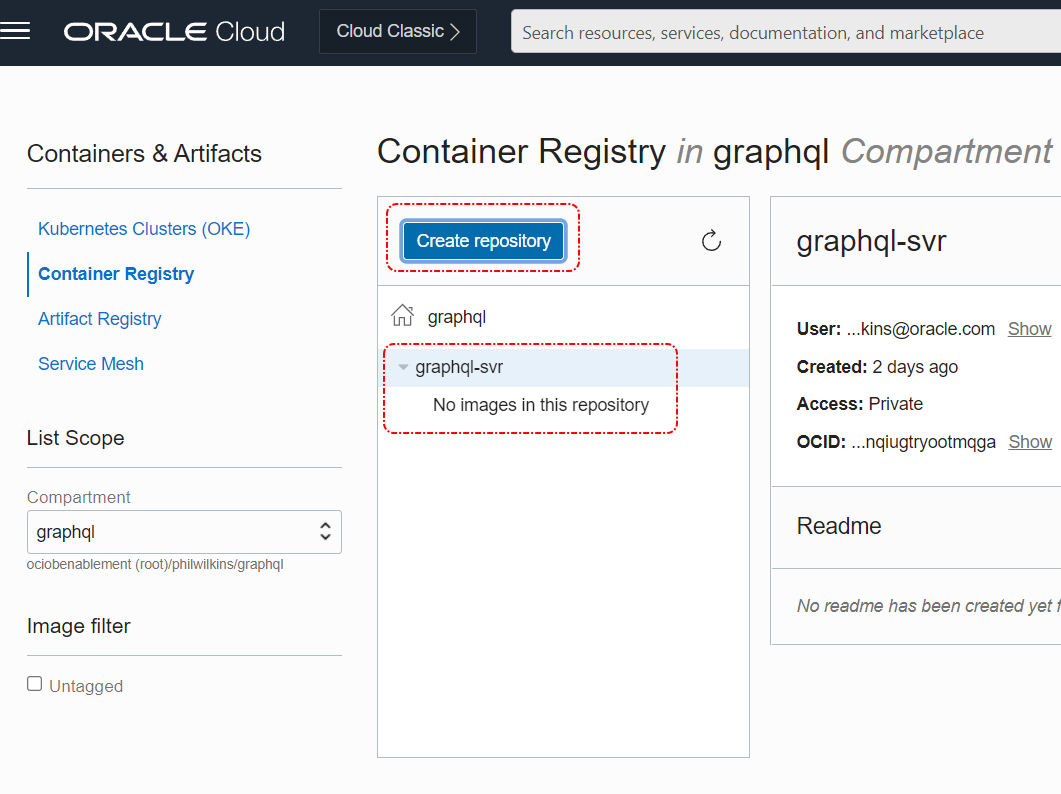
In the screenshot, you can see I’ve created a registry, which is very quick and easy in the UI (in the menu it’s in the Developer Services section).
The Oracle meu to navigate to the OCIR servicethe UI to create a OCIR
Finally, we click on the button to create the specific OCIR.
Deployment…
Having created the image, and with a repo ready we can start the steps of pushing the container to OCIR.
The next step is to tag the created image. This has to be done carefully as the tag needs to reflect where the image is going using the formula <region name>/<tenancy name/<registry name>:<version>. All the registries will be addressed by <region short code>.ocir.io In our case, it would be iad.ocir.io.
docker tag graph-svr:latest iad.ocir.io/ociobenablement/graphql-svr:v0.1-dev
As you may have realized the tag being applied effectively tells OCI which instance of OCIR to place the container in. Getting this wrong can be the core of the gotcha previously mentioned and we’ll elaborate upon it shortly.
To sign in you’ll need an auth token as that is passed as the password. For simplicity, I’ve passed the token in the docker command, which Docker will warn you of as being insecure, and suggest it is passed in as part of a prompt. Note my token will have been changed by the time this is published. The username is built on the structure of <cloud tenancy name>/identitycloudservice/<username>. The identitycloudservice piece only needs to be included for your authentication is managed through IDCS, as is the case here. The final bit is the URI for the appropriate regional OCIR address, as we’ve used previously.
With hopefully a successful authentication response we can push the container. It is worth noting that the Docker authenticated connection will timeout which is why we’ve put everything in place before connecting. The push command is very simple, it is the tag name assigned to the artifact including the version number.
When we deal with repositories from Git to SVN or Apache Archiva to Nexus we work with a repository that holds multiple different assets with multiple versions of those assets. as a result, when we identify an asset uniquely we would expect to name things based on server/location, repository, asset name, and version. However, here each repository is designed for one type of asset but multiple versions. In reality, a Docker repository works in the same manner (but the extended path impact is different).
This means it becomes easy to accidentally define a tag with an extra element. Depending upon your OCI tenancy privileges if you get the path wrong, OCI creates a new root compartment container repository with a name that is a composite of the name elements after the tenancy and puts your artifact in that repository, not the one you expected.
We can address this in several ways, first and probably the best option is to automate the process of loading assets into OCIR, once the process is correct, it will remain correct. Another is to adopt a principle of never holding repositories at the root of a tenancy, which means you can then explicitly remove the permissions to create repositories in that compartment (you’ll need to explicitly grant the permissions elsewhere in the compartment hierarchy because of policy inheritance. This will result in the process of pushing a container to fail because of privileges if the tag is wrong.
Visual representation of structure differences
Repository Structure
Registry Structure
Condensed to a simple script
These steps can be condensed to a simple platform neutral script as follows:
This script would need modifying for each container being built, but you could easily make it parameterized or configuration drive.
A Note on Registry Standards
Oracle’s Container Registry has adopted the Open Registries standard for OCIR. Open Registries come under the Linux Foundation‘s governance. This standard has been adopted by all the major hyperscalers (Google, AWS, Azure, etc). All the technical spec information for the standard is published through GitHub rather than the main website.
If you read press around Java you’ll have come across references to GraalVM. So what is it and why would I use it?
There is an excellent podcast from Software Engineering Daily that digs into the subject and can be found here and here. But let draw out some of the reasons as to why GraalVM is interesting.
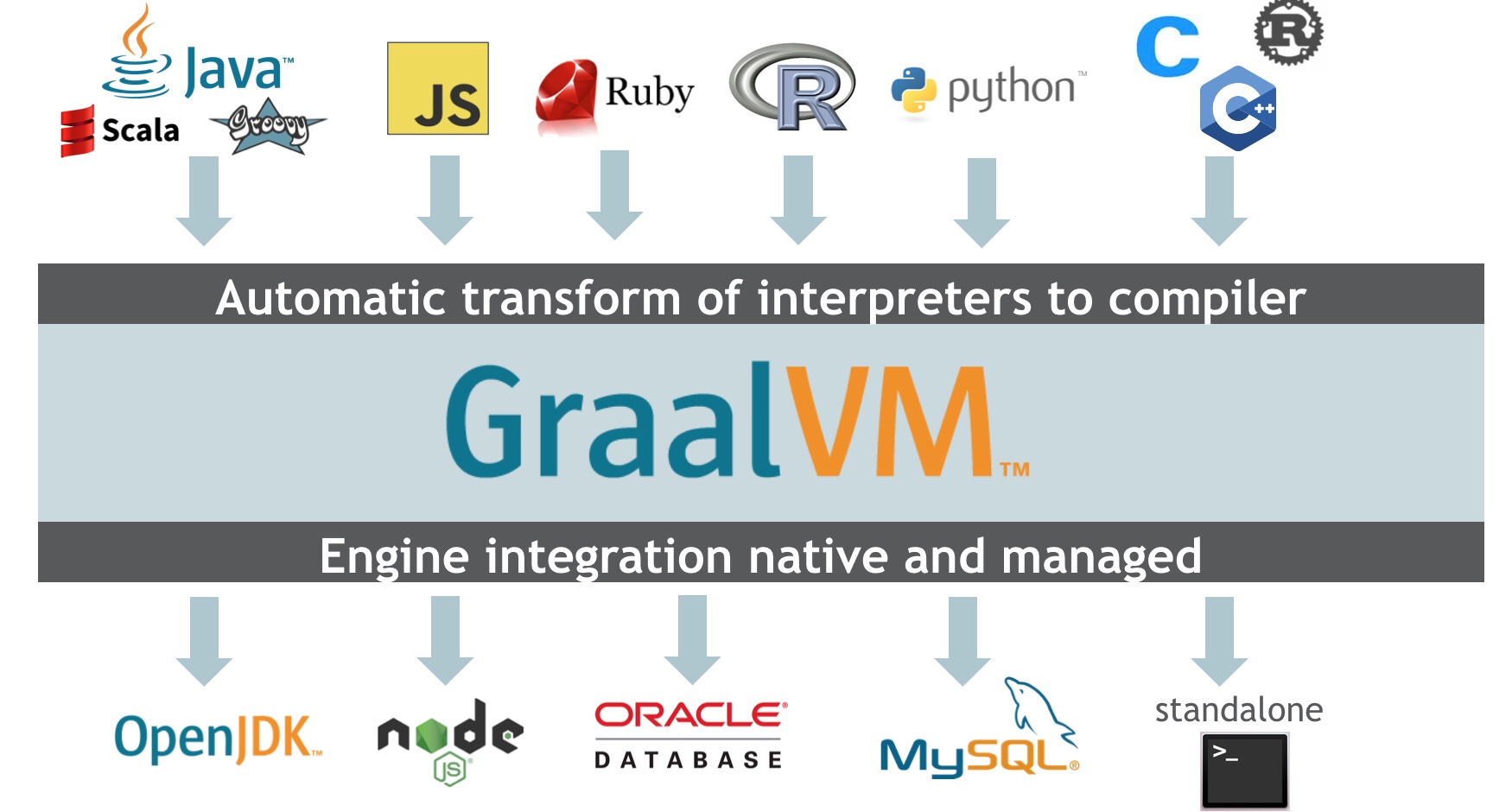
Whilst multiple languages on top of the JVM is nothing new, such as Scala , Kotlin, and Groovy to name a few, GraalVM through the use of its Truffle framework takes it a new level. Truffle provides an Abstract Syntax Tree (AST) which describes the language syntax (more here about AST). The net result is any language can be described and therefore executed using the GraalVM. To this end the GraalVM team have got Node and JavaScript ported in addition to defining existing languages using this approach. Not all of this is proven robustly in production, but some of the languages VM certainly is, for example Twitter have been using the Scala port.
Because the languages are described through the same framework this means the work to optimise the VM performance becomes a lot easier.
It would be easy to assume that using the framework would mean the execution of languages using this mechanism would slow be slower. But, Truffle works by translating the code to standard byte code before execution, so ‘ported’ languages are now no less efficient than Java come runtime.
There is an interesting bi-product of this model, that at runtime with the right object exposures it is possible for multiple languages to interact with the same object easily, no JNI or dropping to the lowest common denominator such as a JSON+REST. This does raise interesting possibilities for thick client solutions or polyglot monoliths!
Probably one of the biggest pay offs for using GraalVM and its ability to run multiple languages is that the base Container images can be simplified as you don’t need different container images. This makes the work of patching and testing configurations of these container a lot simpler as the permutations will drop, particularly for organisations that have wholehearted embraced polyglot micro-service ideas.
One common reason for changing implementations of the JVM particularly at the more performance sensitive use cases (checkout Azul as an example) is how the JVM is optimised and the JIT algorithms and processes particularly the Garbage Collector work (checkout this list of JVMs. For example GraalVM will provide better performance for processes that less heap hungry than Oracle’s JVM.
It is interesting that Oracle are investing in a new VM when it wasn’t that long ago that JRockit was wound down. Given the legal dispute between Oracle and Google (see here) the new VM would give Google a means to escape from the copyright breaches and retain support for Java.





 Phil (aka MP3Monster)'s Blog
You must be logged in to post a comment.