• Home
  • Site Aliases
    • www.cloud-native.info
  • About
    • Background
    • LinkedIn
    • Presenting Activities
    • Internet Profile
    • About
  • Books & Projects
    • Logs and Telemetry using Fluent Bit
      • Fluent Bit book
      • Book Resources in GitHub
      • Fluent Bit Classic to YAML Format configurations
    • Logging in Action with Fluentd, Kubernetes and More
      • Logging in Action with Fluentd – Book
      • Fluentd Book Resources
      • Fluentd & Fluent Bit Additional stuff
    • OpAMP
    • Log Generator
    • API & API Platform
      • API Useful Resources
    • Oracle Integration
      • Book Website
      • Useful Reading Sources
    • Publication Contributions
  • Resources
    • GitHub
    • Oracle Integration Site
    • Oracle Resources
    • Mindmaps Index
    • Useful Tech Resources
      • Fluentd & Fluent Bit Additional stuff
      • Recommended Tech Podcasts
      • Official Sources for Product Logos
      • Java and Graal Useful Links
      • DevTips
  • Music
    • Monster On Music
    • Music Listening
    • Music Reading

Phil (aka MP3Monster)'s Blog

~ from Technology to Music

Phil (aka MP3Monster)'s Blog

Category Archives: Oracle

All things related to Oracle

UKOUG Tech16 Presentation Slides, Apex & Oracle Cloud

15 Thursday Dec 2016

Posted by mp3monster in General, Oracle, Technology

≈ Leave a comment

Tags

APEX, Cloud, Oracle, OUG, tech16

My presentation for UKOUG Tech 16 can be seen by following the link – Introduction to SOA CS. or see below   It was a tremendous 4 days (if you include the Tech stream’s Super Sunday).  If you are a UKOUG member and didn’t make it to the conference I’d look out for the material to be become available.

Whilst I’m not a big Apex fan (stitching business logic into the persistence layer feels wrong to a middleware person), i did attend the keynote session which covered Apex’s history and future direction, and there are some very exiciting things coming and if everything materialises as I understand it then some big steps to getting developers engaged with Oracle cloud offerings.

Oracle has done a lot of work on the middleware layer with apps container (using common Docker configurations without needing to worry about Docker), Kafka, Node.js and others to engage developers and provide the means to offer a polyglot microservices platform that is not just attractive to  the traditional Oracle customer base but also those wanting the middle ground of supported open source. What Oracle are missing is the means to get developers trying the technology and being creative with it. Amazon and Red Hat have got this by offering limited footprints for a long time. Oracle offer 30 day trials which is fine to do a project sponsored PoC. But to hook grass roots users you need a lengthy period where people in spare time can built some cool/geeky solutions.

Now this maybe down to the fact that Oracle cloud is built on their Exa machines with clever on silicon security features, and Oracle can’t manufacture it quick enough. Whereas other cloud providers work with largely commodity components. But if they want to challenge Amazon as Ellison says they need to change this.


Share this:

  • Share on Facebook (Opens in new window) Facebook
  • Share on X (Opens in new window) X
  • Share on Reddit (Opens in new window) Reddit
  • Share on LinkedIn (Opens in new window) LinkedIn
  • Email a link to a friend (Opens in new window) Email
  • Share on WhatsApp (Opens in new window) WhatsApp
  • Print (Opens in new window) Print
  • Share on Tumblr (Opens in new window) Tumblr
  • Share on Mastodon (Opens in new window) Mastodon
  • Share on Pinterest (Opens in new window) Pinterest
  • Share on Bluesky (Opens in new window) Bluesky
Like Loading...

UKOUG Oracle Scene – Another Article Published

16 Wednesday Nov 2016

Posted by mp3monster in Cloud, General, Oracle, Technology

≈ Leave a comment

The latest edition of the UK Oracle User Group (UKOUG) Oracle Scene Journal is out now with another article from me, in addition to some great content from other contributors. This article builds upon and updates an article previously published in the Oracle Apps User Group about 18 months ago. We updated and republished as part of the run up to the UKOUG special Event in March next year which will be fully announced at the conference in a couple of weeks. You can see it here Oracle Scene Edition 62 – Journey to the Cloud


Share this:

  • Share on Facebook (Opens in new window) Facebook
  • Share on X (Opens in new window) X
  • Share on Reddit (Opens in new window) Reddit
  • Share on LinkedIn (Opens in new window) LinkedIn
  • Email a link to a friend (Opens in new window) Email
  • Share on WhatsApp (Opens in new window) WhatsApp
  • Print (Opens in new window) Print
  • Share on Tumblr (Opens in new window) Tumblr
  • Share on Mastodon (Opens in new window) Mastodon
  • Share on Pinterest (Opens in new window) Pinterest
  • Share on Bluesky (Opens in new window) Bluesky
Like Loading...

Oracle 2 Minute Tech Tip

06 Sunday Nov 2016

Posted by mp3monster in General, Oracle

≈ Leave a comment

Tags

2MTT, OMCS, Oracle, video, yip

The Oracle Technology Network (OTN) promote/encourage people to submit short videos as 2 minute tech tips – you can check my 1st attempt out …

Share this:

  • Share on Facebook (Opens in new window) Facebook
  • Share on X (Opens in new window) X
  • Share on Reddit (Opens in new window) Reddit
  • Share on LinkedIn (Opens in new window) LinkedIn
  • Email a link to a friend (Opens in new window) Email
  • Share on WhatsApp (Opens in new window) WhatsApp
  • Print (Opens in new window) Print
  • Share on Tumblr (Opens in new window) Tumblr
  • Share on Mastodon (Opens in new window) Mastodon
  • Share on Pinterest (Opens in new window) Pinterest
  • Share on Bluesky (Opens in new window) Bluesky
Like Loading...

OTN Appreciation Day : OMCS Push Listeners

11 Tuesday Oct 2016

Posted by mp3monster in General, Oracle, Technology

≈ Leave a comment

Tags

#ThanksOTN, Appreciation Day, Cloud, Cloud Service, integration, JMS, messaging, Messaging CS, OMCS, Oracle, oracle-base, OTN, Push Listener, Technology Network

The background to this post, and the OTN Appreciation Day can be seen at Oracle-Base.

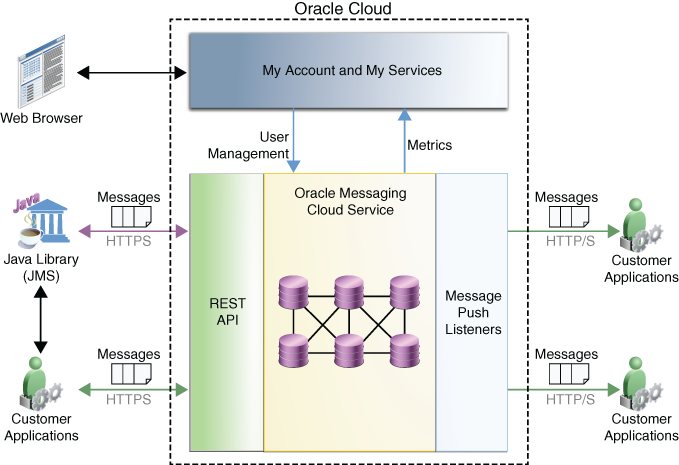
Oracle Messaging Cloud Service (OMCS) is I think an overlooked gem of Oracle iPaaS portfolio.  I say this as it offers a JMS 1.1 compliant Java library but at the same time provides a means through which integration through REST APIs can be performed.  This means it is possible to pretty transparently connect legacy JMS based integrations with new REST based products.  The magic sauce (and therefore my favourite feature) is the concept of the Push Listener. Through the REST API it is possible to register a REST URL as a target for queues and topics to have messages sent to. Once registered when a message appears on the queue or topic it will get passed on as a REST call. Whilst is is possible to do with with a little bit of Java code. the Push Listener simplifies the job to a REST call with a bit of XML configuration.

There is one small challenge that makes the integration completely transparent to the recipient of the PushListener today, and that is it currently demands that authentication process take place on initial contact. This is not a complicated or challenging thing to address, but does require a tiny bit of code to address.

Share this:

  • Share on Facebook (Opens in new window) Facebook
  • Share on X (Opens in new window) X
  • Share on Reddit (Opens in new window) Reddit
  • Share on LinkedIn (Opens in new window) LinkedIn
  • Email a link to a friend (Opens in new window) Email
  • Share on WhatsApp (Opens in new window) WhatsApp
  • Print (Opens in new window) Print
  • Share on Tumblr (Opens in new window) Tumblr
  • Share on Mastodon (Opens in new window) Mastodon
  • Share on Pinterest (Opens in new window) Pinterest
  • Share on Bluesky (Opens in new window) Bluesky
Like Loading...

Open World – Key Messages

22 Thursday Sep 2016

Posted by mp3monster in Cloud, General, Oracle, Technology

≈ 1 Comment

As Oracle Open World comes to a close. What are the big take homes? Well I have to admit to not having been at OOW phyiscally this year, but tracking things from the UK. That sais from this vantage point …

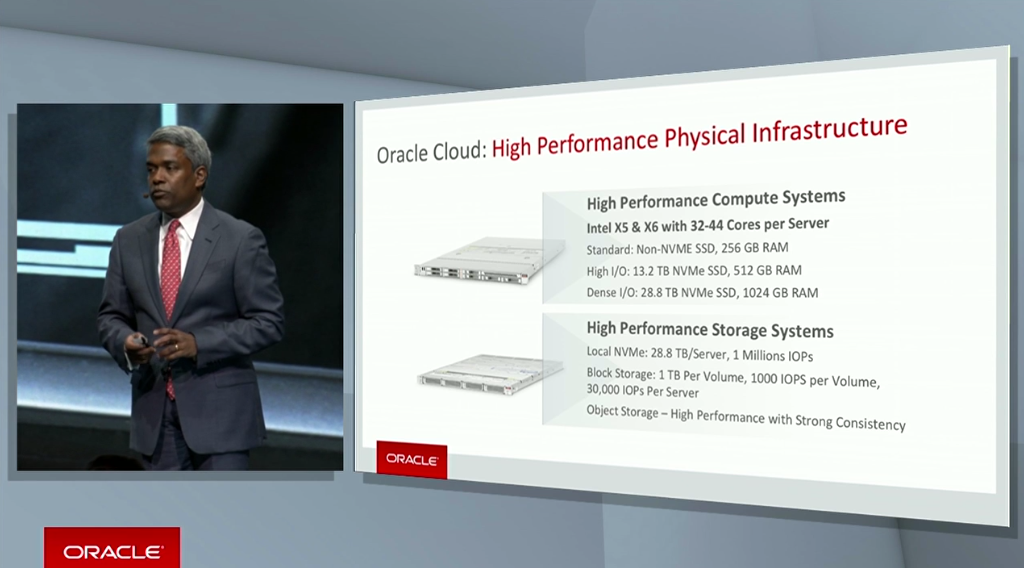
  • 2nd Generation IaaS. The announcements on the evolution of Oracle’s offfering bring some significant steps forward with multi data centre resilience within each region /geographical area. What isn’t clear is whether the resilience will be OOTB on all services, or a cost add at the IaaS and some of the PaaS services. But for SaaS I’d be expecting it to be part of the offering. Below are a couple of screen grabs from Thomas Kurian’s keynote to help convey the details …
Regions Around the World

Regions Around the World

Regions Linked

Regions Highly Permant Linkage

Data Centre Compute

Illustrative details of Data Centre nodes

IaaS Hardware and Platform Supported

IaaS Hardware and Platform Supported

The 2Gen IaaS is interesting because previously Oracle have underplayed the IaaS offering on the basis that it had been necessary to help pitch PaaS and SaaS. But this year with the new generation there seems to be a fair bit of detail on the IaaS make up to help convey and provide clarity of a robust underpinning in capacity, capability, power and security. Which aside from help sell more IaaS it should help reinforce the messaging on the higher order offerings about foundation strength.

  • The IaaS message also makes it easier to convey the message that Oracle cloud doesn’t have to mean Oracle software – it is just as capable with OpenSource tech. This had felt a little niche with the Java cloud services. It certainly appears that Oracle wants to take the fight if not to AWS certainly with Azure, Rackspace etc
  • Following this IaaS message is the cloud in your own data centre. Which addresses residency questions, but provides the cloud software stack and cloud financial models. What will be interesting is how the auditors (as anything likely to demand on-premise deployment is likely to have compliance needs and audit with it) are satisfied that despite Oracle maintaining all the cloud software remotely won’t represent an issue.
  • How the IaaS data centre level resiliency will impact the PaaS offerings is going to be very interesting as SOA providing high availability across multiple locations is not trivial.
  • We have also seen signs of far more dynamic elasticity being shown with examples of being able attach policies to a service to trigger scale up. It will be interesting to see if the ability to mix metered and unmetered resources has also improved. Presently they have to be run as discrete domains because of the pricing models involved.
  • More broadly Oracle are filling out their cloud portfolio and offerings are starting to be harmonised – but there is a long way to go, for example ICS and SOA CS don’t OOTB link to Log Analytics for example). But MySQL as a PaaS offering has crept up on me, with the smallest compute footprint being 24p an hour it is time to take notice.

Share this:

  • Share on Facebook (Opens in new window) Facebook
  • Share on X (Opens in new window) X
  • Share on Reddit (Opens in new window) Reddit
  • Share on LinkedIn (Opens in new window) LinkedIn
  • Email a link to a friend (Opens in new window) Email
  • Share on WhatsApp (Opens in new window) WhatsApp
  • Print (Opens in new window) Print
  • Share on Tumblr (Opens in new window) Tumblr
  • Share on Mastodon (Opens in new window) Mastodon
  • Share on Pinterest (Opens in new window) Pinterest
  • Share on Bluesky (Opens in new window) Bluesky
Like Loading...

New Kid on the Block and others

12 Monday Sep 2016

Posted by mp3monster in General, Oracle

≈ Leave a comment

Tags

Cloud, journal, OIC - ICS, Oracle Scene, oracle-integration.cloud, OUG

So no new blog entries as I have been busy publishing elsewhere, with the Oracle User Group we appear in the latest edition of the Oracle Scene Journal:

UKOUG Scene Issue 61

click on the image to open the journal properly

We also have a submission in for the November edition, which will be published before the user group’s Tech 16 conference – which I will be presenting at.

UKOUG Tech 16

We have been posting a lot on our website that supports the book – oracle-integration.cloud. Lots of useful references to supporting resources, and some blog posts providing supporting information (and more in the pipeline). Not to mention with pressing on with the last couple of chapters.

Then finally a webinar, the first in a series for the UKOUG about adopting cloud – details at – http://www.ukoug.org/events/ukoug-applications-journey-to-cloud-webinar-1/. The webinar was recorded and the presentation that went with it are accessible if you are a UKOUG member.

Share this:

  • Share on Facebook (Opens in new window) Facebook
  • Share on X (Opens in new window) X
  • Share on Reddit (Opens in new window) Reddit
  • Share on LinkedIn (Opens in new window) LinkedIn
  • Email a link to a friend (Opens in new window) Email
  • Share on WhatsApp (Opens in new window) WhatsApp
  • Print (Opens in new window) Print
  • Share on Tumblr (Opens in new window) Tumblr
  • Share on Mastodon (Opens in new window) Mastodon
  • Share on Pinterest (Opens in new window) Pinterest
  • Share on Bluesky (Opens in new window) Bluesky
Like Loading...

Implementing Oracle Integration Cloud Service – Gone Alpha

13 Saturday Aug 2016

Posted by mp3monster in Books, General, Oracle, Technology

≈ Leave a comment

Tags

alpha, book, Cloud, OIC - ICS, Oracle, Packt

alpha-logoWe have taken our book on ICS into Packt Publishing’s Alpha programme so that if you order the book now – you can see the chapters as soon as they have received editorial approval and the complete final book will be made available to you as soon as we’re have addressed all the feedback, made any final improvements we have identified once we have completed the book’s draft.

img_0282-1The book can be found on the Packt website – here

Details about the Authors from Packt can be seen at:

  • Phil Wilkins
  • Robert  van Mölken

Share this:

  • Share on Facebook (Opens in new window) Facebook
  • Share on X (Opens in new window) X
  • Share on Reddit (Opens in new window) Reddit
  • Share on LinkedIn (Opens in new window) LinkedIn
  • Email a link to a friend (Opens in new window) Email
  • Share on WhatsApp (Opens in new window) WhatsApp
  • Print (Opens in new window) Print
  • Share on Tumblr (Opens in new window) Tumblr
  • Share on Mastodon (Opens in new window) Mastodon
  • Share on Pinterest (Opens in new window) Pinterest
  • Share on Bluesky (Opens in new window) Bluesky
Like Loading...

AIA Rides Again?

23 Thursday Jun 2016

Posted by mp3monster in General, Oracle, Technology

≈ Leave a comment

Tags

11g, 12c, AIA, Canonical, canonical model, OAGIS, Oracle, PIP, Scott Nieman, SOA

canonicaldatamodel

For those who have been using the Application Integration Architecture on top of Oracle SOA Suite, will probably know that Oracle have sunset AIA as of 12c.  For 12.1 there are Core Extensions to help transition onto the 12c platform but 12.2 leaves these behind.

One of the more valuable parts of AIA for many has been the prebuilt but extensible canonical data model, which are then used by the Prebuilt Integration Packs (PIPs). Having a ready built canonical form can save an enormous amount of effort (consider the amount of effort invested by OASIS and other standards bodies to define standardised data definitions).

So with AIA not moving forward and the canonical form (i.e. XML Schema) no longer being maintained. The question begs how to move forward?  Well given that the model is represented by XML schema you could harvest the schema from an 11g environment, package them up and deploy them in a standalone manner in a 12c environment.  Whilst this will work, it does mean that the data model wont have any future evolution other than by home grown effort.

Depending on your commitment to the AIA model, there is another option to adopt another prebuild form.  I know as result of talking with several other Oracle AIA customers that people are adopting OAGIS.  This isn’t surprising as they have similar characteristics in the way to extend, the way the definitions are defined and structured etc.  Not to mention some common ancestry. However if you have a significant level of utilisation moving to a new model is potentially going to have a significant level of impact.

image008As we have also elected to go the OAGIS route (but fortunately are fairly youthful in our adoption so have elected to switch quickly for all but a couple of objects types. Given this,  I periodically check in with the OAGIS website to come across the following:

Oracle Enterprise Business Objects Contributed to OAGi 
We are very pleased to announce that Oracle has contributed their Enterprise Business Objects (EBOs) and associated IP to OAGi!
The Oracle EBOs are based on OAGIS BODs from a past release and no longer supported by Oracle so they contributed them to us to harmonize with the current version of OAGIS and preserve a technology path for EBO customers.
This also gives OAGi an opportunity to further improve OAGIS content and scope.
I take this as proof of Oracle’s commitment to Open Standards and plan to say so in a press release.  I personally thank Oracle for this commitment.
Scott Nieman of Land O’Lakes will be presenting his Project Definition to begin the process of harmonization on Friday, June 3, at 11 AM EDT at the Next meeting which, as members, you are all invited. Please let me know if you don’t have an invitation and I will forward it to you.
Please join me in thanking Oracle and also please try to engage in our harmonization process to improve OAGIS.

So the basis of this is that OAGIS will gain greater coverage of their domain views. But additionally Scott Nieman will be blazing the way to easing the migration path. I have been fortunate enough to meet and talk with Scott at Oracle Open World and it will be worth keeping an eye out for his findings.

Share this:

  • Share on Facebook (Opens in new window) Facebook
  • Share on X (Opens in new window) X
  • Share on Reddit (Opens in new window) Reddit
  • Share on LinkedIn (Opens in new window) LinkedIn
  • Email a link to a friend (Opens in new window) Email
  • Share on WhatsApp (Opens in new window) WhatsApp
  • Print (Opens in new window) Print
  • Share on Tumblr (Opens in new window) Tumblr
  • Share on Mastodon (Opens in new window) Mastodon
  • Share on Pinterest (Opens in new window) Pinterest
  • Share on Bluesky (Opens in new window) Bluesky
Like Loading...

Cloud FTP

18 Saturday Jun 2016

Posted by mp3monster in Books, General, Oracle, Technology

≈ Leave a comment

Tags

box, dropbox, FTP, IoT, OIC - ICS, Oracle, social

Whilst working on our book about Oracle’s Integration Cloud Service I looked around to see what options are available for FTP based services, below is a list of the services, we can’t testify to the quality etc of the service but might be easier than a Google search and ploughing through the results as FTP does occur a lot even in services that don’t support the standard.

What was interesting was none of the major document collaboration platforms offer an FTP based view onto their platform, but rather push an API. Whilst it is clear that FTP wouldn’t provide all the richness of the capabilities of Dropbox, Box, One Drive etc it is as a standard so universally supported that it would mean you could have the most common use models supported from just about anywhere without needing to install a proprietary app or writing code against an API. It would be interesting to see how how such capabilities could impact areas such as IoT.

Fortunately ICS includes social adapters that allows it to connect to these social platforms. But, we still need an easy FTP server to help show how to use FTP (it is still used heavily win closed ecosystems), so here is the list:

  • https://www.sharefile.com – free trial
  • https://brickftp.com – free trial
  • https://hostedftp.com/ – free trial
  • https://www.exavault.com – free trial
  • https://byet.host/
  • http://www.zettahost.com/
  • http://www.serversfree.com/

Share this:

  • Share on Facebook (Opens in new window) Facebook
  • Share on X (Opens in new window) X
  • Share on Reddit (Opens in new window) Reddit
  • Share on LinkedIn (Opens in new window) LinkedIn
  • Email a link to a friend (Opens in new window) Email
  • Share on WhatsApp (Opens in new window) WhatsApp
  • Print (Opens in new window) Print
  • Share on Tumblr (Opens in new window) Tumblr
  • Share on Mastodon (Opens in new window) Mastodon
  • Share on Pinterest (Opens in new window) Pinterest
  • Share on Bluesky (Opens in new window) Bluesky
Like Loading...

Maintenance & Patching For SOA CS

30 Monday May 2016

Posted by mp3monster in Cloud, General, Oracle, Technology

≈ 1 Comment

Tags

Cloud, HA, Maintenance, Oracle, PaaS, patching, SOA, SOACS

When you’re using SOA Suite to run round the clock services you need to give a fair bit of thought to your deployment configuration so it becomes possible to perform rolling patches and other maintenance tasks not only to SOA itself but all the way down to the hardware – and at the low levels you have no control on the maintenance process.  Although it is very easy to think that the moment you’re using PaaS that these problems are taken care for you, life isn’t as simple as that.

Oracle cloud services typically go through a patching process once a month and usually within a defined 8 hour period on a Friday night. During this period you may lose the use of your servers as the maintenance is performed within a particular availability zone. In an ideal world this would be a rolling process so you don’t lose everything at once. If the maintenance window is used to to deploy SOA Suite patches then although you will be told of the maintenance window you actually wont have an outage, but post the maintenance window your cloud dashboard will have the option to apply the patches at a time that best suits you. Not only that the patch application process is smart enough to apply it in a rolling manner as the Weblogic nodes in the cluster will have information on each other which the patch mechanism can utilise.

So where is the problem.  It is very easy to forget that the PaaS platform is virtual, this means the virtualization platform being software will inevitably need patching whether that is for bug fixing,  addressing security requirements or adding new capabilities. These kinds of changes today will trigger a service shutdown. Let’s be honest when trying to balance a rolling change and maximise PaaS client density is going to create a monumentally complex problem, so simplicity and and speed of roll-out suggests a small outage is easier. So how do I therefore assure I can maintain a quality of service if I accept this as a necessity?


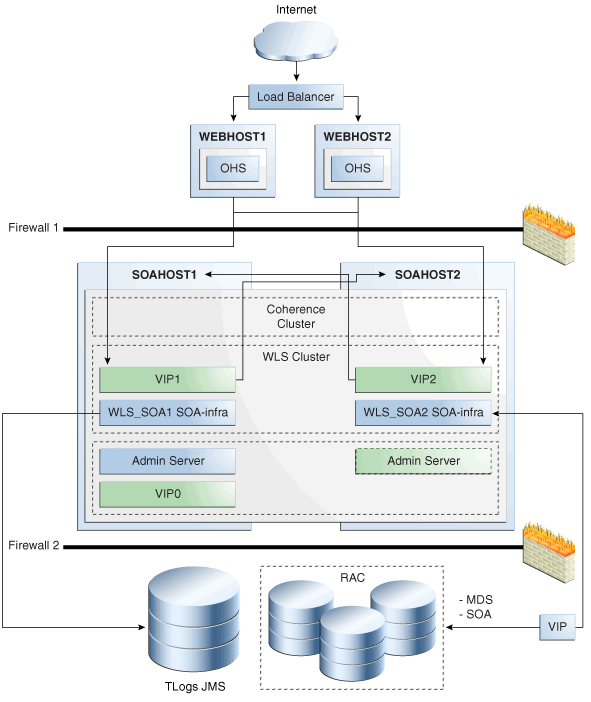
Well the answer is pretty much the same as  an on premise reference architecture.  Have SOA with its supporting databases running in a second availability zone that will have a different patch time. This is going to push up the cost as you’ll need a database with Dataguard. Assuming an active-passive model across your centres, as you approach the maintenance window you’ll get your load balancer to route work load to the second location and let the existing workload run dry on the servers due to go through the maintenance process. Then after the maintenance window you’ll reverse the process.

The current gotchya with this is that you pay for SOA by the month so you in effect have to run two clusters, although hour and daily models are coming.With the hourly model you can have the second availability zone ready for use by keeping the DB alive there, but only startup the SOA instances on the hourly rate when you know the maintenance window is going to occur and it is clear there will be an infrastructure impact.

The other sticky point, is presently as the period allocated is upto eight hours, your second centre needs to be running in a timezone with atleast 8 hours difference (allowing time to fail back). This would mean if you are using the Amsterdam or Slough locations your second location is going to West coast US or Asia Pacific once live later this year or Japan. All of which will present serious issues regarding personal data.

I have been told that some signficiant customers have accepted the situation on the basis the downtime in reality isn’t frequent and correlates to low business periods. But I suspect competition and customer demand will force this to change.

Share this:

  • Share on Facebook (Opens in new window) Facebook
  • Share on X (Opens in new window) X
  • Share on Reddit (Opens in new window) Reddit
  • Share on LinkedIn (Opens in new window) LinkedIn
  • Email a link to a friend (Opens in new window) Email
  • Share on WhatsApp (Opens in new window) WhatsApp
  • Print (Opens in new window) Print
  • Share on Tumblr (Opens in new window) Tumblr
  • Share on Mastodon (Opens in new window) Mastodon
  • Share on Pinterest (Opens in new window) Pinterest
  • Share on Bluesky (Opens in new window) Bluesky
Like Loading...
← Older posts
Newer posts →
    • About
      • Internet Profile
      • Music Buying
      • Presenting Activities
    • Books & Publications
      • Logging in Action with Fluentd, Kubernetes and More
      • Logs and Telemetry using Fluent Bit
      • Oracle Integration
      • API & API Platform
        • API Useful Resources
        • Useful Reading Sources
    • Mindmaps Index
    • Monster On Music
      • Music Listening
      • Music Reading
    • Oracle Resources
    • Useful Tech Resources
      • Fluentd & Fluent Bit Additional stuff
        • Logging Frameworks and Fluent Bit and Fluentd connectivity
        • REGEX for BIC and IBAN processing
      • Formatting etc
      • Java and Graal Useful Links
      • Official Sources for Product Logos
      • Python Setup & related tips
      • Recommended Tech Podcasts

    TOGAF 9

    Logs and Telemetry using Fluent Bit


    Logging in Action — Fluentd

    Logging in Action with Fluentd


    Oracle Ace Director Alumni

    Oracle Cloud Integration Book


    API Platform Book


    Oracle Dev Meetup London

    Blog Categories

    • App Ideas
    • Books
    • Enterprise architecture
    • General
      • ExternalWebPublications
      • LinkedIn
      • Website
    • Music
      • Music Resources
      • Music Reviews
    • Photography
    • Podcasts
    • Technology
      • AI
      • APIs & microservices
      • chatbots
      • Cloud
      • Cloud Native
      • Dev Meetup
      • development
        • languages
      • drone
      • Fluent Observability
        • Fluentbit
        • Fluentd
        • OpAMP
      • logsimulator
      • mindmap
      • OMESA
      • Oracle
        • API Platform CS
          • tools
        • ITSO & OEAF
        • OIC – ICS
        • Oracle Cloud Native
        • OUG
      • railroad diagrams
      • TOGAF

    Enter your email address to subscribe to this blog and receive notifications of new posts by email.

    Join 2,617 other subscribers

    RSS

    RSS Feed RSS - Posts

    RSS Feed RSS - Comments

    June 2026
    M T W T F S S
    1234567
    891011121314
    15161718192021
    22232425262728
    2930  
    « May    

    Speaker Recognition

    Open Source Summit Speaker

    Twitter

    Tweets by mp3monster

    History

    Flickr Pics

    Boxer Rebellion @ Brixton ElectricBoxer Rebellion @ Brixton ElectricBoxer Rebellion @ Brixton ElectricBoxer Rebellion @ Brixton Electric
    More Photos

    Social

    • View @mp3monster’s profile on Twitter
    • View philwilkins’s profile on LinkedIn
    • View mp3monster’s profile on GitHub
    • View mp3monster’s profile on Flickr
    • View mp3muncher’s profile on WordPress.org
    • View philmp3monster’s profile on Twitch
    Follow Phil (aka MP3Monster)'s Blog on WordPress.com

    Blog at WordPress.com.

    • Subscribe Subscribed
      • Phil (aka MP3Monster)'s Blog
      • Join 229 other subscribers
      • Already have a WordPress.com account? Log in now.
      • Phil (aka MP3Monster)'s Blog
      • Subscribe Subscribed
      • Sign up
      • Log in
      • Report this content
      • View site in Reader
      • Manage subscriptions
      • Collapse this bar

    Loading Comments...

    You must be logged in to post a comment.

      Privacy & Cookies: This site uses cookies. By continuing to use this website, you agree to their use.
      To find out more, including how to control cookies, see here: Our Cookie Policy
      %d