• Home
  • Site Aliases
    • www.cloud-native.info
  • About
    • Background
    • LinkedIn
    • Presenting Activities
    • Internet Profile
    • About
  • Books & Projects
    • Logs and Telemetry using Fluent Bit
      • Fluent Bit book
      • Book Resources in GitHub
      • Fluent Bit Classic to YAML Format configurations
    • Logging in Action with Fluentd, Kubernetes and More
      • Logging in Action with Fluentd – Book
      • Fluentd Book Resources
      • Fluentd & Fluent Bit Additional stuff
    • OpAMP
    • Log Generator
    • API & API Platform
      • API Useful Resources
    • Oracle Integration
      • Book Website
      • Useful Reading Sources
    • Publication Contributions
  • Resources
    • GitHub
    • Oracle Integration Site
    • Oracle Resources
    • Mindmaps Index
    • Useful Tech Resources
      • Fluentd & Fluent Bit Additional stuff
      • Recommended Tech Podcasts
      • Official Sources for Product Logos
      • Java and Graal Useful Links
      • DevTips
  • Music
    • Monster On Music
    • Music Listening
    • Music Reading

Phil (aka MP3Monster)'s Blog

~ from Technology to Music

Phil (aka MP3Monster)'s Blog

Category Archives: Oracle

All things related to Oracle

Hierarchy of Data Assurance

19 Sunday Oct 2014

Posted by mp3monster in General, Oracle, Technology

≈ Leave a comment

Tags

AIA, data, integrity, maslow, Oracle, reconciliation, SOA

I was discussing the challenges of ensuring that data is protected and proven to to have integrity and that as the data moves through systems that there isn’t data loss. This sort of thing starts at the simplest level with data validation and with the most advanced and greatest investment you have some end to end reconciliation framework.

Obviously this thinking doesn’t work in every environment, for example complex event processing (CEP) your going to just accept the data coming through and if it’s incomplete or data has been lost along the way you just accept it as it is – these conditions will create outliers which will get smoothed out in trends. It is possible you will have created he gaps by dropping data slow to arrive. But for the majority of your run of the mill solutions such as accounting, HR and so on the thinking stands up.

To communicate the idea effectively to senior management on the risks of just focusing on functional delivery and whether there is maturity in the delivery capability we hit on the idea of using a variant of Maslow’s triangle of needs – something I think everyone gets. You can see our representation here:

hierarchy of Data Assurance

The interesting thing is that you could look at the triangle and suggest that typically the more pressed a project is on factors such as volume of functionality, cost and/or time the more likely a project will remain at the bottom of the triangle. But as the width of the triangle at the point of the capabilities realised also reflects on the operational costs. So if you’re at the bottom of the triangle then you’re likely to incur more costs dealing with data issues as the means to detect and then resolve are a lot more restricted.

With frameworks such as those in Oracle’s SOA Suite and AIA it should make it easier to move up atleast part of the triangle, although full end to end reconciliation is more likely to demand more data centric tools, as you probably want to perform by doing batch like assessments.

Share this:

  • Share on Facebook (Opens in new window) Facebook
  • Share on X (Opens in new window) X
  • Share on Reddit (Opens in new window) Reddit
  • Share on LinkedIn (Opens in new window) LinkedIn
  • Email a link to a friend (Opens in new window) Email
  • Share on WhatsApp (Opens in new window) WhatsApp
  • Print (Opens in new window) Print
  • Share on Tumblr (Opens in new window) Tumblr
  • Share on Mastodon (Opens in new window) Mastodon
  • Share on Pinterest (Opens in new window) Pinterest
  • Share on Bluesky (Opens in new window) Bluesky
Like Loading...

Oracle middleware cloud – what does it mean to Mulesoft and Apigee?

10 Friday Oct 2014

Posted by mp3monster in Oracle

≈ Leave a comment

Tags

Apigee, Mulesoft, Oracle, OSB, SOA

Oracle will soon be launching 2 cloud offerings – a hosted approach to their heavy weight SOA Suite middleware. But more importantly potentially for some of the cloud integration players like Mulesoft and Apigee is a lighter, web interface IDE solution. This lighter solution is clearly aiming (and statements made to the effective of) the Gartner pace layering ethos where you want to quickly link existing services together to offer new capabilities. This new cloud integration service will be aware of all the other cloud service APIs from Oracle you have and provide smart prebuilt transformations, which you can extend or change if you want. For non Oracle integrations the service is meant to use some intelligence and heuristics built through how other customers have realised mappings to make suggestions. With control frameworks for security, access and errors etc based policy mechanisms.

The solution includes access to prebuilt connectors to obviously Oracle products, but also the likes of Salesforce, Workday and more coming like Successfactors. When combined with other new cloud offerings such as their new mobile apps then the pacing message becomes a lot stronger. Add to this the cloud adoption of the CEP (Complex Event Processing) engine (which looks very good) and the addition of several API tools next year for catalog and realtime discovery and they will have a pretty solid suite.

With this lighter weight cloud solution there is meant to be means to pull the integrations out of the cloud and into on-premise middleware deployments. This makes sense as a lot of the capability looks to be built on top of OSB.

Add to all of this the other service offerings being launched such as Dropbox like distributed document with google doc like collaboration and there is a very potent story for the Oracle one stop shop. So you could use Oracle for best of breed integration but convenience and who got fired for buying Oracle is likely to be ruling story.

I suspect you will see Oracle appear strongly in the iPaaS assessments by Gartner soon.

Given Ellison has indicated that the new cloud services from Oracle will be aggressively priced it will be interesting to see how the smaller players differentiate themselves. I suspect one of the keys will be the speed of offering new capabilities by their cloud solutions both at the product core and through connectors. Prior to the 12c launch the rate of change in the middleware space didn’t appear to be rapid.

Share this:

  • Share on Facebook (Opens in new window) Facebook
  • Share on X (Opens in new window) X
  • Share on Reddit (Opens in new window) Reddit
  • Share on LinkedIn (Opens in new window) LinkedIn
  • Email a link to a friend (Opens in new window) Email
  • Share on WhatsApp (Opens in new window) WhatsApp
  • Print (Opens in new window) Print
  • Share on Tumblr (Opens in new window) Tumblr
  • Share on Mastodon (Opens in new window) Mastodon
  • Share on Pinterest (Opens in new window) Pinterest
  • Share on Bluesky (Opens in new window) Bluesky
Like Loading...

Oracle Open World Middleware Update

09 Thursday Oct 2014

Posted by mp3monster in General, Oracle, Technology

≈ Leave a comment

Tags

OOW, open world, Oracle, OUG, SIG

So having been fortunate enough to attend part of Oracle Open World I provided some support to the UKOUG Fusion Middleware SIG chairman with a short briefing on some of the key points from OOW.

The following are my initial notes, if you want the complete deck, it should be available through the UKOUG website.

Cloud
– key note from Larry was all cloud, cloud cloud
– more SaaS than anyone else – announced dozens of services is the last year – probably hundreds across all the sectors
– build and buy
– platform upgrade
– data as a service – BlueKai acquisition Data Management Platform
– Some of these offerings included capabilities that sounded like enterprise offered Dropbox – so might soon see personal cloud?
– data migration of data or app up and down from cloud push of a button (reality bit more complex)
– innovation for securing the cloud at lowest levels
– going after b2c and b2b capabilities

Middleware Cloud
– SOA Suite as a hosted solution or integration cloud which more like web UI for OSB integration.
– ethos change for integration cloud no deployment – develop and promote to production
– Override able Automated mappings when going between own cloud services or Oracle adaptors to 3rd party. Can built own mappings and incorporate own functionality
– Configuration controls policy driven such as error handling etc
– Can bring integrations back to on premise
– breadth & agility / ease (pace layering started to get mentioned a lot more)
– Use cases such as linkage to mobile – 7-11 use case
– More cloud adaptors coming to support 3rd party
– API inventory and discovery capabilities coming – successor to OES
– Support for JSON and REST alway through SOA rather than transformational capability only

Mobile Application Framework
– seems to have crept up quietly, successor to ADF mobile in the form of MAF Faces
– by delivering hybrid strategy like Phone Gap but enables Java in a container on Andriod & iOS
– MAF actually incorporates Apache Cordova – the open source version of PhoneGap
– with it is a new UI presentation style with all the support style guidance – ALTA
– Java on iOS but Jobs said …. done by compiling to native solution

A couple of presentation grabs ….

IMG_0107.JPG

IMG_0104.JPG

Share this:

  • Share on Facebook (Opens in new window) Facebook
  • Share on X (Opens in new window) X
  • Share on Reddit (Opens in new window) Reddit
  • Share on LinkedIn (Opens in new window) LinkedIn
  • Email a link to a friend (Opens in new window) Email
  • Share on WhatsApp (Opens in new window) WhatsApp
  • Print (Opens in new window) Print
  • Share on Tumblr (Opens in new window) Tumblr
  • Share on Mastodon (Opens in new window) Mastodon
  • Share on Pinterest (Opens in new window) Pinterest
  • Share on Bluesky (Opens in new window) Bluesky
Like Loading...

JDeveloper 12c

29 Tuesday Jul 2014

Posted by mp3monster in General, Oracle, Technology

≈ Leave a comment

Tags

11g, 12c, editor, JDeveloper, Oracle, SOA Suite, XSD

So I have been using JDeveloper 11g for a while and have to admit that I wasn’t a big fan finding a bit flaky and prone to crashing. The biggest driver to using it has been the fact that it offers a lot of XMLSpy like features without the stupidly high XMLSpy license costs.

With JDeveloper 12c arriving I took the opportunity to give it a go. Wow, is it so much better – quicker particularly during the startup cycle and way more reliable. The features around XSD editing haven’t significantly changed but just feels subtly easier to use.

With all the features around working with SOA Suite 12c and Weblogic 12c for core Oracle development I can imagine it is a huge step forward.

With the easier deployment of 12c getting PoC work done should be a lot easier. It’s just a shame still needs that huge 8GB footprint to do anything meaningful and my company laptop being a notebook (great for travelling with) doesn’t pack that punch and Oracle isn’t yet offering low cost SOA Suite deployments in the cloud yet.

Share this:

  • Share on Facebook (Opens in new window) Facebook
  • Share on X (Opens in new window) X
  • Share on Reddit (Opens in new window) Reddit
  • Share on LinkedIn (Opens in new window) LinkedIn
  • Email a link to a friend (Opens in new window) Email
  • Share on WhatsApp (Opens in new window) WhatsApp
  • Print (Opens in new window) Print
  • Share on Tumblr (Opens in new window) Tumblr
  • Share on Mastodon (Opens in new window) Mastodon
  • Share on Pinterest (Opens in new window) Pinterest
  • Share on Bluesky (Opens in new window) Bluesky
Like Loading...

Oracle SOA Suite, AIA, PIPs and Fusion apps

23 Monday Jun 2014

Posted by mp3monster in General, Oracle, Technology

≈ 1 Comment

Tags

AIA, Application Integration Architecture, FMW, fusion, middleware, Oracle, PIP, PIPs, Presentation, Process Integration Pack, slides, SOA, SOA Suite

I recently presented on the subject of Oracle middleware (FMW) with an emphasis on  SOA Suite, Application Integration Architecture (AIA), Process Integration Packs (PIPs) and Oracle Fusion Applications.  Below is a derivative of the presentation.  I’ve sought to identify how the technologies relate, and how Fusion applications relate to the non Fusion products.

For those trying to get to grips with this technology stack – you might find the notes useful as I’ve included plenty of links to associated information.

Share this:

  • Share on Facebook (Opens in new window) Facebook
  • Share on X (Opens in new window) X
  • Share on Reddit (Opens in new window) Reddit
  • Share on LinkedIn (Opens in new window) LinkedIn
  • Email a link to a friend (Opens in new window) Email
  • Share on WhatsApp (Opens in new window) WhatsApp
  • Print (Opens in new window) Print
  • Share on Tumblr (Opens in new window) Tumblr
  • Share on Mastodon (Opens in new window) Mastodon
  • Share on Pinterest (Opens in new window) Pinterest
  • Share on Bluesky (Opens in new window) Bluesky
Like Loading...

Impact on Integration when Moving to Fusion Apps

17 Tuesday Jun 2014

Posted by mp3monster in General, Oracle, Technology

≈ Leave a comment

Tags

ABCS, AIA, EBO, EBusiness, Foundation Pack, fusion, integration, master data management, MDM, middleware, OER, Oracle, PDH, PIP, product data hub, R12, Siebel, SOA

So as a road mapping question I have been thinking about the migration to using Fusion Apps so we have a road map and more importantly design patterns that will support a transitions from the likes of Ebiz R12, Siebel etc to their Fusion successors.

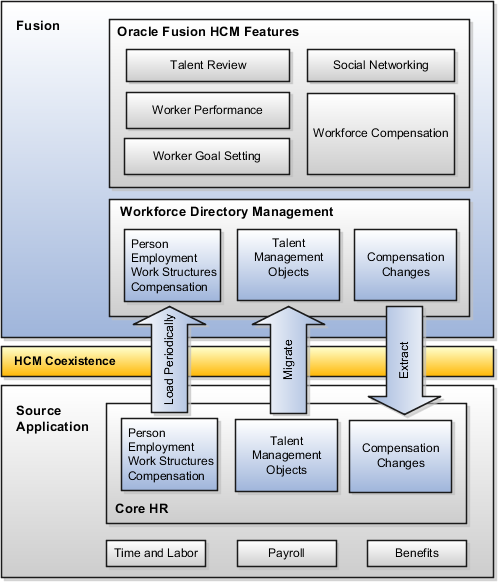
Example of Coexistance

Example of Coexistance

In broad terms the application level transition through the principles of co-existence are well established. What is currently exercising the grey matter is the middle migration. Perhaps the best way to explain this is through an example. The Product Data Hub (PDH) solution exists to provide a Master Data Management capability for your widest and gadgets.

You will want to share that master data with other apps such as Ebiz so you can deal with say order management. All fairly obvious, and in Fusion Apps world the different components should inherently work together. Back in R12 world though you are probably going to be using the Product MDM PIP (Process Integration Pack) with the Ebiz extension pack. When using the PIP like this then it’s just a case of retiring the PIP. But this PIP is designed so that you can extend the process to publish Master Data to your own apps for example you also push the data to your design systems as you maybe sharing available parts data.

So now we have an extended PIP whic in a simple Fusion apps migration you’d leave behind. But leaving the PIP behind also means an integration gap. So what is the answer.

Well on the early days of Fusion Apps the suggestion was that AIA and PIPs would be part of the ongoing story. but the reality is little has moved in this space. Understandable, Fusion Apps development had been far bigger than anyone expected, if fusion Apps are directly conversant then how much real demand exists for the PIP transformation. So what is the answer, well at this stage I’m not sure. I can say I have seen ABCS’ mentioned in the public FusionAppsOER. We know that AIA Foundation Pack EBOs are realised in Fusion Apps albeit via ADF BCs.

Given Fusion Apps underpinnings are the same as AIA so it should be possible to drop the AIA Foundation Pack (FP) into your Fusion Apps environment (setting aside all the licensing questions it would raise). Can you therefore drop in the PIP and disable the legacy Oracle app elements leaving your custom extensions? Do you accept a rewrite of your integration all be it you should just need to redevelop the orchestration layer (ABCS’ for Fusion App exist and you can carry forward your own ABCS’ for your app such as the design system in our illustration)?

Deployment of Fusion Apps with Non Fusion Apps

Deployment of Fusion Apps with Non Fusion Apps

Hopefully in the coming weeks we will get the opportunity to uncover answers with Oracle.

Share this:

  • Share on Facebook (Opens in new window) Facebook
  • Share on X (Opens in new window) X
  • Share on Reddit (Opens in new window) Reddit
  • Share on LinkedIn (Opens in new window) LinkedIn
  • Email a link to a friend (Opens in new window) Email
  • Share on WhatsApp (Opens in new window) WhatsApp
  • Print (Opens in new window) Print
  • Share on Tumblr (Opens in new window) Tumblr
  • Share on Mastodon (Opens in new window) Mastodon
  • Share on Pinterest (Opens in new window) Pinterest
  • Share on Bluesky (Opens in new window) Bluesky
Like Loading...

Oracle NoSQL – free EBook

06 Friday Jun 2014

Posted by mp3monster in Books, General, Oracle, Technology

≈ Leave a comment

Tags

ebook, free, free eBook, NoSQL, Oracle, Oracle NoSQL Database, Oracle Press

Oracle Press are currently offering a free eBook copy of Getting Started with Oracle NoSQL Database, all you need do is register at http://books.mcgraw-hill.com/ebookdownloads/NoSQL/ to get the book.  I don’t know how long the offer will last, so I’d suggest getting it quickly.

Share this:

  • Share on Facebook (Opens in new window) Facebook
  • Share on X (Opens in new window) X
  • Share on Reddit (Opens in new window) Reddit
  • Share on LinkedIn (Opens in new window) LinkedIn
  • Email a link to a friend (Opens in new window) Email
  • Share on WhatsApp (Opens in new window) WhatsApp
  • Print (Opens in new window) Print
  • Share on Tumblr (Opens in new window) Tumblr
  • Share on Mastodon (Opens in new window) Mastodon
  • Share on Pinterest (Opens in new window) Pinterest
  • Share on Bluesky (Opens in new window) Bluesky
Like Loading...

Oracle WebCenter Suite Structure Representation

23 Friday May 2014

Posted by mp3monster in Oracle, Technology

≈ Leave a comment

Tags

Oracle, OTN, product families, software, structure, Webcenter, Webcentre

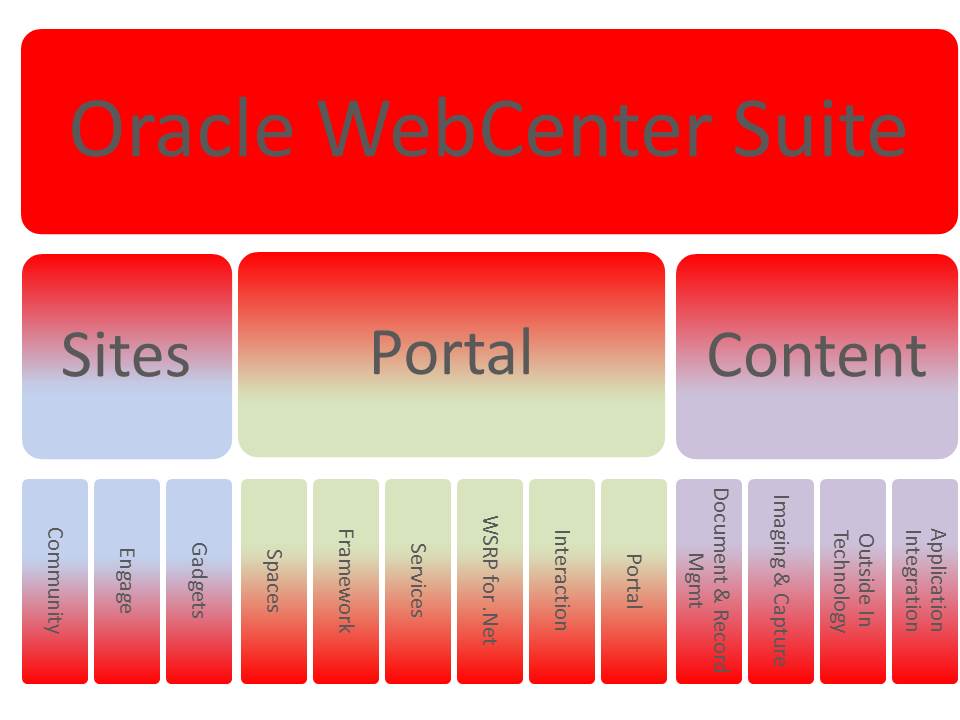
When it comes to understanding the range of products and how product families fit together Oracle have created some helpful block diagrams, such as the one below.

SOA / AIA Structure

This really helpful – particuarly when trying to understand potential licensing relationships. However there doesn’t appear to be an equivalent diagram (certainly not on OTN). So after a bit of navigating around OTN we have produced the following diagram:

WebCentre Suite Makup

WebCentre Suite Makup

If you find it useful, help yourself but a nod would be appreciated.

Share this:

  • Share on Facebook (Opens in new window) Facebook
  • Share on X (Opens in new window) X
  • Share on Reddit (Opens in new window) Reddit
  • Share on LinkedIn (Opens in new window) LinkedIn
  • Email a link to a friend (Opens in new window) Email
  • Share on WhatsApp (Opens in new window) WhatsApp
  • Print (Opens in new window) Print
  • Share on Tumblr (Opens in new window) Tumblr
  • Share on Mastodon (Opens in new window) Mastodon
  • Share on Pinterest (Opens in new window) Pinterest
  • Share on Bluesky (Opens in new window) Bluesky
Like Loading...

Oracle Big Data Handbook – summary review

05 Monday May 2014

Posted by mp3monster in Books, Oracle, Technology

≈ Leave a comment

Tags

Big Data, Big Data Appliance, book, Endeca, Enterprise R, Hadoop, NoSQL, ODI, Oracle, Oracle Big Data Handbook, Oracle Press

Having written several detailed reviews of Oracle Press’ Oracle Big Data Handbook (links below) I thought it useful to produce a summary. Over all is a very insightful and informative book covering the range of technologies that Oracle offers to address the ‘Big Data’ space from a number of view points such hardware with the Big Data Appliance (BDA), software with NoSQL, Enterprise R and Hadoop along with the various adapters (e.g. ODI) and existing product features that existing products make available to support the big data story and contribute to make a cohesive ecosystem. The book looks beyond the technologies classically linked to the ‘Big Data’  term to explore products such as Endeca. I like the act that the book tries to explain the rational behind some of the approaches adopted and the associated value propositions. Finally book looks at governance, maturity and architectural capabilities. All of which makes for an informative and insightful book.

The book isn’t flawless a few challenges that can make the reading a little frustrating occasionally (at least for me as I went cover to cover), for example,looking at the Big Data Appliance we seem to revisit the hardware specifications multiple times. The data governance perspective is data governance not specific to big data in my opinion. Occasionally the book seems to jump about when explaining a number of related areas which means that using the book as more a reference isn’t so easy. Don’t get me wrong these issues are hugely out weighed by the value it brings.

my detailed reviews:

  • Part 1
  • Part 2
  • Part 3
Oracle Big Data Handbook

Oracle Big Data Handbook

Share this:

  • Share on Facebook (Opens in new window) Facebook
  • Share on X (Opens in new window) X
  • Share on Reddit (Opens in new window) Reddit
  • Share on LinkedIn (Opens in new window) LinkedIn
  • Email a link to a friend (Opens in new window) Email
  • Share on WhatsApp (Opens in new window) WhatsApp
  • Print (Opens in new window) Print
  • Share on Tumblr (Opens in new window) Tumblr
  • Share on Mastodon (Opens in new window) Mastodon
  • Share on Pinterest (Opens in new window) Pinterest
  • Share on Bluesky (Opens in new window) Bluesky
Like Loading...

Oracle Big Data Handbook – part 3 reviewed

05 Monday May 2014

Posted by mp3monster in Books, General, Oracle, Technology

≈ 2 Comments

Tags

BDA, Big Data, book, CRAN, data mining, Endeca, ODM, Oracle, Oracle Press, Oracle R Enterprise, review, Revolution analytics, RStudio, spatial, warehouse

This is the third and final part of the review of Oracle Press’ Oracle Big Data Handbook (and last part of our detailed review – previous parts can be seen Part 1 here and Part 2 here). With the first sections having introduced the Big Data Appliance and the case for adopting an appliance, followed by an in depth look at the technologies provided on the BDA for storing data we move into the section that really delivers the pay off, namely the mechanics of converting data to information i.e. Analytics. This means this section of the book concentrates on the likes of Oracle Data Mining (ODM), Oracle R Enterprise and Endeca. The first of the chapters in this part of the book looks at different types of analytics you might need to perform for example data mining, predictive analytics, text mining and so on, the result is that the chapter does seem to flip flop between more classic data warehousing (still Big Data in terms of shear data volumes) to the more contemporary hip and trendy of ‘Big Data’ in the form of Hadoop and R. This may work nicely for a DBA/Data Scientist, but as a technologist and enterprise architect it isn’t so easy as personally I’d prefer to get a sense of each product stack then look at how they compliment/overlap. That said, after the first couple of sections where both the tools and ideas are introduced the flip/flopping is quicker making it easier to cope with, but it also makes for a sizeable opening chapter for this section of the book. But let me show you the kinds in sights that can be gained from the book.

ODM extensions are built around the common Oracle toolkits of RDBMS, SQLDeveloper and additional packages to provide powerful visual paradigms and precanned analytics functionality. Not being a data warehouse expert, I like the fact that the book takes time to describe the processes for building a data model and predictive engine and the likely paths through these steps. The books goes onto to explaining the available Excel tooling. Most of this is helped along with the context of a scenario. Given the claim of realtime capability to take a transaction and use a predictive model against the transactions values to ascertain whether the transaction is likely to be indicative of the characteristics being sought after it would have been nice for the book to provide some outline benchmarks for the scenario. Realtime could be interpreted as a second or two. Which when you’re running millions of transactions with small profit margins per transaction means using such capabilities is a also expectation. Still this doesn’t take away from the clarity of the information that is explained.

From ODM the chapter moves onto introducing the R language. What really got my attention by the book is the apparent willingness to engage with an Open Source model (given the other major players in the evolution of R – Google, Facebook, LinkedIn etc you might argue there is no choice). But the book upfront addresses the fact that Oracle hasn’t (or not yet) incorporated an R editor into SQLDeveloper or JDeveloper and the book suggests a specific tool of RStudio. Then there is the engagement with a library of R extensions (CRAN – Comprehensive R Archive Network with over 5000 extensions).

Google Trends view of Analytics Tools

All of which begs the question, what is Oracle’s value proposition in this pace. The book answers this be describing the challenges of using the Open Source edition of R (memory consumption and single threaded characteristics) and how they have addressed those by extending R into Oracle R Enterprise. In addition to these constraints Oracle’s extension recognises and works with the database governance and security layers properly. It is at this point we’re brought back to earlier focus of the BDA as the extensions allow the BDA Hadoop deployment to be used as a data source (along with Oracle RDBMS). In many respects it feels like a similar proposition to Revolution Analytics (other than the RDBMS emphasis being different). As with the Data Mining the example scenario is used to illustrate the applications of R in conjunction with Hadoop and Oracle RDBMS. To support the illustration the different additional libraries are explained (such as the Hadoop connector, RDBMS connector etc).

R enterprise doesn’t stop here, but has been integrated with PL/SQL, OBIEE and BI Publisher meaning that although some of the tools and the core solution are open source Oracle has achieved a rather rich ecosystem – a point not really called out by the book, but the presentation of the details really makes this jump out.

Still with Chapter 9 we move onto text mining for activities such as sentiment analysis and jump back to ODM with an explanation of the product’s capability in this space and the challenges that this kind of analysis presents. Which is followed by a view of the support R offers. The chapter moves onto things like Spatial analytics and so on. The later forms of analytics don’t confront the ideas of ‘Big Data’ based on the book’s opening definition of big data. That isn’t to say that a brief overview of how Oracle Spatial works and its capabilities to support ideas such as Location Intelligence isn’t interesting but I don’t see any differentiation between big data and normal patterns of use for Oracle Spatial. The examples provided such as knowing if there are patterns of location based usage, but such analysis can be done by ensuring a consistent representation of location from which you can select by a range – either a postal/zip code or by latitude and longitude for example, for which there are more cost effective tools and don’t necessitate pulling data out of a Hadoop cluster to perform such analysis. I would conceded that Oracle Spatial has an information rich data set that could be very effective, but to explore such ideas should we not be looking at ideas like that of ESRI’s integration to Hadoop (and more here) for example if Oracle offer such a capability.

Having crossed a range of technologies Chapter 10 briefly talks about IDEs, but then goes for a deeper dive into R covering the supported Open Source Edition and Enterprise Edition (ORE). The differences between the two versions and the licensing issues are well explained. Based on the description what Oracle have done to make the optimisation and ability to transparently leverage the database seems pretty impressive. The only thing to remember is by transparently moving R’s computational load into the DB is what impact on other processes. Oracle have also enabled ORE to access the predictave analytics capabilities that can reside within an Enterprise Database which are also illustrated here.

After looking at ORE’s capabilities the book moves onto its connection to Hadoop for R (Oracle R Connector for Hadoop – ORCH). ORCH provides the means to interact with HDFS along with the file system and RDBMS. The connector allows for the creating of MapReduce jobs using the R language and interacting the the job scheduler. To fully leverage these capabilities you do want to pull in CRAN libraries. The book then walks through a detailed example of using ORCH with MapReduce (including R script elements). This is then followed by a similar set of examples demonstrating direct interaction with HDFS.

Chapter 11, gives us a focus change again, this time to Endeca for Information Discovery. The book takes us through the history of Endeca and Oracle explaining the component naming – before and after the acquisition and the two dimensions of the Endeca product stack – eCommerce specific and for more general BI.

The chapter looks at the Endeca data model as it is a faceted or tagged model (i.e. all values are represented as label & value). The book emphasis’ the benefits of this model – but not downsides (needing to use the label to determine semantic meaning can have performance implications). This is important is it has implications of the flexibility to enrich data that Endeca can then leverage. Once the basic product and technicalities are examined the book actually steps back to explain the differences between BI and information Discovery and therefore the approaches to using these tools. Then onto to the tooling such as the studio, engine and integration capabilities. The book continues to build on the technical side with the classic NFRs of how to make the technology scale. We then flip back to look at a number of example use cases. Before a final jump to look at mechanics of deploying Endeca and getting some development work underway. The sequencing of the chapter sections does seem a little odd, but it does work, but trying to dive into just the technical dimensions alone probably not a practical proposition here.


Big Data governance is taken on the final chapter of the book – Chapter 12. The emphasis here is to look at the definition of Data Management (e.g. definition by Data Management Association – DAMA) and how Big Data relates to this. So the chapter walks through the key data governance factors – many of which are characterised in the diagram above for example focusing on common legislative considerations such as HIPAA, and Patriot’s Act KYC (Know Your Customer) through to EU Data Protection and UK Financial Services Act. Having a breadth wise view of Data Governance then the book starts to look at how Big Data scenarios differ from raw data and day to day data sets. The problem I have with the chapter here, that all the points being made are valid, but they’re not Big Data issues they are any data governance issues. What Big Data does is introduce technology to capture and use data in ways previously not considered so using the technologies in this way may impact declarations that you may have made to data protection registrar e.g. declare you keep customer data to enable order fulfillment but then use the data to determine effectiveness of sales channels would be an issue. But you dont have to have big data technology to create such an issue (the book itself acknowledges that you could do the analysis with older approaches but the difference is it is easier and quicker now). Having described some ‘any data’ guidance for your big data scenarios the book goes into a raft of big data scenarios in different domains and references some of the relevant legislation. If you read the chapter as just data governance it is a good reminder of the different considerations in data governance.

The final Chapter takes on architectural and road mapping considerations. A good way to conclude as this sort of thing will draw on all the preceeding chapters’ points; and this precisely how the chapter starts recapping the value proposition described up front followed the infrastructure considerations – data volumes need to process in parrallel to handle the volumes in timeframes that mean the insights can be assessed and reacted to in a meaningful manner. After the recap the book moves into a maturity model although the origins of the model aren’t clear (I’d have thought that the basis of what is presented is routed in a wider model). This naturally leads into looking at the Oracle Architecture Design Process (OADP). The details of OADP walks thought the goals and mechanics of developing your ‘As-Is’ and ‘To-Be’ architecture so you develop a transitional roadmap. The final step is obviously enabling the journey by developing the human skills necessary to perform such as journey.


Previous Reviews:

  • Part 1
  • Part 2

Share this:

  • Share on Facebook (Opens in new window) Facebook
  • Share on X (Opens in new window) X
  • Share on Reddit (Opens in new window) Reddit
  • Share on LinkedIn (Opens in new window) LinkedIn
  • Email a link to a friend (Opens in new window) Email
  • Share on WhatsApp (Opens in new window) WhatsApp
  • Print (Opens in new window) Print
  • Share on Tumblr (Opens in new window) Tumblr
  • Share on Mastodon (Opens in new window) Mastodon
  • Share on Pinterest (Opens in new window) Pinterest
  • Share on Bluesky (Opens in new window) Bluesky
Like Loading...
← Older posts
Newer posts →
    • About
      • Internet Profile
      • Music Buying
      • Presenting Activities
    • Books & Publications
      • Logging in Action with Fluentd, Kubernetes and More
      • Logs and Telemetry using Fluent Bit
      • Oracle Integration
      • API & API Platform
        • API Useful Resources
        • Useful Reading Sources
    • Mindmaps Index
    • Monster On Music
      • Music Listening
      • Music Reading
    • Oracle Resources
    • Useful Tech Resources
      • Fluentd & Fluent Bit Additional stuff
        • Logging Frameworks and Fluent Bit and Fluentd connectivity
        • REGEX for BIC and IBAN processing
      • Formatting etc
      • Java and Graal Useful Links
      • Official Sources for Product Logos
      • Python Setup & related tips
      • Recommended Tech Podcasts

    TOGAF 9

    Logs and Telemetry using Fluent Bit


    Logging in Action — Fluentd

    Logging in Action with Fluentd


    Oracle Ace Director Alumni

    Oracle Cloud Integration Book


    API Platform Book


    Oracle Dev Meetup London

    Blog Categories

    • App Ideas
    • Books
    • Enterprise architecture
    • General
      • ExternalWebPublications
      • LinkedIn
      • Website
    • Music
      • Music Resources
      • Music Reviews
    • Photography
    • Podcasts
    • Technology
      • AI
      • APIs & microservices
      • chatbots
      • Cloud
      • Cloud Native
      • Dev Meetup
      • development
        • languages
      • drone
      • Fluent Observability
        • Fluentbit
        • Fluentd
        • OpAMP
      • logsimulator
      • mindmap
      • OMESA
      • Oracle
        • API Platform CS
          • tools
        • ITSO & OEAF
        • OIC – ICS
        • Oracle Cloud Native
        • OUG
      • railroad diagrams
      • TOGAF

    Enter your email address to subscribe to this blog and receive notifications of new posts by email.

    Join 2,617 other subscribers

    RSS

    RSS Feed RSS - Posts

    RSS Feed RSS - Comments

    June 2026
    M T W T F S S
    1234567
    891011121314
    15161718192021
    22232425262728
    2930  
    « May    

    Speaker Recognition

    Open Source Summit Speaker

    Twitter

    Tweets by mp3monster

    History

    Flickr Pics

    Boxer Rebellion @ Brixton ElectricBoxer Rebellion @ Brixton ElectricBoxer Rebellion @ Brixton ElectricBoxer Rebellion @ Brixton Electric
    More Photos

    Social

    • View @mp3monster’s profile on Twitter
    • View philwilkins’s profile on LinkedIn
    • View mp3monster’s profile on GitHub
    • View mp3monster’s profile on Flickr
    • View mp3muncher’s profile on WordPress.org
    • View philmp3monster’s profile on Twitch
    Follow Phil (aka MP3Monster)'s Blog on WordPress.com

    Blog at WordPress.com.

    • Subscribe Subscribed
      • Phil (aka MP3Monster)'s Blog
      • Join 229 other subscribers
      • Already have a WordPress.com account? Log in now.
      • Phil (aka MP3Monster)'s Blog
      • Subscribe Subscribed
      • Sign up
      • Log in
      • Report this content
      • View site in Reader
      • Manage subscriptions
      • Collapse this bar

    Loading Comments...

    You must be logged in to post a comment.

      Privacy & Cookies: This site uses cookies. By continuing to use this website, you agree to their use.
      To find out more, including how to control cookies, see here: Our Cookie Policy
      %d