• Home
  • About
    • Background
    • LinkedIn
    • Presenting Activities
    • Internet Profile
    • About
    • www.cloud-native.info
    • AI Disclosure
  • Observability, Fluent(d) Bit & OpAMP
    • OpAMP Product
    • OpAMP Overview
    • Log Generator
    • Fluent Bit Classic to YAML Format configurations
  • My Books
    • Logs and Telemetry using Fluent Bit
      • Fluent Bit book
      • Book Resources in GitHub
    • Logging in Action with Fluentd, Kubernetes and More
      • Logging in Action with Fluentd – Book
      • Fluentd Book Resources
      • Fluentd & Fluent Bit Additional stuff
    • API & API Platform
      • API Useful Resources
    • Oracle Integration
      • Book Website
      • Useful Reading Sources
    • Publication Contributions
  • Resources
    • GitHub
    • Oracle Integration Site
    • Oracle Resources
    • Mindmaps Index
    • Useful Tech Resources
      • Fluentd & Fluent Bit Additional stuff
      • Recommended Tech Podcasts
      • Official Sources for Product Logos
      • Java and Graal Useful Links
      • DevTips
  • Music
    • Monster On Music
    • Music Listening
    • Music Reading

Phil (aka MP3Monster)'s Blog

~ from Technology to Music

Phil (aka MP3Monster)'s Blog

Category Archives: Security

CVE publication trend and how are known exploits are changing?

02 Monday Nov 2026

Posted by mp3monster in General, Security, Technology

≈ Leave a comment

Tags

attack, CIRCL, CISA, compensating controls, controls, CRACI, CVE, CVSS], exploits, KEV, patching, Security, Technology, trends, VulnCheck, vulnerabilities

With the explosion in the number of CVEs (Common Vulnerabilities and Exposures) being published, it begs the question as to whether the number of Known Exploited Vulnerabilities (KEV) is trending in the same direction. The natural assumption would be that there be some level of correlation. It took some exploring of data before we started to see any data trends that made sense, and threw up some interesting observations.
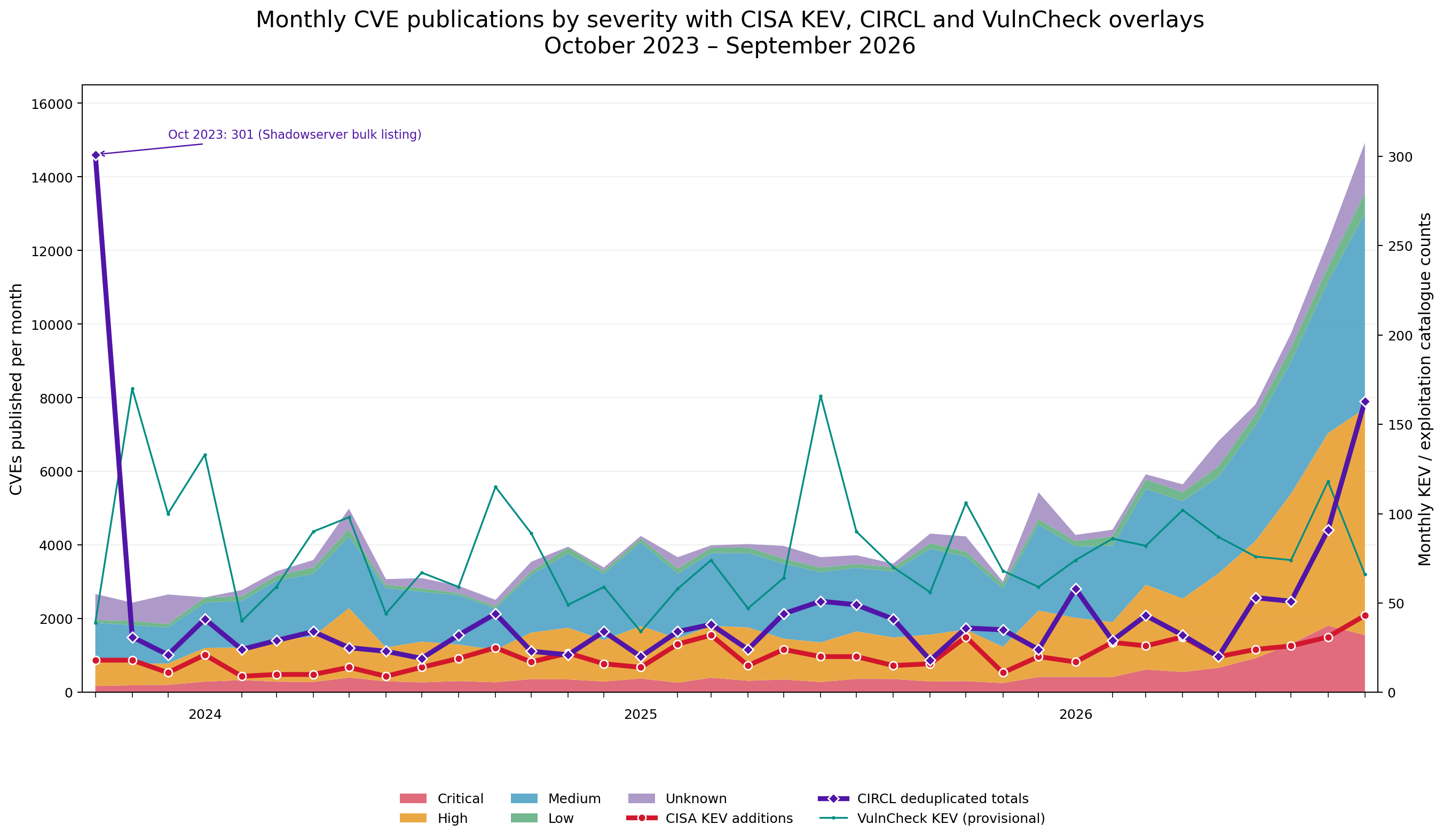
Before we look at what we might be able to infer from the data and the patterns we see, let’s start with the looking at the data we’ve sourced and plotted.

Data sources

  • CVE Publications — CRACI / CVE Program: Monthly counts of published Common Vulnerabilities and Exposures (CVEs), categorized by CVSS severity: Critical, High, Medium, Low and Unknown. The data originates from the CVE Program’s official records and is presented as stacked areas to illustrate changes in vulnerability volumes and severity distribution over time. Sources: CRACI CVE Publication Trends | CVE Program GitHub.
  • CISA Known Exploited Vulnerabilities (KEV): Monthly counts of vulnerabilities added to the US Cybersecurity and Infrastructure Security Agency’s catalogue of vulnerabilities confirmed to have been exploited in the wild. Counts are based on the date vulnerabilities entered the catalogue rather than when exploitation first occurred. Presented as the red line. Sources: CISA KEV Catalogue | CISA KEV GitHub.
  • CIRCL Vulnerability-Lookup: Monthly deduplicated counts of vulnerabilities recorded across multiple exploitation intelligence catalogues, including CISA, Shadowserver, ENISA, Previdian and CIRCL. By aggregating these sources, it provides broader visibility of known exploitation than any individual catalogue, although counts reflect when vulnerabilities were listed rather than necessarily first exploited. Presented as the purple line. Sources: CIRCL Vulnerability-Lookup | GitHub Repository.
  • VulnCheck KEV: Monthly counts of vulnerabilities identified as exploited in the wild through intelligence collected from security researchers, vendors, incident investigations and other publicly available evidence. VulnCheck provides an additional perspective beyond CISA, although its reporting volumes may be influenced by changes in intelligence coverage and retrospective discoveries. Presented as the thinner teal line, with the monthly figures currently treated as provisional pending independent validation. Sources: VulnCheck | Exploit Intelligence Documentation.

Understanding the data

Spikes in KEV data and varying sources

We have seen (and it is visible in our graph that the different sources of KEV data tend to show early spikes, typically triggered when the catalogue is being populated with retrospective data. We initially started looking at individual reporting sources such as VulnCheck thinking that they would give a true figure and the aggregated reporting data such as CIRCL would provide amplified patterns. The opposite appeared to be the case. We’ve kept the VulnCheck and CISA KEV reporting help illustrate this. Where Vulncheck’s spiking tend to be dramatic compared where CIRCL might show a small uptick, but then in the last quarter of 2025 we start to see opposing trends. It appears that CIRCL’s aggregation of sources has smoothed out the fluctuations. CISA’s KEV numbers in comparison a notably different in volume to VulnCheck. The CISA numbers generally follow the same pattern as CIRCL until 2026 – with the worst divergence 50 exploitations identified rather than the triple digit variance of VulnCheck.

Critical and High CVE fluctuations

If you look carefully and the CVE trends in the different categories, while there is clearly an acceleration in the last 12 months (which we could attribute to initiatives such as GlassWing) if you look carefully, you’ll notice that the growth in Severe and High scoring CVEs is growing faster. It is only two dates, but this table supports the observation:

SeveritySeptember 2025September 2026Growth
Critical2951,555+427%
High1,2756,160+383%
Medium2,3315,285+127%
Low148564+281%
Unknown2631,366+419%
Total4,31214,930+246%

The telling difference is if you compare the total growth against the growth numbers and the individual severity growth numbers. The critical numbers have multiplied by nearly 1.75.

Exploits (KEV) appear to be tracking vulnerabilities (CVE)

Perhaps the most important, point in the data is that based on the aggregated CIRCL counts, exploits are following the upward trend with a bit of lag which fits what thought we’d see. Yes at this point we’re are mindful that this could be finding data that supports a hypothesis (particularly given other individual KEV numbers may not support the trend). But on balance I’m inclined to trust the CIRCL numbers because if other numbers are erratic we’d not see such a similar upward track.

How is patching performance responding?

Keeping up with patching is likely to prove challenging, the 2026 Edgescan report picks out a rather telling observation, which supports the problems of not keeping up:

The most striking insight is that vulnerabilities from 2025, 2023, and 2024 account for more than 50% of all occurrences, indicating that newly published or recently discovered issues are the primary drivers of risk this year.

The suggestion is that the really high profile vulnerabilities get addressed, but the progress to address those that don’t get the notoriety is weaker. The alternative possibility relates not on individual exposures but when failures grab the headlines that attention turns back to patching. Another indicator that patching can’t keep up is the Verizon 2026 DBIR reported 26% of CISA KEV vulnerabilities fully remediated in its analyzed population versus 38% in the prior report, with median full remediation time increasing from 32 to 43 days (assuming Verizon’s dataset is representative).

Conclusion

While this is not an exhaustive analysis, it would be fair to treat it as anecdotal evidence to indicate:

  • CVE acceleration is being followed by KEV acceleration – possibly the most concerning.
  • If historic data shows we can’t keep up with patching, then its only going to get worse – supporting the expectation of climbing KEVs.

We do therefore need to look to adopt differing strategies to protect ourselves, and new measurements to reflect whether the new approaches are paying dividends. So what can we do differently, and I’m not saying don’t patch, I’m saying if you have a finite patching capacity, use it wisely, and invest in actions that give you the best vulnerability reduction.

Steps

Patching is by its very nature after the horse has bolted, this is why we have zero day exploits. The bottom line is there will always be vulnerabilities, the question is who finds them first and how do we react. Perhaps an exceptional illustration is the Apollo 11 Guidance Computer 1201 and 1202 errors (more about this and other aspects of the Apollo program at Apollo 11 Journals, the BBC also have an excellent podcast – 13 Minutes to the Moon that broke this down). This essentially was a memory overload error (should sound familiar as it is an attack vector, only difference is the overload was innocent for Apollo 11). The lesson is, the ground crew had encountered various issues during training, so put operational processes in place to allow them to quickly determine cause and action. Just as with modern businesses, the lunar programme could not be stopped to create months to rework Apollo’s software to avoid the issue, so they ensured there are what we might call compensating controls – a manual ground crew process that could tell Armstrong and aldrin what to do.

Continuing compensating controls, is not to have reactions ready, but also preventing attacks from reaching vulnerabilities. For example Oracle’s WebLogic Server has some CVEs around its T3 protocol. If you’re not using this as a communication channel between severs you can switch it off in the configuration. Better still, put those servers within a subnet with network security rules that prevent T3 traffic from getting into the subnet. There are multiple CVEs for T3 – so rather than patching everyone one of them, you’ve prevented the exploit from being usable by anyone other than someone having been able to get into that subnet.

The next upside of such a control is that even if the T3 vulnerability was exploited, the ‘blast radius’ is constrained, as the network configuration will make it a lot harder to move to other servers as first they need to find away to see beyond the local network. This brings another philosophical change which doesn’t have to be difficult to achieve. We always look at security on the inbound traffic – but we should be just as observant about outbound paths, and have controls. One very contemporary aspect of this is to put gateways between applications or agents and LLMs. The focus is that credentials to external tools and services are only introduced beyond the sphere of the LLM(s). But we can also prevent the LLM from being hijacked into abusing tools (from the LLM view point it is an inbound security control). But we should treat all outbound data this way. Its the fastest way to detect and stop data egress.

It doesn’t need a chaos monkey but …

Many will have over the years heard about the development of the chaos monkey at Netflix by Greg Orzell which is a small app that can be unleashed and will try to tear everything up. While this maybe seen as rather extreme, the underlying message is once its secured, don’t assume it remains secure (controls can be accidentally removed). Put basic security probes into the environment – you can test non-destructively. Don’t put a procedure in place and let is rot on a shelf, if you have capacity – fail things over. The more these sorts of processes a run, the more it becomes ‘muscle memory’ and while early iterations will be painful, that pain and cost will be minor to when it happens for real.

It isn’t if, but when …

We all like to think these things won’t happen to us, and we’re prepared. But worldwide 1 in 5 will have cancer in their lifetime. Many cancers are treatable, and largely routine – because the medical profession have had to treat the problem over and over. We just have to see IT attacks in the same manner.

Data sources and reporting

  1. CISA Known Exploited Vulnerabilities catalogue.
  2. CVE monthly trends, including CISA additions — cve.tools.
  3. VulnCheck: State of Exploitation 2026 (analysing 2025).
  4. CIRCL Vulnerability-Lookup | GitHub Repository
  5. CRACI CVE Publication Trends | CVE Program GitHub
  6. VulnCheck: State of Exploitation, H1 2026.
  7. VulnCheck: Expanding KEV, July 2025.
  8. Verizon 2026 DBIR.
  9. Google Threat Intelligence: 2025 zero-day review.
  10. Edgescan report 2026

Share this:

  • Share on Facebook (Opens in new window) Facebook
  • Share on X (Opens in new window) X
  • Share on Reddit (Opens in new window) Reddit
  • Share on LinkedIn (Opens in new window) LinkedIn
  • Email a link to a friend (Opens in new window) Email
  • Share on WhatsApp (Opens in new window) WhatsApp
  • Print (Opens in new window) Print
  • Share on Tumblr (Opens in new window) Tumblr
  • Share on Mastodon (Opens in new window) Mastodon
  • Share on Pinterest (Opens in new window) Pinterest
  • Share on Bluesky (Opens in new window) Bluesky
Like Loading...

Are we heading to a Certificate-apocalypse?

29 Thursday Oct 2026

Posted by mp3monster in development, General, Security, Technology

≈ Leave a comment

Tags

ACME, AI, certbot, certificates, CLM, Cloud, CMC, CMP, cybersecurity, SCEP, Security, Technology, TLS

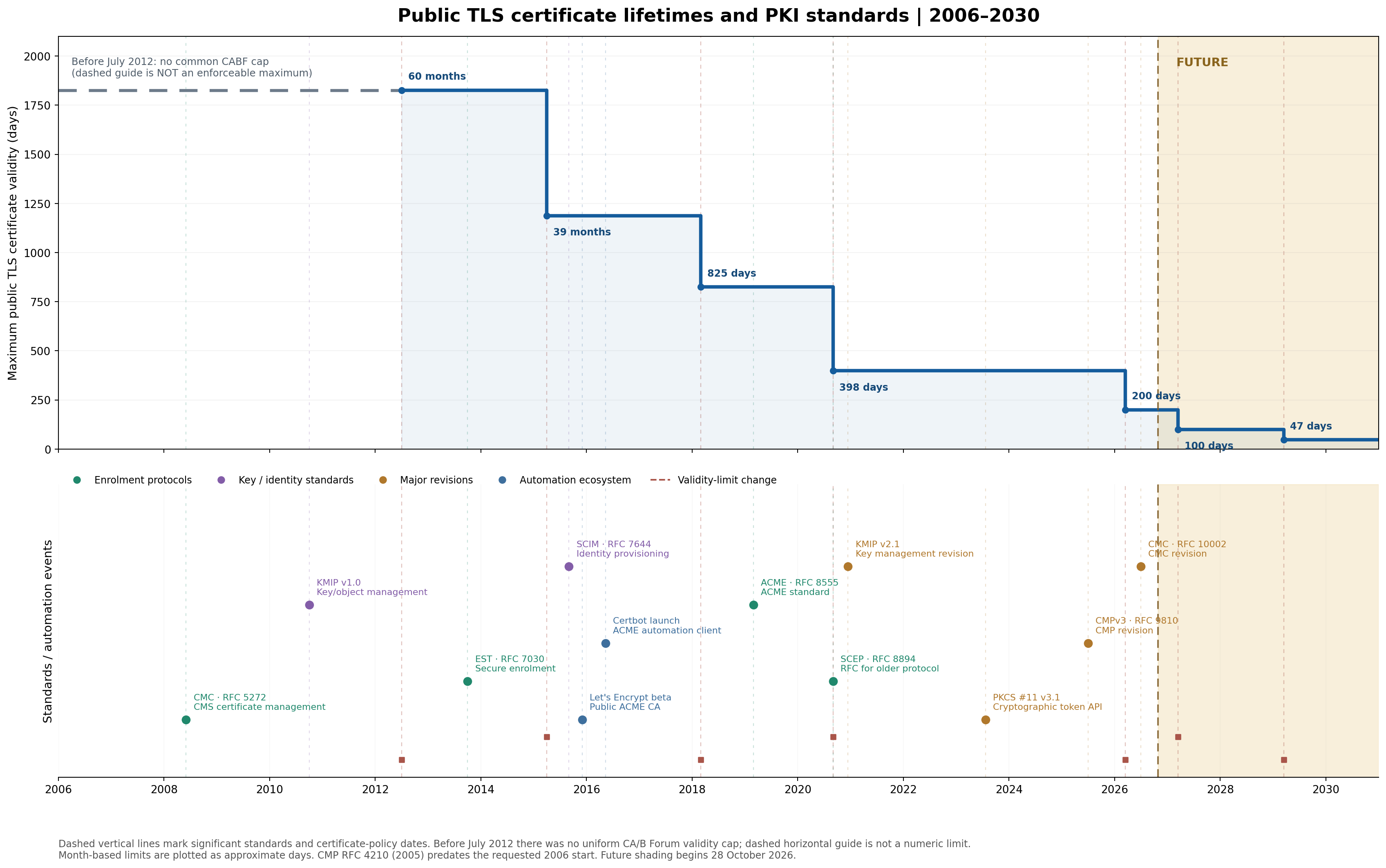
Most engineers are probably aware of the shortening life span of TLS certificates. this year certificate maximum life drops from 398 to 200 days. But what may not have registered is that the roadmap sees the max certificate time will continue to half every year. This means that by 2029 certificate lifecycle will be down to 47 days (31 days (core duration) + core duration/2 days + 1 day). But before 2029, in less than six months we’ll see the current certificate durations half from 200 to 100 days. As with the 2026 change, the new limits come into effect on the 15th March. Which does create an odd situation where certificates issued on the 14th March will outlast certificates issued on the following day.

The addition of half the core duration period is to allow for the recovery from failures. as of 2029 the expectation is every month the certificates should be rotated.

Manual processes are unsustainable

This means that the rotation of certificates has got to be accelerated to be monthly, a velocity that is simply not practical to be done by hand. This means the deployment of certificates really needs to be automated. There are a number of frameworks and standards that support the distribution of certificates.

Perhaps the best known and leading solution has been ACME protocol working in conjunction with Let’s Encrypt CA. The least known is the use of OpAMP also supports certificate distribution. The following table shows the different standards that specifically address certificate management (CLM), some implementations are linked to a Certificate authority , others are not.

StandardSpecificationOpen-source implementationsCommercial implementations
ACMERFC 8555Certbot (client), acme.sh (client), lego (client), step-ca (server), Boulder (server)DigiCert, Sectigo, GlobalSign, EJBCA Enterprise
CMP / CMPv3RFC 9810EJBCA Community, Bouncy Castle (library)EJBCA Enterprise, DigiCert Trust Lifecycle Manager
ESTRFC 7030Cisco libEST (client/server library), EJBCA Community (edition-dependent)EJBCA Enterprise, DigiCert
SCEPRFC 8894MicroMDM SCEP, EJBCA CommunityMicrosoft Intune, EJBCA Enterprise, DigiCert
CMCRFC 5272Dogtag PKICommercial implementations are less prominent; verify explicit CMC support and supported operations with individual PKI vendors

To understand the differences between the different standards, it is worth looking at the standards from the perspective of the operations that are needed to manage certificates.

FunctionACMECMPESTSCEPVendor
CLM API
Certificate issuanceYesYesYesYesUsually
Certificate renewalYesYesYesYesUsually
Certificate revocationYesYesNo native operationLimitedUsually
CA certificate rolloverLimitedYesYesLimitedVaries
Central certificate inventoryNoNoNoNoUsually
Ownership / application mappingNoNoNoNoVaries
Policy managementLimitedLimitedLimitedLimitedUsually
Application deploymentNoNoNoNoVendor-specific
Application activationNoNoNoNoThrough integrations
Deployment verificationNoNoNoNoVaries

You’ll note that the deployment, activation and verification steps fall into the domain of vendor solutions, and are variable. However we can address such considerations in an open-source (or commercial) manner through tooling such as Puppet, Chef and certain payload types provided by OpAMP.

These CLM options aren’t the end of the story as you may wish to look more broadly at no just the request and distribution of certificates, but the mechanisms through which the certificate is stored, and there is an overlap with such management with keys as well as certificates. For example APIs may use keys of certificates to help verify authenticity of the request. This also extends to mTLS operations where the client needs certificate to verify the server requests. For example KMIP provides an interface that can support cryptographic object (keys, certificates (public, private, symmetric), secret data, PGP Keys).

StandardSpecificationOpen-source implementationsCommercial implementations
KMIPOASIS KMIPPyKMIP (Python client/server)HashiCorp Vault Enterprise, Thales CipherTrust
PKCS#11PKCS#11 v3.1SoftHSM, OpenSCHashiCorp Vault Enterprise, Thales Luna HSM
SCIMRFC 7644elimity SCIM (Go library)Microsoft Entra ID, Okta

Managing the impact

There are several impacts that need to be considered:

  • tracking certificate expiry
  • Last mile from client deployer to server folder and any refresh nudge required

Tracking certificate expiry

Traditionally certificate expiry management could be handled as a manual process – after all if you have a log of which systems had certificates then if you simply reviewed the list once a month, you could spot expiries with time to spare. Even if the certificate distribution process was automated across many nodes. This just isn’t going to work, and the contingency time incorporated into the certificate life is contracting. Rather than trusting to a tracker spreadsheet being managed we should really focus on actual certificate data. This points to having a means by which application observability has a reporting metric on when a certificate will expire (date or a number of days). The later will prove to be easier as a metrics measure, but the value needs to be in context of when the metric was collected.

Last mile challenge

While automation frameworks like Certbot and step-ca can drive the certificate issuance. These processes get the certificate to the relevant server. But we still need to move the certificate intro the location the application expects the certificate to be, and do we need to nudge the server to reload the certificate? Certbot for example expects to have a script to trigger for this action. This can get a little messy to deploy and maintain, particularly if there are subtle variances in deployments (as a result of manual application deployment in legacy environments), configuration creep etc. One possible way to simplify this is to leverage the capabilities of environment scanners to locate apps and their configs. Then use that to drive the auto creation of that last mile.

Why the change?

The history for the reduction has largely been driven by browser providers particularly Google and Apple, and their security concerns about the trustworthiness of the web’s public key infrastructure (PKI). Historically, certificates could remain valid for several years, creating a prolonged window of exposure if a private key was compromised, a certificate incorrect certificates being wrongly used (organization or domain information became outdated – fore example domain name changes, acquisition of services etc). Certificate revocation mechanisms, particularly CRLs and OCSP, have not proven to be reliable as a means of ensuring browsers quickly stop trusting compromised certificates. Shorter lifetimes reduce this exposure and encourage the automation of certificate management.

The driving of changes has shifted from browser providers unilaterally declaring they won’t trust certificates that are older than a certain age, to a more formalized process governed primarily by the CA/Browser Forum, (an independent body bringing together Certificate Authorities and browser vendors).

Useful resources

  1. A/Browser Forum — TLS Baseline Requirements, version 2.3.1 (4 October 2026), section 6.3.2. Authoritative current hard limits: 398 days before 15 March 2026; 200 days from that date; 100 days from 15 March 2027; 47 days from 15 March 2029. Section 1.1 and the revision history identify 1 July 2012 as the original effective date. https://cabforum.org/working-groups/server/baseline-requirements/requirements/
  2. CA/Browser Forum — FAQ for Baseline Requirements. Historical summary of the 60-month limit from July 2012 and the 39-month general limit from April 2015. This is a historical source, not the current rule set. https://cabforum.org/faq-about-the-baseline-requirements/
  3. CA/Browser Forum — Ballot 193: 825-day Certificate Lifetimes (17 March 2017). Establishes the March 2018 transition to 825 days; also records the preceding 39-month rule and the qualifying 60-month legacy exception through June 2016. The page contains amendment markup; read the replacement wording in context. https://cabforum.org/2017/03/17/ballot-193-825-day-certificate-lifetimes/
  4. Apple — About upcoming limits on trusted certificates. Announces the 398-day maximum for public TLS server certificates issued on or after 1 September 2020 and explains its scope. This change originated in browser/platform trust policy. https://support.apple.com/en-us/102028
  5. CA/Browser Forum — Ballot SC081v3: Introduce Schedule of Reducing Validity and Data Reuse Periods (11 April 2025). Records the successful vote for the 2026–2029 reductions; source 1 confirms the resulting current requirements. The April milestone is the vote result, not the end of the subsequent intellectual-property review period. https://cabforum.org/2025/04/11/ballot-sc081v3-introduce-schedule-of-reducing-validity-and-data-reuse-periods/
  6. IETF Datatracker — draft-barnes-acme-00 (28 January 2015). First revision of the ACME Internet-Draft, before working-group standardization. https://datatracker.ietf.org/doc/draft-barnes-acme/00/
  7. Let’s Encrypt / ISRG — Entering Public Beta (3 December 2015). Announces public availability without invitations. https://letsencrypt.org/2015/12/03/entering-public-beta
  8. Electronic Frontier Foundation — Announcing Certbot: EFF’s Client for Let’s Encrypt (May 2016). Explains the rename, the EFF home, and ACME-based issuance and configuration automation. https://www.eff.org/deeplinks/2016/05/announcing-certbot-new-tls-robot
  9. Let’s Encrypt community — New name (Certbot) for Python Let’s Encrypt client (12 May 2016). Dated contemporary announcement linking to EFF’s announcement; supports the exact event date. https://community.letsencrypt.org/t/new-name-certbot-for-python-lets-encrypt-client/15688
  10. RFC Editor — RFC 8555: Automatic Certificate Management Environment (ACME), March 2019. Standards-track specification, published as a Proposed Standard. https://www.rfc-editor.org/info/rfc8555/
  11. ACME — RFC 8555: Automated Certificate Management Environment; supports automated certificate issuance, renewal and revocation.
  12. CMP / CMPv3 — RFC 9810: Certificate Management Protocol; supports PKI enrolment and certificate lifecycle operations.
  13. CMP over HTTP — RFC 9811: Defines HTTP transport for CMP messages.
  14. EST — RFC 7030: Enrollment over Secure Transport; supports certificate enrolment and re-enrolment over HTTPS.
  15. SCEP — RFC 8894: Simple Certificate Enrolment Protocol; commonly used for network devices.
  16. CMC — RFC 5272: Certificate Management over CMS; supports certificate requests and management messages. Updated to — RFC 10002: Updated specification superseding RFC 5272.
  17. KMIP 2.1 — OASIS KMIP 2.1 Specification: Key Management Interoperability Protocol; manages cryptographic keys, certificates and other cryptographic objects.
  18. PKCS#11 3.1 — OASIS PKCS#11 3.1 Specification: Cryptographic Token Interface; standard API for accessing cryptographic hardware and software tokens.
  19. SCIM 2.0 — RFC 7644: System for Cross-domain Identity Management; supports identity and account provisioning rather than certificate management.
  20. SPIFFE — SPIFFE Specifications: Secure Production Identity Framework for Everyone; standardizes workload identity across heterogeneous systems.
  21. X.509-SVID — X.509-SVID Specification: Defines X.509 certificates used for workload identity and authentication.
  22. X.509 PKIX — RFC 5280: Defines the Internet X.509 public key certificate and Certificate Revocation List (CRL) profile.
  23. CA/Browser Forum Baseline Requirements — Current Baseline Requirements: Industry requirements governing publicly trusted TLS certificate issuance, domain validation, security practices and maximum certificate validity periods.

Share this:

  • Share on Facebook (Opens in new window) Facebook
  • Share on X (Opens in new window) X
  • Share on Reddit (Opens in new window) Reddit
  • Share on LinkedIn (Opens in new window) LinkedIn
  • Email a link to a friend (Opens in new window) Email
  • Share on WhatsApp (Opens in new window) WhatsApp
  • Print (Opens in new window) Print
  • Share on Tumblr (Opens in new window) Tumblr
  • Share on Mastodon (Opens in new window) Mastodon
  • Share on Pinterest (Opens in new window) Pinterest
  • Share on Bluesky (Opens in new window) Bluesky
Like Loading...

Relationship between CVEs, CVSS, CWE and lots of other TLAs starting with C

07 Friday Aug 2026

Posted by mp3monster in development, General, Security, Technology

≈ Leave a comment

Tags

CVE, CVSS, CWE, cyber, MITRE, NIST, Owasp, Security, standards

A lot of developers are focused on CVEs, as we need to know does the library, language or other building block I use to create a solution have an identified vulnerability that needs mitigating? We probably also pay attention to OWASP (Open Worldwide Application Security Project). But CVEs and OWASP aren’t the beginning and end of the story. This a larger ecosystem of standards involved.

CWE (Common Weakness Enumeration) is of particular interest if you get a chance to step back from fire fighting CVEs. This is interesting because, rather than addressing individually identified vulnerabilities, like the OWASP Top 10s, it looks at a classifies the vulnerabilities. When you get down the Base and Variant categories we’re into specific details. This is helpful, as classifying our CVEs against CWE can tell us the technical domains where the maximum effort can return the greatest level of mitigation/remediation of CVEs (be that creating a patch or defining a mitigation strategy).

I was going to sketch out the relationships between the key standards, but realized an LLM can do a better job, so here is a visual summary:

With so many TLAs in the diagram, here is a quick reference pulled together (including from my own library of handy links).

Acronym / referenceExpanded formOfficial HTTP linkOne-sentence summaryAuthority / allocation relevance
CVECommon Vulnerabilities and Exposurescve.org/about/overviewCVE provides globally recognised identifiers and records for publicly disclosed cybersecurity vulnerabilities. (cve.org)CVE IDs are assigned by authorised CNAs or by MITRE/CVE Program structures.
CNACVE Numbering Authoritycve.org/partnerinformation/listofpartnersCNAs are authorised organisations that assign CVE IDs and publish CVE Records within an agreed scope. (cve.org)Primary delegated authorities for allocating CVE IDs.
CNA-LRCNA of Last Resortcve.org/ProgramOrganization/StructureA CNA-LR supports CVE assignment when no more specific CNA is available for a vulnerability. (cve.org)Fallback route for CVE ID allocation.
MITREThe MITRE Corporationmitre.org/focus-areas/cybersecurity/capabilities-resourcesMITRE is closely associated with CVE, CWE, CAPEC and ATT&CK as a maintainer, operator or steward of major cybersecurity knowledge bases. (MITRE)Current CVE Program Secretariat and maintainer of CWE/CAPEC resources.
CWECommon Weakness Enumerationcwe.mitre.orgCWE is a community-developed catalogue of software and hardware weakness types that can lead to vulnerabilities. (Common Weakness Enumeration)CWE IDs are maintained by MITRE; they classify weakness types, not individual vulnerabilities.
CWSSCommon Weakness Scoring Systemcwe.mitre.org/cwssCWSS is a CWE-related scoring method for prioritising software weaknesses, but the older version referenced by MITRE is marked obsolete. (Common Weakness Enumeration)Scores weaknesses, not CVE vulnerabilities; largely secondary compared with CVSS in current vulnerability workflows.
CVSS v4.0Common Vulnerability Scoring System version 4.0first.org/cvss/v4.0CVSS v4.0 is the current major CVSS standard family used to express vulnerability severity with base, threat, environmental and supplemental metrics. (FIRST Forum) (Forum of Incident Response and Security Teams)Maintained by FIRST; it scores vulnerabilities but does not allocate vulnerability IDs.
Defines the scoring structure/ranking scale, not ID allocation.
NISTNational Institute of Standards and Technologynist.govNIST hosts and maintains important security automation resources including NVD and CPE-related specifications. (NVD)Maintains NVD and official CPE dictionary infrastructure.
NVDNational Vulnerability Databasenvd.nist.govNVD enriches CVE records with structured metadata such as affected platforms, weakness classifications, references and severity scores.Enrichment database, not the allocator of CVE IDs.
CPECommon Platform Enumerationnvd.nist.gov/Products/CPECPE provides standardised names for identifying affected products, platforms and software configurations. (NVD)Supports product/platform matching in NVD and vulnerability scanners.
CAPECCommon Attack Pattern Enumeration and Classificationcapec.mitre.orgCAPEC is a MITRE-maintained catalogue of attack patterns used to understand how weaknesses may be exploited. (CAPEC)CAPEC entries relate to CWEs and help connect weaknesses to attack behaviour.
CSAFCommon Security Advisory Frameworkoasis-open.org/committees/csafCSAF is an OASIS standard for creating and exchanging structured machine-readable security advisories. (OASIS)Advisory exchange format that can carry CVE, product status, remediation and scoring data.
VEXVulnerability Exploitability eXchangecisa.gov SBOM resourcesVEX communicates whether a known vulnerability is exploitable in a specific product or deployment context. (CISA)Helps qualify CVE findings so consumers can distinguish exploitable from non-exploitable exposure.
CISACybersecurity and Infrastructure Security Agencycisa.govCISA publishes operational vulnerability guidance and maintains the Known Exploited Vulnerabilities catalogue. (CISA)Maintains KEV and participates in the wider CVE/vulnerability ecosystem.
KEVKnown Exploited Vulnerabilities cataloguecisa.gov/known-exploited-vulnerabilities-catalogKEV is CISA’s authoritative catalogue of vulnerabilities known to have been exploited in the wild. (CISA)Prioritisation signal based on observed exploitation, not severity alone.
EPSSExploit Prediction Scoring Systemfirst.org/epssEPSS estimates the probability that a published CVE will be exploited in the wild within the next 30 days. (FIRST Forum)Probability-based prioritisation signal that complements CVSS and KEV.
CERT/CCCERT Coordination Centerkb.cert.org/vulsCERT/CC coordinates vulnerability disclosure and publishes Vulnerability Notes. (CERT Coordination Center)Can act as a coordinator in disclosure workflows and may interact with CNA/CVE processes.
CVDCoordinated Vulnerability DisclosureCERT Guide to CVDCVD is the process of coordinating information among finders, vendors and other stakeholders before public disclosure and mitigation communication. (CERT Coordination Center)Process framework around disclosure; not itself an ID system.
SBOMSoftware Bill of Materialsntia.gov/software-bill-materialsAn SBOM describes the software components that make up a product so downstream users can reason about exposure and supply-chain risk. (NTIA)Often paired with VEX and vulnerability feeds to assess affected components.
CycloneDXCycloneDX Bill of Materials standardcyclonedx.orgCycloneDX is an OWASP full-stack Bill of Materials standard for supply-chain and cyber-risk use cases. (CycloneDX)SBOM/VEX-capable format used in vulnerability management pipelines.
SPDXSoftware Package Data Exchangespdx.devSPDX is an open standard, ISO/IEC 5962:2021, for representing SBOMs and other software supply-chain metadata. (SPDX)SBOM format often used alongside vulnerability data sources.
SWIDSoftware Identification tagNIST SWID guidanceSWID tags are ISO/IEC 19770-2 software identification files that can support software asset, patch and vulnerability management. (NIST Computer Security Resource Center)Product identification standard related to CPE-style inventory matching.
SSVCStakeholder-Specific Vulnerability CategorizationCMU SEI SSVC v2.0SSVC uses decision trees to prioritise vulnerability response actions for specific stakeholder contexts. (SEI)Prioritisation model that complements CVSS, KEV and EPSS.
MITRE ATT&CKAdversarial Tactics, Techniques and Common Knowledgeattack.mitre.orgMITRE ATT&CK is a knowledge base of adversary tactics, techniques and procedures based on real-world observations. (MITRE ATT&CK)Related attack-behaviour framework that can be connected to CAPEC/CWE/CVE analysis.
OWASP Top 10Open Worldwide Application Security Project Top 10owasp.org/Top10The OWASP Top 10 is a standard awareness document for developers and web application security risks. (OWASP Foundation)Useful application-security reference that often maps conceptually to CWEs.
OSVOpen Source Vulnerabilities / OSV schemaosv.devOSV provides a machine-readable vulnerability format and database that maps open-source vulnerabilities precisely to package versions or commit hashes. (OSV)Adjacent vulnerability-data ecosystem, especially useful for open-source dependency scanning.

Share this:

  • Share on Facebook (Opens in new window) Facebook
  • Share on X (Opens in new window) X
  • Share on Reddit (Opens in new window) Reddit
  • Share on LinkedIn (Opens in new window) LinkedIn
  • Email a link to a friend (Opens in new window) Email
  • Share on WhatsApp (Opens in new window) WhatsApp
  • Print (Opens in new window) Print
  • Share on Tumblr (Opens in new window) Tumblr
  • Share on Mastodon (Opens in new window) Mastodon
  • Share on Pinterest (Opens in new window) Pinterest
  • Share on Bluesky (Opens in new window) Bluesky
Like Loading...
    • About
      • AI Disclosure
      • Internet Profile
      • Music Buying
      • Presenting Activities
    • Books & Publications
      • Logging in Action with Fluentd, Kubernetes and More
      • Logs and Telemetry using Fluent Bit
      • Oracle Integration
      • API & API Platform
        • API Useful Resources
        • Useful Reading Sources
    • Mindmaps Index
    • Monster On Music
      • Music Listening
      • Music Reading
    • OpAMP explained: the control plane for observability agents
    • Oracle Resources
    • Useful Tech Resources
      • Fluentd & Fluent Bit Additional stuff
        • Logging Frameworks and Fluent Bit and Fluentd connectivity
        • REGEX for BIC and IBAN processing
      • Formatting etc
      • Java and Graal Useful Links
      • Official Sources for Product Logos
      • Python Setup & related tips
      • Recommended Tech Podcasts

    TOGAF 9

    Logs and Telemetry using Fluent Bit


    Logging in Action — Fluentd

    Logging in Action with Fluentd


    Oracle Ace Director Alumni

    Oracle Cloud Integration Book


    API Platform Book


    Oracle Dev Meetup London

    Blog Categories

    • App Ideas
    • Books
    • Enterprise architecture
    • General
      • ExternalWebPublications
      • LinkedIn
      • Website
    • Music
      • Music Resources
      • Music Reviews
    • Photography
    • Podcasts
    • Security
    • Technology
      • AI
      • APIs & microservices
      • chatbots
      • Cloud
      • Cloud Native
      • Dev Meetup
      • development
        • languages
      • drone
      • Fluent Observability
        • Fluentbit
        • Fluentd
        • OpAMP
      • logsimulator
      • mindmap
      • OMESA
      • Oracle
        • API Platform CS
          • tools
        • ITSO & OEAF
        • OIC – ICS
        • Oracle Cloud Native
        • OUG
      • railroad diagrams
      • TOGAF

    Enter your email address to subscribe to this blog and receive notifications of new posts by email.

    Join 2,628 other subscribers

    RSS

    RSS Feed RSS - Posts

    RSS Feed RSS - Comments

    November 2026
    M T W T F S S
     1
    2345678
    9101112131415
    16171819202122
    23242526272829
    30  
    « Oct    

    Speaker Recognition

    Open Source Summit Speaker

    Twitter

    Tweets by mp3monster

    History

    Flickr Pics

    More Photos

    Social

    • View @mp3monster’s profile on Twitter
    • View philwilkins’s profile on LinkedIn
    • View mp3monster’s profile on GitHub
    • View mp3monster’s profile on Flickr
    • View mp3muncher’s profile on WordPress.org
    • View philmp3monster’s profile on Twitch
    Follow Phil (aka MP3Monster)'s Blog on WordPress.com

    Blog at WordPress.com.

    • Subscribe Subscribed
      Phil (aka MP3Monster)'s Blog
      Join 232 other subscribers

      Have a WordPress.com account? Log in now.

    • Phil (aka MP3Monster)'s Blog
      View site in Reader
      Manage subscriptionsSign upLog in
      Report this content
      Collapse this bar
    Loading Comments...

    You must be logged in to post a comment.

    Privacy & Cookies: This site uses cookies. By continuing to use this website, you agree to their use.
    To find out more, including how to control cookies, see here: Our Cookie Policy
    %d