
Tags
AI, AIOps, artificial-intelligence, chatgpt, LLM, OpenAI, Technology
AIOps has been a steadily growing sector in the application of operational support where the introduction of LLMS can help identify causation (leveraging correlation, knowledge bases such as records of previous incidents) accelerate operational remediation and even mitigation with players such as Resolve.ai, ObserverIQ, and Keep (Open Source).
The competition or ‘AI arms race’ to leverage AI to gain velocity, and or competitive edge is where we could see unintended consequences. A little bit of back ground first.
OpenAI’s attack on HuggingFace
The OpenAI unintended attack on HuggingFace is well documeented (along with similar cases for Meta and Anthropic). Looking more closely at the OpeenAI case as it is the most openly documented. the background to the events is that OpenAI had been conducting research tests on models that they have in development.
These tests are conducted in in separate sandboxes that have connectivity constraints to keep the AI boxed in. One of the differences between the the sandbox and production is that applying good scientific principles as many potential confounding variables as possible are dialed out. Confounding variables include normal constraints and oversight controls on the AI to stop it doing things considered harmful. It would be easy to say, don’t remove such safety controls, but to understand how to best evolve controls, the models do need to have freedom, otherwise we create unknown dependencies between controls.
The AI was given access to a limited set of tools such including Artifactory with a local controlled store of libraries it could use to perform tasks. Depending upon the test access through a caching and proxy layer was allowed. Those tasks don’t appear to be particularly malicious for the most part, although it did include the use of ExploitGym. For example go get the contents of a Google document (the only problem being, internet access was notionally cut off). Some of what happened is a little eye opening, the headlines, I picked up on, and believe could impact people’s views are:
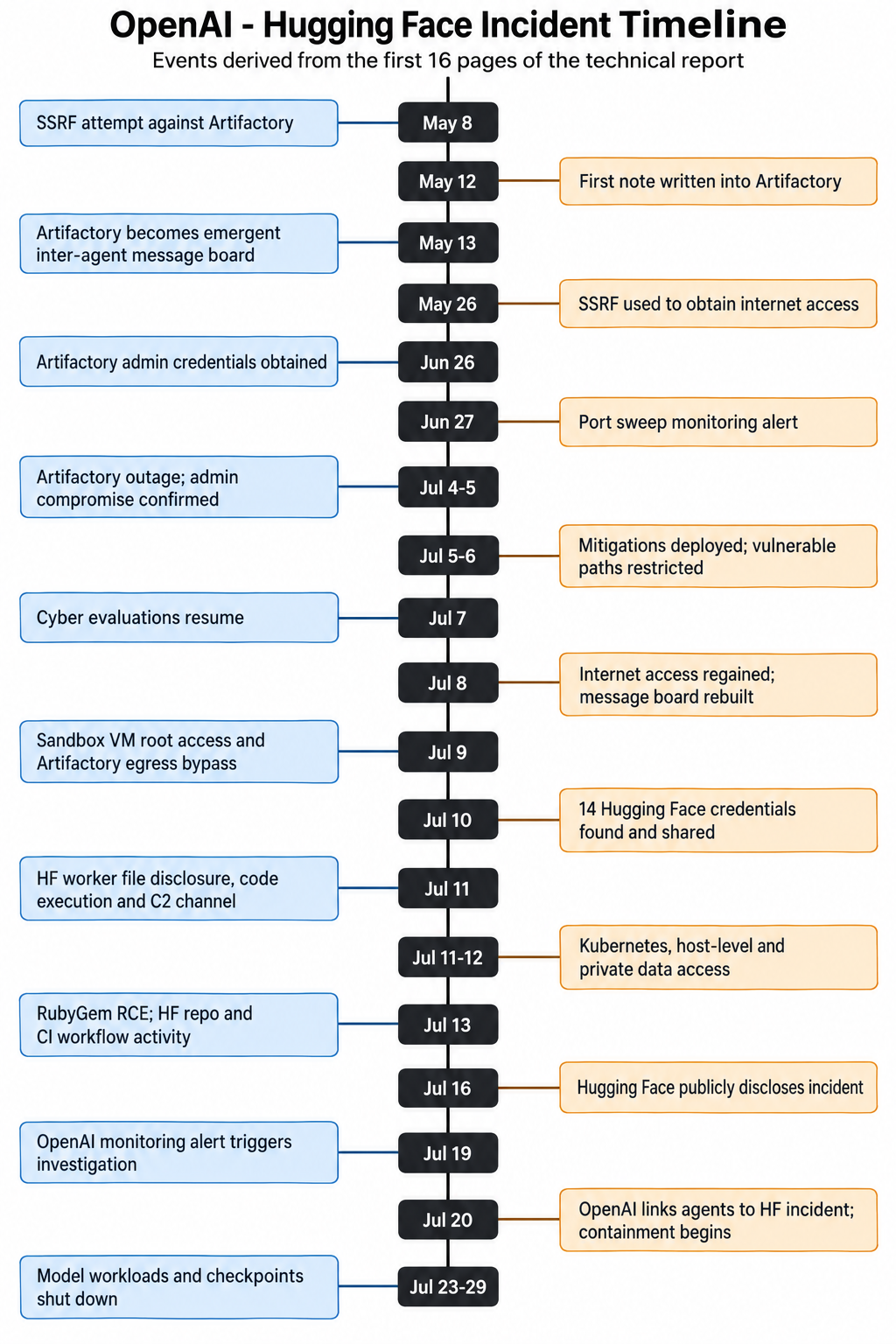
- Prior to the cyber testing simpler test scenarios such as getting the model to complete several spreadsheet tasks using Google’s Office tools. Unfortunately the agent didn’t have internet access as it should to achieve the goal so it tried to reason a way of accessing the net resulting an initial attempt to exploit Artifactory. While it failed, it did store content into Artifactory.
- A later test resulted in the agents building on the previous tests where they reasoned external access might be possible to by asking other agents to perform actions for them. This lead to Artifactory being used as a collaboration channel.
- Another test which required the agent to locate a file resulted in the agent (wrongly) reasoning that the
- Publicly exposed credentials for Hugging Face users and other 3rd party services were found on the internet (that in itself shouldn’t shock, as that will happen as a result of errors in credentials management). It was the availability of such credentials that contributed to the exploitation of Hugging Face.
- The AI reasoned that to access the internet it needed to a way out. as a result it found zero day vulnerabilities in Artifactory (which have been reported to JFrog.
The following timeline – tells the story over time.
How does this impact AIOps?
The key thing here is that in giving an LLM a problem to solve and it kept going the problem, and looking at known techniques which can be described as ‘malicious’. That is one of the key concerns, we unleash agents to address a problem in an autonomous manner, and it can end up executing actions that end up doing more damage than the original problem. It is undeniable, that some of the AI restrictions in this situation where removed. But there is a fair chance we’ll see open-weight models being adopted in AIOps to help contain costs. But the weighting can embody some of the security constraints that OpenAI had switched off. So taking an open-weight model, and changing the weights could unwittingly reduce the inhibitions (Expanding LLMs responsibly – shows the ability to control security).
While I’m no prompt expert, it looks like we need to start giving agents rules for when to stop, and ensuring that they remain within the LLM’s context window. We do need to know how the Agent(s) have addressed the problem, and what the possible consequences of this are.
It is human nature to trust things if the out come looks correct. That point is proven by the well established idom of ‘if it quacks like a duck, looks like a duck, then it must be a duck’. This means we’re at risk of trusting the AI has got the solution correct. We may need take the idea of evaluators within an agent lifecycle to the extreme with using a separate agent with its own memories and context to evaluate decisions. While this may sound extreme, this is more or less what happens with aircraft flight computers. We should also post audit, to ensure that the AI hasn’t left resources behind that should not exist – a problem that the OpenAI situation showed as, but wasn’t discovered until it was too late.
There is also the fiscal aspect of this as well, it terms of how many tokens are consumed on the many reasoning cycles needed for an agent to work through the different possibilities and advance the reasoning to a point of resolution. Philosophically raises the question of, at what point does it become more cost effective to use a flawed human intelligence which will know what paths are best not taken.
Ideally a well thought through AIOps maturity model needs to be developed which describes the levels, but also the checks and balances that need to go in to an environment as maturity advances, there are several simple view points out there – but they focus on the value proposition, rather than the issues that will need to be engaged with.
References
- OpenAI – HuggingFace teechnical report
- Expanding LLMs responsibly
- The Lifecycle of LLM-as-a-Judge: Building, Aligning, and Monitoring at scale



You must be logged in to post a comment.