• Home
  • Site Aliases
    • www.cloud-native.info
  • About
    • Background
    • Presenting Activities
    • Internet Profile
      • LinkedIn
    • About
  • Books & Publications
    • Log Generator
    • Logs and Telemetry using Fluent Bit
      • Fluent Bit book
      • Book Resources in GitHub
      • Fluent Bit Classic to YAML Format configurations
    • Logging in Action with Fluentd, Kubernetes and More
      • Logging in Action with Fluentd – Book
      • Fluentd Book Resources
      • Fluentd & Fluent Bit Additional stuff
    • API & API Platform
      • API Useful Resources
    • Oracle Integration
      • Book Website
      • Useful Reading Sources
    • Publication Contributions
  • Resources
    • GitHub
    • Oracle Integration Site
    • Oracle Resources
    • Mindmaps Index
    • Useful Tech Resources
      • Fluentd & Fluent Bit Additional stuff
      • Recommended Tech Podcasts
      • Official Sources for Product Logos
      • Java and Graal Useful Links
      • Python Setup & related stuff
      • DevTips
  • Music
    • Monster On Music
    • Music Listening
    • Music Reading

Phil (aka MP3Monster)'s Blog

~ from Technology to Music

Phil (aka MP3Monster)'s Blog

Author Archives: mp3monster

Oracle Fusion Applications Development and Extensibility Handbook Chapters 3 & 4

23 Sunday Mar 2014

Posted by mp3monster in Book Reviews, Books, General, Oracle, Oracle Press, Technology

≈ 6 Comments

Tags

applications, book, flexfields, fusion, Fusion Applications, Oracle, Oracle Press, review, Security

Continuing with the review of Oracle Fusion Applications Development and Extensibility Handbook (Oracle Press) I’m going to look at chapters 3 & 4. Chapter 3 looks at the different types of Flex Fields from the well known Dynamic Flexfields (DFF) and the more advanced EFFs and KFFs (different ways to provide more advanced flex values such as linking other tables of data).

The book describes briefly the steps to utilise many of the capabilities with some screenshots but don’t mistake this for a detailed key this value followed by click that button combined with screenshots of every step for all aspects (if you did that we’d probably trying to read 5000 pages not 500). So if you want to see and feel all the different aspects explained you will need to have an instance of Fusion apps to try the techniques out with. For me, this is no bad thing, I want to understand what the capabilities are and a sense of the effort and complexity involved – if I want to have blow by blow guide I’d turn to OTN and the tutorial video clips being made available everyday by Oracle on YouTube.

The book also recognises not all strategies are available with all Fusion apps and what can therefore be done. Either by implementing the capability yourself, or asking Oracle to prioritise feature development in the Fusion apps domain.

Unusually rather than continuing with customisation capabilities in Chapter 4 we look at Security. This is no bad thing as if you want to achieve security in depth you need to understand how it can be incorporated at every level as you go rather than as an after thought at the end. But as you go through this chapter you’ll see just how central the security framework is to working with Fusion Apps.

The security perspective comes primarily from an authentication and authorisation (A&A) perspective so bringing in OAM and OID along with related tooling (including APM which is a central tool for Fusion Apps Security). The A&A framework provides an advanced hierarchy of roles and permissions as the capability to integrate extensions with it. The book again provides a solid foundation on which you can build specific implementation understanding.  Security comes in two forms – functional (i.e. restricting access to Fusion app capabilities) and data (which records a user can or cant see). The fascinating aspect for me is the data view because the different organisational possibilities that can influence the data you can or can’t see – for example by value, by internal organisational structures such as departments, by suppliers/partners/customers and so on (Oracle use the terminology of sets).

Security considerations go beyond just managing major roles, but how to autoprovision users (i.e. I create an OID entry for a new employee – how to provide them with a standard set of credentials). How to interact with Fusion Apps at the web service level from inside or outside the secured FusionApps environment.

As with Chapter 3, there are illustrations on how to establish some security settings and leverage security for your own development, but not in an exhaustive click by click manner.

Both chapters, particularly Chapter 4 introduce the ideas and approaches in a succinct manner explaining both the more well known concepts but also the more advanced capabilities along with identifying some common challenges and how they can be overcome (through the provision of tooling or technique for diagnosis).

So far this has been the best introduction to Fusion Applications I have come across.

Share this:

  • Share on Facebook (Opens in new window) Facebook
  • Share on X (Opens in new window) X
  • Share on Reddit (Opens in new window) Reddit
  • Email a link to a friend (Opens in new window) Email
  • Share on WhatsApp (Opens in new window) WhatsApp
  • Print (Opens in new window) Print
  • Share on Tumblr (Opens in new window) Tumblr
  • Share on Mastodon (Opens in new window) Mastodon
  • Share on Pinterest (Opens in new window) Pinterest
  • More
  • Share on Bluesky (Opens in new window) Bluesky
  • Share on LinkedIn (Opens in new window) LinkedIn
Like Loading...

Packt Promotion as they hit 2000 titles

20 Thursday Mar 2014

Posted by mp3monster in Books

≈ Leave a comment

Tags

books, Packt, promotion, statistics

We’ve just heard that Packt Publishing have reached 2000 titles now.  To celebrate they’re running a promotion until  26th March 2014 with a buy one get one free. The offer is unlimited within the period and the discount will appear when you checkout.  For more go to  Packt here.

Packt2KPromo

This news got me thinking I’ve contributed to the book authoring process for 5 books now – which means I’ve contributed to 0.25% of the Packt books.  Reviewing a book takes on average 4 hours per chapter and most Packt books comes with 10-12 chapters. If it takes 4 times longer to write a chapter (16 hours) that’s 160 hours per book and 32,000 hours of authoring effort in the Packt library, which equates to over 3 1/2 years of non stop writing.

Share this:

  • Share on Facebook (Opens in new window) Facebook
  • Share on X (Opens in new window) X
  • Share on Reddit (Opens in new window) Reddit
  • Email a link to a friend (Opens in new window) Email
  • Share on WhatsApp (Opens in new window) WhatsApp
  • Print (Opens in new window) Print
  • Share on Tumblr (Opens in new window) Tumblr
  • Share on Mastodon (Opens in new window) Mastodon
  • Share on Pinterest (Opens in new window) Pinterest
  • More
  • Share on Bluesky (Opens in new window) Bluesky
  • Share on LinkedIn (Opens in new window) LinkedIn
Like Loading...

Enterprise Security – A Data Centric Approach to Securing the Enterprise – A Slight Return

13 Thursday Mar 2014

Posted by mp3monster in Books, General, mindmap, Technology

≈ Leave a comment

Tags

Aaron Woody, data centric, mindmap, Security, xmind

A while back I reviewed the excellent book Enterprise Security: A Data-Centric Approach to Securing the Enterprise.  I had mentioned that I would in due course make a mindmap available based on my reading of the book as I use mindmaps as a memory jog when I need to go back to referencable material.

Well I have made by first cut of the mind map – which can be found with my shared mindmaps here. I shall be updating it and adding details, so it is worth checking back.

As WordPress prevents embedding iframes – I can only offer an image here – but the mindmap toolsite provides a fully interactive view to the mindmap.

Share this:

  • Share on Facebook (Opens in new window) Facebook
  • Share on X (Opens in new window) X
  • Share on Reddit (Opens in new window) Reddit
  • Email a link to a friend (Opens in new window) Email
  • Share on WhatsApp (Opens in new window) WhatsApp
  • Print (Opens in new window) Print
  • Share on Tumblr (Opens in new window) Tumblr
  • Share on Mastodon (Opens in new window) Mastodon
  • Share on Pinterest (Opens in new window) Pinterest
  • More
  • Share on Bluesky (Opens in new window) Bluesky
  • Share on LinkedIn (Opens in new window) LinkedIn
Like Loading...

Oracle Fusion Applications Development and Extensibility Handbook – review Chapters 1 & 2

13 Thursday Mar 2014

Posted by mp3monster in Book Reviews, Books, General, Oracle, Oracle Press, Technology

≈ 6 Comments

Tags

applications, development, extensibility, fusion, Oracle, Vlad Ajvaz

So I’ve got through the first couple of chapters of Oracle Fusion Applications Development and Extensibility Handbook (Oracle Press). The book starts with a presumption of minimal knowledge so the first chapter provides an excellent high level overview on the framework and assembly of Fusion Applications and some of the principles such as Weblogic node management. Although an appreciation of non Fusion Apps will give you a sense of some ideas such as Flexfields would be useful at this stage, but they are explained in a lot more depth later on.

Chapter 2 moves onto the different kinds of customisation that can be performed and how those customisations are achieved from user configuration through to tools in the Fusion Apps and onto JDeveloper and the Fusion Apps libraries. The interesting thing is that all though it is clear a lot of work has gone into managing the dev and test cycles on a shared Fusion Apps platform including potential change conflict management there seems to be little for direct linkage or built in configuration management.

In terms of a book, it has started very well, providing a sense of over all shape of Fusion Apps in a very readable and informative  manner.  I think this is going to be a informative & easy read.

Oracle Fusion Apps at Google

Share this:

  • Share on Facebook (Opens in new window) Facebook
  • Share on X (Opens in new window) X
  • Share on Reddit (Opens in new window) Reddit
  • Email a link to a friend (Opens in new window) Email
  • Share on WhatsApp (Opens in new window) WhatsApp
  • Print (Opens in new window) Print
  • Share on Tumblr (Opens in new window) Tumblr
  • Share on Mastodon (Opens in new window) Mastodon
  • Share on Pinterest (Opens in new window) Pinterest
  • More
  • Share on Bluesky (Opens in new window) Bluesky
  • Share on LinkedIn (Opens in new window) LinkedIn
Like Loading...

TOGAF Mindmap

11 Tuesday Mar 2014

Posted by mp3monster in General, mindmap, Technology, TOGAF

≈ Leave a comment

Tags

mindmap, TOGAF, xmind

Following yesterday’s post, I thought I’d share a mindmap that was useful with the TOGAF stuff …

TOGAF Mindmap

To use a friendly readable & navigable version of the mind map click on the image or here.

This is one of a number of mind maps I have made available through a SaaS mindmapping tool now.

Share this:

  • Share on Facebook (Opens in new window) Facebook
  • Share on X (Opens in new window) X
  • Share on Reddit (Opens in new window) Reddit
  • Email a link to a friend (Opens in new window) Email
  • Share on WhatsApp (Opens in new window) WhatsApp
  • Print (Opens in new window) Print
  • Share on Tumblr (Opens in new window) Tumblr
  • Share on Mastodon (Opens in new window) Mastodon
  • Share on Pinterest (Opens in new window) Pinterest
  • More
  • Share on Bluesky (Opens in new window) Bluesky
  • Share on LinkedIn (Opens in new window) LinkedIn
Like Loading...

TOGAF Certification – Passing on the Helpful Tips

10 Monday Mar 2014

Posted by mp3monster in General, Technology, TOGAF

≈ Leave a comment

Tags

books, certification, exam, study, TOGAF

Having successfully become certified with TOGAF 9. I thought it would be good to share some hints, tips and observations that have helped me along the way.  So as you may know the exam is conducted through multiple choice – but that simple examination approach should not give a false sense of ease – because a lot of the options will sound right (until you understand the exact technical meanings).

  • Training course or not to training course, that is the question? Personally I wouldn’t taken on the exam without the training – the TOGAF full text runs to 1000 pages. The course for me at least gave 1000 foot view, an some insight from practitioners and the 1st set of suggestions on preparing for the exam.
  • One of the key points I picked up is the terminology and language is very important. Understand the key terms and read questions very carefully and a lot of information will standout. As I was told when on the training, it is surprisingly common for the right answer to often be the longest textual answer because it is being semantically accurate.
  • Books – well I’d suggest that the full TOGAF® Version 9.1 manual is a desk reference for whilst practicing TOGAF. To get the exam under your belt read TOGAF® 9 Foundation Study Guide you will need to pretty much need to know this stuff cover to cover. Although the guide is Foundation stage – it will get you a long way and you can add additional knowledge from the TOGAF® Version 9.1 A Pocket Guide
  • From these guides you need to know the ADM itself, including the steps in each phase, what the techniques are for and why you might use them (things like gap analysis etc).
  • The study guide has mock stage 1 exams, and each section also has practice questions – take advantage of them. The questions are stylistically pretty good, although in hindsight perhaps erring of the easier side, and the mock exam questions got progressively harder in my opinion.  But the real exam for me, question 1 was a real curve ball.
  • There are other sources of mock questions (including other books) – I found the mock exams at http://theopenarch.com/ helpful.  After each mock exam, I reviewed the answers that I got wrong to try and understand why they are wrong – which helped me identify any areas of reading I was weak on.
  • Read the questions very carefully, there are sometimes indicators as the right answer in the question. Also watch for things like, not what answer in A-E is right, but which one is wrong.
  • Timing – 60 minutes for 40 questions in part 1 doesn’t sound like very long – particularly given the advise of take your time read the questions very carefully. But actually, you’ll find once you’ve got a handle on a chunk of the study guide you’ll find you can rip through some of the questions very quickly giving you time to think carefully about the questions that aren’t so easy – the exam also has means by which you can go back and review questions if you want.
  • For the harder questions, in part 1 I ended up writing A-E on the paper and crossing off the answers I could eliminate. That made it easier (for me at least) to then focus on dissecting the 1 or 2 possible options left. In part 2, I applied a similar approach – part 2 is more about which phase(s) do I need to use and what are the steps. So I took each possible answer and wrote on paper what phase(s) then answer needed and then went through each answer option teasing out the terminology for the different steps (and the phases they originated from). The option with the most steps from the correct phase, appear to give me the best or second best answers.
  • Part 1 is closed book, but part 2 you are meant to be able to refer to the TOGAF material – for me the link to the TOGAF reference failed.  So best not to bank on having it available.

Aside all of this there are classic exam suggestions – give yourself time to get to the exam location – a calm composed mind is crucial for this.  Try and rush through this and you’re potentially facing a disaster. Make sure you have all the information the test centre requires (id’s etc) – one less stress.  Travel light as you wont be able to take anything into the test room. Finally, try and get into ‘the zone’ and roll with the blows dont let the process of taking the exams stress you.  I thought I’d scrapped through stage 1, and flunked stage 2 – but discovered I came through with reasonably good scores.

Share this:

  • Share on Facebook (Opens in new window) Facebook
  • Share on X (Opens in new window) X
  • Share on Reddit (Opens in new window) Reddit
  • Email a link to a friend (Opens in new window) Email
  • Share on WhatsApp (Opens in new window) WhatsApp
  • Print (Opens in new window) Print
  • Share on Tumblr (Opens in new window) Tumblr
  • Share on Mastodon (Opens in new window) Mastodon
  • Share on Pinterest (Opens in new window) Pinterest
  • More
  • Share on Bluesky (Opens in new window) Bluesky
  • Share on LinkedIn (Opens in new window) LinkedIn
Like Loading...

Spotting an audiophile with 1 question

26 Wednesday Feb 2014

Posted by mp3monster in General, Music

≈ 2 Comments

Tags

"Mike Oldfield", audiophile, cd, Hifi, MP3, Music

I recently changed my car, and in the process of sorting all the various things out (removing CDs etc from my previous car) lead me to a thinking about a question I have seen often mentioned in music blogs, biographies and other books.  That simple question ‘When you get a new bit of audio kit, do you have a specific album that’s at be played first?’  That audio kit could be simply a car stereo or iPod through to some audiophile exotica (go look at marvels such as http://www.michell-engineering.co.uk/turntables/gyrodec/ or http://www.bowers-wilkins.co.uk/Speakers/Home_Audio/Nautilus/Overview.html and these are still relatively tame).

By know you’re either reading this going – what planet are you on, or mug you can’t tell the difference between £100 and £1000 piece of stereo, or perhaps a knowing response of  yes it’s xyz album.  If you’re response is the later, then you’re probably at least a self confessed audiophile.  So, you have the question, and I’m sure if you ask it unless you’re a known audiophile basher (middle response above) you’ll probably get the appropriate response every time.

The fascinating thing is that the album concerned doesn’t necessarily reflect a persons’ taste; it might even be a recording that particularly exercises a HiFi in a manner that shows off its strengths or reveal audio weaknesses (every audiophile will have a few albums they like to use to test a bit of kit with) but most likely something like the first album played on the first bit of proper HiFi.  So for me, it is a rather uncool Mike Oldfield QEII.  It was one of the first CDs I purchased and played on my 1st vaguely ok HiFi.  I still love the album for the swooping guitar work, diverse musical styling. But I’d not suggest it is reflective of my musical taste which which is very wide, but with a strong deference to Alt Rock/Americana these days.

Before I risk getting flamed out by audiophiles about associating CD with quality – yes I do have vinyl and a well respected turntable.  For those at the other end, I’m not audiophile zealot – I do have an iPod  (a 80GB classic as it happens which is perpetually full) & the name MP3Monster is not without reason.  Right playback for the right conditions  – MP3 on the move, CD for day to day and those rare quiet moments just occasionally the vinyl gets out. But always music.

Share this:

  • Share on Facebook (Opens in new window) Facebook
  • Share on X (Opens in new window) X
  • Share on Reddit (Opens in new window) Reddit
  • Email a link to a friend (Opens in new window) Email
  • Share on WhatsApp (Opens in new window) WhatsApp
  • Print (Opens in new window) Print
  • Share on Tumblr (Opens in new window) Tumblr
  • Share on Mastodon (Opens in new window) Mastodon
  • Share on Pinterest (Opens in new window) Pinterest
  • More
  • Share on Bluesky (Opens in new window) Bluesky
  • Share on LinkedIn (Opens in new window) LinkedIn
Like Loading...

Architecting within a License constrained world

20 Thursday Feb 2014

Posted by mp3monster in Oracle, Technology

≈ Leave a comment

Tags

architecture, Design, Licensing, Oracle, Patterns

In an ideal world software design shouldn’t be driven by software license costs if constraints. But when you can be paying tens or hundreds of thousands of dollars per server for an application or middleware it isn’t an aspect you can ignore. The challenge is when licensing rules are so complex like those for Oracle you either end up with licensing experts reviewing design artefact or you need to find an alternate approach (and the hope of using agile strategies with such a review framework necessary have gone).

For those less aware of Oracle’s licensing you have be licensed by CPU, by users, by profitability and probably will be impacted by atleast 2 of these models. Then each license can also be constrained by usage (unlimited or limited) which says that you can use some products with some things and not others, or use your licenses for only particular activities. Finally you have product dependencies, so the licensing of 1 product and indirectly impact how you can use another. For example I may have unlimited use for Weblogic (on 20 CPUs) but SOA Suite, the components that together allow you to run Process Integration Packs (PIPs) which as a Fusion Middleware offering provide a collection of middleware components to achieve common tasks – for example keep your customer information synchronised between a CRM solution and your accounting solution, which maybe limited to only work with Oracle applications – so extending a PIP to also send one of your own application an event wouldn’t be allowed (unless you’ve built an extension on an approved Oracle application).  Then for fun you have what are called Unlimited License Agreements (ULAs) – although they’re not really unlimited.

Just when you think you’ve got a grip of the licensing story, there is one more mix of the pot.  When you’re negotiating licensing you’re likely to be working through a purchasing team who aren’t technical Oracle product experts, and licensing discussions are likely to be done whilst costing a programme where unless you’re an enterprise mature organisation or operationally very well instrumented to measure this information it isn’t going to be easy to get volumetrics and an ability to determine likely throughput (i.e. how complex and demanding will your custom logic be).  So by the time you get to from your conceptual to-be perspective which told your which products you need to when you’re actually working on the realisation you may well hit  challenges.

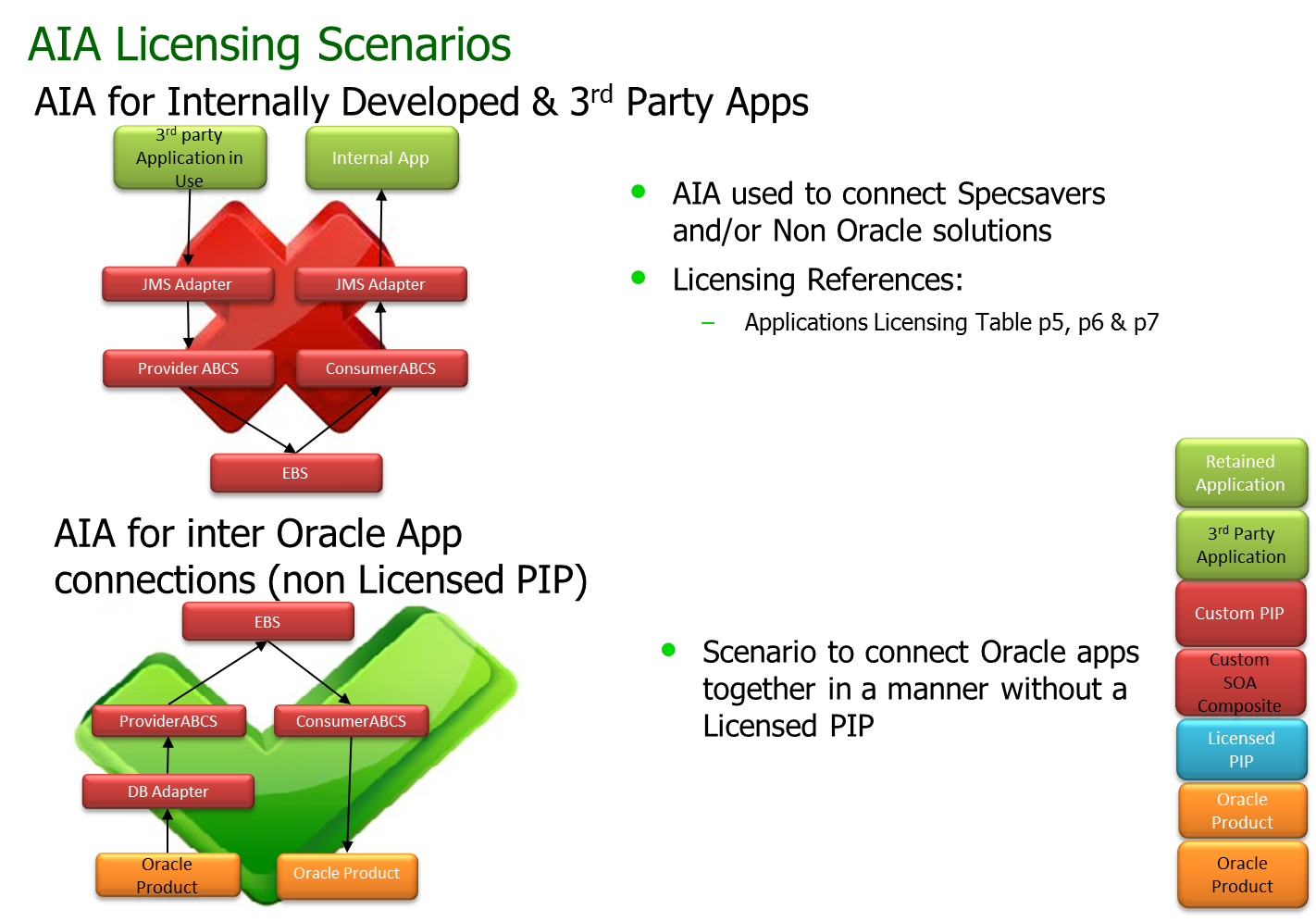
With all of this in mind, we’ve arrived with the idea of usage scenarios. We’ve tried to differentiate usage scenarios from design patterns, as their goals also differ; a pattern is typically to provide a means to describe and provide good design approaches to technical problems, think of things facades and factory’s from the Gang of Four (GoF) or composite patterns such as VETO and here we seeking a means to communicate what can or can’t be done. These aren’t use cases either, if for no other reason to avoid the UML notation association.

So how does it work, so we have identified common or likely approaches to using our Oracle technology stack, need them so there is a short hand reference (as you have with design patterns) and then determined of the scenario is permissible by licensing rules. The idea is that an application architect or developer can design a solution and then verify the solution against the scenarios. To start with go for the obvious scenarios, as things go forward when a situation crops up where there isn’t a scenario you can add the the catalogue  and get confirmation as to compliance.  This should mean after a short period of development you’ll reach a point where you’re not consulting licensing experts all the time.  The secret is not to try ‘boil the ocean’ on day 1 as you’ll invest a lot of time, potentially creating representations of things you’ll never do and produce a very bulky artefact for your developers to try and work with.  Oracle’s AIA Developer Guide

With the scenario we document references to the various license and contract documents showing which clauses drove the decision so you don’t have to rework out how you determined the legitimacy of the scenario.  I’ve created a fake representation of a usage scenario below.

There is a further bonus, you can drive into the guidance when there is a need for additional governance attention.

Of course this mechanism doesn’t tackle the question of is there sufficient licensed capacity. As capacity management has its own set of challenges (such as balancing the capacity requirement forecasts for multiple current development programmes that are likely to be taking place vs actual consumption and forecast consumption for business growth).

The following diagram is a mock up of the sort of diagrams produced. Mocked up as I don’t want (and shouldn’t) disclose any information about what specific technologies and approaches we’ve adopted internally.

Usage Scenario with 1 scenario acceptable, another note

Usage Scenario with 1 scenario acceptable, another not


Key


approval


Share this:

  • Share on Facebook (Opens in new window) Facebook
  • Share on X (Opens in new window) X
  • Share on Reddit (Opens in new window) Reddit
  • Email a link to a friend (Opens in new window) Email
  • Share on WhatsApp (Opens in new window) WhatsApp
  • Print (Opens in new window) Print
  • Share on Tumblr (Opens in new window) Tumblr
  • Share on Mastodon (Opens in new window) Mastodon
  • Share on Pinterest (Opens in new window) Pinterest
  • More
  • Share on Bluesky (Opens in new window) Bluesky
  • Share on LinkedIn (Opens in new window) LinkedIn
Like Loading...

UK Oracle User Group – Special Interest Groups

07 Friday Feb 2014

Posted by mp3monster in Oracle, Technology

≈ Leave a comment

Tags

Oracle, OUG, SIG, user group

I am fortunate enough to have an employer who promotes the idea of community participation both internally but also with communities relating to our technology vendors such as Oracle. As a result manage our membership of the UK Oracle User Group.

The original motivation for membership was that membership effectively paid for attendance to the big annual conferences, given the chance of attending Oracle Open World was a lot less likely.

In addition to the conference opportunity, part of our membership is the opportunity to participate in Special Interest Group (SIG) sessions. There are SIGs covering different aspects of Oracle’s portfolio from middleware and development technologies (my specialisms) through to Supply Chain and JD Edwards and obviously database tech. I have to admit I didn’t have great expectations when I attended my first SIG. But actually the first SIG and subsequent ones I have attended have been gold mines of useful information. The sessions cover a range of topics and the presentations come from customers, partners as well as Oracle and are typically very conversational as a result you pickup insight into a lot of practical aspects not just theory as you’d commonly get in say a training session.

As Oracle support the SIGs by having representation at the SIGs which means there is potential opportunities to pick an SME’s brains – 15 minutes of free consultancy over coffee (something that doesn’t come often with Oracle 😉 ). Not to mention time given in the day to chew the fat with partners and other customers. For example on my 2nd SIG session I ended up discussing experiences of working with Packt Publishing with an Oracle Partner (not necessarily directly related, but interesting to see what the experience was like from an author’s perspective).

I know from talking with other colleagues where I work who have attended SIGs have come away feeling that it was a day well used (and have also encouraged other to participate). It would also seem that many people who attend also participate on a regular basis suggesting they to get a lot out of the sessions (all lending towards a bit of a community spirit as well).

Based on my experiences, and those shared with me I would strongly recommend finding an excuse (or making the time as if is for me) to get out of the office a take advantage of your membership (or even joining UKOUG). Justify it as cheap training if need be; but getting yourself along to one of Oracle’s offices (who lend their facilities to support the user group) in London, Reading or Solihull I’m sure you’ll find it will be very worthwhile even if the travel is a bit of a bind.

I would also like to take the time to thank people like  Simon Haslam at Veriton who put their time and effort in organising their particular SIG sessions.

Share this:

  • Share on Facebook (Opens in new window) Facebook
  • Share on X (Opens in new window) X
  • Share on Reddit (Opens in new window) Reddit
  • Email a link to a friend (Opens in new window) Email
  • Share on WhatsApp (Opens in new window) WhatsApp
  • Print (Opens in new window) Print
  • Share on Tumblr (Opens in new window) Tumblr
  • Share on Mastodon (Opens in new window) Mastodon
  • Share on Pinterest (Opens in new window) Pinterest
  • More
  • Share on Bluesky (Opens in new window) Bluesky
  • Share on LinkedIn (Opens in new window) LinkedIn
Like Loading...

Next book review – Oracle Fusion Applications

05 Wednesday Feb 2014

Posted by mp3monster in Books, General

≈ Leave a comment

Tags

applications, books, extensibility, fusion, handbook, Oracle, Vladimir Ajvaz

The next book up for review is going to be Oracle Fusion Applications Development and Extensibility Handbook (Oracle Press)

I have to declare a slight interest in my reviewing as I have had the good fortune to work with one of the authors- Vladimir Ajvaz; and extremely knowledgeable and talented Application Architect.

Oracle Fusion Applications

Share this:

  • Share on Facebook (Opens in new window) Facebook
  • Share on X (Opens in new window) X
  • Share on Reddit (Opens in new window) Reddit
  • Email a link to a friend (Opens in new window) Email
  • Share on WhatsApp (Opens in new window) WhatsApp
  • Print (Opens in new window) Print
  • Share on Tumblr (Opens in new window) Tumblr
  • Share on Mastodon (Opens in new window) Mastodon
  • Share on Pinterest (Opens in new window) Pinterest
  • More
  • Share on Bluesky (Opens in new window) Bluesky
  • Share on LinkedIn (Opens in new window) LinkedIn
Like Loading...
← Older posts
Newer posts →

    I work for Oracle, all opinions here are my own & do not necessarily reflect the views of Oracle

    • About
      • Internet Profile
      • Music Buying
      • Presenting Activities
    • Books & Publications
      • Logging in Action with Fluentd, Kubernetes and More
      • Logs and Telemetry using Fluent Bit
      • Oracle Integration
      • API & API Platform
        • API Useful Resources
        • Useful Reading Sources
    • Mindmaps Index
    • Monster On Music
      • Music Listening
      • Music Reading
    • Oracle Resources
    • Useful Tech Resources
      • Fluentd & Fluent Bit Additional stuff
        • Logging Frameworks and Fluent Bit and Fluentd connectivity
        • REGEX for BIC and IBAN processing
      • Formatting etc
      • Java and Graal Useful Links
      • Official Sources for Product Logos
      • Python Setup & related tips
      • Recommended Tech Podcasts

    Oracle Ace Director Alumni

    TOGAF 9

    Logs and Telemetry using Fluent Bit


    Logging in Action — Fluentd

    Logging in Action with Fluentd


    Oracle Cloud Integration Book


    API Platform Book


    Oracle Dev Meetup London

    Blog Categories

    • App Ideas
    • Books
      • Book Reviews
      • manning
      • Oracle Press
      • Packt
    • Enterprise architecture
    • General
      • economy
      • ExternalWebPublications
      • LinkedIn
      • Website
    • Music
      • Music Resources
      • Music Reviews
    • Photography
    • Podcasts
    • Technology
      • AI
      • APIs & microservices
      • chatbots
      • Cloud
      • Cloud Native
      • Dev Meetup
      • development
        • languages
          • java
          • node.js
          • python
      • drone
      • Fluent Observability
        • Fluentbit
        • Fluentd
        • OpAMP
      • logsimulator
      • mindmap
      • OMESA
      • Oracle
        • API Platform CS
          • tools
        • Helidon
        • ITSO & OEAF
        • Java Cloud
        • NodeJS Cloud
        • OIC – ICS
        • Oracle Cloud Native
        • OUG
      • railroad diagrams
      • TOGAF
    • xxRetired
    • AI
    • API Platform CS
    • APIs & microservices
    • App Ideas
    • Book Reviews
    • Books
    • chatbots
    • Cloud
    • Cloud Native
    • Dev Meetup
    • development
    • drone
    • economy
    • Enterprise architecture
    • ExternalWebPublications
    • Fluent Observability
    • Fluentbit
    • Fluentd
    • General
    • Helidon
    • ITSO & OEAF
    • java
    • Java Cloud
    • languages
    • LinkedIn
    • logsimulator
    • manning
    • mindmap
    • Music
    • Music Resources
    • Music Reviews
    • node.js
    • NodeJS Cloud
    • OIC – ICS
    • OMESA
    • OpAMP
    • Oracle
    • Oracle Cloud Native
    • Oracle Press
    • OUG
    • Packt
    • Photography
    • Podcasts
    • python
    • railroad diagrams
    • Technology
    • TOGAF
    • tools
    • Website
    • xxRetired

    Enter your email address to subscribe to this blog and receive notifications of new posts by email.

    Join 2,556 other subscribers

    RSS

    RSS Feed RSS - Posts

    RSS Feed RSS - Comments

    March 2026
    M T W T F S S
     1
    2345678
    9101112131415
    16171819202122
    23242526272829
    3031  
    « Feb    

    Twitter

    Tweets by mp3monster

    Meta

    • Create account
    • Log in
    • Entries feed
    • Comments feed
    • WordPress.com

    History

    Speaker Recognition

    Open Source Summit Speaker

    Flickr Pics

    Boxer Rebellion @ Brixton ElectricBoxer Rebellion @ Brixton ElectricBoxer Rebellion @ Brixton ElectricBoxer Rebellion @ Brixton Electric
    More Photos

    Meta

    • Create account
    • Log in
    • Entries feed
    • Comments feed
    • WordPress.com

    Social

    • View @mp3monster’s profile on Twitter
    • View philwilkins’s profile on LinkedIn
    • View mp3monster’s profile on GitHub
    • View mp3monster’s profile on Flickr
    • View mp3muncher’s profile on WordPress.org
    • View philmp3monster’s profile on Twitch
    Follow Phil (aka MP3Monster)'s Blog on WordPress.com

    Blog at WordPress.com.

    • Subscribe Subscribed
      • Phil (aka MP3Monster)'s Blog
      • Join 234 other subscribers
      • Already have a WordPress.com account? Log in now.
      • Phil (aka MP3Monster)'s Blog
      • Subscribe Subscribed
      • Sign up
      • Log in
      • Report this content
      • View site in Reader
      • Manage subscriptions
      • Collapse this bar
     

    Loading Comments...
     

    You must be logged in to post a comment.

      Privacy & Cookies: This site uses cookies. By continuing to use this website, you agree to their use.
      To find out more, including how to control cookies, see here: Our Cookie Policy
      %d