• Home
  • Site Aliases
    • www.cloud-native.info
  • About
    • Background
    • Presenting Activities
    • Internet Profile
      • LinkedIn
    • About
  • Books & Publications
    • Log Generator
    • Logs and Telemetry using Fluent Bit
      • Fluent Bit book
      • Book Resources in GitHub
      • Fluent Bit Classic to YAML Format configurations
    • Logging in Action with Fluentd, Kubernetes and More
      • Logging in Action with Fluentd – Book
      • Fluentd Book Resources
      • Fluentd & Fluent Bit Additional stuff
    • API & API Platform
      • API Useful Resources
    • Oracle Integration
      • Book Website
      • Useful Reading Sources
    • Publication Contributions
  • Resources
    • GitHub
    • Oracle Integration Site
    • Oracle Resources
    • Mindmaps Index
    • Useful Tech Resources
      • Fluentd & Fluent Bit Additional stuff
      • Recommended Tech Podcasts
      • Official Sources for Product Logos
      • Java and Graal Useful Links
      • Python Setup & related stuff
      • DevTips
  • Music
    • Monster On Music
    • Music Listening
    • Music Reading

Phil (aka MP3Monster)'s Blog

~ from Technology to Music

Phil (aka MP3Monster)'s Blog

Category Archives: General

All things general

UKOUG Oracle Scene – Another Article Published

16 Wednesday Nov 2016

Posted by mp3monster in Cloud, General, Oracle, Technology

≈ Leave a comment

The latest edition of the UK Oracle User Group (UKOUG) Oracle Scene Journal is out now with another article from me, in addition to some great content from other contributors. This article builds upon and updates an article previously published in the Oracle Apps User Group about 18 months ago. We updated and republished as part of the run up to the UKOUG special Event in March next year which will be fully announced at the conference in a couple of weeks. You can see it here Oracle Scene Edition 62 – Journey to the Cloud


Share this:

  • Share on Facebook (Opens in new window) Facebook
  • Share on X (Opens in new window) X
  • Share on Reddit (Opens in new window) Reddit
  • Email a link to a friend (Opens in new window) Email
  • Share on WhatsApp (Opens in new window) WhatsApp
  • Print (Opens in new window) Print
  • Share on Tumblr (Opens in new window) Tumblr
  • Share on Mastodon (Opens in new window) Mastodon
  • Share on Pinterest (Opens in new window) Pinterest
  • More
  • Share on Bluesky (Opens in new window) Bluesky
  • Share on LinkedIn (Opens in new window) LinkedIn
Like Loading...

Oracle 2 Minute Tech Tip

06 Sunday Nov 2016

Posted by mp3monster in General, Oracle

≈ Leave a comment

Tags

2MTT, OMCS, Oracle, video, yip

The Oracle Technology Network (OTN) promote/encourage people to submit short videos as 2 minute tech tips – you can check my 1st attempt out …

Share this:

  • Share on Facebook (Opens in new window) Facebook
  • Share on X (Opens in new window) X
  • Share on Reddit (Opens in new window) Reddit
  • Email a link to a friend (Opens in new window) Email
  • Share on WhatsApp (Opens in new window) WhatsApp
  • Print (Opens in new window) Print
  • Share on Tumblr (Opens in new window) Tumblr
  • Share on Mastodon (Opens in new window) Mastodon
  • Share on Pinterest (Opens in new window) Pinterest
  • More
  • Share on Bluesky (Opens in new window) Bluesky
  • Share on LinkedIn (Opens in new window) LinkedIn
Like Loading...

OTN Appreciation Day : OMCS Push Listeners

11 Tuesday Oct 2016

Posted by mp3monster in General, Oracle, Technology

≈ Leave a comment

Tags

#ThanksOTN, Appreciation Day, Cloud, Cloud Service, integration, JMS, messaging, Messaging CS, OMCS, Oracle, oracle-base, OTN, Push Listener, Technology Network

The background to this post, and the OTN Appreciation Day can be seen at Oracle-Base.

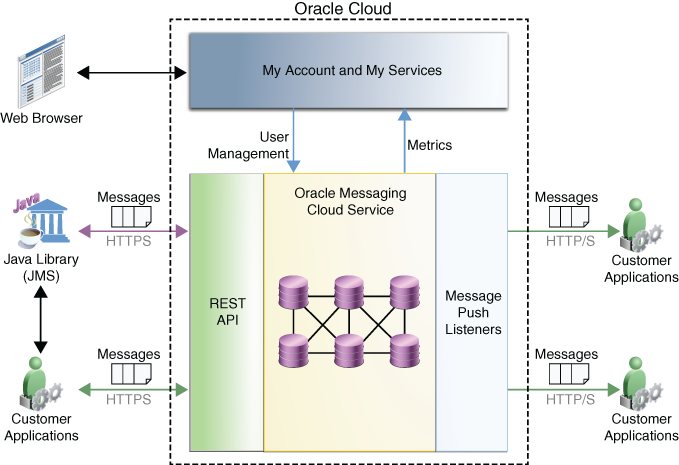
Oracle Messaging Cloud Service (OMCS) is I think an overlooked gem of Oracle iPaaS portfolio.  I say this as it offers a JMS 1.1 compliant Java library but at the same time provides a means through which integration through REST APIs can be performed.  This means it is possible to pretty transparently connect legacy JMS based integrations with new REST based products.  The magic sauce (and therefore my favourite feature) is the concept of the Push Listener. Through the REST API it is possible to register a REST URL as a target for queues and topics to have messages sent to. Once registered when a message appears on the queue or topic it will get passed on as a REST call. Whilst is is possible to do with with a little bit of Java code. the Push Listener simplifies the job to a REST call with a bit of XML configuration.

There is one small challenge that makes the integration completely transparent to the recipient of the PushListener today, and that is it currently demands that authentication process take place on initial contact. This is not a complicated or challenging thing to address, but does require a tiny bit of code to address.

Share this:

  • Share on Facebook (Opens in new window) Facebook
  • Share on X (Opens in new window) X
  • Share on Reddit (Opens in new window) Reddit
  • Email a link to a friend (Opens in new window) Email
  • Share on WhatsApp (Opens in new window) WhatsApp
  • Print (Opens in new window) Print
  • Share on Tumblr (Opens in new window) Tumblr
  • Share on Mastodon (Opens in new window) Mastodon
  • Share on Pinterest (Opens in new window) Pinterest
  • More
  • Share on Bluesky (Opens in new window) Bluesky
  • Share on LinkedIn (Opens in new window) LinkedIn
Like Loading...

eBook(lets) from O’Reilly

27 Tuesday Sep 2016

Posted by mp3monster in Books, General, Technology

≈ Leave a comment

Tags

architecture, Big Data, booklet, books, creative commons, Design, development, ebook, ebooks, free, open books, oreilly, vJUG

I received an email through the virtual Java User Group highlighting the availability of a couple of eBooks around Java published by O’Reilly. The details are below. The books are more booklets (nothing wrong with that). The key difference being that they are shorter and focused on one or two focused subjects (in this case Java 8’s Lambda’s & Streams) which is great because I don’t want a whole Java book again, I just want to get a handle on the key changes and language innovations. It is worth highlighting that these aren’t just ‘free chapters’ which is what you see happen sometimes as the goal of the book is described, doesn’t depend on prior chapters to work the illustrated material and structured with the appropriate cover material contents, index etc so works as a discrete entity.

This approach seems to be coming more common at O’Reilly at least as a marketing device, and we have seen this being done with the Dummies brand where the booklets have then been printed as conference give aways.

Some may argue that this is a reflection of our ever shortening attention span with books. This maybe the case for some, but I suspect it is more about providing some that is more digestible than a ‘free chapter’, but more importantly reflects the recognition that for books that are providing guides (as opposed to reference books – which I’d include patterns books) people don’t want to buy a latest edition of a book where the 1st chapters are exactly the same as the previous edition of the book and that the only significant change is a new section on Lambdas for example.

Any way the latest book details received are:

Introducing Java 8
by Raoul-Gabriel Urma
Offers a practical tutorial to some of the core Java 8 features and gets you programming quickly with Java 8.
Object Oriented vs Functional Programming
by Richard Warburton
Explains the similarities and differences between functional programming and object oriented programming with Java focused examples.

http://insightfullogic.com
@RichardWarburto

The other book(lets) that have drawn my attention to the trend include:

  • Static Site Generators
  • Migrating to Cloud-Native Application Architectures
  • Software Architecture Patterns
  • Little Book of HTML/CSS Coding Guidelines
  • Java the Legend – history of Java
  • Designing Great Web APIs
  • Modern Java Script
  • Hadoop with Python
  • Release Engineering How Google Builds and Delivers Software
  • Functional Programming in Python
  • 20 Python Libraries You Aren’t Using (But Should)
  • Monitoring Distributed Systems
  • Little Book of HTML/CSS Frameworks

In addition to these Book(let)s O’Reilly offer a range of ‘reports’ such as:

  • Mapping Big Data, Evaluating Machine Learning Models, Data Driven  (the full range can be seen at Free Data Reports)
  • Open by Design
  • Design for Voice Interfaces (Siri, Cortana etc)


In addition O’Reilly have a page on ‘Open Books’ (here) – covering significant texts O’Reilly have had some involvement in but published under licenses such as Create Commons.


  • [18-01-16 Update] New booklet added for Modern Java Script
  • [13-03-16 Update] New booklet Continuous Delivery With Windows and Dot Net
  • [14-03-16 Update] New booklet Modern Java EE Design Patterns
  • [13-08-16 Update] New booklet Release Engineering How Google Builds and Delivers Software and Functional Programming in Python
  • [16-09-16 Update] new booklet
    • 20 Python Libraries You Aren’t Using (But Should)
  • [19-09-16 Update] New Booklet Monitoring Distributed Systems
  • [28-09-16]New Booklet Little Book of HTML/CSS Frameworks

Share this:

  • Share on Facebook (Opens in new window) Facebook
  • Share on X (Opens in new window) X
  • Share on Reddit (Opens in new window) Reddit
  • Email a link to a friend (Opens in new window) Email
  • Share on WhatsApp (Opens in new window) WhatsApp
  • Print (Opens in new window) Print
  • Share on Tumblr (Opens in new window) Tumblr
  • Share on Mastodon (Opens in new window) Mastodon
  • Share on Pinterest (Opens in new window) Pinterest
  • More
  • Share on Bluesky (Opens in new window) Bluesky
  • Share on LinkedIn (Opens in new window) LinkedIn
Like Loading...

Open World – Key Messages

22 Thursday Sep 2016

Posted by mp3monster in Cloud, General, Oracle, Technology

≈ 1 Comment

As Oracle Open World comes to a close. What are the big take homes? Well I have to admit to not having been at OOW phyiscally this year, but tracking things from the UK. That sais from this vantage point …

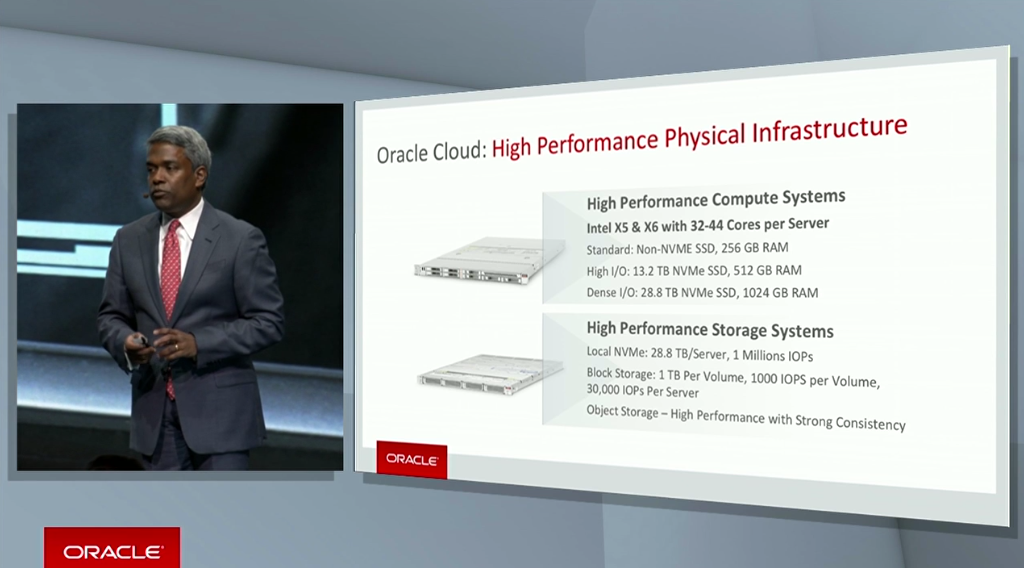
  • 2nd Generation IaaS. The announcements on the evolution of Oracle’s offfering bring some significant steps forward with multi data centre resilience within each region /geographical area. What isn’t clear is whether the resilience will be OOTB on all services, or a cost add at the IaaS and some of the PaaS services. But for SaaS I’d be expecting it to be part of the offering. Below are a couple of screen grabs from Thomas Kurian’s keynote to help convey the details …
Regions Around the World

Regions Around the World

Regions Linked

Regions Highly Permant Linkage

Data Centre Compute

Illustrative details of Data Centre nodes

IaaS Hardware and Platform Supported

IaaS Hardware and Platform Supported

The 2Gen IaaS is interesting because previously Oracle have underplayed the IaaS offering on the basis that it had been necessary to help pitch PaaS and SaaS. But this year with the new generation there seems to be a fair bit of detail on the IaaS make up to help convey and provide clarity of a robust underpinning in capacity, capability, power and security. Which aside from help sell more IaaS it should help reinforce the messaging on the higher order offerings about foundation strength.

  • The IaaS message also makes it easier to convey the message that Oracle cloud doesn’t have to mean Oracle software – it is just as capable with OpenSource tech. This had felt a little niche with the Java cloud services. It certainly appears that Oracle wants to take the fight if not to AWS certainly with Azure, Rackspace etc
  • Following this IaaS message is the cloud in your own data centre. Which addresses residency questions, but provides the cloud software stack and cloud financial models. What will be interesting is how the auditors (as anything likely to demand on-premise deployment is likely to have compliance needs and audit with it) are satisfied that despite Oracle maintaining all the cloud software remotely won’t represent an issue.
  • How the IaaS data centre level resiliency will impact the PaaS offerings is going to be very interesting as SOA providing high availability across multiple locations is not trivial.
  • We have also seen signs of far more dynamic elasticity being shown with examples of being able attach policies to a service to trigger scale up. It will be interesting to see if the ability to mix metered and unmetered resources has also improved. Presently they have to be run as discrete domains because of the pricing models involved.
  • More broadly Oracle are filling out their cloud portfolio and offerings are starting to be harmonised – but there is a long way to go, for example ICS and SOA CS don’t OOTB link to Log Analytics for example). But MySQL as a PaaS offering has crept up on me, with the smallest compute footprint being 24p an hour it is time to take notice.

Share this:

  • Share on Facebook (Opens in new window) Facebook
  • Share on X (Opens in new window) X
  • Share on Reddit (Opens in new window) Reddit
  • Email a link to a friend (Opens in new window) Email
  • Share on WhatsApp (Opens in new window) WhatsApp
  • Print (Opens in new window) Print
  • Share on Tumblr (Opens in new window) Tumblr
  • Share on Mastodon (Opens in new window) Mastodon
  • Share on Pinterest (Opens in new window) Pinterest
  • More
  • Share on Bluesky (Opens in new window) Bluesky
  • Share on LinkedIn (Opens in new window) LinkedIn
Like Loading...

New Kid on the Block and others

12 Monday Sep 2016

Posted by mp3monster in General, Oracle

≈ Leave a comment

Tags

Cloud, journal, OIC - ICS, Oracle Scene, oracle-integration.cloud, OUG

So no new blog entries as I have been busy publishing elsewhere, with the Oracle User Group we appear in the latest edition of the Oracle Scene Journal:

UKOUG Scene Issue 61

click on the image to open the journal properly

We also have a submission in for the November edition, which will be published before the user group’s Tech 16 conference – which I will be presenting at.

UKOUG Tech 16

We have been posting a lot on our website that supports the book – oracle-integration.cloud. Lots of useful references to supporting resources, and some blog posts providing supporting information (and more in the pipeline). Not to mention with pressing on with the last couple of chapters.

Then finally a webinar, the first in a series for the UKOUG about adopting cloud – details at – http://www.ukoug.org/events/ukoug-applications-journey-to-cloud-webinar-1/. The webinar was recorded and the presentation that went with it are accessible if you are a UKOUG member.

Share this:

  • Share on Facebook (Opens in new window) Facebook
  • Share on X (Opens in new window) X
  • Share on Reddit (Opens in new window) Reddit
  • Email a link to a friend (Opens in new window) Email
  • Share on WhatsApp (Opens in new window) WhatsApp
  • Print (Opens in new window) Print
  • Share on Tumblr (Opens in new window) Tumblr
  • Share on Mastodon (Opens in new window) Mastodon
  • Share on Pinterest (Opens in new window) Pinterest
  • More
  • Share on Bluesky (Opens in new window) Bluesky
  • Share on LinkedIn (Opens in new window) LinkedIn
Like Loading...

Implementing Oracle Integration Cloud Service – Gone Alpha

13 Saturday Aug 2016

Posted by mp3monster in Books, General, Oracle, Packt, Technology

≈ Leave a comment

Tags

alpha, book, Cloud, OIC - ICS, Oracle, Packt

alpha-logoWe have taken our book on ICS into Packt Publishing’s Alpha programme so that if you order the book now – you can see the chapters as soon as they have received editorial approval and the complete final book will be made available to you as soon as we’re have addressed all the feedback, made any final improvements we have identified once we have completed the book’s draft.

img_0282-1The book can be found on the Packt website – here

Details about the Authors from Packt can be seen at:

  • Phil Wilkins
  • Robert  van Mölken

Share this:

  • Share on Facebook (Opens in new window) Facebook
  • Share on X (Opens in new window) X
  • Share on Reddit (Opens in new window) Reddit
  • Email a link to a friend (Opens in new window) Email
  • Share on WhatsApp (Opens in new window) WhatsApp
  • Print (Opens in new window) Print
  • Share on Tumblr (Opens in new window) Tumblr
  • Share on Mastodon (Opens in new window) Mastodon
  • Share on Pinterest (Opens in new window) Pinterest
  • More
  • Share on Bluesky (Opens in new window) Bluesky
  • Share on LinkedIn (Opens in new window) LinkedIn
Like Loading...

Windows 10 Pain

20 Wednesday Jul 2016

Posted by mp3monster in General, Technology

≈ Leave a comment

Tags

checkpoint, SSD, volmgrx, Windows 10, Windows 7

Recently I like many have upgraded from Windows 7 (pro) to Windows 10 by passing the much disliked Windows 8.  Whilst it has taken some to settle down with Windows 10 – the UI changes whilst good in some areas have niggled in others.

anniversary_start_menu-600x491But I have learnt a nasty little lesson in the last 24 hours.  I always used to have Windows 7 configured to create restore points – so an app installation typically would also result in a restore point being established.  Well that I discovered appears to have been switched off as a result of the Windows 10 upgrade – so I’ve had to explicitly re-enable it. Fortunately I found this out as result of another problem that I managed to recover from.

As to my other problem, I am also disappointed with the way Windows 10 reacts.  This one is perhaps a little more unusual – I run my desktop with mirrored drives. Whilst I I haven’t switched my system disk over to an SSD (migrating a system disk still involves an OS rebuild – which I never seem to have time for) the mirroring was intended to do 2 things 1 resilience so if a drive lets go then I’m not dead in the water but also more performance as the OS should be smart enough to read from both disks.  However, every now and again when shutting down in Windows 7 (and Windows 10 I have now discovered) will lose synchronization.

Whilst a pain – and also a little unsettling as there is always the question of data corruption. Identifying the problem and resolving in Windows 7 wasn’t difficult – electing which drive image to boot from, then going into Windows management and ensuring disks were ok, and setting the resync activity off. But under Windows 10 – not so great. So you get stuck into a reboot error cycle with a volmgrx_internal_error.  I have a USB stick with a Windows 10 Recovery image – what a waste of space.  Having looked around on the net saw the usual guidance of get to a shell ruin chkdsk etc. Well getting to a prompt is fiddly, and chkdsk doesn’t recognize an issue!  Finally I decided to try the Windows 7 image you can retain when installing – and although slow booting compared to Windows 10. We’re in and see the problem – usual actions, a reboot and all is well.

So lessons, re-enable check pointing, create a restore drive image (probably easier to recover from).  Reconsider a simpler single SSD boot drive, and bite the bullet of a system rebuild.

Share this:

  • Share on Facebook (Opens in new window) Facebook
  • Share on X (Opens in new window) X
  • Share on Reddit (Opens in new window) Reddit
  • Email a link to a friend (Opens in new window) Email
  • Share on WhatsApp (Opens in new window) WhatsApp
  • Print (Opens in new window) Print
  • Share on Tumblr (Opens in new window) Tumblr
  • Share on Mastodon (Opens in new window) Mastodon
  • Share on Pinterest (Opens in new window) Pinterest
  • More
  • Share on Bluesky (Opens in new window) Bluesky
  • Share on LinkedIn (Opens in new window) LinkedIn
Like Loading...

AIA Rides Again?

23 Thursday Jun 2016

Posted by mp3monster in General, Oracle, Technology

≈ Leave a comment

Tags

11g, 12c, AIA, Canonical, canonical model, OAGIS, Oracle, PIP, Scott Nieman, SOA

canonicaldatamodel

For those who have been using the Application Integration Architecture on top of Oracle SOA Suite, will probably know that Oracle have sunset AIA as of 12c.  For 12.1 there are Core Extensions to help transition onto the 12c platform but 12.2 leaves these behind.

One of the more valuable parts of AIA for many has been the prebuilt but extensible canonical data model, which are then used by the Prebuilt Integration Packs (PIPs). Having a ready built canonical form can save an enormous amount of effort (consider the amount of effort invested by OASIS and other standards bodies to define standardised data definitions).

So with AIA not moving forward and the canonical form (i.e. XML Schema) no longer being maintained. The question begs how to move forward?  Well given that the model is represented by XML schema you could harvest the schema from an 11g environment, package them up and deploy them in a standalone manner in a 12c environment.  Whilst this will work, it does mean that the data model wont have any future evolution other than by home grown effort.

Depending on your commitment to the AIA model, there is another option to adopt another prebuild form.  I know as result of talking with several other Oracle AIA customers that people are adopting OAGIS.  This isn’t surprising as they have similar characteristics in the way to extend, the way the definitions are defined and structured etc.  Not to mention some common ancestry. However if you have a significant level of utilisation moving to a new model is potentially going to have a significant level of impact.

image008As we have also elected to go the OAGIS route (but fortunately are fairly youthful in our adoption so have elected to switch quickly for all but a couple of objects types. Given this,  I periodically check in with the OAGIS website to come across the following:

Oracle Enterprise Business Objects Contributed to OAGi 
We are very pleased to announce that Oracle has contributed their Enterprise Business Objects (EBOs) and associated IP to OAGi!
The Oracle EBOs are based on OAGIS BODs from a past release and no longer supported by Oracle so they contributed them to us to harmonize with the current version of OAGIS and preserve a technology path for EBO customers.
This also gives OAGi an opportunity to further improve OAGIS content and scope.
I take this as proof of Oracle’s commitment to Open Standards and plan to say so in a press release.  I personally thank Oracle for this commitment.
Scott Nieman of Land O’Lakes will be presenting his Project Definition to begin the process of harmonization on Friday, June 3, at 11 AM EDT at the Next meeting which, as members, you are all invited. Please let me know if you don’t have an invitation and I will forward it to you.
Please join me in thanking Oracle and also please try to engage in our harmonization process to improve OAGIS.

So the basis of this is that OAGIS will gain greater coverage of their domain views. But additionally Scott Nieman will be blazing the way to easing the migration path. I have been fortunate enough to meet and talk with Scott at Oracle Open World and it will be worth keeping an eye out for his findings.

Share this:

  • Share on Facebook (Opens in new window) Facebook
  • Share on X (Opens in new window) X
  • Share on Reddit (Opens in new window) Reddit
  • Email a link to a friend (Opens in new window) Email
  • Share on WhatsApp (Opens in new window) WhatsApp
  • Print (Opens in new window) Print
  • Share on Tumblr (Opens in new window) Tumblr
  • Share on Mastodon (Opens in new window) Mastodon
  • Share on Pinterest (Opens in new window) Pinterest
  • More
  • Share on Bluesky (Opens in new window) Bluesky
  • Share on LinkedIn (Opens in new window) LinkedIn
Like Loading...

Cloud FTP

18 Saturday Jun 2016

Posted by mp3monster in Books, General, Oracle, Packt, Technology

≈ Leave a comment

Tags

box, dropbox, FTP, IoT, OIC - ICS, Oracle, social

Whilst working on our book about Oracle’s Integration Cloud Service I looked around to see what options are available for FTP based services, below is a list of the services, we can’t testify to the quality etc of the service but might be easier than a Google search and ploughing through the results as FTP does occur a lot even in services that don’t support the standard.

What was interesting was none of the major document collaboration platforms offer an FTP based view onto their platform, but rather push an API. Whilst it is clear that FTP wouldn’t provide all the richness of the capabilities of Dropbox, Box, One Drive etc it is as a standard so universally supported that it would mean you could have the most common use models supported from just about anywhere without needing to install a proprietary app or writing code against an API. It would be interesting to see how how such capabilities could impact areas such as IoT.

Fortunately ICS includes social adapters that allows it to connect to these social platforms. But, we still need an easy FTP server to help show how to use FTP (it is still used heavily win closed ecosystems), so here is the list:

  • https://www.sharefile.com – free trial
  • https://brickftp.com – free trial
  • https://hostedftp.com/ – free trial
  • https://www.exavault.com – free trial
  • https://byet.host/
  • http://www.zettahost.com/
  • http://www.serversfree.com/

Share this:

  • Share on Facebook (Opens in new window) Facebook
  • Share on X (Opens in new window) X
  • Share on Reddit (Opens in new window) Reddit
  • Email a link to a friend (Opens in new window) Email
  • Share on WhatsApp (Opens in new window) WhatsApp
  • Print (Opens in new window) Print
  • Share on Tumblr (Opens in new window) Tumblr
  • Share on Mastodon (Opens in new window) Mastodon
  • Share on Pinterest (Opens in new window) Pinterest
  • More
  • Share on Bluesky (Opens in new window) Bluesky
  • Share on LinkedIn (Opens in new window) LinkedIn
Like Loading...
← Older posts
Newer posts →

    I work for Oracle, all opinions here are my own & do not necessarily reflect the views of Oracle

    • About
      • Internet Profile
      • Music Buying
      • Presenting Activities
    • Books & Publications
      • Logging in Action with Fluentd, Kubernetes and More
      • Logs and Telemetry using Fluent Bit
      • Oracle Integration
      • API & API Platform
        • API Useful Resources
        • Useful Reading Sources
    • Mindmaps Index
    • Monster On Music
      • Music Listening
      • Music Reading
    • Oracle Resources
    • Useful Tech Resources
      • Fluentd & Fluent Bit Additional stuff
        • Logging Frameworks and Fluent Bit and Fluentd connectivity
        • REGEX for BIC and IBAN processing
      • Formatting etc
      • Java and Graal Useful Links
      • Official Sources for Product Logos
      • Python Setup & related tips
      • Recommended Tech Podcasts

    Oracle Ace Director Alumni

    TOGAF 9

    Logs and Telemetry using Fluent Bit


    Logging in Action — Fluentd

    Logging in Action with Fluentd


    Oracle Cloud Integration Book


    API Platform Book


    Oracle Dev Meetup London

    Blog Categories

    • App Ideas
    • Books
      • Book Reviews
      • manning
      • Oracle Press
      • Packt
    • Enterprise architecture
    • General
      • economy
      • ExternalWebPublications
      • LinkedIn
      • Website
    • Music
      • Music Resources
      • Music Reviews
    • Photography
    • Podcasts
    • Technology
      • AI
      • APIs & microservices
      • chatbots
      • Cloud
      • Cloud Native
      • Dev Meetup
      • development
        • languages
          • java
          • node.js
          • python
      • drone
      • Fluentbit
      • Fluentd
      • logsimulator
      • mindmap
      • OMESA
      • Oracle
        • API Platform CS
          • tools
        • Helidon
        • ITSO & OEAF
        • Java Cloud
        • NodeJS Cloud
        • OIC – ICS
        • Oracle Cloud Native
        • OUG
      • railroad diagrams
      • TOGAF
    • xxRetired
    • AI
    • API Platform CS
    • APIs & microservices
    • App Ideas
    • Book Reviews
    • Books
    • chatbots
    • Cloud
    • Cloud Native
    • Dev Meetup
    • development
    • drone
    • economy
    • Enterprise architecture
    • ExternalWebPublications
    • Fluentbit
    • Fluentd
    • General
    • Helidon
    • ITSO & OEAF
    • java
    • Java Cloud
    • languages
    • LinkedIn
    • logsimulator
    • manning
    • mindmap
    • Music
    • Music Resources
    • Music Reviews
    • node.js
    • NodeJS Cloud
    • OIC – ICS
    • OMESA
    • Oracle
    • Oracle Cloud Native
    • Oracle Press
    • OUG
    • Packt
    • Photography
    • Podcasts
    • python
    • railroad diagrams
    • Technology
    • TOGAF
    • tools
    • Website
    • xxRetired

    Enter your email address to subscribe to this blog and receive notifications of new posts by email.

    Join 2,556 other subscribers

    RSS

    RSS Feed RSS - Posts

    RSS Feed RSS - Comments

    March 2026
    M T W T F S S
     1
    2345678
    9101112131415
    16171819202122
    23242526272829
    3031  
    « Feb    

    Twitter

    Tweets by mp3monster

    History

    Speaker Recognition

    Open Source Summit Speaker

    Flickr Pics

    Gogo Penguin at the BarbicanGogo Penguin at the BarbicanGogo Penguin at the BarbicanGogo Penguin at the Barbican
    More Photos

    Social

    • View @mp3monster’s profile on Twitter
    • View philwilkins’s profile on LinkedIn
    • View mp3monster’s profile on GitHub
    • View mp3monster’s profile on Flickr
    • View mp3muncher’s profile on WordPress.org
    • View philmp3monster’s profile on Twitch
    Follow Phil (aka MP3Monster)'s Blog on WordPress.com

    Blog at WordPress.com.

    • Subscribe Subscribed
      • Phil (aka MP3Monster)'s Blog
      • Join 234 other subscribers
      • Already have a WordPress.com account? Log in now.
      • Phil (aka MP3Monster)'s Blog
      • Subscribe Subscribed
      • Sign up
      • Log in
      • Report this content
      • View site in Reader
      • Manage subscriptions
      • Collapse this bar
     

    Loading Comments...
     

    You must be logged in to post a comment.

      Privacy & Cookies: This site uses cookies. By continuing to use this website, you agree to their use.
      To find out more, including how to control cookies, see here: Our Cookie Policy
      %d