• Home
  • Site Aliases
    • www.cloud-native.info
  • About
    • Background
    • Presenting Activities
    • Internet Profile
      • LinkedIn
    • About
  • Books & Publications
    • Log Generator
    • Logs and Telemetry using Fluent Bit
      • Fluent Bit book
      • Book Resources in GitHub
      • Fluent Bit Classic to YAML Format configurations
    • Logging in Action with Fluentd, Kubernetes and More
      • Logging in Action with Fluentd – Book
      • Fluentd Book Resources
      • Fluentd & Fluent Bit Additional stuff
    • API & API Platform
      • API Useful Resources
    • Oracle Integration
      • Book Website
      • Useful Reading Sources
    • Publication Contributions
  • Resources
    • GitHub
    • Oracle Integration Site
    • Oracle Resources
    • Mindmaps Index
    • Useful Tech Resources
      • Fluentd & Fluent Bit Additional stuff
      • Recommended Tech Podcasts
      • Official Sources for Product Logos
      • Java and Graal Useful Links
      • Python Setup & related stuff
  • Music
    • Monster On Music
    • Music Listening
    • Music Reading

Phil (aka MP3Monster)'s Blog

~ from Technology to Music

Phil (aka MP3Monster)'s Blog

Category Archives: Oracle

All things related to Oracle

AIA Rides Again?

23 Thursday Jun 2016

Posted by mp3monster in General, Oracle, Technology

≈ Leave a comment

Tags

11g, 12c, AIA, Canonical, canonical model, OAGIS, Oracle, PIP, Scott Nieman, SOA

canonicaldatamodel

For those who have been using the Application Integration Architecture on top of Oracle SOA Suite, will probably know that Oracle have sunset AIA as of 12c.  For 12.1 there are Core Extensions to help transition onto the 12c platform but 12.2 leaves these behind.

One of the more valuable parts of AIA for many has been the prebuilt but extensible canonical data model, which are then used by the Prebuilt Integration Packs (PIPs). Having a ready built canonical form can save an enormous amount of effort (consider the amount of effort invested by OASIS and other standards bodies to define standardised data definitions).

So with AIA not moving forward and the canonical form (i.e. XML Schema) no longer being maintained. The question begs how to move forward?  Well given that the model is represented by XML schema you could harvest the schema from an 11g environment, package them up and deploy them in a standalone manner in a 12c environment.  Whilst this will work, it does mean that the data model wont have any future evolution other than by home grown effort.

Depending on your commitment to the AIA model, there is another option to adopt another prebuild form.  I know as result of talking with several other Oracle AIA customers that people are adopting OAGIS.  This isn’t surprising as they have similar characteristics in the way to extend, the way the definitions are defined and structured etc.  Not to mention some common ancestry. However if you have a significant level of utilisation moving to a new model is potentially going to have a significant level of impact.

image008As we have also elected to go the OAGIS route (but fortunately are fairly youthful in our adoption so have elected to switch quickly for all but a couple of objects types. Given this,  I periodically check in with the OAGIS website to come across the following:

Oracle Enterprise Business Objects Contributed to OAGi 
We are very pleased to announce that Oracle has contributed their Enterprise Business Objects (EBOs) and associated IP to OAGi!
The Oracle EBOs are based on OAGIS BODs from a past release and no longer supported by Oracle so they contributed them to us to harmonize with the current version of OAGIS and preserve a technology path for EBO customers.
This also gives OAGi an opportunity to further improve OAGIS content and scope.
I take this as proof of Oracle’s commitment to Open Standards and plan to say so in a press release.  I personally thank Oracle for this commitment.
Scott Nieman of Land O’Lakes will be presenting his Project Definition to begin the process of harmonization on Friday, June 3, at 11 AM EDT at the Next meeting which, as members, you are all invited. Please let me know if you don’t have an invitation and I will forward it to you.
Please join me in thanking Oracle and also please try to engage in our harmonization process to improve OAGIS.

So the basis of this is that OAGIS will gain greater coverage of their domain views. But additionally Scott Nieman will be blazing the way to easing the migration path. I have been fortunate enough to meet and talk with Scott at Oracle Open World and it will be worth keeping an eye out for his findings.
Share this:

  • Share on Facebook (Opens in new window) Facebook
  • Share on X (Opens in new window) X
  • Share on Pocket (Opens in new window) Pocket
  • Share on Reddit (Opens in new window) Reddit
  • Email a link to a friend (Opens in new window) Email
  • Share on WhatsApp (Opens in new window) WhatsApp
  • Print (Opens in new window) Print
  • Share on Tumblr (Opens in new window) Tumblr
  • Share on Mastodon (Opens in new window) Mastodon
  • Share on Pinterest (Opens in new window) Pinterest
  • More
  • Share on Bluesky (Opens in new window) Bluesky
  • Share on LinkedIn (Opens in new window) LinkedIn
Like Loading...

Cloud FTP

18 Saturday Jun 2016

Posted by mp3monster in Books, General, Oracle, Packt, Technology

≈ Leave a comment

Tags

box, dropbox, FTP, IoT, OIC - ICS, Oracle, social

Whilst working on our book about Oracle’s Integration Cloud Service I looked around to see what options are available for FTP based services, below is a list of the services, we can’t testify to the quality etc of the service but might be easier than a Google search and ploughing through the results as FTP does occur a lot even in services that don’t support the standard.

What was interesting was none of the major document collaboration platforms offer an FTP based view onto their platform, but rather push an API. Whilst it is clear that FTP wouldn’t provide all the richness of the capabilities of Dropbox, Box, One Drive etc it is as a standard so universally supported that it would mean you could have the most common use models supported from just about anywhere without needing to install a proprietary app or writing code against an API. It would be interesting to see how how such capabilities could impact areas such as IoT.

Fortunately ICS includes social adapters that allows it to connect to these social platforms. But, we still need an easy FTP server to help show how to use FTP (it is still used heavily win closed ecosystems), so here is the list:

  • https://www.sharefile.com – free trial
  • https://brickftp.com – free trial
  • https://hostedftp.com/ – free trial
  • https://www.exavault.com – free trial
  • https://byet.host/
  • http://www.zettahost.com/
  • http://www.serversfree.com/

Share this:

  • Share on Facebook (Opens in new window) Facebook
  • Share on X (Opens in new window) X
  • Share on Pocket (Opens in new window) Pocket
  • Share on Reddit (Opens in new window) Reddit
  • Email a link to a friend (Opens in new window) Email
  • Share on WhatsApp (Opens in new window) WhatsApp
  • Print (Opens in new window) Print
  • Share on Tumblr (Opens in new window) Tumblr
  • Share on Mastodon (Opens in new window) Mastodon
  • Share on Pinterest (Opens in new window) Pinterest
  • More
  • Share on Bluesky (Opens in new window) Bluesky
  • Share on LinkedIn (Opens in new window) LinkedIn
Like Loading...

Maintenance & Patching For SOA CS

30 Monday May 2016

Posted by mp3monster in Cloud, General, Oracle, Technology

≈ 1 Comment

Tags

Cloud, HA, Maintenance, Oracle, PaaS, patching, SOA, SOACS

When you’re using SOA Suite to run round the clock services you need to give a fair bit of thought to your deployment configuration so it becomes possible to perform rolling patches and other maintenance tasks not only to SOA itself but all the way down to the hardware – and at the low levels you have no control on the maintenance process.  Although it is very easy to think that the moment you’re using PaaS that these problems are taken care for you, life isn’t as simple as that.

Oracle cloud services typically go through a patching process once a month and usually within a defined 8 hour period on a Friday night. During this period you may lose the use of your servers as the maintenance is performed within a particular availability zone. In an ideal world this would be a rolling process so you don’t lose everything at once. If the maintenance window is used to to deploy SOA Suite patches then although you will be told of the maintenance window you actually wont have an outage, but post the maintenance window your cloud dashboard will have the option to apply the patches at a time that best suits you. Not only that the patch application process is smart enough to apply it in a rolling manner as the Weblogic nodes in the cluster will have information on each other which the patch mechanism can utilise.

So where is the problem.  It is very easy to forget that the PaaS platform is virtual, this means the virtualization platform being software will inevitably need patching whether that is for bug fixing,  addressing security requirements or adding new capabilities. These kinds of changes today will trigger a service shutdown. Let’s be honest when trying to balance a rolling change and maximise PaaS client density is going to create a monumentally complex problem, so simplicity and and speed of roll-out suggests a small outage is easier. So how do I therefore assure I can maintain a quality of service if I accept this as a necessity?


Well the answer is pretty much the same as  an on premise reference architecture.  Have SOA with its supporting databases running in a second availability zone that will have a different patch time. This is going to push up the cost as you’ll need a database with Dataguard. Assuming an active-passive model across your centres, as you approach the maintenance window you’ll get your load balancer to route work load to the second location and let the existing workload run dry on the servers due to go through the maintenance process. Then after the maintenance window you’ll reverse the process.

The current gotchya with this is that you pay for SOA by the month so you in effect have to run two clusters, although hour and daily models are coming.With the hourly model you can have the second availability zone ready for use by keeping the DB alive there, but only startup the SOA instances on the hourly rate when you know the maintenance window is going to occur and it is clear there will be an infrastructure impact.

The other sticky point, is presently as the period allocated is upto eight hours, your second centre needs to be running in a timezone with atleast 8 hours difference (allowing time to fail back). This would mean if you are using the Amsterdam or Slough locations your second location is going to West coast US or Asia Pacific once live later this year or Japan. All of which will present serious issues regarding personal data.

I have been told that some signficiant customers have accepted the situation on the basis the downtime in reality isn’t frequent and correlates to low business periods. But I suspect competition and customer demand will force this to change.

Share this:

  • Share on Facebook (Opens in new window) Facebook
  • Share on X (Opens in new window) X
  • Share on Pocket (Opens in new window) Pocket
  • Share on Reddit (Opens in new window) Reddit
  • Email a link to a friend (Opens in new window) Email
  • Share on WhatsApp (Opens in new window) WhatsApp
  • Print (Opens in new window) Print
  • Share on Tumblr (Opens in new window) Tumblr
  • Share on Mastodon (Opens in new window) Mastodon
  • Share on Pinterest (Opens in new window) Pinterest
  • More
  • Share on Bluesky (Opens in new window) Bluesky
  • Share on LinkedIn (Opens in new window) LinkedIn
Like Loading...

Book Progress

27 Friday May 2016

Posted by mp3monster in General, Oracle, Packt

≈ Leave a comment

Tags

book, Cloud, integration, iPaaS, OIC - ICS, Oracle, PaaS

The book is progressing well – we have the cover art mocked up now and a domain for any additional stuff we do to support the book – http://oracle-integration.cloud/  ….

Share this:

  • Share on Facebook (Opens in new window) Facebook
  • Share on X (Opens in new window) X
  • Share on Pocket (Opens in new window) Pocket
  • Share on Reddit (Opens in new window) Reddit
  • Email a link to a friend (Opens in new window) Email
  • Share on WhatsApp (Opens in new window) WhatsApp
  • Print (Opens in new window) Print
  • Share on Tumblr (Opens in new window) Tumblr
  • Share on Mastodon (Opens in new window) Mastodon
  • Share on Pinterest (Opens in new window) Pinterest
  • More
  • Share on Bluesky (Opens in new window) Bluesky
  • Share on LinkedIn (Opens in new window) LinkedIn
Like Loading...

Challenges for the Citizen Integrator

02 Saturday Apr 2016

Posted by mp3monster in General, Oracle, Technology

≈ Leave a comment

Tags

apiary, apiary.io, Boomerang, Citizen Integrator, Cloud, mockable, mockable.io, mocking, OIC - ICS, Oracle, REST, SOAP, SoapUI, testing, WSDL

cloudgs_integrationWe’ve been developing the example integrations to go with book on ICS and have encountered some interesting challenges for the Citizen Integrator (CI) when using an iPaaS (integration Platform as a Service). To say it in non techno speak  someone wanting to plumb system together without needing to be equipped and have the skills of a developer and just using the cloud. One such example is SOAP API testing, before connecting live systems together even a CI will probably want to check that you have mapped the data correctly – important when you’ve potentially got functions and repeating structures in the mapping. To go back to my old analogy that tools for a CI like ICS are the same as Excel to ERP. Then like when creating formulas in a spreadsheet you’re going to plumb in some numbers and check the formula’s results before using in anger.boomerang2b1366

So far so obvious, the fun comes not when you’re wanting to simulate the source event coming into the tool – this can be done through a raft of utilities from Chrome Browser extensions such as Boomerang, soapui_logoSoapUI for example. Things become a lot more challenging when   comes when you want the integration output to go to a mock SOAP API.   The choices available are limited, and pretty much come down to:

  • If you’re lucky you might be able to connect to a test instance of the target service. SalesForce offers a sandbox instance for example to those with a production instance of SalesForce.
  • However sandbox/test instances are less likely for ‘in house’ solutions or products offered as an on premise solution unless there happens to be active development on the solution taking place.screenshot_48
  • Ideally a mocking tool is the route to go – but only 1 option in this space appears to be available for SOAP called mockable.io
  • Other than mockable you’re into using locally installed software and things get messy as it means getting the outbound web traffic routed to your own machine and then use something like MockServer (there is a great article about this tool by my book co-author Robert van Molken here). The chances are unless the network & security manager(s) are good friends or you like messing with your home network it isn’t going to happen.
  • The final option is instantiating an IaaS platform such as Amazon (AWS Free Developer intro scheme to keep your cost down) or perhaps Oracle IaaS, although I’d suggest this is a fairly expensive route to enable the testing of an integration, not to mention the effort to setup things to run the test.

With REST services things are somewhat easier, as there is a lot more tools geared to helping the design of APIs, testing them and critically providing a proxy based framework 65f3fc0eadfae8135439b4ff48f63fd4to enable monetisation. For example Apiary.io can create a test harness for you. Others such as Apigee, also offer such abilities. Apiary offers a trial account and we’ll be hearing a lot more about Apiary in the near future. There is a possible work around, which is to create test integrations that  map the SOAP content into a REST service (Apigee offers such a capability) but with certain constraints you could also do this within ICS itself. But we’ll look at such options within the book (can’t go without to money shot 😀 ).

This of course has only looked at the conventional use of SOAP, if you need to work with a SOAP interface that makes use of the more advanced WS-* extensions such as Reliable Messaging then things come pretty serious, and I’m afraid today you’re going to need to resort to development, and I suspect you’ll not escape that in the future either.

Share this:

  • Share on Facebook (Opens in new window) Facebook
  • Share on X (Opens in new window) X
  • Share on Pocket (Opens in new window) Pocket
  • Share on Reddit (Opens in new window) Reddit
  • Email a link to a friend (Opens in new window) Email
  • Share on WhatsApp (Opens in new window) WhatsApp
  • Print (Opens in new window) Print
  • Share on Tumblr (Opens in new window) Tumblr
  • Share on Mastodon (Opens in new window) Mastodon
  • Share on Pinterest (Opens in new window) Pinterest
  • More
  • Share on Bluesky (Opens in new window) Bluesky
  • Share on LinkedIn (Opens in new window) LinkedIn
Like Loading...

Oracle PaaS – the Good and opportunities to get better

19 Saturday Mar 2016

Posted by mp3monster in General, Java Cloud, Oracle, Technology

≈ Leave a comment

Tags

Cloud, deployment, java, Licensing, Oracle, PaaS, SOA

IMG_0180Although Oracle have been late to the cloud party they are certainly making up for it, by bringing products to the cloud at an amazing pace, and using their core products to build out new offerings at a rate that will mean they will at least catch  all the competition across  the breadth of PaaS very quickly.

When it comes to taking on Oracle PaaS  it does have  some quirks, some relate to Oracle’s normal licensing approach, and others I’m told relate to the way US accounting has to work when it comes to realised revenue. A couple of other characteristics I suspect are linked to the fact that the infrastructure for Oracle’s cloud is still being rolled out and grown for capacity.

So firstly the carry over – well outside of a trial account you need to agree and sign a general agreement which provides an overarching legal framework defining terms, conditions and liabilities. This makes dealing with each subsequent purchase a little simpler. Rather than purchasing services as you go, you then purchase credits from Oracle which have a maximum life of 1 year. This does mean you’re not got a pure OPEX spend model – although you do stand a chance of negotiating a better deal as the numbers are naturally bigger. As part of the agreement you’ll get a rate card, so different services cost different amounts – for example a standard edition database will cost x and an enterprise high performance version will cost a bit more. The credits are for specific product families such as SaaS products, products in the PaaS domain for example document cloud, Java cloud, SOA and so on. But make sure the products you might want are in the families you get credits for, there is the odd surprise for example MBaaS isn’t in the same family as the integration products.

In addition your negotiation you need to consider whether  services are in metered or unmetered models.  Unmetered means you agree a level of capacity for the year. This will obviously work out cheaper than a metered model where you can use up your credits as you choose, with different metering rates – for example hourly and monthly. When this was first explained it looked really good for dealing with the situation of having a baseline demand which could be unmetered and then purchasing metered services to capacity burst. Sadly this isn’t possible out of the box. I suspect because of the way Oracle cloud allocates workload to different work domains. So bursting workload would have to be done as if you’re bursting in 2 different clouds. So if you have a dynamic load you either go unmetered to your maximum demand or metered for everything. Either way you’re not getting the best in terms of cost management.  I have to admit I don’t know whether the likes of AWS and Azure when you enter into long term agreements have the same challenges.

One the positive side, with the credits you can then purchase a broad range of configurations of products from just ADB schema all the way a full size  Exadata setup. So performing PoCs is pretty easy and figuring out scaling just means burning your credits quickly and instantiating more capacity.

Before getting into instantiating your cloud instances you’d best  setup access controls to allow people access controls to creating instances. Then you can start creating instances of the products you want. Make sure you protect your credentials as the way things are setup anyone else recovering them will be a problem.

With services such as SOA and Java you do need to go through the process of creating the different layers, storage, then the database and so on. But unlike building on premise each step only requires a couple of clicks and your done. To put it into context the first time I built a small footprint 11g environment took me a couple of days to work my way through on my own create a DB, deploy RCU,Weblogic, SOA and AIA foundation (no load balancing or security etc) and was no way near secure as a cloud instance. Oracle PaaS in three hours we:

  • Meet our Customer Success Manager (more on this shortly)
  • Got the utilities such as putty installed on my laptop
  •  Walked through putty’s key generation quirks and how to avoid the gotchyas
  • being walked through the process, of setting up management rights to our credits and instance creation
  • Instaniated storage, debated on the DB option to use, created the SOA CS instance with OSB, a load balancer and configured SSH security and web access routes to our cloud. Plus setup my developers
  • Had a couple cups of coffee and ordered lunch

With SOA CS and atleast some of the other cloud offerings you also get SSH access to the OS so you can tinker and tune your SOA container and Weblogic etc. Some would argue that totally undermines the ideal of PaaS and that exploiting such a capability means you can end up customising your deployment to the point it will break the moment an update or patch comes along. So it is very double edged. In my mind (but I’m a techie at heart so seeing the engine running is always interesting) it’s good, but must be handled with great care. As they say – with great freedom comes great responsibility.

One of the real wins is that Oracle allocate customers a Cloud Success Manager who are tasked with enabling you to use the Oracle cloud – any problems, guidance needed can be addressed through these people. A cynic might say they exist to help you spend money which becomes released revenue. But our experience is the CSMs are genuinely enthusiastic and helpful  – answering questions at 6pm on a Friday (despite my school boy error).

So in our experience so far I’d suggest Oracle could do two things to really make a big advancement – commercially atleast:

  • Allow payments to be made on a reoccurring model as an alternative to the credits model, perhaps this approach restricts you to metered only services
  • Allow metered and unmetered services to be utilised together – perhaps as a stretched cluster mentality.

This was first made available at https://community.oracle.com/groups/united-kingdom-user-group/blog/2016/03/25/starting-with-oracles-soa-cs 

Share this:

  • Share on Facebook (Opens in new window) Facebook
  • Share on X (Opens in new window) X
  • Share on Pocket (Opens in new window) Pocket
  • Share on Reddit (Opens in new window) Reddit
  • Email a link to a friend (Opens in new window) Email
  • Share on WhatsApp (Opens in new window) WhatsApp
  • Print (Opens in new window) Print
  • Share on Tumblr (Opens in new window) Tumblr
  • Share on Mastodon (Opens in new window) Mastodon
  • Share on Pinterest (Opens in new window) Pinterest
  • More
  • Share on Bluesky (Opens in new window) Bluesky
  • Share on LinkedIn (Opens in new window) LinkedIn
Like Loading...

Oracle High Availability on Azure – What & Why

19 Saturday Mar 2016

Posted by mp3monster in General, Oracle, Technology

≈ Leave a comment

Tags

Azure, Cloud, dataguard, Microsoft, Oracle, rac

Many organisations come to cloud from an approach of ‘not my computer’. This is occurs for a number of reasons but considerations such as:

  • OPEX (operational spend) over CAPEX (capital spend)- converting significant upfront expenditure into an outlay on more regular intervals. Some years ago this might have been approached through lease agreements once you got into the server space
  • Flexibility in sizing (although many forget that this flexibility does come at a premium)
  • Ability to host the kit – many organisations won’t have he appropriate physical infrastructure necessary to house servers to a standard that offers the desirable levels of security and assurance for always on capabilities.everest-group-cloud-chart

But cloud by which I mean IaaS (Infrastructure as a Service), does not really equate to someone housing my computer, or potentially even as simple as virtualising my computer. This comes from several factors:

  • Really big cloud providers such as Amazon with AWS, Microsoft with Azure, Google, Dropbox are not using run of the mill servers, but build their own servers so they can optimise the design to allow the best VM to server densities
  • Ability to make hardware be very cost effective, for example Google is well known for by commodity storage and using data distribution techniques to give performance and. Failure resilience.

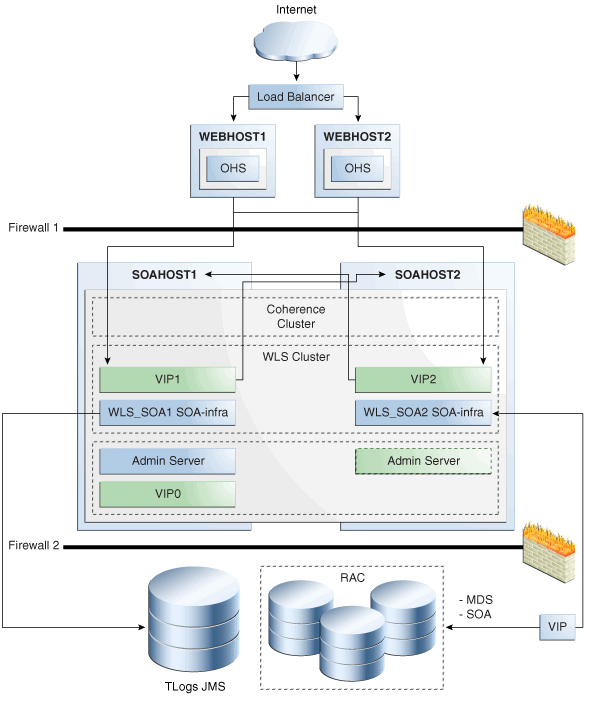
So how does this relate to Oracle and High Availability? Well when you want to make you data tier of an oracle solution both highly available as well as scaling through scale out you end up using Real Application Cluster (RAC) at the database. Simply providing VM resilience will not give sufficient availability for continuously on conditions, you need the software tier to continuously pickup demand, and availability of servers to do that is handled by the virtualisation tier so if you have a node failure then you will have at least 1 remaining whilst the virtualisation launches another instance.

cloud-azureThe problems start because RAC has some platform requirements (disk sharing either virtual or physical) that can’t be offered by all cloud (IaaS) that can be typically established with on premise hardware such as a SAN. Microsoft Azure has one of these very issues meaning it presently can’t run RAC (see here).  Amazon doesn’t have this issue (details here) and obviously not be a problem for Oracle cloud (see here).

mapThe second consideration that tends to get overlooked is data centre level DR. It is very easy to forget regardless how good the data centre is with precautions and redundancy there are some events that can bring a centre down. Even the most sophisticated monitoring and live VM movement can’t avoid the data centre level problems. There are well published illustrations of such issues, the best known are those Amazon have had (probably because it has hit some many customers – Amazon’s own analysis of one event here). So if you want a truly resilient always on, you need Dataguard replicating to another data centre if possible. You can of course use Dataguard within a data centre as well to offset the possibility on not having RAC, but it does mean scaling is limited to what you can do vertically (I.e. More CPU cores, more memory, or disk). It will also place different demands on the design of you application  tiers.
Share this:

  • Share on Facebook (Opens in new window) Facebook
  • Share on X (Opens in new window) X
  • Share on Pocket (Opens in new window) Pocket
  • Share on Reddit (Opens in new window) Reddit
  • Email a link to a friend (Opens in new window) Email
  • Share on WhatsApp (Opens in new window) WhatsApp
  • Print (Opens in new window) Print
  • Share on Tumblr (Opens in new window) Tumblr
  • Share on Mastodon (Opens in new window) Mastodon
  • Share on Pinterest (Opens in new window) Pinterest
  • More
  • Share on Bluesky (Opens in new window) Bluesky
  • Share on LinkedIn (Opens in new window) LinkedIn
Like Loading...

Review of Oracle API Management 12c

22 Monday Feb 2016

Posted by mp3monster in Book Reviews, Books, General, Oracle, Packt, Technology

≈ Leave a comment

Tags

API, book, Oracle, OUG, review

3635en_4575_oracle20api20management2012c20implementation_0My review of the Oracle API Management 12c has been published the the UKOUG at http://www.ukoug.org/what-we-offer/news/review-of-oracle-api-management-12c-implementation/ – rather than repeat the review here, I’d recommed people go read the page.  But I will say here is that it is an excellent book.  The book can be found at:

  • Packt
  • Amazon

Along with a range of other book sellers.

Share this:

  • Share on Facebook (Opens in new window) Facebook
  • Share on X (Opens in new window) X
  • Share on Pocket (Opens in new window) Pocket
  • Share on Reddit (Opens in new window) Reddit
  • Email a link to a friend (Opens in new window) Email
  • Share on WhatsApp (Opens in new window) WhatsApp
  • Print (Opens in new window) Print
  • Share on Tumblr (Opens in new window) Tumblr
  • Share on Mastodon (Opens in new window) Mastodon
  • Share on Pinterest (Opens in new window) Pinterest
  • More
  • Share on Bluesky (Opens in new window) Bluesky
  • Share on LinkedIn (Opens in new window) LinkedIn
Like Loading...

Integration Cloud Service – In the Eyes of the A-Team

15 Monday Feb 2016

Posted by mp3monster in General, Oracle, Technology

≈ Leave a comment

Tags

A-Team, Forrester, Gartner, OIC - ICS, Oracle, Ovum, Robert Van Molken

ics-dev-testSo the A-Team (not the TV show which managed to have lots of things blow up and no one ever get hurt) but the technology gurus at Oracle have started to write blog posts about Integration Cloud Service (ICS).  This is will be a reflection of the increasing uptake of the cloud service.  A fellow Oracle Ace Associate (Robert van Mölken – blog here) and I should about to get a book on the subject underway.

  • On Premise Agent Installation
  • Moving Integrations from test to production in ICS

As an aside to this, as part of creating a case to the publishers of the potential value of a book on the subject, I picked up a number of market assessments which are pretty interesting:

  • “​By 2016, at least 35% of all large and midsized organizations worldwide will be using one or more iPaaS offerings in some form” (Gartner RAS Core Research Note G00210747 – March 11)
  • 2013 Gartner say iPaaS is going to really take off (G00258046)
  • Last summer Gartner forecast by 2018 that iPaaS will be the 2nd largest PaaS offering (G00277176)
  • By 2018, in most organizations, at least 50% of new integration flows will be implemented by citizen integrators – January 2016
  • Various tweets from Gertner researchers have indicated Oracle’s entry into this form of iPaaS is going to be a market disruptor.

All that before you look at what other analysts are saying such as Forrester, Ovum and others.

Share this:

  • Share on Facebook (Opens in new window) Facebook
  • Share on X (Opens in new window) X
  • Share on Pocket (Opens in new window) Pocket
  • Share on Reddit (Opens in new window) Reddit
  • Email a link to a friend (Opens in new window) Email
  • Share on WhatsApp (Opens in new window) WhatsApp
  • Print (Opens in new window) Print
  • Share on Tumblr (Opens in new window) Tumblr
  • Share on Mastodon (Opens in new window) Mastodon
  • Share on Pinterest (Opens in new window) Pinterest
  • More
  • Share on Bluesky (Opens in new window) Bluesky
  • Share on LinkedIn (Opens in new window) LinkedIn
Like Loading...

Oracle ITSO Mindmap Update

14 Sunday Feb 2016

Posted by mp3monster in General, ITSO & OEAF, mindmap, Oracle, Technology

≈ Leave a comment

Tags

ITSO, mindmap, Oracle, reference architecture, Strategies

So I have been chipping away at my mind mapping of the foundation reference architecture from Oracle (part of the IT Strategies from Oracle – ITSO material).  So I have recently updated the mind map.  You can see it via WiseMapping here. Navigate an image of it below (very large now).

ITSO

Share this:

  • Share on Facebook (Opens in new window) Facebook
  • Share on X (Opens in new window) X
  • Share on Pocket (Opens in new window) Pocket
  • Share on Reddit (Opens in new window) Reddit
  • Email a link to a friend (Opens in new window) Email
  • Share on WhatsApp (Opens in new window) WhatsApp
  • Print (Opens in new window) Print
  • Share on Tumblr (Opens in new window) Tumblr
  • Share on Mastodon (Opens in new window) Mastodon
  • Share on Pinterest (Opens in new window) Pinterest
  • More
  • Share on Bluesky (Opens in new window) Bluesky
  • Share on LinkedIn (Opens in new window) LinkedIn
Like Loading...
← Older posts
Newer posts →

    I work for Oracle, all opinions here are my own & do not necessarily reflect the views of Oracle

    • About
      • Internet Profile
      • Music Buying
      • Presenting Activities
    • Books & Publications
      • Logging in Action with Fluentd, Kubernetes and More
      • Logs and Telemetry using Fluent Bit
      • Oracle Integration
      • API & API Platform
        • API Useful Resources
        • Useful Reading Sources
    • Mindmaps Index
    • Monster On Music
      • Music Listening
      • Music Reading
    • Oracle Resources
    • Useful Tech Resources
      • Fluentd & Fluent Bit Additional stuff
        • Logging Frameworks and Fluent Bit and Fluentd connectivity
        • REGEX for BIC and IBAN processing
      • Java and Graal Useful Links
      • Official Sources for Product Logos
      • Python Setup & related tips
      • Recommended Tech Podcasts

    Oracle Ace Director Alumni

    TOGAF 9

    Logs and Telemetry using Fluent Bit


    Logging in Action — Fluentd

    Logging in Action with Fluentd


    Oracle Cloud Integration Book


    API Platform Book


    Oracle Dev Meetup London

    Blog Categories

    • App Ideas
    • Books
      • Book Reviews
      • manning
      • Oracle Press
      • Packt
    • Enterprise architecture
    • General
      • economy
      • ExternalWebPublications
      • LinkedIn
      • Website
    • Music
      • Music Resources
      • Music Reviews
    • Photography
    • Podcasts
    • Technology
      • AI
      • APIs & microservices
      • chatbots
      • Cloud
      • Cloud Native
      • Dev Meetup
      • development
        • languages
          • java
          • node.js
          • python
      • drone
      • Fluentbit
      • Fluentd
      • logsimulator
      • mindmap
      • OMESA
      • Oracle
        • API Platform CS
          • tools
        • Helidon
        • ITSO & OEAF
        • Java Cloud
        • NodeJS Cloud
        • OIC – ICS
        • Oracle Cloud Native
        • OUG
      • railroad diagrams
      • TOGAF
    • xxRetired
    • AI
    • API Platform CS
    • APIs & microservices
    • App Ideas
    • Book Reviews
    • Books
    • chatbots
    • Cloud
    • Cloud Native
    • Dev Meetup
    • development
    • drone
    • economy
    • Enterprise architecture
    • ExternalWebPublications
    • Fluentbit
    • Fluentd
    • General
    • Helidon
    • ITSO & OEAF
    • java
    • Java Cloud
    • languages
    • LinkedIn
    • logsimulator
    • manning
    • mindmap
    • Music
    • Music Resources
    • Music Reviews
    • node.js
    • NodeJS Cloud
    • OIC – ICS
    • OMESA
    • Oracle
    • Oracle Cloud Native
    • Oracle Press
    • OUG
    • Packt
    • Photography
    • Podcasts
    • python
    • railroad diagrams
    • Technology
    • TOGAF
    • tools
    • Website
    • xxRetired

    Enter your email address to subscribe to this blog and receive notifications of new posts by email.

    Join 2,555 other subscribers

    RSS

    RSS Feed RSS - Posts

    RSS Feed RSS - Comments

    January 2026
    M T W T F S S
     1234
    567891011
    12131415161718
    19202122232425
    262728293031  
    « Nov    

    Twitter

    Tweets by mp3monster

    History

    Speaker Recognition

    Open Source Summit Speaker

    Flickr Pics

    Gogo Penguin at the BarbicanGogo Penguin at the BarbicanGogo Penguin at the BarbicanGogo Penguin at the Barbican
    More Photos

    Social

    • View @mp3monster’s profile on Twitter
    • View philwilkins’s profile on LinkedIn
    • View mp3monster’s profile on GitHub
    • View mp3monster’s profile on Flickr
    • View mp3muncher’s profile on WordPress.org
    • View philmp3monster’s profile on Twitch
    Follow Phil (aka MP3Monster)'s Blog on WordPress.com

    Blog at WordPress.com.

    • Subscribe Subscribed
      • Phil (aka MP3Monster)'s Blog
      • Join 233 other subscribers
      • Already have a WordPress.com account? Log in now.
      • Phil (aka MP3Monster)'s Blog
      • Subscribe Subscribed
      • Sign up
      • Log in
      • Report this content
      • View site in Reader
      • Manage subscriptions
      • Collapse this bar
     

    Loading Comments...
     

    You must be logged in to post a comment.

      Privacy & Cookies: This site uses cookies. By continuing to use this website, you agree to their use.
      To find out more, including how to control cookies, see here: Our Cookie Policy
      %d