
Enterprise Security – A Data Centric Approach – Chapters 5 & 6

Tags

, ,

Continuing with Enterprise Security: A Data-Centric Approach to Securing the Enterprise by Aaron Woody Chapter 5 gest into some of the security processes and technologies to securing you compute platforms covering topics such as:

  • anti-virus (or not),
  • network lock down through the use of local firewalls built into the OS (so people can’t then just access the server by any means they desire SSH, RDP, telnet etc)
  • user permissions
  • auditing (so you can see what is happening/happened and by whom)
  • detection of file change in parts of the system that shouldn’t change except through specific mechanisms e.g. OS files should only change when patching the OS

But more importantly the chapter links these kinds of activities to the analysis of risk and previously developed trust models. So that you can understand how much security is suitable and justifiable.  The ideas along with the pros and cons of each activity are well explained and clearly presented.

Chapter 6 takes us back to central theme of the book – data.  With our policies and models identified we need to locate the data – this is harder than it may sound, not everything is in a database (the amount of business operation that runs on spreadsheets on people’s desktops, is endlessly amazing and then compounded by how we make the data collaborative – emailing, moving with personal USB storage, cloud services and on and on). To help find, track and potentially constrain it  (prevent undue leakage) the book walks through the ideas of classification and ownership/accountability and then really starts to tie together the earlier chapters, as well as introduce some additional technology concepts such as the encryption of data when in transit and at rest. Like chapter 5, you don’t need a PhD to understand where to apply security and why – the doing maybe a different kettle of fish of course.

Previous blog entries:

There is also a supporting website for the book athttp://www.datacentricsec.com/
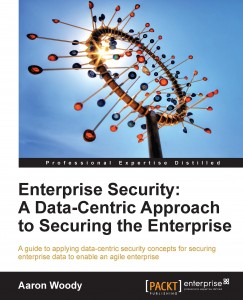
Enterprise Security - A Data Centric Approach

Ed Harcourt – Time Of Dust

Tags

, , , ,

So we’re not even 2 weeks into 2014 and its time to get excited about a new album release. Ed’s latest is more of a mini album available now as a download and physical media at the end of month.

Unlike the more acoustic work of late, this release takes the piano lead performance to but leverages rich orchestral and synth layers giving a more of widescreen drama.

The widescreen drama coupled with some really amazing lyrics from the horrors of war (Parliament of Rooks) “we were only doing what the captain said, we all went down with the ship” to the safest of love songs “love is like a minor key, a jaded weeping willow tree, it hooks its claws until blood is drawn“.

Finally a bonus of Kathryn Williams on backing vocals you really can’t go wrong with your £3.49 on iTunes or £8 on Amazon for the CD and immediate auto rip download.

Ed, we want more….. Play it again Sam

Ed’s site – http://edharcourt.com/

Vinyl Junkies – Adventures In Record Collecting A Review

Tags

, , , , , , , , ,

So I’ve been luxuriating in reading some books more for the pleasure of it (rather than technical stuff to help authors or the day job).  This book is about, record collectors, the act of record collecting and the general love for music both mainstream, obscure and just down right freaky. For the music fan this is Mills & Boon reading.  For those related or taken on the challenge of a partner who is a record collector an insight into the mind of your loved one.

The books tries to explain the passion of collecting from many different perspectives, through the eyes of collectors (some famous – like Peter Buck (of REM fame), Robert Crumb (cartoonist) and Thurston Moore (Sonic Youth), others not so famous but equally obsessed. From a psychologist point of view – clinical (relationship to low sertraline) to psychotherapy.  As a result we get discussions about the sensuality of vinyl and wonderful quotes like “CDs are like sex with a condom”.

We explore the kinds of collecting that go on – from types of records – old pre-war 78s, 1st issues of records, special prints like shaped coloured vinyl, those quickly taken out of circulation through to records that just seem to be rare and then the plain odd like albums commissioned by Listerine (the mouthwash) advocating the product’s wonders to people thinking they’re going to make it big putting out just tuneless oddities, to the child like contributions like Sammy Squirrel Teaches the Multiplication Tables (Which apparently has a publisher’s address on the cover of The Metaphysical Motivational institute, Drawer 400, Ruidoso, NM) and psychotic wonders such  as “Sit on My Face, Stevie Nicks” by the Rotters and Naughty Rock ‘n’ Roll by the P-Verts or maybe various artists on the Sugar Tits Label.

As the book progresses we get a chance to be taken on an exploration of the validity of the portrayal of collector/obsessive music fan portrayed in Nick Hornby’s book High Fidelity by the character Rob Gordon (portrayed by John Cusack in Stephen Frears‘ cinematic adaptation);  music collectors are geeky single men that can’t sustain a relationship etc.

The book is however 10 years old – and sadly doesn’t reflect how the rise in Mp3s has impacted.  As everything get ripped and becomes for ever available (legally or illegally) on the web, what is happening to the passion of the hunt for the mysterious, weird and rare?  Who knows, but its fun hearing the stories.

Vinyl Junkies

Enterprise Security – A Data Centric Approach – Chapter 4

Tags

, , , , , , ,

Continuing into a chapter 4 of
Enterprise Security: A Data-Centric Approach to Securing the Enterprise by Aaron Woody we start to look at some technical aspects of security and technology covering things like the capabilities of new generation of firewalls, DNS security and so on. The information is presented in a very readable manner.

As an Enterprise Technology Architect, and having security specialist friends I thought I was reasonably well informed in this aspect of IT, but the book still taught me me things. Interestingly, perhaps not intended but the chapter left me with a number of things that could be incorporated into development governance that would make the work of network security a lot easier.

The chapter continues with lots of really helpful references many, maybe all are incorporated into a series of appendices that are full of helpful information references and links. If these are made available on the book’s website (see below) it would likely become a must go to site for security resources.

It does leave me asking one question how does this all fit in when using a PaaS solution such as those offered by the likes of Amazon and Rackspace?

Previous blog entries:

The book has been published by Packt (who at the time of writing are running a promotion – more here)

There is also a supporting website for the book at http://www.datacentricsec.com/
Enterprise Security - A Data Centric Approach

Enterprise Security – A Data Centric Approach — Chapter 3

Tags

, , , , ,

So I’m back to reading Enterprise Security: A Data-Centric Approach to Securing the Enterprise by Aaron Woody. I’ve not finished reading the book yet but as I’m reviewing one or two chapters at a time, I thought I’d blog about Chapter 3 – particularly given its value (previous blog entry here and here).

Chapter 3 goes by the name of Security As A Process, which addresses the processes to determining security risk, the analysis of cost benefit of implementing security features to address those risks. The chapter then goes on to provide guidance on defining good policies and standards.

In hindsight the process for determining and analyzing the security risks and classifying them is fairly obvious – it took the reading to to draw the points and the mechanisms into focus. But the fact it makes sense in hindsight suggests that the approach the workability and the chance for the business to understand the risks and challenges being taken on.

The chapter also provides some really good information sources for people to use to support the adotion of the processes described. Some I’ve known about such as the SANS Institute others I hadn’t.

I have to say that based on the strength of this chapter alone I’d recommend the book to any architect who is seeking to develop practical appreciation of addressing security considerations or understand what they should be looking for what to ask for in a new organisation. Those trying to drive up the quality of processes or get across the need for a more proactive security strategy that is also pragmatic – reading this chapter alone should help provide some serious points to get a handle on things.

The book has been published by Packt (who at the time of writing are running a promotion – more here)

There is also a supporting website for the book at http://www.datacentricsec.com/
Enterprise Security - A Data Centric Approach

Appetite for Self-Destruction: The Spectacular Crash of the Record Industry in the Digital Age

Tags

, , , , ,

With the holiday break, I’ve had a bit of time to get through some reading, including finishing Appetite for Self-Destruction: The Spectacular Crash of the Record Industry in the Digital Age. This an excellent book on how the music industry has managed to shoot itself in the feet a number of times (and with a canon at that); although it does only cover events upto 2008 (as we enter 2014 it would be brilliant to see an additional chapter to get insight into how the resurgence of vinyl and the rise of Spotify has impacted thinking – beyond the deadlines of complaints by the likes of Thom Yorke about Spotify).

Thw book feels well researched (certainly references hold testimony to this), but at the same time it doesn’t read like a dry academic read that you would associate with such a well researched text. But given the attitudes and behaviours of some of the individuals in the big labels their egos run riot far more than most of the ‘rock gods’ that they’re trying to sell.

Steve Knopper has done a great job with the book and I’d recommend it to anyone interested in music or how technology such as peer-to-peer has impacted the media industry. You dont need to be a music fiend or geek to find this a satisfying read.

Steve’s website is http://knopps.com/
 

Packt Books $5 Promotion

Tags

, , , , , , , ,

$5 ebook Bonanza1 template 1

My friends at Packt Publishing have just told me they are repeating last year’s amazing offer of ebooks at a flat price of $5 (for us Brits that’s £3.05) go here.  The Offer runs from sometime today (19th Dec) through to the 3rd of January.

The offer covers both their Open Source books, but also their Enterprise books as well (lots of Oracle and Microsoft publications).

Given the pricing you can’t go wrong.  I know last year I ended up with about 6 months of technical reading.

Checkout :  http://bit.ly/1jdCr2W

Crazy intro to the instruments of a rock band

Tags

,

I came across a series of YouTube videos that give the history of different instruments used in a rock band (well perhaps except for the accordion), we are assuming that the series is yet to do the treatment for the synth.  Each video is between 5 and 10 minutes long. Each video is opened with the cheesiest music ever. But then things get better, a lot better.  Each video has the band with the instrument featured up front, with someone who has to stand like a complete plank whilst MTV like facts are layed onto the board hung over their shoulders.

The band then play the instruments, changing as necessary playing snippets of great music to illustrate evolution of the way the instrument is used, and it great fun to try name the snippets used. But if you’re not sure the pieces are credited if you look carefully near the bottom left of the screen.

Part 1 – Guitar:

Part 2 – Drums:

Part 3 – Accordian:

Part 4 – Bass:

Part 5

SOA Pattern Books

Tags

Just as I wrap up the tech reviewing of one book, Packt invite me to start another. This time a book has the working title of SOA Patterns on the Oracle Platform (no link yet – too early). This is certainly going to be a substantial book with about 12 chapters running to about 50 pages per chapter (certainly for the first 4 chapters). Unlike a lot of the more functional Oracle books I’ve seen from Oracle this is low on graphics and screen shots and high on textual content.

So far the book has given me cause to stop and think hard about the points the author is trying to make and then demonstrate. In some respects like the definitive texts by Thomas Erl, however where Erl is solution agnostic, this book is trying to bring the patterns to life through placing them into a scenario and describing the challenges and implementation approaches in terms of the Oracle platform, particularly BPEL, Mediators, rules engines and SCA (i.e. Oracle SOA Suite).  I have laughed, as I found the book referencing back to Apache Camel.

All of this does mean that the review process is more time consuming than I had anticipated, if the review feedback is taken then I think it will have been a very worthwhile experience.  Watch this space, and I’ll blog on this one once we see the final copy, if not before.

Books, Books & More Books

Tags

, , , , , , , , , ,

The blog posts have been a bit slow of late as I’ve been deep into reviewing books for Packt Publishing.  But thought I’d share the fact that Packt are running a big promotion at the moment, offering 50% off all their books if you use the discount code COL50 as part of the celebration of Columbus Day.  The offer currently runs until the Thursday 17th October.

As for books, well I’ve just finished reviewing the Apache Camel Developer’s Cookbook by Jakub Korab and Scott Cranton (Amazon have it currently listed as Camel Enterprise Cookbook.

The version of the book I’ve reviewed was very, very good. I have to admit I went into reviewing this book with high expectations given the fact I’ve worked with Jakub and know the calibre of his output whilst he was consulting for FuseSource (now part of RedHat JBoss) and I’ve not been disappointed.

You can read the book as either a guide to Apache Camel as each recipe builds upon the preceding recipe; or as a dive in as you need a solution to a problem as each recipe pretty much stands up in its own right (cross referencing other supporting recipes or key preceding recipes).  The book explains not only how to do something – from simple routing & filtering through to XA transactions with one of the leading orchestration technology frameworks.

From Jakub & Scott’s fine technical guide, I’ve started to look at a book on Applied SOA Patterns on the Oracle Platform part of Packt’s Enterprise series of books.  I cant say too much on this book yet – it is going to be a fairly chunky book at around 500 pages.  Will post more once we’ve got well into the book I’m sure.