• Home
  • Site Aliases
    • www.cloud-native.info
  • About
    • Background
    • Presenting Activities
    • Internet Profile
      • LinkedIn
    • About
  • Books & Publications
    • Log Generator
    • Logs and Telemetry using Fluent Bit
      • Fluent Bit book
      • Book Resources in GitHub
      • Fluent Bit Classic to YAML Format configurations
    • Logging in Action with Fluentd, Kubernetes and More
      • Logging in Action with Fluentd – Book
      • Fluentd Book Resources
      • Fluentd & Fluent Bit Additional stuff
    • API & API Platform
      • API Useful Resources
    • Oracle Integration
      • Book Website
      • Useful Reading Sources
    • Publication Contributions
  • Resources
    • GitHub
    • Oracle Integration Site
    • Oracle Resources
    • Mindmaps Index
    • Useful Tech Resources
      • Fluentd & Fluent Bit Additional stuff
      • Recommended Tech Podcasts
      • Official Sources for Product Logos
      • Java and Graal Useful Links
      • Python Setup & related stuff
  • Music
    • Monster On Music
    • Music Listening
    • Music Reading

Phil (aka MP3Monster)'s Blog

~ from Technology to Music

Phil (aka MP3Monster)'s Blog

Tag Archives: Oracle

Oracle Press – Free EBooks

05 Thursday Mar 2015

Posted by mp3monster in Books, General, Oracle, Technology

≈ Leave a comment

Tags

ebook, free, Oracle, Oracle Press, publications, UKOCN

So Oracle Press have been celebrating 20 years of publications.  As part of that celebration they have over the year offered a number of eBooks for free.  The UKOCN site have pulled a list of these free books together along with relevant links for request the ebooks – go checkout http://www.ukocn.com/article/oracle-press-free-copies – if this link doesn’t work (UKOCN maybe preventing deep links) then go to http://www.ukocn.com/ and visit articles, and you should see an article called “ORACLE PRESS FREE COPIES!”. at the time of writing this post this is on the homepage of listed articles.

“

Share this:

  • Share on Facebook (Opens in new window) Facebook
  • Share on X (Opens in new window) X
  • Share on Reddit (Opens in new window) Reddit
  • Email a link to a friend (Opens in new window) Email
  • Share on WhatsApp (Opens in new window) WhatsApp
  • Print (Opens in new window) Print
  • Share on Tumblr (Opens in new window) Tumblr
  • Share on Mastodon (Opens in new window) Mastodon
  • Share on Pinterest (Opens in new window) Pinterest
  • More
  • Share on Bluesky (Opens in new window) Bluesky
  • Share on LinkedIn (Opens in new window) LinkedIn
Like Loading...

Oracle Free EBook on Enterprise Mobility

26 Monday Jan 2015

Posted by mp3monster in Books, Oracle, Technology

≈ Leave a comment

Tags

ebook, enterprise, free, mobile, Oracle

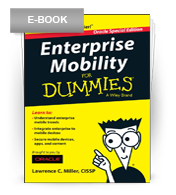
Oracle a free Ebook about enterprise Mobility – it can be downloaded from https://blogs.oracle.com/imc/entry/free_oracle_special_edition_ebook1  The book focuses on the following areas:

  • Mobile Trends and Concepts
  • Mobile Architectures, Integration, Scalability, and Security
  • Exploring the Oracle Mobile Platform

Share this:

  • Share on Facebook (Opens in new window) Facebook
  • Share on X (Opens in new window) X
  • Share on Reddit (Opens in new window) Reddit
  • Email a link to a friend (Opens in new window) Email
  • Share on WhatsApp (Opens in new window) WhatsApp
  • Print (Opens in new window) Print
  • Share on Tumblr (Opens in new window) Tumblr
  • Share on Mastodon (Opens in new window) Mastodon
  • Share on Pinterest (Opens in new window) Pinterest
  • More
  • Share on Bluesky (Opens in new window) Bluesky
  • Share on LinkedIn (Opens in new window) LinkedIn
Like Loading...

Push Notifications with a Bit of Java

24 Saturday Jan 2015

Posted by mp3monster in Java Cloud, Oracle, Technology

≈ Leave a comment

Tags

12c, Apache Maven, archetype, Eclipse, IDE, IntelliJ, java, JDeveloper, jProwlAPI, maven, mvn, Oracle, Oracle Java Cloud, OTN, POM, prowl, ProwlAPI, sourceForge

So continuing from my previous posts:

  • Intro
  • Push Notifications Without Your Own Mobile App

We’re going to use the Prowl API and create the equivalent classic “Hello World” App using the push framework – but cutting out the need for Growl etc.  For this blog post we’re not going to use the Oracle Java Cloud as we need to see the code working locally and get ready to promote the code to the cloud.  Once we’ve got some code working we can look at setting up the Java Cloud environment, package and promote what we have here using our IDE into the cloud environment.

As we’re cutting Java code now – you can obviously use your own preferred IDE, I’m going to use JDeveloper 12c if for no other reason than it being a huge improvement on 11g (download here) and I’ve become somewhat disappointed with Eclipse.  Whilst talking about IDEs;  you should be aware that Oracle provide an Oracle Cloud SDK which integrates with a number of IDEs to make some of the interactions with the cloud straight forward.

The SDK provides Ant and Maven scripts to help the build and deploy process – so we will be using those later, plus command line tools to help manage other activities, a number of code examples and HTML documentation.  To setup the SDK you will need to unpack the file into a folder and add that folder into your PATH environment variables. The bundle includes a readme that contains just enough to show what is required to get unpacked and make the command line tools work.

To download from Oracle you will need to setup an Oracle Technology Network (OTN) account – so if you don’t have one now is the time to create one – there is no cost to this, we’re going to need

We could use the REST based API that is provided by the ProwlApp, but at least to start with we’re going to follow the approach using a library to make using the API very simple. By using the API provided on SourceForge (jProwlAPI). Using an API will allow us to show the use of 3rd party libraries in the cloud deployment but also follows some of the Oracle ideas of offering ‘adaptors’ to simplify integration.

So you need to download:

  • JDeveloper 12c – http://www.oracle.com/technetwork/developer-tools/jdev/downloads/index.html (if you want to use JDeveloper as shown)
  • The jProwlAPI from SourceForge
  • Oracle Cloud SDK

So with this downloaded we are going to:

Setup an new Maven based project (or copy my file structure into place and import) using a maven quickstart archtetype (org.apache.maven.archetypes:maven-archetype-quickstart) . We will probably need to modify this later to leverage the full cloud capable archetype. This will build your project environment and retrieve a bunch of plugins you might need.

Next lets take a peak inside of the jProwlAPI download. You’ll see an example bit of java that shows how to fire the API.  Rather than tinker with this we have created a small package and JUnit test as we would if writing a proper solution created with the maven archetype.

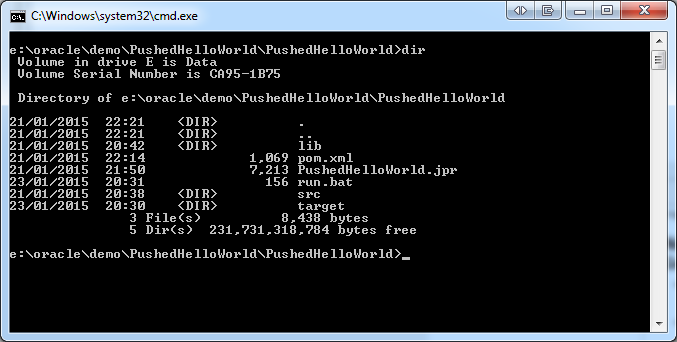
PushedHelloWorld directory structure

We also need to make the JProwlAPI jar file available to the project. So we use maven pattern, and create a folder called lib and copy the jar file into it. We then add the lib folder to project setup.


pushedhello-RunConfig

To be able to create the deployable artefact we need to load the jar file into the local repository, which we can do with a command line instruction (presuming maven is also available by your PATH variable).

mvn install:install-file -Dfile=./lib/JProwlAPI-0.5.jar -DgroupId=prowl -DartefactId=JProwlAPI -Dversion=12.1.3-0-0 -Dpackage=jar

We’ll come back to the command line in a bit, but within JDeveloper the code I have provided needs 1 change from yourself – replace the references to –YourAPIKey– in the run execute command and in the JUnit class with your own key.

JDEveloper 12c Run Config

In the the ProwlProcessor class I have included a man in method so we can just execute the class to see things working. So having done that we can then repeat by running the class via the JUnit test. You should see the same result. When we we’ve deployed or class to the cloud we can use the JUnit test to invoke the cloud.

ProwlProcessor - main method

The last step, within the IDE we have been compiling to get the class, but not creating a deployable jar file. We could do this with the IDE but we would also in a real development condition be creating artefacts via a Continuous Integration tooling which will effectively fire the maven command line like interface. So let’s do that to create the jar files, using the following command:

mvn clean package

You should then see a folder created if not already there and a jar file reflecting the values in the POM file, that we can see below.

JDeveloper 12C - view of a simple POM

So we have enough now we could in theory deploy a jar to a weblogic container and fire it from a Unit test. In the next post we’ll deploy and execute the unit test, and throw a crude front end into the mix.

Share this:

  • Share on Facebook (Opens in new window) Facebook
  • Share on X (Opens in new window) X
  • Share on Reddit (Opens in new window) Reddit
  • Email a link to a friend (Opens in new window) Email
  • Share on WhatsApp (Opens in new window) WhatsApp
  • Print (Opens in new window) Print
  • Share on Tumblr (Opens in new window) Tumblr
  • Share on Mastodon (Opens in new window) Mastodon
  • Share on Pinterest (Opens in new window) Pinterest
  • More
  • Share on Bluesky (Opens in new window) Bluesky
  • Share on LinkedIn (Opens in new window) LinkedIn
Like Loading...

Oracle Java & Node.JS Cloud Blogs Coming

23 Tuesday Dec 2014

Posted by mp3monster in General, Java Cloud, NodeJS Cloud, Oracle, Technology

≈ 1 Comment

Tags

Cloud, java, node.js, Oracle

Over the coming months I’m planning on running a series of blogs on getting setup and using Oracle’s Java Cloud and the upcoming Oracle Node.JS Cloud when we can get access to it.

In both cases we’re aiming to demo the capabilities, setup eyc around the classic Hello World – but with a bit of a twist. Rather than simply sending to the console we’re going to use a mobile push notification – without resorting to having to build a mobile app.

By taking this approach to hello world aside from keeping it simple we can see how to bring 3rd party APIs into the mix.  The first couple of posts wont need to much on the Oracle front – as we’ll walk through getting things setup and running a proof without the cloud stuff. As they say keep it simple stupid.

So that you can see the blog entries for each of this two stories, I specifically setup in my blog two entry categories:

  • Oracle Java Cloud
  • Oracle Node.JS Cloud

A few posts will obviously be common to both.

Share this:

  • Share on Facebook (Opens in new window) Facebook
  • Share on X (Opens in new window) X
  • Share on Reddit (Opens in new window) Reddit
  • Email a link to a friend (Opens in new window) Email
  • Share on WhatsApp (Opens in new window) WhatsApp
  • Print (Opens in new window) Print
  • Share on Tumblr (Opens in new window) Tumblr
  • Share on Mastodon (Opens in new window) Mastodon
  • Share on Pinterest (Opens in new window) Pinterest
  • More
  • Share on Bluesky (Opens in new window) Bluesky
  • Share on LinkedIn (Opens in new window) LinkedIn
Like Loading...

Oracle Press Celebrates 20 Years of Support for the Global Oracle Workforce – – Originally @UKOCN

19 Friday Dec 2014

Posted by mp3monster in General

≈ Leave a comment

Tags

ebook, Oracle, Oracle Press, UKOCN

Oracle Press Celebrates 20 Years of Support for the Global Oracle Workforce  

Happy 20th Birthday, Oracle Press! Since 1994, McGraw-Hill Education has partnered with Oracle Corporation to help Oracle professionals develop the skills they need to be successful with Oracle’s products and technologies.

What started out as one book on Oracle’s groundbreaking database, Oracle: The Complete Reference, has grown to 120 titles covering the entire Oracle ecosystem-databases, middleware, applications, servers, and certification. Oracle Press titles have sold more than 3 million books in print around the world, with thousands of eBooks accessed via devices and platforms, including Safari, Books 24X7, and McGraw-Hill Education’s own McGraw-Hill Education eBookLibrary.

Working closely with Oracle’s internal product development teams, Oracle Press has developed rigorous best practices for producing the highest quality content on the topics most critical to our readers.

More than half of Oracle Press’s authors are Oracle employees–the technologists driving Oracle’s products forward. And we’re always looking for new book ideas, authors and technical advisors.

  • To get an amazing 20% off all Oracle Press titles from McGraw-Hill please Click here

Share this:

  • Share on Facebook (Opens in new window) Facebook
  • Share on X (Opens in new window) X
  • Share on Reddit (Opens in new window) Reddit
  • Email a link to a friend (Opens in new window) Email
  • Share on WhatsApp (Opens in new window) WhatsApp
  • Print (Opens in new window) Print
  • Share on Tumblr (Opens in new window) Tumblr
  • Share on Mastodon (Opens in new window) Mastodon
  • Share on Pinterest (Opens in new window) Pinterest
  • More
  • Share on Bluesky (Opens in new window) Bluesky
  • Share on LinkedIn (Opens in new window) LinkedIn
Like Loading...

Single Vendor Cloud

20 Thursday Nov 2014

Posted by mp3monster in General, Oracle, Technology

≈ 1 Comment

Tags

Amazon, Azure, chaos, IoT, Microsoft, monkey, nextflix, Oracle, PaaS, SaaS, SQS

The recent outage of Microsoft Azure, raises some interesting questions. This isn’t the first big vendor cloud service outage, Amazon AWS and others have had their moments. Of course this had lead to the recommendation that to ensure your service has continuity that a DR arrangement with a different provider be in place. This works with Platform as a Service. But what we have been seeing is move from PaaS up the value stack to vendors offering their own rich ecosystem to build on – from Amazon SQS to Oracle’s latest announcement Oracle Internet of Things platform.

These solutions, can be built with open standards etc but ultimately when used create vendor lock-in as no one else will have an equivalent capability with the same APIs. So how do you mitigate these outages, or even the risk of such an outage? Well Oracle do claim you can actually run all their cloud capabilities on premise. But is that practical? As cloud is adopted organisations are going to wind back their hardware capital outlay, after all that is one of the value points of cloud.

So where does that leave us? Accepting the risk and trying to mitigate the risks in our own commercial agreements? What about the fact in an IoT solution where you’re event stream processing and using period on period comparisons to set thresholds which means the likely data loss from an outage will have both ‘echos’ as you period analysis has holes in data plus false thresholds as the data hole will skew the data when that period is being used for period comparison.

Difficult questions with no obvious answers, other than you mitigate you things commercially and push Microsoft and others to make things more robust – time for Netflix Chaos monkey?

Share this:

  • Share on Facebook (Opens in new window) Facebook
  • Share on X (Opens in new window) X
  • Share on Reddit (Opens in new window) Reddit
  • Email a link to a friend (Opens in new window) Email
  • Share on WhatsApp (Opens in new window) WhatsApp
  • Print (Opens in new window) Print
  • Share on Tumblr (Opens in new window) Tumblr
  • Share on Mastodon (Opens in new window) Mastodon
  • Share on Pinterest (Opens in new window) Pinterest
  • More
  • Share on Bluesky (Opens in new window) Bluesky
  • Share on LinkedIn (Opens in new window) LinkedIn
Like Loading...

Thinking about a COTs Mobile Strategy

28 Tuesday Oct 2014

Posted by mp3monster in General, Technology

≈ 1 Comment

Tags

app, authentication, Facebook Connect, LDAP, mobile, OID, OpenID, Oracle, white label

More and more software capability is becoming commoditised and off the shelf either in the form of COTS packages or SaaS solutions new considerations and challenges arrive for customer businesses.

Recently we had an initial conversation at the architectural level with a vendor who have a well thought out end to end offering which includes mobile apps for our customers (white label offering). This is great in many respects as we can depend on our vendor to deal with the challenges of keeping mobile apps upto date and contend with the ever changing mobile landscape.

If a business you don’t fit into classic solution stacks for example Boots (now part of Walgreens) isn’t just a retailer but also a prescription pharmacist you’re likely to be sourcing solutions from different suppliers. The challenge comes from the fact you’re likely want to leverage different white label apps for different offerings e.g. prescriptions, eye test related etc (which are potentially going to come from different vendors, particularly if you want to adopt a best of breed set of solutions). It is however important that you get a consistency in look and feel, and unified authentication to the different apps is essential when presenting solutions to end customers. The worst thing in the world would be have different authentications which means the customer has to remember multiple passwords to engage with your business.

The look and feel can be to an extend dealt with by the fact a lot of contemporary mobile applications are built on a hybrid framework so you can use CSS3 to drive standardisation or atleast colour and branding; which plays to a white label strategy.

As to authentication that could be more challenging, you need consistency in approach between all of the applications, there are standards out there such as OpenId but you the different apps to offer the same authentication sources. Even OpenId has issues, and the support for the latest version of the standard looks somewhat mixed. But in addition to that there is the fact there is a degree of fragmentation for example Facebook used to support OpenId but now has Facebook Connect.

So if you wanted to offer a voucher system from your POS (Point of Sale) provider and perhaps an app for an ordering capability built around your ERP from a different vendor what are the chances of having consistency?

If you know all your vendors and launching your mobile solutions you can look for common denominators and drive in that direction. But this is a rare situation. All of this is ideally linked to your normal website as well which may well be linked to a different solution such as Oracle’s OID.

If the apps offer their own LDAP authentication service then you have the possibility of synchronising these repositories so if the user interacts with one app then the details can be pushed to the other apps’ repository through your own integration layer.

In a perfect world your white label apps will have the means to configure to connect to a single LDAP server, in this case you can get things aligned at-least for authentication.

Without this then there is going to be a pretty challenging situation, to the point the ROI on consistent user experience needs to be seriously examined ad it maybe time to think about building the solutions yourself.

Share this:

  • Share on Facebook (Opens in new window) Facebook
  • Share on X (Opens in new window) X
  • Share on Reddit (Opens in new window) Reddit
  • Email a link to a friend (Opens in new window) Email
  • Share on WhatsApp (Opens in new window) WhatsApp
  • Print (Opens in new window) Print
  • Share on Tumblr (Opens in new window) Tumblr
  • Share on Mastodon (Opens in new window) Mastodon
  • Share on Pinterest (Opens in new window) Pinterest
  • More
  • Share on Bluesky (Opens in new window) Bluesky
  • Share on LinkedIn (Opens in new window) LinkedIn
Like Loading...

Hierarchy of Data Assurance

19 Sunday Oct 2014

Posted by mp3monster in General, Oracle, Technology

≈ Leave a comment

Tags

AIA, data, integrity, maslow, Oracle, reconciliation, SOA

I was discussing the challenges of ensuring that data is protected and proven to to have integrity and that as the data moves through systems that there isn’t data loss. This sort of thing starts at the simplest level with data validation and with the most advanced and greatest investment you have some end to end reconciliation framework.

Obviously this thinking doesn’t work in every environment, for example complex event processing (CEP) your going to just accept the data coming through and if it’s incomplete or data has been lost along the way you just accept it as it is – these conditions will create outliers which will get smoothed out in trends. It is possible you will have created he gaps by dropping data slow to arrive. But for the majority of your run of the mill solutions such as accounting, HR and so on the thinking stands up.

To communicate the idea effectively to senior management on the risks of just focusing on functional delivery and whether there is maturity in the delivery capability we hit on the idea of using a variant of Maslow’s triangle of needs – something I think everyone gets. You can see our representation here:

hierarchy of Data Assurance

The interesting thing is that you could look at the triangle and suggest that typically the more pressed a project is on factors such as volume of functionality, cost and/or time the more likely a project will remain at the bottom of the triangle. But as the width of the triangle at the point of the capabilities realised also reflects on the operational costs. So if you’re at the bottom of the triangle then you’re likely to incur more costs dealing with data issues as the means to detect and then resolve are a lot more restricted.

With frameworks such as those in Oracle’s SOA Suite and AIA it should make it easier to move up atleast part of the triangle, although full end to end reconciliation is more likely to demand more data centric tools, as you probably want to perform by doing batch like assessments.

Share this:

  • Share on Facebook (Opens in new window) Facebook
  • Share on X (Opens in new window) X
  • Share on Reddit (Opens in new window) Reddit
  • Email a link to a friend (Opens in new window) Email
  • Share on WhatsApp (Opens in new window) WhatsApp
  • Print (Opens in new window) Print
  • Share on Tumblr (Opens in new window) Tumblr
  • Share on Mastodon (Opens in new window) Mastodon
  • Share on Pinterest (Opens in new window) Pinterest
  • More
  • Share on Bluesky (Opens in new window) Bluesky
  • Share on LinkedIn (Opens in new window) LinkedIn
Like Loading...

Oracle User Groups

18 Saturday Oct 2014

Posted by mp3monster in General

≈ Leave a comment

Tags

ambassador, collaborate, OAUG, Oracle, OUG

It has been an active time with Oracle User Groups. In addition to the recent SIG we have been reviewing articles for the next UKOUG Scene magazine, and there have been some great submissions. In addition whilst at Oracle Open World I signed my employer up to join the OAUG and quickly put together several submissions for Collaborate 15 (OAUG conference in April). For me, OAUG also extends to being an organisational Ambassador. Then finally we have shared a profile on the UKOUG site as to why we have become members.

Share this:

  • Share on Facebook (Opens in new window) Facebook
  • Share on X (Opens in new window) X
  • Share on Reddit (Opens in new window) Reddit
  • Email a link to a friend (Opens in new window) Email
  • Share on WhatsApp (Opens in new window) WhatsApp
  • Print (Opens in new window) Print
  • Share on Tumblr (Opens in new window) Tumblr
  • Share on Mastodon (Opens in new window) Mastodon
  • Share on Pinterest (Opens in new window) Pinterest
  • More
  • Share on Bluesky (Opens in new window) Bluesky
  • Share on LinkedIn (Opens in new window) LinkedIn
Like Loading...

Oracle middleware cloud – what does it mean to Mulesoft and Apigee?

10 Friday Oct 2014

Posted by mp3monster in Oracle

≈ Leave a comment

Tags

Apigee, Mulesoft, Oracle, OSB, SOA

Oracle will soon be launching 2 cloud offerings – a hosted approach to their heavy weight SOA Suite middleware. But more importantly potentially for some of the cloud integration players like Mulesoft and Apigee is a lighter, web interface IDE solution. This lighter solution is clearly aiming (and statements made to the effective of) the Gartner pace layering ethos where you want to quickly link existing services together to offer new capabilities. This new cloud integration service will be aware of all the other cloud service APIs from Oracle you have and provide smart prebuilt transformations, which you can extend or change if you want. For non Oracle integrations the service is meant to use some intelligence and heuristics built through how other customers have realised mappings to make suggestions. With control frameworks for security, access and errors etc based policy mechanisms.

The solution includes access to prebuilt connectors to obviously Oracle products, but also the likes of Salesforce, Workday and more coming like Successfactors. When combined with other new cloud offerings such as their new mobile apps then the pacing message becomes a lot stronger. Add to this the cloud adoption of the CEP (Complex Event Processing) engine (which looks very good) and the addition of several API tools next year for catalog and realtime discovery and they will have a pretty solid suite.

With this lighter weight cloud solution there is meant to be means to pull the integrations out of the cloud and into on-premise middleware deployments. This makes sense as a lot of the capability looks to be built on top of OSB.

Add to all of this the other service offerings being launched such as Dropbox like distributed document with google doc like collaboration and there is a very potent story for the Oracle one stop shop. So you could use Oracle for best of breed integration but convenience and who got fired for buying Oracle is likely to be ruling story.

I suspect you will see Oracle appear strongly in the iPaaS assessments by Gartner soon.

Given Ellison has indicated that the new cloud services from Oracle will be aggressively priced it will be interesting to see how the smaller players differentiate themselves. I suspect one of the keys will be the speed of offering new capabilities by their cloud solutions both at the product core and through connectors. Prior to the 12c launch the rate of change in the middleware space didn’t appear to be rapid.

Share this:

  • Share on Facebook (Opens in new window) Facebook
  • Share on X (Opens in new window) X
  • Share on Reddit (Opens in new window) Reddit
  • Email a link to a friend (Opens in new window) Email
  • Share on WhatsApp (Opens in new window) WhatsApp
  • Print (Opens in new window) Print
  • Share on Tumblr (Opens in new window) Tumblr
  • Share on Mastodon (Opens in new window) Mastodon
  • Share on Pinterest (Opens in new window) Pinterest
  • More
  • Share on Bluesky (Opens in new window) Bluesky
  • Share on LinkedIn (Opens in new window) LinkedIn
Like Loading...
← Older posts
Newer posts →

    I work for Oracle, all opinions here are my own & do not necessarily reflect the views of Oracle

    • About
      • Internet Profile
      • Music Buying
      • Presenting Activities
    • Books & Publications
      • Logging in Action with Fluentd, Kubernetes and More
      • Logs and Telemetry using Fluent Bit
      • Oracle Integration
      • API & API Platform
        • API Useful Resources
        • Useful Reading Sources
    • Mindmaps Index
    • Monster On Music
      • Music Listening
      • Music Reading
    • Oracle Resources
    • Useful Tech Resources
      • Fluentd & Fluent Bit Additional stuff
        • Logging Frameworks and Fluent Bit and Fluentd connectivity
        • REGEX for BIC and IBAN processing
      • Formatting etc
      • Java and Graal Useful Links
      • Official Sources for Product Logos
      • Python Setup & related tips
      • Recommended Tech Podcasts

    Oracle Ace Director Alumni

    TOGAF 9

    Logs and Telemetry using Fluent Bit


    Logging in Action — Fluentd

    Logging in Action with Fluentd


    Oracle Cloud Integration Book


    API Platform Book


    Oracle Dev Meetup London

    Blog Categories

    • App Ideas
    • Books
      • Book Reviews
      • manning
      • Oracle Press
      • Packt
    • Enterprise architecture
    • General
      • economy
      • ExternalWebPublications
      • LinkedIn
      • Website
    • Music
      • Music Resources
      • Music Reviews
    • Photography
    • Podcasts
    • Technology
      • AI
      • APIs & microservices
      • chatbots
      • Cloud
      • Cloud Native
      • Dev Meetup
      • development
        • languages
          • java
          • node.js
          • python
      • drone
      • Fluentbit
      • Fluentd
      • logsimulator
      • mindmap
      • OMESA
      • Oracle
        • API Platform CS
          • tools
        • Helidon
        • ITSO & OEAF
        • Java Cloud
        • NodeJS Cloud
        • OIC – ICS
        • Oracle Cloud Native
        • OUG
      • railroad diagrams
      • TOGAF
    • xxRetired
    • AI
    • API Platform CS
    • APIs & microservices
    • App Ideas
    • Book Reviews
    • Books
    • chatbots
    • Cloud
    • Cloud Native
    • Dev Meetup
    • development
    • drone
    • economy
    • Enterprise architecture
    • ExternalWebPublications
    • Fluentbit
    • Fluentd
    • General
    • Helidon
    • ITSO & OEAF
    • java
    • Java Cloud
    • languages
    • LinkedIn
    • logsimulator
    • manning
    • mindmap
    • Music
    • Music Resources
    • Music Reviews
    • node.js
    • NodeJS Cloud
    • OIC – ICS
    • OMESA
    • Oracle
    • Oracle Cloud Native
    • Oracle Press
    • OUG
    • Packt
    • Photography
    • Podcasts
    • python
    • railroad diagrams
    • Technology
    • TOGAF
    • tools
    • Website
    • xxRetired

    Enter your email address to subscribe to this blog and receive notifications of new posts by email.

    Join 2,556 other subscribers

    RSS

    RSS Feed RSS - Posts

    RSS Feed RSS - Comments

    February 2026
    M T W T F S S
     1
    2345678
    9101112131415
    16171819202122
    232425262728  
    « Jan    

    Twitter

    Tweets by mp3monster

    History

    Speaker Recognition

    Open Source Summit Speaker

    Flickr Pics

    Gogo Penguin at the BarbicanGogo Penguin at the BarbicanGogo Penguin at the BarbicanGogo Penguin at the Barbican
    More Photos

    Social

    • View @mp3monster’s profile on Twitter
    • View philwilkins’s profile on LinkedIn
    • View mp3monster’s profile on GitHub
    • View mp3monster’s profile on Flickr
    • View mp3muncher’s profile on WordPress.org
    • View philmp3monster’s profile on Twitch
    Follow Phil (aka MP3Monster)'s Blog on WordPress.com

    Blog at WordPress.com.

    • Subscribe Subscribed
      • Phil (aka MP3Monster)'s Blog
      • Join 234 other subscribers
      • Already have a WordPress.com account? Log in now.
      • Phil (aka MP3Monster)'s Blog
      • Subscribe Subscribed
      • Sign up
      • Log in
      • Report this content
      • View site in Reader
      • Manage subscriptions
      • Collapse this bar
     

    Loading Comments...
     

    You must be logged in to post a comment.

      Privacy & Cookies: This site uses cookies. By continuing to use this website, you agree to their use.
      To find out more, including how to control cookies, see here: Our Cookie Policy
      %d