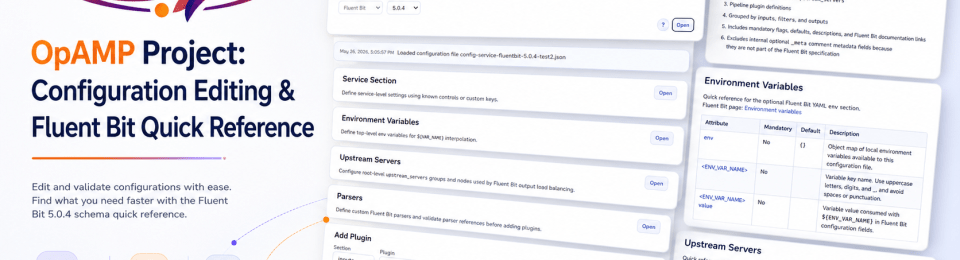
Fluent Bit’s documentation is spread across many static web pages; in some cases, attributes allowed for a plugin are documented across several pages. There is absolutely nothing wrong with this. Having written a book on Fluent Bit, I can say it makes sense, and if the standard docs went into further detail, it would increase the spread of content.
The problem is, once you’ve got a grip on Fluent Bit, you want a quick reference just to check the attribute names or confirm that an attribute does what you expect.
The good news is that’s what we have created …
Each quick reference page has a section at the top that provides a comma-separated list of all the plugins for the different operations, inputs, outputs, etc., with anchor links to that section. Each plugin has a table that lists all configuration attributes, including those inherited from the Fluent Bit kernel and those introduced by extending another plugin.
Why and how …
The “why” may prove even more appealing. As part of our OpAMP project, we wanted to make it easy to edit and validate Fluent Bit and Fluentd configurations before deployment using the OpAMP tooling. That tool became the config-service part of the OpAMP repo, and can be independently deployed as well as function as part of the main OpAMP service. As a result, the UI offers the same authentication and authorisation options, ranging from running without authentication to using OAuth.
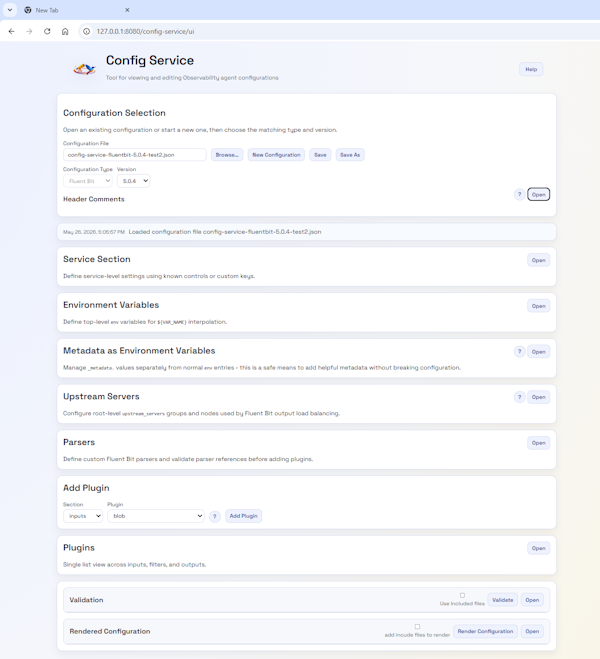
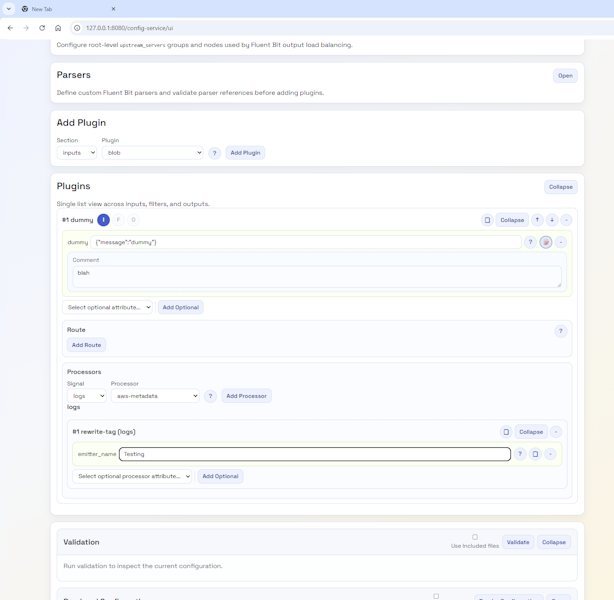
The key to both the UI and documentation is the use of JSON Schemas, as they contain all the information needed to create documentation just as easily as they power the UI. We have therefore generated a markdown page using a Python script. This means the docs are easy to check (compared to an HTML file) and can be rendered within GitHub. We could extend the script to generate HTML. But rather than trying to remember to keep both document types in sync (and double-check formatting), we found a JavaScript tool (marked.js) that performs an on-the-fly transformation that, as long as we stay within the core Markdown syntax, won’t cause any issues. We’ve then enriched that output a bit by applying stylesheets.
To come…
At the moment, we have only covered a subset of Fluent Bit versions, so we will, in due course, expand to cover more versions. Today, this is just the last version from each major release. We haven’t done every version to date as it does take a lot of effort to go through the documentation to generate and check the schema, and we’re still refining things as we enhance the UI.
We are also looking to do the same for Fluentd, though this is much trickier, as the portfolio of plugins that make up the core is smaller than those incorporated into the core of Fluent Bit, and the leveraging of Ruby’s dynamic behaviour makes it very easy for people to offer plugins separately. Then, of course, there is the task of collating all that information.


You must be logged in to post a comment.