
• Home
  • Site Aliases
    • www.cloud-native.info
  • About
    • Background
    • Presenting Activities
    • Internet Profile
      • LinkedIn
    • About
  • Books & Publications
    • Log Generator
    • Logs and Telemetry using Fluent Bit
      • Fluent Bit book
      • Book Resources in GitHub
      • Fluent Bit Classic to YAML Format configurations
    • Logging in Action with Fluentd, Kubernetes and More
      • Logging in Action with Fluentd – Book
      • Fluentd Book Resources
      • Fluentd & Fluent Bit Additional stuff
    • API & API Platform
      • API Useful Resources
    • Oracle Integration
      • Book Website
      • Useful Reading Sources
    • Publication Contributions
  • Resources
    • GitHub
    • Oracle Integration Site
    • Oracle Resources
    • Mindmaps Index
    • Useful Tech Resources
      • Fluentd & Fluent Bit Additional stuff
      • OpAMP
      • Recommended Tech Podcasts
      • Official Sources for Product Logos
      • Java and Graal Useful Links
      • Python Setup & related stuff
      • DevTips
  • Music
    • Monster On Music
    • Music Listening
    • Music Reading

Phil (aka MP3Monster)'s Blog

~ from Technology to Music

Phil (aka MP3Monster)'s Blog

Tag Archives: docs

Fluent Bit configuration quick reference and editor

27 Wednesday May 2026

Posted by mp3monster in Fluent Observability, Fluentbit, General, OpAMP, Technology

≈ Leave a comment

Tags

AI, docs, Fluent Bit, Fluentd, GitHub, MCP, Music, OpAMP, youtube

Fluent Bit’s documentation is spread across many static web pages; in some cases, attributes allowed for a plugin are documented across several pages. There is absolutely nothing wrong with this. Having written a book on Fluent Bit, I can say it makes sense, and if the standard docs went into further detail, it would increase the spread of content.

The problem is, once you’ve got a grip on Fluent Bit, you want a quick reference just to check the attribute names or confirm that an attribute does what you expect.

The good news is that’s what we have created …

  • Quick references
    • 3.2.10 HTML, Markdown
    • 4.2.4 HTML , Markdown
    • 5.0.4 HTML , Markdown

Each quick reference page has a section at the top that provides a comma-separated list of all the plugins for the different operations, inputs, outputs, etc., with anchor links to that section. Each plugin has a table that lists all configuration attributes, including those inherited from the Fluent Bit kernel and those introduced by extending another plugin.

Why and how …

The “why” may prove even more appealing. As part of our OpAMP project, we wanted to make it easy to edit and validate Fluent Bit and Fluentd configurations before deployment using the OpAMP tooling. That tool became the config-service part of the OpAMP repo, and can be independently deployed as well as function as part of the main OpAMP service. As a result, the UI offers the same authentication and authorisation options, ranging from running without authentication to using OAuth.
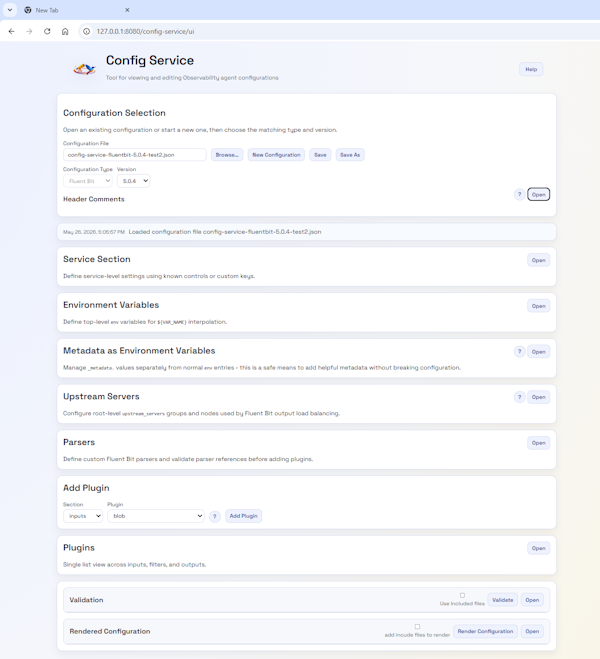
This shows the editor with all the different configuration sections collapsed.
All the different editable components collapsed
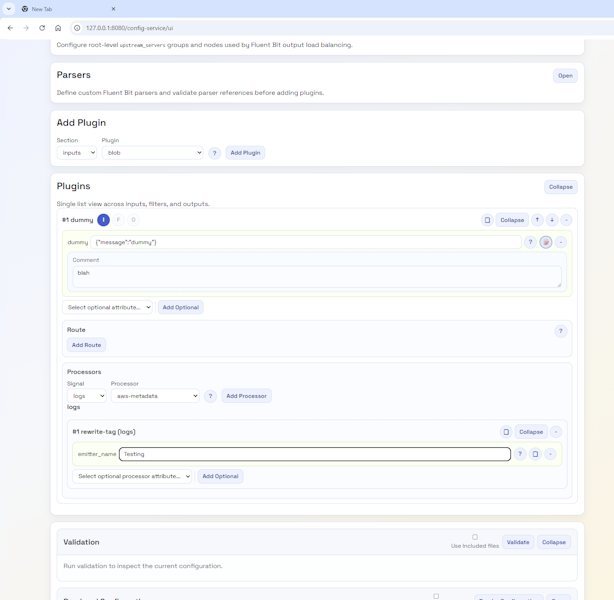
The editor UI showing part of the plugin config feature
Plugins part of the editor

The key to both the UI and documentation is the use of JSON Schemas, as they contain all the information needed to create documentation just as easily as they power the UI. We have therefore generated a markdown page using a Python script. This means the docs are easy to check (compared to an HTML file) and can be rendered within GitHub. We could extend the script to generate HTML. But rather than trying to remember to keep both document types in sync (and double-check formatting), we found a JavaScript tool (marked.js) that performs an on-the-fly transformation that, as long as we stay within the core Markdown syntax, won’t cause any issues. We’ve then enriched that output a bit by applying stylesheets.

To come…

At the moment, we have only covered a subset of Fluent Bit versions, so we will, in due course, expand to cover more versions. Today, this is just the last version from each major release. We haven’t done every version to date as it does take a lot of effort to go through the documentation to generate and check the schema, and we’re still refining things as we enhance the UI.

We are also looking to do the same for Fluentd, though this is much trickier, as the portfolio of plugins that make up the core is smaller than those incorporated into the core of Fluent Bit, and the leveraging of Ruby’s dynamic behaviour makes it very easy for people to offer plugins separately. Then, of course, there is the task of collating all that information.
Resources

  • Quick references
    • 3.2.10 HTML, Markdown
    • 4.2.4 HTML, Markdown
    • 5.0.4 HTML, Markdown
  • OpAMP landing page
  • GitHub home
  • Fluent Bit
  • Fluentd

Share this:

  • Share on Facebook (Opens in new window) Facebook
  • Share on X (Opens in new window) X
  • Share on Reddit (Opens in new window) Reddit
  • Email a link to a friend (Opens in new window) Email
  • Share on WhatsApp (Opens in new window) WhatsApp
  • Print (Opens in new window) Print
  • Share on Tumblr (Opens in new window) Tumblr
  • Share on Mastodon (Opens in new window) Mastodon
  • Share on Pinterest (Opens in new window) Pinterest
  • More
  • Share on Bluesky (Opens in new window) Bluesky
  • Share on LinkedIn (Opens in new window) LinkedIn
Like Loading...

No documentation – a coding error?

01 Friday Dec 2017

Posted by mp3monster in development, General, Oracle

≈ Leave a comment

Tags

coding, development, docs, documentation, error, NoBugsProject

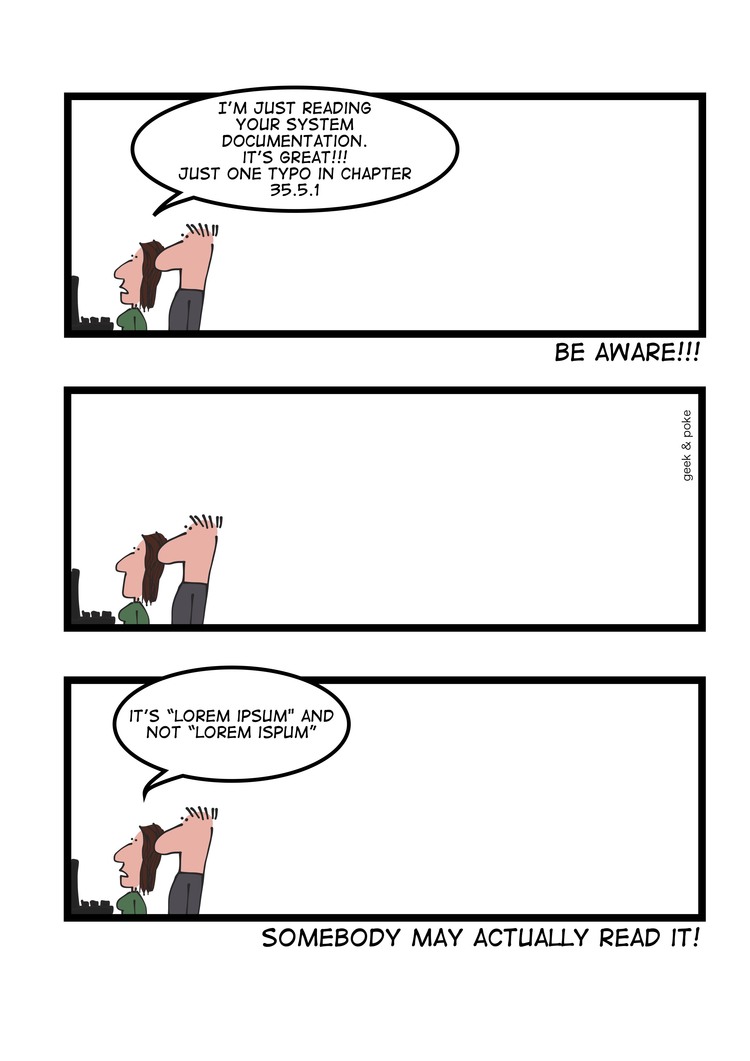
Documentation

from http://geek-and-poke.com

I came across this tweet from Oracle Developers (Oracle Developers Tweet) which picked up on a post from the NoBugsProject about common errors with the use of exceptions. One of the first errors the article described is one of my pet hates – the use of standard exceptions for application specific errors.

This took me onto one of my other pet hates – code without any documentation. I’m not advocating the days of waterfall Development where reams of documentation had to be produced before a single line of Code was written. In fact this is in my option worse than nothing as the docs would often not match the coded reality. But I absolutely agree with the agile manifesto statement:

We value working code over documentation

This doesn’t say no documentation, despite the fact that I have encountered more times than I care to recall the use of this statement to justify not documenting code. So what is the right balance?

We want to save effort from Code reviews and get clean code by using static code analysis but it doesn’t have the ability to apply smarts as what needs documenting? Pair programming is rarely practised, and there is plenty of psychology about group behaviour that can undermine documentation in a pair working approach effort. So what is the answer?

Well, I’ve always applied a couple of personal rules of thumb that can be measured with static code analysis particularly if you use conventional documentation tags. The rules are:

  • Interfaces warrant an interface level description of the interface purpose. It’s always helpful to describe/illustrate with use example. This is code equivalent to a good API Blueprint or swagger doc.
  • Provide a class level description of what the class is for – if it is a DAO then just say what the entity is.
  • If a class is part of a pattern, name the pattern. This is most important when relating to supporting a composite or solution pattern. Remember there will always situations where a newbie will get asked to extend or change your code, help them. Remember not every developer is as experienced or clever as you. If in doubt, give your code to someone who doesn’t know what you’re working on and ask them to explain what your code is doing and why. I had once, had to create a JDBC abstraction layer as we needed to support multiple databases. But if you know JDBC you’ll be aware of there are some subtle but important differences in implementation of connectors. I took the time to explain it in the interface header. I know a couple of developers appreciated the investment of 5 minutes.
  • If you have a function that has a code analytics score such as cyclometeric then describe the function. Use the comment to convey why the high score is justifiable.
  • If the code has specific dependencies or has to perform in a very specific sequence a short comment will help, and anyone going through refactoring code.

With these guidelines it becomes possible to then use javadoc tools to generate your documentation. It doesn’t require you to go find a word document or a wiki page to update the documentation. Of course then reviewing the generated documentation will soon help you finesse the process of documenting in a manner that is whilst light also supports readability without needing the code.

For those, who still disagree I would say …

  • Do you want to be maintaining and updating the same code for the rest of your career to meet new minor changes etc?
  • Not everyone is a great coder like you, do you want someone less capable who may have to make a change messing up your elegant code?
  • Sooner or later someone will ask you to fix or enhance some code that in your eyes is a chaotic unintelligible mess, I’m sure you’d appreciate some comments that will help you understand what the developer was trying to do? We can’t expect those not so good at the craft to document if the best of us are not prepared to do so.

If you don’t agree, or have found different approaches that ensure enough accurate documentation, please share.

Share this:

  • Share on Facebook (Opens in new window) Facebook
  • Share on X (Opens in new window) X
  • Share on Reddit (Opens in new window) Reddit
  • Email a link to a friend (Opens in new window) Email
  • Share on WhatsApp (Opens in new window) WhatsApp
  • Print (Opens in new window) Print
  • Share on Tumblr (Opens in new window) Tumblr
  • Share on Mastodon (Opens in new window) Mastodon
  • Share on Pinterest (Opens in new window) Pinterest
  • More
  • Share on Bluesky (Opens in new window) Bluesky
  • Share on LinkedIn (Opens in new window) LinkedIn
Like Loading...
    • About
      • Internet Profile
      • Music Buying
      • Presenting Activities
    • Books & Publications
      • Logging in Action with Fluentd, Kubernetes and More
      • Logs and Telemetry using Fluent Bit
      • Oracle Integration
      • API & API Platform
        • API Useful Resources
        • Useful Reading Sources
    • Mindmaps Index
    • Monster On Music
      • Music Listening
      • Music Reading
    • Oracle Resources
    • Useful Tech Resources
      • Fluentd & Fluent Bit Additional stuff
        • Logging Frameworks and Fluent Bit and Fluentd connectivity
        • REGEX for BIC and IBAN processing
      • Formatting etc
      • Java and Graal Useful Links
      • Official Sources for Product Logos
      • Python Setup & related tips
      • Recommended Tech Podcasts

    Oracle Ace Director Alumni

    TOGAF 9

    Logs and Telemetry using Fluent Bit


    Logging in Action — Fluentd

    Logging in Action with Fluentd


    Oracle Cloud Integration Book


    API Platform Book


    Oracle Dev Meetup London

    Blog Categories

    • App Ideas
    • Books
      • Book Reviews
      • manning
      • Oracle Press
      • Packt
    • Enterprise architecture
    • General
      • economy
      • ExternalWebPublications
      • LinkedIn
      • Website
    • Music
      • Music Resources
      • Music Reviews
    • Photography
    • Podcasts
    • Technology
      • AI
      • APIs & microservices
      • chatbots
      • Cloud
      • Cloud Native
      • Dev Meetup
      • development
        • languages
          • java
          • node.js
          • python
      • drone
      • Fluent Observability
        • Fluentbit
        • Fluentd
        • OpAMP
      • logsimulator
      • mindmap
      • OMESA
      • Oracle
        • API Platform CS
          • tools
        • Helidon
        • ITSO & OEAF
        • Java Cloud
        • NodeJS Cloud
        • OIC – ICS
        • Oracle Cloud Native
        • OUG
      • railroad diagrams
      • TOGAF
    • xxRetired
    • AI
    • API Platform CS
    • APIs & microservices
    • App Ideas
    • Book Reviews
    • Books
    • chatbots
    • Cloud
    • Cloud Native
    • Dev Meetup
    • development
    • drone
    • economy
    • Enterprise architecture
    • ExternalWebPublications
    • Fluent Observability
    • Fluentbit
    • Fluentd
    • General
    • Helidon
    • ITSO & OEAF
    • java
    • Java Cloud
    • languages
    • LinkedIn
    • logsimulator
    • manning
    • mindmap
    • Music
    • Music Resources
    • Music Reviews
    • node.js
    • NodeJS Cloud
    • OIC – ICS
    • OMESA
    • OpAMP
    • Oracle
    • Oracle Cloud Native
    • Oracle Press
    • OUG
    • Packt
    • Photography
    • Podcasts
    • python
    • railroad diagrams
    • Technology
    • TOGAF
    • tools
    • Website
    • xxRetired

    Enter your email address to subscribe to this blog and receive notifications of new posts by email.

    Join 2,617 other subscribers

    RSS

    RSS Feed RSS - Posts

    RSS Feed RSS - Comments

    June 2026
    M T W T F S S
    1234567
    891011121314
    15161718192021
    22232425262728
    2930  
    « May    

    Twitter

    Tweets by mp3monster

    History

    Speaker Recognition

    Open Source Summit Speaker

    Flickr Pics

    Boxer Rebellion @ Brixton ElectricBoxer Rebellion @ Brixton ElectricBoxer Rebellion @ Brixton ElectricBoxer Rebellion @ Brixton Electric
    More Photos

    Social

    • View @mp3monster’s profile on Twitter
    • View philwilkins’s profile on LinkedIn
    • View mp3monster’s profile on GitHub
    • View mp3monster’s profile on Flickr
    • View mp3muncher’s profile on WordPress.org
    • View philmp3monster’s profile on Twitch
    Follow Phil (aka MP3Monster)'s Blog on WordPress.com

    Blog at WordPress.com.

    • Subscribe Subscribed
      • Phil (aka MP3Monster)'s Blog
      • Join 229 other subscribers
      • Already have a WordPress.com account? Log in now.
      • Phil (aka MP3Monster)'s Blog
      • Subscribe Subscribed
      • Sign up
      • Log in
      • Report this content
      • View site in Reader
      • Manage subscriptions
      • Collapse this bar

    Loading Comments...

    You must be logged in to post a comment.

      Privacy & Cookies: This site uses cookies. By continuing to use this website, you agree to their use.
      To find out more, including how to control cookies, see here: Our Cookie Policy
      %d