• Home
  • Site Aliases
    • www.cloud-native.info
  • About
    • Background
    • Presenting Activities
    • Internet Profile
      • LinkedIn
    • About
  • Books & Publications
    • Log Generator
    • Logs and Telemetry using Fluent Bit
      • Fluent Bit book
      • Book Resources in GitHub
      • Fluent Bit Classic to YAML Format configurations
    • Logging in Action with Fluentd, Kubernetes and More
      • Logging in Action with Fluentd – Book
      • Fluentd Book Resources
      • Fluentd & Fluent Bit Additional stuff
    • API & API Platform
      • API Useful Resources
    • Oracle Integration
      • Book Website
      • Useful Reading Sources
    • Publication Contributions
  • Resources
    • GitHub
    • Oracle Integration Site
    • Oracle Resources
    • Mindmaps Index
    • Useful Tech Resources
      • Fluentd & Fluent Bit Additional stuff
      • Recommended Tech Podcasts
      • Official Sources for Product Logos
      • Java and Graal Useful Links
      • Python Setup & related stuff
      • DevTips
  • Music
    • Monster On Music
    • Music Listening
    • Music Reading

Phil (aka MP3Monster)'s Blog

~ from Technology to Music

Phil (aka MP3Monster)'s Blog

Tag Archives: MCP

OpAMP server with MCP – aka conversational Fluent Bit control

14 Tuesday Apr 2026

Posted by mp3monster in AI, chatbots, development, Fluent Observability, General, OpAMP, Technology

≈ Leave a comment

Tags

AI, chatops, Fluent Bit, Fluentd, LangGraph, LLM, MCP, OpAMP, OpenTelemetry, OTel, OTLP

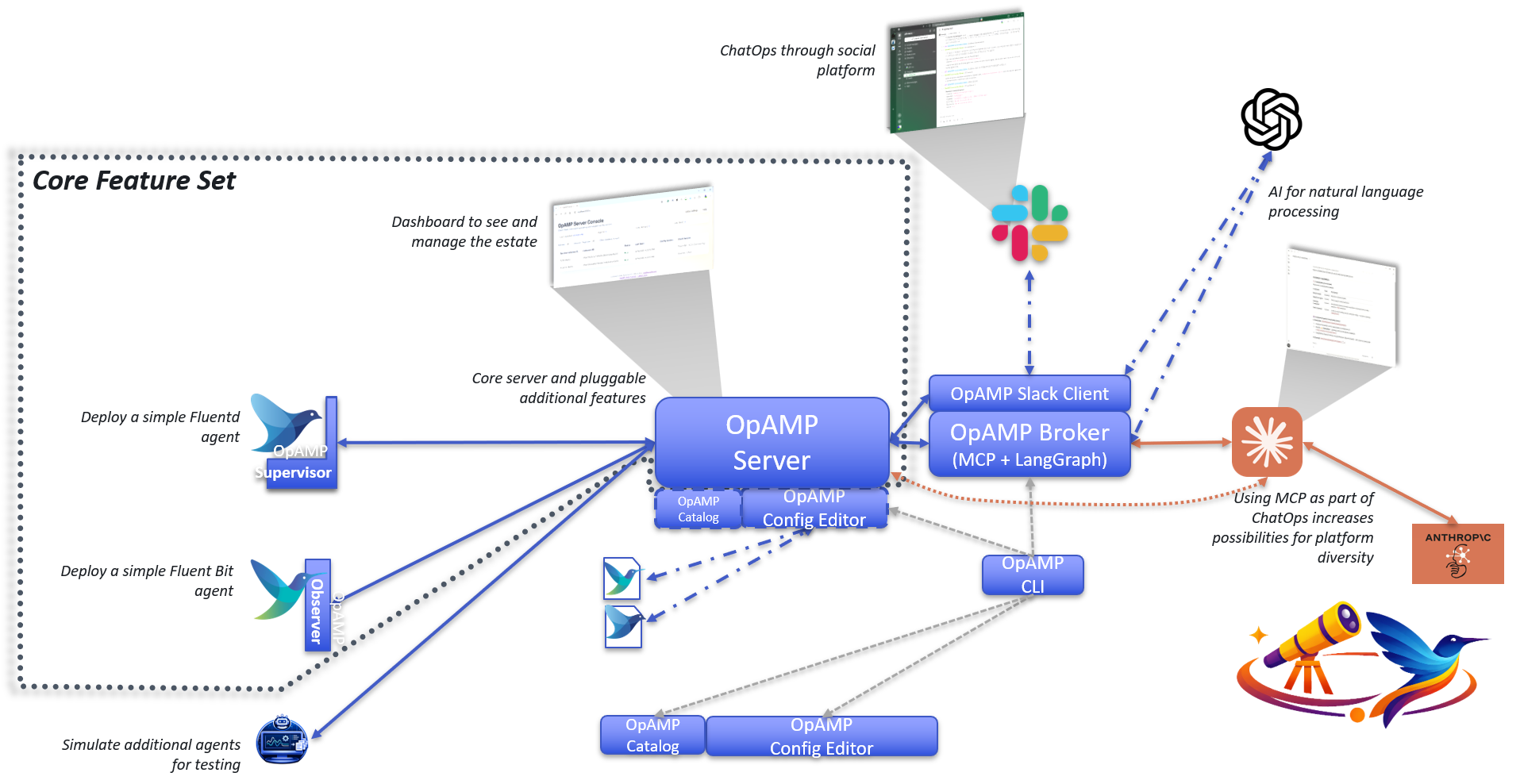
I’ve written a few times about how OpAMP (Open Agent Management Protocol) may emerge from the OpenTelemetry CNCF project, but like OTLP (OpenTelemetry Protocol), it applies to just about any observability agent, not just the OTel Collector. As a side project, giving a real-world use case work on my Python skills, as well as an excuse to work with FastMCP (and LangGraph shortly). But also to bring the evolved idea of ChatOps (see here and here).

One of the goals of ChatOps was to free us from having to actively log into specific tools to mine for information once metrics, traces, and logs reach the aggregating back ends, but being able to. If we leverage a decent LLM with Model Context Protocol tools through an app such as Claude Desktop or ChatGPT (or their mobile variants). Ideally, we have a means to free ourselves to use social collaboration tools, rather than being tied to a specific LLM toolkit.

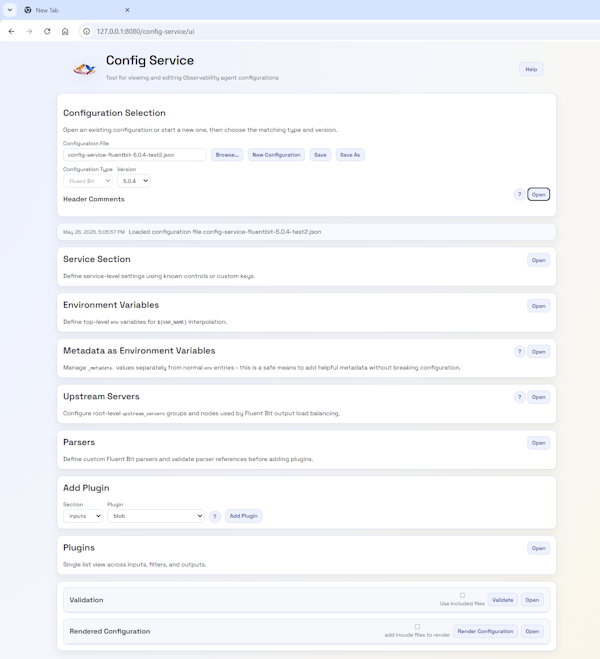
With a UI and the ability to communicate with Fluentd and Fluent Bit without imposing changes on the agent code base (we use a supervisor model), issue commands, track what is going on, and have the option of authentication. (more improvements in this space to come).

New ChatOps – Phase 1

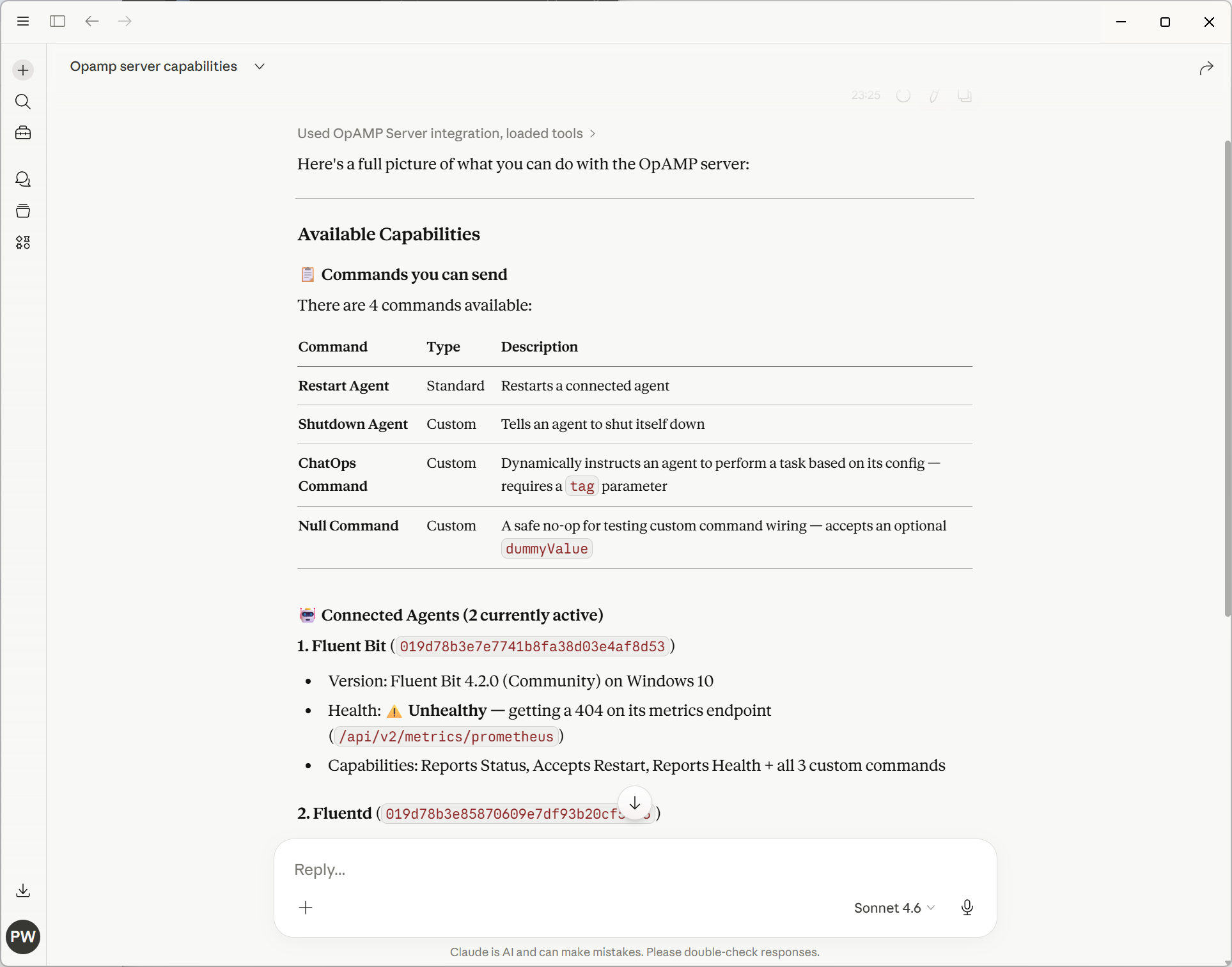
With the first level of the new ChatOps dynamism being through LLM desktop tooling and MCP, the following are screenshots showing how we’ve exposed part of our OpAMP server via APIs. As you can see in the screenshot within our OpAMP server, we have the concept of commands. What we have done is take some of the commands described in the OpAMP spec, call them standard commands, and then define a construct for Custom Commands (which can be dynamically added to the server and client).

interaction through Claude Desktop which has been configured with our MCP server (part of our OpAMP server) showing us what can be done

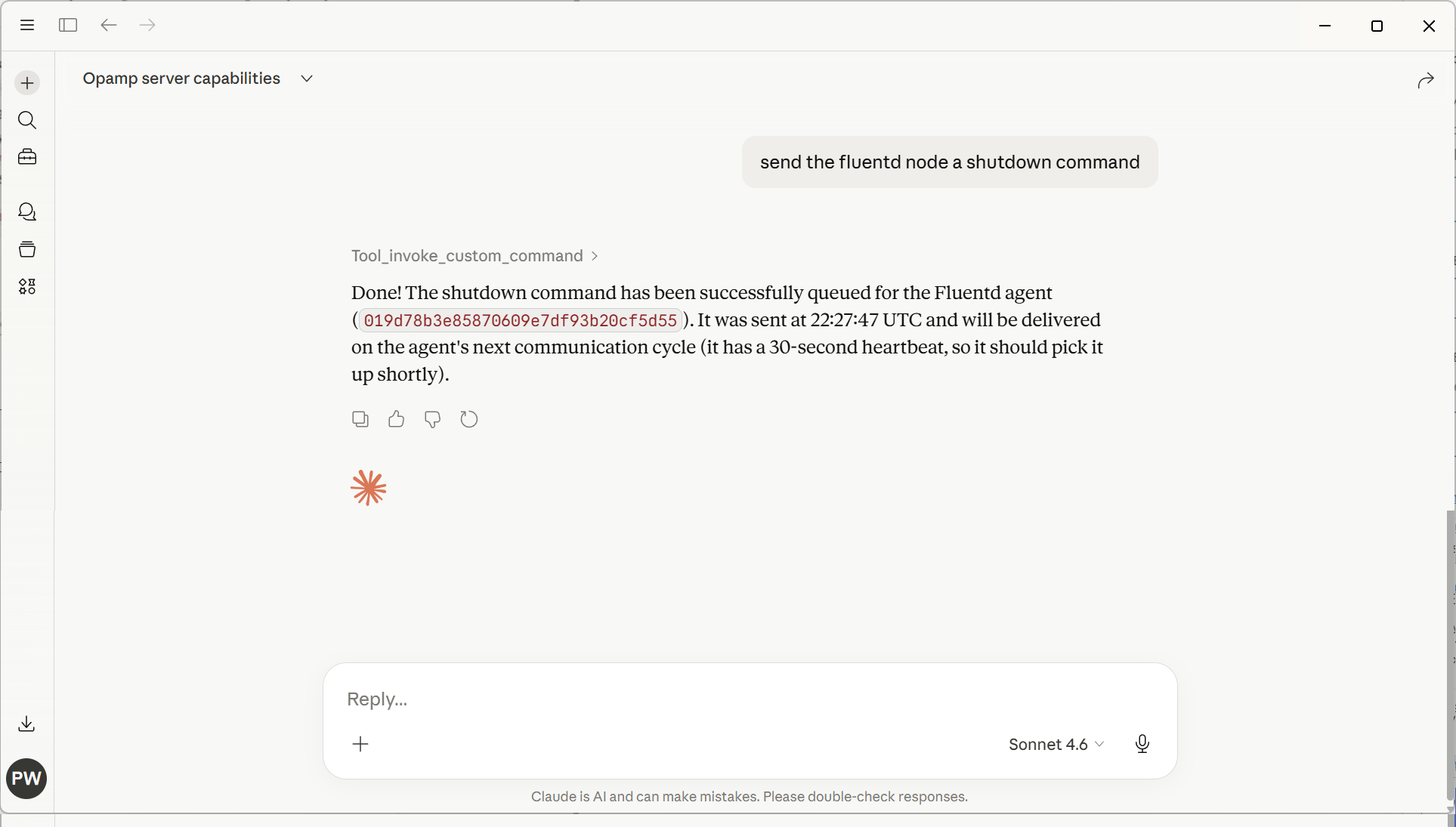
The following screenshot illustrates using plain text rather than trying to come up with structured English to get the OpAMP server to shut down a Fluentd node (in this case, as we only had 1 Fluentd node, it worked out which node to stop).

Claude Desktop showing conversation to shutdown a FLuentd node

Interesting considerations

What will be interesting to see is the LLM token consumption changes as the portfolio of managed agents changes, given that, to achieve the shutdown, the LLM will have had to obtain all the Fluent Bit & Fluentd instances being managed. If we provide an endpoint to find an agent instance, would the LLM reason to use that rather than trawl all the information?

Next phase

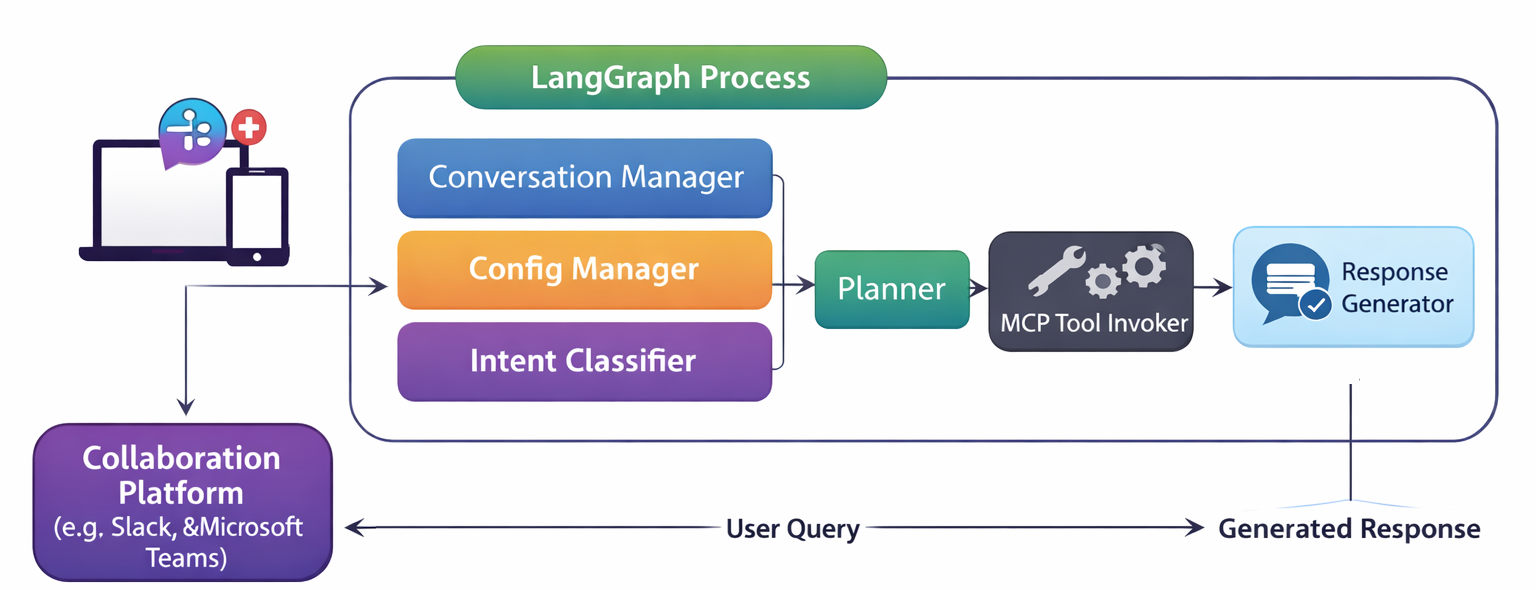
ChatGPT, Claude Desktop, and others already incorporate some level of collaboration capabilities if the users involved are on a suitable premium account (Team/Enterprise). It would be good to enable greater freedom and potentially lower costs by enabling the capability to operate through collaboration platforms such as Teams and Slack. This means the next steps need to look something along the lines of:

Share this:

  • Share on Facebook (Opens in new window) Facebook
  • Share on X (Opens in new window) X
  • Share on Reddit (Opens in new window) Reddit
  • Email a link to a friend (Opens in new window) Email
  • Share on WhatsApp (Opens in new window) WhatsApp
  • Print (Opens in new window) Print
  • Share on Tumblr (Opens in new window) Tumblr
  • Share on Mastodon (Opens in new window) Mastodon
  • Share on Pinterest (Opens in new window) Pinterest
  • More
  • Share on Bluesky (Opens in new window) Bluesky
  • Share on LinkedIn (Opens in new window) LinkedIn
Like Loading...

MCP Security

30 Thursday Oct 2025

Posted by mp3monster in AI, development, General, Technology

≈ Leave a comment

Tags

AI, artificial-intelligence, attack, attacks, cybersecurity, MCP, model context protocol, Paper, Security, Technology, vectors

MCP (Model Context Protocol) has really taken off as a way to amplify the power of AI, providing tools for utilising data to supplement what a foundation model has already been trained on, and so on.

With the rapid uptake of a standard and technology that has been development/implementation led aspects of governance and security can take time to catch up. While the use of credentials with tools and how they propagate is well covered, there are other attack vectors to consider. On the surface, it may seem superficial until you start looking more closely. A recent paper Model Context Protocol (MCP): Landscape, Security Threats, and Future Research Directions highlights this well, and I thought (even if for my own benefit) to explain some of the vectors.

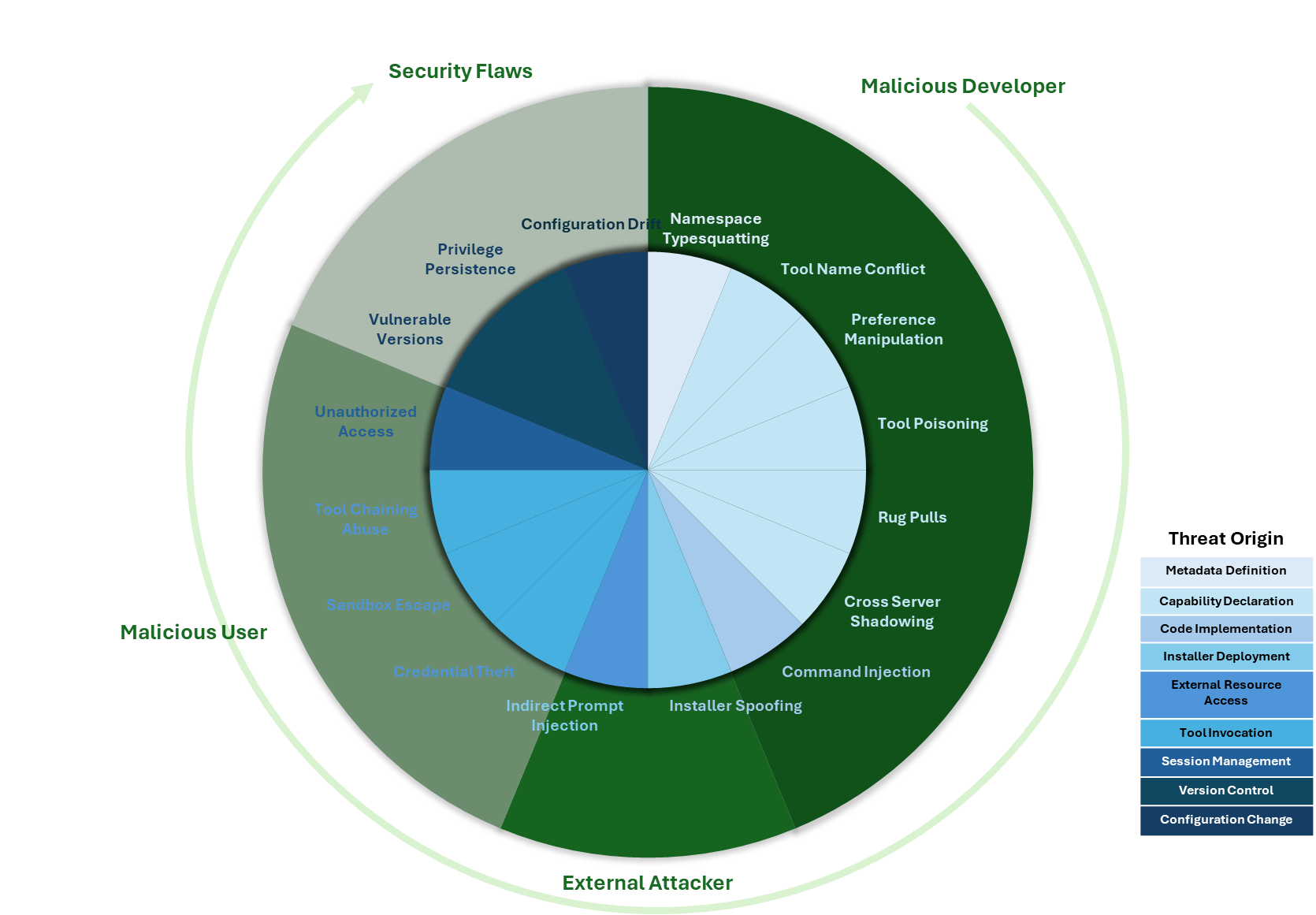
I’ve also created a visual representation based on the paper of the vectors described.

The inner ring represents each threat, with its color denoting the likely origin of the threat. The outer ring groups threats into four categories, reflecting where in the lifecycle of an MCP solution the threat could originate.

I won’t go through all the vectors in detail, though I’ve summarized them below (the paper provides much more detail on each vector). But let’s take a look at one or two to highlight the unusual nature of some of the issues, where the threat in some respects is a hybrid of potential attack vectors we’ve seen elsewhere. It will be easy to view some of the vectors as fairly superficial until you start walking through the consequences of the attack, at which point things look a lot more insidious.

Several of the vectors can be characterised as forms of spoofing, such as namespace typosquatting, where a malicious tool is registered on a portal of MCP services, appearing to be a genuine service — for example, banking.com and bankin.com. Part of the problem here is that there are a number of MCP registries/markets, but the governance they have and use to mitigate abuse varies, and as this report points out, those with stronger governance tend to have smaller numbers of services registered. This isn’t a new problem; we have seen it before with other types of repositories (PyPI, npm, etc.). The difference here is that the attacker could install malicious logic, but also implement identity theft, where a spoofed service mimics the real service’s need for credentials. As the UI is likely to be primarily textual, it is far easier to deceive (compared to, say, a website, where the layout is adrift or we inspect URIs for graphics that might give clues to something being wrong). A similar vector is Tool Name Conflict, where the tool metadata provided makes it difficult for the LLM to distinguish the correct tool from a spoofed one, leading the LLM to trust the spoof rather than the user.

Another vector, which looks a little like search engine gaming (additional text is hidden in web pages to help websites improve their search rankings), is Preference Manipulation Attacks, where the tool description can include additional details to prompt the LLM to select one solution over another.

The last aspect of MCP attacks I wanted to touch upon is that, as an MCP tool can provide prompts or LLM workflows, it is possible for the tool to co-opt other utilities or tools to action the malicious operations. For example, an MCP-provided prompt or tool could ask the LLM to use an approved FTP tool to transfer a file, such as a secure token, to a legitimate service, such as Microsoft OneDrive, but rather than an approved account, it is using a different one for that task. While the MCP spec says that such external connectivity actions should have the tool request approval, if we see a request coming from something we trust, it is very typical for people to just say okay without looking too closely.

Even with these few illustrations, tooling interaction with an LLM comes with deceptive risks, partially because we are asking the LLM to work on our behalf, but we have not yet trained LLMs to reason about whether an action’s intent is in the user’s best interests. Furthermore, we need to educate users on the risks and telltale signs of malicious use.

Attack Vector Summary

The following list provides a brief summary of the attack vectors. The original paper examines each in greater depth, illustrating many of the vectors and describing possible mitigation strategies. While many technical things can be done. One of the most valuable things is to help potential users understand the risks, use that to guide which MCP solutions are used, and watch for signs that things aren’t as they should be.

Continue reading →

Share this:

  • Share on Facebook (Opens in new window) Facebook
  • Share on X (Opens in new window) X
  • Share on Reddit (Opens in new window) Reddit
  • Email a link to a friend (Opens in new window) Email
  • Share on WhatsApp (Opens in new window) WhatsApp
  • Print (Opens in new window) Print
  • Share on Tumblr (Opens in new window) Tumblr
  • Share on Mastodon (Opens in new window) Mastodon
  • Share on Pinterest (Opens in new window) Pinterest
  • More
  • Share on Bluesky (Opens in new window) Bluesky
  • Share on LinkedIn (Opens in new window) LinkedIn
Like Loading...

    I work for Oracle, all opinions here are my own & do not necessarily reflect the views of Oracle

    • About
      • Internet Profile
      • Music Buying
      • Presenting Activities
    • Books & Publications
      • Logging in Action with Fluentd, Kubernetes and More
      • Logs and Telemetry using Fluent Bit
      • Oracle Integration
      • API & API Platform
        • API Useful Resources
        • Useful Reading Sources
    • Mindmaps Index
    • Monster On Music
      • Music Listening
      • Music Reading
    • Oracle Resources
    • Useful Tech Resources
      • Fluentd & Fluent Bit Additional stuff
        • Logging Frameworks and Fluent Bit and Fluentd connectivity
        • REGEX for BIC and IBAN processing
      • Formatting etc
      • Java and Graal Useful Links
      • Official Sources for Product Logos
      • Python Setup & related tips
      • Recommended Tech Podcasts

    Oracle Ace Director Alumni

    TOGAF 9

    Logs and Telemetry using Fluent Bit


    Logging in Action — Fluentd

    Logging in Action with Fluentd


    Oracle Cloud Integration Book


    API Platform Book


    Oracle Dev Meetup London

    Blog Categories

    • App Ideas
    • Books
      • Book Reviews
      • manning
      • Oracle Press
      • Packt
    • Enterprise architecture
    • General
      • economy
      • ExternalWebPublications
      • LinkedIn
      • Website
    • Music
      • Music Resources
      • Music Reviews
    • Photography
    • Podcasts
    • Technology
      • AI
      • APIs & microservices
      • chatbots
      • Cloud
      • Cloud Native
      • Dev Meetup
      • development
        • languages
          • java
          • node.js
          • python
      • drone
      • Fluent Observability
        • Fluentbit
        • Fluentd
        • OpAMP
      • logsimulator
      • mindmap
      • OMESA
      • Oracle
        • API Platform CS
          • tools
        • Helidon
        • ITSO & OEAF
        • Java Cloud
        • NodeJS Cloud
        • OIC – ICS
        • Oracle Cloud Native
        • OUG
      • railroad diagrams
      • TOGAF
    • xxRetired
    • AI
    • API Platform CS
    • APIs & microservices
    • App Ideas
    • Book Reviews
    • Books
    • chatbots
    • Cloud
    • Cloud Native
    • Dev Meetup
    • development
    • drone
    • economy
    • Enterprise architecture
    • ExternalWebPublications
    • Fluent Observability
    • Fluentbit
    • Fluentd
    • General
    • Helidon
    • ITSO & OEAF
    • java
    • Java Cloud
    • languages
    • LinkedIn
    • logsimulator
    • manning
    • mindmap
    • Music
    • Music Resources
    • Music Reviews
    • node.js
    • NodeJS Cloud
    • OIC – ICS
    • OMESA
    • OpAMP
    • Oracle
    • Oracle Cloud Native
    • Oracle Press
    • OUG
    • Packt
    • Photography
    • Podcasts
    • python
    • railroad diagrams
    • Technology
    • TOGAF
    • tools
    • Website
    • xxRetired

    Enter your email address to subscribe to this blog and receive notifications of new posts by email.

    Join 2,616 other subscribers

    RSS

    RSS Feed RSS - Posts

    RSS Feed RSS - Comments

    April 2026
    M T W T F S S
     12345
    6789101112
    13141516171819
    20212223242526
    27282930  
    « Mar    

    Twitter

    Tweets by mp3monster

    History

    Speaker Recognition

    Open Source Summit Speaker

    Flickr Pics

    Boxer Rebellion @ Brixton ElectricBoxer Rebellion @ Brixton ElectricBoxer Rebellion @ Brixton ElectricBoxer Rebellion @ Brixton Electric
    More Photos

    Social

    • View @mp3monster’s profile on Twitter
    • View philwilkins’s profile on LinkedIn
    • View mp3monster’s profile on GitHub
    • View mp3monster’s profile on Flickr
    • View mp3muncher’s profile on WordPress.org
    • View philmp3monster’s profile on Twitch
    Follow Phil (aka MP3Monster)'s Blog on WordPress.com

    Blog at WordPress.com.

    • Subscribe Subscribed
      • Phil (aka MP3Monster)'s Blog
      • Join 228 other subscribers
      • Already have a WordPress.com account? Log in now.
      • Phil (aka MP3Monster)'s Blog
      • Subscribe Subscribed
      • Sign up
      • Log in
      • Report this content
      • View site in Reader
      • Manage subscriptions
      • Collapse this bar
     

    Loading Comments...
     

    You must be logged in to post a comment.

      Privacy & Cookies: This site uses cookies. By continuing to use this website, you agree to their use.
      To find out more, including how to control cookies, see here: Our Cookie Policy
      %d