• Home
  • About
    • Background
    • LinkedIn
    • Presenting Activities
    • Internet Profile
    • About
    • www.cloud-native.info
    • AI Disclosure
  • Observability, Fluent(d) Bit & OpAMP
    • OpAMP Product
    • OpAMP Overview
    • Log Generator
    • Fluent Bit Classic to YAML Format configurations
  • My Books
    • Logs and Telemetry using Fluent Bit
      • Fluent Bit book
      • Book Resources in GitHub
    • Logging in Action with Fluentd, Kubernetes and More
      • Logging in Action with Fluentd – Book
      • Fluentd Book Resources
      • Fluentd & Fluent Bit Additional stuff
    • API & API Platform
      • API Useful Resources
    • Oracle Integration
      • Book Website
      • Useful Reading Sources
    • Publication Contributions
  • Resources
    • GitHub
    • Oracle Integration Site
    • Oracle Resources
    • Mindmaps Index
    • Useful Tech Resources
      • Fluentd & Fluent Bit Additional stuff
      • Recommended Tech Podcasts
      • Official Sources for Product Logos
      • Java and Graal Useful Links
      • DevTips
  • Music
    • Monster On Music
    • Music Listening
    • Music Reading

Phil (aka MP3Monster)'s Blog

~ from Technology to Music

Phil (aka MP3Monster)'s Blog

Tag Archives: patching

CVE publication trend and how are known exploits are changing?

02 Monday Nov 2026

Posted by mp3monster in General, Security, Technology

≈ Leave a comment

Tags

attack, CIRCL, CISA, compensating controls, controls, CRACI, CVE, CVSS], exploits, KEV, patching, Security, Technology, trends, VulnCheck, vulnerabilities

With the explosion in the number of CVEs (Common Vulnerabilities and Exposures) being published, it begs the question as to whether the number of Known Exploited Vulnerabilities (KEV) is trending in the same direction. The natural assumption would be that there be some level of correlation. It took some exploring of data before we started to see any data trends that made sense, and threw up some interesting observations.
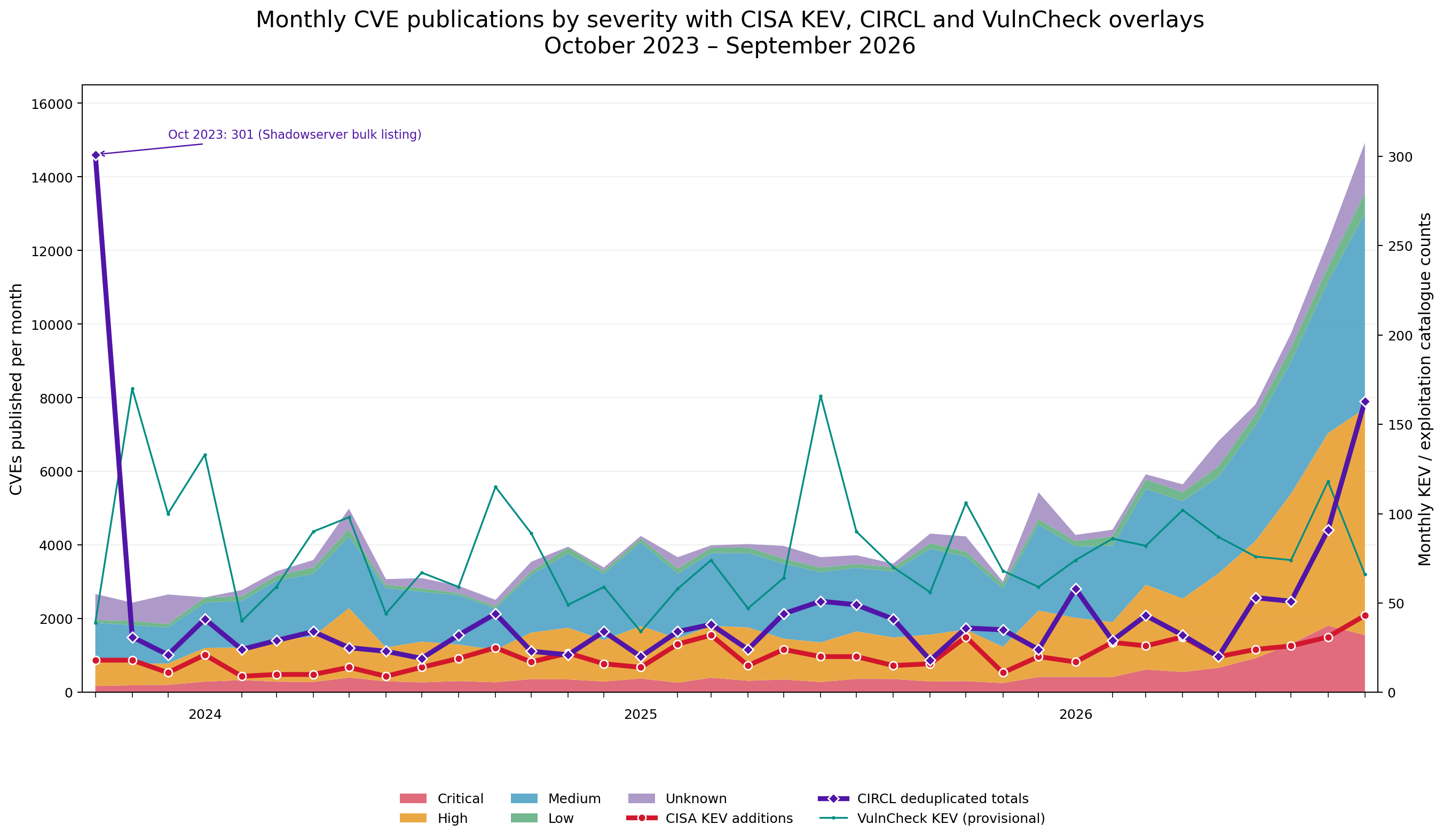
Before we look at what we might be able to infer from the data and the patterns we see, let’s start with the looking at the data we’ve sourced and plotted.

Data sources

  • CVE Publications — CRACI / CVE Program: Monthly counts of published Common Vulnerabilities and Exposures (CVEs), categorized by CVSS severity: Critical, High, Medium, Low and Unknown. The data originates from the CVE Program’s official records and is presented as stacked areas to illustrate changes in vulnerability volumes and severity distribution over time. Sources: CRACI CVE Publication Trends | CVE Program GitHub.
  • CISA Known Exploited Vulnerabilities (KEV): Monthly counts of vulnerabilities added to the US Cybersecurity and Infrastructure Security Agency’s catalogue of vulnerabilities confirmed to have been exploited in the wild. Counts are based on the date vulnerabilities entered the catalogue rather than when exploitation first occurred. Presented as the red line. Sources: CISA KEV Catalogue | CISA KEV GitHub.
  • CIRCL Vulnerability-Lookup: Monthly deduplicated counts of vulnerabilities recorded across multiple exploitation intelligence catalogues, including CISA, Shadowserver, ENISA, Previdian and CIRCL. By aggregating these sources, it provides broader visibility of known exploitation than any individual catalogue, although counts reflect when vulnerabilities were listed rather than necessarily first exploited. Presented as the purple line. Sources: CIRCL Vulnerability-Lookup | GitHub Repository.
  • VulnCheck KEV: Monthly counts of vulnerabilities identified as exploited in the wild through intelligence collected from security researchers, vendors, incident investigations and other publicly available evidence. VulnCheck provides an additional perspective beyond CISA, although its reporting volumes may be influenced by changes in intelligence coverage and retrospective discoveries. Presented as the thinner teal line, with the monthly figures currently treated as provisional pending independent validation. Sources: VulnCheck | Exploit Intelligence Documentation.

Understanding the data

Spikes in KEV data and varying sources

We have seen (and it is visible in our graph that the different sources of KEV data tend to show early spikes, typically triggered when the catalogue is being populated with retrospective data. We initially started looking at individual reporting sources such as VulnCheck thinking that they would give a true figure and the aggregated reporting data such as CIRCL would provide amplified patterns. The opposite appeared to be the case. We’ve kept the VulnCheck and CISA KEV reporting help illustrate this. Where Vulncheck’s spiking tend to be dramatic compared where CIRCL might show a small uptick, but then in the last quarter of 2025 we start to see opposing trends. It appears that CIRCL’s aggregation of sources has smoothed out the fluctuations. CISA’s KEV numbers in comparison a notably different in volume to VulnCheck. The CISA numbers generally follow the same pattern as CIRCL until 2026 – with the worst divergence 50 exploitations identified rather than the triple digit variance of VulnCheck.

Critical and High CVE fluctuations

If you look carefully and the CVE trends in the different categories, while there is clearly an acceleration in the last 12 months (which we could attribute to initiatives such as GlassWing) if you look carefully, you’ll notice that the growth in Severe and High scoring CVEs is growing faster. It is only two dates, but this table supports the observation:

SeveritySeptember 2025September 2026Growth
Critical2951,555+427%
High1,2756,160+383%
Medium2,3315,285+127%
Low148564+281%
Unknown2631,366+419%
Total4,31214,930+246%

The telling difference is if you compare the total growth against the growth numbers and the individual severity growth numbers. The critical numbers have multiplied by nearly 1.75.

Exploits (KEV) appear to be tracking vulnerabilities (CVE)

Perhaps the most important, point in the data is that based on the aggregated CIRCL counts, exploits are following the upward trend with a bit of lag which fits what thought we’d see. Yes at this point we’re are mindful that this could be finding data that supports a hypothesis (particularly given other individual KEV numbers may not support the trend). But on balance I’m inclined to trust the CIRCL numbers because if other numbers are erratic we’d not see such a similar upward track.

How is patching performance responding?

Keeping up with patching is likely to prove challenging, the 2026 Edgescan report picks out a rather telling observation, which supports the problems of not keeping up:

The most striking insight is that vulnerabilities from 2025, 2023, and 2024 account for more than 50% of all occurrences, indicating that newly published or recently discovered issues are the primary drivers of risk this year.

The suggestion is that the really high profile vulnerabilities get addressed, but the progress to address those that don’t get the notoriety is weaker. The alternative possibility relates not on individual exposures but when failures grab the headlines that attention turns back to patching. Another indicator that patching can’t keep up is the Verizon 2026 DBIR reported 26% of CISA KEV vulnerabilities fully remediated in its analyzed population versus 38% in the prior report, with median full remediation time increasing from 32 to 43 days (assuming Verizon’s dataset is representative).

Conclusion

While this is not an exhaustive analysis, it would be fair to treat it as anecdotal evidence to indicate:

  • CVE acceleration is being followed by KEV acceleration – possibly the most concerning.
  • If historic data shows we can’t keep up with patching, then its only going to get worse – supporting the expectation of climbing KEVs.

We do therefore need to look to adopt differing strategies to protect ourselves, and new measurements to reflect whether the new approaches are paying dividends. So what can we do differently, and I’m not saying don’t patch, I’m saying if you have a finite patching capacity, use it wisely, and invest in actions that give you the best vulnerability reduction.

Steps

Patching is by its very nature after the horse has bolted, this is why we have zero day exploits. The bottom line is there will always be vulnerabilities, the question is who finds them first and how do we react. Perhaps an exceptional illustration is the Apollo 11 Guidance Computer 1201 and 1202 errors (more about this and other aspects of the Apollo program at Apollo 11 Journals, the BBC also have an excellent podcast – 13 Minutes to the Moon that broke this down). This essentially was a memory overload error (should sound familiar as it is an attack vector, only difference is the overload was innocent for Apollo 11). The lesson is, the ground crew had encountered various issues during training, so put operational processes in place to allow them to quickly determine cause and action. Just as with modern businesses, the lunar programme could not be stopped to create months to rework Apollo’s software to avoid the issue, so they ensured there are what we might call compensating controls – a manual ground crew process that could tell Armstrong and aldrin what to do.

Continuing compensating controls, is not to have reactions ready, but also preventing attacks from reaching vulnerabilities. For example Oracle’s WebLogic Server has some CVEs around its T3 protocol. If you’re not using this as a communication channel between severs you can switch it off in the configuration. Better still, put those servers within a subnet with network security rules that prevent T3 traffic from getting into the subnet. There are multiple CVEs for T3 – so rather than patching everyone one of them, you’ve prevented the exploit from being usable by anyone other than someone having been able to get into that subnet.

The next upside of such a control is that even if the T3 vulnerability was exploited, the ‘blast radius’ is constrained, as the network configuration will make it a lot harder to move to other servers as first they need to find away to see beyond the local network. This brings another philosophical change which doesn’t have to be difficult to achieve. We always look at security on the inbound traffic – but we should be just as observant about outbound paths, and have controls. One very contemporary aspect of this is to put gateways between applications or agents and LLMs. The focus is that credentials to external tools and services are only introduced beyond the sphere of the LLM(s). But we can also prevent the LLM from being hijacked into abusing tools (from the LLM view point it is an inbound security control). But we should treat all outbound data this way. Its the fastest way to detect and stop data egress.

It doesn’t need a chaos monkey but …

Many will have over the years heard about the development of the chaos monkey at Netflix by Greg Orzell which is a small app that can be unleashed and will try to tear everything up. While this maybe seen as rather extreme, the underlying message is once its secured, don’t assume it remains secure (controls can be accidentally removed). Put basic security probes into the environment – you can test non-destructively. Don’t put a procedure in place and let is rot on a shelf, if you have capacity – fail things over. The more these sorts of processes a run, the more it becomes ‘muscle memory’ and while early iterations will be painful, that pain and cost will be minor to when it happens for real.

It isn’t if, but when …

We all like to think these things won’t happen to us, and we’re prepared. But worldwide 1 in 5 will have cancer in their lifetime. Many cancers are treatable, and largely routine – because the medical profession have had to treat the problem over and over. We just have to see IT attacks in the same manner.

Data sources and reporting

  1. CISA Known Exploited Vulnerabilities catalogue.
  2. CVE monthly trends, including CISA additions — cve.tools.
  3. VulnCheck: State of Exploitation 2026 (analysing 2025).
  4. CIRCL Vulnerability-Lookup | GitHub Repository
  5. CRACI CVE Publication Trends | CVE Program GitHub
  6. VulnCheck: State of Exploitation, H1 2026.
  7. VulnCheck: Expanding KEV, July 2025.
  8. Verizon 2026 DBIR.
  9. Google Threat Intelligence: 2025 zero-day review.
  10. Edgescan report 2026

Share this:

  • Share on Facebook (Opens in new window) Facebook
  • Share on X (Opens in new window) X
  • Share on Reddit (Opens in new window) Reddit
  • Share on LinkedIn (Opens in new window) LinkedIn
  • Email a link to a friend (Opens in new window) Email
  • Share on WhatsApp (Opens in new window) WhatsApp
  • Print (Opens in new window) Print
  • Share on Tumblr (Opens in new window) Tumblr
  • Share on Mastodon (Opens in new window) Mastodon
  • Share on Pinterest (Opens in new window) Pinterest
  • Share on Bluesky (Opens in new window) Bluesky
Like Loading...

Can patches have functional impacts?

27 Tuesday Oct 2026

Posted by mp3monster in General, Technology

≈ Leave a comment

Tags

AI, artificial-intelligence, cybersecurity, languages, OS, patches, patching, Security, Technology, vulnerability

With the recent upheaval from the newly discovered PHP vulnerability (often referred to as PHP2Shell), and updates to OpenTelemetry declarations, it struck me that it’s worth highlighting an assumption we all tend to make with patches.

We tend to think patches introduce fixes or defences that mean functional behavior is immutable. It is an understandable reading based on definitions such as Semantic Versioning (semver):

PATCH version when you make backward compatible bug fixes

However, languages and frameworks point towards a different model, where defined API behaviour will be respected.

The bottom line is if you’re exploiting undocumented behaviors, it makes it all the more necessary to test and ideally in an automated manner changes not only in the applications but also for the stack.

If you are taking advantage of undocumented behavior, then it is worth adding an abstraction layer to allow mitigation changes to be added.

The following identifies the statements at a language level relating to what impact a patch can have:

Language / runtimeBehavior changes in patchesBreaking API changes in patchesPolicy, limitations and supporting documentation
GoYesExceptionalExplicit security, unspecified-behavior and specification-correction exceptions. Go compatibility promise
PHPYes, for correctionsGenerally noSecurity and bug fixes permitted; public userland API must remain backward compatible. Internal ABI/API has narrowly defined exceptions. PHP release policy
Python (CPython)Yes, restrictedExceptionalReasonable bug fixes may affect behavior; stronger incompatibilities require exceptional justification. PEP 387
Java (OpenJDK / Oracle JDK)YesGenerally noSecurity corrections can alter runtime behavior; source, binary and behavioral compatibility are evaluated separately. OpenJDK compatibility
C# / .NET runtimeExceptionalExceptionalBreaking changes generally prohibited during servicing, except for security vulnerabilities or other critical issues. .NET release policy
F# / .NET runtimeExceptionalExceptionalShares .NET runtime servicing policies; compiler and language tooling have their own compatibility considerations. .NET compatibility rules
VB.NET / .NET runtimeExceptionalExceptionalSame underlying .NET servicing guarantees. .NET servicing
TypeScriptYes, restrictedNot normallyPatch releases may contain high-priority regression, performance-regression and safe language-service corrections. Ordinary breaking changes are targeted at larger releases. TypeScript release process
JavaScript (ECMAScript)Not applicable at language-specification levelNot applicableECMAScript is a specification, not a separately patched runtime. Behavior depends on implementations such as V8, SpiderMonkey, JavaScriptCore and Node.js. ECMAScript specification
Node.jsYes, for correctionsExceptionalPatch releases accept fixes; semver-major changes are excluded under normal procedures. LTS security exceptions can affect native API/ABI compatibility when unavoidable. Node.js release procedures

The following table, takes the same approach looking at how operating systems view changes for patches:

Operating systemBehavior changes in maintenance patchesBreaking API / ABI changesPolicy, limitations and supporting documentation
Red Hat Enterprise Linux (RHEL)YesGenerally avoidedBackports security and bug fixes into supported versions. Red Hat explicitly tests for unwanted side effects, so this is not general permission to break compatibility. RHEL security backporting
SUSE Linux Enterprise Server (SLES)YesGenerally avoidedMaintenance includes security corrections and defect fixes; individual components have different lifecycle rules. Service packs allow broader changes. SUSE support policy and SLES release notes
Oracle LinuxYesNo general permission establishedOracle distributes security, bug-fix and enhancement errata as package updates. Security hardening can alter functionality independently of major OS releases. Oracle Linux errata policy
Ubuntu LTSYes, cautiouslyGenerally avoidedBackported security patches prioritize compatibility. Exceptional changes and certain feature updates can be accepted under the Stable Release Updates process. Ubuntu security updates
Debian StableYes, restrictedGenerally avoidedImportant bug and security fixes are acceptable; updates are deliberately minimal and require review. Debian Stable update rules
Microsoft Windows 11 / Windows ServerYesNo general permission establishedCumulative security, quality and out-of-band updates may change functionality. Windows 11 may also deliver feature enhancements through monthly servicing. Windows update release policy
Apple macOSPossibleNo general permission establishedSecurity and maintenance releases can affect operating behavior, but there is no general published patch-version exception equivalent to Go’s. Apple security releases

Often when building solutions we don’t see low level frameworks and how they work, so we may not know about any undocumented feature exploitation.

The challenge it can bring

This points to increased testing, which ideally is automated. The reaction is initially is so what. But, when vulnerabilities like PHP come up which had openly triggered systems being disconnected from the net.

So extending testing (even if automated) is going to experience resistance from the commercial parts of an organization who are unlikely to understand the nuances, but will react to headlining risks.

How do we move forward?

There are some strategies we can adopt that can help us. The industry used to talk about security in depth and, more recently, system resilience. Regardless of terminology, we want to introduce control layers that reduce the chance of malicious intent. Often referred to as compensating controls.

For example, if the vulnerability is overloading the runtime by sending an oversized payload, a firewall or proxy layer can have rules that prevent payloads from being too big from hitting the backend.

If the networking allows it, then segmenting the network reduces the risk of a breach affecting other environments.

This doesn’t mean if we can patch, that we shouldn’t. What it does mean is we can be considered and not knee-jerk panic and unwittingly introduce new problems.

Conclusion

Adding additional security and proxy layers and segmenting system environments may seem like overkill, particularly when introducing new systems. But these steps create the means to be far more resilient.

Share this:

  • Share on Facebook (Opens in new window) Facebook
  • Share on X (Opens in new window) X
  • Share on Reddit (Opens in new window) Reddit
  • Share on LinkedIn (Opens in new window) LinkedIn
  • Email a link to a friend (Opens in new window) Email
  • Share on WhatsApp (Opens in new window) WhatsApp
  • Print (Opens in new window) Print
  • Share on Tumblr (Opens in new window) Tumblr
  • Share on Mastodon (Opens in new window) Mastodon
  • Share on Pinterest (Opens in new window) Pinterest
  • Share on Bluesky (Opens in new window) Bluesky
Like Loading...

Software Patching doesn’t mean you’re secure

03 Monday Aug 2026

Posted by mp3monster in General, Technology

≈ 1 Comment

Tags

CEMLI, Mythos, patching, prioritization, RBVM, risk, Security, Technology, vulnerability

Ok, as a heading, that is a bit clickbait. But the underlying message is true. Let’s ask ourselves some simple questions. What is a patch? The Cambridge Dictionary says within the context a computers:

small computer program that can be added to an existing program in order to make the existing program work as it should

The key here is change to make something existing to be correct. That means there is something wrong. this can include a means to circumvent security. But to need a fix, we first need to find the fault. As a result that must mean we there is ALWAYS the chance of a fault. Simply put, there is always a vulnerability before a fix. Therefore regardless of how patched we are there is always a possibility however small of their being a vulnerability and that a malicious actor (or hopefully a bug bonus schema or something like Mythos) finds it first.

Cultural challenge

As an industry, our first question when there is a problem is, have you applied the patches (or bug fixes), or have you upgraded to the latest version yet? This is almost as pervasive as the old joke when there is a computer problem: Have you turned it off and on again?

Don’t get me wrong, if you have patches, I’d err towards applying them. But, I’d also advocate trying make a risk assessment as to what patching could go wrong; if you can safely eliminate a problem, it is better to do so. But, blindly patching can be an issue. Patches can conflict other parts of the system, be applied to systems resulting devices being ‘bricked‘ or hitting the ‘blue screen of death‘.

Let me illustrate, using desktop PC. When I receive a windows update, it takes a couple of minutes to see what is there. If the update looks like a malware signatures update – no hesitation, the risk of not taking the change is bigger than bot. If the update is for a driver, then we’re more cautious, which driver, can I install the older one. Time to make sure there is an OS recovery point. If it’s something like a H1 or H2 cumulative and features update – time to run a backup and a restore point.

In an enterprise software environment, be that monolithic on-premises ERPs, through to vast microservice deployments there are the potential for problems. Particularly when you consider the amount of possible customisation that could be involved (in the Oracle domain you’ll hear about CEMLI). This means the possible permutations makes it impossible for the vendor to provide assurances. Not to mention if you’ve applied Modification level changes a patch may well conflict with your modification.

Security in Depth

But security, and the principle of security in depth, is far more than just patching. But I will always advocate more. The ideal world is that we have layers of security, so if one can’t be patched, then other layers are mitigations, or to use another term often used in enterprise security, a ‘compensating controls’ (the idea that if you can’t address a vulnerability in one place, you have security controls elsewhere that can compensate for a weakness).

But we forget – breaches precede patches

The thing we tend to overlook when we get fixated on the idea that staying patched means we’re secure is that a patch always follows a breach. Remember, somewhere along the line, a ‘hacker’ (preferably a security researcher, penetration tester, or a white-hat hacker looking to earn money through bug bounty schemes) will find a vulnerability and breach a system as a result. It is only now that the exploit (vulnerability) is known that the work on creating a patch to address it.

But sometimes a patch isn’t practical (it has massive performance implications and demands a rewrite of a key element of the solution). Therefore, we can address the issue with mitigating controls – this could be at a code level, e.g. adding upfront checks for a specific scenario, through to preventing a piece of software from being used in a particular way.

A vulnerability doesn’t mean you’re vulnerable

This is the difficult perspective, and makes interpreting vulnerability scanner data hard to understand. Often, vulnerability scanners will look across a server and determine what products and components are deployed, and what versions of that functionality are deployed. Then look up those components for the list of attributed vulnerabilities. This is helpful, you know, you need to give this some due consideration. But we should not forget that software (and particularly enterprise software) has many configuration points that can cause it to follow different paths, and the vulnerability may lie only in one path. The latest version of WebLogic server has 650-700 mBeans (one of the techniques to configure the WLS behavior).

Look at it another way, you’re a single person with a car (which usually has 4 seats). You need the car to commute to and from work, and to do common chores like going shopping. But one of the back seats ended up getting ripped. The garage wants thousands to replace it. This does not stop you from using the car to commute to work and to do other necessary tasks. Yo have probably unconsciously applied a ‘compensating control’ – never take more than 2 other people in the car with you, and prevent a back seat passenger from sitting on the ripped seat. Frustrating – maybe, but not inoperable. Of course, applying that compensating control to use the car as a taxi would not be commercially viable. You, as the car owner, need to do some due diligence, such as ensuring the rip isn’t a symptom of a more fundamental risk? Yes. Do you need to consider the likelihood of needing more than 2 passengers? Yes.

Patch velocity

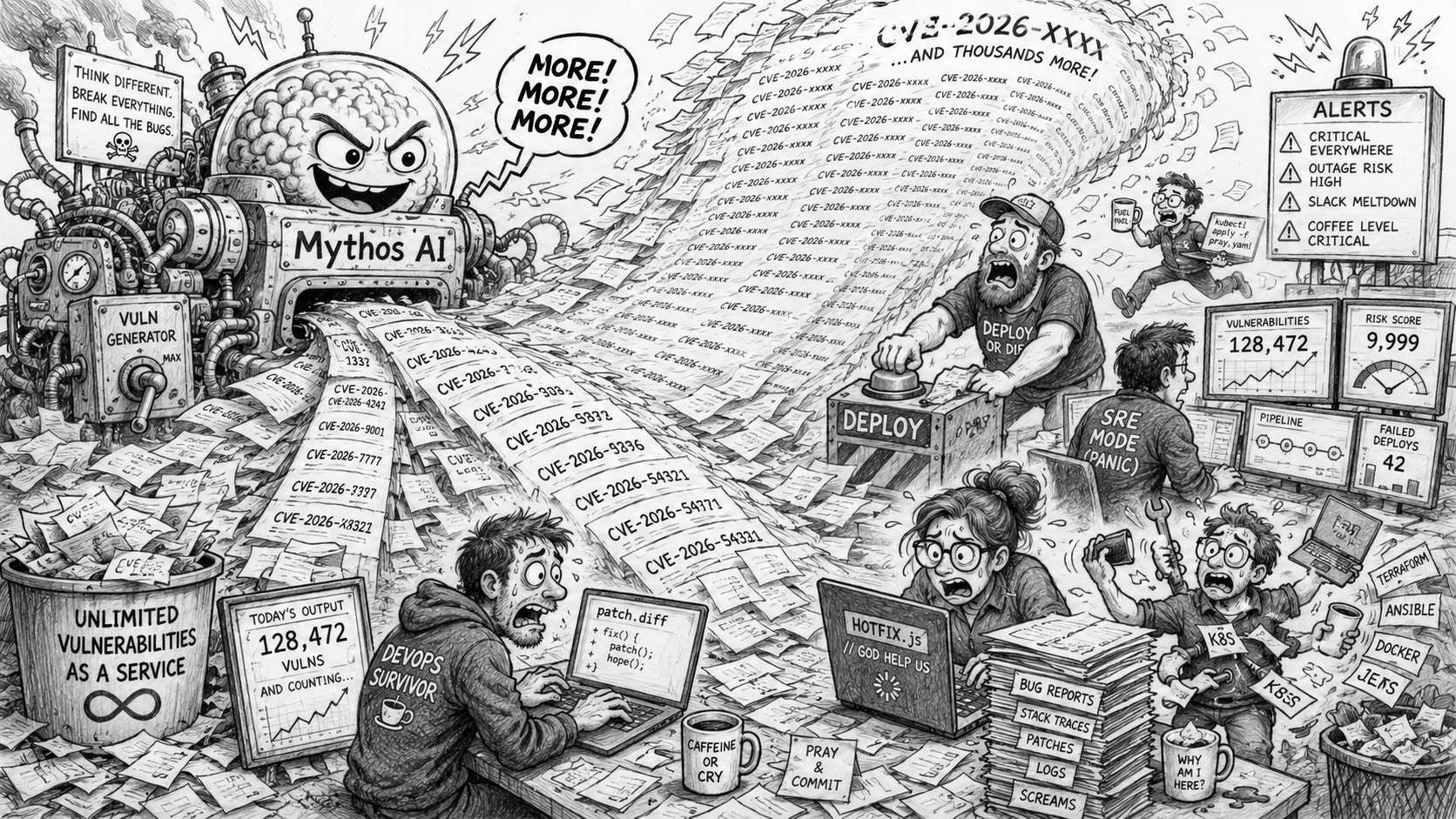
One of the challenges that are developing is the velocity of patches coming as AI is able to be used to locate potential errors that then get addressed. This creates an issue of the organization’s being able to rollout patches. This may not sound too challenging, until consider

  • not all organizations have a pure Kubernetes ecosystem with the means to orchestrate node replacement quickly and easily.
  • Capacity demands (people, and or compute resources) needed for performing verification steps for any change can out strip resources, or impact other change effort – such as legal compliance, or changes to keep you in business (although a breach could be just as catastrophic).
  • Demand impacts, when organizations are also trying to create bandwidth and/or budget to transition off vulnerable systems can end up being blocked.
  • Patch volumes for an environment that is already considered ‘fragile’ are going to generate a lot of work, as not only does the patch need to be applied, but a lot of effort will be needed to demonstrate the the wider business the possible impact has been validated.

To combat velocity, is to work on ccompensating controls in other areas of your system. If the application has a networking weakness, consider not patching the software, and ensuring networking configurations block the network port(s) that are associated with the vulnerability. Add monitoring, and checks to ensure the change to the network aren’t accidentally undone. If you do later apply the patch to address the weakness, don’t unpick the network mitigations, as this gives you ‘security in depth’.

Scanning tools

We can also use detection or scanning tooling to help. For solutions that you have development control over, and preproduction environments should be using these tools. But we have to be careful how we interpret the outcomes of these tools. Blindly take their reports can send us chasing issues, that aren’t really issues. While measuring detecting and measuring risk management is a positive thing, it needs to be done in an informed way.

For example, you run the scanning tool with admin level privileges so it can inspect everything. But, then it detects the finger print of an old version of Java with vulnerabilities in the Swing UI library. But the only reason Java is present is to run some CLI admin utilities. It is never used by the core application, there are no deployed Swing solutions in the environment. If we don’t give consideration to the context of the problem, we end up patching an issue that is in all probability going to be a problem.

At the same time, we can use this understanding to prioritise patching. Yes, applying a patch if available is good, but if applying a patch that breaks your tool is not. Spending time patching a vulnerability, when you don’t use the vulnerable code is eating into capacity to actually implement business change which may well eliminate the problem anyway (for example standardising scripting tools on Python).

What does this all mean?

Bottom line is, if you can patch, you have the ability and capacity to do so then it’s better to do so, as it keeps another layer of defence in place. But you don’t have access to patches (out of support etc), capacity to solve everything immediately then intelligent assessment of the vulnerability, risk driven prioritisation, look to mitigation strategies.

Defence in depth is not a security seller’s motto, but a genuine way to ensure that if one point fails, the next should protect you. But if you can’t patch, understand what the vulnerability is, and ensure you have mitigations in place. Ensure the issue and its implications in your context are documented along with the mitigations – so you have auditable content for any audit. You have been told where the minefield is, so you’ve fenced the area off, so people don’t wander into the issue unwittingly.

Useful Resources

  • NIST compensating security control
  • Patch velocity
  • NCSC Vulnerability management
  • Risk Based Vulnerability Management

Share this:

  • Share on Facebook (Opens in new window) Facebook
  • Share on X (Opens in new window) X
  • Share on Reddit (Opens in new window) Reddit
  • Share on LinkedIn (Opens in new window) LinkedIn
  • Email a link to a friend (Opens in new window) Email
  • Share on WhatsApp (Opens in new window) WhatsApp
  • Print (Opens in new window) Print
  • Share on Tumblr (Opens in new window) Tumblr
  • Share on Mastodon (Opens in new window) Mastodon
  • Share on Pinterest (Opens in new window) Pinterest
  • Share on Bluesky (Opens in new window) Bluesky
Like Loading...

Maintenance & Patching For SOA CS

30 Monday May 2016

Posted by mp3monster in Cloud, General, Oracle, Technology

≈ 1 Comment

Tags

Cloud, HA, Maintenance, Oracle, PaaS, patching, SOA, SOACS

When you’re using SOA Suite to run round the clock services you need to give a fair bit of thought to your deployment configuration so it becomes possible to perform rolling patches and other maintenance tasks not only to SOA itself but all the way down to the hardware – and at the low levels you have no control on the maintenance process.  Although it is very easy to think that the moment you’re using PaaS that these problems are taken care for you, life isn’t as simple as that.

Oracle cloud services typically go through a patching process once a month and usually within a defined 8 hour period on a Friday night. During this period you may lose the use of your servers as the maintenance is performed within a particular availability zone. In an ideal world this would be a rolling process so you don’t lose everything at once. If the maintenance window is used to to deploy SOA Suite patches then although you will be told of the maintenance window you actually wont have an outage, but post the maintenance window your cloud dashboard will have the option to apply the patches at a time that best suits you. Not only that the patch application process is smart enough to apply it in a rolling manner as the Weblogic nodes in the cluster will have information on each other which the patch mechanism can utilise.

So where is the problem.  It is very easy to forget that the PaaS platform is virtual, this means the virtualization platform being software will inevitably need patching whether that is for bug fixing,  addressing security requirements or adding new capabilities. These kinds of changes today will trigger a service shutdown. Let’s be honest when trying to balance a rolling change and maximise PaaS client density is going to create a monumentally complex problem, so simplicity and and speed of roll-out suggests a small outage is easier. So how do I therefore assure I can maintain a quality of service if I accept this as a necessity?


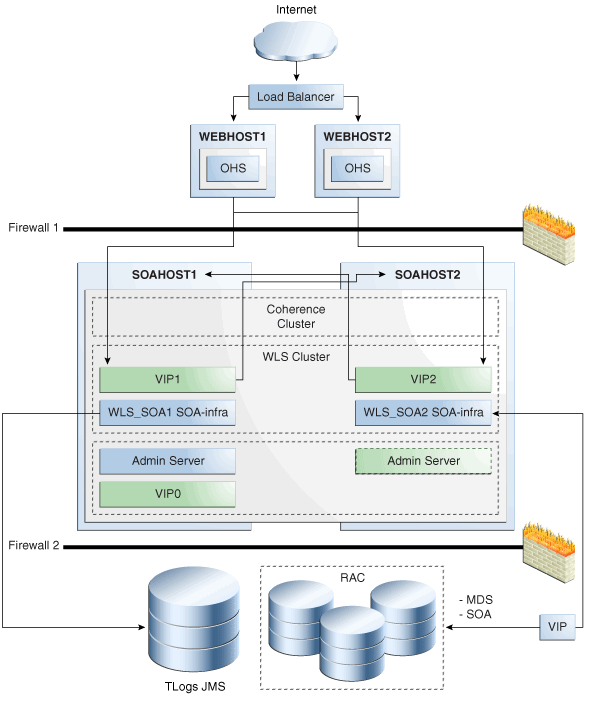
Well the answer is pretty much the same as  an on premise reference architecture.  Have SOA with its supporting databases running in a second availability zone that will have a different patch time. This is going to push up the cost as you’ll need a database with Dataguard. Assuming an active-passive model across your centres, as you approach the maintenance window you’ll get your load balancer to route work load to the second location and let the existing workload run dry on the servers due to go through the maintenance process. Then after the maintenance window you’ll reverse the process.

The current gotchya with this is that you pay for SOA by the month so you in effect have to run two clusters, although hour and daily models are coming.With the hourly model you can have the second availability zone ready for use by keeping the DB alive there, but only startup the SOA instances on the hourly rate when you know the maintenance window is going to occur and it is clear there will be an infrastructure impact.

The other sticky point, is presently as the period allocated is upto eight hours, your second centre needs to be running in a timezone with atleast 8 hours difference (allowing time to fail back). This would mean if you are using the Amsterdam or Slough locations your second location is going to West coast US or Asia Pacific once live later this year or Japan. All of which will present serious issues regarding personal data.

I have been told that some signficiant customers have accepted the situation on the basis the downtime in reality isn’t frequent and correlates to low business periods. But I suspect competition and customer demand will force this to change.

Share this:

  • Share on Facebook (Opens in new window) Facebook
  • Share on X (Opens in new window) X
  • Share on Reddit (Opens in new window) Reddit
  • Share on LinkedIn (Opens in new window) LinkedIn
  • Email a link to a friend (Opens in new window) Email
  • Share on WhatsApp (Opens in new window) WhatsApp
  • Print (Opens in new window) Print
  • Share on Tumblr (Opens in new window) Tumblr
  • Share on Mastodon (Opens in new window) Mastodon
  • Share on Pinterest (Opens in new window) Pinterest
  • Share on Bluesky (Opens in new window) Bluesky
Like Loading...
    • About
      • AI Disclosure
      • Internet Profile
      • Music Buying
      • Presenting Activities
    • Books & Publications
      • Logging in Action with Fluentd, Kubernetes and More
      • Logs and Telemetry using Fluent Bit
      • Oracle Integration
      • API & API Platform
        • API Useful Resources
        • Useful Reading Sources
    • Mindmaps Index
    • Monster On Music
      • Music Listening
      • Music Reading
    • OpAMP explained: the control plane for observability agents
    • Oracle Resources
    • Useful Tech Resources
      • Fluentd & Fluent Bit Additional stuff
        • Logging Frameworks and Fluent Bit and Fluentd connectivity
        • REGEX for BIC and IBAN processing
      • Formatting etc
      • Java and Graal Useful Links
      • Official Sources for Product Logos
      • Python Setup & related tips
      • Recommended Tech Podcasts

    TOGAF 9

    Logs and Telemetry using Fluent Bit


    Logging in Action — Fluentd

    Logging in Action with Fluentd


    Oracle Ace Director Alumni

    Oracle Cloud Integration Book


    API Platform Book


    Oracle Dev Meetup London

    Blog Categories

    • App Ideas
    • Books
    • Enterprise architecture
    • General
      • ExternalWebPublications
      • LinkedIn
      • Website
    • Music
      • Music Resources
      • Music Reviews
    • Photography
    • Podcasts
    • Security
    • Technology
      • AI
      • APIs & microservices
      • chatbots
      • Cloud
      • Cloud Native
      • Dev Meetup
      • development
        • languages
      • drone
      • Fluent Observability
        • Fluentbit
        • Fluentd
        • OpAMP
      • logsimulator
      • mindmap
      • OMESA
      • Oracle
        • API Platform CS
          • tools
        • ITSO & OEAF
        • OIC – ICS
        • Oracle Cloud Native
        • OUG
      • railroad diagrams
      • TOGAF

    Enter your email address to subscribe to this blog and receive notifications of new posts by email.

    Join 2,628 other subscribers

    RSS

    RSS Feed RSS - Posts

    RSS Feed RSS - Comments

    November 2026
    M T W T F S S
     1
    2345678
    9101112131415
    16171819202122
    23242526272829
    30  
    « Oct    

    Speaker Recognition

    Open Source Summit Speaker

    Twitter

    Tweets by mp3monster

    History

    Flickr Pics

    More Photos

    Social

    • View @mp3monster’s profile on Twitter
    • View philwilkins’s profile on LinkedIn
    • View mp3monster’s profile on GitHub
    • View mp3monster’s profile on Flickr
    • View mp3muncher’s profile on WordPress.org
    • View philmp3monster’s profile on Twitch
    Follow Phil (aka MP3Monster)'s Blog on WordPress.com

    Blog at WordPress.com.

    • Subscribe Subscribed
      Phil (aka MP3Monster)'s Blog
      Join 232 other subscribers

      Have a WordPress.com account? Log in now.

    • Phil (aka MP3Monster)'s Blog
      View site in Reader
      Manage subscriptionsSign upLog in
      Report this content
      Collapse this bar
    Loading Comments...

    You must be logged in to post a comment.

    Privacy & Cookies: This site uses cookies. By continuing to use this website, you agree to their use.
    To find out more, including how to control cookies, see here: Our Cookie Policy
    %d