 Packt Publishing have been running a scheme where each day they give away a book. Today is the Business Analyst’s Guide to Oracle Hyperion Interactive Reporting 11.
Packt Free Learning goes Oracle for 24hours
22 Saturday Aug 2015

22 Saturday Aug 2015
Packt Publishing have been running a scheme where each day they give away a book. Today is the Business Analyst’s Guide to Oracle Hyperion Interactive Reporting 11.
20 Thursday Aug 2015
Posted in General, Technology
 I regularly encounter arguments where people justify relaxed security in a design with the argument of – well the connection between systems will be protected by a VPN (Virtual Private Network) – so everything is fine.
Trying to dissuade a someone like a project manager or business end user that just trusting to just a VPN is challenging, after all private networks are safe aren’t they. So I have tried to identify a few resources – that can simply and clearly explain why this approach alone is not good. Just pointing to the principle of ‘security in depth’ is difficult to sell. So hopefully the following will help:
12 Wednesday Aug 2015
Posted in General
So we have refreshed the blog a little and added a new shortcut URL https://oracle.mp3monster.org to the Oracle blog entries. The art work is part of a tremendous image of the Sydney Opera House taken by Peter Lik. We would recommend you checkout his stunning work.
11 Tuesday Aug 2015
02 Sunday Aug 2015
Posted in General
Packt publishing undertook a survey to get a greater understanding of the tech world. As a result they have compiled the findings into several books. In addition they have launched a new promotion …
Check it all out at http://bit.ly/1JxwRUI
26 Sunday Jul 2015
Posted in General, Oracle, Technology
Tags
 On Friday I attended Estafet‘s UK leading 1st open session on Oracle Integration Cloud Service (ICS). A great session run by Phil McLoughlin from Estafet.It was good to hear people’s perspectives on the capability and value proposition. The session included an update from the Director of Product Management James Allerton-Austin. So aside from ICS having gone live, we can expect several more of the middleware services previously mentioned launched in the second half on 2015, including:
The messaging around far faster cloud release cycles was reaffirmed again with cycles in 6-12 week time frame. For example support for REST based web services will be in the next update – so no more than a month or two from now.
In addition to this I’ve heard that if you want to have ODI in the cloud it is certified to run on the Java Cloud Service – this is no surprise given that until the full SOA cloud is available you can deploy SOA into JCS. The question is will there be a ODI cloud offering.
10 Friday Jul 2015
Posted in General, Oracle, Technology
Tags
12c, AIA, AIA Foundation Pack, canonical model, OAGI, OER, Oracle, Oracle SOA Suite, PIP, SOA Suite, WLST
 Oracle has elected to move away from offering AIA Foundation Pack in its current form. Many of the features offered are being offered in a different packaging – predominantly SOA 12c Core Extensions, and some of the tooling which has not been heavily used will not be available in 12c.
AIA 11g Foundation Pack then it will be replaced by Oracle SOA Suite 12c Core Extensions via a SOA Suite 12c upgrade process for those who have already licensed it. The key consideration is the changes in feature availability in on premise upgrades and the ability to exploit all the tooling particularly into the SOA cloud is unlikely in the future.
Based on this we would recommended that any capabilities not offered natively in 12c should be retired from use, to remove potential issues as a result of upgrading or adopting a lift and shift cloud strategy. There is 1 possible caveat to this in the form of utilising the AIA canonical model, more on this below. The sections shows how AIA capabilities have been re-aligned and you might move forwards.
A lot of the UI features have moved to products such as the Oracle Enterprise Repository (OER 12c) as a result the retirement of the Lifecycle Workbench and a few features have been retired.
Reference Process Models, are more aligned to the process of solution analysis and design. The capabilities here can be obtained from other tooling. Separating out process models from a product that is more technically aligned makes sense. We would recommend you want to look at process models in a solution independent capability – particularly as your processes maybe split across platforms and products and even between on-premise and the cloud.
Personally I have seen little use of the top down business process models wrapped up by AIA outside of prepackaged PIPs where process models have been considered they have been examined by business architects before determining by the technologists the delivery approach.
The canonical model piece is lost in the transition to 12c. The canonical model is presented through a series of XML Schemas and HTML documentation, so could be packaged up and continued to be used irrespective of of the SOA versioning – subject to ensuring no licensing constraint on where the schemas are applied that might prevent them being used in the SOA cloud for example.
If there are to be constraints around carrying schemas forward then a strategy of migrating to another broad canonical model such as OAGI would be recommended. OAGI is particularly appealing given it strongly influenced AIA’s model but also their specialist domains leverage it as base definitions for example HR Open Standards.
CAVS provided a means by which it is possible to build integration tests that exercise composite components. This component could be leveraged by any Continuous Integration infrastructure. We have done this in the past before Oracle’s significant progress in adopting Maven and Hudson.
This is now part of the SOA Suite Core Extensions pack.
This provides the common error management framework that can be extended to provide automated error handling – for example delay for a period and retry. This one of the most valuable capabilities offered in terms of functionality as it provides a unified framework on which you can do basic error trapping and retry to far more complex advanced capabilities. As part of 12c this has been advanced as well.
This is now part of the SOA Suite Core Extensions pack.
Deployment plans tooling has now gone as the deployment mechanism (AID) has also been dropped. More on this below.
This tool provided the means to identify and understand how mappings have been customised or extended from base. This has been superseded by the Mapping Editor tooling in 12c which offers a better approach to this activity.
This capability wrapped up a series of smaller WLST based processes to deploy a PIP either licensed or custom PIP. As the concept of custom PIP has been dropped in favour of a collection of composites and other artefacts as would be applied if building using just SOA Suite. The capabilities use within Specsavers’ has in the past been shown to be mixed with some people preferring the SOA deployment approach rather than the wrapped up AIA mechanism.
The PIP auditor was provided AIA 11g as a means to perform a health check on the configuration of a PIP including custom PIPs. Whilst it is possible also include this tool into a Continuous Integration process aide quality management it requires a lot of work to break the lengthy report into more manageable . However this was not heavily adopted, and also not known to be used manually either, therefore the impact of not continuing its use is negligible.
Still applicable as this is simply a set of architectural approaches utilising Oracle Middleware products such as SOA Suite
As a design tool this has been deprecated. However from a Specsavers viewpoint this has minimal impact as the workbench has not been heavily used in this form (this includes AIA Artefact Generator) as the elements can be generated manually by SOA during the development process.
As the above diagram shows, the life cycle processes are all underpinned by the development process itself.
With respect to the deployment of artefacts such as composites,DVMs etc this is still available through standard SOA mechanisms such WLST. Viewing deployed artefacts can still be done through various management consoles.
23 Tuesday Jun 2015
Posted in General, Technology
 So 22nd June saw Larry Ellison announce a raft of new Oracle cloud services, and the beefing up of some existing services. Based on what he said, Oracle are about to seriously go to war with a number of major players. So much so one of Gartner’s analysts tweeted that they see something of a shakeup in the market. Not only as Oracle has the delivery muscle, but based on figures Larry presented also on price – Oracle’s Cloud Archive offering which is being aimed at Amazon Web Services’ Glacier was quoted at a 1/10th of the price! Okay, we need to see all the costs, but the headline numbers are sounding extremely competitive.
In terms of service that I’m looking forward to have a play with are:
Not all of these service are openly accessible yet, or offer Trial periods, but the access is only a matter of time now.
This little list doesn’t even touch on the IaaS or SaaS.
20 Saturday Jun 2015
Posted in General, ITSO & OEAF, Oracle, Technology
Tags
accreditation, arcchitecture, autonomics, BCS, Chaos Monkey, ITSO, Kubernetes, monitoring, Netflix, Open Group, semantics, TOGAF, TRM
So I have an objective to get myself certified as an Oracle Technical Architect. Although the training is only open to Oracle and Partners, the exam is open to all. As you may have guessed from my blog posts I use a lot of Oracle technology. However the Technical Architect examination is based largely on Oracle’s IT Strategies library, and usually referred to as ITSO.  Before non-Oracle users switch off, the ITSO is actually built around presenting solid good solution agnostic practises, and only once that is laid out does the material overlay Oracle products. So at least 75% percent of the material applies regardless of the vendor (yes cynics will say the practises will naturally lead you to products – but hey someone has to be bad guy). This actually makes it a worthwhile accreditation – as far as any accreditation can go (no I’ve not done a detailed comparison against Open Group’s Certified Architect – very expensive or the BCS accreditation – bound to BCS membership). TOGAF gives your framework, processes, means to communicate, and the ITSO does well at explaining the technical considerations and could be mapped onto the TOGAF Technical Reference Model (TRM) and Standards Information Base (SIB).
The point, I wanted to get across was in the ITSO is an element on Management and Monitoring (E16583-03 if you want the document reference on the Oracle Technology Network). It makes a lot of really good points about monitoring challenges such as bottom up approach where people monitor the parts of the full capability that they’re responsible for, rather than developing monitoring from a business perspective. The rationale for adopting the business based approach is explained (this is not to say you don’t go into the technical measures & monitors of looking at your infrastructure, databases, services etc. But from the business approach you will capture the information to understand reporting from a user perspective which is how you’ll here about issues. Through your detailed monitoring decomposition to get the right specific data points you can then look at correlation of monitoring data for root cause analysis, but also see and .
What the I think the document misses, or at least underemphasises is the ever increasing importance of the monitoring and logging of what is happening as systems and environments become ever more elastic and self managing, and have as IBM call it autonomics. or self  healing, self scaling characteristics. So consider trying to diagnose a problem when a user complains of intermittent performance issues, but you have Kubernetes or another tool scaling up your environment for a period and then back down. Only through measuring from a business context will you able to understand when the user might perceive performance as an issue. Then with excellent logging and audit data as to what components are doing at all levels – so services maybe behaving perfectly but your scaling mechanisms are scaling back too soon.
This leads to another consideration, for those organisations that absolutely committed to idea of self healing and proving in resilience production, as the famous Netflix Chaos Monkey does. You need to be able to correlate the monkey’s activities to what is happening in your environment. Has the monkey uncovered an issue that manifests in a manner you hadn’t expected and as a result your user see intermittent issues.
 This all leads me to a rather good presentation from Jimmi Dyson at RedHat who showed the simple value of ensuring you can get semantic meaning from logging. As that means you and slice and dice the information to get understanding of what is happening and lead to root cause. In Oracle land Oracle Enterprise Manage (OEM) is ensuring the semantic understanding when it come to known products.
I’ve meandered a bit, so key points consider ITSO or any other vendor equivalent for sources of good practise. Monitor and measure from a business perspective, but still ensure your collecting detailed semantically meaningful metrics.
20 Saturday Jun 2015
Posted in General, Oracle, Technology
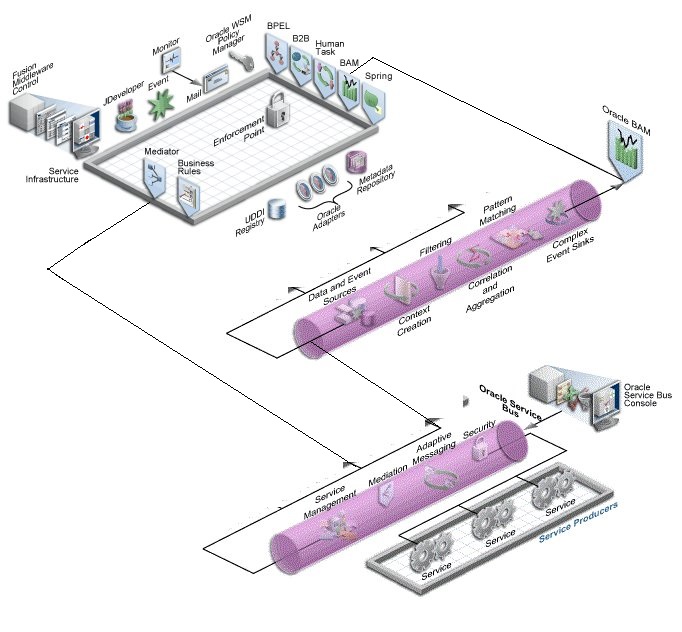
Understanding all the different elements available to you with Oracle SOA Suite can be a little tricky to say the least as the often the building blocks available are shown in diagrams like:
They say a picture says a thousand words. But, those thousand words can omit some details. Take this diagram for example, it only reflects the common elements in the main SOA server. But within the SOA license you also have Oracle Service Bus (OSB) and the Complex Event Processing (CEP) engine which run as separate servers. Which means you’d see the following:

as shown in http://docs.oracle.com/cd/E28280_01/doc.1111/e10223/04_osb.htm
Oh, but hang on; we still haven’t got a representation of JMS, and Coherence. JMS like CEP and OSB actually instantiates as a separate server as well. So got a handle on everything now? Well there is a little confusion still needing to be added to the mix. The following diagram is commonly used showing interoperability with other products with separate licenses:
Taking the above diagram at face value, you could interpret things as actually you don’t have the CEP capability as it is the key part of the Oracle Event Driven Architecture Suite.
I have merged together the diagrams to show the bulk of all the SOA stack that comes into the main SOA license. As you can see ….


You must be logged in to post a comment.