• Home
  • Site Aliases
    • www.cloud-native.info
  • About
    • Background
    • Presenting Activities
    • Internet Profile
      • LinkedIn
    • About
  • Books & Publications
    • Log Generator
    • Logs and Telemetry using Fluent Bit
      • Fluent Bit book
      • Book Resources in GitHub
      • Fluent Bit Classic to YAML Format configurations
    • Logging in Action with Fluentd, Kubernetes and More
      • Logging in Action with Fluentd – Book
      • Fluentd Book Resources
      • Fluentd & Fluent Bit Additional stuff
    • API & API Platform
      • API Useful Resources
    • Oracle Integration
      • Book Website
      • Useful Reading Sources
    • Publication Contributions
  • Resources
    • GitHub
    • Oracle Integration Site
    • Oracle Resources
    • Mindmaps Index
    • Useful Tech Resources
      • Fluentd & Fluent Bit Additional stuff
      • Recommended Tech Podcasts
      • Official Sources for Product Logos
      • Java and Graal Useful Links
      • Python Setup & related stuff
  • Music
    • Monster On Music
    • Music Listening
    • Music Reading

Phil (aka MP3Monster)'s Blog

~ from Technology to Music

Phil (aka MP3Monster)'s Blog

Tag Archives: applications

API Platform – Plans & Subscriptions

15 Wednesday May 2019

Posted by mp3monster in API Platform CS, General, Oracle, Technology

≈ 2 Comments

Tags

APIs, applications, entitlement, Plans, Subscription

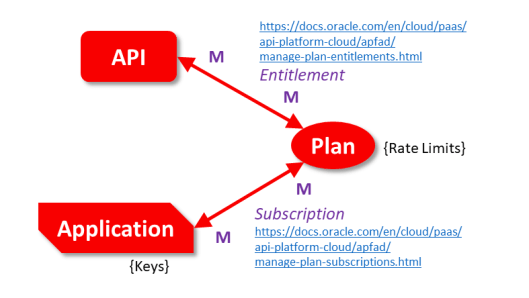
When it comes to Plans and Subscriptions on the Oracle API Platform we have a very flexible set of relationships. When it comes to checking the relationships to ensure a configuration is correct and that the impact of changing a plan or subscription is clear.  I end up having to draw a little diagram, which always leaves me second-guessing myself about which way the linkages are. So I created a quick aide memoir, particularly given the unfortunate fact that Oracle’s online documentation isn’t great for diagrams.

If the diagram helps me, then perhaps it can help others, so here it is:

API-Plan - Entitlement

I’ve also attached the original PowerPoint document so it can be modified, enhanced if you want to – API-Plan – Entitlement.

Share this:

  • Click to share on Facebook (Opens in new window) Facebook
  • Click to share on X (Opens in new window) X
  • Click to share on Pocket (Opens in new window) Pocket
  • Click to share on Reddit (Opens in new window) Reddit
  • Click to email a link to a friend (Opens in new window) Email
  • Click to share on WhatsApp (Opens in new window) WhatsApp
  • Click to print (Opens in new window) Print
  • Click to share on Tumblr (Opens in new window) Tumblr
  • Click to share on Mastodon (Opens in new window) Mastodon
  • Click to share on Pinterest (Opens in new window) Pinterest
  • More
  • Click to share on Bluesky (Opens in new window) Bluesky
  • Click to share on LinkedIn (Opens in new window) LinkedIn
Like Loading...

Oracle Fusion Applications Development and Extensibility Handbook – Summary Review

14 Monday Apr 2014

Posted by mp3monster in Book Reviews, Books, General, Oracle, Oracle Press, Technology

≈ Leave a comment

Tags

applications, book, extension, fusion, Fusion Applications, Oracle, Oracle Press, review


So having written a series of detailed blog entries reviewing a couple of chapters at at time I thought it might be worth just providing a very brief review. Writing a book that provides both breadth of coverage for a very large subject area as well as meaningful depth is a very difficult trick to pull off. But the authors of this book have succeeded magnificently. The book tackles the subject of basic customization that users can perform through to in-depth feature development using the Oracle SOA stack. Not to mention reporting and analytics. The book has been written in an engaging way providing context, background and Fusion Application principles and then taking examples of how to implement the different kinds of capabilities. From this book, you should have a good grasp of what to expect and how to approach Fusion application Extension work.

As a result I’d recommend this book to Architects, Project Manager’s who want to understand what their development team should be doing and the risks of their approach. This would also form a good roadmap into the detail for developers starting out in the Fusion applications space.


Detailed reviews can be seen at:

  • Chapters 1 & 2
  • Chapters 3 & 4
  • Chapters 5 & 6
  • Chapters 7 & 8
  • Chapters 9 & 10
  • Chapters 11 & 12
  • Chapters 13, 14 & 15

Share this:

  • Click to share on Facebook (Opens in new window) Facebook
  • Click to share on X (Opens in new window) X
  • Click to share on Pocket (Opens in new window) Pocket
  • Click to share on Reddit (Opens in new window) Reddit
  • Click to email a link to a friend (Opens in new window) Email
  • Click to share on WhatsApp (Opens in new window) WhatsApp
  • Click to print (Opens in new window) Print
  • Click to share on Tumblr (Opens in new window) Tumblr
  • Click to share on Mastodon (Opens in new window) Mastodon
  • Click to share on Pinterest (Opens in new window) Pinterest
  • More
  • Click to share on Bluesky (Opens in new window) Bluesky
  • Click to share on LinkedIn (Opens in new window) LinkedIn
Like Loading...

Oracle Fusion Applications Development and Extensibility Handbook – Chapters 13, 14 & 15 reviewed

12 Saturday Apr 2014

Posted by mp3monster in Book Reviews, Books, General, Oracle, Oracle Press, Technology

≈ 1 Comment

Tags

ADF, applications, book, fusion, integration, look and feel, OER, Oracle, Oracle Press, review, scheduler, Scheduling

Our final detailed visit to  Oracle Fusion Applications Development and Extensibility Handbook (Oracle Press) covers the final 3 chapters which engage with the Scheduler, Look and Feel customisation and the relationship with integration and service concepts (dare I use the acronym SOA).

The chapter on the scheduler is pretty short, but then compared to many other chapters the size of the product/component is small. The book relates how the scheduler behaves compared to the Schedule Management offered in EBusiness. The surprising things is that each product domain (Financials, HCM, CRM etc) has its own scheduler rather than a single shared service; the book doesn’t attempt to explain the rational here which is a shame.  It does describe how it deploys into each domain, where the configuration exists and how to work with the configuration of the scheduler itself (e.g. where logging goes etc) and attempts to address some obvious questions from a administration perspective.  It then goes onto how to create a custom scheduled process with a worked illustration. All very well done, although I have to admit to a nagging feeling of I’m missing something – it maybe simply that deployment is very much through server administration rather than through an automated mechanism (so if you develop and test in a preproduction environment, you can package up the process of deploying config custom app to your production environment without needing to repeat the admin UI interactions, so you can be assured there is no inconsistency between deployment instances).

The Look and Feel chapter is about largely applying the changes so that the product feels like part of your business’ corporate solution – important if you’re exposing any aspects of it to the outside world. So aside from the use of the tools you have the ADF controls to effectively ‘skin’ the product. The chapter provides a brief but concise view of how skinning works, in relation to the old EBusiness technologies (CLAF and UIX) and current HTML technology of CSS and the key part of ADF (Rich Faces). More importantly it points out the relevant documentation on all the sources of information, and tooling such as the skinning editor. Not to mention addressing the issue of deployment. Obviously there is a short illustration demonstrating an element of skinning.

ADF Architecture

The initial emphasis on the last chapter is the reality that organisations can’t simply migrate all non Fusion Apps such as EBusines, Seibel etc to the Fusion solutions in one hit therefore you need to provide a degree of integration between solutions for as long as the transition may take. This neatly leads into the question of well how do I know what components exist to support integration, which brings OER (Oracle Enterprise Repository) into the picture. So obviously the book provides a brief overview to the use of OER. The various Fusion apps offer different interfaces for different tasks (from bulk data export to business events) so each of these ‘patterns’ are briefly explianed and as Fusion apps is offered as a SaaS solution how that might impact the ‘pattern’ availability. The chapter finishes by walking through the use of using a SCA Composite and web services to interact with a Fusion App – probably one of the most common approaches to integration at a transactional (rather than bulk) manner.  The only thing missing for me would be a brief discussion on Process Integration Packs (PIPs) which leverage all of  the technologies underpinning Fusion Apps into a custom package of integration operations or ready made integrations.

So the final chapters provide a strong close to the book continuing to offer an excellent overview, pointing you to resources to ‘deep dive’ as necessary.


Previous Chapter reviews:

    • Chapters 1 & 2
    • Chapters 3 & 4
    • Chapters 5 & 6
    • Chapters 7 & 8
    • Chapters 9 & 10
    • Chapters 11 & 12

Share this:

  • Click to share on Facebook (Opens in new window) Facebook
  • Click to share on X (Opens in new window) X
  • Click to share on Pocket (Opens in new window) Pocket
  • Click to share on Reddit (Opens in new window) Reddit
  • Click to email a link to a friend (Opens in new window) Email
  • Click to share on WhatsApp (Opens in new window) WhatsApp
  • Click to print (Opens in new window) Print
  • Click to share on Tumblr (Opens in new window) Tumblr
  • Click to share on Mastodon (Opens in new window) Mastodon
  • Click to share on Pinterest (Opens in new window) Pinterest
  • More
  • Click to share on Bluesky (Opens in new window) Bluesky
  • Click to share on LinkedIn (Opens in new window) LinkedIn
Like Loading...

Oracle Fusion Applications Development and Extensibility Handbook – Chapters 11 & 12 reviewed

08 Tuesday Apr 2014

Posted by mp3monster in Book Reviews, Books, General, Oracle, Oracle Press, Technology

≈ 2 Comments

Tags

applications, book, fusion, OBIEE, Oracle, Oracle Press, Oracle Transactional Business Intelligence, review

We continue on in our review of Oracle Fusion Applications Development and Extensibility Handbook (Oracle Press) to chapters 11 and 12 which look at Reporting and Analytics respectively.

Reporting in Fusion Apps is based upon OBIEE rather than vanilla BI Publisher against the application database. This means that you and build your reporting capability against a far more diverse set of data sources (license permitting of course). It does also mean that the steps for creating reports at least to start with are more complex as OBIEE realizes a multi-tier approach to report generation. The chapter goes onto to describe the types of data source, the means by which reports can be configured conditional execution and then through ideas such as ‘bursting’ where the report generating process can be partitioned and run in parallel by multiple processes each concentrate on a range of data (sound a little like Map Reduce doesn’t it). Finally how to format the output. All of which is then supported with a detailed illustration.  As you might imagine there are prepackaged reports and templates, so loading and configuring these in an environment is considered.

The book recognises that in a single chapter you can only really scratch the surface of reporting and makes reference to other tools in the OBIEE kit bag such as OTBI (Oracle Transactional Business Intelligence) BI and Mobile BI composer.  The only little trick here is the opportunity to point out some good sources of information.  But that isn’t a significant, there is such a thing as Google and it might take a bit more reading to find the best resources around these tools.

Chapter 12 looks briefly at the use of Analytics through OBIA (Oracle Business Intelligence Applications), Oracle Hyperion (also known as Essbase) that is available with Financial Reporting studio and focuses on OBTI. The chapter feels pretty standalone from the preceding chapter on reporting – which when using the book more as a reference is great, but from a cover to cover read can niggle a little, particularly when both chapters rely on OBIEE background.  But to be honest we are nit picking here. As with previous chapters there is an illustrated scenario walked through (the layout of which isn’t as good as previous chapters – but it is a relative observation), the illustration perhaps misses the opportunity for a killer blow of referencing the core app customisation to show how you might bind the dynamic reporting provided by OBTI view into the core CRM with the customisation. I have to say I am impressed by the OBTI technologies given the integration into the Fusion security framework, leveraging ADF and its optimisation strategies – all of which are clearly explained here.

It would have been nice to explore OBIA and Oracle Hyperion a bit further, but doing so would probably have warranted additional chapters. Overall a good chapter again, covering a lot of capability efficiently.


OTBI Architecture

Previous Chapter reviews:

    • Chapters 1 & 2
    • Chapters 3 & 4
    • Chapters 5 & 6
    • Chapters 7 & 8
    • Chapters 9 & 10


Share this:

  • Click to share on Facebook (Opens in new window) Facebook
  • Click to share on X (Opens in new window) X
  • Click to share on Pocket (Opens in new window) Pocket
  • Click to share on Reddit (Opens in new window) Reddit
  • Click to email a link to a friend (Opens in new window) Email
  • Click to share on WhatsApp (Opens in new window) WhatsApp
  • Click to print (Opens in new window) Print
  • Click to share on Tumblr (Opens in new window) Tumblr
  • Click to share on Mastodon (Opens in new window) Mastodon
  • Click to share on Pinterest (Opens in new window) Pinterest
  • More
  • Click to share on Bluesky (Opens in new window) Bluesky
  • Click to share on LinkedIn (Opens in new window) LinkedIn
Like Loading...

Oracle Fusion Applications Development and Extensibility Handbook Chapters 3 & 4

23 Sunday Mar 2014

Posted by mp3monster in Book Reviews, Books, General, Oracle, Oracle Press, Technology

≈ 6 Comments

Tags

applications, book, flexfields, fusion, Fusion Applications, Oracle, Oracle Press, review, Security

Continuing with the review of Oracle Fusion Applications Development and Extensibility Handbook (Oracle Press) I’m going to look at chapters 3 & 4. Chapter 3 looks at the different types of Flex Fields from the well known Dynamic Flexfields (DFF) and the more advanced EFFs and KFFs (different ways to provide more advanced flex values such as linking other tables of data).

The book describes briefly the steps to utilise many of the capabilities with some screenshots but don’t mistake this for a detailed key this value followed by click that button combined with screenshots of every step for all aspects (if you did that we’d probably trying to read 5000 pages not 500). So if you want to see and feel all the different aspects explained you will need to have an instance of Fusion apps to try the techniques out with. For me, this is no bad thing, I want to understand what the capabilities are and a sense of the effort and complexity involved – if I want to have blow by blow guide I’d turn to OTN and the tutorial video clips being made available everyday by Oracle on YouTube.

The book also recognises not all strategies are available with all Fusion apps and what can therefore be done. Either by implementing the capability yourself, or asking Oracle to prioritise feature development in the Fusion apps domain.

Unusually rather than continuing with customisation capabilities in Chapter 4 we look at Security. This is no bad thing as if you want to achieve security in depth you need to understand how it can be incorporated at every level as you go rather than as an after thought at the end. But as you go through this chapter you’ll see just how central the security framework is to working with Fusion Apps.

The security perspective comes primarily from an authentication and authorisation (A&A) perspective so bringing in OAM and OID along with related tooling (including APM which is a central tool for Fusion Apps Security). The A&A framework provides an advanced hierarchy of roles and permissions as the capability to integrate extensions with it. The book again provides a solid foundation on which you can build specific implementation understanding.  Security comes in two forms – functional (i.e. restricting access to Fusion app capabilities) and data (which records a user can or cant see). The fascinating aspect for me is the data view because the different organisational possibilities that can influence the data you can or can’t see – for example by value, by internal organisational structures such as departments, by suppliers/partners/customers and so on (Oracle use the terminology of sets).

Security considerations go beyond just managing major roles, but how to autoprovision users (i.e. I create an OID entry for a new employee – how to provide them with a standard set of credentials). How to interact with Fusion Apps at the web service level from inside or outside the secured FusionApps environment.

As with Chapter 3, there are illustrations on how to establish some security settings and leverage security for your own development, but not in an exhaustive click by click manner.

Both chapters, particularly Chapter 4 introduce the ideas and approaches in a succinct manner explaining both the more well known concepts but also the more advanced capabilities along with identifying some common challenges and how they can be overcome (through the provision of tooling or technique for diagnosis).

So far this has been the best introduction to Fusion Applications I have come across.

Share this:

  • Click to share on Facebook (Opens in new window) Facebook
  • Click to share on X (Opens in new window) X
  • Click to share on Pocket (Opens in new window) Pocket
  • Click to share on Reddit (Opens in new window) Reddit
  • Click to email a link to a friend (Opens in new window) Email
  • Click to share on WhatsApp (Opens in new window) WhatsApp
  • Click to print (Opens in new window) Print
  • Click to share on Tumblr (Opens in new window) Tumblr
  • Click to share on Mastodon (Opens in new window) Mastodon
  • Click to share on Pinterest (Opens in new window) Pinterest
  • More
  • Click to share on Bluesky (Opens in new window) Bluesky
  • Click to share on LinkedIn (Opens in new window) LinkedIn
Like Loading...

Oracle Fusion Applications Development and Extensibility Handbook – review Chapters 1 & 2

13 Thursday Mar 2014

Posted by mp3monster in Book Reviews, Books, General, Oracle, Oracle Press, Technology

≈ 6 Comments

Tags

applications, development, extensibility, fusion, Oracle, Vlad Ajvaz

So I’ve got through the first couple of chapters of Oracle Fusion Applications Development and Extensibility Handbook (Oracle Press). The book starts with a presumption of minimal knowledge so the first chapter provides an excellent high level overview on the framework and assembly of Fusion Applications and some of the principles such as Weblogic node management. Although an appreciation of non Fusion Apps will give you a sense of some ideas such as Flexfields would be useful at this stage, but they are explained in a lot more depth later on.

Chapter 2 moves onto the different kinds of customisation that can be performed and how those customisations are achieved from user configuration through to tools in the Fusion Apps and onto JDeveloper and the Fusion Apps libraries. The interesting thing is that all though it is clear a lot of work has gone into managing the dev and test cycles on a shared Fusion Apps platform including potential change conflict management there seems to be little for direct linkage or built in configuration management.

In terms of a book, it has started very well, providing a sense of over all shape of Fusion Apps in a very readable and informative  manner.  I think this is going to be a informative & easy read.

Oracle Fusion Apps at Google

Share this:

  • Click to share on Facebook (Opens in new window) Facebook
  • Click to share on X (Opens in new window) X
  • Click to share on Pocket (Opens in new window) Pocket
  • Click to share on Reddit (Opens in new window) Reddit
  • Click to email a link to a friend (Opens in new window) Email
  • Click to share on WhatsApp (Opens in new window) WhatsApp
  • Click to print (Opens in new window) Print
  • Click to share on Tumblr (Opens in new window) Tumblr
  • Click to share on Mastodon (Opens in new window) Mastodon
  • Click to share on Pinterest (Opens in new window) Pinterest
  • More
  • Click to share on Bluesky (Opens in new window) Bluesky
  • Click to share on LinkedIn (Opens in new window) LinkedIn
Like Loading...

Next book review – Oracle Fusion Applications

05 Wednesday Feb 2014

Posted by mp3monster in Books, General

≈ Leave a comment

Tags

applications, books, extensibility, fusion, handbook, Oracle, Vladimir Ajvaz

The next book up for review is going to be Oracle Fusion Applications Development and Extensibility Handbook (Oracle Press)

I have to declare a slight interest in my reviewing as I have had the good fortune to work with one of the authors- Vladimir Ajvaz; and extremely knowledgeable and talented Application Architect.

Oracle Fusion Applications

Share this:

  • Click to share on Facebook (Opens in new window) Facebook
  • Click to share on X (Opens in new window) X
  • Click to share on Pocket (Opens in new window) Pocket
  • Click to share on Reddit (Opens in new window) Reddit
  • Click to email a link to a friend (Opens in new window) Email
  • Click to share on WhatsApp (Opens in new window) WhatsApp
  • Click to print (Opens in new window) Print
  • Click to share on Tumblr (Opens in new window) Tumblr
  • Click to share on Mastodon (Opens in new window) Mastodon
  • Click to share on Pinterest (Opens in new window) Pinterest
  • More
  • Click to share on Bluesky (Opens in new window) Bluesky
  • Click to share on LinkedIn (Opens in new window) LinkedIn
Like Loading...

    I work for Oracle, all opinions here are my own & do not necessarily reflect the views of Oracle

    • About
      • Internet Profile
      • Music Buying
      • Presenting Activities
    • Books & Publications
      • Logging in Action with Fluentd, Kubernetes and More
      • Logs and Telemetry using Fluent Bit
      • Oracle Integration
      • API & API Platform
        • API Useful Resources
        • Useful Reading Sources
    • Mindmaps Index
    • Monster On Music
      • Music Listening
      • Music Reading
    • Oracle Resources
    • Useful Tech Resources
      • Fluentd & Fluent Bit Additional stuff
        • Logging Frameworks and Fluent Bit and Fluentd connectivity
        • REGEX for BIC and IBAN processing
      • Java and Graal Useful Links
      • Official Sources for Product Logos
      • Python Setup & related tips
      • Recommended Tech Podcasts

    Oracle Ace Director Alumni

    TOGAF 9

    Logs and Telemetry using Fluent Bit


    Logging in Action — Fluentd

    Logging in Action with Fluentd


    Oracle Cloud Integration Book


    API Platform Book


    Oracle Dev Meetup London

    Blog Categories

    • App Ideas
    • Books
      • Book Reviews
      • manning
      • Oracle Press
      • Packt
    • Enterprise architecture
    • General
      • economy
      • ExternalWebPublications
      • LinkedIn
      • Website
    • Music
      • Music Resources
      • Music Reviews
    • Photography
    • Podcasts
    • Technology
      • AI
      • APIs & microservices
      • chatbots
      • Cloud
      • Cloud Native
      • Dev Meetup
      • development
        • languages
          • java
          • node.js
      • drone
      • Fluentbit
      • Fluentd
      • logsimulator
      • mindmap
      • OMESA
      • Oracle
        • API Platform CS
          • tools
        • Helidon
        • ITSO & OEAF
        • Java Cloud
        • NodeJS Cloud
        • OIC – ICS
        • Oracle Cloud Native
        • OUG
      • railroad diagrams
      • TOGAF
    • xxRetired
    • AI
    • API Platform CS
    • APIs & microservices
    • App Ideas
    • Book Reviews
    • Books
    • chatbots
    • Cloud
    • Cloud Native
    • Dev Meetup
    • development
    • drone
    • economy
    • Enterprise architecture
    • ExternalWebPublications
    • Fluentbit
    • Fluentd
    • General
    • Helidon
    • ITSO & OEAF
    • java
    • Java Cloud
    • languages
    • LinkedIn
    • logsimulator
    • manning
    • mindmap
    • Music
    • Music Resources
    • Music Reviews
    • node.js
    • NodeJS Cloud
    • OIC – ICS
    • OMESA
    • Oracle
    • Oracle Cloud Native
    • Oracle Press
    • OUG
    • Packt
    • Photography
    • Podcasts
    • railroad diagrams
    • Technology
    • TOGAF
    • tools
    • Website
    • xxRetired

    Enter your email address to subscribe to this blog and receive notifications of new posts by email.

    Join 2,555 other subscribers

    RSS

    RSS Feed RSS - Posts

    RSS Feed RSS - Comments

    December 2025
    M T W T F S S
    1234567
    891011121314
    15161718192021
    22232425262728
    293031  
    « Nov    

    Twitter

    Tweets by mp3monster

    History

    Speaker Recognition

    Open Source Summit Speaker

    Flickr Pics

    Turin Brakes Acoustic Tour 24 @ The Maltings FarnhamTurin Brakes Acoustic Tour 24 @ The Maltings FarnhamTurin Brakes Acoustic Tour 24 @ The Maltings FarnhamTurin Brakes Acoustic Tour 24 @ The Maltings Farnham
    More Photos

    Social

    • View @mp3monster’s profile on Twitter
    • View philwilkins’s profile on LinkedIn
    • View mp3monster’s profile on GitHub
    • View mp3monster’s profile on Flickr
    • View mp3muncher’s profile on WordPress.org
    • View philmp3monster’s profile on Twitch
    Follow Phil (aka MP3Monster)'s Blog on WordPress.com

    Blog at WordPress.com.

    • Subscribe Subscribed
      • Phil (aka MP3Monster)'s Blog
      • Join 233 other subscribers
      • Already have a WordPress.com account? Log in now.
      • Phil (aka MP3Monster)'s Blog
      • Subscribe Subscribed
      • Sign up
      • Log in
      • Report this content
      • View site in Reader
      • Manage subscriptions
      • Collapse this bar
     

    Loading Comments...
     

    You must be logged in to post a comment.

      Privacy & Cookies: This site uses cookies. By continuing to use this website, you agree to their use.
      To find out more, including how to control cookies, see here: Our Cookie Policy
      %d