
• Home
  • Site Aliases
    • www.cloud-native.info
  • About
    • Background
    • LinkedIn
    • Presenting Activities
    • Internet Profile
    • About
  • Books & Projects
    • Logs and Telemetry using Fluent Bit
      • Fluent Bit book
      • Book Resources in GitHub
      • Fluent Bit Classic to YAML Format configurations
    • Logging in Action with Fluentd, Kubernetes and More
      • Logging in Action with Fluentd – Book
      • Fluentd Book Resources
      • Fluentd & Fluent Bit Additional stuff
    • OpAMP
    • Log Generator
    • API & API Platform
      • API Useful Resources
    • Oracle Integration
      • Book Website
      • Useful Reading Sources
    • Publication Contributions
  • Resources
    • GitHub
    • Oracle Integration Site
    • Oracle Resources
    • Mindmaps Index
    • Useful Tech Resources
      • Fluentd & Fluent Bit Additional stuff
      • Recommended Tech Podcasts
      • Official Sources for Product Logos
      • Java and Graal Useful Links
      • DevTips
  • Music
    • Monster On Music
    • Music Listening
    • Music Reading

Phil (aka MP3Monster)'s Blog

~ from Technology to Music

Phil (aka MP3Monster)'s Blog

Tag Archives: open telementry

OpAMP implementation update

15 Monday Jun 2026

Posted by mp3monster in Fluent Observability, General, OpAMP, Technology

≈ Leave a comment

Tags

AI, artificial-intelligence, development, Fluent Bit, LLM, MCP, OpAMP, open telementry, Technology

So we’ve been busy working on our OpAMP solution. We’ve made a number of enhancements since we labelled the code v0.4 back in April. For this post, we’ll look at the features added and where we’re looking next.

For a start, we demo’d what has been developed as part of CNCF Webinar about OpAMP

There has been a lot of feature development, particularly in support of working with Fluent Bit (and to a degree Fluentd).

Standalone or OpAMP server plugin for editor

We started building the Configuration Editor as a standalone capability. The thinking was that we would refactor it into the OpAMP server once we were happy with the functionality and had progressed far enough. But, as we saw this come together, it occurred to me that both deployments are good, as part of the OpAMP server, seeing the configuration being used is handy, but having a freestanding editor (without worrying about the connectivity to communicate with agents) is also a real use case.

So we have created the setup, where if the OpAMP is told to look for the Editor via the definition of Python endpoints in the configuration and it is deployed, it will be incorporated into the server. If the editor isn’t provided (deployed, or not identified in the configuration it isn’t offered in the navigation.
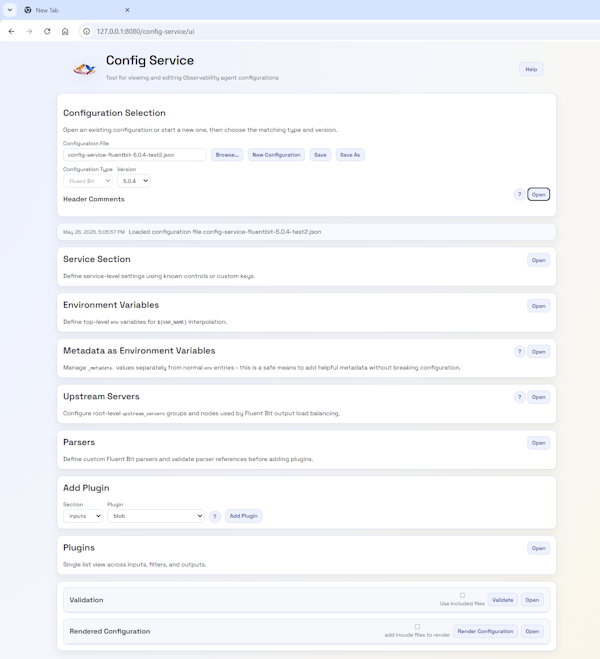
Config Editor view with collapsible segments

The editor is completely configuration-driven through JSON, so it only requires extending the JSON to support custom plugins or to enhance the validation rules (e.g., adding a REGEX to how a particular parameter is set). This far outweighs the current Dry run checks.
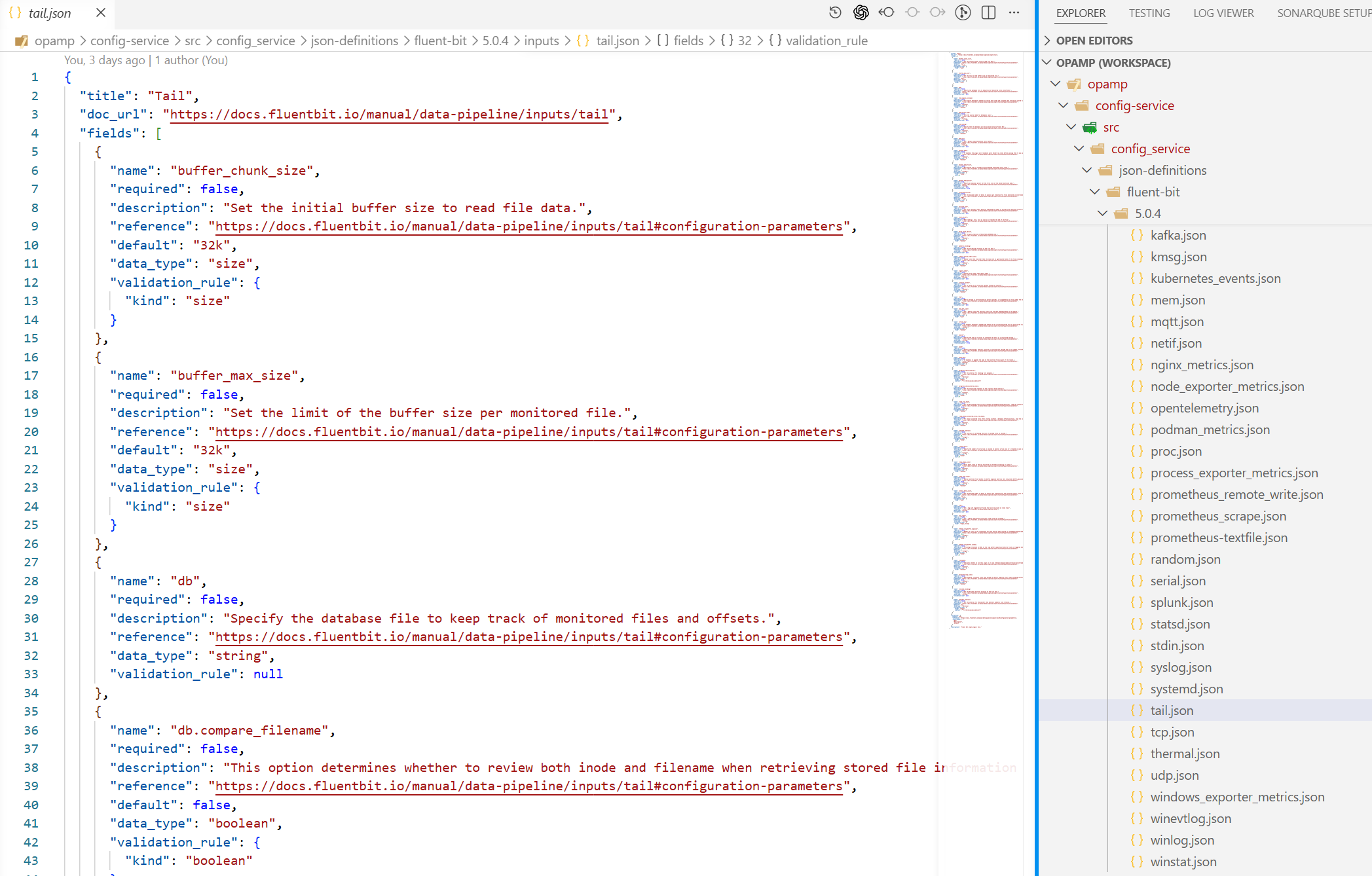
Configuration that drives the UI and its validation logic for the Editor

The configuration is considerable, so we refactored the structure to make it far easier to work with, and created some code that can mine Fluent Bit’s GitHub to generate an initial clean set of JSON docs. Of course these need an eyeballing to ensure they’re correct.

Catalog viewer

The catalogue viewer is a natural extension of the editor and leverages the way we tag configuration files with version details in the editor. The catalogue viewer has a configuration which tells it where to look for candidate files. These are then listed with the metadata.

The catalogue viewer presents all the identified files, which, when selected, if it knows about the config editor, will open the editor with the file. Otherwise, it opens a simple view of the file.

The catalogue viewer works in the same way as the editor in terms of authentication.

CLI

A Command Line tool maybe and odd choice of feature, but we found ourselves creating more and more scripts to support Windows and Bash shells with commonality. So we elected to leverage some frameworks to help reduce the ongoing effort required to maintain them. The utility can be used to generate the command, if you wanted embed the process of starting or stopping a process into the host OS.
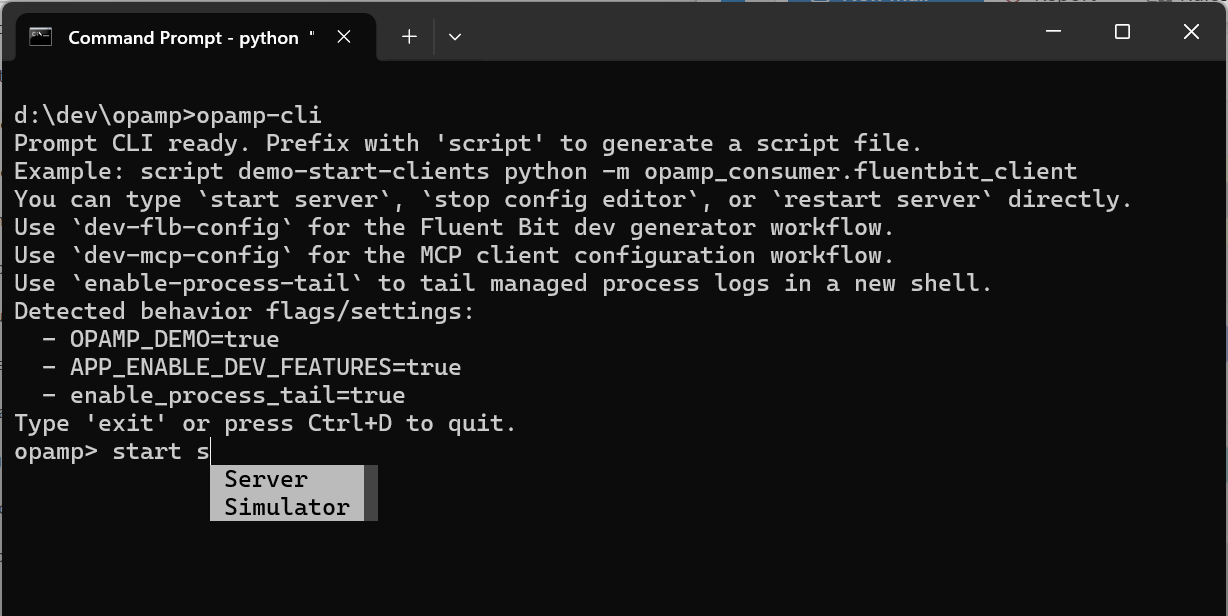
OpAMP CLI with its auto complete capabilities

Agent as Supervisor or observer

The OpAMP documentation suggests that the agent logic is embedded, or wrapped with a supervisor, with the inference that the agent forks the application process. This means that introducing the OpAMP would be invasive. There is a noninvasive variant of the Supervisor that we’ve called Observer. Here, the agent know how to identify the key process by examining the host’s processes. Then tasks such as restarting require an understanding of how to get the OS to trigger, for example, if the service is known to init.d in Linux, we can use the service command.

Architecture view
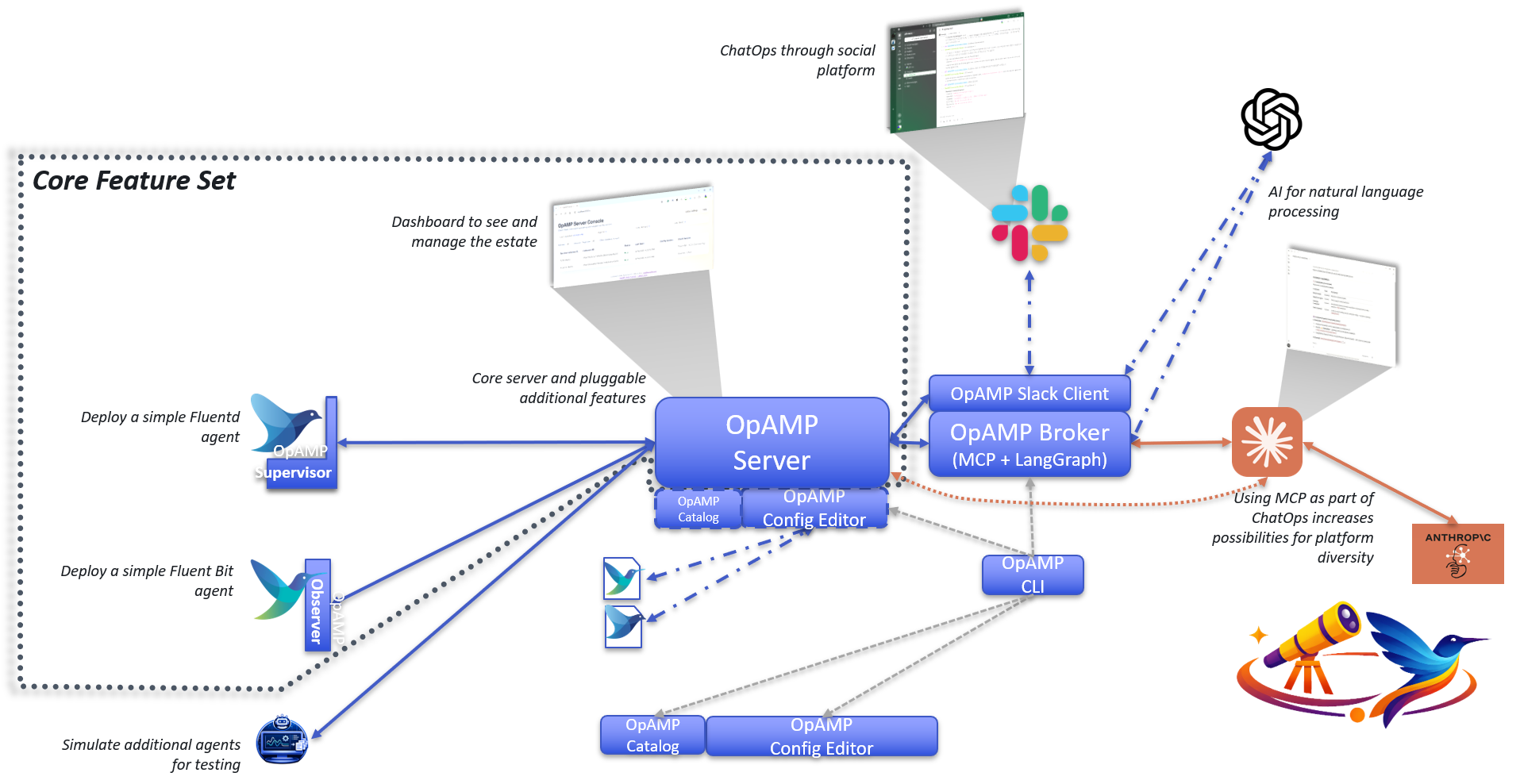
OpAMP solution - building blocks and their relationships

MCP and Slack for ChatOps

We’ve got the Slack foundations progressed, so we can use natural language VIA langgraph to then work with MCP, which exposes a subset of API capabilities. We’ve developed both the main server and the Broker to support the MCP endpoints, with the Broker acting as a proxy to the regular Server APIs. This means if we want the MCP to be usable from outside our network, then we can separate the Broker and Agent into separate networks so that the wider set of endpoints the server provides aren’t exposed.

But if you don’t want that the MCP endpoint can be switched on.

What next …

Config deployment

We have started to address the foundations of managing configuration deployment (for example, if our Catalogue Service is used with the Server, it can be used to select the configuration files to deploy.

Part of config deployment is understanding what is deployed, so we have developed some strategies for versioning Fluent Bit and Fluentd, and I think it will translate to other configuration files (at least into the Observability space).

What we haven’t done is fully implement the process. So we’ll focus on that

E2E Testing

There is a lot of functionality here now, including tests with Playwright, but we really need to extend it to provide end-to-end tests in a clean environment that is set up from the various pip and wheel files.

Deployment Artefact access

We also want to start making these artefacts easier to retrieve, such as pulling the Wheel or PIP files from GitHub or PyPi.

Share this:

  • Share on Facebook (Opens in new window) Facebook
  • Share on X (Opens in new window) X
  • Share on Reddit (Opens in new window) Reddit
  • Share on LinkedIn (Opens in new window) LinkedIn
  • Email a link to a friend (Opens in new window) Email
  • Share on WhatsApp (Opens in new window) WhatsApp
  • Print (Opens in new window) Print
  • Share on Tumblr (Opens in new window) Tumblr
  • Share on Mastodon (Opens in new window) Mastodon
  • Share on Pinterest (Opens in new window) Pinterest
  • Share on Bluesky (Opens in new window) Bluesky
Like Loading...
    • About
      • Internet Profile
      • Music Buying
      • Presenting Activities
    • Books & Publications
      • Logging in Action with Fluentd, Kubernetes and More
      • Logs and Telemetry using Fluent Bit
      • Oracle Integration
      • API & API Platform
        • API Useful Resources
        • Useful Reading Sources
    • Mindmaps Index
    • Monster On Music
      • Music Listening
      • Music Reading
    • Oracle Resources
    • Useful Tech Resources
      • Fluentd & Fluent Bit Additional stuff
        • Logging Frameworks and Fluent Bit and Fluentd connectivity
        • REGEX for BIC and IBAN processing
      • Formatting etc
      • Java and Graal Useful Links
      • Official Sources for Product Logos
      • Python Setup & related tips
      • Recommended Tech Podcasts

    TOGAF 9

    Logs and Telemetry using Fluent Bit


    Logging in Action — Fluentd

    Logging in Action with Fluentd


    Oracle Ace Director Alumni

    Oracle Cloud Integration Book


    API Platform Book


    Oracle Dev Meetup London

    Blog Categories

    • App Ideas
    • Books
    • Enterprise architecture
    • General
      • ExternalWebPublications
      • LinkedIn
      • Website
    • Music
      • Music Resources
      • Music Reviews
    • Photography
    • Podcasts
    • Technology
      • AI
      • APIs & microservices
      • chatbots
      • Cloud
      • Cloud Native
      • Dev Meetup
      • development
        • languages
      • drone
      • Fluent Observability
        • Fluentbit
        • Fluentd
        • OpAMP
      • logsimulator
      • mindmap
      • OMESA
      • Oracle
        • API Platform CS
          • tools
        • ITSO & OEAF
        • OIC – ICS
        • Oracle Cloud Native
        • OUG
      • railroad diagrams
      • TOGAF

    Enter your email address to subscribe to this blog and receive notifications of new posts by email.

    Join 2,617 other subscribers

    RSS

    RSS Feed RSS - Posts

    RSS Feed RSS - Comments

    June 2026
    M T W T F S S
    1234567
    891011121314
    15161718192021
    22232425262728
    2930  
    « May    

    Speaker Recognition

    Open Source Summit Speaker

    Twitter

    Tweets by mp3monster

    History

    Flickr Pics

    Boxer Rebellion @ Brixton ElectricBoxer Rebellion @ Brixton ElectricBoxer Rebellion @ Brixton ElectricBoxer Rebellion @ Brixton Electric
    More Photos

    Social

    • View @mp3monster’s profile on Twitter
    • View philwilkins’s profile on LinkedIn
    • View mp3monster’s profile on GitHub
    • View mp3monster’s profile on Flickr
    • View mp3muncher’s profile on WordPress.org
    • View philmp3monster’s profile on Twitch
    Follow Phil (aka MP3Monster)'s Blog on WordPress.com

    Blog at WordPress.com.

    • Subscribe Subscribed
      • Phil (aka MP3Monster)'s Blog
      • Join 229 other subscribers
      • Already have a WordPress.com account? Log in now.
      • Phil (aka MP3Monster)'s Blog
      • Subscribe Subscribed
      • Sign up
      • Log in
      • Report this content
      • View site in Reader
      • Manage subscriptions
      • Collapse this bar

    Loading Comments...

    You must be logged in to post a comment.

      Privacy & Cookies: This site uses cookies. By continuing to use this website, you agree to their use.
      To find out more, including how to control cookies, see here: Our Cookie Policy
      %d