We’ve made the latest version of our implementation of the OpAMP specification available. It has taken longer to ready than the previous versions, but there is a lot been included, both in the core functionality, but also capabilities supporting the use and setup. Here are the headlines…
Automated regression from clean to deployed and running a series of end-to-end tests as well as producing a guaranteed fresh set of artefacts has been implemented. This can be run against AWS (currently in use) or Azure (needs refining). These are triggered on changes to the main branch.
GitHub pages with links all the documentation are established now.
The Python wheel release artefacts are no incorporated into the release assets.
The client/consumer side has been refactored so it is easy to build your own observability agent controls and independently deploy them (not supported by the config editor).
The CLI has been enhanced so it can help quickly spin up more advanced configurations – helpful for demos and real deployments.
The Dev CLI has been improved.
The server side now has a basic client side (Supervisor/Observer) configuration editor UI. Which can be deployed as a plugin.
Improvements around the use of Podman and Docker for the containerization.
What next?
We’ve added to the documentation pages for the roadmap, initially we’re working to fill out the regression test sets at the moment. Other possibilities:
Expand the client types
Extend the client types to exploit more features.
Perhaps the most interesting idea, we’re thinking about is can we exploit tools like Netdata to discover what solutions are deployed and generate a requirements/configuration definition which can be used to generate a suitable agent configuration file.
A FIPS safe mode to ensure things are safe during start and restart.
Ensuring timestamps will work beyond 2038.
TLS handling refinements such as certificate reloading
Management of the internal buffers can be made more dynamic now.
Improvements across a number of plugins for input and output.
Dynamic flushing to allow dynamic optimization within configured boundaries.
Packaging improvements for Windows Nano and Debian deployments.
New root section called Extensions.
A lot of these gains are great, and will really pay off for high volume deployments, where small savings, cumulative can really payoff economically. It is the new extensions feature that I’m most interested in as it open up some capabilities when managing the observability domain.
Extensions
The extension structure (first identified as a useful feature with issue 11863) doesn’t impact Fluent Bit behavior but is retained and accepted as YAML configuration values. This means that any tools being used to manage Fluent Bit configuration can now add YAML key value pairs (including nested values) without causing Fluent Bit a problem, and can therefore be used by management tools. For example we can track what version of a configuration is being handled by Fluent Bit by injecting a Git version identifier (just as you see in the Fluent Bit output at startup). This simple change means that it is now possible to understand which version of configuration is being executed. When you’re rolling out to a large estate (particularly outside of containerized environments) it is easy to know what has been rolled out.
extensions:
opamp:
endpoint: 127.0.0.1:4318
insecure: true
deployment:
config_version: 12345
If you’re using Fleet Management capabilities such as OpAMP (a specification developed as part of the Open Telemetry project) you can embed the client side controller/supervisor configuration within the Fluent Bit configuration (as long as the controller supervisor understand where to get the values from within a YAML file).
It also means that you’re allowing more dynamic changes, it becomes easy to notate such dynamic changes., for example:
extensions:
deployment:
changeDTG: 2026.08.05.16.25
notes:
- changed flush interval
- moved plugin x output
Personally I’d not advocate changes without using configuration control tooling, but it certainly is better than no record.
Next steps
If you follow this blog regularly, they’ll be aware of the OpAMP project which implements the protocol, and provides a server that includes fleet management and configuration editing and validation for Fluent Bit server side, and a client supervisor/observer on client client/consumer side which can manage Fluent Bit instances. These changes mean that the project will need:
New configuration and validation settings (the UI is entirely meta-data driven) for the new properties.
The configuration catalogue viewer will need to be updated to exploit the extensions feature for showing versioning.
The client/consumer side can be extended to become Fluent Bit aware and exploit the embeddable extensions capability.
We may also offer the dynamic change recording possibility as an optional feature (from a product view – we shouldn’t force specific ways of working, but from a personal view it isn’t a way I’d recommend working)
Fluent Bit version 4’s first major release dropped a couple of weeks ago (September 24, 2025). The release’s feature list isn’t as large as 4.0.4 (see my blog here). It would therefore be easy to interpret the change as less profound. But that isn’t the case. There are some new features, which we’ll come to shortly, but there are some significant improvements under the hood.
Under the hood
Fluent Bit v4.1 has introduced significant enhancements to its processing capabilities, particularly in the handling of JSON. This is really important as handling JSON is central to Fluent Bit. As many systems are handling JSON, there is at the lowest levels, continuous work happening in different libraries to make it as fast as possible. Fluent Bit has amended its processing to use a mechanism based on a yyjson, without going into the deep technical details. If you examine the benchmarking of yyjson and other comparable libraries, you’ll see that its throughput is astonishing. So accelerating processing by even a couple of percentage points can have a profound performance enhancement.
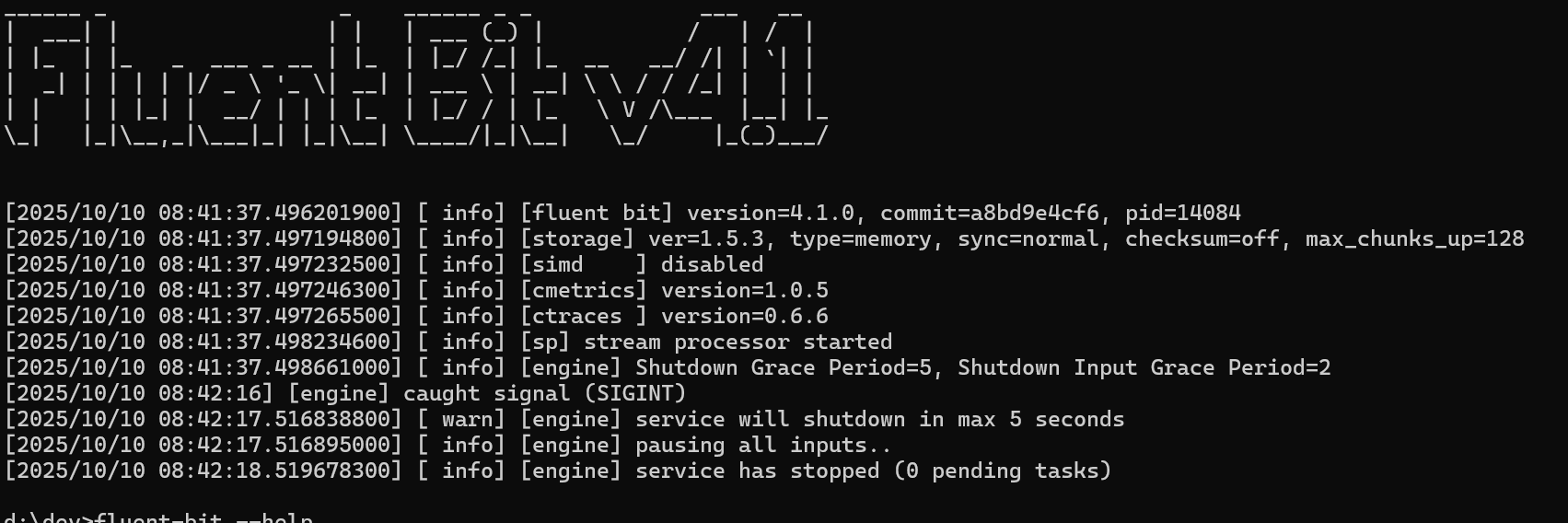
The next improvement in this area is the use of SIMD (Single Instruction, Multiple Data). This is all about how our code can exploit microprocessor architecture to achieve faster processing. As logs often need characters like new line, quotes, and other special characters encoding, and logs often carry these characters (and we tend to overlook this – consider a stack trace, where each step of the stack chain is provided on a new line, or embedding a stringified XML or JSON block in the log, which will hve multiple uses of quotes etc. As a result, any optimization of string encoding will quickly yield performance benefits. As SIMD takes advantage of CPU characteristics, not every build will have the feature. You can check to see if SIMD is being used by checking the output during startup, like tthis:
This build for Windows x86-64 as shown in the 3rd info statement doesn’t have SIMD enabled.
Other backend improvements have been made with TLS handling. The ability to collect GPU metrics with AMD hardware (significant as GPUs are becoming ever more critical not only in large AI arrays, but also for AI at the edge).
So, how do we as app developers benefit?
If Fluent Bit’s performance improves, we benefit from reduced risk of backpressure-related issues. We can either complete more work with the same compute (assuming we’re at maximum demand all the time), or we can reduce our footprint – saving money either as capital expenditure (capex) or operational expenditure (opex) (not something that most developers are typically seeking until systems are operating at hyperscale). Alternatively, we can further utilize Fluent Bit to make our operational life easier, for example, by reducing sampling slightly, implementing additional filtering/payload load logic, and streaming to detect scenarios as they occur rather than bulk processing on a downstream platform.
Functional Features
In terms of functionality, which as a developer we’re very interested in as it can make our day job easier, we have a few features.
AWS
In terms of features, there are a number of enhancements to support AWS services. This isn’t unusual; as the AWS team appears to have a very active and team of contributors for their plugins. Here the improvement is for supporting Parquet files in S3.
Supervisory Process
As our systems go ever faster, and become more complex, particularly when distributed it becomes harder to observe and intervene if a process appears to fail or worse becomes unresponsive. As a result, we need tools to have some ‘self awareness’. Fluen bit introduces the idea of an optional supervisor process. This is a small, relatively simple process that spawns the core of Fluent Bit and has the means to check the process and act as necessary. To enable the supervisor , we can add to the command line –supervisor. This feature is not available on all platforms, and the logic should report back to you during startup if you can’t use the feature. Unfortunately, the build I’m trying doesn’t appear to have the supervisor correctly wired in (it returns an error message saying it doesn’t recognize the command-line parameter).
If you want to see in detail what the supervisor is doing – you can find its core in /src/flb_supervisor.c with the supervisor_supervise_loop function, specifically.
Conclusion
With the number of differently built and configured systems, we’ll see a 4.1.x releases as these edge case gremlins are found and resolved.
Depeche Mode are to release a new 8 track mini album on December 8th in time for their forthcoming UK tour. The album features track pulled from their recent ‘Sounds of the Universe‘ album as well as some special remixes. The full track list runs:
‘Fragile Tension’ – radio mix, ‘Hole To Feed’ – radio mix, ‘Perfect’ – Roger Sanchez Club Mix, ‘Come Back’ – SixToes Remix, ‘Fragile Tension’ – Laidback Luke Remix, ‘Hole To Feed’ – Popof Vocal Mix, ‘Fragile Tension’ – Peter Bjorn And John Remix, ‘Hole To Feed’ – Joebot Remix
Way Out West along with a new album are providing an additional free track that can be downloaded by using the widget below. The new album is called We Love Machine which can be purchased at all good online retailers, or directly from their website – http://www.wayoutwest.mu/way-out-west-love-machine-buy-album/
Massive Attack have announced a new EP – Splitting the Atom to be released on the 5th October which precedes the long awaited new album early next year. The new album this time around sees collaborations with Damon Albarn, Hope Sandoval, Martina Topley-Bird, Guy Garvey and Tunde Adebimpe.
Epic Records is proud to announce the September 8th release of Howie Day’s highly anticipated third studio album, SOUND THE ALARM. It’s been close to six years since the singer-songwriter released his last album Stop All The World Now which spawned the massive # 1 hit single, “Collide” and went on to sell over 1 million copies worldwide. The album is a stunning collection of the kind of emotionally resonant, melody-minded pop-rock gems that have earned Day a legion of devoted fans over the past 10 years.




You must be logged in to post a comment.