• Home
  • Site Aliases
    • www.cloud-native.info
  • About
    • Background
    • Presenting Activities
    • Internet Profile
      • LinkedIn
    • About
  • Books & Publications
    • Log Generator
    • Logs and Telemetry using Fluent Bit
      • Fluent Bit book
      • Book Resources in GitHub
      • Fluent Bit Classic to YAML Format configurations
    • Logging in Action with Fluentd, Kubernetes and More
      • Logging in Action with Fluentd – Book
      • Fluentd Book Resources
      • Fluentd & Fluent Bit Additional stuff
    • API & API Platform
      • API Useful Resources
    • Oracle Integration
      • Book Website
      • Useful Reading Sources
    • Publication Contributions
  • Resources
    • GitHub
    • Oracle Integration Site
    • Oracle Resources
    • Mindmaps Index
    • Useful Tech Resources
      • Fluentd & Fluent Bit Additional stuff
      • Recommended Tech Podcasts
      • Official Sources for Product Logos
      • Java and Graal Useful Links
      • Python Setup & related stuff
  • Music
    • Monster On Music
    • Music Listening
    • Music Reading

Phil (aka MP3Monster)'s Blog

~ from Technology to Music

Phil (aka MP3Monster)'s Blog

Category Archives: APIs & microservices

Design of Web APIs – 2nd Edition

06 Monday Oct 2025

Posted by mp3monster in APIs & microservices, Books, General, Technology

≈ Leave a comment

Tags

API, API Evangelist, APIHandyman, AsyncAPI, book, development, OAS, Open API, practises, review, Swagger

When it comes to REST-based web APIs, I’ve long been an advocate of the work of Arnaud Lauret (better known as the API Handyman) and his book The Design of Web APIs. I have, with Arnaud’s blessing, utilized some of his web resources to help illustrate key points when presenting at conferences and to customers on effective API design. I’m not the only one who thinks highly of Arnaut’s content; other leading authorities, such as Kin Lane (API Evangelist), have also expressed the same sentiment. The news that a 2nd Edition of the book has recently been published is excellent. Given that the 1st edition was translated into multiple languages, it is fair to presume this edition will see the same treatment (as well as having the audio treatment).

Why 2nd Edition?

So, why a second edition, and what makes it good news? While the foundational ideas of REST remain the same, the standard used to describe and bootstrap development has evolved to address practices and offer a more comprehensive view of REST APIs. Understanding the Open API specification in its latest form also helps with working with the Asynchronous API specifications, as there is a significant amount of harmony between these standards in many respects.

The new edition also tackles a raft of new considerations as the industry has matured, from the use of tooling to lint and help consistency as our catalogue of APIs grows, to be able to use linting tools, we need guidelines on how to use the specification, and what we might want to make uniform nd ensure the divergence is addressed. Then there are the questions about how to integrate my API support / fit into an enriched set of documents and resources, such as those often offered by a developer portal.

However, the book isn’t simply a guide to Open API; the chapters delve into the process of API design itself, including what to expose and how to expose it. How to make the APIs consistent, so that a developer understanding one endpoint can apply that understanding to others. For me, the book shows some great visual tools for linking use cases, resources, endpoint definitions, and operations. Then, an area that is often overlooked is the considerations under the Non-Functional Requirements heading, such as those that ensure an API is performant/responsive, secure, supports compatibility (avoiding or managing breaking changes), and clear about how it will respond in ‘unhappy paths’. Not to mention, as we expand our API offerings, the specification content can become substantial, so helping to plot a way through this is excellent.

Think You Know API Design

There will be some who will think, ‘Hey, I understand the OpenAPI Specification; I don’t need a book to teach me how to design my APIs.’ To those, I challenge you to reconsider and take a look at the book. The spec shows you how to convey your API. The spec won’t guarantee a good API. The importance of good APIs grows from an external perspective – it’s a way to differentiate your service from others. When there is competition, and if your API is complex to work with, developers will fight to avoid using it. Not only that, in a world where AI utilizes protocols like MCP, having a well-designed, well-documented API increases the likelihood of an LLM being able to reason and make calls to it.

Conclusion

If there is anything to find fault with – and I’m trying hard, is it would be it would have been nice if it expanded its coverage a little further to Asynchronous APIs (there is a lot of Kafka and related tech out there which could benefit from good AsyncAPI material) and perhaps venture further into how we can make it easier to achieve natural language to API (NL2API) for use cases like working with MCP (and potentially with A2A).

  • Amazon UK
  • Amazon US
  • Manning Direct
  • Barnes & Noble

Share this:

  • Click to share on Facebook (Opens in new window) Facebook
  • Click to share on X (Opens in new window) X
  • Click to share on Pocket (Opens in new window) Pocket
  • Click to share on Reddit (Opens in new window) Reddit
  • Click to email a link to a friend (Opens in new window) Email
  • Click to share on WhatsApp (Opens in new window) WhatsApp
  • Click to print (Opens in new window) Print
  • Click to share on Tumblr (Opens in new window) Tumblr
  • Click to share on Mastodon (Opens in new window) Mastodon
  • Click to share on Pinterest (Opens in new window) Pinterest
  • More
  • Click to share on Bluesky (Opens in new window) Bluesky
  • Click to share on LinkedIn (Opens in new window) LinkedIn
Like Loading...

Open API’s Arazzo and overlay specifications

03 Thursday Apr 2025

Posted by mp3monster in APIs & microservices, General, Technology

≈ Leave a comment

Tags

Apache, Apache Camel, Async API, Azarro, BPEL, business process orchestration language, GeoJSON, GraphQL, OAI, OAS, Open API, orchestration, Overlays, PolyAPI, SOAP, specifications, standards, Swagger, WS-BPEL

The OpenAPI Specification OAS and its Open API Initiative (OAI)—the governing body—have been around for 10 years, and of course, OAS’s foundation, Swagger, has been around a lot longer. OpenAPI is very much a mature proposition. But the OAI community hasn’t stood still. Two standards have been developed, the first being Overlays and the latter being Arazzo.

Overlays

Overlays support the Arazzo specification. So let’s start there. It is a simple specification that describes how an OpenAPI definition can be extended, particularly for providing additional information about the API. While we don’t strictly need such a specification, as the OpenAPI spec provides the means to incorporate additional information, it doesn’t say how to best use the extension points to support use cases such as elaborating on the application.

This means an organisation could use an overlay to describe how internally particular APIs from mainly 3rd party APIs or standards can or should best be used. For example, if we built an API using GeoJSON for passing data describing no-fly zones (sometimes called prohibited airspace), the zone’s shape is easily expressed as a polygon or circle. However, no-fly zones can often have ceilings or base altitudes (consider the use of airspace for military low-altitude air training, which shouldn’t impact airliners at cruising altitude). GeoJSON can support this by attaching attributes to the shapes. What GeoJSON doesn’t describe is the name of the additional attributes. We can document this attribute using the overlay without refining the GeoJSON specification.

Simply put, an Overlay describes a structured way to add detail to an API without changing the original specification. Hopefully, we’ll see tooling to take the overlay detail, merge that content into the original specification, and generate enhanced API documentation.

This presents some interesting possibilities. With the rise of AI, we could potentially use it to provide a structured explanation to an LLM that can then take the additional information to generate the code needed to build functionality using a selected API, which could then be reused when an API is updated. While asking an LLM to generate code will not guarantee the same result (the result of reranking, ongoing training, etc), it is unlikely things will drift radically. This means any breaking changes in the API should be more easily absorbed.

Arazzo

Arazzo, takes the ability to define overlays to APIs a step further, as it leverages the OpenAPI overlay concept to define workflows that can be used to show how APIs can be orchestrated. This is hardly a new idea. Before RESTful APIs became dominant, we saw various standards complementary to WSDL, such as WS-BPEL (bringing BPEL together with WSDL). After open source solutions, which may have closer alignment to languages such as Apache Camel, they also provide the means to define orchestration of APIs that can be used in a language-agnostic manner.

Unlike OAS and Overlays, this standard is not being presented a contract, which will always need a specific way of being written to minimize ambiguity as it is effectively a contract between two or more parties (we even see this in the way contracts are drawn up, from NDAs to T&Cs and Liability disclaimers). It is being presented as a means to be illustrative of API use, where ambiguity can be tolerated (by being stateless, we have to accept some ambiguity in how people will use APIs and eliminate ambiguity through contractual clarity.

While Arrazo’s structure and schema are much easier to work with than BPEL, particularly if you’re comfortable with AOS, as the schema has a similar style and weaves OAS specifications as first-class citizens. My concern is that BPEL, and the more domain-specific orchestration definitions, while adopted by some more prominent organisations in the search for standardisation and consistency, never had a profound impact; most organizations ended up extending, tailoring it, or using the notation as a means to apply effective configuration management. Only time will tell whether Arazzo will make a profound impact. There are certainly some headwinds for Arazzo to overcome. Consider these …

  • The LLM domain is evolving so quickly that we aren’t too far away from mainstream tool vendors that have built or acquired companies like  Poly API, which can document and integrate APIs using LLMs. We can also look at LangGraph’s work on developing AI agents’ ability to orchestrate tools such as APIs to solve complex problems. Remember that LangGraph was launched in January 2023, whereas the Arazzo committee was formed mid-2021.
  • If we can’t reach a point where natural language will be sufficient to see APIs orchestrated in a predictable manner, is it possible to describe sufficient information using structured English (language)?  PlantUML and Mermaid diagrams provide sufficient structured English to achieve the goal, which is less sensitive to things like positioning and white space, such as YAML.

Personal wish

While I applaud Overlays as they allow me to add qualification to an existing API (contract), I would be happier if the OAI worked to find a way for the core OAS syntax to bring OAS and Async API (very possible as Async API makes use of a similar schema structure) without needing the additional complexity of the orchestration concepts in Arazzo. The North Star ideal would be a means to weave GraphQL capabilities into the notation without complexity, although, to be honest, this is a lot further apart, maybe too far apart today.

Today, we must use more advanced (often commercial) tools that combine the notations in a single tool or multiple plugins sourced from different places. These tools are not aligned and don’t offer a seamless experience, e.g., defining JSON structures that could work across multiple APIs.

Additional Reading

  • Swagger blog on Arazzo
  • Arazzo and AsyncAPI
  • New Stack Article on Arazzo
  • PolyAPI
  • GraphQL

Share this:

  • Click to share on Facebook (Opens in new window) Facebook
  • Click to share on X (Opens in new window) X
  • Click to share on Pocket (Opens in new window) Pocket
  • Click to share on Reddit (Opens in new window) Reddit
  • Click to email a link to a friend (Opens in new window) Email
  • Click to share on WhatsApp (Opens in new window) WhatsApp
  • Click to print (Opens in new window) Print
  • Click to share on Tumblr (Opens in new window) Tumblr
  • Click to share on Mastodon (Opens in new window) Mastodon
  • Click to share on Pinterest (Opens in new window) Pinterest
  • More
  • Click to share on Bluesky (Opens in new window) Bluesky
  • Click to share on LinkedIn (Opens in new window) LinkedIn
Like Loading...

A Fast (and Dirty) Way to Publish API specs

03 Monday Jun 2024

Posted by mp3monster in APIs & microservices, General, Technology

≈ Leave a comment

Tags

API, AstyncAPI, AsyncAPI, Backstage, CLI, CNCF, Git, GitHub, npm, OAS, Open API, Simple Web Server

The API specs created using Open API Specification (OAS) and ASyncAPI specification aren’t just for public API consumption. In today’s world of modular component services that make up a business solution, we’re more than likely to have APIs of one sort or another. These need documenting, perhaps not as robustly as those public-facing ones, but the material needs to be easily accessible.

Spotify’s contribution to the CNCF—Backstage is a great tool for sharing development content, particularly when your document and code repository is at least git-based if not GitHub (you move away from this or don’t easily have permissions to configure application authentication, you can still work with Backstage, but your workload will grow a lot). There is no doubt that Backstage is a very powerful, information-rich product. But that does come at the cost of needing lots of configuration, the generation of metadata descriptors additional to the APIs to be cataloged, etc. All of these can be a little heavy if you’re using Backstage as a low-cost API documentation portal that might fill the gaps that your corporate wiki/doc management (Confluence/SharePoint) solution can’t support (it is one of the very, very few open-source options that can support both OAS and AsyncAPI reader friendly API rendering tools).

We could, of course, adopt the approach of there are free VS Code plugins that can render the friendly views of APIs, so just perform a git pull (or copy the API specs from a central location) to give the nice visualization. This is fine, but the obligation is now on the developer to ensure they have the latest version of the API spec and that they are using VSCode – while it is very dominant as an IDE – not everyone uses it, particularly if you’re working with low code tooling.

There is a fast and inelegant solution to this if you’re not in need of nice features such as attribute-based search and sorting, etc. Both the Open API Specification and the Async API communities have built command line-based renderers that will read your API specification (even if the schema is spread across multiple files) and generate HTML (an index.html file), CCS, and JavaScript renderings that you see in many tools (hyperlinked, folding, with code and payload examples of the API).

So, we need to grab the YAML/JSON specifications and run them through the tool to get the presentation formatting. You do need to get the specs, but we can easily script that with a bit of shell script that retrieves/finds the relevant files from a repository and then runs the CLI utility on the files.

We want to bring the static content to life across the network for developers. So, on a little server, we can host this logic, plus an instance of Apache, IIS, or Nginx if you’re comfortable with one of the industrial superpower web servers. Or use a spin-off project from the Chrome Server called the Simple Web Server. This tool is incredibly simple and provides you with a UI that allows you to configure quickly and easily and then start a web server that can dish up static content. I would hesitate to suggest such an approach for production use cases, but it’s not to be sniffed at for internal solutions, safely behind firewalls, network security, etc.

Steps in summary:

  • Install NPM
  • Install a Simpler Web Server – Apache, Nginx, or even Simple Web Server
  • Install the CLI tools for OpenAPI and AsyncAPI
  • Script to identify API documents and use the CLIs

Steps …

As all the functionality is dependent on Node, we need both Niode.js and NPM (Node Package Manager). Installing the Node Version Manager (NVM) is the easiest way to do that for Linux, and Mac with the command:

curl -o- https://raw.githubusercontent.com/nvm-sh/nvm/v0.39.7/install.sh | bash

Windows has a separately produced binary called NVM for Windows (which will eventually be superseded by Runtime), which has an installer that can be downloaded from the GitHub releases part of the repo.

Once nvm is installed (and ideally in the OS’ PATH environment variable) we can complete the process with the command:

nvm install lts

Which will see the latest Long Term Support (LTS) version installed.

Open API

To install Open API using NPM:

npm install @openapitools/openapi-generator-cli -g

The command that we will need to wrap in a script is:

npx @openapitools/openapi-generator-cli generate -i <your-open-api-spec.yaml> -g html2 -o <your-output-folder-for-this-api>

As the output generated is index.html with subfolders for the stylesheet and Javascript needed, we recommend using the name of the API Spec file (without the postfix, e.g., .yaml) as the folder name.

AsyncAPI

Just Like the Open API command line, we need to install the Async version using the command line:

npm install -g @asyncapi/cli

The equivalent command to generate the HTML is pretty similar, but, note over time, the template-referenced version will evolve (i.e. @2.3.5 to be a newer version)

asyncapi generate fromTemplate <your-async-api-spec.yaml> @asyncapi/html-template@2.3.5 -o ./<your-output-folder-for-this-api> --force-write

Scripting the Process

As you can see, we need to tease out the API files from the source folder, which may contain other resources, even if such resources are schemas that get included in the API (as our APIs grow in scope, we’ll want to break the definitions up to keep things manageable. but also re-use common schema definitions.

The easiest way to do this is to have a text file providing the path and name of the API definition. Each type of API has its own file – removing the need to first work out which type of API needs to be run.

This also means we can read all the API list files to determine then if any API spec pages need to be removed.

Final Thoughts

One of the things we saw when adopting this approach is that the generating process did highlight an issue in the API YAML that the VS Code plugin for Open API didn’t flag, which was the accidental duplication of the operationId when defining an API (an error when creating related API definitions using a bit of cut, paste, and edit).

A static documentation generator is also available for GraphQL (https://2fd.github.io/graphdoc/); although we have not tested it, the available examples, while making the schema navigable, it isn’t as elegant in presenting the details as our Async and Open APIs,

Share this:

  • Click to share on Facebook (Opens in new window) Facebook
  • Click to share on X (Opens in new window) X
  • Click to share on Pocket (Opens in new window) Pocket
  • Click to share on Reddit (Opens in new window) Reddit
  • Click to email a link to a friend (Opens in new window) Email
  • Click to share on WhatsApp (Opens in new window) WhatsApp
  • Click to print (Opens in new window) Print
  • Click to share on Tumblr (Opens in new window) Tumblr
  • Click to share on Mastodon (Opens in new window) Mastodon
  • Click to share on Pinterest (Opens in new window) Pinterest
  • More
  • Click to share on Bluesky (Opens in new window) Bluesky
  • Click to share on LinkedIn (Opens in new window) LinkedIn
Like Loading...

Useful Quick Reference Links when Writing API Specs

13 Monday May 2024

Posted by mp3monster in APIs & microservices, General, Technology

≈ Leave a comment

Tags

API, Async, development, OAS

Whether you’re writing Asynchronous or Open APIs unless you’re doing it pretty much constantly, it is useful to have links to the specific details, to quickly check the less commonly used keywords, or to check whether you’re not accidentally mixing OpenAPI with AsyncAPI or the differences between version 2 or version 3 of the specs. So here are the references I keep handy:

  • API Handyman’s excellent OpenAPI Map and his spec navigator for Async and OpenAPI
  • Async API Schema (v3) and v2.6
  • Open API Specification (3.1)
  • JSON Schema
  • YAML Schema
  • Common Mark (as allowed in AsyncAPI for formatting text)

There are some useful ISO Specs for common data types like dates. Ideally, if you’re working in a specific industry domain, it is worth evaluating the industry standard definitions (even if you elect to use entire standardized objects). But when you’re not in such a position, it is at least work using standard ways of representing data—it saves on documentation effort.

  • ISO Message Catalog covers a wide range from Swift to Telecos (emphasis is on financial-related standards)
  • ISO 3166 – Country Codes
  • ISO 639 – Language Codes
  • ISO 8601 Date & Time

Not a standard, but still an initiative to promote consistency back by the likes of Microsoft etc, so could provide some insights/ideas/templates for common data structures – https://schema.org/

There are, of course, a lot of technology-centered standards such as media streaming, use of HTTP, etc.

These and many more resources are in my Tech resources.

Share this:

  • Click to share on Facebook (Opens in new window) Facebook
  • Click to share on X (Opens in new window) X
  • Click to share on Pocket (Opens in new window) Pocket
  • Click to share on Reddit (Opens in new window) Reddit
  • Click to email a link to a friend (Opens in new window) Email
  • Click to share on WhatsApp (Opens in new window) WhatsApp
  • Click to print (Opens in new window) Print
  • Click to share on Tumblr (Opens in new window) Tumblr
  • Click to share on Mastodon (Opens in new window) Mastodon
  • Click to share on Pinterest (Opens in new window) Pinterest
  • More
  • Click to share on Bluesky (Opens in new window) Bluesky
  • Click to share on LinkedIn (Opens in new window) LinkedIn
Like Loading...

Article in DevOps Magazine – Stop Polling Let’s Go Streaming

02 Tuesday May 2023

Posted by mp3monster in APIs & microservices, Books, General, Technology

≈ Leave a comment

Tags

API, API Conference, blog, demio, devops, JAXLondon, magazine, polling, streaming

DevOps Magazine 2-2023 which includes my article

A while back, I was invited to contribute to Devmio (the knowledge portal driven by the publishers involved with the JAX London and other events). After a little bit of delay from my end, I offered an article that they decided was sufficient to be incorporated into DevOps magazine.

You can check out the content at:

  • DevOps Magazine
  • Devmio
  • my article
  • JAXLondon and other conferences

Update (July 23) – no longer behind a paid wall

The article has been used in a blog post now and a mailout from the API Conference – read for free, check it out.

Share this:

  • Click to share on Facebook (Opens in new window) Facebook
  • Click to share on X (Opens in new window) X
  • Click to share on Pocket (Opens in new window) Pocket
  • Click to share on Reddit (Opens in new window) Reddit
  • Click to email a link to a friend (Opens in new window) Email
  • Click to share on WhatsApp (Opens in new window) WhatsApp
  • Click to print (Opens in new window) Print
  • Click to share on Tumblr (Opens in new window) Tumblr
  • Click to share on Mastodon (Opens in new window) Mastodon
  • Click to share on Pinterest (Opens in new window) Pinterest
  • More
  • Click to share on Bluesky (Opens in new window) Bluesky
  • Click to share on LinkedIn (Opens in new window) LinkedIn
Like Loading...

DeveloperWeek 23 – Stop Polling, Let’s Go Streaming

23 Thursday Feb 2023

Posted by mp3monster in APIs & microservices, development, General, Oracle, Technology

≈ Leave a comment

Tags

API, DeveloperWeek, GraphQL, gRPC, Oracle, ServerSideEvents, streaming, WebHooks

The last week or so has been the DeveloperWeek 23 Conference – in Hybrid form, with the physical event last week and online this week. Circumstances prevented me from attending physically, but yesterday I was honored with the opportunity to present virtually. My session covered the adoption of API Streaming as an alternative approach to needing to poll with APIs to get the latest data state/updates.

Developer Week logo

My presentation is available below.

wilkins-phil-tue-21-stop-polling-lets-go-streamingDownload

Share this:

  • Click to share on Facebook (Opens in new window) Facebook
  • Click to share on X (Opens in new window) X
  • Click to share on Pocket (Opens in new window) Pocket
  • Click to share on Reddit (Opens in new window) Reddit
  • Click to email a link to a friend (Opens in new window) Email
  • Click to share on WhatsApp (Opens in new window) WhatsApp
  • Click to print (Opens in new window) Print
  • Click to share on Tumblr (Opens in new window) Tumblr
  • Click to share on Mastodon (Opens in new window) Mastodon
  • Click to share on Pinterest (Opens in new window) Pinterest
  • More
  • Click to share on Bluesky (Opens in new window) Bluesky
  • Click to share on LinkedIn (Opens in new window) LinkedIn
Like Loading...

API Gateways to manage dynamic scaling

17 Friday Feb 2023

Posted by mp3monster in APIs & microservices, Cloud, development, General, Technology

≈ 1 Comment

Tags

Cloud, CloudEvents, CNCF, dynamic, Plans, scaling

One of the benefits of using cloud providers is the potential to scale solutions to meet demand by scaling out with additional compute nodes without concern for physical capacity limits (cost considerations are smaller, but still apply). Dynamic scaling is typically driven by monitoring defined groups of nodes for CPU use and when demand hits a threshold an additional node is spun up. Kubernetes can create some more nuanced scaling configurations but this is tends to be used for microservice style solutions.

This is well and fine, but if we need to finesse the configuration to ensure multiple container instances (such as microservices) can be allowed on a single node without compromising the deployment of containers across nodes of a cluster to provide resilience things can get a lot more challenging. We also want to manage the number of active containers – we don’t want to have unnecessary volumes of containers effectively idling. So how do we manage this?

In addition to this, what if we’re using services that demand tens of seconds or even minutes to be spun up to a point of readiness – such as instantiating database servers, adding new nodes to data caches such as Coherence which will need time to clone data, and adjust the demand balancing algorithms? Likewise, for more traditional application servers. Some service calls will impact upstream configuration changes, such as altering load-balancing configurations. Cloud-native Load Balancers typically can understand node groups, but what if your configuration is more nuanced? If you’re running services such as ActiveMQ you need to update all the impacted nodes in a cluster to be aware of the new node. Bottomline is some solutions or solution parts need lead time to handle increased demand?

This points to more advanced, nuanced metrics than simply current CPU load. And possibly the scaling algorithm needs to be aware of lead times of the different types of functionality involved. So how can we advance a more nuanced, and informed scaling logic? You could look at the inbound traffic on firewalls or load balancers. But this will require a fair bit of additional effort to apply application context. For example is the traffic just getting directed to static page content? We do need to derive some context so that the right rules are impacted. Even in simple K8s only hosted solutions a cluster may host services that aren’t related to the changes in demand and need to be scaled as a result.

A use case perspective

Let’s look at this from a hypothetical use case. We’re a music streaming service. Artists can control when their music is made available, but the industry norm is 12:01am on a Friday morning. There is always a demand spike at this time, but the size of the demand spike can vary, with some artists triggering larger spikes (this isn’t directly correlating to an artist’s popularity, some smaller groups can have very enthusiastic fans) – so dynamic scaling is needed, and reactive to demand. Reporting, analytics, and payment services see cyclical bumps around the monthly financial periods. These monthly cyclic activities can also be done during quieter operating hours. So it is clear we may wish to apply logical partitioning, but for maximum cost efficiency keep everything in the same cluster. There are correlations between different service demands. Certain data services see increased demand during the demand spikes and reporting period, but ‘The bottom line is we need to not only address dynamic scaling, but tailor the scaling to different services at different times.

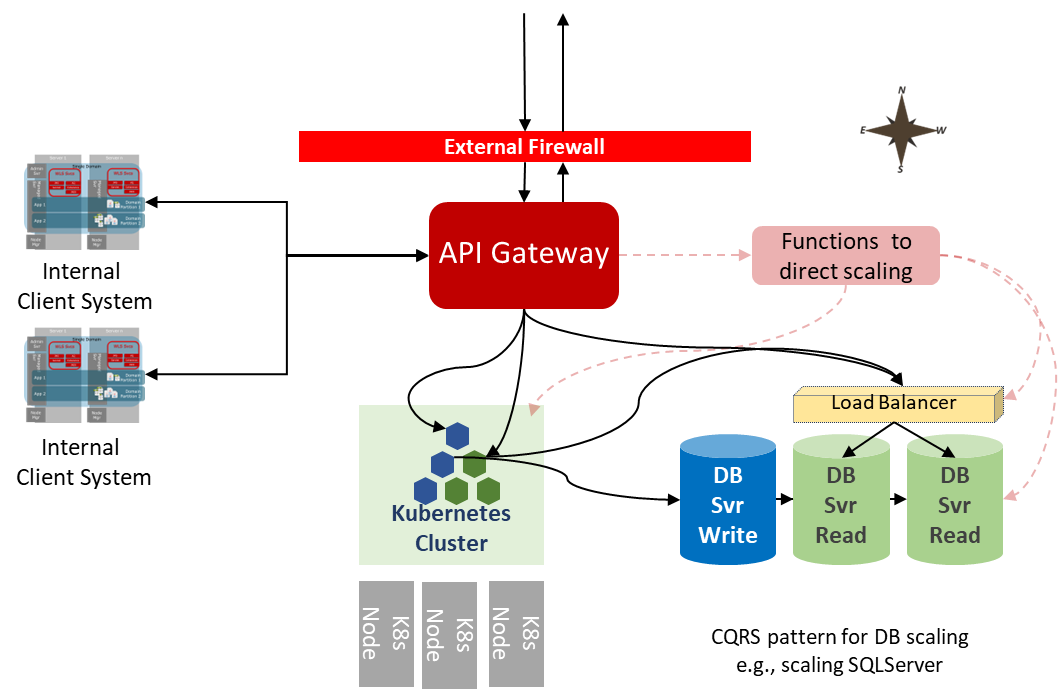
Back to our question – how do we manage the scaling? We could monitor the firewall and load balancer logs and analyze the kinds of requests being received. That would need additional processing logic to determine which services are receiving the traffic. But our API gateway is likely to have that intelligence implicitly in place as we have different API policies for the different types of endpoints. So we can monitor specific endpoints or groups of endpoints very easily – meaning we can infer the types of traffic demand and how to respond. Not only that, we may have API plans in place so we can control priority and prevent the free versions of our service from using APIs to initiate high-quality media streams. So we already have business and specific process meaning. So linking scaling controls such as KEDA (Kubernetes Event-driven Autoscaling) directly to measurements such as plans and specific APIs creates a relatively easy way to control scaling. Further, we may also use the gateways to provide a rate throttle so it’s not possible to crash our backend with an instantaneous spike. This strategy isn’t that different from an approach we’ve demonstrated for scaling message processing backends (see here and here).

Representation of how we can use the metrics from a gateway to  not only support the scaling of a K8s cluster but also other cloud services
Representation of how we can use the metrics from a gateway to not only support the scaling of a K8s cluster but also other cloud services

We can also use the data KEDA can see in terms of node readiness to adjust the API Gateway rate limiting dynamically as well. Either as a direct trigger from the number of active container instances or by triggering a more advanced check because we still have to address our services that need more lead time before relaxing the rate limiting.

Handling slow scaling services

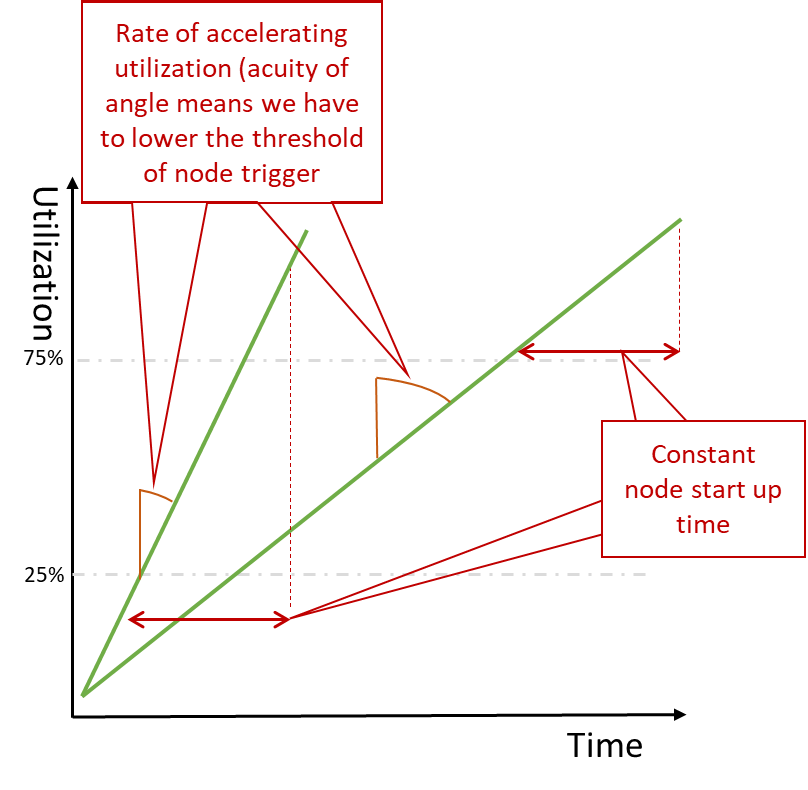
So we’ve got a way of targeting the scaling of services. But what do we do to address the slower scaling services we described? With the data dimensioned, we can do a couple of things. Firstly we can use the rate of change to determine how many nodes to add. A very sudden increase in demand and adding a node at a time will create the effect of the service performance stuttering as it scales, and all additional capacity is suddenly consumed and then scales again. Factoring in the rate of change to the workload threshold and the context of which services could generate the increased workload can be used to not only determine which databases may need scaling but also be used to adjust the threshold of workload that actually triggers the node introduction. So a sudden increase in demand on services that are known to create a lot of DB activity is then met with dropping the threshold that triggers new nodes from, say, 75% to 25% so we effectively start the nodes on a lower threshold, means the process is effectively started sooner.

Illustrating how the rate of growth in utilization can mean the need to change the threshold to trigger scaling up
With different rates of utilization growth, we can see that we need to alter the trigger threshold for launching new resources

For this to be fully effective we do need the Gateway tracking traffic both internally (East-West) and inbound (North-South). Using the gateway with East-West traffic means that we can establish an anti corruption layer.

Conclusion

Not all parts of a solution will be instantaneous in scaling – regardless of how fast the code startup cycle might be, some services have to address the need to move large chunks of data before becoming ready, e.g., in-memory databases. Some services may not have been built for the latest business demands and the ability to exploit cloud scale and dynamic scaling. Some services need time to adjust configurations.

We may also need to adjust our protection mechanisms if we’re protecting against service overloading.

Scaling capabilities that have response latency to the scaling process can be addressed by achieving earlier, more intelligent recognition of need than warning simply by CPU loads hitting a threshold. The intelligence that can be derived from implicit service context simplifies the effort in creating such intelligence and makes it easier to recognize the change. API Gateways, message queues, message streams, and shared data storage are all means that, by their nature, have implicit context.

Pushing the recognition towards the front of the process creates milliseconds or possibly seconds more warning of the demand than waiting for the impacted nodes to see compute spikes.

Share this:

  • Click to share on Facebook (Opens in new window) Facebook
  • Click to share on X (Opens in new window) X
  • Click to share on Pocket (Opens in new window) Pocket
  • Click to share on Reddit (Opens in new window) Reddit
  • Click to email a link to a friend (Opens in new window) Email
  • Click to share on WhatsApp (Opens in new window) WhatsApp
  • Click to print (Opens in new window) Print
  • Click to share on Tumblr (Opens in new window) Tumblr
  • Click to share on Mastodon (Opens in new window) Mastodon
  • Click to share on Pinterest (Opens in new window) Pinterest
  • More
  • Click to share on Bluesky (Opens in new window) Bluesky
  • Click to share on LinkedIn (Opens in new window) LinkedIn
Like Loading...

API payload design getting the semantics right

14 Wednesday Dec 2022

Posted by mp3monster in APIs & microservices, development, General, Technology

≈ Leave a comment

Tags

API, Design, OAGI, OASIS, OMG, payload, semantics, TMForum

One area of API design that doesn’t get discussed much is the semantics of the payload. That is, the names we give our attributes and elements for the values being communicated. When developing single-use APIs (usually for client applications), this is unlikely to be an issue as the team(s) involved are likely to know each other and are able to interact and resolve clarity issues easily enough (although getting the semantics right makes this easier particularly in the long term). But when it comes to providing reusable endpoints, we may know the early adopters but are unlikely to interact with consumers beyond that unless there is a problem.

This makes getting the semantics right somewhat harder. How do we know if our early adopters represent the wider customer base (internally and externally)? Conversely, if we simply use our own company terminology, how do we know that it is representative of the wider user base? It isn’t unusual for organizations to develop their own variations of a term or apply assumed meaning. Even simple things, a ‘post code’ element of an address, other parts of the world use ‘zip codes’ or PINS are they the same? Perhaps if we said ‘postal code,’ we break the direct specific country associations with ‘post code.’ We can overcome these issues by providing a dictionary of meanings and lengthy explanations. Using the right term goes beyond simply understanding the data value; it will infer specific formatting and potential application behaviors. Taking our postcode/zip code example. In the UK data is published, which means it is possible to easily validate a postcode against the address line and vice versa. In fact, in the UK to get something delivered, you only need the property number and the postcode. A US 5-digit zipcode can’t do that. For that precision, the ZIP+4 needs to be used.

If we can address these issues, then life becomes easier for us in maintaining the information and for consumers in not needing to look up the details. The question is how can we be sure of using semantics that is consistent across our APIs and widely understood and, when necessary, already documented, so we don’t have to document the information again?

Read more: API payload design getting the semantics right

Public Data Models

There is a shortcut to some of these problems. Many industries have agreed on data models for different industries. The bodies such as OASIS, OMG, and others are developed and maintained by multiple organizations. As a result, there is a commonality in the meaning achieved. So if you align with that meaning, then use that semantic. Not only can the naming of attributes become easier, but any documentation can be simplified to reference the published definitions. in most cases, these standards are publicly available as it promotes the widest adoption – one of the goals of developing such models. But there are some pitfalls to be mindful of using this approach:

  • Sometimes rather than arrive at a universal definition, the models will accommodate structural variations or aliased names – as a result, they may not necessarily be helpful to you.
  • The more well-known models are internationalized. If you have no intent to support international needs and not expecting to have international consumers, then the naming may not align with localized conventions.
  • If you use the semantics provided, ensure your data abides by the meaning. For example, don’t use ‘shipping address’ if you’re not shipping anything.
  • Don’t slavishly copy the data models provided – the model may not be intended for API use cases. At the same time, it doesn’t stop you from asking why the data in the model is there and whether your users may want such data (and whether it makes sense for you to provide that information).

Predefined APIs

Some organizations, such as TMForum have taken the public data model to the next step and provided predefined API specifications. This is ideal where you’re following industry standards and providing standardized/common services that aren’t a differentiator but need to be offered as part of doing business.

Data Catalogs

Larger, data-mature organizations will keep some form of Data Catalog. These catalogs are often held to help understand compliance needs, such as where personal data is held, how data issues can impact data accuracy and integrity, etc. It is possible that metadata may also be kept to address the semantic meaning of data or reference the definitions. Such information is used to help inform any data cleansing that may be needed. This offers a potentially good source of information for internal API use cases.

Vendor Led

If your business is delivery/service focussed so that your unique value isn’t in IT processes but perhaps something that the company manufactures or a specialist service such as consulting in a specific industry, then it is possible that the majority of your systems are SaaS or COTs based. If your business has opted to focus on a particular vendor, e.g., Oracle or SAP, for most services, then vendor-led data models are a possibility. These vendors are often involved with public data model development, so they won’t be too divergent in most situations – but awareness of differences is necessary, but as both models should be internally consistent, the differences will also be consistent. This approach will give you better alignment and reduce the chances of needing to address any divergence. The downside of this is a change of direction on strategic vendors can create additional work going forward as the alignment is disrupted. More work will be needed to map from your naming and semantics to the new core, and attempts to move away from the selected model to try to realign semantics with a new core will potentially create breaking changes for API consumers.

Don’t Forget

Regardless of the approach taken, there are some very simple but critical rules that will keep you in a good place:

  • Don’t use your underlying storage data models – this is a well-documented API anti-pattern.
  • Consistency of language across your APIs, regardless of whether they are internal or external, is important.

Information Sources

Regardless of approach – be careful not to lock your API semantics and data model to that of the storage layer – these can change and even create breaking changes that you shouldn’t expose to your users. Some sources to consider.

  • OAGIS – covers a broad variety of business data domains. Some ERP suppliers have used this as a foundation for their application data models.
  • OASIS – covers many industries
  • TMForum APIs
  • ARTS (formally hosted by NRF now with the OMG). The full OMG standards catalog.
  • GS1 – lots here on shipping, supply chain, and product tracking

Some more reading on the subject:

  • http://mlwiki.org/index.php/Semantic_Domains
  • https://www.w3.org/TR/vocab-dcat-2/

Share this:

  • Click to share on Facebook (Opens in new window) Facebook
  • Click to share on X (Opens in new window) X
  • Click to share on Pocket (Opens in new window) Pocket
  • Click to share on Reddit (Opens in new window) Reddit
  • Click to email a link to a friend (Opens in new window) Email
  • Click to share on WhatsApp (Opens in new window) WhatsApp
  • Click to print (Opens in new window) Print
  • Click to share on Tumblr (Opens in new window) Tumblr
  • Click to share on Mastodon (Opens in new window) Mastodon
  • Click to share on Pinterest (Opens in new window) Pinterest
  • More
  • Click to share on Bluesky (Opens in new window) Bluesky
  • Click to share on LinkedIn (Opens in new window) LinkedIn
Like Loading...

Streaming APIs

05 Friday Aug 2022

Posted by mp3monster in APIs & microservices, development, General, Technology

≈ 1 Comment

Tags

API, architecture, code, GraphQL, gRPC, Oracle, streaming, subscriptions

Yesterday I was fortunate enough to participate in the Dev Innovation summit part of the World Festival virtual conference.

The presentation took a look at how Streaming APIs offer an alternative to API polling and the considerations needed when adopting streaming.

Continue reading →

Share this:

  • Click to share on Facebook (Opens in new window) Facebook
  • Click to share on X (Opens in new window) X
  • Click to share on Pocket (Opens in new window) Pocket
  • Click to share on Reddit (Opens in new window) Reddit
  • Click to email a link to a friend (Opens in new window) Email
  • Click to share on WhatsApp (Opens in new window) WhatsApp
  • Click to print (Opens in new window) Print
  • Click to share on Tumblr (Opens in new window) Tumblr
  • Click to share on Mastodon (Opens in new window) Mastodon
  • Click to share on Pinterest (Opens in new window) Pinterest
  • More
  • Click to share on Bluesky (Opens in new window) Bluesky
  • Click to share on LinkedIn (Opens in new window) LinkedIn
Like Loading...

Kubernetes Deployment – pulling from OCI Registry (OCIR)

26 Thursday May 2022

Posted by mp3monster in APIs & microservices, Cloud Native, General, Oracle, Oracle Cloud Native, Technology

≈ Leave a comment

Tags

Containers, deploy, K8s, Kuberrnetes, OCIR, registry, secret, token

The following isn’t unique to OCIR, as it will hold true for any K8s Deployment YAML configuration that works with an Open Container Initiative compliant registry. To define the containers part of the YAML file we need to provide an attribute that can be used to confirm the legitimacy of the request. To do this we need to supply a token. However, we don’t want this token to be visible in plain sight in our YAML. The solution to this is to set up a secret within Kubernetes.

In the following YAML extract, we can see the secret is named.

kind: Deployment
metadata:
  name: graph-svr-deploy
  labels:
    app: arch-oke-graphql
spec:
  replicas: 1
  selector:
    matchLabels:
      app: arch-oke-graphql
  template:
    metadata:
      name: graph-svr-deploy
      labels:
        app: arch-oke-graphql
    spec:
      containers:
      - name: graphql-svr
        image: iad.ocir.io/ociobenablement/graphql-svr:latest 
        ports:
        - containerPort: 4000    
          name: graph-svr-web
      imagePullSecrets:
      - name: ocirsecret     

This does mean we need to create the secret. As this is a one-off task the easiest step is to create the secret by hand. To do that we use the command:

@kubectl create secret docker-registry ocirsecret --docker-server=iad.ocir.io --docker-username=ociobenablement/identitycloudservice/philip.wilkins@oracle.com --docker-password='xxxxxxxx' --docker-email=philip.wilkins@oracle.com

This naturally leads to the next question where do we get the secret?

This step is straightforward. Navigating using the user icon top right (highlighted in the screenshot below), select the User Settings option to get to the screen shown below. Then use the right-hand menu option highlight (Auth Tokens). This displays a section of the UI showing your current auth tokens and provides a button that will popup a window to guide you through creating a new auth token.

Related Posts

  • Image building across machine architectures for Oracle Container Registry (OCIR)
  • Container Registry – pushing and storing containers

Share this:

  • Click to share on Facebook (Opens in new window) Facebook
  • Click to share on X (Opens in new window) X
  • Click to share on Pocket (Opens in new window) Pocket
  • Click to share on Reddit (Opens in new window) Reddit
  • Click to email a link to a friend (Opens in new window) Email
  • Click to share on WhatsApp (Opens in new window) WhatsApp
  • Click to print (Opens in new window) Print
  • Click to share on Tumblr (Opens in new window) Tumblr
  • Click to share on Mastodon (Opens in new window) Mastodon
  • Click to share on Pinterest (Opens in new window) Pinterest
  • More
  • Click to share on Bluesky (Opens in new window) Bluesky
  • Click to share on LinkedIn (Opens in new window) LinkedIn
Like Loading...
← Older posts

    I work for Oracle, all opinions here are my own & do not necessarily reflect the views of Oracle

    • About
      • Internet Profile
      • Music Buying
      • Presenting Activities
    • Books & Publications
      • Logging in Action with Fluentd, Kubernetes and More
      • Logs and Telemetry using Fluent Bit
      • Oracle Integration
      • API & API Platform
        • API Useful Resources
        • Useful Reading Sources
    • Mindmaps Index
    • Monster On Music
      • Music Listening
      • Music Reading
    • Oracle Resources
    • Useful Tech Resources
      • Fluentd & Fluent Bit Additional stuff
        • Logging Frameworks and Fluent Bit and Fluentd connectivity
        • REGEX for BIC and IBAN processing
      • Java and Graal Useful Links
      • Official Sources for Product Logos
      • Python Setup & related tips
      • Recommended Tech Podcasts

    Oracle Ace Director Alumni

    TOGAF 9

    Logs and Telemetry using Fluent Bit


    Logging in Action — Fluentd

    Logging in Action with Fluentd


    Oracle Cloud Integration Book


    API Platform Book


    Oracle Dev Meetup London

    Blog Categories

    • App Ideas
    • Books
      • Book Reviews
      • manning
      • Oracle Press
      • Packt
    • Enterprise architecture
    • General
      • economy
      • ExternalWebPublications
      • LinkedIn
      • Website
    • Music
      • Music Resources
      • Music Reviews
    • Photography
    • Podcasts
    • Technology
      • AI
      • APIs & microservices
      • chatbots
      • Cloud
      • Cloud Native
      • Dev Meetup
      • development
        • languages
          • java
          • node.js
      • drone
      • Fluentbit
      • Fluentd
      • logsimulator
      • mindmap
      • OMESA
      • Oracle
        • API Platform CS
          • tools
        • Helidon
        • ITSO & OEAF
        • Java Cloud
        • NodeJS Cloud
        • OIC – ICS
        • Oracle Cloud Native
        • OUG
      • railroad diagrams
      • TOGAF
    • xxRetired
    • AI
    • API Platform CS
    • APIs & microservices
    • App Ideas
    • Book Reviews
    • Books
    • chatbots
    • Cloud
    • Cloud Native
    • Dev Meetup
    • development
    • drone
    • economy
    • Enterprise architecture
    • ExternalWebPublications
    • Fluentbit
    • Fluentd
    • General
    • Helidon
    • ITSO & OEAF
    • java
    • Java Cloud
    • languages
    • LinkedIn
    • logsimulator
    • manning
    • mindmap
    • Music
    • Music Resources
    • Music Reviews
    • node.js
    • NodeJS Cloud
    • OIC – ICS
    • OMESA
    • Oracle
    • Oracle Cloud Native
    • Oracle Press
    • OUG
    • Packt
    • Photography
    • Podcasts
    • railroad diagrams
    • Technology
    • TOGAF
    • tools
    • Website
    • xxRetired

    Enter your email address to subscribe to this blog and receive notifications of new posts by email.

    Join 2,555 other subscribers

    RSS

    RSS Feed RSS - Posts

    RSS Feed RSS - Comments

    January 2026
    M T W T F S S
     1234
    567891011
    12131415161718
    19202122232425
    262728293031  
    « Nov    

    Twitter

    Tweets by mp3monster

    History

    Speaker Recognition

    Open Source Summit Speaker

    Flickr Pics

    Gogo Penguin at the BarbicanGogo Penguin at the BarbicanGogo Penguin at the BarbicanGogo Penguin at the Barbican
    More Photos

    Social

    • View @mp3monster’s profile on Twitter
    • View philwilkins’s profile on LinkedIn
    • View mp3monster’s profile on GitHub
    • View mp3monster’s profile on Flickr
    • View mp3muncher’s profile on WordPress.org
    • View philmp3monster’s profile on Twitch
    Follow Phil (aka MP3Monster)'s Blog on WordPress.com

    Blog at WordPress.com.

    • Subscribe Subscribed
      • Phil (aka MP3Monster)'s Blog
      • Join 233 other subscribers
      • Already have a WordPress.com account? Log in now.
      • Phil (aka MP3Monster)'s Blog
      • Subscribe Subscribed
      • Sign up
      • Log in
      • Report this content
      • View site in Reader
      • Manage subscriptions
      • Collapse this bar
     

    Loading Comments...
     

    You must be logged in to post a comment.

      Privacy & Cookies: This site uses cookies. By continuing to use this website, you agree to their use.
      To find out more, including how to control cookies, see here: Our Cookie Policy
      %d