• Home
  • Site Aliases
    • www.cloud-native.info
  • About
    • Background
    • Presenting Activities
    • Internet Profile
      • LinkedIn
    • About
  • Books & Publications
    • Log Generator
    • Logs and Telemetry using Fluent Bit
      • Fluent Bit book
      • Book Resources in GitHub
      • Fluent Bit Classic to YAML Format configurations
    • Logging in Action with Fluentd, Kubernetes and More
      • Logging in Action with Fluentd – Book
      • Fluentd Book Resources
      • Fluentd & Fluent Bit Additional stuff
    • API & API Platform
      • API Useful Resources
    • Oracle Integration
      • Book Website
      • Useful Reading Sources
    • Publication Contributions
  • Resources
    • GitHub
    • Oracle Integration Site
    • Oracle Resources
    • Mindmaps Index
    • Useful Tech Resources
      • Fluentd & Fluent Bit Additional stuff
      • Recommended Tech Podcasts
      • Official Sources for Product Logos
      • Java and Graal Useful Links
      • Python Setup & related stuff
  • Music
    • Monster On Music
    • Music Listening
    • Music Reading

Phil (aka MP3Monster)'s Blog

~ from Technology to Music

Phil (aka MP3Monster)'s Blog

Category Archives: Oracle

All things related to Oracle

Integrating API Management with the rest of your Development Pipeline

30 Thursday May 2019

Posted by mp3monster in API Platform CS, APIs & microservices, General, OIC - ICS, Oracle, Technology

≈ Leave a comment

Tags

API, CI/CD, Flexagon, Flexdeploy, OIC, SOASuite

Oracle API Management keeps API policy configuration and management internalized for a number of reasons including security (after all you don’t want your security rules for APIs out in the open).  The Platform does provide simple versioning.  But you need to able to link the policies to the back end implementations – so the policy configuration is aligned to what is implemented. For example you don’t want the policy to accept parameters that your back end can’t handle in version 1, but does in version 2 of your solution. I have blogged about some of these considerations in the past here.

We have had the good fortune to sit and discuss the challenges of how API configurations could be managed with Flexagon. As a result of our input and from others Flexdeploy has a number of new features making the configuration management of APIs very easy. In addition to this is further simplifying gateway deployment processes. When combined with a very powerful CI/CD that can handle traditional development, microservices and development with integration products such as like SOA Suite and OIC a huge amount of flexibility is made available enabling configuration management, multi environment deployments.

cropped-flexagon_diagram_81816-01-1024x343

Flexagon have started a series of blogs on the subject – recommend checking them out – here.
Share this:

  • Share on Facebook (Opens in new window) Facebook
  • Share on X (Opens in new window) X
  • Share on Pocket (Opens in new window) Pocket
  • Share on Reddit (Opens in new window) Reddit
  • Email a link to a friend (Opens in new window) Email
  • Share on WhatsApp (Opens in new window) WhatsApp
  • Print (Opens in new window) Print
  • Share on Tumblr (Opens in new window) Tumblr
  • Share on Mastodon (Opens in new window) Mastodon
  • Share on Pinterest (Opens in new window) Pinterest
  • More
  • Share on Bluesky (Opens in new window) Bluesky
  • Share on LinkedIn (Opens in new window) LinkedIn
Like Loading...

API Platform – Plans & Subscriptions

15 Wednesday May 2019

Posted by mp3monster in API Platform CS, General, Oracle, Technology

≈ 2 Comments

Tags

APIs, applications, entitlement, Plans, Subscription

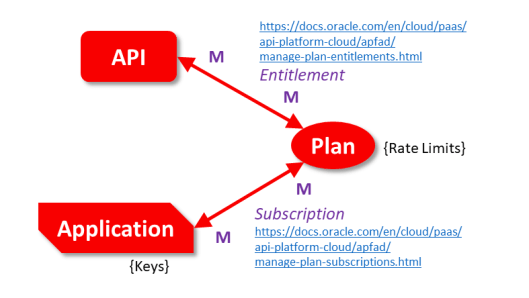
When it comes to Plans and Subscriptions on the Oracle API Platform we have a very flexible set of relationships. When it comes to checking the relationships to ensure a configuration is correct and that the impact of changing a plan or subscription is clear.  I end up having to draw a little diagram, which always leaves me second-guessing myself about which way the linkages are. So I created a quick aide memoir, particularly given the unfortunate fact that Oracle’s online documentation isn’t great for diagrams.

If the diagram helps me, then perhaps it can help others, so here it is:

API-Plan - Entitlement

I’ve also attached the original PowerPoint document so it can be modified, enhanced if you want to – API-Plan – Entitlement.

Share this:

  • Share on Facebook (Opens in new window) Facebook
  • Share on X (Opens in new window) X
  • Share on Pocket (Opens in new window) Pocket
  • Share on Reddit (Opens in new window) Reddit
  • Email a link to a friend (Opens in new window) Email
  • Share on WhatsApp (Opens in new window) WhatsApp
  • Print (Opens in new window) Print
  • Share on Tumblr (Opens in new window) Tumblr
  • Share on Mastodon (Opens in new window) Mastodon
  • Share on Pinterest (Opens in new window) Pinterest
  • More
  • Share on Bluesky (Opens in new window) Bluesky
  • Share on LinkedIn (Opens in new window) LinkedIn
Like Loading...

Everything As Code – Article for PTK

01 Wednesday May 2019

Posted by mp3monster in General, Oracle, OUG, Technology

≈ 2 Comments

Tags

article, Capgemini, EverythingAsCode, IaaS, OUG, PTK

PTK 2019-04-30.pngPTK (Pass The Knowledge) is the new name for the Independent UK Oracle User Group‘s journal, previously known as Oracle Scene.  Yesterday saw the 1st release under its new name, and I’m proud to say that I have an article included called Everything as Code.

Not only that,  it is great to see the journal includes the appearance of one of my Oracle Team colleagues at Capgemini – Amy Simpson-Grange (here).

The magazine features the approach trialled in the last issue of Oracle Scene where the Journal was split in two – one half focusing on Oracle Applications and Applications Technology and the other on Oracle core technologies i.e PaaS, IaaS, Database, Infrastructure etc.  it also just happens that Amy appears in one half, and I in the other.

One thing that hasn’t changed is the high quality of articles that reflect the diversity of Oracle’s portfolio and community – covering things like Women In IT, Conversational AI, Sanjeevan Bala from Channel 4 discussing the use of Data Science, Database Security and Table Scans.

Share this:

  • Share on Facebook (Opens in new window) Facebook
  • Share on X (Opens in new window) X
  • Share on Pocket (Opens in new window) Pocket
  • Share on Reddit (Opens in new window) Reddit
  • Email a link to a friend (Opens in new window) Email
  • Share on WhatsApp (Opens in new window) WhatsApp
  • Print (Opens in new window) Print
  • Share on Tumblr (Opens in new window) Tumblr
  • Share on Mastodon (Opens in new window) Mastodon
  • Share on Pinterest (Opens in new window) Pinterest
  • More
  • Share on Bluesky (Opens in new window) Bluesky
  • Share on LinkedIn (Opens in new window) LinkedIn
Like Loading...

Oracle Groundbreakers Podcast – Helidon

21 Sunday Apr 2019

Posted by mp3monster in APIs & microservices, development, General, Helidon, Oracle, Podcasts, Technology

≈ Leave a comment

Tags

groundbreakers, Helidon, meetup, podcast

One of the things I am fortunate enough to get involved with on occasion is the Oracle Groundbreakers Podcast (previously known as the Oracle Developer Podcast) and something I have written about in the past, even as Oracle Developer Community (ODC) Appreciation Day post.

As a result of the recent Meetups on the subject of Helidon that have been occurring recently, we made the suggestion that Helidon is the subject of a Groundbreaker’s Podcast, net result I was invited to be part of the panel.  The podcast was recorded a few weeks ago, and know available (here). Go check it out, as it includes the key contributors to the project Dmitry Kornilov and Tomas Langer.

GBPodcast-image-365

Share this:

  • Share on Facebook (Opens in new window) Facebook
  • Share on X (Opens in new window) X
  • Share on Pocket (Opens in new window) Pocket
  • Share on Reddit (Opens in new window) Reddit
  • Email a link to a friend (Opens in new window) Email
  • Share on WhatsApp (Opens in new window) WhatsApp
  • Print (Opens in new window) Print
  • Share on Tumblr (Opens in new window) Tumblr
  • Share on Mastodon (Opens in new window) Mastodon
  • Share on Pinterest (Opens in new window) Pinterest
  • More
  • Share on Bluesky (Opens in new window) Bluesky
  • Share on LinkedIn (Opens in new window) LinkedIn
Like Loading...

On Line Training – API Driven Architecture

15 Friday Feb 2019

Posted by mp3monster in General, Oracle, Packt, Technology

≈ Leave a comment

Tags

API, oreilly, Packt, Packt Publishing, training, video

In January we presented our 1st online training, looking at API Design and use of Apiary and Swagger. Things went well until near the end where for some reason voice and video dropped for no apparent reason. Our coordinator Lindsay kept the recording going and soon as we reconnected I continued the session and went through the Q&A.

So if you missed the end of the training, please do check back with the recording.

If you missed the training – we’ll be rerunning in March – go here.

For those on the training will have seen at the start of the training links to my social media profile, so happy to try to respond to any further questions.

We are also scheduled to run the session again in a month or so.

One of the questions received during the session I thought worth mentioning was when would Apiary support Open API 3.0. Well according to their blog very soon, looking forward to it as the OAS 3 does look a little cleaner.

Share this:

  • Share on Facebook (Opens in new window) Facebook
  • Share on X (Opens in new window) X
  • Share on Pocket (Opens in new window) Pocket
  • Share on Reddit (Opens in new window) Reddit
  • Email a link to a friend (Opens in new window) Email
  • Share on WhatsApp (Opens in new window) WhatsApp
  • Print (Opens in new window) Print
  • Share on Tumblr (Opens in new window) Tumblr
  • Share on Mastodon (Opens in new window) Mastodon
  • Share on Pinterest (Opens in new window) Pinterest
  • More
  • Share on Bluesky (Opens in new window) Bluesky
  • Share on LinkedIn (Opens in new window) LinkedIn
Like Loading...

Making Scripts Work with IDCS Deployed PaaS

09 Saturday Feb 2019

Posted by mp3monster in API Platform CS, APIs & microservices, General, Oracle, Technology, tools

≈ 5 Comments

Tags

API Platform, GitHub, Groovy, IDCS, OAuth, Script, tokens

A while back I made some utilities I developed to help with managing the API Platform. At the time we didn’t have access to an IDCS based environment, so credentials worked using basic auth (I.e. user name and password). But with environments managed by IDCS tokens are used.

As a developer with a Java background I have to admit to liking Groovy over Python for scripting, not to mention for the API Platform groovy is part of the gateway deployment and SDK. Meaning it is readily available in its 2.x form (3.x is relatively recent and aligning to the latest Java idioms). We haven’t tested against Groovy 3.0

Thank you to Andy Knight for sharing with us some Java code which I adapted to be pure Groovy (removing external dependencies for processing JSON). The result is a script that can be taken can be taken and worked into other scripts (which is what we have done for our previously provided scripts – Understanding API Deployment State on API Platform, Managing API Policy Versioning in Oracle API Platform, Documenting APIs on the Oracle API Platform). But this script can be used to get a token and display it on the command line or write it to file. Writing tokens to files is generally not good practise, but as a temporary measure when working on developing scripts arguably a managed risk.

The script can be found at https://github.com/mp3monster/API-Platform-Utils/tree/master/getToken and all the details on using the script can be obtained by passing -h as a parameter. The important thing is to understand how to obtain the Client ID and Client Secret, the details of which are described at https://docs.oracle.com/en/cloud/paas/api-platform-cloud/apfad/find-your-client-id-and-client-secret.html

Share this:

  • Share on Facebook (Opens in new window) Facebook
  • Share on X (Opens in new window) X
  • Share on Pocket (Opens in new window) Pocket
  • Share on Reddit (Opens in new window) Reddit
  • Email a link to a friend (Opens in new window) Email
  • Share on WhatsApp (Opens in new window) WhatsApp
  • Print (Opens in new window) Print
  • Share on Tumblr (Opens in new window) Tumblr
  • Share on Mastodon (Opens in new window) Mastodon
  • Share on Pinterest (Opens in new window) Pinterest
  • More
  • Share on Bluesky (Opens in new window) Bluesky
  • Share on LinkedIn (Opens in new window) LinkedIn
Like Loading...

Oracle Developer Meetup – London Feb 19

05 Tuesday Feb 2019

Posted by mp3monster in Dev Meetup, development, General, Helidon, Oracle, Technology

≈ 2 Comments

Tags

developer, GitHub, Helidon, meetup, micro profile, Microservices, open tracing, Oracle, signatures

Last night was the first Oracle Developer Meetup in London for 2019.  We were very fortunate to have Tomas Langer fly over to talk about the new micro container/framework being developed as an open-source solution by Oracle.


Oracle Developer Meet-up - Tomas Langer presenting on Helidon

Tomas, opened by explaining the evolution of the micro-profile being championed by the Eclipse Foundation who are now the guardians of J2EE also known as Jakarta and how the J2EE and Micro-Profile standards compare (in simplistic terms – micro-profile is J2EE stripped back to be simple and support what is typically needed in a micro-service world).

The presentation then went onto compare Helidon SE and Helidon MP (micro-profile).  What was really pleasing is that with a couple of exceptions everything that Helidon MP can do, can be done in the SE edition, the difference being that for SE you have to implement more code, rather than the auto-magic of annotations, but in return you have a Reactive Java platform with a development paradigm which relates to JavaScript Express.

In addition to talking about what can be done, Tomas described the kinds of features being developed, this includes:

  • Bringing micro-profile support up to the very latest specification,
  • More reactive persistence technologies support,

With the scene set, Tomas then worked through a series of live code scenarios starting with a clean slate and building Hello World in both the SE & MP models illustrating the differences in approach.  This was then built upon to add the following capabilities:

  • Tracing (using Zipkin leveraging the Open Tracing Standard)
  • Dynamic configuration
  • Security (including Signatures)
  • Fault Handling (just MP)

You can get the complete example which uses Helidon in both configurations from Tomas GitHub.

In addition to Helidon itself on GitHub, there are resources provided include rich documentation and examples of each key feature.  Plus a Slack community, that if you contact any of the Helidon team will get you invited allowing you to discuss with the development team how to do things along with other developers using Helidon.

Tomas can be contracted via @Langer_Tomas.  Helidon project also has its own Twitter account – Helidon Project

Helidon itself can be found at:

  • Helidon website
  • GitHub
  • Helidon documentation

I have previously blogged on Helidon at Exploring Helidon – Part 1


Share this:

  • Share on Facebook (Opens in new window) Facebook
  • Share on X (Opens in new window) X
  • Share on Pocket (Opens in new window) Pocket
  • Share on Reddit (Opens in new window) Reddit
  • Email a link to a friend (Opens in new window) Email
  • Share on WhatsApp (Opens in new window) WhatsApp
  • Print (Opens in new window) Print
  • Share on Tumblr (Opens in new window) Tumblr
  • Share on Mastodon (Opens in new window) Mastodon
  • Share on Pinterest (Opens in new window) Pinterest
  • More
  • Share on Bluesky (Opens in new window) Bluesky
  • Share on LinkedIn (Opens in new window) LinkedIn
Like Loading...

API Caching with the Oracle API Platform

01 Friday Feb 2019

Posted by mp3monster in API Platform CS, APIs & microservices, General, Oracle, Technology

≈ 4 Comments

Tags

API, API-CS, cache-control, caching, Coherence, ehcache, forceResponse, Helidon, IETF, Oracle, proxy, Redis, RGC

We have been developing some advanced custom API policies for a client and in the process picked up on a few insights that didn’t even make into the API book. One of these policies is to provide an optimization around caching of API calls. The rest of this blog will talk about the tricks we have specifically applied to link an API Gateway to a caching mechanism and why.

Before I go into the details, I’d like to thank the Oracle product management team and particularly Glenn Mi at Oracle for their support getting through the deeper undocumented elements of the capabilities of the API Platform SDK.

Caching Options

Caching comes in may forms, and is motivated by varying reasons and not always the wanting the same behaviours. When getting into the subject of caching it is surprising how polarised people’s view points can be about which cache strategies are correct. The following diagram illustrates the diversity of caches that could appear in an end to solution solution.

Bringing together a caching technology in the Reverse Proxy model and an API Gateway makes a lot of sense. Data being provided to API consumers needs to be protected whether it comes from a cache or an active back-end system. At the same time you also want to exploit an API Gateway to provide analytics on API traffic, so any caching needs to be behind the gateway. But, if In front of an application layer then we can reduce the application workload.

When it comes to caching technology to partner with the gateway, there are a number of options available from Coherence to ehCache, memcache and Redis. We have avoided Coherence, whilst the gateway currently runs on a WebLogic server, we don’t want to need to unduly distort the performance profile and configuration of the Gateway by forcing a cache onto that server. In addition to which as Coherence is a licensed addition to WebLogic it raises difficult questions about licensing when deploying gateways (with gateways licensed based on logical groupings and API volumes but Coherence is licensed by OCPU). We also know that Oracle is moving towards having a micro-gateway which may mean we see the gateway engine moved onto something like Helidon (but this last point is my speculation).

We have elected to use Redis for several reasons –

  • Available as a PaaS service with several cloud providers (AWS & Azure) so no setup or management effort but can also be deployed on-premises,
  • Has an out of the box deployment that means cached entities can have a time to live (TTL) rather than needing to implement separate processes to expire cached values,
  • The ability to make it scale through clustering,
  • Cost

This caching model also allows us to optionally allow application development teams to push into the cache directly results. So rather than waiting on TTL the cache can be refreshed directly or even primed, rather than having to create fake requests to prime a cache.

Custom Policy

Continue reading →

Share this:

  • Share on Facebook (Opens in new window) Facebook
  • Share on X (Opens in new window) X
  • Share on Pocket (Opens in new window) Pocket
  • Share on Reddit (Opens in new window) Reddit
  • Email a link to a friend (Opens in new window) Email
  • Share on WhatsApp (Opens in new window) WhatsApp
  • Print (Opens in new window) Print
  • Share on Tumblr (Opens in new window) Tumblr
  • Share on Mastodon (Opens in new window) Mastodon
  • Share on Pinterest (Opens in new window) Pinterest
  • More
  • Share on Bluesky (Opens in new window) Bluesky
  • Share on LinkedIn (Opens in new window) LinkedIn
Like Loading...

Helidon Live

26 Saturday Jan 2019

Posted by mp3monster in General, Helidon, Oracle, Technology

≈ Leave a comment

Tags

developer, Helidon, London, meetup, micro contaIner, Oracle

The London Oracle Developer Meetup (here) are excited to say that on that we’ll have 2 of the lead engineers with us from the Helidon.io project with us to introduce and demo the new open-source micro container platform. Bring your laptop and code along if you like.

Hope to see you there.

Share this:

  • Share on Facebook (Opens in new window) Facebook
  • Share on X (Opens in new window) X
  • Share on Pocket (Opens in new window) Pocket
  • Share on Reddit (Opens in new window) Reddit
  • Email a link to a friend (Opens in new window) Email
  • Share on WhatsApp (Opens in new window) WhatsApp
  • Print (Opens in new window) Print
  • Share on Tumblr (Opens in new window) Tumblr
  • Share on Mastodon (Opens in new window) Mastodon
  • Share on Pinterest (Opens in new window) Pinterest
  • More
  • Share on Bluesky (Opens in new window) Bluesky
  • Share on LinkedIn (Opens in new window) LinkedIn
Like Loading...

Exploring Helidon – Part 1

01 Tuesday Jan 2019

Posted by mp3monster in General, Helidon

≈ 4 Comments

Tags

Helidon, java, micro profile, Oracle

So I recently blogged (here) about the announcement of Helidon – the open source project from Oracle to provide a microservice app server that includes optional support for the J2EE Microprofile.

This is the first of what will probably become a series of blogs about Helidon, particularly in its SE form (non J2EE Micro-Profile) as Micro Profile and the wider J2EE model in general will have been documented more widely.

Hello World

Helidon comes with a quick start example app implemented both in SE and MP forms.  It is worth following the very simple instructions provided by the Helidon site to instantiate both versions of the Hello World app as it provides a good way to start to understand the differences in the way Helidon can be used.

The thing that really jumps out when you compare the code (for me at least) is the fact that the SE code being driven from values loading from configuration is more dynamic. The configuration can be sourced in a number of different ways from YAML files to etcd.So for our for first experiment we took the hello World app, and made the path /greet dynamic by loading the path from from some additional configuration. Enhancing the main with :

private static Routing createMultiRouting() {
Map greetingConfig = Config.create().get(“greeting”).asMap();
Routing.Builder routing = Routing.builder();
if (!greetingConfig.isEmpty())
{
greetingConfig.forEach((k,v)->
{
System.out.println (“Read config value>” + k + “=” + v + “<“);
// as the key is the fully qualified name, I just want the last piece,
// so let’s strip it to be a substring
String key = (String)k;
key = key.substring(key.lastIndexOf(“.”)+1);
// each different URI should have its own instance of the Greet Service
// with its tailored key which will mean it responds with the key e.g. France
routing.register(JsonSupport.get())
.register(“/”+v, new GreetService(key));
});
}
else
{
System.out.println(“No config\n”);
}
return routing.build();
}
 

We can create URLs for greetings in different languages, and see the different instances of the Service object responding to the web calls. Whilst many may associate this approach with Node.js for me it felt more like the webserver multiplexer (MUX) such as Gorilla used with Go (you can see what I mean here).

Helidon and On the Road

Two of the leading figures Tomas Langer and Dmitry Kornikov will be presenting at a number of meet-ups in Europe, including the London Meetup (go here)

Part 1?

Yes, I will be blogging more about Helidon as soon as I can, but presently wrapping up a white paper and running an API Design training session soon.

Share this:

  • Share on Facebook (Opens in new window) Facebook
  • Share on X (Opens in new window) X
  • Share on Pocket (Opens in new window) Pocket
  • Share on Reddit (Opens in new window) Reddit
  • Email a link to a friend (Opens in new window) Email
  • Share on WhatsApp (Opens in new window) WhatsApp
  • Print (Opens in new window) Print
  • Share on Tumblr (Opens in new window) Tumblr
  • Share on Mastodon (Opens in new window) Mastodon
  • Share on Pinterest (Opens in new window) Pinterest
  • More
  • Share on Bluesky (Opens in new window) Bluesky
  • Share on LinkedIn (Opens in new window) LinkedIn
Like Loading...
← Older posts
Newer posts →

    I work for Oracle, all opinions here are my own & do not necessarily reflect the views of Oracle

    • About
      • Internet Profile
      • Music Buying
      • Presenting Activities
    • Books & Publications
      • Logging in Action with Fluentd, Kubernetes and More
      • Logs and Telemetry using Fluent Bit
      • Oracle Integration
      • API & API Platform
        • API Useful Resources
        • Useful Reading Sources
    • Mindmaps Index
    • Monster On Music
      • Music Listening
      • Music Reading
    • Oracle Resources
    • Useful Tech Resources
      • Fluentd & Fluent Bit Additional stuff
        • Logging Frameworks and Fluent Bit and Fluentd connectivity
        • REGEX for BIC and IBAN processing
      • Java and Graal Useful Links
      • Official Sources for Product Logos
      • Python Setup & related tips
      • Recommended Tech Podcasts

    Oracle Ace Director Alumni

    TOGAF 9

    Logs and Telemetry using Fluent Bit


    Logging in Action — Fluentd

    Logging in Action with Fluentd


    Oracle Cloud Integration Book


    API Platform Book


    Oracle Dev Meetup London

    Blog Categories

    • App Ideas
    • Books
      • Book Reviews
      • manning
      • Oracle Press
      • Packt
    • Enterprise architecture
    • General
      • economy
      • ExternalWebPublications
      • LinkedIn
      • Website
    • Music
      • Music Resources
      • Music Reviews
    • Photography
    • Podcasts
    • Technology
      • AI
      • APIs & microservices
      • chatbots
      • Cloud
      • Cloud Native
      • Dev Meetup
      • development
        • languages
          • java
          • node.js
          • python
      • drone
      • Fluentbit
      • Fluentd
      • logsimulator
      • mindmap
      • OMESA
      • Oracle
        • API Platform CS
          • tools
        • Helidon
        • ITSO & OEAF
        • Java Cloud
        • NodeJS Cloud
        • OIC – ICS
        • Oracle Cloud Native
        • OUG
      • railroad diagrams
      • TOGAF
    • xxRetired
    • AI
    • API Platform CS
    • APIs & microservices
    • App Ideas
    • Book Reviews
    • Books
    • chatbots
    • Cloud
    • Cloud Native
    • Dev Meetup
    • development
    • drone
    • economy
    • Enterprise architecture
    • ExternalWebPublications
    • Fluentbit
    • Fluentd
    • General
    • Helidon
    • ITSO & OEAF
    • java
    • Java Cloud
    • languages
    • LinkedIn
    • logsimulator
    • manning
    • mindmap
    • Music
    • Music Resources
    • Music Reviews
    • node.js
    • NodeJS Cloud
    • OIC – ICS
    • OMESA
    • Oracle
    • Oracle Cloud Native
    • Oracle Press
    • OUG
    • Packt
    • Photography
    • Podcasts
    • python
    • railroad diagrams
    • Technology
    • TOGAF
    • tools
    • Website
    • xxRetired

    Enter your email address to subscribe to this blog and receive notifications of new posts by email.

    Join 2,555 other subscribers

    RSS

    RSS Feed RSS - Posts

    RSS Feed RSS - Comments

    January 2026
    M T W T F S S
     1234
    567891011
    12131415161718
    19202122232425
    262728293031  
    « Nov    

    Twitter

    Tweets by mp3monster

    History

    Speaker Recognition

    Open Source Summit Speaker

    Flickr Pics

    Gogo Penguin at the BarbicanGogo Penguin at the BarbicanGogo Penguin at the BarbicanGogo Penguin at the Barbican
    More Photos

    Social

    • View @mp3monster’s profile on Twitter
    • View philwilkins’s profile on LinkedIn
    • View mp3monster’s profile on GitHub
    • View mp3monster’s profile on Flickr
    • View mp3muncher’s profile on WordPress.org
    • View philmp3monster’s profile on Twitch
    Follow Phil (aka MP3Monster)'s Blog on WordPress.com

    Blog at WordPress.com.

    • Subscribe Subscribed
      • Phil (aka MP3Monster)'s Blog
      • Join 233 other subscribers
      • Already have a WordPress.com account? Log in now.
      • Phil (aka MP3Monster)'s Blog
      • Subscribe Subscribed
      • Sign up
      • Log in
      • Report this content
      • View site in Reader
      • Manage subscriptions
      • Collapse this bar
     

    Loading Comments...
     

    You must be logged in to post a comment.

      Privacy & Cookies: This site uses cookies. By continuing to use this website, you agree to their use.
      To find out more, including how to control cookies, see here: Our Cookie Policy
      %d