• Home
  • About
    • Background
    • LinkedIn
    • Presenting Activities
    • Internet Profile
    • About
    • www.cloud-native.info
  • Observability, Fluent(d) Bit & OpAMP
    • OpAMP Product
    • OpAMP Overview
    • Log Generator
    • Fluent Bit Classic to YAML Format configurations
  • My Books
    • Logs and Telemetry using Fluent Bit
      • Fluent Bit book
      • Book Resources in GitHub
    • Logging in Action with Fluentd, Kubernetes and More
      • Logging in Action with Fluentd – Book
      • Fluentd Book Resources
      • Fluentd & Fluent Bit Additional stuff
    • API & API Platform
      • API Useful Resources
    • Oracle Integration
      • Book Website
      • Useful Reading Sources
    • Publication Contributions
  • Resources
    • GitHub
    • Oracle Integration Site
    • Oracle Resources
    • Mindmaps Index
    • Useful Tech Resources
      • Fluentd & Fluent Bit Additional stuff
      • Recommended Tech Podcasts
      • Official Sources for Product Logos
      • Java and Graal Useful Links
      • DevTips
  • Music
    • Monster On Music
    • Music Listening
    • Music Reading

Phil (aka MP3Monster)'s Blog

~ from Technology to Music

Phil (aka MP3Monster)'s Blog

Category Archives: Technology

Sending Push Notifications Without Your Own App

24 Wednesday Dec 2014

Posted by mp3monster in General, Oracle, Technology

≈ 2 Comments

Tags

android, API, app, growl, ios, NMA, prowl, Prowl App, push notifications

So in my opening blog entry I talked about creating mobile push notifications. So before we start playing with cloud solutions and developing anything, the best place to start is be able to push a notification.

We’re going to do this with the use of Prowl. Prowl offers both a mobile application and a cloud service with an API. So setting up an account on Prowl you can connect you mobile Prowl App to then through another app – for example Growl (which is how I came across Prowl) which can be extended by a plugin framework to use Prowl so potentially all your desktop alert can become push notifications if you want.

So if you hadn’t already noticed Prowl is presently an IOS only solution – however there is an Android equivalent called Notify My Android (NMA). I should also be upfront the Prowl App does cost a couple of pounds or dollars (depending upon your App Store).  But this is a small price to pay to avoid having to build an app (which needs to you to be a fully paid up IOS Developer Account holder to play with push notifications as we do).

So I will concentrate primarily on working from a Windows platform to an Apple device – but I will loop back to Android at points as well.  For those who bulk at the idea of Windows and swear only to live with Mac or a proper OS as many Linux fans will say – I will point out where to get the info you need and hack your Linux flavour into appropriate shape. Our goal is to see Oracle cloud in use.

Just as an aside quick detour – Growl is a Mac based notification consolidation tool, which has a Windows implementation as well called Growl For Windows.  The idea is all your applications and system notifications go via Growl which allows your to customise the notifications and route them to lots of different channels such as to browser plugin, push notifications and so on.

So lets get the first steps called out:

  1. Create an account on Prowl or NMA
  2. Install the Prowl App on your IOS device
  3. From the Prowl web app or NMA web send a message to your device

So we have proven notifications to our device from a central device. We are going to go one step further and use a local client to prove we can safely send events to the Prowl or NMA servers. We can do this several different ways – on the Prowl site are several browser plugins that you could use or combine prowl with Growl or Growl for Windows plus the Growl notifier.

So I assume that you have installed Growl or Growl for Windows as previously mentioned. Then the Growl notifier extension needs to be installed from http://www.growlforwindows.com/gfw/help/growlnotify.aspx. With the extension installed we need to make sure Growl sends its notifications to Prowl and send the notifications from a command line.

To do this you need to create a API Key on the Prowl website. Then in settings part of the app setup the key details as shown below (note I’ve hidden my account and key):
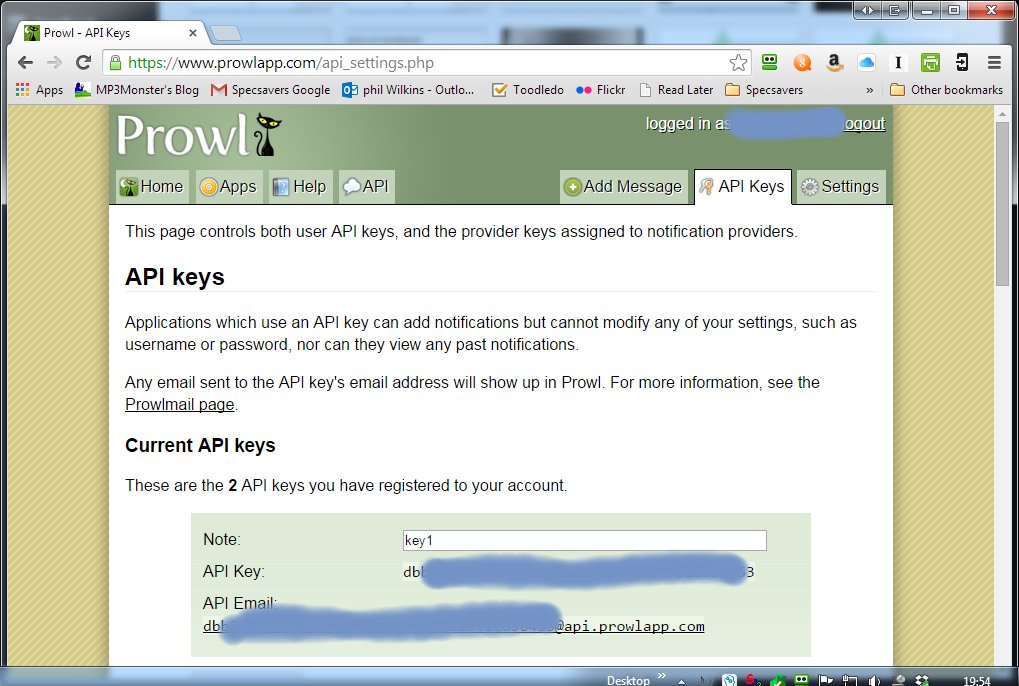
Prowl API Config
So this links the credentials of the account. You could impose local security constraints so the local notification is only accepted by Growl with good credentials.

Then you you need to configure the notifier to use the configured key as you can see below:

In The Network part of Growl's configuration you need to establish the Key

In The Network part of Growl’s configuration you need to establish the Key

The Plus key you can see provides a dialogue like the following where you select the type of notification and then complete the necessary details i.e.  copy in the API Key from the website:

In The Network part of Growl's configuration you need to establish the Key

In The Network part of Growl’s configuration you need to establish the Key

GrowlConfig- forward NotificationsGrowl-setKey

You’ll may have noticed – that the key name carries through from the website – this is more to make it convenient to track the key rather than a necessity.

With the API Key setup we can link the notification side of things via the Notifications section.  You’ll note the App extension is selected and in the notification type I have gone to the Choices menu which provides a popup

Selecting Notification


Selecting the key:

Selecting the Destination KeyThe final step is to then run a command line, which would look something like:


Growl Notifier Script

You’ll notice the command line is very simple as we’ve not setup an security in Growl the only security is around the API Key.

Then we get the pay off of the pushed notification and you can see your notification history as well in the Prowl app – as this shows:

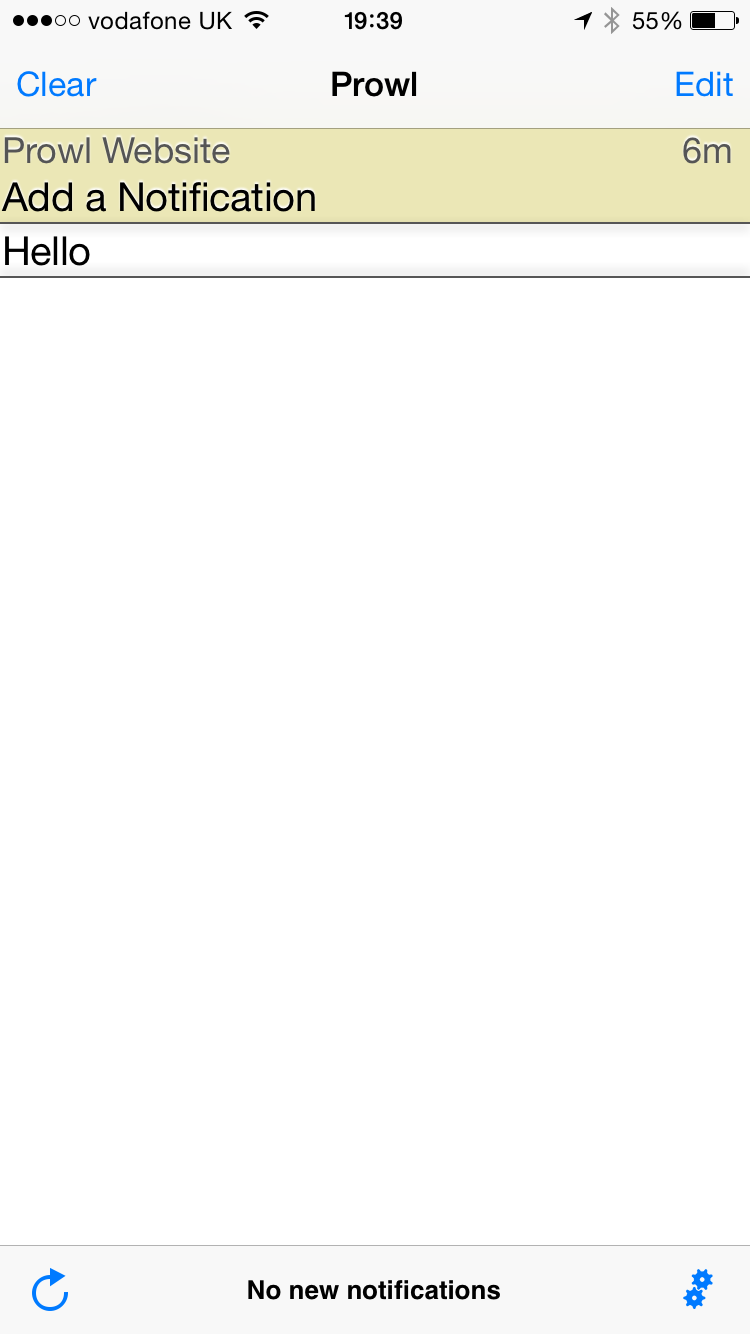
IMG_1944

Prowl App View


So the steps just performed:

  • Created the API key on the ProwlAPI site
  • made sure we’ve got Growl and Growl Notifier installed
  • Established the link from Growl to Growl Web App via the API Key
  • Configured the notifications for GrowlNotifier to go through Growl and get pushed onto the Prowl API
  • Run the command line script
  • Seen the command line message go from the desktop shell through Growl onto the Prowl API and arrive on your smart phone.


Summary
So we have shown we can create push notifications without the distraction of building our own app. Not very exciting as we haven’t created anything but does show the art of the possible.

Next post we’ll cut some code to perform the same process using the Prowl API directly.
Share this:

  • Share on Facebook (Opens in new window) Facebook
  • Share on X (Opens in new window) X
  • Share on Reddit (Opens in new window) Reddit
  • Share on LinkedIn (Opens in new window) LinkedIn
  • Email a link to a friend (Opens in new window) Email
  • Share on WhatsApp (Opens in new window) WhatsApp
  • Print (Opens in new window) Print
  • Share on Tumblr (Opens in new window) Tumblr
  • Share on Mastodon (Opens in new window) Mastodon
  • Share on Pinterest (Opens in new window) Pinterest
  • Share on Bluesky (Opens in new window) Bluesky
Like Loading...

Oracle Java & Node.JS Cloud Blogs Coming

23 Tuesday Dec 2014

Posted by mp3monster in General, Oracle, Technology

≈ 1 Comment

Tags

Cloud, java, node.js, Oracle

Over the coming months I’m planning on running a series of blogs on getting setup and using Oracle’s Java Cloud and the upcoming Oracle Node.JS Cloud when we can get access to it.

In both cases we’re aiming to demo the capabilities, setup eyc around the classic Hello World – but with a bit of a twist. Rather than simply sending to the console we’re going to use a mobile push notification – without resorting to having to build a mobile app.

By taking this approach to hello world aside from keeping it simple we can see how to bring 3rd party APIs into the mix.  The first couple of posts wont need to much on the Oracle front – as we’ll walk through getting things setup and running a proof without the cloud stuff. As they say keep it simple stupid.

So that you can see the blog entries for each of this two stories, I specifically setup in my blog two entry categories:

  • Oracle Java Cloud
  • Oracle Node.JS Cloud

A few posts will obviously be common to both.

Share this:

  • Share on Facebook (Opens in new window) Facebook
  • Share on X (Opens in new window) X
  • Share on Reddit (Opens in new window) Reddit
  • Share on LinkedIn (Opens in new window) LinkedIn
  • Email a link to a friend (Opens in new window) Email
  • Share on WhatsApp (Opens in new window) WhatsApp
  • Print (Opens in new window) Print
  • Share on Tumblr (Opens in new window) Tumblr
  • Share on Mastodon (Opens in new window) Mastodon
  • Share on Pinterest (Opens in new window) Pinterest
  • Share on Bluesky (Opens in new window) Bluesky
Like Loading...

Free Network Security eBook

23 Tuesday Dec 2014

Posted by mp3monster in Books, Technology

≈ Leave a comment

Tags

computer crime, computer networks, ebook, network, network security, Network Security For Dummies, Security

I came across the following promotion via LinkedIn. The book isn’t that new, but looking at Amazon reviews suggests that there maybe some value still:

“Network Security For Dummies — eBook (usually $22.99) FREE until January 1st!“

Get quick, easy, low-cost solutions to all your network security concerns.

CNN is reporting that a vicious new virus is wreaking havoc on the world’s computer networks. Somebody’s hacked one of your favorite Web sites and stolen thousands of credit card numbers. The FBI just released a new report on computer crime that’s got you shaking in your boots. The experts will tell you that keeping your network safe from the cyber-wolves howling after your assets is complicated, expensive, and best left to them. But the truth is, anybody with a working knowledge of networks and computers can do just about everything necessary to defend their network against most security threats.

Whether your network consists of one computer with a high-speed Internet connection or hundreds of workstations distributed across dozens of locations, you’ll find what you need to confidently:

  • Identify your network’s security weaknesses
  • Install an intrusion detection system
  • Use simple, economical techniques to secure your data
  • Defend against viruses
  • Keep hackers at bay
  • Plug security holes in individual applications
  • Build a secure network from scratch

– Download from: http://opensourceuniverse.tradepub.com/free/w_wile145/?p=w_wile145#sthash.i4fHNQgA.dpuf

Share this:

  • Share on Facebook (Opens in new window) Facebook
  • Share on X (Opens in new window) X
  • Share on Reddit (Opens in new window) Reddit
  • Share on LinkedIn (Opens in new window) LinkedIn
  • Email a link to a friend (Opens in new window) Email
  • Share on WhatsApp (Opens in new window) WhatsApp
  • Print (Opens in new window) Print
  • Share on Tumblr (Opens in new window) Tumblr
  • Share on Mastodon (Opens in new window) Mastodon
  • Share on Pinterest (Opens in new window) Pinterest
  • Share on Bluesky (Opens in new window) Bluesky
Like Loading...

Enterprise Architect Cloud

18 Thursday Dec 2014

Posted by mp3monster in General, Technology

≈ Leave a comment

Tags

Cloud, EA, EA Cloud, Enterprise Architect, modelling, software, Sparx, tool

With version 11 of Sparx‘ Enterprise Architect tool a new cloud feature was introduced to support team working, which previously had been achieved using a shared Database.

When we heard about EA Cloud, both myself and my colleagues got rather excited, thinking that this would be the opportunity to offload the effort of looking after a central DB (making sure backups happened, fine tuning the DB settings and so on) plus maintaining the platform’s patching for security etc. Not only that through the cloud capability we could host the repository that made it very easy for the team to access the repository on the move without needing to have another whole in our corporate firewall etc.

Unfortunately, EA Cloud provides all the software to establish a cloud based repository – which can be used through firewalls etc – HTTPS traffic rather than DB connectors on unusual ports but not the hosting.  This seems to a bit of a missed opportunity for Sparx who already have to deal with all of these points to host 3 demo cloud servers.  So the next step of instantiating a server for a regular on going fee doesn’t seem too challenging, not to mention promotes customer tie in, plus the ability to capture some potentially interesting metrics about its users (e.g. which modelling techniques are most popular etc).  Having looked at Sparx partners they don’t offer the capability either which is a shame.

Share this:

  • Share on Facebook (Opens in new window) Facebook
  • Share on X (Opens in new window) X
  • Share on Reddit (Opens in new window) Reddit
  • Share on LinkedIn (Opens in new window) LinkedIn
  • Email a link to a friend (Opens in new window) Email
  • Share on WhatsApp (Opens in new window) WhatsApp
  • Print (Opens in new window) Print
  • Share on Tumblr (Opens in new window) Tumblr
  • Share on Mastodon (Opens in new window) Mastodon
  • Share on Pinterest (Opens in new window) Pinterest
  • Share on Bluesky (Opens in new window) Bluesky
Like Loading...

Packt has sent another Camel along

08 Monday Dec 2014

Posted by mp3monster in Books, Technology

≈ 1 Comment

Tags

Apache, Apache Camel, book, camel, cookbook, Packt, review

 Having been a little inactive on the book reviewing front with Packt in the last couple of months.  They have been working on a new Camel book – in addition to the excellent Apache Camel Developer’s Cookbook and several smaller Instant books (Instant Apache Camel Message Routing, Instant Apache Camel Messaging System) and asked me to again prepublication review.

Does Packt need another Camel book?  Maybe, this new volume from what I have reviewed so far is focusing on custom development and certainly starts with the real Camel development basics.  So feels like it is more targeted to a complete newbie to Camel. Several chapters in and the book hasn’t faced into how Camel supports Enterprise Integration Patterns in a deep manner – although that may yet come.  Watch this space as I’ll  post on how the book is likely to shape up.

Share this:

  • Share on Facebook (Opens in new window) Facebook
  • Share on X (Opens in new window) X
  • Share on Reddit (Opens in new window) Reddit
  • Share on LinkedIn (Opens in new window) LinkedIn
  • Email a link to a friend (Opens in new window) Email
  • Share on WhatsApp (Opens in new window) WhatsApp
  • Print (Opens in new window) Print
  • Share on Tumblr (Opens in new window) Tumblr
  • Share on Mastodon (Opens in new window) Mastodon
  • Share on Pinterest (Opens in new window) Pinterest
  • Share on Bluesky (Opens in new window) Bluesky
Like Loading...

Mitigating Risks of Cloud Services

08 Monday Dec 2014

Posted by mp3monster in General, Technology

≈ Leave a comment

Tags

Big Data, data, Data Warehouse, RPO, RTO, SaaS, service, Splunk, XaaS

As previously blogged there are risks with using cloud that differ from self hosting solutions. SaaS, PaaS and all the other XaaS offerings aren’t a panacea. Hopefully you won’t become the next Sony as the provider keeps you patched etc. But if you’re using a SaaS provider that goes bust or you get into litigation with your provider, as result losing access to your data. It could be potentially be months whilst the lawyers sort things out. A horrible situation that no one wants to find themselves in. But how to mitigate such risks?

Any half decent SaaS provider should give directly the means to get a view of all your data through a generic or custom report (s), or will should make available the means for providing an export of your data. The later approach may well come with a cost. If your SaaS solution has a lot of data in place – for example a multinational’s HR solution you may want to just target the extract of deltas. This means extra donkey work and someone to ensure it is happening. How frequently that should depend upon your business needs through an agreed Recovery Point Objective and the tolerance to potential data loss as you can assume you’ll lose everything from the last snapshot. If you have middleware in front of your SaaS service you can have a wiretap to reduce the risk here.

Your net position is in the event of a loss or possibly a prolonged service outage (remember even Amazon have had multi-day failures & not all SaaS solutions follow good cloud practise of being able to fail to secondary centres) is that you have your data and can atleast cobble something together to bridge the gap. Unless you SaaS vendor is offering you something very unique then they’re probably going to have competitors that are more than likely to be glade to help you import the data into their solution for you.

All this for a case of paranoia? Well actually you can have harvest a raft of other benefits from taking full data extracts – for example reconciliation with a view to managing data quality – statistics from Experian show the value of resolving discrepancies. This is to say – that you might find data errors between systems as a result things like edge scenarios such as handling errors in the integration layer. To illustrate the point, let’s assume that your web sales channel is via a SaaS provider and you’re receiving the sales into your on premise ERP for fulfilment and accounting. By taking every week all transactions in the SaaS solution you can identify and discrepancies and reconcile any issues between the sales solution, your finance and fulfilment capabilities to ensure what you have sold is what you have accounted for.  If we’re talking about solutions that impact your financial accounting, then for atleast US declarations it maybe necessary to perform such reconciliation in support of Sarbanes Oxley (SOX) requirements.

Add to this a richer data set can be added to your Big Data or Data Warehouse environments allowing you to gain potentially further insights into your activities.

When you are running a hybrid of on premise and cloud solutions or event just cloud but a mix of vendors don’t just think about you application data, but consider whether audit and web traffic information can be retrieved from the vendor – there maybe value in feeding that data into a solution such as Splunk which may then find a pattern of misuse or attack that may not show up with just the monitoring data from your on premise solutions.

The final point I should make, is don’t assume your service provider will let you at the data as described – look at your contracts before any payment or act of agreement. Ideally such checks should be part of your service due diligence activities (along with ESCROW) etc. There are SaaS providers who will consider the data as their property not yours even when the data might be about your employees.

Share this:

  • Share on Facebook (Opens in new window) Facebook
  • Share on X (Opens in new window) X
  • Share on Reddit (Opens in new window) Reddit
  • Share on LinkedIn (Opens in new window) LinkedIn
  • Email a link to a friend (Opens in new window) Email
  • Share on WhatsApp (Opens in new window) WhatsApp
  • Print (Opens in new window) Print
  • Share on Tumblr (Opens in new window) Tumblr
  • Share on Mastodon (Opens in new window) Mastodon
  • Share on Pinterest (Opens in new window) Pinterest
  • Share on Bluesky (Opens in new window) Bluesky
Like Loading...

Single Vendor Cloud

20 Thursday Nov 2014

Posted by mp3monster in General, Oracle, Technology

≈ 1 Comment

Tags

Amazon, Azure, chaos, IoT, Microsoft, monkey, nextflix, Oracle, PaaS, SaaS, SQS

The recent outage of Microsoft Azure, raises some interesting questions. This isn’t the first big vendor cloud service outage, Amazon AWS and others have had their moments. Of course this had lead to the recommendation that to ensure your service has continuity that a DR arrangement with a different provider be in place. This works with Platform as a Service. But what we have been seeing is move from PaaS up the value stack to vendors offering their own rich ecosystem to build on – from Amazon SQS to Oracle’s latest announcement Oracle Internet of Things platform.

These solutions, can be built with open standards etc but ultimately when used create vendor lock-in as no one else will have an equivalent capability with the same APIs. So how do you mitigate these outages, or even the risk of such an outage? Well Oracle do claim you can actually run all their cloud capabilities on premise. But is that practical? As cloud is adopted organisations are going to wind back their hardware capital outlay, after all that is one of the value points of cloud.

So where does that leave us? Accepting the risk and trying to mitigate the risks in our own commercial agreements? What about the fact in an IoT solution where you’re event stream processing and using period on period comparisons to set thresholds which means the likely data loss from an outage will have both ‘echos’ as you period analysis has holes in data plus false thresholds as the data hole will skew the data when that period is being used for period comparison.

Difficult questions with no obvious answers, other than you mitigate you things commercially and push Microsoft and others to make things more robust – time for Netflix Chaos monkey?

Share this:

  • Share on Facebook (Opens in new window) Facebook
  • Share on X (Opens in new window) X
  • Share on Reddit (Opens in new window) Reddit
  • Share on LinkedIn (Opens in new window) LinkedIn
  • Email a link to a friend (Opens in new window) Email
  • Share on WhatsApp (Opens in new window) WhatsApp
  • Print (Opens in new window) Print
  • Share on Tumblr (Opens in new window) Tumblr
  • Share on Mastodon (Opens in new window) Mastodon
  • Share on Pinterest (Opens in new window) Pinterest
  • Share on Bluesky (Opens in new window) Bluesky
Like Loading...

Next Generation SOA book

12 Wednesday Nov 2014

Posted by mp3monster in Books, General, Technology

≈ Leave a comment

Tags

Arciture, book, reviewer, SOA

My copy of the Next Generation SOA on the Service Tech Press /Prentice Hall arrived today. This is first Prentice Hall book I have contributed to as a pre publication reviewer. It is always nice to see a recognition in the book, particularly when the draft of the book is of such a high standing your feedback is more helping finesse things.

Acknowledgements

Next Generation SOA

I have previously blogged that this is a book I would highly recommend, it isn’t a vast heavyweight text, but provides a great broad view of SOA in the current IT landscape.  If you’re not adverse to eBooks you might consider getting the ebook version as the diagrams look far better in colour than in the grayscale of the print edition.

Next Generation SOA

Share this:

  • Share on Facebook (Opens in new window) Facebook
  • Share on X (Opens in new window) X
  • Share on Reddit (Opens in new window) Reddit
  • Share on LinkedIn (Opens in new window) LinkedIn
  • Email a link to a friend (Opens in new window) Email
  • Share on WhatsApp (Opens in new window) WhatsApp
  • Print (Opens in new window) Print
  • Share on Tumblr (Opens in new window) Tumblr
  • Share on Mastodon (Opens in new window) Mastodon
  • Share on Pinterest (Opens in new window) Pinterest
  • Share on Bluesky (Opens in new window) Bluesky
Like Loading...

Thinking about a COTs Mobile Strategy

28 Tuesday Oct 2014

Posted by mp3monster in General, Technology

≈ 1 Comment

Tags

app, authentication, Facebook Connect, LDAP, mobile, OID, OpenID, Oracle, white label

More and more software capability is becoming commoditised and off the shelf either in the form of COTS packages or SaaS solutions new considerations and challenges arrive for customer businesses.

Recently we had an initial conversation at the architectural level with a vendor who have a well thought out end to end offering which includes mobile apps for our customers (white label offering). This is great in many respects as we can depend on our vendor to deal with the challenges of keeping mobile apps upto date and contend with the ever changing mobile landscape.

If a business you don’t fit into classic solution stacks for example Boots (now part of Walgreens) isn’t just a retailer but also a prescription pharmacist you’re likely to be sourcing solutions from different suppliers. The challenge comes from the fact you’re likely want to leverage different white label apps for different offerings e.g. prescriptions, eye test related etc (which are potentially going to come from different vendors, particularly if you want to adopt a best of breed set of solutions). It is however important that you get a consistency in look and feel, and unified authentication to the different apps is essential when presenting solutions to end customers. The worst thing in the world would be have different authentications which means the customer has to remember multiple passwords to engage with your business.

The look and feel can be to an extend dealt with by the fact a lot of contemporary mobile applications are built on a hybrid framework so you can use CSS3 to drive standardisation or atleast colour and branding; which plays to a white label strategy.

As to authentication that could be more challenging, you need consistency in approach between all of the applications, there are standards out there such as OpenId but you the different apps to offer the same authentication sources. Even OpenId has issues, and the support for the latest version of the standard looks somewhat mixed. But in addition to that there is the fact there is a degree of fragmentation for example Facebook used to support OpenId but now has Facebook Connect.

So if you wanted to offer a voucher system from your POS (Point of Sale) provider and perhaps an app for an ordering capability built around your ERP from a different vendor what are the chances of having consistency?

If you know all your vendors and launching your mobile solutions you can look for common denominators and drive in that direction. But this is a rare situation. All of this is ideally linked to your normal website as well which may well be linked to a different solution such as Oracle’s OID.

If the apps offer their own LDAP authentication service then you have the possibility of synchronising these repositories so if the user interacts with one app then the details can be pushed to the other apps’ repository through your own integration layer.

In a perfect world your white label apps will have the means to configure to connect to a single LDAP server, in this case you can get things aligned at-least for authentication.

Without this then there is going to be a pretty challenging situation, to the point the ROI on consistent user experience needs to be seriously examined ad it maybe time to think about building the solutions yourself.

Share this:

  • Share on Facebook (Opens in new window) Facebook
  • Share on X (Opens in new window) X
  • Share on Reddit (Opens in new window) Reddit
  • Share on LinkedIn (Opens in new window) LinkedIn
  • Email a link to a friend (Opens in new window) Email
  • Share on WhatsApp (Opens in new window) WhatsApp
  • Print (Opens in new window) Print
  • Share on Tumblr (Opens in new window) Tumblr
  • Share on Mastodon (Opens in new window) Mastodon
  • Share on Pinterest (Opens in new window) Pinterest
  • Share on Bluesky (Opens in new window) Bluesky
Like Loading...

Hierarchy of Data Assurance

19 Sunday Oct 2014

Posted by mp3monster in General, Oracle, Technology

≈ Leave a comment

Tags

AIA, data, integrity, maslow, Oracle, reconciliation, SOA

I was discussing the challenges of ensuring that data is protected and proven to to have integrity and that as the data moves through systems that there isn’t data loss. This sort of thing starts at the simplest level with data validation and with the most advanced and greatest investment you have some end to end reconciliation framework.

Obviously this thinking doesn’t work in every environment, for example complex event processing (CEP) your going to just accept the data coming through and if it’s incomplete or data has been lost along the way you just accept it as it is – these conditions will create outliers which will get smoothed out in trends. It is possible you will have created he gaps by dropping data slow to arrive. But for the majority of your run of the mill solutions such as accounting, HR and so on the thinking stands up.

To communicate the idea effectively to senior management on the risks of just focusing on functional delivery and whether there is maturity in the delivery capability we hit on the idea of using a variant of Maslow’s triangle of needs – something I think everyone gets. You can see our representation here:

hierarchy of Data Assurance

The interesting thing is that you could look at the triangle and suggest that typically the more pressed a project is on factors such as volume of functionality, cost and/or time the more likely a project will remain at the bottom of the triangle. But as the width of the triangle at the point of the capabilities realised also reflects on the operational costs. So if you’re at the bottom of the triangle then you’re likely to incur more costs dealing with data issues as the means to detect and then resolve are a lot more restricted.

With frameworks such as those in Oracle’s SOA Suite and AIA it should make it easier to move up atleast part of the triangle, although full end to end reconciliation is more likely to demand more data centric tools, as you probably want to perform by doing batch like assessments.

Share this:

  • Share on Facebook (Opens in new window) Facebook
  • Share on X (Opens in new window) X
  • Share on Reddit (Opens in new window) Reddit
  • Share on LinkedIn (Opens in new window) LinkedIn
  • Email a link to a friend (Opens in new window) Email
  • Share on WhatsApp (Opens in new window) WhatsApp
  • Print (Opens in new window) Print
  • Share on Tumblr (Opens in new window) Tumblr
  • Share on Mastodon (Opens in new window) Mastodon
  • Share on Pinterest (Opens in new window) Pinterest
  • Share on Bluesky (Opens in new window) Bluesky
Like Loading...
← Older posts
Newer posts →
    • About
      • Internet Profile
      • Music Buying
      • Presenting Activities
    • Books & Publications
      • Logging in Action with Fluentd, Kubernetes and More
      • Logs and Telemetry using Fluent Bit
      • Oracle Integration
      • API & API Platform
        • API Useful Resources
        • Useful Reading Sources
    • Mindmaps Index
    • Monster On Music
      • Music Listening
      • Music Reading
    • OpAMP explained: the control plane for observability agents
    • Oracle Resources
    • Useful Tech Resources
      • Fluentd & Fluent Bit Additional stuff
        • Logging Frameworks and Fluent Bit and Fluentd connectivity
        • REGEX for BIC and IBAN processing
      • Formatting etc
      • Java and Graal Useful Links
      • Official Sources for Product Logos
      • Python Setup & related tips
      • Recommended Tech Podcasts

    TOGAF 9

    Logs and Telemetry using Fluent Bit


    Logging in Action — Fluentd

    Logging in Action with Fluentd


    Oracle Ace Director Alumni

    Oracle Cloud Integration Book


    API Platform Book


    Oracle Dev Meetup London

    Blog Categories

    • App Ideas
    • Books
    • Enterprise architecture
    • General
      • ExternalWebPublications
      • LinkedIn
      • Website
    • Music
      • Music Resources
      • Music Reviews
    • Photography
    • Podcasts
    • Security
    • Technology
      • AI
      • APIs & microservices
      • chatbots
      • Cloud
      • Cloud Native
      • Dev Meetup
      • development
        • languages
      • drone
      • Fluent Observability
        • Fluentbit
        • Fluentd
        • OpAMP
      • logsimulator
      • mindmap
      • OMESA
      • Oracle
        • API Platform CS
          • tools
        • ITSO & OEAF
        • OIC – ICS
        • Oracle Cloud Native
        • OUG
      • railroad diagrams
      • TOGAF

    Enter your email address to subscribe to this blog and receive notifications of new posts by email.

    Join 2,619 other subscribers

    RSS

    RSS Feed RSS - Posts

    RSS Feed RSS - Comments

    October 2026
    M T W T F S S
     1234
    567891011
    12131415161718
    19202122232425
    262728293031  
    « Sep    

    Speaker Recognition

    Open Source Summit Speaker

    Twitter

    Tweets by mp3monster

    History

    Flickr Pics

    More Photos

    Social

    • View @mp3monster’s profile on Twitter
    • View philwilkins’s profile on LinkedIn
    • View mp3monster’s profile on GitHub
    • View mp3monster’s profile on Flickr
    • View mp3muncher’s profile on WordPress.org
    • View philmp3monster’s profile on Twitch
    Follow Phil (aka MP3Monster)'s Blog on WordPress.com

    Blog at WordPress.com.

    • Subscribe Subscribed
      Phil (aka MP3Monster)'s Blog
      Join 232 other subscribers

      Have a WordPress.com account? Log in now.

    • Phil (aka MP3Monster)'s Blog
      View site in Reader
      Manage subscriptionsSign upLog in
      Report this content
      Collapse this bar
    Loading Comments...

    You must be logged in to post a comment.

    Privacy & Cookies: This site uses cookies. By continuing to use this website, you agree to their use.
    To find out more, including how to control cookies, see here: Our Cookie Policy
    %d