Could RedHat’s absolute commitment to OpenShift put them into difficult waters?

Tags

, , , , , , ,

As a middleware (to use a fading term) or technical architect, I preferred not to get too involved in the detailed OS layer considerations when it can be helped (my Infrastructure Architect colleagues will always know more about NICs, port bonding, kernel versions etc etc than I ever will) and why I prefer to work with PaaS over IaaS.

But there is an undeniable trend where having a greater understanding of the OS is necessary, this is because we’re seeing PaaS expanding to cover code abstracted solutions such as Oracle’s Integration Cloud, Mulesoft, Dell’s Boomi etc. down to every things as code in the form of Terraform, Kubernetes, Docker and of course  microservices.

So what does this have to do with OpenShift?  Well to apply those heady aspirations we’ve had with middleware of “I can build my solution and run it on my platform anywhere” means in the world of microservices I need to find a common denominator on which I can be portable.  This comes in the form of Kubernetes and Docker and we’ll probably see service meshs in due course (Istio, Linkerd etc). Docker obviously brings the need to understand the OS albeit not at the level of bonding network connections, but still a good level of OS knowledge to do things properly. Over the last couple of years there has been a fair bit of work to achieve this with the inertia of Cloud Native Computing Foundation (CNCF), Open Container Initiative (OCI).

Continue reading

API Developer Podcast

Tags

, , , ,

The authors of the API Platform book, got to record an Oracle Developer Podcast together in support of the book – the recording can be here at here or at here

As ever, thanks to Bob Rhubart for giving us this opportunity.


Podding the Tunes

Tags

, , , , , , , , ,

I track a lot of podcasts because I find they can be a great way to catch up on news and ideas or listen to interesting discussions. This is great when travelling (if you can block out the ambient noise with some good earphones) when sitting and working isn’t so easy (standing on a commuter train for example).

My podcasts come in a couple of categories: tech-related, business / thought leadership – think FreakonomicsMalcolm Gladwell’s OutliersHarvard Business Review, BBC Radio 4 documentaries, and so on, and then music. The music podcasts are great fun because you can relate to what is being said in so many ways, the insight into the music you love, discovery of artists you’d not heard or considered, and a reminder of a song or album you’d not listened to for a while and get that jolt of ‘oh, yes I remember how wonderful that song is’ and you you end up roaming through (your) music from a different perspective.

I thought this would be worth sharing. Some of these are well known to any music fan, others less obvious …

  • Sound of Cinema – one of a couple of BBC programmes about music for film, this is the more ‘high brow’
  • Soundtracking with Edith Bowman – BBC Radio presenter and more, interview-based and more influenced by the film promo circuit
  • Classic Album Sundays – Primarily recordings of the introductions to Classic Album Sunday events, where an album is introduced. The ones I’ve heard are well researched and provide some interesting insights. Worth listening to then, playing the album afterwards
  • Life of a Song – A Financial Times podcast (yes FT does cover the arts). The presentation comes across as an attempt to be rather academic and high-brow (which, for me, can irritate), but the content can be pretty interesting. These are relatively short podcasts.
  • Mastertapes – An intermittent podcast, but really good. This takes the musician and really gets into the details of an album, the context in which it was recorded, as a conversation. ~You could think of this as Radio version of the Classic Albums programmes.
  • Radio 4 on Music – A grouping for documentaries that Radio 4 makes available. As a result, the subject matter can be very diverse. But as you would expect from the BBC, production quality is very high and typically well researched.
  • Sound Opinions – A couple of well known music journals chat about news of the day, maybe recent releases and then a segment of the show focusing on a theme, such as the top 50 albums of the year.
  • Deezer Trailblazers – Interview with people who have had a strong influence on the dance music scene, from the founder of Mute, Daniel Miller, to Gary Numan.  If you know about the artist already, you’re not going to get nuggets of gold in terms of new insights, but the love of music and references to songs will get you spinning off into your collection at interesting tangents. The podcasts made available so far, I think, were first recorded about 2 years ago.
  • Cover Stories – this podcast is relatively short and kind of takes its idea from a 7″ single (remember the vinyl 45?). Two halves: a chat about a song and its various cover versions. There is a cleverness in the simplicity of this podcast as this feels like you’re sat hanging out with friends chatting about a song.
  • Twenty Thousand Hertz – Not so much music in the conventional sense,  more about sound. The two parts of the THX Deep Note is fascinating (yes, film again, but it is an iconic sound)

In addition to these, some artists, such as Counting Crows, have their own podcasts. Perhaps another story for another day.

Just a Quick post on Presenting

Tags

,

I was shown this following TED video.  Whilst the content itself is meaningless (and funny as a result).  It is a great illustration of presenting strategies. The full details are available at https://tedxinnovations.ted.com/2015/03/13/spotlight-tedx-talk-how-to-sound-smart/

Implementing API Platform Book extract

Tags

, , , ,

An extract of our new book Implementing API Platform has been made available by the publishers Packt here. Of course you could enjoy all the content by buying the book directly from Packt (go here) or from book retails such as Amazon (here).

Oracle Podcasts – Beer & Pizza

Tags

, ,

We have been fortunate enough to participate an ArchDev podcast about meetups – https://oracledevs.podbean.com/e/pizza-beer-and-dev-expertise-at-your-local-meet-up/

The podcast talks about the differences between the meet-ups and events such as conferences, what we try to get out of a meetup and the effort put into arranging them.

For more info about the meetup I help organise checkout out https://www.meetup.com/Oracle-Developer-Meetup-London/events/249256400/

We’d also like to thankyou Jurgen Kress and his team for all the behind the scenes work that means the London Dev Meetup events can happen and ensure all are suitable feed and watered.

Oracle Code – Capgemini Blog

Tags

, , , ,

I have a new blog post over on the Capgemini site – https://www.capgemini.com/2018/06/oracle-code-london/ talks about the way Oracle has changed its engagement towards developers and the Oracle Code London event that I presented at – first mentioned at Oracle Code London – Presentation & Periscope Interview


Oracle Code London – Presentation & Periscope Interview

Tags

, , , ,

Whilst in London Wednesday to present Microservices in a Monolith World at the Oracle Code London,  I also participated in an interview streamed via Periscope.  The interview can be seen at https://www.pscp.tv/w/1jMKgqBrwYyJL 

Not only was this interview captured, my entire presentation is available on YouTube …

Implementing Oracle API Platform Cloud Service

Tags

, , , , , , , , ,

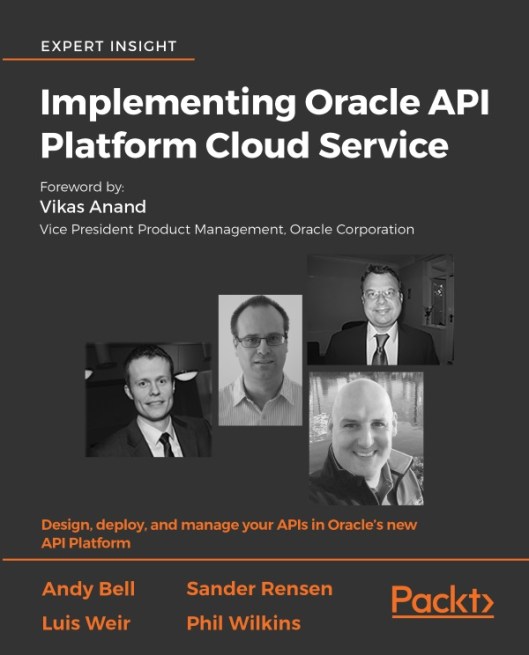
After months of labour, the arrival of new family members for a couple of the authors the Implementing Oracle API Platform Cloud Service book as finally been published. The book has been included into Packt’s Expert series so, earns(?) the privilege of having photos of the authors on the cover.  The book can be purchased directly from Packt (go here) or from book retails such as Amazon (here).


B08683_front-Coverx600

It has been an interesting experience. Whilst working as part of a team of four authors lightened the writing load, a lot more energy went into communication so things were lined up. If you want a challenge, why not read the book and try to work out who wrote which chapters!

Continue reading

Documenting APIs on the Oracle API Platform

Tags

, , , , ,

Updated reflecting changes discussed in blog post:
Making Scripts Work with IDCS Deployed PaaS

The last week or two I have been working on a new API Platform utility to add to my existing tools (see here). This tool addresses the question of generating documentation.  Much as been said about API documentation and the quality of it, check out these articles :

If you look at these articles and others, there are some common themes, which are:

  • Document the URI / payload
  • Describe error handling
  • Describe contracts such as how many API calls
  • How the API is authenticated

Apiary covers the first theme to a first class standard,  and you will see Apiary called out for its ability to document APIs in a lot of articles. Well written API Blueprints will cover the bulk of the second bullet. But the other points tend to fall outside of a Blueprint and fit more the API Policies and their use.

Not everyone is so commited or enjoys writing documentation. The other driver for going beyond the use of Apiary is that some organizations feel the need to have a traditional word style document to capture/define an API’s contract in detail. With the API Platform the management portal enables an API to be published into the developer portal with the Apiary definition and a markdown file for further documentation.

Continue reading