Packt promotion

Packt publishing undertook a survey to get a greater understanding of the tech world.  As a result they have compiled the findings into several books. In addition they have launched a new promotion …

  1. Every eBook and Video is now available for $10!.
  2. Grab some great course bundles – 5 for $25 on every Video and eBook based on your most essential skills.
  3. PacktLib with over 3000 titles in our library at a reduced rate of $80 for a limited time.

Check it all out at http://bit.ly/1JxwRUI

Oracle iPaaS news

Tags

, , , ,

On Friday I attended Estafet‘s UK leading 1st open session on Oracle Integration Cloud Service (ICS). A great session run by Phil McLoughlin from Estafet.It was good to hear people’s perspectives on the capability and value proposition.  The session included an update from the Director of Product Management James Allerton-Austin.  So aside from ICS having gone live, we can expect several more of the middleware services previously mentioned launched in the second half on 2015, including:

  • SOA Suite (possibly OSB as a discrete service)
  • Business App Developer
  • Node JS

The messaging around far faster cloud release cycles was reaffirmed again with cycles in 6-12 week time frame. For example support for REST based web services will be in the next update – so no more than a month or two from now.

In addition to this I’ve heard that if you want to have ODI in the cloud it is certified to run on the Java Cloud Service – this is no surprise given that until the full SOA cloud is available you can deploy SOA into JCS. The question is will there be a ODI cloud offering.

From AIA to SOA Suite 12c

Tags

, , , , , , , , , ,

Oracle has elected to move away from offering AIA Foundation Pack in its current form. Many of the features offered are being offered in a different packaging – predominantly SOA 12c Core Extensions, and some of the tooling which has not been heavily used will not be available in 12c.

AIA 11g Foundation Pack then it will be replaced by Oracle SOA Suite 12c Core Extensions via a SOA Suite 12c upgrade process for those who have already licensed it. The key consideration is the changes in feature availability in on premise upgrades and the ability to exploit all the tooling particularly into the SOA cloud is unlikely in the future.

Based on this we would recommended that any capabilities not offered natively in 12c should be retired from use, to remove potential issues as a result of upgrading or adopting  a  lift and shift cloud strategy. There is 1 possible caveat to this in the form of utilising the AIA canonical model, more on this  below. The sections shows how AIA capabilities have been re-aligned and you might move forwards.

A lot of the UI features have moved to products such as the Oracle Enterprise Repository (OER 12c) as a result the retirement of the Lifecycle Workbench and a few features have been retired.

Reference Process Models

Reference Process Models, are more aligned to the process of solution analysis and design. The capabilities here can be obtained from other tooling. Separating out process models from a product that is more technically aligned makes sense. We would recommend you want to look at process models in a solution independent capability – particularly as your processes maybe split across platforms and products and even between on-premise and the cloud.

Personally I have seen little use of the top down business process models wrapped up by AIA outside of prepackaged PIPs where process models have been considered they have been examined by business architects before determining by the technologists the delivery approach.

Common Objects

The canonical model piece is lost in the transition to 12c. The canonical model is presented through a series of XML Schemas and HTML documentation, so could be packaged up and continued to be used irrespective of of the SOA versioning – subject to ensuring no licensing constraint on where the schemas are applied that might prevent them being used in the SOA cloud for example.

If there are to be constraints around carrying schemas forward then a strategy of migrating to another broad canonical model such as OAGI  would be recommended. OAGI is particularly appealing given it strongly influenced AIA’s model but also their specialist domains leverage it as base definitions for example HR Open Standards.

Composite Application Validation System (CAVS)

CAVS provided a means by which it is possible to build integration tests that exercise composite components. This component could be leveraged by any Continuous Integration infrastructure. We have done this in the past before Oracle’s significant progress in adopting Maven and Hudson.

This is now part of the SOA Suite Core Extensions pack.

AIA Error Handling Framework (AIA-EH) including Resubmission Feature and Logging

This provides the common error management framework that can be extended to provide automated error handling – for example delay for a period and retry. This one of the most valuable capabilities offered in terms of functionality as it provides a unified framework on which you can do basic error trapping and retry to far more complex advanced capabilities. As part of 12c this has been advanced as well.

This is now part of the SOA Suite Core Extensions pack.

AIA Deployment Plans

Deployment plans tooling has now gone as the deployment mechanism (AID) has also been dropped. More on this below.

XSL Mapping Analyzer & reporting(XMan)

This tool provided the means to identify and understand how mappings have been customised or extended from base. This has been superseded by the Mapping Editor tooling in 12c which offers a better approach to this activity.

AIA Installation Driver & AIA Installer properties

This capability wrapped up a series of smaller WLST based processes to deploy a PIP either licensed or custom PIP. As the concept of custom PIP has been dropped in favour of a collection of composites and other artefacts as would be applied if building using just SOA Suite. The capabilities use within Specsavers’ has in the past been shown to be mixed with some people preferring the SOA deployment approach rather than the wrapped up AIA mechanism.

PIP Auditor

The PIP auditor was provided AIA 11g as a means to perform a health check on the configuration of a PIP including custom PIPs. Whilst  it is possible also include this tool into a Continuous Integration process  aide quality management it requires a lot of work to break the lengthy report into more manageable  . However this was not heavily adopted, and also not known to be used manually either, therefore the impact of not continuing its use is negligible.

Framework & Methodology

Still applicable as this is simply a set of architectural approaches utilising Oracle Middleware products such as SOA Suite

Project Life Cycle Workbench including AIA Artefact Generator

As a design tool this has been deprecated. However from a Specsavers viewpoint this has minimal impact as the workbench has not been heavily used in this form (this includes AIA Artefact Generator) as the elements can be generated manually by SOA during the development process.

As the above diagram shows, the life cycle processes are all underpinned by the development process itself.

With respect to the deployment of artefacts such as composites,DVMs etc this is still available through standard SOA mechanisms such WLST. Viewing deployed artefacts can still be done through various management consoles.

Oracle PaaS

Tags

, ,

So 22nd June saw Larry Ellison announce a raft of new Oracle cloud services, and the beefing up of some existing services.  Based on what he said, Oracle are about to seriously go to war with a number of major players. So much so one of Gartner’s analysts tweeted that they see something of a shakeup in the market. Not only as Oracle has the delivery muscle, but based on figures Larry presented also on price – Oracle’s Cloud Archive offering which is being aimed at Amazon Web Services’ Glacier was quoted at a 1/10th of the price!  Okay, we need to see all the costs, but the headline numbers are sounding extremely competitive.

In terms of service that I’m looking forward to have a play with are:

  • Node.JS
  • Java Standard Edition
  • Java Cloud (aka Weblogic) with SOA deployed
  • JRuby
  • Simple Business Application Builder

Not all of these service are openly accessible yet, or offer Trial periods, but the access is only a matter of time now.

This little list doesn’t even touch on the IaaS or SaaS.

Oracle IT Strategies and logging 

Tags

, , , , , , , , , , , ,

So I have an objective to get myself certified as an Oracle Technical Architect. Although the training is only open to Oracle and Partners, the exam is open to all.  As you may have guessed from my blog posts I use a lot of Oracle technology. However the Technical Architect examination is based  largely on Oracle’s IT Strategies library, and usually referred to as ITSO. Before non-Oracle users switch off, the ITSO is actually built around presenting solid good solution agnostic practises, and only once that is laid out does the material overlay Oracle products. So at least 75% percent of the material applies regardless of the vendor (yes cynics will say the practises will naturally lead you to products – but hey someone has to be bad guy).  This actually makes it a worthwhile accreditation – as far as any accreditation can go (no I’ve not done a detailed comparison against Open Group’s Certified Architect – very expensive or the BCS accreditation – bound to BCS membership). TOGAF gives your framework, processes, means to communicate, and the ITSO does well at explaining the technical considerations and could be mapped onto the TOGAF Technical Reference Model (TRM) and Standards Information Base (SIB).

The point, I wanted to get across was in the ITSO is an element on Management and Monitoring (E16583-03 if you want the document reference on the Oracle Technology Network). It makes a lot of really good points about monitoring challenges such as bottom up approach where people monitor the parts of the full capability that they’re responsible for, rather than developing monitoring from a business perspective. The rationale for adopting the business based approach is explained (this is not to say you don’t go  into the technical measures & monitors of looking at your infrastructure, databases, services etc. But from the business approach you will capture the information to understand reporting from a user perspective which is how you’ll here about issues.  Through your detailed monitoring decomposition to get the right specific data points you can then look at correlation of monitoring data for root cause analysis, but also see and .

What the I think the document misses, or at least underemphasises is the ever increasing importance of the monitoring and logging of what is happening as systems and environments become ever more elastic and self managing, and have as IBM call it  autonomics. or self healing, self scaling characteristics. So consider trying to diagnose a problem when a user complains of intermittent performance issues, but you have Kubernetes or another tool scaling up your environment for a period and then back down.  Only through measuring from a business context will you able to understand when the user might perceive performance as an issue. Then with  excellent logging and audit data as to what components are doing at all levels – so services maybe behaving perfectly but your scaling mechanisms are scaling back too soon.

This leads to another consideration, for those organisations that absolutely committed to idea of self healing and proving in resilience production, as the famous Netflix Chaos Monkey does. You need to be able to correlate the monkey’s activities to what is happening in your environment. Has the monkey uncovered an issue that manifests in a manner you hadn’t expected and as a result your user see intermittent issues.

This all leads me to a rather good presentation from Jimmi Dyson at RedHat who showed the simple value of ensuring you can get semantic meaning from logging. As that means you and slice and dice the information to get understanding of what is happening and lead to root cause. In Oracle land Oracle Enterprise Manage (OEM) is ensuring the semantic understanding when it come to known products.
I’ve meandered a bit, so key points  consider ITSO or any other vendor equivalent for sources of good practise. Monitor and measure from a business perspective, but still ensure your collecting detailed semantically meaningful metrics.

Oracle SOA Components

Tags

, , , ,

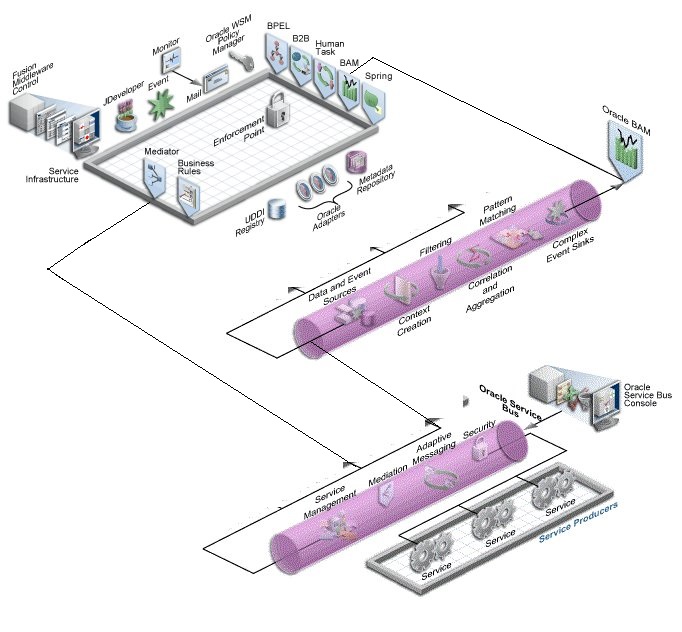
Understanding all the different elements available to you with Oracle SOA Suite can be a little tricky to say the least as the often the building blocks available are shown in diagrams like:

They say a picture says a thousand words. But, those thousand words can omit some details.  Take this diagram for example, it only reflects the common elements in the main SOA server. But within the SOA license you also have Oracle Service Bus (OSB) and the Complex Event Processing (CEP) engine which run as separate servers.  Which means you’d see the following:

as shown in http://docs.oracle.com/cd/E28280_01/doc.1111/e10223/04_osb.htm

Oh, but hang on; we still haven’t got a representation of JMS, and Coherence.  JMS like CEP and OSB actually instantiates as a separate server as well.  So got a handle on everything now?  Well there is a little confusion still needing to be added to the mix.  The following diagram is commonly used showing interoperability with other products with separate licenses:

Taking the above diagram at face value, you could interpret things as actually you don’t have the CEP capability as it is the key part of the Oracle Event Driven Architecture Suite.

I have merged together the diagrams to show the bulk of all the SOA stack that comes into the main SOA license. As you can see ….

gs_1

Microservices in a COTs and SaaS world

Tags

, , , , , ,

Moving my recent blogs on Microservices (Microservices & UIMicroservices) forward a bit further as a result of discussing the ins and outs of using the paradigm. Microservices as the very name suggests is the polar opposite of most COTs and particularly ERP solutions which are pretty much modularised monoliths.

It raises the question of can Microservice Architecture (MSA) deliver any benefit in this situation where buy dominates over build. I believe the answer is to an extend yes. Many consider MSA to be SOA++ although I’m not sold on this MSA does exhibit what has been referred to as Service Oriented Integration (SOI) characteristics. That is the key is not the pure service ideas that you would get if you applied the recommendations of Thomas Erl.

The difference between SOI and SOA is that SOI focuses on things like interface contracts and pulling components together (regardless of whether they embody SOA ideals). Where as SOA focuses more on the business process and capability composition. How components are pulled together is an area where MSA has a strong position.

Where SOA and to an extent SOI would need an ESB (or ESB like) platform to perform the business rules and decisioning we should be keeping the intelligence out of the ESB. You will probably still want an ESB or event registration framework so that all services can register to receive events and react as necessary – I.e. Pure pub-sub model.

One of the SOA patterns for dealing with monoliths was to promote the idea of wrapping such services with a SOA abstraction tier so that you can replace the ERP, build out custom capabilities etc.  does this hold true friends a MSA approach. I would suggest yes, but rather than the purity of SOA the abstraction should be aiming for the goals of SOI and simplification both in the ERP interaction, but also moving orchestration intelligence out of an ESB into the services.  You can seen a Genesis of this potential with Oracle’s Cloud Adapters whose base framework aims to simplify the integration.

So what might be he benefit of building the Microservice layer?  We know MSA exchanges code complexity in the service for agility in service delivery. But when there is a monolith behind the services do you gain anything?  The answer is potentially, but will be very dependent on the monolith and ESB. For example if you can actually patch your monolith quickly and easily I.e it doesn’t have  huge dependency chains and deployment capabilities such as Oracle EBZ 12.2 includes improved deployment framework that reduces or removes downtime. Like wise if the middleware is exploiting the best of SCA (as offered by Oracle SOA Suite) and or an OSGi container such as Apache Karaf then the benefits start to become more marginal. It becomes more a devil you know style of debate.

Microservice UI Positioning

Tags

, , , , ,

Last week I was fortunate enough to attend RedHat’s day in London on Microservices. There were some great presentations and some ideas that are both simple and potentially very effective. It wasn’t a simple Microservices solves everything get into out tech stack, there was some reality checks as well.

The challenge I have been unable to square up yet, is the idea that each Microservices would have its own UI.  On the surface, it makes a lot of sense, after all the UI needs to reflect the capabilities of the service.

The challenge comes in the form, that a User Interface needs to have consistency across the board. Yes, many will immediately point to CSS., which undeniably provide a level of consistency. But UI needs run a lot deeper. Let me point out a couple of illustrations of this:

  • Recent switch to web interfaces reflecting the new ‘flat’ visual format
  • Adoption of app on a page through AngularJS
  • Lots of illustrations can be seen at elegant Theme

This goes beyond CSS3 in many cases, but the libraries being used – so impacting development. Now here is the rub, the backend service functionality won’t change but the UI implementation will and needs to be deployed consistently across the board in one go for B2B and critically for B2C. You can destroy a good product with a poor UI and sell a rubbish app with a good one. All of which would mean deploying updated all Microservices at once if they embody the UI. The linking of all the Microservices like this is completely contrary to the goals of agility driven the Microservices strategy.

Add to this, the Microservices approach promotes a DevOps approach, yet organisations may only employ 1 or 2 real user experience specialists rather than  try and spread them across multiple service teams it maybe better to focus them into one or two service teams that just build the UI.

Which kind of leads me to the argument that I would suggest that your UI is a separate service or small group of services to the core functional side of things. So those PR driven website overhauls, and revisions to match user experience expectations can be done without impacting the core capabilities, demanding a total regression test and locking your entire set of services into a unified release cycle.

Citizen Integrators – Excel for Integration?

Tags

, , , , , , , , , ,

Over the last year or so I have been looking a lot at technologies that Gartner and others have branded as ‘Citizen Integrators‘ – products such as Dell Boomi, and the recently launched Oracle Integration Cloud Service.  What I believe we are seeing is the appearance of a product family that in many respects will be to Integration what Excel has been to Finance systems.  This is to say that Finance Systems such as large ERPs tend to be changed slowly when it comes to introducing process changes, but users can get reports easily to extract data into their Excel spreadsheets.  We have the old joke that organisations finance can end up being run on Excel (http://www.wired.com/2014/03/many-spreadsheets-take-run-fortune-500-company/).

So don’t get me wrong,  I’m not saying these tool are evil and should be banned or the such like, as such thinking is utter folly.  I am looking at the quote much attributed to Spiderman (Stan Lee) but has been traced back to Voltaire:

With great power comes great responsibility

Why do I use this quote, well my experience (and that established by many others) is that with ease and agility comes a quick answer rather than a well thought out answer. That ease can be through cost (how many times have organisations discovered key systems solutions being run off someone’s desktop stuffed away in the corner of an office because they have been able to cheaply acquire the hardware and software get setup and then had viral adoption).

cityIt is therefore beholden on those of us that understand the challenges of integration should be seeking to help our ‘citizens’ appreciate (not lecture, brow beat etc) the implications and some intelligent governance to ensure systems are not accidentally ‘poisoned with unexpected data’ and you don’t fall foul of legal obligations.

The biggest challenge, is for SME’s to ensure that their colleagues within the IT organisation who face into the business organisation understand and promote the right thinking. After all, developers and architects alike, think like all drivers -that they’re at least above average if not good drivers – after all why would we be in the job?  But to set the average we can’t all be in that place (http://www.psychologicalscience.org/index.php/news/motr/when-it-comes-to-driving-most-people-think-their-skills-are-above-average.html).

This of course also touches upon the arguments with Gartner’s bi-modal approach to IT, such as those presented by Jason Bloomberg. Personally I believe pace layering is right, but bi-modal thinking can create opportunities for things to be done badly – not an absolute certainty, but to work needs some strong hands trusted by organisational executives to steer successfully – something that  seems rather rare.

Do we really need a an app for everything?

Tags

, , ,

It is fascinating despite the fact that HTML5 and CSS3 give us very good user experience, when it comes solutions that largely push or marketing channels where caching has limited benefit there is still the ever growing perceived need to produce mobile apps. There are some great images which compares  Facebook as an app vs Facebook as a web app.

 So, if the labels didn’t give the game away then, you’d be looking for the tell tail signs of the browser – icons at the bottom of the page.
So the question begs, why build the mobile app and the mobile capable web app?  The argument that the web app requires less traffic as you’re not downloading all he graphics has only limited credence as you have to pull all of this down with the app to start with. The browser will cache a lot of the content if you let it. Good web apps will make use of AJAX or Sockets to ensure only necessary content is retrieved so your download is going to be limited.  The offline argument doesn’t work as you’re trying to provide current content.

To be honest, I think a lot of the answer comes down to a couple of simple factors:

  •  is rather simple, a mobile app will find it easier to retrieve more information about the user
  • There is the mentality of I’m not a ‘digital’ player if I don’t have an app, and who isn’t going to challenge this?

So should we be pushing for OS providers to make it easier to install launch icons from your device (it is do able already but not in your face obvious).  But also allow web apps that are designed to work well on mobile devices to be certified and listed within their stores. Perhaps even offer a configuration shell that setups a desktop link as if an app has been downloaded.

Doing so should take the burden off the app stores! may not benefit beyond a small download bandwidth, but has to be good news for Apple and others.