
• Home
  • Site Aliases
    • www.cloud-native.info
  • About
    • Background
    • Presenting Activities
    • Internet Profile
      • LinkedIn
    • About
  • Books & Publications
    • Log Generator
    • Logs and Telemetry using Fluent Bit
      • Fluent Bit book
      • Book Resources in GitHub
      • Fluent Bit Classic to YAML Format configurations
    • Logging in Action with Fluentd, Kubernetes and More
      • Logging in Action with Fluentd – Book
      • Fluentd Book Resources
      • Fluentd & Fluent Bit Additional stuff
    • API & API Platform
      • API Useful Resources
    • Oracle Integration
      • Book Website
      • Useful Reading Sources
    • Publication Contributions
  • Resources
    • GitHub
    • Oracle Integration Site
    • Oracle Resources
    • Mindmaps Index
    • Useful Tech Resources
      • Fluentd & Fluent Bit Additional stuff
      • Recommended Tech Podcasts
      • Official Sources for Product Logos
      • Java and Graal Useful Links
      • Python Setup & related stuff
  • Music
    • Monster On Music
    • Music Listening
    • Music Reading

Phil (aka MP3Monster)'s Blog

~ from Technology to Music

Phil (aka MP3Monster)'s Blog

Monthly Archives: October 2025

MCP Security

30 Thursday Oct 2025

Posted by mp3monster in AI, development, General, Technology

≈ Leave a comment

Tags

AI, artificial-intelligence, attack, attacks, cybersecurity, MCP, model context protocol, Paper, Security, Technology, vectors

MCP (Model Context Protocol) has really taken off as a way to amplify the power of AI, providing tools for utilising data to supplement what a foundation model has already been trained on, and so on.

With the rapid uptake of a standard and technology that has been development/implementation led aspects of governance and security can take time to catch up. While the use of credentials with tools and how they propagate is well covered, there are other attack vectors to consider. On the surface, it may seem superficial until you start looking more closely. A recent paper Model Context Protocol (MCP): Landscape, Security Threats, and Future Research Directions highlights this well, and I thought (even if for my own benefit) to explain some of the vectors.

I’ve also created a visual representation based on the paper of the vectors described.
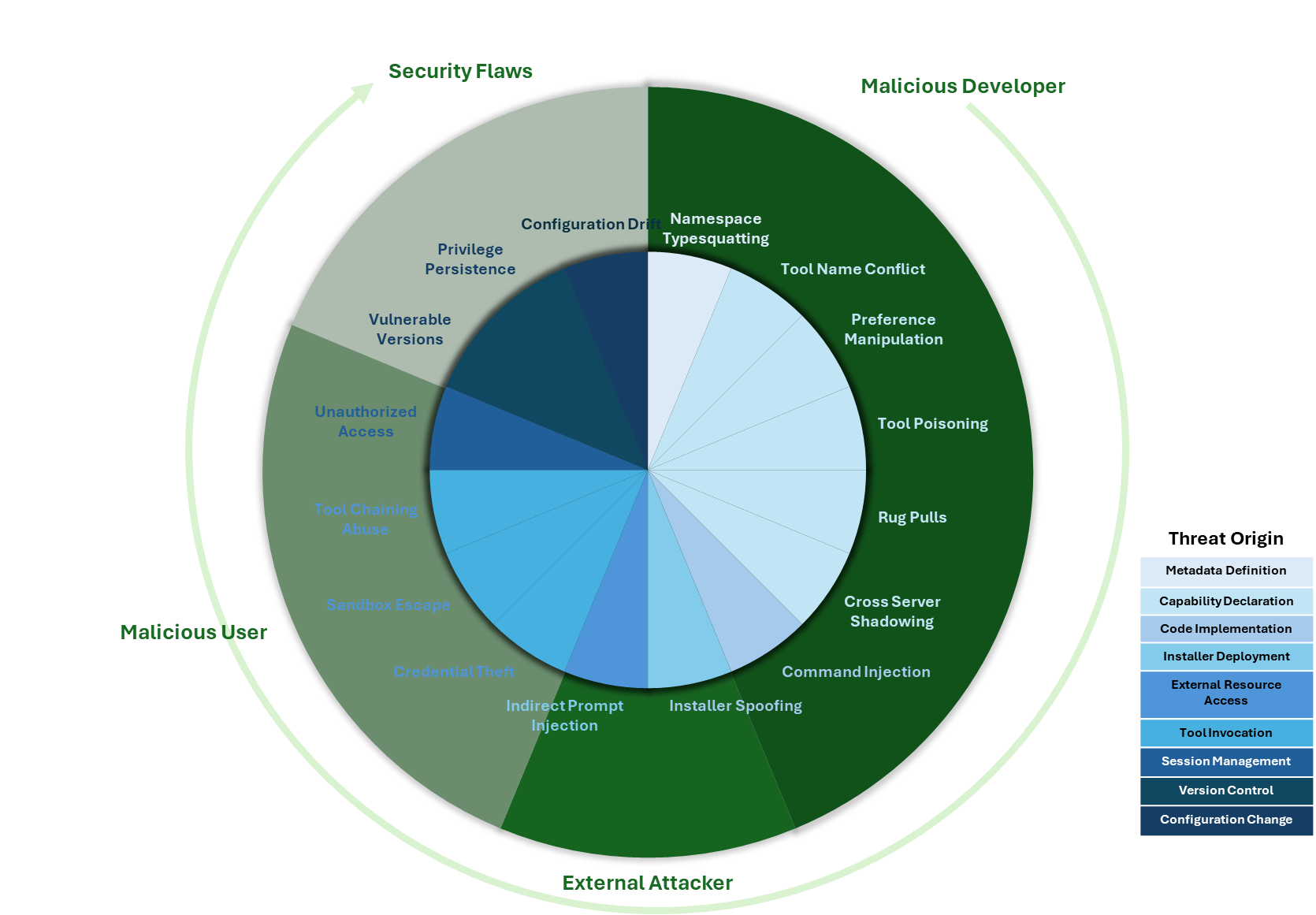
The inner ring represents each threat, with its color denoting the likely origin of the threat. The outer ring groups threats into four categories, reflecting where in the lifecycle of an MCP solution the threat could originate.

I won’t go through all the vectors in detail, though I’ve summarized them below (the paper provides much more detail on each vector). But let’s take a look at one or two to highlight the unusual nature of some of the issues, where the threat in some respects is a hybrid of potential attack vectors we’ve seen elsewhere. It will be easy to view some of the vectors as fairly superficial until you start walking through the consequences of the attack, at which point things look a lot more insidious.

Several of the vectors can be characterised as forms of spoofing, such as namespace typosquatting, where a malicious tool is registered on a portal of MCP services, appearing to be a genuine service — for example, banking.com and bankin.com. Part of the problem here is that there are a number of MCP registries/markets, but the governance they have and use to mitigate abuse varies, and as this report points out, those with stronger governance tend to have smaller numbers of services registered. This isn’t a new problem; we have seen it before with other types of repositories (PyPI, npm, etc.). The difference here is that the attacker could install malicious logic, but also implement identity theft, where a spoofed service mimics the real service’s need for credentials. As the UI is likely to be primarily textual, it is far easier to deceive (compared to, say, a website, where the layout is adrift or we inspect URIs for graphics that might give clues to something being wrong). A similar vector is Tool Name Conflict, where the tool metadata provided makes it difficult for the LLM to distinguish the correct tool from a spoofed one, leading the LLM to trust the spoof rather than the user.

Another vector, which looks a little like search engine gaming (additional text is hidden in web pages to help websites improve their search rankings), is Preference Manipulation Attacks, where the tool description can include additional details to prompt the LLM to select one solution over another.

The last aspect of MCP attacks I wanted to touch upon is that, as an MCP tool can provide prompts or LLM workflows, it is possible for the tool to co-opt other utilities or tools to action the malicious operations. For example, an MCP-provided prompt or tool could ask the LLM to use an approved FTP tool to transfer a file, such as a secure token, to a legitimate service, such as Microsoft OneDrive, but rather than an approved account, it is using a different one for that task. While the MCP spec says that such external connectivity actions should have the tool request approval, if we see a request coming from something we trust, it is very typical for people to just say okay without looking too closely.

Even with these few illustrations, tooling interaction with an LLM comes with deceptive risks, partially because we are asking the LLM to work on our behalf, but we have not yet trained LLMs to reason about whether an action’s intent is in the user’s best interests. Furthermore, we need to educate users on the risks and telltale signs of malicious use.

Attack Vector Summary

The following list provides a brief summary of the attack vectors. The original paper examines each in greater depth, illustrating many of the vectors and describing possible mitigation strategies. While many technical things can be done. One of the most valuable things is to help potential users understand the risks, use that to guide which MCP solutions are used, and watch for signs that things aren’t as they should be.

Continue reading →
Share this:

  • Click to share on Facebook (Opens in new window) Facebook
  • Click to share on X (Opens in new window) X
  • Click to share on Pocket (Opens in new window) Pocket
  • Click to share on Reddit (Opens in new window) Reddit
  • Click to email a link to a friend (Opens in new window) Email
  • Click to share on WhatsApp (Opens in new window) WhatsApp
  • Click to print (Opens in new window) Print
  • Click to share on Tumblr (Opens in new window) Tumblr
  • Click to share on Mastodon (Opens in new window) Mastodon
  • Click to share on Pinterest (Opens in new window) Pinterest
  • More
  • Click to share on Bluesky (Opens in new window) Bluesky
  • Click to share on LinkedIn (Opens in new window) LinkedIn
Like Loading...

AI to Agriculture

17 Friday Oct 2025

Posted by mp3monster in General, Oracle, Technology

≈ Leave a comment

Tags

AI, artificial-intelligence, Cloud, development, Oracle, Technology

Now that details of the product I’ve been involved with for the last 18 months or so are starting to reach the public domain  (such as the recent announcement at the UN General Assembly on September 25), I can talk to a bit about what we’ve been doing.  Oracle’s Digital Government Global Industry Unit has been working on a solution that can help governments address the questions of food security.

So what is food security?  The World Food Programme describes it as:

Food security exists when people have access to enough safe and nutritious food for normal growth and development, and an active and healthy life. By contrast, food insecurity refers to when the aforementioned conditions don’t exist. Chronic food insecurity is when a person is unable to consume enough food over an extended period to maintain a normal, active and healthy life. Acute food insecurity is any type that threatens people’s lives or livelihoods.

World Food Programme

By referencing the World Food Programme, it would be easy to interpret this as a 3rd world problem. But in reality, it applies to just about every nation. We can see this, with the effect the war in Ukraine has had on crops like Wheat, as reported by organizations such as CGIAR, European Council, and World Development journal. But global commodities aren’t the only driver for every nation to consider food security. Other factors such as Food Miles (an issue that perhaps has been less attention over the last few years) and national farming economics (a subject that comes up if you want to it through a humour filter with Clarkson’s Farm to dry UK government reports and US Department of Agriculture.

Looking at it from another perspective, some countries will have a notable segment of their export revenue coming from the production of certain crops.  We know this from simple anecdotes like ‘for all the tea in China’, coffee variants are often referred to by their country of origin (Kenyan, Columbian etc.). For example, Palm Oil is the fourth-largest economic contributor in Malaysia (here). 

So, how is Oracle helping countries?

One of the key means of managing food security is understanding food production and measuring the factors that can impact it (both positively and negatively), which range from the obvious—like weather (and its relationship to soil, water management, etc.) —to what crop is being planted and when. All of which can then be overlayed with government policies for land management and farming subsidies (paying farmers to help them diversify crops, periodically allowing fields to go fallow, or subsidizing the cost of fertilizer).

Oracle is a technology company capable of delivering systems that can operate at scale. Technology and the recent progress in using AI to help solve problems are not new to agriculture; in fact, several trailblazing organizations in this space run on Oracle’s Cloud (OCI), such as Agriscout. Before people start assuming that this is another story of a large cloud provider eating their customers’ lunch, far from it, many of these companies operate at the farm or farm cooperative level, often collecting data through aerial imagery from drones and aircraft, along with ground-based sensors.  Some companies will also leverage satellite imagery for localized areas to complement these other sources. This is where Oracle starts to differentiate itself – by taking high-resolution imagery (think about the resolution level needed to differentiate Wheat and Maize, or spot rice and carrots, differentiate an orchard from a natural copse of trees). To get an idea, look at Google Earth and try to identify which crops are growing.

We take the satellite multi-spectral images from each ‘satellite over flight’ and break it down, working out what the land is being used for (ruling out roads, tracks, buildings, and other land usage).  To put the effort to do this into context, the UK is 24,437,600,000 square meters and is only 78th in the list of countries by area (here).  It’s this level of scale that makes it impractical to use more localized data sources (imagine how many people and the number of drones needed to fly over every possible field in a country, even at a monthly frequency).

This only solves the 1st step of the problem, which is to tell us the total crop growing area.  It doesn’t tell us whether the crop will actually grow well and produce a good yield.  For this, you’re going to need to know about weather (current, forecast, and historic trends), soil chemical composition and structure, and information such as elevation, angle, etc. Combined with an understanding of optimal crop growing needs (water levels, sun light duration, atmospheric moisture, soil types and health) – good crops can be ruined by it simply being too wet to harvest them, or store them dryly.  All these factors need to be taken into account for each ‘cell’ we’re detecting, so we can calculate with any degree of confidence what can be produced.

If this isn’t hard enough, we need to account for the fact that some crops may have several growing seasons per year, or succession planting is used, where Carrots may be grown between March and June, followed by Cucumbers through to August, and so on.

Using technology

Hopefully, you can see there are tens of millions of data points being processed every day, and Oracle’s data products can handle that. As a cloud vendor, we’re able to provide the computing scale and, importantly, elasticity, so we can crunch the numbers quickly enough that users benefit from the revised numbers and can work out mitigation actions to communicate to farmers. As mentioned, this could be planning where to best use fertilizer or publishing advice on when to plant which crops for optimal growing conditions. In the worst cases recognizing there is going to be a national shortage of a staple crop and start purchasing crops from elsewhere and ensure when the crops arrive in ports they get moved out to the markets  (like all large operations – as we saw with the Covid crises – if you need to react quickly, more mistakes can be made, costs grow massively driven by demand).

I mentioned AI, if you have more than the most superficial awareness of AI, you will probably be wondering how we use it, and the problems of AI hallucination – the last thing you want is a being asked to evaluate something and hallucinating (injecting data/facts that are not based on the data you have collected) to create a projection.  At worst, this would mean providing an indication that everything is going well, when things are about to really go wrong.  So, first, most of the AI discussed today is generative, and that is where we see issues like hallucinations.  We’re have and are adopting this aspect of AI where it fits best, such as explainability and informing visualization, but Oracle is making heavy use of the more traditional ideas of AI in the form of Machine Learning and Deep Learning which are best suited to heavy numerical computational uses, that is not to say there aren’t challenges to be ddressed with training the AI.

Conclusion

When it comes to Oracle’s expertise in the specialized domains of agriculture and government, Oracle has a strong record of working with governments and government agencies from its inception. But we’ve also worked closely with the Tony Blair Institute for Global Change, which works with many national government agencies, including the agriculture sector.

My role in this has been as an architect, focused primarily on applying integration techniques (enabling scaling and operational resilience, data ingestion, and how our architecture can work as we work with more and more data sources) and on applying AI (in the generative domain). We’re fortunate to be working alongside two other architects who cover other aspects of the product, such as infrastructure needs and the presentation tier. In addition, there is a specialist data science team with more PhDs and related awards than I can count.

Oracle’s Digital Government business is more than just this agriculture use case; we’ve identified other use cases that can benefit from the data and its volume being handled here. This is in addition to bringing versions of its better-known products, such as ERP, Healthcare (digital health records management, vaccine programmes, etc.), national Energy and Water (metering, infrastructure management, etc).

For more on the agricultural product:

  • Government Data Intelligence for Agriculture
  • Agriculture on the Digital Government page
  • TBI on Food Security
  • iGrow News
  • Oracle Launches AI Platform to Strengthen Government Led Agricultural Resilience – AgroTechSpace

Share this:

  • Click to share on Facebook (Opens in new window) Facebook
  • Click to share on X (Opens in new window) X
  • Click to share on Pocket (Opens in new window) Pocket
  • Click to share on Reddit (Opens in new window) Reddit
  • Click to email a link to a friend (Opens in new window) Email
  • Click to share on WhatsApp (Opens in new window) WhatsApp
  • Click to print (Opens in new window) Print
  • Click to share on Tumblr (Opens in new window) Tumblr
  • Click to share on Mastodon (Opens in new window) Mastodon
  • Click to share on Pinterest (Opens in new window) Pinterest
  • More
  • Click to share on Bluesky (Opens in new window) Bluesky
  • Click to share on LinkedIn (Opens in new window) LinkedIn
Like Loading...

Fluent Bit 4.1 what to be excited about in this major release?

10 Friday Oct 2025

Posted by mp3monster in Fluentbit, General, Technology

≈ Leave a comment

Tags

4.1, Fluent Bit, Fluentbit, release

Fluent Bit version 4’s first major release dropped a couple of weeks ago (September 24, 2025). The release’s feature list isn’t as large as 4.0.4 (see my blog here). It would therefore be easy to interpret the change as less profound. But that isn’t the case. There are some new features, which we’ll come to shortly, but there are some significant improvements under the hood.

Under the hood

Fluent Bit v4.1 has introduced significant enhancements to its processing capabilities, particularly in the handling of JSON. This is really important as handling JSON is central to Fluent Bit. As many systems are handling JSON, there is at the lowest levels, continuous work happening in different libraries to make it as fast as possible. Fluent Bit has amended its processing to use a mechanism based on a yyjson, without going into the deep technical details. If you examine the benchmarking of yyjson and other comparable libraries, you’ll see that its throughput is astonishing. So accelerating processing by even a couple of percentage points can have a profound performance enhancement.

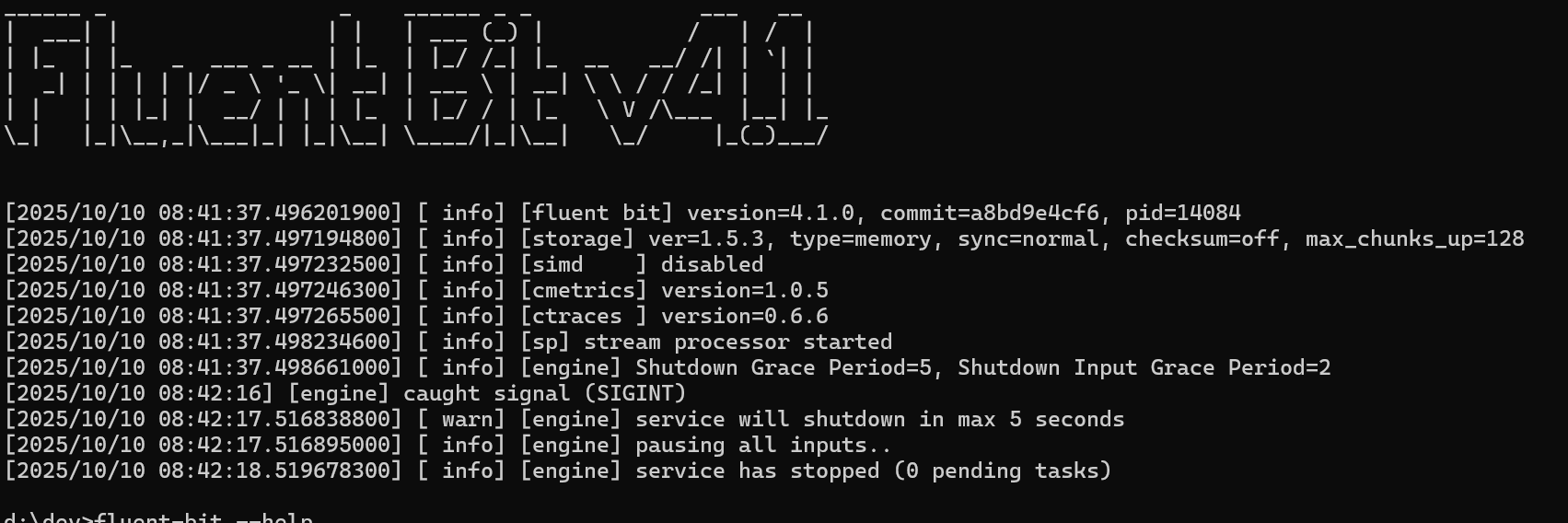
The next improvement in this area is the use of SIMD (Single Instruction, Multiple Data). This is all about how our code can exploit microprocessor architecture to achieve faster processing. As logs often need characters like new line, quotes, and other special characters encoding, and logs often carry these characters (and we tend to overlook this – consider a stack trace, where each step of the stack chain is provided on a new line, or embedding a stringified XML or JSON block in the log, which will hve multiple uses of quotes etc. As a result, any optimization of string encoding will quickly yield performance benefits. As SIMD takes advantage of CPU characteristics, not every build will have the feature. You can check to see if SIMD is being used by checking the output during startup, like tthis:

This build for Windows x86-64 as shown in the 3rd info statement doesn’t have SIMD enabled.

Other backend improvements have been made with TLS handling. The ability to collect GPU metrics with AMD hardware (significant as GPUs are becoming ever more critical not only in large AI arrays, but also for AI at the edge).

So, how do we as app developers benefit?

If Fluent Bit’s performance improves, we benefit from reduced risk of backpressure-related issues. We can either complete more work with the same compute (assuming we’re at maximum demand all the time), or we can reduce our footprint – saving money either as capital expenditure (capex) or operational expenditure (opex) (not something that most developers are typically seeking until systems are operating at hyperscale). Alternatively, we can further utilize Fluent Bit to make our operational life easier, for example, by reducing sampling slightly, implementing additional filtering/payload load logic, and streaming to detect scenarios as they occur rather than bulk processing on a downstream platform.

Functional Features

In terms of functionality, which as a developer we’re very interested in as it can make our day job easier, we have a few features.

AWS

In terms of features, there are a number of enhancements to support AWS services. This isn’t unusual; as the AWS team appears to have a very active and team of contributors for their plugins. Here the improvement is for supporting Parquet files in S3.

Supervisory Process

As our systems go ever faster, and become more complex, particularly when distributed it becomes harder to observe and intervene if a process appears to fail or worse becomes unresponsive. As a result, we need tools to have some ‘self awareness’. Fluen bit introduces the idea of an optional supervisor process. This is a small, relatively simple process that spawns the core of Fluent Bit and has the means to check the process and act as necessary. To enable the supervisor , we can add to the command line –supervisor. This feature is not available on all platforms, and the logic should report back to you during startup if you can’t use the feature. Unfortunately, the build I’m trying doesn’t appear to have the supervisor correctly wired in (it returns an error message saying it doesn’t recognize the command-line parameter).

If you want to see in detail what the supervisor is doing – you can find its core in /src/flb_supervisor.c with the supervisor_supervise_loop function, specifically.

Conclusion

With the number of differently built and configured systems, we’ll see a 4.1.x releases as these edge case gremlins are found and resolved.

Share this:

  • Click to share on Facebook (Opens in new window) Facebook
  • Click to share on X (Opens in new window) X
  • Click to share on Pocket (Opens in new window) Pocket
  • Click to share on Reddit (Opens in new window) Reddit
  • Click to email a link to a friend (Opens in new window) Email
  • Click to share on WhatsApp (Opens in new window) WhatsApp
  • Click to print (Opens in new window) Print
  • Click to share on Tumblr (Opens in new window) Tumblr
  • Click to share on Mastodon (Opens in new window) Mastodon
  • Click to share on Pinterest (Opens in new window) Pinterest
  • More
  • Click to share on Bluesky (Opens in new window) Bluesky
  • Click to share on LinkedIn (Opens in new window) LinkedIn
Like Loading...

Design of Web APIs – 2nd Edition

06 Monday Oct 2025

Posted by mp3monster in APIs & microservices, Books, General, Technology

≈ Leave a comment

Tags

API, API Evangelist, APIHandyman, AsyncAPI, book, development, OAS, Open API, practises, review, Swagger

When it comes to REST-based web APIs, I’ve long been an advocate of the work of Arnaud Lauret (better known as the API Handyman) and his book The Design of Web APIs. I have, with Arnaud’s blessing, utilized some of his web resources to help illustrate key points when presenting at conferences and to customers on effective API design. I’m not the only one who thinks highly of Arnaut’s content; other leading authorities, such as Kin Lane (API Evangelist), have also expressed the same sentiment. The news that a 2nd Edition of the book has recently been published is excellent. Given that the 1st edition was translated into multiple languages, it is fair to presume this edition will see the same treatment (as well as having the audio treatment).

Why 2nd Edition?

So, why a second edition, and what makes it good news? While the foundational ideas of REST remain the same, the standard used to describe and bootstrap development has evolved to address practices and offer a more comprehensive view of REST APIs. Understanding the Open API specification in its latest form also helps with working with the Asynchronous API specifications, as there is a significant amount of harmony between these standards in many respects.

The new edition also tackles a raft of new considerations as the industry has matured, from the use of tooling to lint and help consistency as our catalogue of APIs grows, to be able to use linting tools, we need guidelines on how to use the specification, and what we might want to make uniform nd ensure the divergence is addressed. Then there are the questions about how to integrate my API support / fit into an enriched set of documents and resources, such as those often offered by a developer portal.

However, the book isn’t simply a guide to Open API; the chapters delve into the process of API design itself, including what to expose and how to expose it. How to make the APIs consistent, so that a developer understanding one endpoint can apply that understanding to others. For me, the book shows some great visual tools for linking use cases, resources, endpoint definitions, and operations. Then, an area that is often overlooked is the considerations under the Non-Functional Requirements heading, such as those that ensure an API is performant/responsive, secure, supports compatibility (avoiding or managing breaking changes), and clear about how it will respond in ‘unhappy paths’. Not to mention, as we expand our API offerings, the specification content can become substantial, so helping to plot a way through this is excellent.

Think You Know API Design

There will be some who will think, ‘Hey, I understand the OpenAPI Specification; I don’t need a book to teach me how to design my APIs.’ To those, I challenge you to reconsider and take a look at the book. The spec shows you how to convey your API. The spec won’t guarantee a good API. The importance of good APIs grows from an external perspective – it’s a way to differentiate your service from others. When there is competition, and if your API is complex to work with, developers will fight to avoid using it. Not only that, in a world where AI utilizes protocols like MCP, having a well-designed, well-documented API increases the likelihood of an LLM being able to reason and make calls to it.

Conclusion

If there is anything to find fault with – and I’m trying hard, is it would be it would have been nice if it expanded its coverage a little further to Asynchronous APIs (there is a lot of Kafka and related tech out there which could benefit from good AsyncAPI material) and perhaps venture further into how we can make it easier to achieve natural language to API (NL2API) for use cases like working with MCP (and potentially with A2A).

  • Amazon UK
  • Amazon US
  • Manning Direct
  • Barnes & Noble

Share this:

  • Click to share on Facebook (Opens in new window) Facebook
  • Click to share on X (Opens in new window) X
  • Click to share on Pocket (Opens in new window) Pocket
  • Click to share on Reddit (Opens in new window) Reddit
  • Click to email a link to a friend (Opens in new window) Email
  • Click to share on WhatsApp (Opens in new window) WhatsApp
  • Click to print (Opens in new window) Print
  • Click to share on Tumblr (Opens in new window) Tumblr
  • Click to share on Mastodon (Opens in new window) Mastodon
  • Click to share on Pinterest (Opens in new window) Pinterest
  • More
  • Click to share on Bluesky (Opens in new window) Bluesky
  • Click to share on LinkedIn (Opens in new window) LinkedIn
Like Loading...

    I work for Oracle, all opinions here are my own & do not necessarily reflect the views of Oracle

    • About
      • Internet Profile
      • Music Buying
      • Presenting Activities
    • Books & Publications
      • Logging in Action with Fluentd, Kubernetes and More
      • Logs and Telemetry using Fluent Bit
      • Oracle Integration
      • API & API Platform
        • API Useful Resources
        • Useful Reading Sources
    • Mindmaps Index
    • Monster On Music
      • Music Listening
      • Music Reading
    • Oracle Resources
    • Useful Tech Resources
      • Fluentd & Fluent Bit Additional stuff
        • Logging Frameworks and Fluent Bit and Fluentd connectivity
        • REGEX for BIC and IBAN processing
      • Java and Graal Useful Links
      • Official Sources for Product Logos
      • Python Setup & related tips
      • Recommended Tech Podcasts

    Oracle Ace Director Alumni

    TOGAF 9

    Logs and Telemetry using Fluent Bit


    Logging in Action — Fluentd

    Logging in Action with Fluentd


    Oracle Cloud Integration Book


    API Platform Book


    Oracle Dev Meetup London

    Blog Categories

    • App Ideas
    • Books
      • Book Reviews
      • manning
      • Oracle Press
      • Packt
    • Enterprise architecture
    • General
      • economy
      • ExternalWebPublications
      • LinkedIn
      • Website
    • Music
      • Music Resources
      • Music Reviews
    • Photography
    • Podcasts
    • Technology
      • AI
      • APIs & microservices
      • chatbots
      • Cloud
      • Cloud Native
      • Dev Meetup
      • development
        • languages
          • java
          • node.js
      • drone
      • Fluentbit
      • Fluentd
      • logsimulator
      • mindmap
      • OMESA
      • Oracle
        • API Platform CS
          • tools
        • Helidon
        • ITSO & OEAF
        • Java Cloud
        • NodeJS Cloud
        • OIC – ICS
        • Oracle Cloud Native
        • OUG
      • railroad diagrams
      • TOGAF
    • xxRetired
    • AI
    • API Platform CS
    • APIs & microservices
    • App Ideas
    • Book Reviews
    • Books
    • chatbots
    • Cloud
    • Cloud Native
    • Dev Meetup
    • development
    • drone
    • economy
    • Enterprise architecture
    • ExternalWebPublications
    • Fluentbit
    • Fluentd
    • General
    • Helidon
    • ITSO & OEAF
    • java
    • Java Cloud
    • languages
    • LinkedIn
    • logsimulator
    • manning
    • mindmap
    • Music
    • Music Resources
    • Music Reviews
    • node.js
    • NodeJS Cloud
    • OIC – ICS
    • OMESA
    • Oracle
    • Oracle Cloud Native
    • Oracle Press
    • OUG
    • Packt
    • Photography
    • Podcasts
    • railroad diagrams
    • Technology
    • TOGAF
    • tools
    • Website
    • xxRetired

    Enter your email address to subscribe to this blog and receive notifications of new posts by email.

    Join 2,555 other subscribers

    RSS

    RSS Feed RSS - Posts

    RSS Feed RSS - Comments

    October 2025
    M T W T F S S
     12345
    6789101112
    13141516171819
    20212223242526
    2728293031  
    « Sep   Nov »

    Twitter

    Tweets by mp3monster

    History

    Speaker Recognition

    Open Source Summit Speaker

    Flickr Pics

    Gogo Penguin at the BarbicanGogo Penguin at the BarbicanGogo Penguin at the BarbicanGogo Penguin at the Barbican
    More Photos

    Social

    • View @mp3monster’s profile on Twitter
    • View philwilkins’s profile on LinkedIn
    • View mp3monster’s profile on GitHub
    • View mp3monster’s profile on Flickr
    • View mp3muncher’s profile on WordPress.org
    • View philmp3monster’s profile on Twitch
    Follow Phil (aka MP3Monster)'s Blog on WordPress.com

    Blog at WordPress.com.

    • Subscribe Subscribed
      • Phil (aka MP3Monster)'s Blog
      • Join 233 other subscribers
      • Already have a WordPress.com account? Log in now.
      • Phil (aka MP3Monster)'s Blog
      • Subscribe Subscribed
      • Sign up
      • Log in
      • Report this content
      • View site in Reader
      • Manage subscriptions
      • Collapse this bar
     

    Loading Comments...
     

    You must be logged in to post a comment.

      Privacy & Cookies: This site uses cookies. By continuing to use this website, you agree to their use.
      To find out more, including how to control cookies, see here: Our Cookie Policy
      %d