• Home
  • Site Aliases
    • www.cloud-native.info
  • About
    • Background
    • Presenting Activities
    • Internet Profile
      • LinkedIn
    • About
  • Books & Publications
    • Log Generator
    • Logs and Telemetry using Fluent Bit
      • Fluent Bit book
      • Book Resources in GitHub
      • Fluent Bit Classic to YAML Format configurations
    • Logging in Action with Fluentd, Kubernetes and More
      • Logging in Action with Fluentd – Book
      • Fluentd Book Resources
      • Fluentd & Fluent Bit Additional stuff
    • API & API Platform
      • API Useful Resources
    • Oracle Integration
      • Book Website
      • Useful Reading Sources
    • Publication Contributions
  • Resources
    • GitHub
    • Oracle Integration Site
    • Oracle Resources
    • Mindmaps Index
    • Useful Tech Resources
      • Fluentd & Fluent Bit Additional stuff
      • Recommended Tech Podcasts
      • Official Sources for Product Logos
      • Java and Graal Useful Links
      • Python Setup & related stuff
  • Music
    • Monster On Music
    • Music Listening
    • Music Reading

Phil (aka MP3Monster)'s Blog

~ from Technology to Music

Phil (aka MP3Monster)'s Blog

Tag Archives: API

Design of Web APIs – 2nd Edition

06 Monday Oct 2025

Posted by mp3monster in APIs & microservices, Books, General, Technology

≈ Leave a comment

Tags

API, API Evangelist, APIHandyman, AsyncAPI, book, development, OAS, Open API, practises, review, Swagger

When it comes to REST-based web APIs, I’ve long been an advocate of the work of Arnaud Lauret (better known as the API Handyman) and his book The Design of Web APIs. I have, with Arnaud’s blessing, utilized some of his web resources to help illustrate key points when presenting at conferences and to customers on effective API design. I’m not the only one who thinks highly of Arnaut’s content; other leading authorities, such as Kin Lane (API Evangelist), have also expressed the same sentiment. The news that a 2nd Edition of the book has recently been published is excellent. Given that the 1st edition was translated into multiple languages, it is fair to presume this edition will see the same treatment (as well as having the audio treatment).

Why 2nd Edition?

So, why a second edition, and what makes it good news? While the foundational ideas of REST remain the same, the standard used to describe and bootstrap development has evolved to address practices and offer a more comprehensive view of REST APIs. Understanding the Open API specification in its latest form also helps with working with the Asynchronous API specifications, as there is a significant amount of harmony between these standards in many respects.

The new edition also tackles a raft of new considerations as the industry has matured, from the use of tooling to lint and help consistency as our catalogue of APIs grows, to be able to use linting tools, we need guidelines on how to use the specification, and what we might want to make uniform nd ensure the divergence is addressed. Then there are the questions about how to integrate my API support / fit into an enriched set of documents and resources, such as those often offered by a developer portal.

However, the book isn’t simply a guide to Open API; the chapters delve into the process of API design itself, including what to expose and how to expose it. How to make the APIs consistent, so that a developer understanding one endpoint can apply that understanding to others. For me, the book shows some great visual tools for linking use cases, resources, endpoint definitions, and operations. Then, an area that is often overlooked is the considerations under the Non-Functional Requirements heading, such as those that ensure an API is performant/responsive, secure, supports compatibility (avoiding or managing breaking changes), and clear about how it will respond in ‘unhappy paths’. Not to mention, as we expand our API offerings, the specification content can become substantial, so helping to plot a way through this is excellent.

Think You Know API Design

There will be some who will think, ‘Hey, I understand the OpenAPI Specification; I don’t need a book to teach me how to design my APIs.’ To those, I challenge you to reconsider and take a look at the book. The spec shows you how to convey your API. The spec won’t guarantee a good API. The importance of good APIs grows from an external perspective – it’s a way to differentiate your service from others. When there is competition, and if your API is complex to work with, developers will fight to avoid using it. Not only that, in a world where AI utilizes protocols like MCP, having a well-designed, well-documented API increases the likelihood of an LLM being able to reason and make calls to it.

Conclusion

If there is anything to find fault with – and I’m trying hard, is it would be it would have been nice if it expanded its coverage a little further to Asynchronous APIs (there is a lot of Kafka and related tech out there which could benefit from good AsyncAPI material) and perhaps venture further into how we can make it easier to achieve natural language to API (NL2API) for use cases like working with MCP (and potentially with A2A).

  • Amazon UK
  • Amazon US
  • Manning Direct
  • Barnes & Noble

Share this:

  • Click to share on Facebook (Opens in new window) Facebook
  • Click to share on X (Opens in new window) X
  • Click to share on Pocket (Opens in new window) Pocket
  • Click to share on Reddit (Opens in new window) Reddit
  • Click to email a link to a friend (Opens in new window) Email
  • Click to share on WhatsApp (Opens in new window) WhatsApp
  • Click to print (Opens in new window) Print
  • Click to share on Tumblr (Opens in new window) Tumblr
  • Click to share on Mastodon (Opens in new window) Mastodon
  • Click to share on Pinterest (Opens in new window) Pinterest
  • More
  • Click to share on Bluesky (Opens in new window) Bluesky
  • Click to share on LinkedIn (Opens in new window) LinkedIn
Like Loading...

A Fast (and Dirty) Way to Publish API specs

03 Monday Jun 2024

Posted by mp3monster in APIs & microservices, General, Technology

≈ Leave a comment

Tags

API, AstyncAPI, AsyncAPI, Backstage, CLI, CNCF, Git, GitHub, npm, OAS, Open API, Simple Web Server

The API specs created using Open API Specification (OAS) and ASyncAPI specification aren’t just for public API consumption. In today’s world of modular component services that make up a business solution, we’re more than likely to have APIs of one sort or another. These need documenting, perhaps not as robustly as those public-facing ones, but the material needs to be easily accessible.

Spotify’s contribution to the CNCF—Backstage is a great tool for sharing development content, particularly when your document and code repository is at least git-based if not GitHub (you move away from this or don’t easily have permissions to configure application authentication, you can still work with Backstage, but your workload will grow a lot). There is no doubt that Backstage is a very powerful, information-rich product. But that does come at the cost of needing lots of configuration, the generation of metadata descriptors additional to the APIs to be cataloged, etc. All of these can be a little heavy if you’re using Backstage as a low-cost API documentation portal that might fill the gaps that your corporate wiki/doc management (Confluence/SharePoint) solution can’t support (it is one of the very, very few open-source options that can support both OAS and AsyncAPI reader friendly API rendering tools).

We could, of course, adopt the approach of there are free VS Code plugins that can render the friendly views of APIs, so just perform a git pull (or copy the API specs from a central location) to give the nice visualization. This is fine, but the obligation is now on the developer to ensure they have the latest version of the API spec and that they are using VSCode – while it is very dominant as an IDE – not everyone uses it, particularly if you’re working with low code tooling.

There is a fast and inelegant solution to this if you’re not in need of nice features such as attribute-based search and sorting, etc. Both the Open API Specification and the Async API communities have built command line-based renderers that will read your API specification (even if the schema is spread across multiple files) and generate HTML (an index.html file), CCS, and JavaScript renderings that you see in many tools (hyperlinked, folding, with code and payload examples of the API).

So, we need to grab the YAML/JSON specifications and run them through the tool to get the presentation formatting. You do need to get the specs, but we can easily script that with a bit of shell script that retrieves/finds the relevant files from a repository and then runs the CLI utility on the files.

We want to bring the static content to life across the network for developers. So, on a little server, we can host this logic, plus an instance of Apache, IIS, or Nginx if you’re comfortable with one of the industrial superpower web servers. Or use a spin-off project from the Chrome Server called the Simple Web Server. This tool is incredibly simple and provides you with a UI that allows you to configure quickly and easily and then start a web server that can dish up static content. I would hesitate to suggest such an approach for production use cases, but it’s not to be sniffed at for internal solutions, safely behind firewalls, network security, etc.

Steps in summary:

  • Install NPM
  • Install a Simpler Web Server – Apache, Nginx, or even Simple Web Server
  • Install the CLI tools for OpenAPI and AsyncAPI
  • Script to identify API documents and use the CLIs

Steps …

As all the functionality is dependent on Node, we need both Niode.js and NPM (Node Package Manager). Installing the Node Version Manager (NVM) is the easiest way to do that for Linux, and Mac with the command:

curl -o- https://raw.githubusercontent.com/nvm-sh/nvm/v0.39.7/install.sh | bash

Windows has a separately produced binary called NVM for Windows (which will eventually be superseded by Runtime), which has an installer that can be downloaded from the GitHub releases part of the repo.

Once nvm is installed (and ideally in the OS’ PATH environment variable) we can complete the process with the command:

nvm install lts

Which will see the latest Long Term Support (LTS) version installed.

Open API

To install Open API using NPM:

npm install @openapitools/openapi-generator-cli -g

The command that we will need to wrap in a script is:

npx @openapitools/openapi-generator-cli generate -i <your-open-api-spec.yaml> -g html2 -o <your-output-folder-for-this-api>

As the output generated is index.html with subfolders for the stylesheet and Javascript needed, we recommend using the name of the API Spec file (without the postfix, e.g., .yaml) as the folder name.

AsyncAPI

Just Like the Open API command line, we need to install the Async version using the command line:

npm install -g @asyncapi/cli

The equivalent command to generate the HTML is pretty similar, but, note over time, the template-referenced version will evolve (i.e. @2.3.5 to be a newer version)

asyncapi generate fromTemplate <your-async-api-spec.yaml> @asyncapi/html-template@2.3.5 -o ./<your-output-folder-for-this-api> --force-write

Scripting the Process

As you can see, we need to tease out the API files from the source folder, which may contain other resources, even if such resources are schemas that get included in the API (as our APIs grow in scope, we’ll want to break the definitions up to keep things manageable. but also re-use common schema definitions.

The easiest way to do this is to have a text file providing the path and name of the API definition. Each type of API has its own file – removing the need to first work out which type of API needs to be run.

This also means we can read all the API list files to determine then if any API spec pages need to be removed.

Final Thoughts

One of the things we saw when adopting this approach is that the generating process did highlight an issue in the API YAML that the VS Code plugin for Open API didn’t flag, which was the accidental duplication of the operationId when defining an API (an error when creating related API definitions using a bit of cut, paste, and edit).

A static documentation generator is also available for GraphQL (https://2fd.github.io/graphdoc/); although we have not tested it, the available examples, while making the schema navigable, it isn’t as elegant in presenting the details as our Async and Open APIs,

Share this:

  • Click to share on Facebook (Opens in new window) Facebook
  • Click to share on X (Opens in new window) X
  • Click to share on Pocket (Opens in new window) Pocket
  • Click to share on Reddit (Opens in new window) Reddit
  • Click to email a link to a friend (Opens in new window) Email
  • Click to share on WhatsApp (Opens in new window) WhatsApp
  • Click to print (Opens in new window) Print
  • Click to share on Tumblr (Opens in new window) Tumblr
  • Click to share on Mastodon (Opens in new window) Mastodon
  • Click to share on Pinterest (Opens in new window) Pinterest
  • More
  • Click to share on Bluesky (Opens in new window) Bluesky
  • Click to share on LinkedIn (Opens in new window) LinkedIn
Like Loading...

Secure APIs (MEAP) book – Initial Impressions

24 Friday May 2024

Posted by mp3monster in Book Reviews, General, manning

≈ Leave a comment

Tags

API, book, manning, MEAP, secure, Security

My day job as a technical architect means I spend a lot of time working on and around technical non-functional needs, from observability to APIs. And APIs are everywhere (sometimes we don’t talk about things like the OpenTelemetry Protocol (OTLP) as APIs, but this is what it is). and I’ve written and blogged on the subject many times in the past.

One of the things I tend to do is read books on the subject – always on the lookout for new strategies, ideas, and techniques for handling an API’s number one challenge – security. With a new book on Secure APIs from José Haro Peralto being published by Manning (as a Manning author, I have the perks of looking at books published and in the Early Access Program).

The Early Access Program means that after the first couple of chapters have been written and go through initial review processes, they’re made available. However, the book is still in development and has not gone through a full copy edit process. However, the core ideas and messages are there in the book.

The book so far looks really good. It comes across as very practical and illustrative of the points it needs from the outset, with some nicely presented insights about why API Security is such an important consideration—54% of web traffic is API-driven, organizations see as many as 10 million attacks per day, and a breach typically costs $6.1 million. If you’re trying to make a case for investing in API security – there are some great references here.

The book doesn’t just look at implementing the code that powers the API contract but also the tools from firewalls to gateways. It engages in the process of figuring out what risks an API needs to mitigate and the consequences of failing to do so. While the first couple of chapters look at the broader landscape and ideas. We can expect a closer look at things like the OWASP Top 10 (a resource that should be mandatory learning for anyone going to implement APIs or web app development more generally) as the book progresses.

The first couple of chapters read well and are easy to absorb, and we’re looking forward to reading the coming chapters, which will discuss the nuts and bolts of securing APIs.

The only observation to be aware of at this point is that, while not explicitly stated, the illustrations suggest a strong bias to RESTful web services with the appearance of just the Open API Initiative logo. While REST is the most common API approach, gRPC, and GraphQL are continuing to make big inroads and are supported by the Asynchronous API Spec. I suspect this will be addressed given José’ background and expertise. I#m looking forward to the coming chapters.

Share this:

  • Click to share on Facebook (Opens in new window) Facebook
  • Click to share on X (Opens in new window) X
  • Click to share on Pocket (Opens in new window) Pocket
  • Click to share on Reddit (Opens in new window) Reddit
  • Click to email a link to a friend (Opens in new window) Email
  • Click to share on WhatsApp (Opens in new window) WhatsApp
  • Click to print (Opens in new window) Print
  • Click to share on Tumblr (Opens in new window) Tumblr
  • Click to share on Mastodon (Opens in new window) Mastodon
  • Click to share on Pinterest (Opens in new window) Pinterest
  • More
  • Click to share on Bluesky (Opens in new window) Bluesky
  • Click to share on LinkedIn (Opens in new window) LinkedIn
Like Loading...

Useful Quick Reference Links when Writing API Specs

13 Monday May 2024

Posted by mp3monster in APIs & microservices, General, Technology

≈ Leave a comment

Tags

API, Async, development, OAS

Whether you’re writing Asynchronous or Open APIs unless you’re doing it pretty much constantly, it is useful to have links to the specific details, to quickly check the less commonly used keywords, or to check whether you’re not accidentally mixing OpenAPI with AsyncAPI or the differences between version 2 or version 3 of the specs. So here are the references I keep handy:

  • API Handyman’s excellent OpenAPI Map and his spec navigator for Async and OpenAPI
  • Async API Schema (v3) and v2.6
  • Open API Specification (3.1)
  • JSON Schema
  • YAML Schema
  • Common Mark (as allowed in AsyncAPI for formatting text)

There are some useful ISO Specs for common data types like dates. Ideally, if you’re working in a specific industry domain, it is worth evaluating the industry standard definitions (even if you elect to use entire standardized objects). But when you’re not in such a position, it is at least work using standard ways of representing data—it saves on documentation effort.

  • ISO Message Catalog covers a wide range from Swift to Telecos (emphasis is on financial-related standards)
  • ISO 3166 – Country Codes
  • ISO 639 – Language Codes
  • ISO 8601 Date & Time

Not a standard, but still an initiative to promote consistency back by the likes of Microsoft etc, so could provide some insights/ideas/templates for common data structures – https://schema.org/

There are, of course, a lot of technology-centered standards such as media streaming, use of HTTP, etc.

These and many more resources are in my Tech resources.

Share this:

  • Click to share on Facebook (Opens in new window) Facebook
  • Click to share on X (Opens in new window) X
  • Click to share on Pocket (Opens in new window) Pocket
  • Click to share on Reddit (Opens in new window) Reddit
  • Click to email a link to a friend (Opens in new window) Email
  • Click to share on WhatsApp (Opens in new window) WhatsApp
  • Click to print (Opens in new window) Print
  • Click to share on Tumblr (Opens in new window) Tumblr
  • Click to share on Mastodon (Opens in new window) Mastodon
  • Click to share on Pinterest (Opens in new window) Pinterest
  • More
  • Click to share on Bluesky (Opens in new window) Bluesky
  • Click to share on LinkedIn (Opens in new window) LinkedIn
Like Loading...

Bucharest Tech Week Conference – Monoliths in a Microservices World

29 Monday May 2023

Posted by mp3monster in General, Technology

≈ Leave a comment

Tags

anti-corruption, Apache, API, architecture, Bucharest, Celix, conference, Felix, Istio, Linkerd, micro-kernel, Microservices, monoliths, OSGi, presenting, Tech Week, Verrazzano

Last week I was fortunate enough to have the opportunity to present at the Software Architecture Summit as part of the Bucharest Tech Week conference. My presentation, Monoliths in a Microservice World, was all new content that, by chance, worked well, bringing together a number of points made by other speakers. The presentation aimed at the challenges of adopting Microservices and whether Monoliths had a place in modern IT, and for those of us not fortunate enough to be working for one of the poster children for microservices like Netflix, Amazon, etc, how we can get our existing monoliths playing nicely with microservices.

The conference may not have the size of Devoxx (yet), but it certainly had quality with presenters from globally recognized organizations such as Google (Abdelkfettah Sghiouar), Thoughtworks (Arne Lapõnin), Vodafone (IT Services business unit – _VOIS – Stefan Ciobanu), Bosch, as well as subsidiaries of companies like DXC (Luxsoft) and rapid growth SaaS vendor LucaNet.

As a presenter, you’re always wanting to walk the tightrope of being at the biggest conferences to maximize reach for your message while at the same time wanting the experience to be friendly and personable, which often means slightly smaller conferences. The Software Architecture Summit balanced that really well; rather than lots of smaller breakout sessions, the conference focussed on a single auditorium for a large number of attendees, with presentation slots varying in length depending upon the subject matter. If a session didn’t interest you, then there were plenty of exhibitors to talk with – although, from what I saw, the auditorium was full during the sessions, reflecting the interest in the content.

“Always code as if the guy who ends up maintaining your code will be a violent psychopath who knows where you live.” – John F. Woods

Quote of the conference – as cited by @DevPaco (Paco van Beckhoven)

The conference organizers (Universum) certainly put in the effort to ensure the presenters were looked after. It is the little touches that really make the difference, such as taking care of logistics which can be as simple as organizing airport transfers. A letter of thanks will be waiting for you at the hotel after the event, organizing a meal for the presenters at a local restaurant and so on.

Continue reading →

Share this:

  • Click to share on Facebook (Opens in new window) Facebook
  • Click to share on X (Opens in new window) X
  • Click to share on Pocket (Opens in new window) Pocket
  • Click to share on Reddit (Opens in new window) Reddit
  • Click to email a link to a friend (Opens in new window) Email
  • Click to share on WhatsApp (Opens in new window) WhatsApp
  • Click to print (Opens in new window) Print
  • Click to share on Tumblr (Opens in new window) Tumblr
  • Click to share on Mastodon (Opens in new window) Mastodon
  • Click to share on Pinterest (Opens in new window) Pinterest
  • More
  • Click to share on Bluesky (Opens in new window) Bluesky
  • Click to share on LinkedIn (Opens in new window) LinkedIn
Like Loading...

Article in DevOps Magazine – Stop Polling Let’s Go Streaming

02 Tuesday May 2023

Posted by mp3monster in APIs & microservices, Books, General, Technology

≈ Leave a comment

Tags

API, API Conference, blog, demio, devops, JAXLondon, magazine, polling, streaming

DevOps Magazine 2-2023 which includes my article

A while back, I was invited to contribute to Devmio (the knowledge portal driven by the publishers involved with the JAX London and other events). After a little bit of delay from my end, I offered an article that they decided was sufficient to be incorporated into DevOps magazine.

You can check out the content at:

  • DevOps Magazine
  • Devmio
  • my article
  • JAXLondon and other conferences

Update (July 23) – no longer behind a paid wall

The article has been used in a blog post now and a mailout from the API Conference – read for free, check it out.

Share this:

  • Click to share on Facebook (Opens in new window) Facebook
  • Click to share on X (Opens in new window) X
  • Click to share on Pocket (Opens in new window) Pocket
  • Click to share on Reddit (Opens in new window) Reddit
  • Click to email a link to a friend (Opens in new window) Email
  • Click to share on WhatsApp (Opens in new window) WhatsApp
  • Click to print (Opens in new window) Print
  • Click to share on Tumblr (Opens in new window) Tumblr
  • Click to share on Mastodon (Opens in new window) Mastodon
  • Click to share on Pinterest (Opens in new window) Pinterest
  • More
  • Click to share on Bluesky (Opens in new window) Bluesky
  • Click to share on LinkedIn (Opens in new window) LinkedIn
Like Loading...

Getting in the queue – content here, there, and everywhere

10 Friday Mar 2023

Posted by mp3monster in development, ExternalWebPublications, General, Technology

≈ Leave a comment

Tags

API, Cloud, Devmio, DZone, external, external publications, log simulator, OCI, Oracle, Queue, video

We’ve been having a busy period building and helping people build content to use Oracle services:

  • Create and implement OCI Queue by using its APIs and the Java SDK – which includes a brand-new enhancement that illustrates the use of Stomp
  • Learn about selecting an appropriate messaging solution
  • Use Oracle Notifications service with applications
  • Another webinar relating to OCI Queue – with the recording freely available here.
  • OCI API piece on looking at the application of APIs can be found here

Contributed to the creation of a couple of demo videos:

  • OCI Queue Overview Video
  • OCI Queue Detailed demo video

Outside of my Oracle cloud-related content, we’ve just published an article on DZone. Those who follow this blog will be familiar with the article theme as it relates to the Log Simulator work. We’ve also written for Devmio – although we don’t yet know when the article will be published and whether the content will be publicly available or behind their paid firewall.

Share this:

  • Click to share on Facebook (Opens in new window) Facebook
  • Click to share on X (Opens in new window) X
  • Click to share on Pocket (Opens in new window) Pocket
  • Click to share on Reddit (Opens in new window) Reddit
  • Click to email a link to a friend (Opens in new window) Email
  • Click to share on WhatsApp (Opens in new window) WhatsApp
  • Click to print (Opens in new window) Print
  • Click to share on Tumblr (Opens in new window) Tumblr
  • Click to share on Mastodon (Opens in new window) Mastodon
  • Click to share on Pinterest (Opens in new window) Pinterest
  • More
  • Click to share on Bluesky (Opens in new window) Bluesky
  • Click to share on LinkedIn (Opens in new window) LinkedIn
Like Loading...

DeveloperWeek 23 – Stop Polling, Let’s Go Streaming

23 Thursday Feb 2023

Posted by mp3monster in APIs & microservices, development, General, Oracle, Technology

≈ Leave a comment

Tags

API, DeveloperWeek, GraphQL, gRPC, Oracle, ServerSideEvents, streaming, WebHooks

The last week or so has been the DeveloperWeek 23 Conference – in Hybrid form, with the physical event last week and online this week. Circumstances prevented me from attending physically, but yesterday I was honored with the opportunity to present virtually. My session covered the adoption of API Streaming as an alternative approach to needing to poll with APIs to get the latest data state/updates.

Developer Week logo

My presentation is available below.

wilkins-phil-tue-21-stop-polling-lets-go-streamingDownload

Share this:

  • Click to share on Facebook (Opens in new window) Facebook
  • Click to share on X (Opens in new window) X
  • Click to share on Pocket (Opens in new window) Pocket
  • Click to share on Reddit (Opens in new window) Reddit
  • Click to email a link to a friend (Opens in new window) Email
  • Click to share on WhatsApp (Opens in new window) WhatsApp
  • Click to print (Opens in new window) Print
  • Click to share on Tumblr (Opens in new window) Tumblr
  • Click to share on Mastodon (Opens in new window) Mastodon
  • Click to share on Pinterest (Opens in new window) Pinterest
  • More
  • Click to share on Bluesky (Opens in new window) Bluesky
  • Click to share on LinkedIn (Opens in new window) LinkedIn
Like Loading...

API Gateway for data egress

11 Wednesday Jan 2023

Posted by mp3monster in Cloud, General, Technology

≈ Leave a comment

Tags

API, architecture, gateway, Security

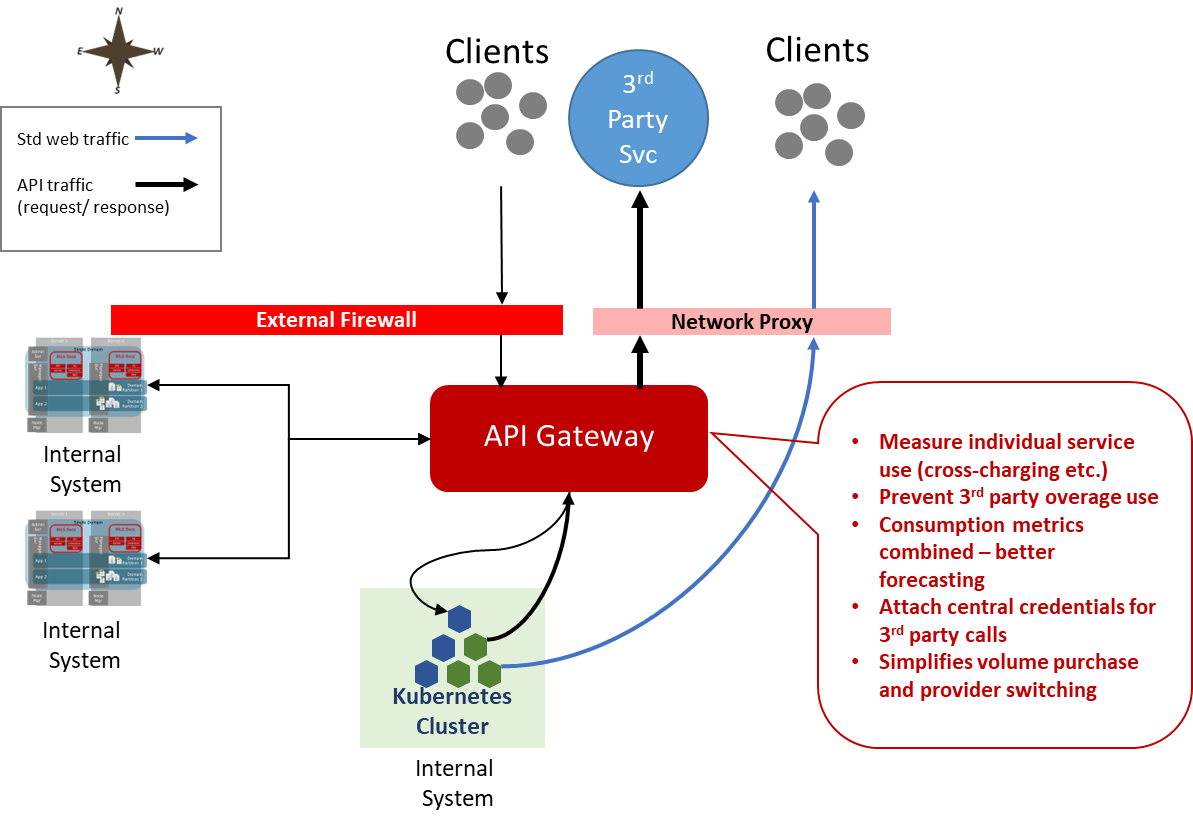
Most larger organizations route their outbound web traffic through a web proxy. The primary motivation for this is to measure where traffic is going. Log traffic for analysis to try and detect activities trying to egress data that should remain within the organization and prevent access to websites that are considered harmful in one form or another.

So why consider an API Gateway as part of an outbound traffic flow? After all, isn’t a Gateway there to protect us? Several very good reasons. Let’s look at them:

  • Managing the use of an external paid service. You may have multiple solutions using a third-party service – for example, an SMS service. Rather than expecting all these different calls to the external API, each having a copy of the 3rd party credentials to manage, we could use the gateway as a single point to attach the credentials.
  • When it comes to being charged for a service, being able to identify the requests at the API level makes it very easy to track your own consumption and forecast forward before being billed. This is really helpful if you have an agreement that provides a good price for pre-booked capacity and a higher charge for overage/capacity not pre-booked.
  • Economies of scale for using 3rd party services can be very powerful. But it can also present two problems.
    • Switching providers quickly can be difficult as multiple points of possible change
    • How to partition the cost of the external service across different departments if everyone is using a common account.

The first of these issues can be easily overcome using the anti-corruption layer pattern where the gateway represents the correct route so it can reformat the requests in one place to work with a different provider.

At the same time, we can more intelligently use Gateway’s metering mechanisms rather than having to implement functionality to mine the proxy’s logs.

Of course you can achieve same effect without a gateway, but you don’t get the benefits that a gateway will offer out of the box. In addition the chances are that you have already got an API Gateway running for your current North-South traffic.

Share this:

  • Click to share on Facebook (Opens in new window) Facebook
  • Click to share on X (Opens in new window) X
  • Click to share on Pocket (Opens in new window) Pocket
  • Click to share on Reddit (Opens in new window) Reddit
  • Click to email a link to a friend (Opens in new window) Email
  • Click to share on WhatsApp (Opens in new window) WhatsApp
  • Click to print (Opens in new window) Print
  • Click to share on Tumblr (Opens in new window) Tumblr
  • Click to share on Mastodon (Opens in new window) Mastodon
  • Click to share on Pinterest (Opens in new window) Pinterest
  • More
  • Click to share on Bluesky (Opens in new window) Bluesky
  • Click to share on LinkedIn (Opens in new window) LinkedIn
Like Loading...

Podcast with Anatolii Ulitovskyi of UNmiss

28 Wednesday Dec 2022

Posted by mp3monster in Books, General, Podcasts, Technology

≈ Leave a comment

Tags

API, book, integration, manning, Oracle, podcast

Just before the Christmas break, I got to record an excellent podcast with Anatolii of UNmiss. It was a great conversation about Cloud Integration, APIs, and approaches to Cloud-based integration. While I am not in a consulting role in the conventional sense, a lot of an Evangelist’s task is still to listen, understand, and, when necessary, challenge assumptions and help people understand how technologies can help address problems. This might include sketching out a journey of evolution and improvement. During the podcast, we discussed some of these ideas.

You can listen to the podcast audio or the live video stream of the conversation here.

In addition to some of the practices, we’ve used. The conversation touched upon books. My books are on the sidebar, including links to Manning, who, as a publisher, I’d recommend. I’ve previously blogged some reading recommendations and previously written some book reviews which may be of interest to anyone following up.

Share this:

  • Click to share on Facebook (Opens in new window) Facebook
  • Click to share on X (Opens in new window) X
  • Click to share on Pocket (Opens in new window) Pocket
  • Click to share on Reddit (Opens in new window) Reddit
  • Click to email a link to a friend (Opens in new window) Email
  • Click to share on WhatsApp (Opens in new window) WhatsApp
  • Click to print (Opens in new window) Print
  • Click to share on Tumblr (Opens in new window) Tumblr
  • Click to share on Mastodon (Opens in new window) Mastodon
  • Click to share on Pinterest (Opens in new window) Pinterest
  • More
  • Click to share on Bluesky (Opens in new window) Bluesky
  • Click to share on LinkedIn (Opens in new window) LinkedIn
Like Loading...
← Older posts

    I work for Oracle, all opinions here are my own & do not necessarily reflect the views of Oracle

    • About
      • Internet Profile
      • Music Buying
      • Presenting Activities
    • Books & Publications
      • Logging in Action with Fluentd, Kubernetes and More
      • Logs and Telemetry using Fluent Bit
      • Oracle Integration
      • API & API Platform
        • API Useful Resources
        • Useful Reading Sources
    • Mindmaps Index
    • Monster On Music
      • Music Listening
      • Music Reading
    • Oracle Resources
    • Useful Tech Resources
      • Fluentd & Fluent Bit Additional stuff
        • Logging Frameworks and Fluent Bit and Fluentd connectivity
        • REGEX for BIC and IBAN processing
      • Java and Graal Useful Links
      • Official Sources for Product Logos
      • Python Setup & related tips
      • Recommended Tech Podcasts

    Oracle Ace Director Alumni

    TOGAF 9

    Logs and Telemetry using Fluent Bit


    Logging in Action — Fluentd

    Logging in Action with Fluentd


    Oracle Cloud Integration Book


    API Platform Book


    Oracle Dev Meetup London

    Blog Categories

    • App Ideas
    • Books
      • Book Reviews
      • manning
      • Oracle Press
      • Packt
    • Enterprise architecture
    • General
      • economy
      • ExternalWebPublications
      • LinkedIn
      • Website
    • Music
      • Music Resources
      • Music Reviews
    • Photography
    • Podcasts
    • Technology
      • AI
      • APIs & microservices
      • chatbots
      • Cloud
      • Cloud Native
      • Dev Meetup
      • development
        • languages
          • java
          • node.js
      • drone
      • Fluentbit
      • Fluentd
      • logsimulator
      • mindmap
      • OMESA
      • Oracle
        • API Platform CS
          • tools
        • Helidon
        • ITSO & OEAF
        • Java Cloud
        • NodeJS Cloud
        • OIC – ICS
        • Oracle Cloud Native
        • OUG
      • railroad diagrams
      • TOGAF
    • xxRetired
    • AI
    • API Platform CS
    • APIs & microservices
    • App Ideas
    • Book Reviews
    • Books
    • chatbots
    • Cloud
    • Cloud Native
    • Dev Meetup
    • development
    • drone
    • economy
    • Enterprise architecture
    • ExternalWebPublications
    • Fluentbit
    • Fluentd
    • General
    • Helidon
    • ITSO & OEAF
    • java
    • Java Cloud
    • languages
    • LinkedIn
    • logsimulator
    • manning
    • mindmap
    • Music
    • Music Resources
    • Music Reviews
    • node.js
    • NodeJS Cloud
    • OIC – ICS
    • OMESA
    • Oracle
    • Oracle Cloud Native
    • Oracle Press
    • OUG
    • Packt
    • Photography
    • Podcasts
    • railroad diagrams
    • Technology
    • TOGAF
    • tools
    • Website
    • xxRetired

    Enter your email address to subscribe to this blog and receive notifications of new posts by email.

    Join 2,555 other subscribers

    RSS

    RSS Feed RSS - Posts

    RSS Feed RSS - Comments

    December 2025
    M T W T F S S
    1234567
    891011121314
    15161718192021
    22232425262728
    293031  
    « Nov    

    Twitter

    Tweets by mp3monster

    History

    Speaker Recognition

    Open Source Summit Speaker

    Flickr Pics

    Turin Brakes Acoustic Tour 24 @ The Maltings FarnhamTurin Brakes Acoustic Tour 24 @ The Maltings FarnhamTurin Brakes Acoustic Tour 24 @ The Maltings FarnhamTurin Brakes Acoustic Tour 24 @ The Maltings Farnham
    More Photos

    Social

    • View @mp3monster’s profile on Twitter
    • View philwilkins’s profile on LinkedIn
    • View mp3monster’s profile on GitHub
    • View mp3monster’s profile on Flickr
    • View mp3muncher’s profile on WordPress.org
    • View philmp3monster’s profile on Twitch
    Follow Phil (aka MP3Monster)'s Blog on WordPress.com

    Blog at WordPress.com.

    • Subscribe Subscribed
      • Phil (aka MP3Monster)'s Blog
      • Join 233 other subscribers
      • Already have a WordPress.com account? Log in now.
      • Phil (aka MP3Monster)'s Blog
      • Subscribe Subscribed
      • Sign up
      • Log in
      • Report this content
      • View site in Reader
      • Manage subscriptions
      • Collapse this bar
     

    Loading Comments...
     

    You must be logged in to post a comment.

      Privacy & Cookies: This site uses cookies. By continuing to use this website, you agree to their use.
      To find out more, including how to control cookies, see here: Our Cookie Policy
      %d