• Home
  • Site Aliases
    • www.cloud-native.info
  • About
    • Background
    • Presenting Activities
    • Internet Profile
      • LinkedIn
    • About
  • Books & Publications
    • Log Generator
    • Logs and Telemetry using Fluent Bit
      • Fluent Bit book
      • Book Resources in GitHub
      • Fluent Bit Classic to YAML Format configurations
    • Logging in Action with Fluentd, Kubernetes and More
      • Logging in Action with Fluentd – Book
      • Fluentd Book Resources
      • Fluentd & Fluent Bit Additional stuff
    • API & API Platform
      • API Useful Resources
    • Oracle Integration
      • Book Website
      • Useful Reading Sources
    • Publication Contributions
  • Resources
    • GitHub
    • Oracle Integration Site
    • Oracle Resources
    • Mindmaps Index
    • Useful Tech Resources
      • Fluentd & Fluent Bit Additional stuff
      • Recommended Tech Podcasts
      • Official Sources for Product Logos
      • Java and Graal Useful Links
      • Python Setup & related stuff
  • Music
    • Monster On Music
    • Music Listening
    • Music Reading

Phil (aka MP3Monster)'s Blog

~ from Technology to Music

Phil (aka MP3Monster)'s Blog

Tag Archives: article

InfoQ Article on Fluent Bit with MultiCloud

23 Tuesday Apr 2024

Posted by mp3monster in Cloud, Fluentbit, Technology

≈ Leave a comment

Tags

article, FluentBit, InfoQ, multicloud

I’m excited to say that we’ve had an article on Fluent Bit and multi-cloud published on InfoQ. Check it out at https://www.infoq.com/articles/multi-cloud-observability-fluent-bit/ . This is another first for me.

As you may have guessed from the title, the article is about how Fluent Bit can support multi-cloud use cases. As part of the introduction, I walked through some of the challenges that aren’t so obvious when operating with a multi-cloud scenario. The following diagram illustrates that.

The book is now in its final peer review process with updates also being sent to the Early Access Program as well (MEAP).

Fluent Bit book cover

Share this:

  • Click to share on Facebook (Opens in new window) Facebook
  • Click to share on X (Opens in new window) X
  • Click to share on Pocket (Opens in new window) Pocket
  • Click to share on Reddit (Opens in new window) Reddit
  • Click to email a link to a friend (Opens in new window) Email
  • Click to share on WhatsApp (Opens in new window) WhatsApp
  • Click to print (Opens in new window) Print
  • Click to share on Tumblr (Opens in new window) Tumblr
  • Click to share on Mastodon (Opens in new window) Mastodon
  • Click to share on Pinterest (Opens in new window) Pinterest
  • More
  • Click to share on Bluesky (Opens in new window) Bluesky
  • Click to share on LinkedIn (Opens in new window) LinkedIn
Like Loading...

DZone article – IDE Changing as Fast as Cloud Native

12 Monday Jun 2023

Posted by mp3monster in General

≈ Leave a comment

Tags

article, IDE, Oracle, post, SZone, Visual code

While this might be my home for sharing thoughts and knowledge, my domain name can work against me when it comes to new potential readers (once people have found me – it’s a fairly easy domain name to remember and get back to). That does mean I occasionally write and publish content elsewhere (Software Engineering Daily, and Medium, for example). I’ve recently written a couple of posts on DZone, the latest of which looks at how IDEs have evolved.

Today we’ve just heard that the article is on the DZone homepage (top left in the image below). If you’re a bit old school, it feels like we’ve made the front page of the national press (for the really old, it would be fair to say as a More Articles piece, it is ‘below the fold’). Go check it out here.

Share this:

  • Click to share on Facebook (Opens in new window) Facebook
  • Click to share on X (Opens in new window) X
  • Click to share on Pocket (Opens in new window) Pocket
  • Click to share on Reddit (Opens in new window) Reddit
  • Click to email a link to a friend (Opens in new window) Email
  • Click to share on WhatsApp (Opens in new window) WhatsApp
  • Click to print (Opens in new window) Print
  • Click to share on Tumblr (Opens in new window) Tumblr
  • Click to share on Mastodon (Opens in new window) Mastodon
  • Click to share on Pinterest (Opens in new window) Pinterest
  • More
  • Click to share on Bluesky (Opens in new window) Bluesky
  • Click to share on LinkedIn (Opens in new window) LinkedIn
Like Loading...

OraWorld Magazine – Latest Edition

09 Tuesday Mar 2021

Posted by mp3monster in APIs & microservices, General, Oracle, Technology

≈ Leave a comment

Tags

API, article, external, external publications, GraphQL, journal, magazine, OraWorld

The latest edition of OraWorld has become available to today. With its blend of insight into the Oracle community, and Oracle technologies from database to modern apps. I have to own up and say, I mention the magazine not only because of the beautifully crafted independent insights, but also it includes an article from myself. Taking a look at GraphQL what it is and how recent new Oracle product features could make a big difference to the GraphQL adoption opportunities.

The next edition should include a follow up article to this focussing on API security considerations.

Share this:

  • Click to share on Facebook (Opens in new window) Facebook
  • Click to share on X (Opens in new window) X
  • Click to share on Pocket (Opens in new window) Pocket
  • Click to share on Reddit (Opens in new window) Reddit
  • Click to email a link to a friend (Opens in new window) Email
  • Click to share on WhatsApp (Opens in new window) WhatsApp
  • Click to print (Opens in new window) Print
  • Click to share on Tumblr (Opens in new window) Tumblr
  • Click to share on Mastodon (Opens in new window) Mastodon
  • Click to share on Pinterest (Opens in new window) Pinterest
  • More
  • Click to share on Bluesky (Opens in new window) Bluesky
  • Click to share on LinkedIn (Opens in new window) LinkedIn
Like Loading...

Tips for Social Media as an Oracle Ace (Part 2)

06 Monday Apr 2020

Posted by mp3monster in General, Oracle, Technology

≈ Leave a comment

Tags

Ace, article, Blogging, Oracle, OraWorld, social media

The second part of a two part article about the sort of things an Ace Associate or anyone else in a Technology Advocacy programme such as the Ace & Groundbreakers could approach social media has been published.

You can check out at (http://www.oraworld.org/home/ – page 10)

You can check part 1 (http://www.oraworld.org/home/ – page 15) along with other articles in the 19th edition of OraWorld covering subjects as diverse as Open World, Apex and Spam (read and you’ll understand).

I’d like to thank my colleagues, particularly James Neate for the inspiration behind this article.

Share this:

  • Click to share on Facebook (Opens in new window) Facebook
  • Click to share on X (Opens in new window) X
  • Click to share on Pocket (Opens in new window) Pocket
  • Click to share on Reddit (Opens in new window) Reddit
  • Click to email a link to a friend (Opens in new window) Email
  • Click to share on WhatsApp (Opens in new window) WhatsApp
  • Click to print (Opens in new window) Print
  • Click to share on Tumblr (Opens in new window) Tumblr
  • Click to share on Mastodon (Opens in new window) Mastodon
  • Click to share on Pinterest (Opens in new window) Pinterest
  • More
  • Click to share on Bluesky (Opens in new window) Bluesky
  • Click to share on LinkedIn (Opens in new window) LinkedIn
Like Loading...

Tips for Social Media as an Oracle Ace

03 Monday Feb 2020

Posted by mp3monster in General, Oracle, Technology

≈ Leave a comment

Tags

Ace, article, Blogging, Oracle, OraWorld, social media

The first part of a two part article about the sort of things an Ace Associate, or anyone else in a Technology Advocacy programme such as the Ace & Groundbreakers could approach social media has been published.  Go check it out (http://www.oraworld.org/home/ – page 15) along with other articles in the latest edition of OraWorld covering subjects as diverse as Open World, Apex and Spam (read and you’ll understand).

I’d like to thank my colleagues, particularly James Neate for the inspiration behind this article.

Share this:

  • Click to share on Facebook (Opens in new window) Facebook
  • Click to share on X (Opens in new window) X
  • Click to share on Pocket (Opens in new window) Pocket
  • Click to share on Reddit (Opens in new window) Reddit
  • Click to email a link to a friend (Opens in new window) Email
  • Click to share on WhatsApp (Opens in new window) WhatsApp
  • Click to print (Opens in new window) Print
  • Click to share on Tumblr (Opens in new window) Tumblr
  • Click to share on Mastodon (Opens in new window) Mastodon
  • Click to share on Pinterest (Opens in new window) Pinterest
  • More
  • Click to share on Bluesky (Opens in new window) Bluesky
  • Click to share on LinkedIn (Opens in new window) LinkedIn
Like Loading...

Millennials in the Workforce – PTK

03 Thursday Oct 2019

Posted by mp3monster in General, OUG

≈ Leave a comment

Tags

article, Capgemini, interview, millenials, OUG, PTK, workforce

Those who know me will be aware that I try to support the UK Oracle User Group’s journal (#PTK) in a number of ways from submitting articles through to being part of the review panel.  I’ve mentioned in the past some of the changes that the journal has undergone (here for example).  But another change is that the editorial team are including more diverse content. For example in the latest issue just out. It includes an article about Millennials in the workforce and how things are changing. A theme that is confronting not only businesses as employers, but as the new generation of influencers and decision-makers and that will be making our enterprise buying decisions, and dare I say it,  members of a user group.

As part of the team who also informs the User Group’s event planning, I happened to throw in some thoughts about supporting and engaging the newer generation. That led to an invitation to participate in an interview which has contributed an interesting article on millennials in the workforce.

Putting the company man hat on for a moment, it was good to highlight the efforts that Capgemini make to support new talent into the organisation.

The article is here, and links to the Tech and App parts of #PTK journal are here.

PTK_ISSUE71_TECH_COVER_FINAL

Share this:

  • Click to share on Facebook (Opens in new window) Facebook
  • Click to share on X (Opens in new window) X
  • Click to share on Pocket (Opens in new window) Pocket
  • Click to share on Reddit (Opens in new window) Reddit
  • Click to email a link to a friend (Opens in new window) Email
  • Click to share on WhatsApp (Opens in new window) WhatsApp
  • Click to print (Opens in new window) Print
  • Click to share on Tumblr (Opens in new window) Tumblr
  • Click to share on Mastodon (Opens in new window) Mastodon
  • Click to share on Pinterest (Opens in new window) Pinterest
  • More
  • Click to share on Bluesky (Opens in new window) Bluesky
  • Click to share on LinkedIn (Opens in new window) LinkedIn
Like Loading...

Everything As Code – Article for PTK

01 Wednesday May 2019

Posted by mp3monster in General, Oracle, OUG, Technology

≈ 2 Comments

Tags

article, Capgemini, EverythingAsCode, IaaS, OUG, PTK

PTK 2019-04-30.pngPTK (Pass The Knowledge) is the new name for the Independent UK Oracle User Group‘s journal, previously known as Oracle Scene.  Yesterday saw the 1st release under its new name, and I’m proud to say that I have an article included called Everything as Code.

Not only that,  it is great to see the journal includes the appearance of one of my Oracle Team colleagues at Capgemini – Amy Simpson-Grange (here).

The magazine features the approach trialled in the last issue of Oracle Scene where the Journal was split in two – one half focusing on Oracle Applications and Applications Technology and the other on Oracle core technologies i.e PaaS, IaaS, Database, Infrastructure etc.  it also just happens that Amy appears in one half, and I in the other.

One thing that hasn’t changed is the high quality of articles that reflect the diversity of Oracle’s portfolio and community – covering things like Women In IT, Conversational AI, Sanjeevan Bala from Channel 4 discussing the use of Data Science, Database Security and Table Scans.

Share this:

  • Click to share on Facebook (Opens in new window) Facebook
  • Click to share on X (Opens in new window) X
  • Click to share on Pocket (Opens in new window) Pocket
  • Click to share on Reddit (Opens in new window) Reddit
  • Click to email a link to a friend (Opens in new window) Email
  • Click to share on WhatsApp (Opens in new window) WhatsApp
  • Click to print (Opens in new window) Print
  • Click to share on Tumblr (Opens in new window) Tumblr
  • Click to share on Mastodon (Opens in new window) Mastodon
  • Click to share on Pinterest (Opens in new window) Pinterest
  • More
  • Click to share on Bluesky (Opens in new window) Bluesky
  • Click to share on LinkedIn (Opens in new window) LinkedIn
Like Loading...

Message Push Listener – Article Update

30 Saturday Dec 2017

Posted by mp3monster in Cloud, development, General, NodeJS Cloud, Technology

≈ Leave a comment

Tags

"Message Push Listener", article, AWS, Cloud, fn, Functions, google, IBM, JMS, Lambda, messaging, OpenWhisk, Oracle, OraWorld, serverless

When I first wrote about Oracle Messaging Cloud we used a service called WebScript.io to make it easy to demonstrate the Message Push Listener. WebScript was essentially what we better know as a Serverless or Functions oriented offering (that is we wrote pieces of code and deployed them without any consideration servers etc). Well as I prepared my demos for Messaging Cloud for the UK Oracle User Group Tech 17 Conference I discovered that WebScript is being shutdown in December 2017.

In the light of this news, I needto provide an alternate implementation for my Message Push Listener demo Google’s Cloud Functions.  Before I go into the Google implementation I thought it worth sharing how I landed on Google’s offering.

The Google Cloud Functions is a new service that has been launched with an interesting future. I had hoped to try using project Fn (Oracle’s open source serverless offering) but the cloud offering is not yet publicly available – although you can run Fn on any platform today if you’re prepared to invest in setting up the environment (defeating the point of serverless). I know some of Oracle’s Developer Champions have had a preview so it cant be too far away now. I’m sure when we get a chance to access the new Cloud Native Service announced which will include Fn we will revisit it. Before settling on Google we looked at several other offerings in the serverless space. Whilst this is not an exhaustive analysis it should help give a sense of the challenges and ease of adoption. If you search today on Serverless you’ll most commonly come across Auth0’s WebTask.io, AWS Lambda and IBM OpenWhisk (based on Apache OpenWhisk).

WebTask.io

I started with WebTask.io and it was very nearly a done deal, with a nice easy to work with Cloud Development Platform, integrated testing. Extensive support for Node.js and a number of standard frameworks to use with it such as Express available without doing anything.

Other languages are supported as well by WebTask.io. But as I’m trying to create a demo that warrants very little explanation of the Serverless platform we didn’t dig in to this area. Everything went swimmingly until I tried to setup external calls to my function. This became a headache as the security model whilst not overly complex (several ways to provide the REST call with authentication e.g. adding a key in the URI). The process of generating and associating the credentials was far from clear in the documentation.

AWS Lambda

I moved to look at AWS Lambda, this I just found horribly confusing to get started with. I have heard others saying that getting going isn’t straight forward. So I found myself giving up pretty quickly as the setting up wasn’t that clear. Whilst having used AWS with its IaaS capabilities which is both powerful, flexible and pretty easy to get to grips with if you understand basic ideas like virtual machines this didnt hold true fory Lambdas.

OpenWhisk

As for OpenWisk, we started to look at it, but getting a 404 error when trying to access the Editor following the IBM documentation didn’t inspire confidence. The was plenty of supoprting documentation which explains how OpenWhisk works.
openwhisk_flow_of_processing

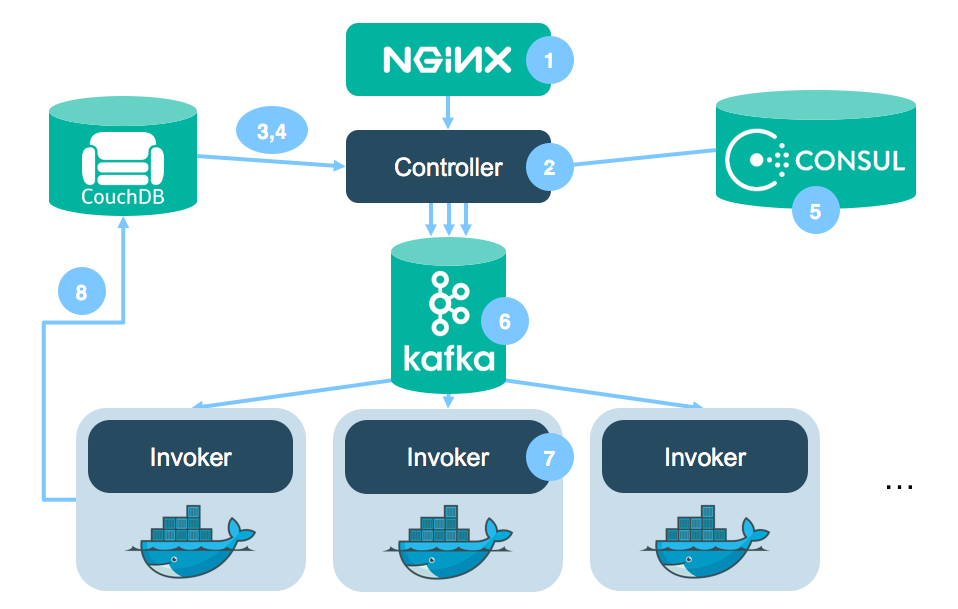
The Execution framework for OpenWhisk

  1.  Ningx is used for SSL termination and forwarding appropriate HTTP calls to the next component
  2. Controller first disambiguates what the user is trying to do. It does so based on the HTTP method you use in your HTTP request. This is a Scala solution built using Akka & Spray. This includes ..
  3. Verification who you are (Authentication) against a CouchDB based identiy store.
  4. Once approved details of the Action to be executed is retrieved from the whisks database in CouchDB.
  5. With information on what to do, the action of service discovery is formed using Consul. Which tracks the available executors in the system. Those executors are called Invokers
  6. Kafka is then used to mitigate the demand pipeline from a failure by recording the request and the consumer (invoker) identified by Consul.
  7. The invoker is built using Scala and uses a Docker instance to run the Action which could be anything e.g. Node.js. The action is injected into the container to be processed.
  8. As the result is obtained by the Invoker, it is stored into the whisks database as an activation under the ActivationId. The whisks database lives in CouchDB.

In addition to the 404, as you can see we have a two step process to execute an action and return a respoinse. However the Message Push Listener initial challenge needs a call and response in a single step. So trying to massage this into a call and response is going to be challenging and a distraction from what we want to be conveying.

Using Google Functions

This brings us Back to Google, whilst the Cloud IDE is not as elegant or mature as WebTask it was sufficient and the security model wasn’t imposed. I liked the documentation when needed to refer back  to it, but to be honest it is pretty intuitive. You can’t fault the docs, to the point Google gave time over to explaining how to manage or avoid incurring costs.

Setting up, was very simple, and then once you’ve choosen your cloud services you get a dashboard like this:

Google CLoud mgmt

Google provides the idea of projects which allows you to group pieces together – such as related functions. Each project is name space separated. If we then navigate into a Functions project we get a view as follows:
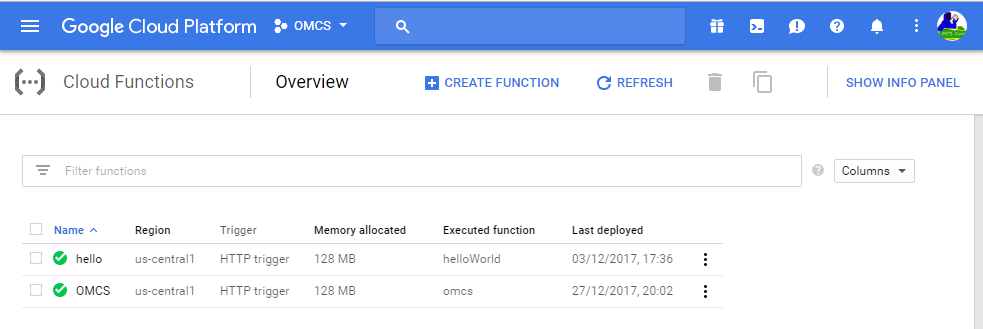
Google cloud functionsAs you can see in the preceeding diagram I created two functions within a project called OMCS. From here you can create more functions in your project or drill into an individual function, as the following view shows:
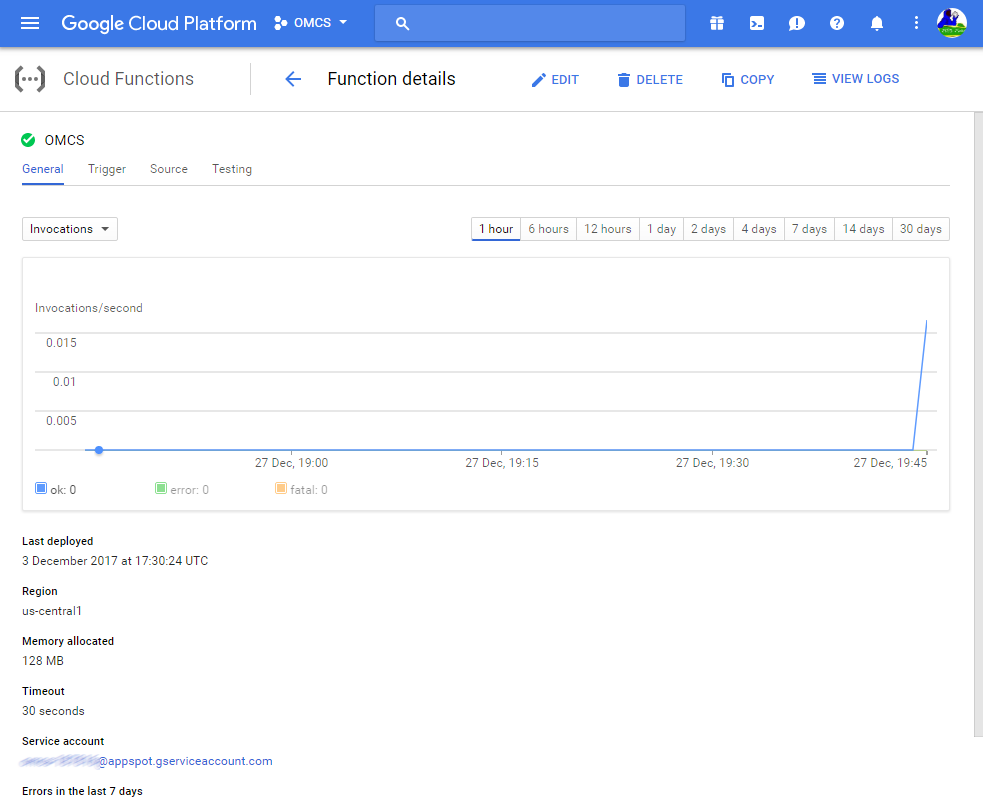
Google Functiuons performance

An individual function provides you with several tabbed views overing the Gernal information  (as shown above) or Trigger, Source and Testing. We can see the other views in the following screenshots. The following screen shot shows the Functions Editor, as you can see it is fairly simple – but sufficient to do the job.

GoogleCloud-OMCS

Once saved, if valid the code will automatically get deployed, or you can work offline and then upload the code if you want to use a nice editor like Sublime.

with your code edited and saved, then the next step is to invoke it. This can be done with the next tab, or the details such as the URI can be copied and you can test from your preferred test tool such as SOAPUI, Postman and APIFortress.
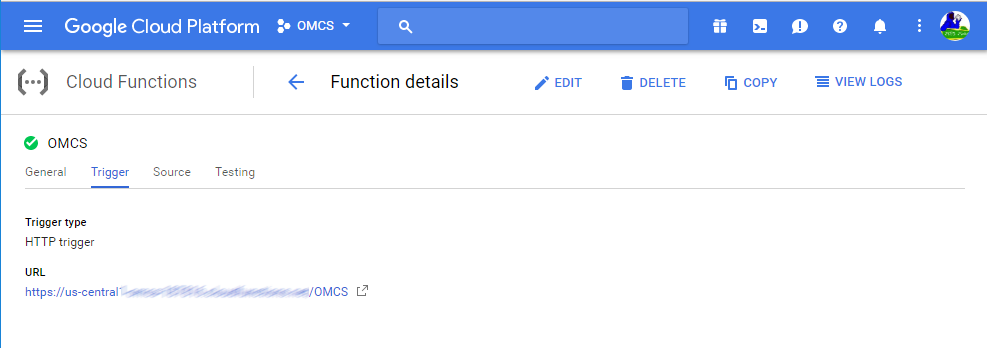
Google functions Trigger

The testing view allows you 5o define input and output values, along with the outcomes. Personally I worked with SOAPUI.

Google Functiuons Test

The important thing with running tests or diagnosing issues, is to be able to examine execution logs. In this area Google Functions is pretty feature rich with a solution that works in a style somewhat like the searching in Splunk (and I’m sure other log analytics tools) where you can drill into the logs and build log filters on the fly. The log view is shown in the next screenshot.

Gogole Functions Logging 2

as you can see tool looks pretty straight forward and uncomplicated to use, with freedom to adapt how you work to your preferred style. Based on my experience of using Project FN on my desktop – it is this simplicity I think we’ll see with the Cloud Native Platform from Oracle when it becomes available.

Finally, let’s take a look at the code in Google Functions code produced for this example:

code

conclusion

Google Code whilst its UI is a bit basic, it is easy to use and get started, certainly for using as a demo platform or perhaps for creating stubs, test and mock end points. Having been critical of the other offerings for security and it getting in the way of a simple illustration it is possible that the Google Functions may need some work in this area. I didn’t see anything that obviously integrated security features in easily.

Back to my Orginal Articles…

Just to tie back the impacted articles …

  • http://www.oraworld.org/home/ – Issues 6 & 7
  • http://www.oracle.com/technetwork/articles/cloudcomp/wilkins-ocms-3855268.html
  • https://www.youtube.com/watch?v=9Elf2DBisEU

Share this:

  • Click to share on Facebook (Opens in new window) Facebook
  • Click to share on X (Opens in new window) X
  • Click to share on Pocket (Opens in new window) Pocket
  • Click to share on Reddit (Opens in new window) Reddit
  • Click to email a link to a friend (Opens in new window) Email
  • Click to share on WhatsApp (Opens in new window) WhatsApp
  • Click to print (Opens in new window) Print
  • Click to share on Tumblr (Opens in new window) Tumblr
  • Click to share on Mastodon (Opens in new window) Mastodon
  • Click to share on Pinterest (Opens in new window) Pinterest
  • More
  • Click to share on Bluesky (Opens in new window) Bluesky
  • Click to share on LinkedIn (Opens in new window) LinkedIn
Like Loading...

hAPI times – latest contribution to Oracle Scene

22 Wednesday Nov 2017

Posted by mp3monster in General

≈ Leave a comment

Tags

API, article, award, Capgemini, Oracle, OUG, PYA

My latest contribution to the Oracle Scene journal is available at here. This article looks at the evolution of APIs, and a look at modern API Gateway capabilities. The article uses an analogy to explian the capabilities in a non-techie way.

In addition to my article the team I’m part of get a mention for their wins at this years Partner of the Year awards.

Share this:

  • Click to share on Facebook (Opens in new window) Facebook
  • Click to share on X (Opens in new window) X
  • Click to share on Pocket (Opens in new window) Pocket
  • Click to share on Reddit (Opens in new window) Reddit
  • Click to email a link to a friend (Opens in new window) Email
  • Click to share on WhatsApp (Opens in new window) WhatsApp
  • Click to print (Opens in new window) Print
  • Click to share on Tumblr (Opens in new window) Tumblr
  • Click to share on Mastodon (Opens in new window) Mastodon
  • Click to share on Pinterest (Opens in new window) Pinterest
  • More
  • Click to share on Bluesky (Opens in new window) Bluesky
  • Click to share on LinkedIn (Opens in new window) LinkedIn
Like Loading...

More Articles Published Elsewhere

03 Monday Jul 2017

Posted by mp3monster in chatbots, Cloud, General, Oracle, Technology

≈ Leave a comment

Tags

API, article, blog, chatbots, integration, Leon Smiers, Luis Weir, Oracle, OTN, registries

So it has been a busy week in terms of seeing articles published that I’ve at least contributed to. It’s funny the gap between writing and publishing can be several weeks. So whilst we’re thinking about new things we see the twitter pickup etc or work several weeks old.

Anyway, first up was a contribution to Leon Smiers‘ blog on integrating chatbots. The latest in a series of excellent blog posts looking at  the capabilities a chatbot solution needs etc. The latest post is about integration, hence my contribution. My contributions to the blog series go back to the conversations Leon and I had whilst at the Oracle Partner event earlier this year. Since then, I have helped Leon by providing a critical eye and offering suggestions.

The big event, has been to have an article published on Oracle Technology Network(OTN). This is a bit of an honour as we where invited to write. My piece can be found at here. It is actually a part of a pair of articles written for OTN. With article was written by Luis Weir, and is the parent article about API management.

My article came about as a result several discussions with Luis whilst travelling to and from a client about the relationship between between microservice registries, load balancers and API Gateways. Particularly as API Gateways have a natural relationship with microservices. I’ll say no more, go read the article.

Share this:

  • Click to share on Facebook (Opens in new window) Facebook
  • Click to share on X (Opens in new window) X
  • Click to share on Pocket (Opens in new window) Pocket
  • Click to share on Reddit (Opens in new window) Reddit
  • Click to email a link to a friend (Opens in new window) Email
  • Click to share on WhatsApp (Opens in new window) WhatsApp
  • Click to print (Opens in new window) Print
  • Click to share on Tumblr (Opens in new window) Tumblr
  • Click to share on Mastodon (Opens in new window) Mastodon
  • Click to share on Pinterest (Opens in new window) Pinterest
  • More
  • Click to share on Bluesky (Opens in new window) Bluesky
  • Click to share on LinkedIn (Opens in new window) LinkedIn
Like Loading...

    I work for Oracle, all opinions here are my own & do not necessarily reflect the views of Oracle

    • About
      • Internet Profile
      • Music Buying
      • Presenting Activities
    • Books & Publications
      • Logging in Action with Fluentd, Kubernetes and More
      • Logs and Telemetry using Fluent Bit
      • Oracle Integration
      • API & API Platform
        • API Useful Resources
        • Useful Reading Sources
    • Mindmaps Index
    • Monster On Music
      • Music Listening
      • Music Reading
    • Oracle Resources
    • Useful Tech Resources
      • Fluentd & Fluent Bit Additional stuff
        • Logging Frameworks and Fluent Bit and Fluentd connectivity
        • REGEX for BIC and IBAN processing
      • Java and Graal Useful Links
      • Official Sources for Product Logos
      • Python Setup & related tips
      • Recommended Tech Podcasts

    Oracle Ace Director Alumni

    TOGAF 9

    Logs and Telemetry using Fluent Bit


    Logging in Action — Fluentd

    Logging in Action with Fluentd


    Oracle Cloud Integration Book


    API Platform Book


    Oracle Dev Meetup London

    Blog Categories

    • App Ideas
    • Books
      • Book Reviews
      • manning
      • Oracle Press
      • Packt
    • Enterprise architecture
    • General
      • economy
      • ExternalWebPublications
      • LinkedIn
      • Website
    • Music
      • Music Resources
      • Music Reviews
    • Photography
    • Podcasts
    • Technology
      • AI
      • APIs & microservices
      • chatbots
      • Cloud
      • Cloud Native
      • Dev Meetup
      • development
        • languages
          • java
          • node.js
      • drone
      • Fluentbit
      • Fluentd
      • logsimulator
      • mindmap
      • OMESA
      • Oracle
        • API Platform CS
          • tools
        • Helidon
        • ITSO & OEAF
        • Java Cloud
        • NodeJS Cloud
        • OIC – ICS
        • Oracle Cloud Native
        • OUG
      • railroad diagrams
      • TOGAF
    • xxRetired
    • AI
    • API Platform CS
    • APIs & microservices
    • App Ideas
    • Book Reviews
    • Books
    • chatbots
    • Cloud
    • Cloud Native
    • Dev Meetup
    • development
    • drone
    • economy
    • Enterprise architecture
    • ExternalWebPublications
    • Fluentbit
    • Fluentd
    • General
    • Helidon
    • ITSO & OEAF
    • java
    • Java Cloud
    • languages
    • LinkedIn
    • logsimulator
    • manning
    • mindmap
    • Music
    • Music Resources
    • Music Reviews
    • node.js
    • NodeJS Cloud
    • OIC – ICS
    • OMESA
    • Oracle
    • Oracle Cloud Native
    • Oracle Press
    • OUG
    • Packt
    • Photography
    • Podcasts
    • railroad diagrams
    • Technology
    • TOGAF
    • tools
    • Website
    • xxRetired

    Enter your email address to subscribe to this blog and receive notifications of new posts by email.

    Join 2,555 other subscribers

    RSS

    RSS Feed RSS - Posts

    RSS Feed RSS - Comments

    December 2025
    M T W T F S S
    1234567
    891011121314
    15161718192021
    22232425262728
    293031  
    « Nov    

    Twitter

    Tweets by mp3monster

    History

    Speaker Recognition

    Open Source Summit Speaker

    Flickr Pics

    Turin Brakes Acoustic Tour 24 @ The Maltings FarnhamTurin Brakes Acoustic Tour 24 @ The Maltings FarnhamTurin Brakes Acoustic Tour 24 @ The Maltings FarnhamTurin Brakes Acoustic Tour 24 @ The Maltings Farnham
    More Photos

    Social

    • View @mp3monster’s profile on Twitter
    • View philwilkins’s profile on LinkedIn
    • View mp3monster’s profile on GitHub
    • View mp3monster’s profile on Flickr
    • View mp3muncher’s profile on WordPress.org
    • View philmp3monster’s profile on Twitch
    Follow Phil (aka MP3Monster)'s Blog on WordPress.com

    Blog at WordPress.com.

    • Subscribe Subscribed
      • Phil (aka MP3Monster)'s Blog
      • Join 233 other subscribers
      • Already have a WordPress.com account? Log in now.
      • Phil (aka MP3Monster)'s Blog
      • Subscribe Subscribed
      • Sign up
      • Log in
      • Report this content
      • View site in Reader
      • Manage subscriptions
      • Collapse this bar
     

    Loading Comments...
     

    You must be logged in to post a comment.

      Privacy & Cookies: This site uses cookies. By continuing to use this website, you agree to their use.
      To find out more, including how to control cookies, see here: Our Cookie Policy
      %d