• Home
  • Site Aliases
    • www.cloud-native.info
  • About
    • Background
    • Presenting Activities
    • Internet Profile
      • LinkedIn
    • About
  • Books & Publications
    • Log Generator
    • Logs and Telemetry using Fluent Bit
      • Fluent Bit book
      • Book Resources in GitHub
      • Fluent Bit Classic to YAML Format configurations
    • Logging in Action with Fluentd, Kubernetes and More
      • Logging in Action with Fluentd – Book
      • Fluentd Book Resources
      • Fluentd & Fluent Bit Additional stuff
    • API & API Platform
      • API Useful Resources
    • Oracle Integration
      • Book Website
      • Useful Reading Sources
    • Publication Contributions
  • Resources
    • GitHub
    • Oracle Integration Site
    • Oracle Resources
    • Mindmaps Index
    • Useful Tech Resources
      • Fluentd & Fluent Bit Additional stuff
      • Recommended Tech Podcasts
      • Official Sources for Product Logos
      • Java and Graal Useful Links
      • Python Setup & related stuff
  • Music
    • Monster On Music
    • Music Listening
    • Music Reading

Phil (aka MP3Monster)'s Blog

~ from Technology to Music

Phil (aka MP3Monster)'s Blog

Tag Archives: code

AI coding tools vs low code

23 Wednesday Apr 2025

Posted by mp3monster in General, Technology

≈ Leave a comment

Tags

AI, code, Code Assist, Copilot, developer, developer tools, low-code, tools

The rapid development of generative AI in traditional code development (third-generation language use) has had a lot of impact, with claims of massive productivity improvements. Given that developer productivity has historically been the domain of low-code tooling, this has led me to wonder whether the gap is shrinking and whether we are approaching a point where the benefits of low-code tools are being eroded for mainstream development.

To better understand this, let’s revisit how both technologies help.

AI-supported development

Delivered value in several ways:

  • Code refactoring and optimization
  • Code documentation generation
  • Unit test generation
  • Next generation of auto-complete

This can include creating code in a green field context. If you’ve been following reports on the value of services like Copilot, AWS Q Developer, and Code Assist, you’ll see that these tools are delivering a significant productivity boost. A recent ACM article pointed to benefits as high as a threefold boost for more routine activities, tapering off as tasks became more complex.

Low Code

Low-code tools have been around for a long time, while they have evolved and progressed, and have come in a number of forms, such as:

  • UI applications that map databases to screens.
  • Business process is defined with a visual tool support for BPM.
  • Connecting different data sources by using visual notations to leverage representations of sources and sinks and link them together.

The central value proposition of low-code development is speed and agility. This performance comes with the constraint that your development has to fit into the framework, which may have constraints such as how it can scale, elasticity for rapid scaling, and performance optimization. ACM conducted some research into the productivity gains here.

Development acceleration narrowing

Low-code/no-code tools are often associated with the idea of citizen developers, where people with primarily a business background and a broad appreciation of IT are able to develop applications (personal experience points to more developers being able to focus less on code, and more on usability of apps). KPMG shares a view on this here.

Evolution of AI that could change low-code?

It would be easy to be a doom monger and say that this will be the end of highly paid software engineering jobs. But we have said this many times over in the last twenty or thirty years (e.g Future of Development).

Looking at the figures, the gains of Gen AI for code development aren’t going to invalidate Low/no code tooling. Where it really benefits is where a low-code tool is not going to offer a good fit to the needs being developed, such as complex graphical UI.

What if …

If Low-Code and Generative AI assistive technologies coalesce, then we’ll see a new generation of citizen developers who can accomplish a lot more. Typical business solutions will be built more rapidly. For example, I can simply describe the UI, and the AI generates a suitable layout that incorporates all the UX features, supporting the W3C guidelines. Furthermore, it may also be able to escape the constraints of low-code frameworks.

The work of developing very efficient, highly scalable Ui building blocks, with libraries to use them will still demand talented developers. Such work is likely to also involve AI model and agent development skills, so the AI can work out how to use such building blocks.

To build such capabilities, we’re going to need to help iron out issues of hallucination from the models. Some UX roles could well be impacted as well, as how we impose consistency in a user’s experience probably needs to be approached differently to defining templates.

Merging of assistive technologies

To truly leverage AI for low-code development, we will likely need to bring multiple concepts together, including describing UIs, linking application logic to leverage other services, and defining algorithms. Bringing these together will require work to harmonize how we communicate with the different AI elements so they can leverage a common context and interact with the user if using a single voice.

Conclusion

So the productivity gap between traditional development and low/no-code has shrunk a bit, I suspect we’ll see this grow quickly if generative AI can be harnessed and is applied, not just as a superficial enhancement, but from a ground-up revisit of how the load-code tooling works. Although the first wave, like everywhere else, will be superficial in the rush for everyone to say their service or tool is AI-enabled.

Share this:

  • Click to share on Facebook (Opens in new window) Facebook
  • Click to share on X (Opens in new window) X
  • Click to share on Pocket (Opens in new window) Pocket
  • Click to share on Reddit (Opens in new window) Reddit
  • Click to email a link to a friend (Opens in new window) Email
  • Click to share on WhatsApp (Opens in new window) WhatsApp
  • Click to print (Opens in new window) Print
  • Click to share on Tumblr (Opens in new window) Tumblr
  • Click to share on Mastodon (Opens in new window) Mastodon
  • Click to share on Pinterest (Opens in new window) Pinterest
  • More
  • Click to share on Bluesky (Opens in new window) Bluesky
  • Click to share on LinkedIn (Opens in new window) LinkedIn
Like Loading...

Streaming APIs

05 Friday Aug 2022

Posted by mp3monster in APIs & microservices, development, General, Technology

≈ 1 Comment

Tags

API, architecture, code, GraphQL, gRPC, Oracle, streaming, subscriptions

Yesterday I was fortunate enough to participate in the Dev Innovation summit part of the World Festival virtual conference.

The presentation took a look at how Streaming APIs offer an alternative to API polling and the considerations needed when adopting streaming.

Continue reading →

Share this:

  • Click to share on Facebook (Opens in new window) Facebook
  • Click to share on X (Opens in new window) X
  • Click to share on Pocket (Opens in new window) Pocket
  • Click to share on Reddit (Opens in new window) Reddit
  • Click to email a link to a friend (Opens in new window) Email
  • Click to share on WhatsApp (Opens in new window) WhatsApp
  • Click to print (Opens in new window) Print
  • Click to share on Tumblr (Opens in new window) Tumblr
  • Click to share on Mastodon (Opens in new window) Mastodon
  • Click to share on Pinterest (Opens in new window) Pinterest
  • More
  • Click to share on Bluesky (Opens in new window) Bluesky
  • Click to share on LinkedIn (Opens in new window) LinkedIn
Like Loading...

Node (npm) package licensing

05 Tuesday Jul 2022

Posted by mp3monster in development, General, node.js, Technology

≈ Leave a comment

Tags

code, developer, development, Licensing, node.js, package, Technology

When building Node solutions, even if you’re not going to publish the code to a public repository you’re likely to be using package.json to declare the dependencies for your app. Doing this makes it easier to build and deploy a utility. But if you’re conversant with several languages there is a tendency to just adapt your existing skills to work with others. The downside of this is small tooling nuances can catch you off guard and consume time while figuring them out. The workings of packages with NPM (as shown below) is one possible case.

{
  "name": "graph-svr",
  "version": "1.0.0",
  "description": "packages needed for this service",
  "main": "index.js",
  "type": "module",
  "scripts": {
    "start": "node index.js"
  },
  "dependencies": {
    "@graphql-tools/graphql-file-loader": "^7.3.11",
    "@graphql-tools/load-files": "^6.5.4",
    "@graphql-tools/schema": "^8.3.10",
    "@graphql-yoga/node": "^2.4.1",
    "apollo-datasource-rest": "^3.5.2",
    "apollo-server": "^3.6.7",
    "graphql": "^16.4.0",
    "graphql-tools": "^8.2.8"
  },
  "author": "Phil Wilkins",
  "license": "MIT"
}

If you create the package.json using npm init to create the initial version of the file, it is fairly common to set values to default. In the case of the license, this is an ISC license. This is easily forgotten. The problem here is twofold:

  • Does the license set reflect the constraints of the dependencies and their licenses
  • Does the default license reflect the position you want?

Looking at the latter point first, This is important as organizations have matured (and tooling greatly improved) when it comes to understanding how open source licensing can impact. This is particularly important for any organizations leveraging open source as part of their revenue generating activities either ‘as a service’ but also selling software solutions. If you put the wrong license here the license checking tools often protecting code repositories may reject your code, even in internal only use cases (yes this tripped me up).

To help overcome this issue you can install a tool that will analyze the dependencies and optionally their dependencies and report back on your license exposure. This tool is called license-report. Once installed (npm install -g license-report) we just need to point the tool to the package.json file. e.g. license-report package.json. We can make the results a lot more consumable by outputting the content in a number of formats. For example a simple text value:

From this, you could set your license declaration in package.json or validate that your preferred license won’t conflict,

Share this:

  • Click to share on Facebook (Opens in new window) Facebook
  • Click to share on X (Opens in new window) X
  • Click to share on Pocket (Opens in new window) Pocket
  • Click to share on Reddit (Opens in new window) Reddit
  • Click to email a link to a friend (Opens in new window) Email
  • Click to share on WhatsApp (Opens in new window) WhatsApp
  • Click to print (Opens in new window) Print
  • Click to share on Tumblr (Opens in new window) Tumblr
  • Click to share on Mastodon (Opens in new window) Mastodon
  • Click to share on Pinterest (Opens in new window) Pinterest
  • More
  • Click to share on Bluesky (Opens in new window) Bluesky
  • Click to share on LinkedIn (Opens in new window) LinkedIn
Like Loading...

Apollo GraphQL – some pointers

16 Thursday Jun 2022

Posted by mp3monster in development, General, languages, node.js, Technology

≈ 2 Comments

Tags

API, code, development, GraphQL, javascript, node.js, Technology

I’ve designed a variety of GraphQL schemas and developed microservice backends. But not done much with configuring the Apollo implementation of a GraphQL server until recently. This may reflect the fact my understanding of JavaScript doesn’t extend into the world of Node.JS as much as I’d like (the problem with being a multi-language developer is you’re likely to find your way around many languages but never be a master of one). Anyway, the following content is about the implementation within a GraphQL server part of a solution. It may be these pointers are just for my benefit you might find them helpful as well.

Read more: Apollo GraphQL – some pointers

To make it easy to reference the code, we’ve added entries (n) into the code, where n is a number. This is not part of the code. But there to make the different lines referenceable. Where code should go but is not relevant to the point being made I’ve added ellipsis (…)

Dynamic loading and server configuration

import { ApolloServer } from 'apollo-server';
import { loadFilesSync } from '@graphql-tools/load-files';
import { resolvers } from './resolvers.js';   (1)
import ProviderInternalAPI from './ProviderInternalAPI.js'; (1)
import EventsInternalAPI from './EventsInternalAPI.js';  (1)
const server = new ApolloServer({
  debug : true,    (2)
  typeDefs: loadFilesSync('./schema.graphql'),   (3)
  resolvers,
  dataSources: () => {
    return {
      eventsInternalAPI: new EventsInternalAPI(),    (4)
      providerInternalAPI: new ProviderInternalAPI() (4)
      pro
    };
  }});

There is the potential to dynamically load the resolvers rather than importing each JavaScript file as we see on lines (1). The mechanics to do this is documented here. It would be cool if an opinionated implementation was provided. As shown by (3) we can take a independent schema file being loaded. The Apollo example approach for this didn’t seem to work for us, although both approaches make use of graphql-tools in a synchronous manner.

We can switch on debugging (2) for the GraphQL server, although the level of information published doesn’t appear to be significant. Ideally this setting is changed for production.

Defining the resolvers

The prefix for each resolver (1) must correlate to the name in the schema of the mutator or query (not the type as you would expect with Java). Often we don’t need all the parameters for the resolver. The documentation describes replacing each unused parameter with one or more underscores (i.e _, __ ). The underscore denoting the field not in use. However we can satisfy the indication of not being used, but keep the meaning of each position by using the underscore then a name (i.e. _parent, _args ) as shown in (2).

By taking the response into a variable (3) we can optionally log it. Trying to return using invocation line would result in the handler object rather than the payload itself. By taking the result into a variable we can log the content if desired and return the content.

The use of the backward quote is a node feature. It allows us to incorporate variables into a string by referencing it within ${} (4).

We need to supply the GraphQL server with instances with a layer of code that will interact with the resolvers. We can instantiate the instances in the declaration. The naming of the object is important (4) to the resolver.js (declarations).

import { useLogger } from "@graphql-yoga/node";
...
latestEvent (1): async (_parent, _args, { dataSources }, _info) (2)   => {
      if (log) { console.log("resolvers - get latest event"); }
      let responseValue = await dataSources.eventsInternalAPI.getLatestEvent(); (3)
      if (log) { console.log(`(4)  Resolver response for latest event:\n ${responseValue}`); }
      return responseValue;
    },

Resolver declarations

 Query: {  ...
 },
  
Mutation: {...
},
  Event: {  (1)
    providers: (event, args, { dataSources }, info) => {
      if (log) { console.log(`going to locate ${event.sources}`) }
      let responseValue = await (2) dataSources.providerInternalAPI.getProviders(event.sources);
      return responseValue;
    }

To handle the use of resolvers within a larger resolver we need to declare the resolution outside of the Query and Mutator blocks (but inside the whole declaration block)(1). The name provided needs to match the parent entity that the query resolver contributes to.

To then provide values from the outer resolution we need to prover to the chained resolution use the naming as represented in the GraphQL schema as shown by (2). The GraphQL engine will resolve the mapping values.

Web resolver URL

  // GET
  async getProvider(code) {
    console.log("getProvider (%s) directing to %s",code,this.baseURL);
    return this.get(`provider?code=${code} (1)`);
  }

The URL parameters need to be appended to the base URL path for the parent class to use in the invocation as shown by (1). The Apollo examples showed a setter option but we didn’t see the URI being addressed properly. This approach produces the relevant requirement.

Share this:

  • Click to share on Facebook (Opens in new window) Facebook
  • Click to share on X (Opens in new window) X
  • Click to share on Pocket (Opens in new window) Pocket
  • Click to share on Reddit (Opens in new window) Reddit
  • Click to email a link to a friend (Opens in new window) Email
  • Click to share on WhatsApp (Opens in new window) WhatsApp
  • Click to print (Opens in new window) Print
  • Click to share on Tumblr (Opens in new window) Tumblr
  • Click to share on Mastodon (Opens in new window) Mastodon
  • Click to share on Pinterest (Opens in new window) Pinterest
  • More
  • Click to share on Bluesky (Opens in new window) Bluesky
  • Click to share on LinkedIn (Opens in new window) LinkedIn
Like Loading...

Visual Studio Code – Oracle Plugins

26 Tuesday Apr 2022

Posted by mp3monster in development, General, Technology

≈ Leave a comment

Tags

code, development, Oracle, plugins, tools, Visual code

Oracle’s product portfolio is significant, from databases (obviously) to GraalVM to a cloud platform capable of competing with GCP, AWS, and Azure. This means locating the Oracle-provided plugins, or community ones can get messy. Depending on your perspective Oracle Developer Plugins could relate to Java and GraalVM or Oracle Database.

As broad as the portfolio, is the Oracle details regarding the plugins. So the following two tables represent what we’ve identified as Oracle-provided tooling, and the second table of plugins we’ve used when working on Oracle-based solutions from the community.

Name / Plugin SearchDescription / Additional DetailsRelated resource links
search:Oracle Labs
This will return all the Oracle plugins related to GraalVM
There are several different extensions covering GrallVM
– GraalVM Tools for Java
– GraalVM Extension Pack for Java (the name here is a little miss leading as there is support for JavaScript, Python, Ruby, R)
– GraalVM Tools for Micronaut
– PointTo-SourceLine
The extension packs also helps bring of SOA journey,
GraalVM.org
micronaut
Oracle Developer Tools
(PL/SQL & Oracle Database)
Provider is Oracle Corporation
This extension enables editing and execution of SQL and PL/SQL for Oracle Database and Oracle Autonomous Databasehttps://www.oracle.com/
database/technologies
/appdev/dotnet/

odtvscodequickstart.html
Oracle JET corelibrary of UI elements that form part of a web UI.Udemy training
Oracle NetSuiteSuiteCloud Extension for Visual Studio Code is part of the SuiteCloud Software Development Kit (SuiteCloud SDK), a set of tools to customize your NetSuite accounts.Netsuite dev blog
Oracle Provided Plugins

Name / Plugin SearchDescription / Additional DetailsRelated resource links
OCI Policy LanguageThis extension is a language highlighter for OCI Policies.
CPQ DevKitCPQKit™ is a website built to augment Oracle CPQ Cloud system’s functionalityhttps://www.cpqkit.com/
ApexIntelliSenseIntellisense for APEX
Docker
YAMLProvides comprehensive YAML Language support to Visual Studio Code, via the yaml-language-server, with built-in Kubernetes syntax support.
KubernetesThe extension for developers building applications to run in Kubernetes clusters
Language Support for JavaSupports Java 11 onwards
GitHub ActionsGithub actions is a means by which actions like commits to github trigger external infrastructure to perform actions such as creating application binaries.
Regexp Explainhelp to evaluate and develop regular expressions

Share this:

  • Click to share on Facebook (Opens in new window) Facebook
  • Click to share on X (Opens in new window) X
  • Click to share on Pocket (Opens in new window) Pocket
  • Click to share on Reddit (Opens in new window) Reddit
  • Click to email a link to a friend (Opens in new window) Email
  • Click to share on WhatsApp (Opens in new window) WhatsApp
  • Click to print (Opens in new window) Print
  • Click to share on Tumblr (Opens in new window) Tumblr
  • Click to share on Mastodon (Opens in new window) Mastodon
  • Click to share on Pinterest (Opens in new window) Pinterest
  • More
  • Click to share on Bluesky (Opens in new window) Bluesky
  • Click to share on LinkedIn (Opens in new window) LinkedIn
Like Loading...

Detailed (Low Level) documentation

10 Friday Dec 2021

Posted by mp3monster in development, General, Technology

≈ Leave a comment

Tags

code, development, documentation

Low level aka detailed design documentation has been an interesting point of debate. We range from the agile manifesto which states focus should be on working code over documentation and people using this as an argument for not producing documentation. On the other end of the spectrum as someone working for a large SI, documentation is more often than not contractually binding and accurate docs are key when taking work from a different supplier organization.

It is clear that documentation is an essential element. But I do agree with the agile manifesto, a business operates on its software, not documents, although the docs help us keep the software maintained and running.

How do we balance the age-old conflicts of …

  • Documents get out of date because they are kept separate from the implementation
  • Documents, particularly when rushed don’t provide the information necessary
  • Document templates having sections used a tickboxes rather than guide rails
  • Making sure we’re working with the most upto date document

Possibilities

One of the key issues for documents getting out of date is a compound issue of accessibility, visibility and ease of maintenance. These compound to separate the documentation from the reality of code and configuration.

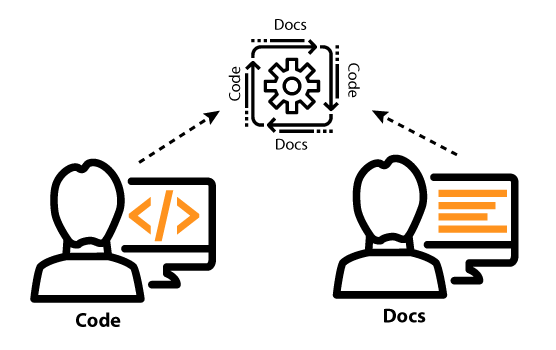
This can be eased by bringing documentation to being ‘physically’ closer to the code as we often see with readme markdown files on GitHub for example. But we can get closer with quality code commenting, particularly for each package and module. Just about every code or notation format had its own document generator from well-proven Javadoc to Terradoc for Terraform. To illustrate my point here are a couple of examples:

  • https://docs.oracle.com/javase/8/docs/api/java/io/BufferedReader.html
  • https://ruby-doc.org/stdlib-3.0.3/libdoc/observer/rdoc/Observable.html

If done well the documentation can be generated and deliver the right information. It would mean in structured change management the change task for the code includes the documentation. The ideas behind combining code and documentation can be seen with good API Blueprints.

When you still need to produce publishable documents, you have the opportunity to stitch multiple class and package generated docs together using tools such as pandoc. Arguably it would be the developer’s job to establish the pandoc configuration file (Documentation as Code).

You can add to this if done carefully, by adding diagrams such as UML representations. Importantly this process can generate representations that include lots of detail that would be noise to the key representation (time for tools like Sparx to support annotations that can give hints as to what to show in a generated model).

Pitfalls

The biggest risks of this approach are:

  • People paying lip service to documenting code, or using the argument that agile means no documentation (an age old misrepresentation).
  • Comments reflect the code correctly
  • Assuming the documentation will be clear because it is writte6x n

These pitfalls could be in theory be addressed through some smarts such as comparing the volume documentation generated against the number of lines of code and code complexity metrics.

But like many things, good culture and good application of principles are essential.

Exploring further

There are growing dedicated resources in this space, check out:

  • https://idratherbewriting.com/
  • https://swimm.io/

Share this:

  • Click to share on Facebook (Opens in new window) Facebook
  • Click to share on X (Opens in new window) X
  • Click to share on Pocket (Opens in new window) Pocket
  • Click to share on Reddit (Opens in new window) Reddit
  • Click to email a link to a friend (Opens in new window) Email
  • Click to share on WhatsApp (Opens in new window) WhatsApp
  • Click to print (Opens in new window) Print
  • Click to share on Tumblr (Opens in new window) Tumblr
  • Click to share on Mastodon (Opens in new window) Mastodon
  • Click to share on Pinterest (Opens in new window) Pinterest
  • More
  • Click to share on Bluesky (Opens in new window) Bluesky
  • Click to share on LinkedIn (Opens in new window) LinkedIn
Like Loading...

Developer Meetup – JavaScript Frameworks and Web Components

17 Monday Feb 2020

Posted by mp3monster in Dev Meetup, development, General, Oracle, Technology

≈ Leave a comment

Tags

@GeertjanW, code, developer, enterprise, framework, javascript, JET, meetup, toolket

Last night was the latest in #OracleDeveloperMeetups in London. The evening’s focus was on JavaScript Frameworks, Toolkits and Web Components.  Whilst the event is sponsored by Oracle the focus is very much on the challenges of JavaScript Frameworks.

Thanks to the Oracle and Cap Gemini teams including @GeertjanW and @PhilConsultant for an excellent session in London on Oracle Jet @OracleJET this evening. Very insightful. #oracledevelopermeetup

— David Archbold (@archbold_david) February 17, 2020

Continue reading →

Share this:

  • Click to share on Facebook (Opens in new window) Facebook
  • Click to share on X (Opens in new window) X
  • Click to share on Pocket (Opens in new window) Pocket
  • Click to share on Reddit (Opens in new window) Reddit
  • Click to email a link to a friend (Opens in new window) Email
  • Click to share on WhatsApp (Opens in new window) WhatsApp
  • Click to print (Opens in new window) Print
  • Click to share on Tumblr (Opens in new window) Tumblr
  • Click to share on Mastodon (Opens in new window) Mastodon
  • Click to share on Pinterest (Opens in new window) Pinterest
  • More
  • Click to share on Bluesky (Opens in new window) Bluesky
  • Click to share on LinkedIn (Opens in new window) LinkedIn
Like Loading...

Development Standards for API Policies?

16 Monday Dec 2019

Posted by mp3monster in API Platform CS, General, tools

≈ Leave a comment

Tags

API, Azure, code, GitHub, Oracle, quality, regex, utility

When it comes to development, we have had coding standards for almost as long as we have been coding. We tend to look at coding standards for purposes of helping to promote good quality code and reduce the likelihood of bugs and so on. But they also help with readability, making it easy to navigate a code base and so on. This is sufficiently important that there is a vast choice of tools to help us ensure we align with good practices.

That readability etc, when it comes to code interfaces lends to making it easier to use an interface as it promotes consistency and as Don Norman would say avoids ‘cognitive load‘, in other words, the effort involved in performing actions with the interface. Any Java Developer will tell you, want to print out an object (any object) you get a string representation using the .toString() method and direct it using the io packages.

That consistency and predictability are important not just for code if you look at any API best practises documents you’ll encounter directly or indirectly the need to use conventions that drive consistency – use of singular or plural for the name of entities, application of case – camel case, snake case etc. Good naming etc and we’ll see related things appear together in the documentation. Products such as Apiary and SwaggerHub include tooling to help police this in our API design work.

But what about policies that we use to define how an API Gateway handles the receipt and routing of API invocations? Well yes, we should have standards here as well. Some might say, governance gone mad. But gateways are often shared services, so making it easy to see and logically group APIs together at very least by using a good naming convention will help as a minimum. If API management is being administered in a more DevOps fashion, then information security professionals will probably want assurance that developers are applying policies in a recommended manner.

Continue reading →

Share this:

  • Click to share on Facebook (Opens in new window) Facebook
  • Click to share on X (Opens in new window) X
  • Click to share on Pocket (Opens in new window) Pocket
  • Click to share on Reddit (Opens in new window) Reddit
  • Click to email a link to a friend (Opens in new window) Email
  • Click to share on WhatsApp (Opens in new window) WhatsApp
  • Click to print (Opens in new window) Print
  • Click to share on Tumblr (Opens in new window) Tumblr
  • Click to share on Mastodon (Opens in new window) Mastodon
  • Click to share on Pinterest (Opens in new window) Pinterest
  • More
  • Click to share on Bluesky (Opens in new window) Bluesky
  • Click to share on LinkedIn (Opens in new window) LinkedIn
Like Loading...

Oracle Code – Capgemini Blog

11 Monday Jun 2018

Posted by mp3monster in General, Oracle, Technology

≈ Leave a comment

Tags

blog, Capgemini, code, London, Oracle

I have a new blog post over on the Capgemini site – https://www.capgemini.com/2018/06/oracle-code-london/ talks about the way Oracle has changed its engagement towards developers and the Oracle Code London event that I presented at – first mentioned at Oracle Code London – Presentation & Periscope Interview


Share this:

  • Click to share on Facebook (Opens in new window) Facebook
  • Click to share on X (Opens in new window) X
  • Click to share on Pocket (Opens in new window) Pocket
  • Click to share on Reddit (Opens in new window) Reddit
  • Click to email a link to a friend (Opens in new window) Email
  • Click to share on WhatsApp (Opens in new window) WhatsApp
  • Click to print (Opens in new window) Print
  • Click to share on Tumblr (Opens in new window) Tumblr
  • Click to share on Mastodon (Opens in new window) Mastodon
  • Click to share on Pinterest (Opens in new window) Pinterest
  • More
  • Click to share on Bluesky (Opens in new window) Bluesky
  • Click to share on LinkedIn (Opens in new window) LinkedIn
Like Loading...

Tracing Executions in an API Environment

07 Wednesday Feb 2018

Posted by mp3monster in API Platform CS, APIs & microservices, General, Technology

≈ 2 Comments

Tags

API, API Platform, code, ecid, Groovy, Kibana, UUID, Zipkin

As APIs become more pervasive within our solutions we see the arrival of not just design and cataloging tools such as Apiary, Apigee and others but also the arrival of gateways. The gateways provide execution of operations including validation, accounting (moneytization), routing, and other controls such as throttled checks that would often not occur until the first contact with a service bus. For example initial routing based on the API call, fine grained authentication and authorisation (differing from your firewalls who will just perhaps authorise).

In the more traditional integration middleware of Oracle Service Bus and SOA (regardless of cloud, on-premises) you can trace the execution through the middleware end to end. This tracing can be achieved because the platform creates and assigns the a UUID (aka eCID) and ensures that it is carried through the middleware. It is this very behaviour that allows Oracle to provide Business Activity Monitoring without any need to be invasive. Burt not only that in a highly distyributed environment you can track the processing of a transaction from end to end.

The challenge now is that the first point of middleware style behaviour can be at the gateway. So we actually need to move forward the UUID or equivalent forward the the first point of contact. Not only that we need to think about the fact we will see non Oracle integration middleware involved.  Within Spring, Kabana and other established frameworks and tools which are getting signficiant traction with the rise of Microservices, the Ids being used are not the same as the UUIDs used by Oracle. For example Spring Cloud Slueth uses the same HTTP header Ids that Zipkin and Kabana support:

  • X-B3-TraceId
  • X-B3-SpanId
  • X-B3-ParentSpanId

More information can be found here and here.

For the new Oracle API Platform Cloud Service we can check for the existance of the header attributes as a policy and apply actions such as:

  • Apply a header with a TraceId or spanId,
  • If a SpanId exists then we may wish to nest our call as a child span by moving the SpandId to the ParentSpanId and creating a new SpanId.

Ultimately it would be more attractive to apply the logic using the API Platform’s SDK but to get things rolling applying the IDs with the API Groovy policy is sufficient (more here).

Next question that begs, is where to put the ID and want to call it? Put the value in the body, and you’re invading the business aspect of an API with execution specific details, not to mention potentially  changing the API definition. Whilst stuffing HTTP(s) headers with custom attributes is often discouraged as the values aren’t to immediately visible. In my opinion at least the answer largely has been set by president for us. If you weren’t using HTTPS but JMS then you would use the header, but also a number of frameworks already exist that do make use of this strategy such as those mentioned above.

Using the header defined by Kabana etc means that the very process will mean that a number of Support tools out of the box will understand and be able to help visualise your logs with no additional effort.

The following is a Groovy script that could ber used for the purposes of applying an Id appropriately into the HTTP header in the API Platform:

if (!context.getApiRequest().getHeaders().containsKey ("baggage-UUID "))
{
  // use current time to seed random generator
  def now = java.time.Instant.now()
  def random = new java.util.Random(now.getEpochSecond())

  // create an array of 16 bytes to hold the random value
  byte[] uid = new byte[16]
  random.nextBytes(uid)

  // convert the random string from Hex to an ASCII string
  Writable uidInHex= uid.encodeHex()
  String uidStr= uidInHex.toString() 

  // set the outbound header
  context.getServiceRequest().setHeader("baggage-UUID", uidStr)
}

Share this:

  • Click to share on Facebook (Opens in new window) Facebook
  • Click to share on X (Opens in new window) X
  • Click to share on Pocket (Opens in new window) Pocket
  • Click to share on Reddit (Opens in new window) Reddit
  • Click to email a link to a friend (Opens in new window) Email
  • Click to share on WhatsApp (Opens in new window) WhatsApp
  • Click to print (Opens in new window) Print
  • Click to share on Tumblr (Opens in new window) Tumblr
  • Click to share on Mastodon (Opens in new window) Mastodon
  • Click to share on Pinterest (Opens in new window) Pinterest
  • More
  • Click to share on Bluesky (Opens in new window) Bluesky
  • Click to share on LinkedIn (Opens in new window) LinkedIn
Like Loading...
← Older posts

    I work for Oracle, all opinions here are my own & do not necessarily reflect the views of Oracle

    • About
      • Internet Profile
      • Music Buying
      • Presenting Activities
    • Books & Publications
      • Logging in Action with Fluentd, Kubernetes and More
      • Logs and Telemetry using Fluent Bit
      • Oracle Integration
      • API & API Platform
        • API Useful Resources
        • Useful Reading Sources
    • Mindmaps Index
    • Monster On Music
      • Music Listening
      • Music Reading
    • Oracle Resources
    • Useful Tech Resources
      • Fluentd & Fluent Bit Additional stuff
        • Logging Frameworks and Fluent Bit and Fluentd connectivity
        • REGEX for BIC and IBAN processing
      • Java and Graal Useful Links
      • Official Sources for Product Logos
      • Python Setup & related tips
      • Recommended Tech Podcasts

    Oracle Ace Director Alumni

    TOGAF 9

    Logs and Telemetry using Fluent Bit


    Logging in Action — Fluentd

    Logging in Action with Fluentd


    Oracle Cloud Integration Book


    API Platform Book


    Oracle Dev Meetup London

    Blog Categories

    • App Ideas
    • Books
      • Book Reviews
      • manning
      • Oracle Press
      • Packt
    • Enterprise architecture
    • General
      • economy
      • ExternalWebPublications
      • LinkedIn
      • Website
    • Music
      • Music Resources
      • Music Reviews
    • Photography
    • Podcasts
    • Technology
      • AI
      • APIs & microservices
      • chatbots
      • Cloud
      • Cloud Native
      • Dev Meetup
      • development
        • languages
          • java
          • node.js
      • drone
      • Fluentbit
      • Fluentd
      • logsimulator
      • mindmap
      • OMESA
      • Oracle
        • API Platform CS
          • tools
        • Helidon
        • ITSO & OEAF
        • Java Cloud
        • NodeJS Cloud
        • OIC – ICS
        • Oracle Cloud Native
        • OUG
      • railroad diagrams
      • TOGAF
    • xxRetired
    • AI
    • API Platform CS
    • APIs & microservices
    • App Ideas
    • Book Reviews
    • Books
    • chatbots
    • Cloud
    • Cloud Native
    • Dev Meetup
    • development
    • drone
    • economy
    • Enterprise architecture
    • ExternalWebPublications
    • Fluentbit
    • Fluentd
    • General
    • Helidon
    • ITSO & OEAF
    • java
    • Java Cloud
    • languages
    • LinkedIn
    • logsimulator
    • manning
    • mindmap
    • Music
    • Music Resources
    • Music Reviews
    • node.js
    • NodeJS Cloud
    • OIC – ICS
    • OMESA
    • Oracle
    • Oracle Cloud Native
    • Oracle Press
    • OUG
    • Packt
    • Photography
    • Podcasts
    • railroad diagrams
    • Technology
    • TOGAF
    • tools
    • Website
    • xxRetired

    Enter your email address to subscribe to this blog and receive notifications of new posts by email.

    Join 2,555 other subscribers

    RSS

    RSS Feed RSS - Posts

    RSS Feed RSS - Comments

    December 2025
    M T W T F S S
    1234567
    891011121314
    15161718192021
    22232425262728
    293031  
    « Nov    

    Twitter

    Tweets by mp3monster

    History

    Speaker Recognition

    Open Source Summit Speaker

    Flickr Pics

    Turin Brakes Acoustic Tour 24 @ The Maltings FarnhamTurin Brakes Acoustic Tour 24 @ The Maltings FarnhamTurin Brakes Acoustic Tour 24 @ The Maltings FarnhamTurin Brakes Acoustic Tour 24 @ The Maltings Farnham
    More Photos

    Social

    • View @mp3monster’s profile on Twitter
    • View philwilkins’s profile on LinkedIn
    • View mp3monster’s profile on GitHub
    • View mp3monster’s profile on Flickr
    • View mp3muncher’s profile on WordPress.org
    • View philmp3monster’s profile on Twitch
    Follow Phil (aka MP3Monster)'s Blog on WordPress.com

    Blog at WordPress.com.

    • Subscribe Subscribed
      • Phil (aka MP3Monster)'s Blog
      • Join 233 other subscribers
      • Already have a WordPress.com account? Log in now.
      • Phil (aka MP3Monster)'s Blog
      • Subscribe Subscribed
      • Sign up
      • Log in
      • Report this content
      • View site in Reader
      • Manage subscriptions
      • Collapse this bar
     

    Loading Comments...
     

    You must be logged in to post a comment.

      Privacy & Cookies: This site uses cookies. By continuing to use this website, you agree to their use.
      To find out more, including how to control cookies, see here: Our Cookie Policy
      %d