• Home
  • Site Aliases
    • www.cloud-native.info
  • About
    • Background
    • Presenting Activities
    • Internet Profile
      • LinkedIn
    • About
  • Books & Publications
    • Log Generator
    • Logs and Telemetry using Fluent Bit
      • Fluent Bit book
      • Book Resources in GitHub
      • Fluent Bit Classic to YAML Format configurations
    • Logging in Action with Fluentd, Kubernetes and More
      • Logging in Action with Fluentd – Book
      • Fluentd Book Resources
      • Fluentd & Fluent Bit Additional stuff
    • API & API Platform
      • API Useful Resources
    • Oracle Integration
      • Book Website
      • Useful Reading Sources
    • Publication Contributions
  • Resources
    • GitHub
    • Oracle Integration Site
    • Oracle Resources
    • Mindmaps Index
    • Useful Tech Resources
      • Fluentd & Fluent Bit Additional stuff
      • Recommended Tech Podcasts
      • Official Sources for Product Logos
      • Java and Graal Useful Links
      • Python Setup & related stuff
  • Music
    • Monster On Music
    • Music Listening
    • Music Reading

Phil (aka MP3Monster)'s Blog

~ from Technology to Music

Phil (aka MP3Monster)'s Blog

Tag Archives: Kubernetes

Migrating from Fluentd to Fluent Bit

08 Tuesday Oct 2024

Posted by mp3monster in Fluentbit, Fluentd, General, Technology

≈ Leave a comment

Tags

devops, FluentBit, Fluentd, Kubernetes, mapping, migration, tooling, utility

Earlier in the year, I made a utility available that supported the migration from Fluent Bit classic configuration format to YAML. I also mentioned I would explore the migration of Fluentd to Fluent Bit. I say explore because while both tools have a common conceptual foundation, there are many differences in the structure of the configuration.

We discussed the bigger ones in the Logs and Telemetry book. But as we’ve been experimenting with creating a Fluentd migration tool, it is worth exploring the fine details and discussing how we’ve approached it as part of a utility to help the transformation.

Routing

Many of the challenges come from the key difference in terms of routing and consumption of events from the buffer. Fluentd assumes that an event is consumed by a single output; if you want to direct the output to more than one output, you need to copy the event. Fluent Bit looks at things very differently, with every output plugin having the potential to output every event – the determination of output is controlled by the match attribute. These two approaches put a different emphasis on the ordering of declarations. Fluent Bit focuses on routing and the use of tags and match declarations to control the rounding of output.

  <match *>
    @type copy
    <store>
      @type file
      path ./Chapter5/label-pipeline-file-output
      <buffer>
        delayed_commit_timeout 10
        flush_at_shutdown true
        chunk_limit_records 50
        flush_interval 15
        flush_mode interval
      </buffer>
      <format>
        @type out_file
        delimiter comma
        output_tag true
      </format> 
    </store>
    <store>
      @type relabel
      @label common
    </store>
  </match>

Hierarchical

We can also see that Fluentd’s directives are more hierarchical (e.g., buffer, and format are within the store) than the structures used by Fluentd Bit, so we need to be able to ‘flatten’ the hierarchy. As a result, it makes sense that where the copy occurs, we’ll define both outputs in the copy declaration as having their own output plugins.

Buffering

There is a notable difference between the outputs’ buffer configurations: in Fluent Bit, the output can only control how much storage in the filesystem can be used. As you can see in the preceding example, we can set the flushing frequency, control the number of chunks involved (regardless of storage type).

Pipelines

Fluentd allows us to implicitly define multiple pipelines of sources and destinations, as ordering of declarations and event consumption is key. ~In addition to this, we can group plugin behavior with the use of the Fluentd label attribute. But the YAML representation of a Fluent Bit doesn’t support this idea.

<source>
  @type dummy
  tag dummy
  auto_increment_key counter
  dummy {"hello":"me"}
  rate 1
</source>
<filter dummy>
 @type stdout
 </filter>
<match dummy>
  @id redisTarget
  @type redislist
  port 6379
</match>
<source>
  @id redisSource
  @type redislist
  tag redisSource
  run_interval 1
</source>
<match *>
  @type stdout
</match>

Secondary outputs

Fluentd also supports the idea of a secondary output as the following fragment illustrates. If the primary output failed, you could write the event to an alternate location. Fluent Bit doesn’t have an equivalent mechanism. To create a mapping tool, we’ve taken the view we should create a separate output.

<match *>
    @type roundrobin
    <store> 
      @type forward
      buffer_type memory
      flush_interval 1s  
      weight 50
      <server>
        host 127.0.0.1
        port 28080
      </server>  
    </store>
    <store>
      @type forward
      buffer_type memory
      flush_interval 1s        
        weight 50
      <server>
        host 127.0.0.1
        port 38080
      </server> 
    </store>
  <secondary>
    @type stdout
  </secondary>
</match>

The reworked structure requires consideration for the matching configuration, which isn’t so easily automated and can require manual intervention. To help with this, we’ve included an option to add comments to link the new output to the original configuration.

Configuration differences

While the plugins have a degree of consistency, a closer look shows that there are also attributes and, as a result, features of plugins that don’t translate. To address this, we have commented out the attribute so that the translated configuration can be seen in the new configuration to allow manual modification.

Conclusion

While the tool we’re slowly piecing together will do a lot of the work in converting Fluentd to Fluent Bit, there aren’t exact correlations for all attributes and plugins. So the utility will only be able to perform the simplest of mappings without developer involvement. But we can at least help show where the input is needed.

Resources

  • Fluent Bit from Classic to YAML
  • https://github.com/mp3monster/fluent-bit-classic-to-yaml-converter
  • Fluent Bit
  • Fluentd
  • https://github.com/mp3monster/fluent-bit-classic-to-yaml-converter/tree/fluentd-experimental
  • Logs and Telemetry book

Share this:

  • Click to share on Facebook (Opens in new window) Facebook
  • Click to share on X (Opens in new window) X
  • Click to share on Pocket (Opens in new window) Pocket
  • Click to share on Reddit (Opens in new window) Reddit
  • Click to email a link to a friend (Opens in new window) Email
  • Click to share on WhatsApp (Opens in new window) WhatsApp
  • Click to print (Opens in new window) Print
  • Click to share on Tumblr (Opens in new window) Tumblr
  • Click to share on Mastodon (Opens in new window) Mastodon
  • Click to share on Pinterest (Opens in new window) Pinterest
  • More
  • Click to share on Bluesky (Opens in new window) Bluesky
  • Click to share on LinkedIn (Opens in new window) LinkedIn
Like Loading...

Cloud Native Architecture book

31 Friday May 2024

Posted by mp3monster in Books, General

≈ Leave a comment

Tags

BPB, Cloud Native, CNCF, Fernando Harris, Kubernetes, organization, people, process, Technology

It’s a busy time with books at the moment. I am excited, and pleased to hear that Fernando Harris‘ first book project has been published. It can be found on amazon.com and amazon.co.uk among sites.

Having been fortunate enough to be a reviewer of the book, I can say that what makes this book different from others that examine cloud-native architecture is its holistic approach to the challenge. Successful adoption of cloud-native approaches isn’t just technical (although this is an important element that the book addresses); it also considers organizational, processes, and people dimensions. Without these dimensions, the best technology in the world will only be successful as a result of chance rather than by intent.

As a result, this book guides and connects content to the Kubernetes technical content (technical how-to books we typically see from publishers like Manning and O’Reilly) and the more organizational leadership books that you might expect from IT Revolution (Gene Kim et al.).

A read I’d recommend to any architect or technical lead who wants to understand the different aspects of achieving cloud-native adoption rather than just the mastery of an individual technology.

Share this:

  • Click to share on Facebook (Opens in new window) Facebook
  • Click to share on X (Opens in new window) X
  • Click to share on Pocket (Opens in new window) Pocket
  • Click to share on Reddit (Opens in new window) Reddit
  • Click to email a link to a friend (Opens in new window) Email
  • Click to share on WhatsApp (Opens in new window) WhatsApp
  • Click to print (Opens in new window) Print
  • Click to share on Tumblr (Opens in new window) Tumblr
  • Click to share on Mastodon (Opens in new window) Mastodon
  • Click to share on Pinterest (Opens in new window) Pinterest
  • More
  • Click to share on Bluesky (Opens in new window) Bluesky
  • Click to share on LinkedIn (Opens in new window) LinkedIn
Like Loading...

Road to Kubernetes – MEAP book review

22 Thursday Jun 2023

Posted by mp3monster in Book Reviews, Books, General, Technology

≈ Leave a comment

Tags

book, K8s, Kubernetes, manning

One of the benefits of being a Manning author is that we get access to the Manning book catalog, including those currently in the MEAP early access programme (MEAP). The Road to Kubernetes title was bought to my attention. The book has just become available as a MEAP title; this means that the book has just completed its first major review milestone, and about a third of the book has been written. It does mean our review only covers the first 3 chapters at the moment.

What got my attention with this book is that unlike other titles about Kubernetes \9of which there are a number of great titles in the Manning portfolio already) is that it has adopted a different approach.

Most books focus on one technology and deep dive into that technology and dig into the more advanced features of that specific area. For an experienced IT person, that is great. But, when it comes to Kubernetes, if you’re skills are largely just focused on largely coding with languages like Java, Python, and JavaScript – not unusual for a graduate or junior developers it means the amount of reading and learning curve to get to grips with developing and deploying containers to Kubernetes is considerable. Here, Justin has taken the approach of assuming basic development skills and then taking you on a journey of focussing on the basics of containers, deployment automation, and then Kubernetes with just enough to be able to deploy a simple solution using good practices. This makes the learning path to gaining the skills that allow you to work within a team and building containerized solutions a lot easier.

I imagine once the book is complete and you’ve followed it through, you’ll be in a position to focus on learning new, more advanced aspects of containers and Kubernetes in a focused manner to meet the needs of a day-to-day job.

Having coached and mentored junior developers and graduates, this is a book I’d recommend to help them along, and if my experience with the Manning book development process is anything to go by, as Justin goes through the major milestones, this book will go from good to great.

My only word of caution is that this book will take the reader on a journey of building and deploying microservices to Kubernetes. Don’t be fooled into thinking Kubernetes and microservices are easy – there is a lot of technologies that I don’t think the book will go into (but then not all developers need to understand details such the differences in network fabric (Calico, Flannel) or container engines cri-o, Docker Engine, deploying support tooling for things like observability). Without good design and, depending upon your solution, a handle in a variety of more specialized areas, it is still possible to get yourself into a mess, even for the most experienced of teams.

Share this:

  • Click to share on Facebook (Opens in new window) Facebook
  • Click to share on X (Opens in new window) X
  • Click to share on Pocket (Opens in new window) Pocket
  • Click to share on Reddit (Opens in new window) Reddit
  • Click to email a link to a friend (Opens in new window) Email
  • Click to share on WhatsApp (Opens in new window) WhatsApp
  • Click to print (Opens in new window) Print
  • Click to share on Tumblr (Opens in new window) Tumblr
  • Click to share on Mastodon (Opens in new window) Mastodon
  • Click to share on Pinterest (Opens in new window) Pinterest
  • More
  • Click to share on Bluesky (Opens in new window) Bluesky
  • Click to share on LinkedIn (Opens in new window) LinkedIn
Like Loading...

OpenLens or Lens app

17 Monday Apr 2023

Posted by mp3monster in Cloud Native, development, General, Technology

≈ Leave a comment

Tags

K8s, Kubernetes, lens, OpenLens, openlens-node-pod-menu, Plugin

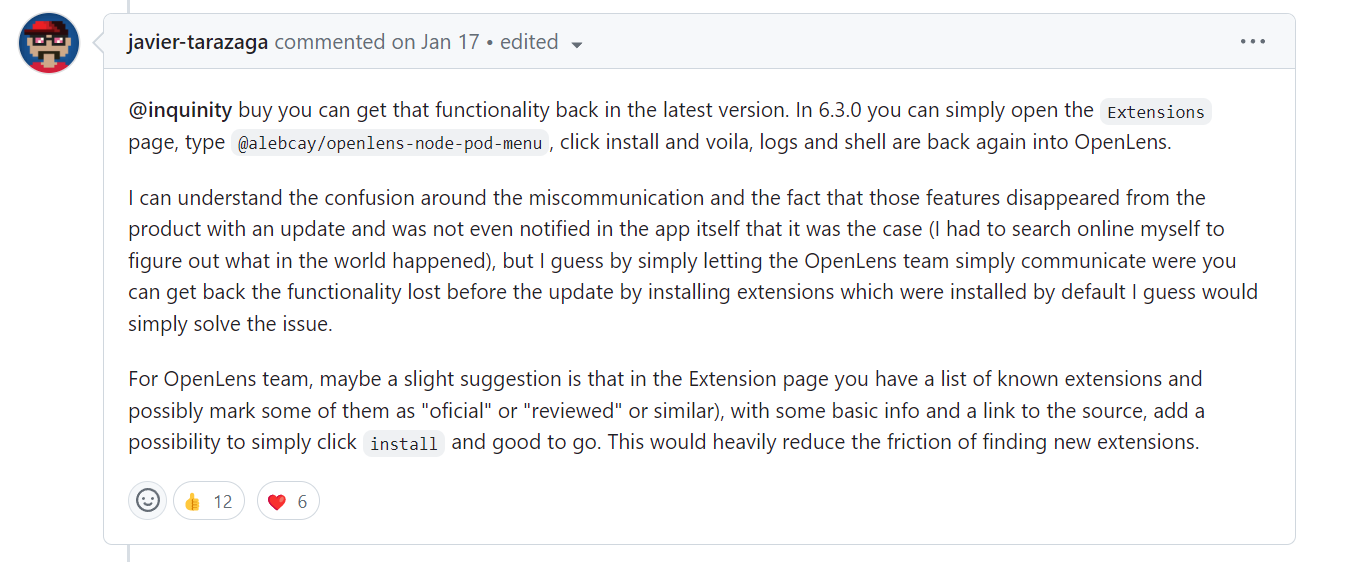
I wrote about how much I like the lens app K8s dashboard capability without needing to deploy K8s dashboard. Sadly recently, there has been some divergence from K8sLens being a pure open source to a licensed tool with an upstream open-source version called Open Lens (article here). It has fallen to individual contributors to maintain the open-lens binary (here) and made it available via Chocolatey and Brew. The downside is that one of the nice features of K8sLens has been removed – the ability to look at container logs. If you read the Git repo issue on this matter – you’ll see that a lot of people are not very happy about this.

If you read through all the commentary on the ticket, you’ll eventually find the following part of the post that describes how the feature can be reintroduced.

In short, if you use the extensions feature and provide the URL of the extension as @alebcay/openlens-node-pod-menu then the option will be reintroduced. The access to the extension is here:

The details …

The extension identified is detailed here.

I’m not sure why, but I did find the installation a little unstable, and needed to reinstall the plugin, restart OpenLens and reenable the plugin. But once we got past that, as you can see below the plugin delivered on its promise.

The problem with the licensing is that it doesn’t distinguish between me as an individual and using Lens for my own personal use vs. using Lens for commercial activities. The condition sets out:

ELIGIBILITY:You or your company have less than $10M in annual revenue or funding.

https://app.k8slens.dev/subscribe

Given this wording, I can’t use the licensed version, even if I was working on an open-source project and in a personal capacity, as the company I’m employed by has more than $10 million in revenue. For me, the issue is $200 per year is a lot for something I only need to use intermittently. While I get k8slens includes additional features such as Lens Security which performs vulnerability management, and Lens Teamwork, along with support, are features and services that are oriented to commercial use – these are features I don’t actually want or need. Lens Kubernetes sounds like an interesting proposition (a built-in distribution of K8s), but when many others already provide this freely – from Docker Desktop to Kind it seems rather limited in value.

We did try installing Komodor, given its claims for an always free edition. But on my Windows 11 Pro (developer early access) installation, it failed to install, as you can see:

Share this:

  • Click to share on Facebook (Opens in new window) Facebook
  • Click to share on X (Opens in new window) X
  • Click to share on Pocket (Opens in new window) Pocket
  • Click to share on Reddit (Opens in new window) Reddit
  • Click to email a link to a friend (Opens in new window) Email
  • Click to share on WhatsApp (Opens in new window) WhatsApp
  • Click to print (Opens in new window) Print
  • Click to share on Tumblr (Opens in new window) Tumblr
  • Click to share on Mastodon (Opens in new window) Mastodon
  • Click to share on Pinterest (Opens in new window) Pinterest
  • More
  • Click to share on Bluesky (Opens in new window) Bluesky
  • Click to share on LinkedIn (Opens in new window) LinkedIn
Like Loading...

K8s dashboard capability without needing to deploy K8s dashboard

14 Tuesday Jun 2022

Posted by mp3monster in Cloud Native, General, Technology

≈ 1 Comment

Tags

dashboard, K8s, Kubectl, Kubernetes, lens, UI

Let’s be honest we’re not all command line warriors when it comes to Kubernetes. I can get around Kubectl but the time it takes to key in a CLI command you can get the same information in a couple of clicks of the UI. For me, Kubectl is for automating my tasks, for example pushing a local build into a image repository, initiating a refresh deployment and ensuring old container instances are flushed out.

Lens view
K8s Dashboard

The only problem is that the K8s dashboard requires a lot of config work to secure its deployment, and do you want to be deploying such tools in a production environment? A colleague suggested I look at Lens. A tool that offers both Personal (free) and Team licensed versions and both versions deploy to Windows, Linux, and Mac natively so installation doesn’t require any messing around.

I have to say I have been very impressed with Lens. Everything useful about the K8s dashboard is here, but without needing to deploy anything to your cluster as lens runs as a local thick app. Just like the K8s dashboard you need the privileges to talk to the K8s APIs. But the Visualization is all local and the way the data is retrieved means the UI is very reactive.

Read more: K8s dashboard capability without needing to deploy K8s dashboard

Lens supports extensions, although to date I’ve not tried any of the extensions personally – you can see a list of extensions here. I will be trying out a couple Of extensions in due course. For example:

Network Policy Viewer
Certificate Info (via K8s secrets)

Lens goes further by the fact you can connect to multiple clusters from a single viewer instance. So no need for multiple deployments of the dashboard or creating an additional management cluster.

I only have one minor grumble today with the implementation. When using a console facility to access a container it is not possible to paste into the console any text/script or copy out any of the log contents. The latter can make generating things like JIRA tickets a bit annoying. So far I’ve worked around it by creating screenshots.

Useful Resources

  • K8s Lens website – https://k8slens.dev/
  • GitHub list of extensions – https://github.com/lensapp/lens-extensions
  • Kubernetes dashboard – https://github.com/kubernetes/dashboard

Share this:

  • Click to share on Facebook (Opens in new window) Facebook
  • Click to share on X (Opens in new window) X
  • Click to share on Pocket (Opens in new window) Pocket
  • Click to share on Reddit (Opens in new window) Reddit
  • Click to email a link to a friend (Opens in new window) Email
  • Click to share on WhatsApp (Opens in new window) WhatsApp
  • Click to print (Opens in new window) Print
  • Click to share on Tumblr (Opens in new window) Tumblr
  • Click to share on Mastodon (Opens in new window) Mastodon
  • Click to share on Pinterest (Opens in new window) Pinterest
  • More
  • Click to share on Bluesky (Opens in new window) Bluesky
  • Click to share on LinkedIn (Opens in new window) LinkedIn
Like Loading...

Container Registry – pushing and storing containers

12 Thursday May 2022

Posted by mp3monster in Cloud Native, General, Oracle, Oracle Cloud Native, Technology

≈ 2 Comments

Tags

container, development, Docker, Kubernetes, OCIR, OKE, Oracle, registry, Technology

A container registry is as essential as a Kubernetes service as you want to manage the deployable resources. That registry could be the public Docker repository or something else. In most people’s cases, the registry needs to be private as you don’t want to expose your product assets to potential external tampering. As a result, we need a service such as Oracle’s container registry OCIR.

The re of this blog is going to walk through how to push a container you’ve built into OCIR and a gotcha that can trip up users if you make assumptions about how the registry works.

Build container

Let’s assume you’re building your microservices locally or retrieving vetting 3rd party services for use. In both cases, you want to manually push your assets into OCIR manually rather than have an automated build pipeline do it for you.

To make it easier to see what is happening, we can exploit some code from Oracle’s Github repo (such as this piece being developed) or you could use the classic hello world container (https://github.com/whotutorials/docker-busybox-hello-world/blob/master/Dockerfile). For the rest of the post, we’ll assume it is the code developed for the Oracle Architecture Center-provided code.

docker build -t event-data-svc .

This creates a container locally, and we can see the container listed using the command:

docker images

Setup of OCIR

We need an OCIR to target so the easiest thing is to manually create an OCIR instance in one of the regions, for the sake of this illustration we’ll use Ashburn (short code is IAD). To help with the visibility we can put the registry in a separate compartment as a child of the root. Let’s assume we’re going to call the registry GraphQL. So before creating your OCIR set up the compartment as necessary.

fragment of the compartment hierarchy

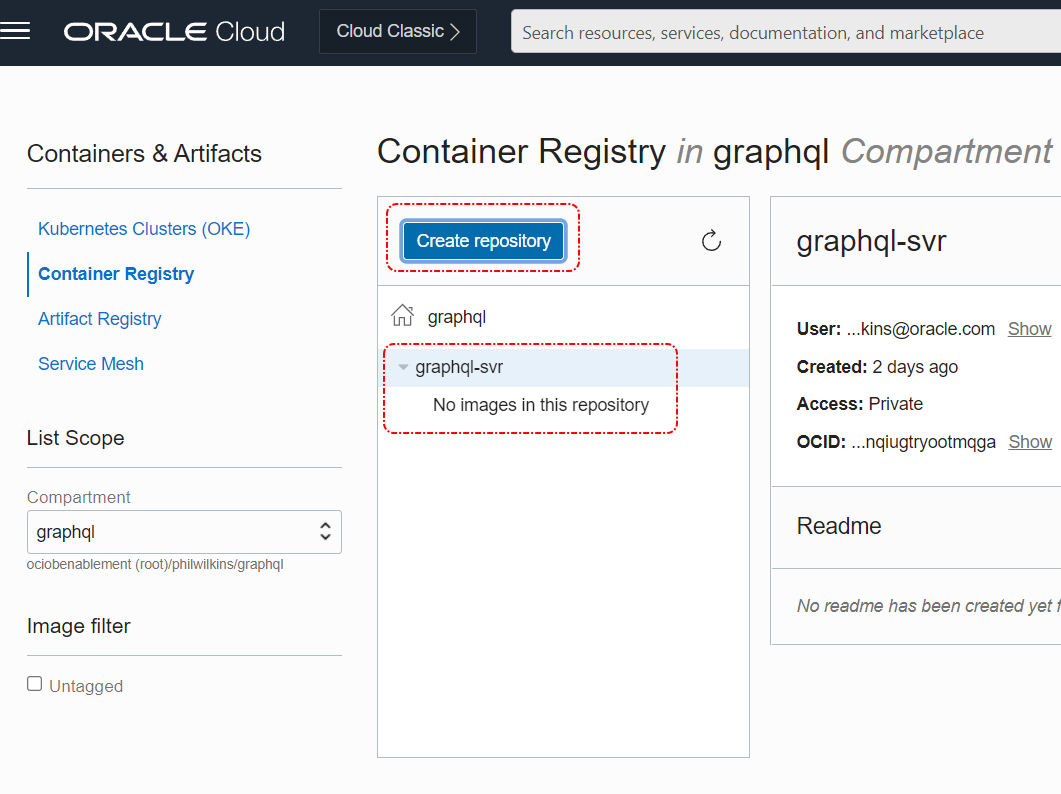
In the screenshot, you can see I’ve created a registry, which is very quick and easy in the UI (in the menu it’s in the Developer Services section).

The Oracle meu to navigate to the OCIR service
the UI to create a OCIR

Finally, we click on the button to create the specific OCIR.

Deployment…

Having created the image, and with a repo ready we can start the steps of pushing the container to OCIR.

The next step is to tag the created image. This has to be done carefully as the tag needs to reflect where the image is going using the formula <region name>/<tenancy name/<registry name>:<version>. All the registries will be addressed by <region short code>.ocir.io In our case, it would be iad.ocir.io.

docker tag graph-svr:latest iad.ocir.io/ociobenablement/graphql-svr:v0.1-dev

As you may have realized the tag being applied effectively tells OCI which instance of OCIR to place the container in. Getting this wrong can be the core of the gotcha previously mentioned and we’ll elaborate upon it shortly.

To sign in you’ll need an auth token as that is passed as the password. For simplicity, I’ve passed the token in the docker command, which Docker will warn you of as being insecure, and suggest it is passed in as part of a prompt. Note my token will have been changed by the time this is published. The username is built on the structure of <cloud tenancy name>/identitycloudservice/<username>. The identitycloudservice piece only needs to be included for your authentication is managed through IDCS, as is the case here. The final bit is the URI for the appropriate regional OCIR address, as we’ve used previously.

docker login -u ociobenablement/identitycloudservice/philip.wilkins@oracle.com -p XXXXXXXXXXX  iad.ocir.io

With hopefully a successful authentication response we can push the container. It is worth noting that the Docker authenticated connection will timeout which is why we’ve put everything in place before connecting. The push command is very simple, it is the tag name assigned to the artifact including the version number.

docker push iad.ocir.io/ociobenablement/graphql/graph-svr:v0.1-dev
OCIR with several versions of a container

Avoiding the gotcha

When we deal with repositories from Git to SVN or Apache Archiva to Nexus we work with a repository that holds multiple different assets with multiple versions of those assets. as a result, when we identify an asset uniquely we would expect to name things based on server/location, repository, asset name, and version. However, here each repository is designed for one type of asset but multiple versions. In reality, a Docker repository works in the same manner (but the extended path impact is different).

This means it becomes easy to accidentally define a tag with an extra element. Depending upon your OCI tenancy privileges if you get the path wrong, OCI creates a new root compartment container repository with a name that is a composite of the name elements after the tenancy and puts your artifact in that repository, not the one you expected.

We can address this in several ways, first and probably the best option is to automate the process of loading assets into OCIR, once the process is correct, it will remain correct. Another is to adopt a principle of never holding repositories at the root of a tenancy, which means you can then explicitly remove the permissions to create repositories in that compartment (you’ll need to explicitly grant the permissions elsewhere in the compartment hierarchy because of policy inheritance. This will result in the process of pushing a container to fail because of privileges if the tag is wrong.

Visual representation of structure differences

Repository Structure
Registry Structure

Condensed to a simple script

These steps can be condensed to a simple platform neutral script as follows:

docker build -t event-data-svc .
docker tag event-data-svc:latest iad.ocir.io/ociobenablement/event-data-svc:latest

docker login -u ociobenablement/identitycloudservice/philip.wilkins@oracle.com -p XXXXX  iad.ocir.io
docker push iad.ocir.io/ociobenablement/event-data-svc:latest

This script would need modifying for each container being built, but you could easily make it parameterized or configuration drive.

A Note on Registry Standards

Oracle’s Container Registry has adopted the Open Registries standard for OCIR. Open Registries come under the Linux Foundation‘s governance. This standard has been adopted by all the major hyperscalers (Google, AWS, Azure, etc). All the technical spec information for the standard is published through GitHub rather than the main website.

References

  • Push an Image to Oracle Cloud Infrastructure Registry
  • Notes about Repository Creation
  • Creating a Container Registry
  • Open Registries
  • Policies to Control Repository Access

Share this:

  • Click to share on Facebook (Opens in new window) Facebook
  • Click to share on X (Opens in new window) X
  • Click to share on Pocket (Opens in new window) Pocket
  • Click to share on Reddit (Opens in new window) Reddit
  • Click to email a link to a friend (Opens in new window) Email
  • Click to share on WhatsApp (Opens in new window) WhatsApp
  • Click to print (Opens in new window) Print
  • Click to share on Tumblr (Opens in new window) Tumblr
  • Click to share on Mastodon (Opens in new window) Mastodon
  • Click to share on Pinterest (Opens in new window) Pinterest
  • More
  • Click to share on Bluesky (Opens in new window) Bluesky
  • Click to share on LinkedIn (Opens in new window) LinkedIn
Like Loading...

Istio In Action

25 Friday Mar 2022

Posted by mp3monster in Book Reviews, Books, General, manning

≈ Leave a comment

Tags

book, Istio, K8s, Kubernetes, manning, mesh, mindmap

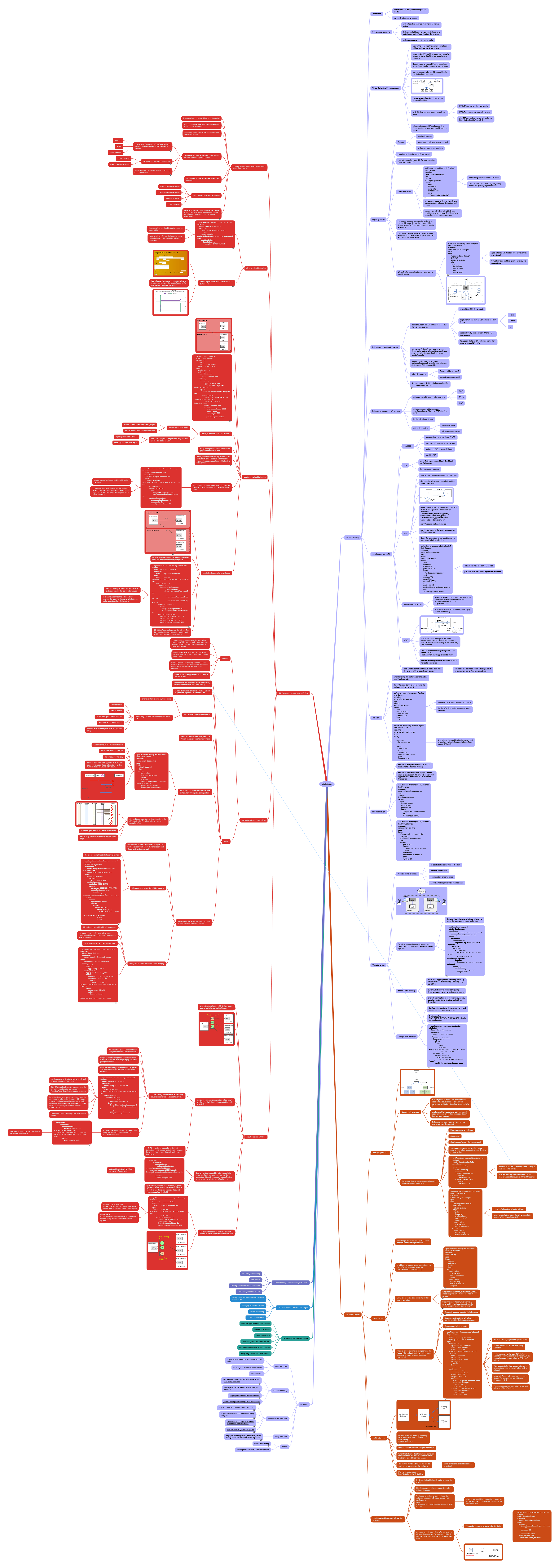
Christian Posta and Rinor Maloku’s book with Manning, Istio In Action has just been published. I’ve previously said it’s a good book, and that’s not surprising given Christian’s role at solo.io. When the final chapters became available I started to go through it in more detail and built a mind map (As with the recent review of Kubernetes best practices). The map can be seen below.

As you can see the map is very substantial reflecting on the depth and value of the book. For those who look at the maps, may notice there are a couple of chapters not fully mapped. I will update the map to fill those gaps in, but given they focus on monitoring and observability, I was less concerned about those areas given my own writing. The book’s exercises are very much built around using Docker Desktop making it very easy to spin up the examples and exercises. If you want to know about Istio Service Mesh on K8s then I’d recommend it.

Reading through the book, I’ve learned details that I was not entirely aware of, for example the integration of non K8s workloads into the mesh. The tuning of Istio to keep it highly performant with a lot of workloads.

The book can be obtained from:

  • Manning
  • Amazon

And other retailers of course.

Share this:

  • Click to share on Facebook (Opens in new window) Facebook
  • Click to share on X (Opens in new window) X
  • Click to share on Pocket (Opens in new window) Pocket
  • Click to share on Reddit (Opens in new window) Reddit
  • Click to email a link to a friend (Opens in new window) Email
  • Click to share on WhatsApp (Opens in new window) WhatsApp
  • Click to print (Opens in new window) Print
  • Click to share on Tumblr (Opens in new window) Tumblr
  • Click to share on Mastodon (Opens in new window) Mastodon
  • Click to share on Pinterest (Opens in new window) Pinterest
  • More
  • Click to share on Bluesky (Opens in new window) Bluesky
  • Click to share on LinkedIn (Opens in new window) LinkedIn
Like Loading...

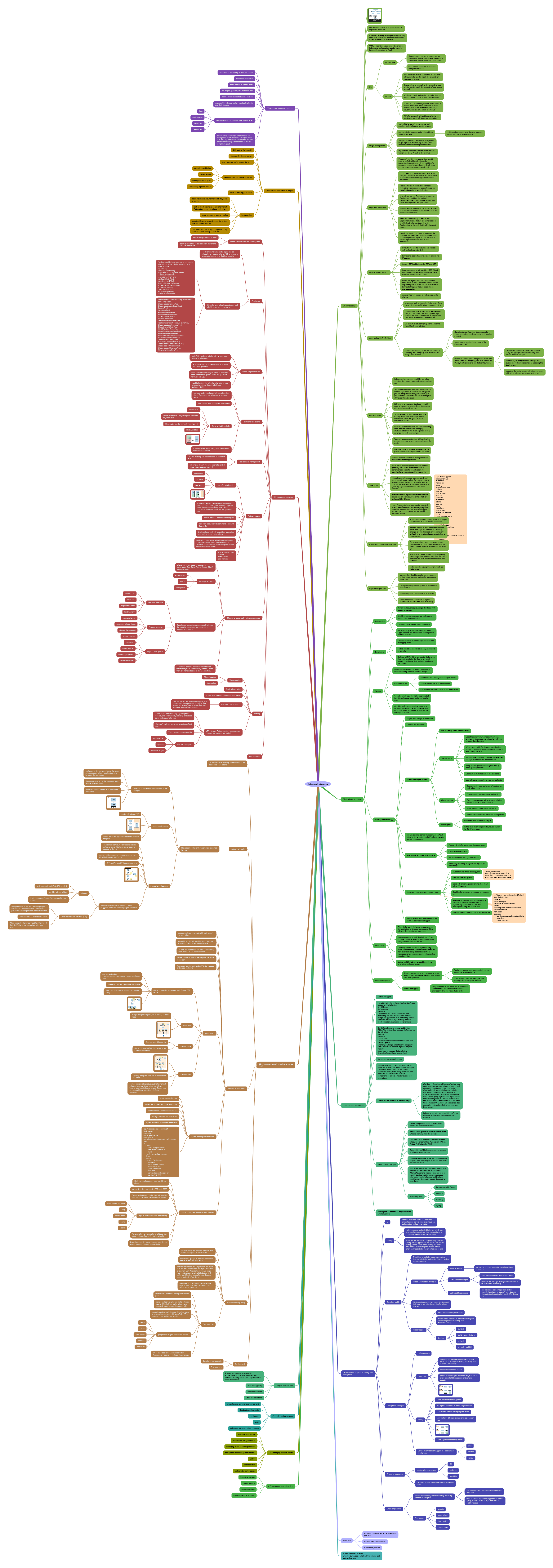
Kubernetes Best Practises – Review & Mindmaps

13 Thursday Jan 2022

Posted by mp3monster in APIs & microservices, Book Reviews, Books, Cloud, Cloud Native, development, General, Technology

≈ 2 Comments

Tags

"best practise", book, Istio, Kubernetes, mindmap, review

I’ve had some time to catch up on books I’d like to read, including Kubernetes Best Practises in the last few weeks. While I think I have a fair handle on Kubernetes, the development of my understanding has been a bit ad-hoc as I’ve dug into different areas as I’ve needed to know more. This meant reading a Dummies/Introduction to entry style guide would, to an extent, likely prove to be a frustrating read. Given this, I went for the best practises book because if I don’t understand the practises, then there are gaps in my understanding still, and I can look at more foundation resources.

As it goes, this book was perfect. It quickly covered the basics of the different aspects of Kubernetes helping to give context to the more advanced aspects, and the best practices become almost a formulated summary in each section. The depth of coverage and detail is certainly very comprehensive, explaining the background of CNI (Container Network Interface) to network-level security within Kubernetes.

The book touched upon Service Meshes such as Istio and Linkerd2 but didn’t go into great depth, but again this is probably down to the fact that Service Mesh ideas are still maturing, and you have initiatives like SMI (Service Mesh Interface still in the CNCF’s sandbox).

In terms of best practices, that really stood out for me:

  • Use of Taints and Tolerations for refined control of pod deployment (Allowing affinity to be controlled to optimise resilience, or direct types of pod deployment to nodes with specialist capabilities such as GPU).
  • There are a lot more differences and options then you might realize in terms of ingress controller capabilities, so take time to identify what you may need from an ingress controller.
  • Don’t forget pods can be scaled vertically with the VPA (Vertical Pod Autoscaler)as well as horizontally through the HPA.
  • While using a managed persistence service will make statement storage a lot easier, stateful sets will give you a very portable solution.

As with a lot of technical books I read. As I go through the book I build up a mind map of what I think are the key points. Doing so leaves me with a resource I can use as a quick reference, but creating the mind map helps reinforce the learning. So here is the mind map …


  • mindmap in iThoughts format
  • mindmap in FreeMind format
  • mindmap as an expanded png

Share this:

  • Click to share on Facebook (Opens in new window) Facebook
  • Click to share on X (Opens in new window) X
  • Click to share on Pocket (Opens in new window) Pocket
  • Click to share on Reddit (Opens in new window) Reddit
  • Click to email a link to a friend (Opens in new window) Email
  • Click to share on WhatsApp (Opens in new window) WhatsApp
  • Click to print (Opens in new window) Print
  • Click to share on Tumblr (Opens in new window) Tumblr
  • Click to share on Mastodon (Opens in new window) Mastodon
  • Click to share on Pinterest (Opens in new window) Pinterest
  • More
  • Click to share on Bluesky (Opens in new window) Bluesky
  • Click to share on LinkedIn (Opens in new window) LinkedIn
Like Loading...

Logging In Action – almost there

08 Thursday Jul 2021

Posted by mp3monster in Books, General, manning

≈ Leave a comment

Tags

CNCF, Docker, Fluentd, fluentd bit, Kubernetes, logging

We’ve got the peer review comments back on the completed 1st draft back of the book. So I’d like to take this opportunity to thanks those who have been involved as peer reviewers, particularly those involved in the previous review cycles. I hope the reviewers found it satisfying to see between iterations that their suggestions and feedback have been taken on board and where we can.

The feed back is really exciting to read. Some tweaks and refinements to do to address the suggestions made.

The work on the Kubernetes and Docker elements and the chapter which has become available on MEAP has helped round that aspect off. But importantly, the final chapters help address the wider challenges of logging, and some of the feedback positively reflects this.

To paraphrase the comments, we’ve addressed the issues of logging which don’t get the attention that they deserve. Which for me is a success.

Share this:

  • Click to share on Facebook (Opens in new window) Facebook
  • Click to share on X (Opens in new window) X
  • Click to share on Pocket (Opens in new window) Pocket
  • Click to share on Reddit (Opens in new window) Reddit
  • Click to email a link to a friend (Opens in new window) Email
  • Click to share on WhatsApp (Opens in new window) WhatsApp
  • Click to print (Opens in new window) Print
  • Click to share on Tumblr (Opens in new window) Tumblr
  • Click to share on Mastodon (Opens in new window) Mastodon
  • Click to share on Pinterest (Opens in new window) Pinterest
  • More
  • Click to share on Bluesky (Opens in new window) Bluesky
  • Click to share on LinkedIn (Opens in new window) LinkedIn
Like Loading...

Unified Logging with Fluentd becomes Logging in Action using Fluentd, Kubernetes and more

08 Monday Feb 2021

Posted by mp3monster in Books, Fluentd, General, manning, Technology

≈ Leave a comment

Tags

book, Fluentd, In Action, Kubernetes, manning, progress

The book has had a title change as Manning found that links the book was clashing with other solutions using the term ‘Unified Logging’. With the name change it helps bring the book inline with the Manning naming with their In action series. This means the book website is now https://www.manning.com/books/logging-in-action.

With the name change we’ve agreed that there should an additional chapter added. As I’d written the book with a view that everything we cover applies to both modern solutions such as Microservices coming from the CNCF camp but equally relevant to more traditional IT landscapes. Within the book we have explianed how things are positioned and can be used in Kubernetes, but it was agreed with our editorial team that not tackling the configuration of Fluentd with Kubernetes and Docker was to an extent ignoring a key community that will be using Fluentd. So the new chapter will be introduced to address this aspect.

In terms of progress we’re into the 1’s – 1 Chapter to start (the new one), 1 Chapter back from the Technical Editor (Logging Best Practises) – some edits to be done, 1 Chapter now with the editor (How To Create Custom Plugins), 1 Chapter being finished (Logging Frameworks) and finally 1 peer review cycle to go.

Given the lovely review comments that have been quoted on the book’s page. I can only recommend if you have an interest in logging and monitoring then check it out through Manning Early Access Programme (MEAP).

Share this:

  • Click to share on Facebook (Opens in new window) Facebook
  • Click to share on X (Opens in new window) X
  • Click to share on Pocket (Opens in new window) Pocket
  • Click to share on Reddit (Opens in new window) Reddit
  • Click to email a link to a friend (Opens in new window) Email
  • Click to share on WhatsApp (Opens in new window) WhatsApp
  • Click to print (Opens in new window) Print
  • Click to share on Tumblr (Opens in new window) Tumblr
  • Click to share on Mastodon (Opens in new window) Mastodon
  • Click to share on Pinterest (Opens in new window) Pinterest
  • More
  • Click to share on Bluesky (Opens in new window) Bluesky
  • Click to share on LinkedIn (Opens in new window) LinkedIn
Like Loading...
← Older posts

    I work for Oracle, all opinions here are my own & do not necessarily reflect the views of Oracle

    • About
      • Internet Profile
      • Music Buying
      • Presenting Activities
    • Books & Publications
      • Logging in Action with Fluentd, Kubernetes and More
      • Logs and Telemetry using Fluent Bit
      • Oracle Integration
      • API & API Platform
        • API Useful Resources
        • Useful Reading Sources
    • Mindmaps Index
    • Monster On Music
      • Music Listening
      • Music Reading
    • Oracle Resources
    • Useful Tech Resources
      • Fluentd & Fluent Bit Additional stuff
        • Logging Frameworks and Fluent Bit and Fluentd connectivity
        • REGEX for BIC and IBAN processing
      • Java and Graal Useful Links
      • Official Sources for Product Logos
      • Python Setup & related tips
      • Recommended Tech Podcasts

    Oracle Ace Director Alumni

    TOGAF 9

    Logs and Telemetry using Fluent Bit


    Logging in Action — Fluentd

    Logging in Action with Fluentd


    Oracle Cloud Integration Book


    API Platform Book


    Oracle Dev Meetup London

    Blog Categories

    • App Ideas
    • Books
      • Book Reviews
      • manning
      • Oracle Press
      • Packt
    • Enterprise architecture
    • General
      • economy
      • ExternalWebPublications
      • LinkedIn
      • Website
    • Music
      • Music Resources
      • Music Reviews
    • Photography
    • Podcasts
    • Technology
      • AI
      • APIs & microservices
      • chatbots
      • Cloud
      • Cloud Native
      • Dev Meetup
      • development
        • languages
          • java
          • node.js
      • drone
      • Fluentbit
      • Fluentd
      • logsimulator
      • mindmap
      • OMESA
      • Oracle
        • API Platform CS
          • tools
        • Helidon
        • ITSO & OEAF
        • Java Cloud
        • NodeJS Cloud
        • OIC – ICS
        • Oracle Cloud Native
        • OUG
      • railroad diagrams
      • TOGAF
    • xxRetired
    • AI
    • API Platform CS
    • APIs & microservices
    • App Ideas
    • Book Reviews
    • Books
    • chatbots
    • Cloud
    • Cloud Native
    • Dev Meetup
    • development
    • drone
    • economy
    • Enterprise architecture
    • ExternalWebPublications
    • Fluentbit
    • Fluentd
    • General
    • Helidon
    • ITSO & OEAF
    • java
    • Java Cloud
    • languages
    • LinkedIn
    • logsimulator
    • manning
    • mindmap
    • Music
    • Music Resources
    • Music Reviews
    • node.js
    • NodeJS Cloud
    • OIC – ICS
    • OMESA
    • Oracle
    • Oracle Cloud Native
    • Oracle Press
    • OUG
    • Packt
    • Photography
    • Podcasts
    • railroad diagrams
    • Technology
    • TOGAF
    • tools
    • Website
    • xxRetired

    Enter your email address to subscribe to this blog and receive notifications of new posts by email.

    Join 2,555 other subscribers

    RSS

    RSS Feed RSS - Posts

    RSS Feed RSS - Comments

    January 2026
    M T W T F S S
     1234
    567891011
    12131415161718
    19202122232425
    262728293031  
    « Nov    

    Twitter

    Tweets by mp3monster

    History

    Speaker Recognition

    Open Source Summit Speaker

    Flickr Pics

    Gogo Penguin at the BarbicanGogo Penguin at the BarbicanGogo Penguin at the BarbicanGogo Penguin at the Barbican
    More Photos

    Social

    • View @mp3monster’s profile on Twitter
    • View philwilkins’s profile on LinkedIn
    • View mp3monster’s profile on GitHub
    • View mp3monster’s profile on Flickr
    • View mp3muncher’s profile on WordPress.org
    • View philmp3monster’s profile on Twitch
    Follow Phil (aka MP3Monster)'s Blog on WordPress.com

    Blog at WordPress.com.

    • Subscribe Subscribed
      • Phil (aka MP3Monster)'s Blog
      • Join 233 other subscribers
      • Already have a WordPress.com account? Log in now.
      • Phil (aka MP3Monster)'s Blog
      • Subscribe Subscribed
      • Sign up
      • Log in
      • Report this content
      • View site in Reader
      • Manage subscriptions
      • Collapse this bar
     

    Loading Comments...
     

    You must be logged in to post a comment.

      Privacy & Cookies: This site uses cookies. By continuing to use this website, you agree to their use.
      To find out more, including how to control cookies, see here: Our Cookie Policy
      %d