Implementing API Platform Book extract
19 Tuesday Jun 2018
Posted in API Platform CS, Books, Packt, Technology

19 Tuesday Jun 2018
Posted in API Platform CS, Books, Packt, Technology
18 Monday Jun 2018
Posted in Dev Meetup, General, Oracle, Technology
We have been fortunate enough to participate an ArchDev podcast about meetups – https://oracledevs.podbean.com/e/pizza-beer-and-dev-expertise-at-your-local-meet-up/
 The podcast talks about the differences between the meet-ups and events such as conferences, what we try to get out of a meetup and the effort put into arranging them.
For more info about the meetup I help organise checkout out https://www.meetup.com/Oracle-Developer-Meetup-London/events/249256400/
We’d also like to thankyou Jurgen Kress and his team for all the behind the scenes work that means the London Dev Meetup events can happen and ensure all are suitable feed and watered.
11 Monday Jun 2018
Posted in General, Oracle, Technology
I have a new blog post over on the Capgemini site – https://www.capgemini.com/2018/06/oracle-code-london/ talks about the way Oracle has changed its engagement towards developers and the Oracle Code London event that I presented at – first mentioned at Oracle Code London – Presentation & Periscope Interview
31 Thursday May 2018
Posted in General, Oracle, Technology
Tags
Whilst in London Wednesday to present Microservices in a Monolith World at the Oracle Code London, I also participated in an interview streamed via Periscope. The interview can be seen at https://www.pscp.tv/w/1jMKgqBrwYyJL
Not only was this interview captured, my entire presentation is available on YouTube …
21 Monday May 2018
Posted in API Platform CS, General, Oracle, Technology, tools
Tags
Updated reflecting changes discussed in blog post:
Making Scripts Work with IDCS Deployed PaaS
The last week or two I have been working on a new API Platform utility to add to my existing tools (see here). This tool addresses the question of generating documentation. Much as been said about API documentation and the quality of it, check out these articles :
If you look at these articles and others, there are some common themes, which are:
Apiary covers the first theme to a first class standard, and you will see Apiary called out for its ability to document APIs in a lot of articles. Well written API Blueprints will cover the bulk of the second bullet. But the other points tend to fall outside of a Blueprint and fit more the API Policies and their use.
Not everyone is so commited or enjoys writing documentation. The other driver for going beyond the use of Apiary is that some organizations feel the need to have a traditional word style document to capture/define an API’s contract in detail. With the API Platform the management portal enables an API to be published into the developer portal with the Apiary definition and a markdown file for further documentation.

08 Tuesday May 2018
Posted in General, Oracle, OUG, Technology
Tags
The call for papers for the U.K. Oracle User Group’s 2018 Conference in December is out. The committee are looking for papers across not just core Oracle technologies like the database and SOA Suite but newer technologies such as Event Hub. With Oracle’s engagement with developers and the commitment to open source the UKOUG has moved to engage with these users as well. So the committee will welcome submissions about open source tech that maybe run on an Oracle platform. You can submit your proposals here.
If you’re considering making a submission but want some advise or suggestions then reachout to the UKOUG and its committee members – contact details are here.

We look forward to seeing you in Liverpool in December.
07 Monday May 2018
Posted in General, Oracle, Technology
Oracle Cloud is growing and maturing at a tremendous rate if the breadth of PaaS capabilities is any indication. However, there are a few gotchas out there, that can cause some headaches if they get you. These typically relate to processes that impact across different functional areas. A common middleware stack (API CS, SOA CS, OIC etc) will look something like the following:
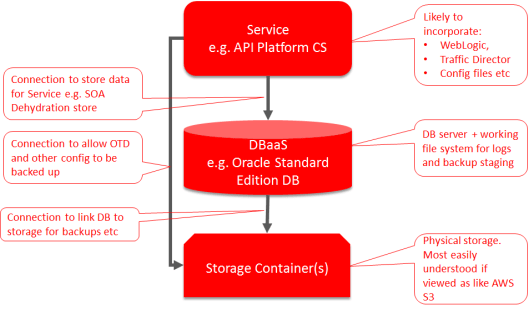
As the diagram shows when you build the cloud services, the layers get configured with credentials to the lower layers needed (although Oracle have in the pipeline the Oracle managed version of many services where this is probably going to be hidden from us). Continue reading
27 Tuesday Feb 2018
Posted in API Platform CS, APIs & microservices, Books, General, Oracle, Technology
Tags
API Platform, API-P, APIs & microservices, CLI, command line, GitHub, Oracle, revert forward, utility, versioning
Updated reflecting changes discussed in blog post:
 Making Scripts Work with IDCS Deployed PaaS
Oracle’s API Platform (API-P) product avoids the use of external configuration management. If you want to better understand why, then checkout our forthcoming book as it goes into detail about why this is the case (it can be pre-release version of the book can be obtained here). In a previous blog I wrote about and illustrated the use of the API-P’s own APIs so that it was possible to see what API iterations had been deployed to API Gateways.
In this blog I want to explore the issues of version management a bit further. API-P provides internal version management through the idea of iterations as previously explored (Understanding API Deployment State on API Platform). In addition to this there are API policy attributes called version, status etc. This information whilst having some impact on behaviour reflects the version of the ‘contract’ that the API represents between the consumer and provider, and requires a manual change.

The API policies themselves are version tracked through the iteration identifiers. Each time a policy is saved the iteration is is incremented. What the API-P doesn’t support is the concept of branching. In relatively simple API Policy branching is unlikely to ever be an issue.
Let’s take a more complex scenario. In our book API Platform we introduced the some APIs that would allow the retrieval of meta data about artists in the record companies’ catalog. It has however come to light that the API has been targeted with malicious calls, firstly through trying to attack using injection attacks and secondly trying to overload the back end by creating data requests that make the back-end work hard in retrieving data.
To defend against this, the API Policy has been enhanced to include some custom groovy policies to inspect the values provided. Strictly speaking following the principles of Semantic Versioning the API version should go from 1.0.0 to 1.0.1. However seeing that the ‘contract’ as presented to the consumer hasn’t really changed – the data models are the same, the URI goes unaltered resulting in the implementation team not changing the version.
During development processes, it is not unusual to be developing existing logic, and decide that approach being used isn’t right or not going to perform as well. So you abandon your changes and revert back to the last approved version. However, this isn’t possible as any save will result in a new iteration. The API-P will be getting some enhanced version management features. But today to be able to undo the changes we need a means to ‘revert forward‘ (hence the tool name) that is to take an older iteration and make it the latest, as illustrated in the next diagram.

Today the API-P doesn’t provide a means to perform this process within the User interface. However when looking at a gateway you can review the API policy deployed. As we established previously that you may have different gateways deployed with different iterations. Given this, as API-P has been built true to the principles of separating the UI from the back-end through the use of APIs we can deduce there should be a means to get the details of an API with a specific iteration.
To this end we have built on the pattern previously illustrated to provide the means to ‘Revert Forward’ by creating a Groovy script that will use the APIs provided by API-P to retrieve an iteration and push it back at the latest version. When the policy is pushed back it also modifies the description to show which iteration has been pushed.
You may ask, why not use the conventional developer approach of branching as suggested in the following diagram. However API-P’s iteration framework doesn’t extend to support this.
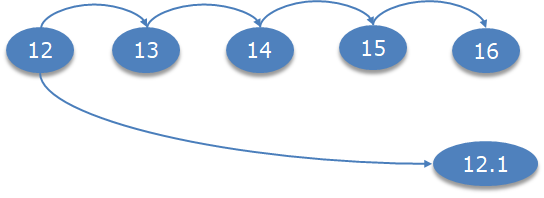
The next with this is pretty predictable – how do I know which iteration to revert to. You have two options here, firstly either revert in order so you can see the prior version in turn – which whilst visually good, is not necessarily the most practical option. So in the tool we have a parameter that will allow you to display on the console the configuration of each iteration. This does mean you are going to see the policies in a JSON presentation. To make life easier we would recommend good practise and recording in the policy description information that helps determine the policy’s characteristics – and this can be used to better determine iteration behaviour.
If we are able to take an earlier iteration and make it the latest one by pushing it back then it is a short step to actually target a different management cloud in effect migrating the policies. Whilst possible it comes with some serious cautions …
Oracle does not recommend that the policies be stored anywhere outside of the platform, whilst it this utility makes that a possibility, it deliberately avoids writing any of the information to the file, the policies only reside outside of the platform for the duration of the process execution.
All the parameters assume the values will not contain any space characters. Each command is preceded by a dash eg. revertForward.groovy -inpassword mypass -inSvr https://a.b.com
The code can be obtained from my GitHub repository here.
07 Wednesday Feb 2018
Posted in API Platform CS, APIs & microservices, General, Technology
As APIs become more pervasive within our solutions we see the arrival of not just design and cataloging tools such as Apiary, Apigee and others but also the arrival of gateways. The gateways provide execution of operations including validation, accounting (moneytization), routing, and other controls such as throttled checks that would often not occur until the first contact with a service bus. For example initial routing based on the API call, fine grained authentication and authorisation (differing from your firewalls who will just perhaps authorise).
In the more traditional integration middleware of Oracle Service Bus and SOA (regardless of cloud, on-premises) you can trace the execution through the middleware end to end. This tracing can be achieved because the platform creates and assigns the a UUID (aka eCID) and ensures that it is carried through the middleware. It is this very behaviour that allows Oracle to provide Business Activity Monitoring without any need to be invasive. Burt not only that in a highly distyributed environment you can track the processing of a transaction from end to end.
The challenge now is that the first point of middleware style behaviour can be at the gateway. So we actually need to move forward the UUID or equivalent forward the the first point of contact. Not only that we need to think about the fact we will see non Oracle integration middleware involved. Within Spring, Kabana and other established frameworks and tools which are getting signficiant traction with the rise of Microservices, the Ids being used are not the same as the UUIDs used by Oracle. For example Spring Cloud Slueth uses the same HTTP header Ids that Zipkin and Kabana support:
More information can be found here and here.
For the new Oracle API Platform Cloud Service we can check for the existance of the header attributes as a policy and apply actions such as:
Ultimately it would be more attractive to apply the logic using the API Platform’s SDK but to get things rolling applying the IDs with the API Groovy policy is sufficient (more here).
Next question that begs, is where to put the ID and want to call it? Put the value in the body, and you’re invading the business aspect of an API with execution specific details, not to mention potentially changing the API definition. Whilst stuffing HTTP(s) headers with custom attributes is often discouraged as the values aren’t to immediately visible. In my opinion at least the answer largely has been set by president for us. If you weren’t using HTTPS but JMS then you would use the header, but also a number of frameworks already exist that do make use of this strategy such as those mentioned above.
Using the header defined by Kabana etc means that the very process will mean that a number of Support tools out of the box will understand and be able to help visualise your logs with no additional effort.
The following is a Groovy script that could ber used for the purposes of applying an Id appropriately into the HTTP header in the API Platform:
if (!context.getApiRequest().getHeaders().containsKey ("baggage-UUID "))
{
  // use current time to seed random generator
  def now = java.time.Instant.now()
  def random = new java.util.Random(now.getEpochSecond())

  // create an array of 16 bytes to hold the random value
  byte[] uid = new byte[16]
  random.nextBytes(uid)

  // convert the random string from Hex to an ASCII string
  Writable uidInHex= uid.encodeHex()
  String uidStr= uidInHex.toString()

  // set the outbound header
  context.getServiceRequest().setHeader("baggage-UUID", uidStr)
}
05 Monday Feb 2018
Posted in API Platform CS, APIs & microservices, Books, General, mindmap
Tags
When it comes to ensuring I keep up good practises, I try to look at books in areas I think I have a good handle on such as APIs. Why? well it confirms and validates I’m upto date; sometimes another view point can spark ideas on how to make something better, improve an approach or simply understand another way of explaining an idea. The later is important as the key benefit of knowing something is the opportunity to help someone else. Not everyone communicates or understands ideas in the same so this is always helpful.
 So recently I ran through James Higginbotham’s Designing Great Web API’s book(let). Often when goping through a book I mindmap it so that I can share it, and refer to it as a lit of prompts reminders if necessary. Whilst’s James’ book doesnt reveal anything new or relevatory for anyone working with APIs it does provide a good succinct explination to basic practises. So here is the mindmap:
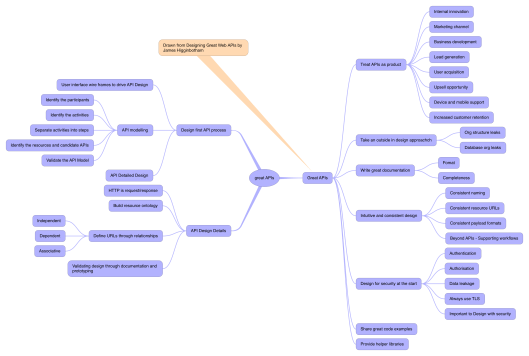
You can also access my MapWise view here. James’ book can be obtained freely from O’Reilly here.
The book doesn’t go into the depth of details for practises that Apiary (Pro Edition) offers with style guidelines which will describe morec detailed recommended practises (more here).

 Phil (aka MP3Monster)'s Blog
You must be logged in to post a comment.