
• Home
  • Site Aliases
    • www.cloud-native.info
  • About
    • Background
    • Presenting Activities
    • Internet Profile
      • LinkedIn
    • About
  • Books & Publications
    • Log Generator
    • Logs and Telemetry using Fluent Bit
      • Fluent Bit book
      • Book Resources in GitHub
      • Fluent Bit Classic to YAML Format configurations
    • Logging in Action with Fluentd, Kubernetes and More
      • Logging in Action with Fluentd – Book
      • Fluentd Book Resources
      • Fluentd & Fluent Bit Additional stuff
    • API & API Platform
      • API Useful Resources
    • Oracle Integration
      • Book Website
      • Useful Reading Sources
    • Publication Contributions
  • Resources
    • GitHub
    • Oracle Integration Site
    • Oracle Resources
    • Mindmaps Index
    • Useful Tech Resources
      • Fluentd & Fluent Bit Additional stuff
      • Recommended Tech Podcasts
      • Official Sources for Product Logos
      • Java and Graal Useful Links
      • Python Setup & related stuff
      • DevTips
  • Music
    • Monster On Music
    • Music Listening
    • Music Reading

Phil (aka MP3Monster)'s Blog

~ from Technology to Music

Phil (aka MP3Monster)'s Blog

Category Archives: Technology

A busy 25 hours at UKOUG Conference

05 Tuesday Dec 2017

Posted by mp3monster in General, OIC - ICS, Oracle, Technology

≈ Leave a comment

Tags

Cloud, conference, integration, messaging, OIC, OIC - ICS, OMESA, OraWorld, OUG, PushListener, WebScript

I’ve just come to the end of a very busy 25 hours at the UK Oracle User Group (UKOUG) Conference in Birmingham. Four presentations – interestingly the same subject area, that of Oracle Integration Cloud (OIC) / Integration Cloud Service (ICS) started and ended the day.  Between this we also covered some approaches to start working towards Microservices in a Monolith World and Oracle Messaging Cloud.

Below are the presentations on the Microservices and ICS/OIC. The piece on Oracle Messaging Cloud was largely demo based, so rather than sharing the presentation slides, which won’t tell you too much. The best way to find out about this is to read the 2 articles about the capability in the OraWorld magazine (issues 6 & 7). With issue 7 perfectly timed by becoming available in the last couple of days.

With the Oracle Messaging Cloud article, there is one word of caution. When the article was written and submitted I used a free cloud service (which using contemporary terminology we’d describe as Serverless) called WebScript.io.  The WebScript piece served to make it easy to consume the webservice calls illustrating the PushListener feature.  This service however is being closed down – a shame as it was an elegantly simple solution.  Given this I am currently working on a blog post which will show how another services can take the place of WebScript.io; whilst not finalised, this maybe Google Cloud Functions.

If this wasn’t enough we also squeezed in the keynote presentations, a meeting with several other contributors to OMESA (Open Modern Enterprise Software Architecture) , a lunch conversation with our Publisher (Packt) and several other Oracle book authors, Oracle Ace dinner (great food with a lot of brilliant & friendly people), some very valuable incidental conversations and some work for a customer.

Microservices in a Monolith World

Look at Oracle Integration Cloud – its relationship to ICS. Customer use Cases an Insight into why ICS

Share this:

  • Share on Facebook (Opens in new window) Facebook
  • Share on X (Opens in new window) X
  • Share on Reddit (Opens in new window) Reddit
  • Email a link to a friend (Opens in new window) Email
  • Share on WhatsApp (Opens in new window) WhatsApp
  • Print (Opens in new window) Print
  • Share on Tumblr (Opens in new window) Tumblr
  • Share on Mastodon (Opens in new window) Mastodon
  • Share on Pinterest (Opens in new window) Pinterest
  • More
  • Share on Bluesky (Opens in new window) Bluesky
  • Share on LinkedIn (Opens in new window) LinkedIn
Like Loading...

No documentation – a coding error?

01 Friday Dec 2017

Posted by mp3monster in development, General, Oracle

≈ Leave a comment

Tags

coding, development, docs, documentation, error, NoBugsProject

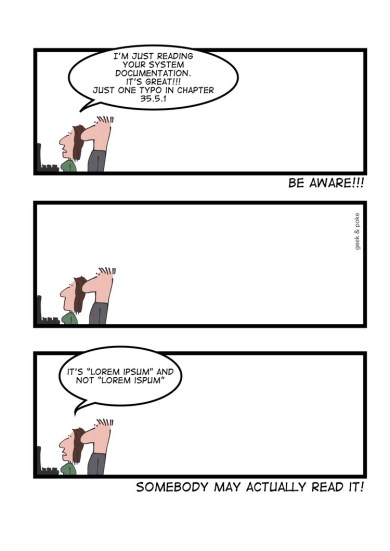
Documentation

from http://geek-and-poke.com

I came across this tweet from Oracle Developers (Oracle Developers Tweet) which picked up on a post from the NoBugsProject about common errors with the use of exceptions. One of the first errors the article described is one of my pet hates – the use of standard exceptions for application specific errors.

This took me onto one of my other pet hates – code without any documentation. I’m not advocating the days of waterfall Development where reams of documentation had to be produced before a single line of Code was written. In fact this is in my option worse than nothing as the docs would often not match the coded reality. But I absolutely agree with the agile manifesto statement:

We value working code over documentation

This doesn’t say no documentation, despite the fact that I have encountered more times than I care to recall the use of this statement to justify not documenting code. So what is the right balance?

We want to save effort from Code reviews and get clean code by using static code analysis but it doesn’t have the ability to apply smarts as what needs documenting? Pair programming is rarely practised, and there is plenty of psychology about group behaviour that can undermine documentation in a pair working approach effort. So what is the answer?

Well, I’ve always applied a couple of personal rules of thumb that can be measured with static code analysis particularly if you use conventional documentation tags. The rules are:

  • Interfaces warrant an interface level description of the interface purpose. It’s always helpful to describe/illustrate with use example. This is code equivalent to a good API Blueprint or swagger doc.
  • Provide a class level description of what the class is for – if it is a DAO then just say what the entity is.
  • If a class is part of a pattern, name the pattern. This is most important when relating to supporting a composite or solution pattern. Remember there will always situations where a newbie will get asked to extend or change your code, help them. Remember not every developer is as experienced or clever as you. If in doubt, give your code to someone who doesn’t know what you’re working on and ask them to explain what your code is doing and why. I had once, had to create a JDBC abstraction layer as we needed to support multiple databases. But if you know JDBC you’ll be aware of there are some subtle but important differences in implementation of connectors. I took the time to explain it in the interface header. I know a couple of developers appreciated the investment of 5 minutes.
  • If you have a function that has a code analytics score such as cyclometeric then describe the function. Use the comment to convey why the high score is justifiable.
  • If the code has specific dependencies or has to perform in a very specific sequence a short comment will help, and anyone going through refactoring code.

With these guidelines it becomes possible to then use javadoc tools to generate your documentation. It doesn’t require you to go find a word document or a wiki page to update the documentation. Of course then reviewing the generated documentation will soon help you finesse the process of documenting in a manner that is whilst light also supports readability without needing the code.

For those, who still disagree I would say …

  • Do you want to be maintaining and updating the same code for the rest of your career to meet new minor changes etc?
  • Not everyone is a great coder like you, do you want someone less capable who may have to make a change messing up your elegant code?
  • Sooner or later someone will ask you to fix or enhance some code that in your eyes is a chaotic unintelligible mess, I’m sure you’d appreciate some comments that will help you understand what the developer was trying to do? We can’t expect those not so good at the craft to document if the best of us are not prepared to do so.

If you don’t agree, or have found different approaches that ensure enough accurate documentation, please share.

Share this:

  • Share on Facebook (Opens in new window) Facebook
  • Share on X (Opens in new window) X
  • Share on Reddit (Opens in new window) Reddit
  • Email a link to a friend (Opens in new window) Email
  • Share on WhatsApp (Opens in new window) WhatsApp
  • Print (Opens in new window) Print
  • Share on Tumblr (Opens in new window) Tumblr
  • Share on Mastodon (Opens in new window) Mastodon
  • Share on Pinterest (Opens in new window) Pinterest
  • More
  • Share on Bluesky (Opens in new window) Bluesky
  • Share on LinkedIn (Opens in new window) LinkedIn
Like Loading...

I’ll be presenting at UKOUG Conference with …

18 Saturday Nov 2017

Posted by mp3monster in General, Oracle

≈ Leave a comment

Tags

conference, Microservices, OIC, OIC - ICS, OUG, Presentation, speaker, Tech17


I will be presenting at the UKOUG Conference this year as an Oracle Ace and Snr Consultant from a award winning Partner of the Year. I’ll be speaking about:

  • ICS (now part of Oracle Integration Cloud)
  • Microservices and WebLogic
  • Oracle Messaging Cloud Service

I also have colleagues from Capgemini covering IaaS and SaaS among other things. I hope that we see you in Birmingham. Full details of my sessions :

Integration Cloud Service (ICS) Customer use Cases an Insight Into why ICS

04/12/2017 09:00 &

05/12/2017 09:00

In this session the presenters will talk about several applications of Integration Cloud Service (ICS) with customers from Capgemini. Whilst presenting the use cases, the reasoning for adopting ICS over other integration options will be explained and some of the design considerations that had to be addressed in the application of ICS. Whilst looking at the example cases, factors involved in deciding which iPaaS offering to adopt based on needs.
This session will be presented by Phil Wilkins one of the authors of the book Implementing Oracle Integration Cloud Service and supporting blog.


Microservices in a Monolith World

04/12/2017 15:25

Whilst microservices are mainstream thinking, many organisations make significant long term investments in application containers such as WebLogic and can be resistant to moving on from such investments. So how do we realise the microservice thinking with such constraints? This presentation looks at several approaches that can allow us to leverage microservice thinking without sacrificing the existing investment.


Why Should I Consider Oracle Messaging Cloud Service as an Integration Solution?

04/12/2017 17:55

Oracle Messaging Cloud Service is an often-overlooked service in the family of iPaaS options, but why? So, what makes it worth considering and makes it more contemporary than JMS with Java Cloud Service? This presentation will look at what differentiates MCS from JCS and Event Hub and others and does it offer that makes it distinct and worthwhile option?

Share this:

  • Share on Facebook (Opens in new window) Facebook
  • Share on X (Opens in new window) X
  • Share on Reddit (Opens in new window) Reddit
  • Email a link to a friend (Opens in new window) Email
  • Share on WhatsApp (Opens in new window) WhatsApp
  • Print (Opens in new window) Print
  • Share on Tumblr (Opens in new window) Tumblr
  • Share on Mastodon (Opens in new window) Mastodon
  • Share on Pinterest (Opens in new window) Pinterest
  • More
  • Share on Bluesky (Opens in new window) Bluesky
  • Share on LinkedIn (Opens in new window) LinkedIn
Like Loading...

Equifax Security Breach – Time for a Change In Mindset

27 Friday Oct 2017

Posted by mp3monster in General, Technology

≈ Leave a comment

Tags

equifax, Security

I was reading a blog post from the Cloud Security Alliance (here) about the on-going mess and disinformation around Equifax’s security breach.

The article makes a very good point. Sadly Security is seen as just a cost, and whilst people have that mindset we will see decisions being made that favours ‘high share value now’ over long time assurance of sensitive data which means that ‘now value doesnt nose dive’.


The article goes on to show the approximate cost to the US public of the breach. But if we can quantify the costs, can we not quantify the value of protection?

Even with today’s legislation in many countries it is a legal obligation to disclose the details of a security breach. The only problem here, is ignorance is bliss, if I don’t know I’m being compromised then nothing to report. The blog post also points out that often the only time security investment is recognised is, and often that information doesn’t propergate within an organisation. This got me to thinking why can’t companies also disclose how many attempts on their security have been mitigated on in the same way companies have to declare profit and loss.

It could produce some interesting information, as you could compare data from different companies of similar profile. When plotting the data, any outliers suggest something maybe wrong. But it would give consumers a means to decide do they trust their data with X over Y when they get a chance to influence the decision.  But we’re now moving into the territory where security is becoming a positive measure.  If nothing else it may engender an ‘arms war’ of who has the best protection.

As with all things, they way you measure something influences behaviour. This sort of measurement may encourage companies to invest in more ‘white hat’ attacks. That’s no bad thing as if a white hat attack suceeds – the vulnerability has been found.

The interesting thing is that, the article points out that Equifax and other large companies that have been breached have been certified as ISO 9001 compliant, PCI DSS compliant and so on. The issue here is, that these accreditations have a strong emphasis on process and policy, and are down to the auditor spotting non-compliance. In a large organisation the opportunity to steer the auditor towards what is good exists. But more importantly, process requires people to know and follow it. Following process and being prepared to uphold the processes requires an organizational culture that genders its adherence. I can have a rulebook as big as the Encyclopedia Britannica but if my boss, and his boss apply constant pressure to say we have to deliver and there is no repercutions to bending the rules – well then I’m going to start bending.

Leaders like Gray understand the value of an organization’s culture. This can be defined as the set of deeply embedded, self-reinforcing behaviors, beliefs, and mind-sets that determine “how we do things around here.” People within an organizational culture share a tacit understanding of the way the world works, their place in it, the informal and formal dimensions of their workplace, and the value of their actions. Though it seems intangible, the culture has a substantial influence on everyday actions and on performance.

https://www.strategy-business.com/article/11108?gko=f4e8d

This brings us back to the idea – hard data on the execution (not that i have a process for execution) will give strong indications of compliance. This kind of data is difficult to fudge and with a good sample set, then fudges  are more likely to stand out.

Practical? I don’t know, but worth exploring? If we are to change security thinking then yes.

Share this:

  • Share on Facebook (Opens in new window) Facebook
  • Share on X (Opens in new window) X
  • Share on Reddit (Opens in new window) Reddit
  • Email a link to a friend (Opens in new window) Email
  • Share on WhatsApp (Opens in new window) WhatsApp
  • Print (Opens in new window) Print
  • Share on Tumblr (Opens in new window) Tumblr
  • Share on Mastodon (Opens in new window) Mastodon
  • Share on Pinterest (Opens in new window) Pinterest
  • More
  • Share on Bluesky (Opens in new window) Bluesky
  • Share on LinkedIn (Opens in new window) LinkedIn
Like Loading...

APIs and OMESA video

20 Friday Oct 2017

Posted by mp3monster in APIs & microservices, General, OMESA, Technology

≈ Leave a comment

Tags

APIs & microservices, Archbeat, Arturo Viveros, Bob Rhubart, Dev Live, Luis Weir, OMESA, OMESA.io, OOW17, video

If you like seeing or hearing people like Arturo Viveros, Luis Weir and myself (not for me  :-0 ) discussing OMESA.io (Open Modern Enterprise Software Architecture) and APIs then you’ll like the following video, recorded with Bob Rhubart of Oracle Developer Community ArchBeat fame at Oracle Open World 2017.

Share this:

  • Share on Facebook (Opens in new window) Facebook
  • Share on X (Opens in new window) X
  • Share on Reddit (Opens in new window) Reddit
  • Email a link to a friend (Opens in new window) Email
  • Share on WhatsApp (Opens in new window) WhatsApp
  • Print (Opens in new window) Print
  • Share on Tumblr (Opens in new window) Tumblr
  • Share on Mastodon (Opens in new window) Mastodon
  • Share on Pinterest (Opens in new window) Pinterest
  • More
  • Share on Bluesky (Opens in new window) Bluesky
  • Share on LinkedIn (Opens in new window) LinkedIn
Like Loading...

UKOUG Partner of the Year Awards – contribution to bringing Glassware Home

13 Friday Oct 2017

Posted by mp3monster in General, Oracle, Technology

≈ Leave a comment

Tags

awards, Capgemini, middleware, OUG, PYA, Transformation

Proud to have been part of the Capgemini team who picked up some Glassware last night at ther UK Oracle User Group Partner of the Year Awards …

UKOUG Awards evening

UKOUG Awards Won by Capgemini


Gold – Business Transformation

Silver – Middleware

Share this:

  • Share on Facebook (Opens in new window) Facebook
  • Share on X (Opens in new window) X
  • Share on Reddit (Opens in new window) Reddit
  • Email a link to a friend (Opens in new window) Email
  • Share on WhatsApp (Opens in new window) WhatsApp
  • Print (Opens in new window) Print
  • Share on Tumblr (Opens in new window) Tumblr
  • Share on Mastodon (Opens in new window) Mastodon
  • Share on Pinterest (Opens in new window) Pinterest
  • More
  • Share on Bluesky (Opens in new window) Bluesky
  • Share on LinkedIn (Opens in new window) LinkedIn
Like Loading...

ODC Appreciation Day : Apiary Editor

10 Tuesday Oct 2017

Posted by mp3monster in General, Oracle, Technology

≈ Leave a comment

Tags

"Open API", apiary, apiary.io, APIBlueprint, editor, ODC, Swagger

This post is my contribution to the Oracle Developer Community (ODC) Appreciation Day. The idea of the event is best explained by Oracle Base – go here.

The Apiary Editor has to count as a pretty new entry into the possible features that could be considered with Apiary only coming into the Oracle family in the last year. Apiary as a solution provides a platform by which modern REST based APIs can be designed, documented and simulated. Apiary supports the API First design philosophy (more here) using API Blueprint notation or Swagger (now known as Open API).

The feature I want to focus on is the Apiary Editor itself (shown below), particularly when working with the API Blueprint.  The beauty of the solution is that as the documentation or API syntax is edited in the editing side (left)  the API definition/documentation immediately appears on the presentation side of the editor  (right) making it easy both see the technical specificastion and how the information is initially presented to a potential API user. This makes it really easy to understand the clarity of what is being communicated which is one of the important aspects of an API definition and API first.

Whilst Agile development states ‘prefer working code over documentation’ this provides agility as you can develop the API definition and allow people to develop against the contract we can still easily deliver quality API descriptions with sufficient information to make it understandable to a 3rd party.

Share this:

  • Share on Facebook (Opens in new window) Facebook
  • Share on X (Opens in new window) X
  • Share on Reddit (Opens in new window) Reddit
  • Email a link to a friend (Opens in new window) Email
  • Share on WhatsApp (Opens in new window) WhatsApp
  • Print (Opens in new window) Print
  • Share on Tumblr (Opens in new window) Tumblr
  • Share on Mastodon (Opens in new window) Mastodon
  • Share on Pinterest (Opens in new window) Pinterest
  • More
  • Share on Bluesky (Opens in new window) Bluesky
  • Share on LinkedIn (Opens in new window) LinkedIn
Like Loading...

Presentations from Oracle Open World

05 Thursday Oct 2017

Posted by mp3monster in API Platform CS, General, OIC - ICS, Oracle

≈ Leave a comment

Tags

API, API Platform, APIP, conference, OIC - ICS, OOW, OOW17, Oracle, presentations

With Oracle Open World 2017 over the ICS presentation is available at – Oracle integration cloud service (ICS) best practices learned from the field (OOW17)

We saw a lot of exciting new features and capabilities coming from Oracle in the ICS space. So keep an eye on the site as we publish new articles.

The API Platform presentation that was co-presented with Luis Weir is here…

Share this:

  • Share on Facebook (Opens in new window) Facebook
  • Share on X (Opens in new window) X
  • Share on Reddit (Opens in new window) Reddit
  • Email a link to a friend (Opens in new window) Email
  • Share on WhatsApp (Opens in new window) WhatsApp
  • Print (Opens in new window) Print
  • Share on Tumblr (Opens in new window) Tumblr
  • Share on Mastodon (Opens in new window) Mastodon
  • Share on Pinterest (Opens in new window) Pinterest
  • More
  • Share on Bluesky (Opens in new window) Bluesky
  • Share on LinkedIn (Opens in new window) LinkedIn
Like Loading...

Chatbot Blogs

12 Wednesday Jul 2017

Posted by mp3monster in chatbots

≈ 2 Comments

Tags

Ace, blog, bot, Capgemini, chatbot, Leon Smiers, Oracle

I have been fortunate to be supporting and occasionally contributing to a series of blogs on Chatbots written by Leon Smiers, Capgemini Oracle Chatbot SME (and also Oracle Ace).  The blog posts are:

  • Chatbots meeting expectations, introducing the chatbot maturity model
  • Chatting with the chatbots? – How intelligence makes the conversation
  • Integrating the Chatbot

I’ve been talking with Leon about what’s next in the blog series, and we can expect to see some more exciting blog posts in the series.

Chatbot Maturity Model

Share this:

  • Share on Facebook (Opens in new window) Facebook
  • Share on X (Opens in new window) X
  • Share on Reddit (Opens in new window) Reddit
  • Email a link to a friend (Opens in new window) Email
  • Share on WhatsApp (Opens in new window) WhatsApp
  • Print (Opens in new window) Print
  • Share on Tumblr (Opens in new window) Tumblr
  • Share on Mastodon (Opens in new window) Mastodon
  • Share on Pinterest (Opens in new window) Pinterest
  • More
  • Share on Bluesky (Opens in new window) Bluesky
  • Share on LinkedIn (Opens in new window) LinkedIn
Like Loading...

UKOUG Conference

12 Wednesday Jul 2017

Posted by mp3monster in General, Oracle, Technology

≈ Leave a comment

Tags

conference, microservice, Oracle, OUG, planning, Presentation, SOA, Tech17

As part of the UKOUG SIG committee for middleware I have had the opportunity to contribute to the planning of the conference in December (Tech17). The agenda looks really exciting with a range a high class submissions covering on-premises to cloud, from micro to monolith, API to application, source to SOA.

Presenters go from newbies to world class names, not to mention key Oracle product managers.

Here are a couple of tweets from the planning day …


It's Agenda Planning Day at @UKOUG – selecting talks for #Tech17 #apps17 so much choice!!! pic.twitter.com/B6xtUDkZ72

— Neil Chandler (@ChandlerDBA) July 7, 2017


https://twitter.com/UKOUG/status/883389052166078464

Want to get involved with the usergroup? Volunteering doesn't have to be tedious, check out the fun our #ukoug_apps17 committee had today pic.twitter.com/36ZNqi2UMX

— UK Oracle User Group (@UKOUG) July 7, 2017

Share this:

  • Share on Facebook (Opens in new window) Facebook
  • Share on X (Opens in new window) X
  • Share on Reddit (Opens in new window) Reddit
  • Email a link to a friend (Opens in new window) Email
  • Share on WhatsApp (Opens in new window) WhatsApp
  • Print (Opens in new window) Print
  • Share on Tumblr (Opens in new window) Tumblr
  • Share on Mastodon (Opens in new window) Mastodon
  • Share on Pinterest (Opens in new window) Pinterest
  • More
  • Share on Bluesky (Opens in new window) Bluesky
  • Share on LinkedIn (Opens in new window) LinkedIn
Like Loading...
← Older posts
Newer posts →

    I work for Oracle, all opinions here are my own & do not necessarily reflect the views of Oracle

    • About
      • Internet Profile
      • Music Buying
      • Presenting Activities
    • Books & Publications
      • Logging in Action with Fluentd, Kubernetes and More
      • Logs and Telemetry using Fluent Bit
      • Oracle Integration
      • API & API Platform
        • API Useful Resources
        • Useful Reading Sources
    • Mindmaps Index
    • Monster On Music
      • Music Listening
      • Music Reading
    • Oracle Resources
    • Useful Tech Resources
      • Fluentd & Fluent Bit Additional stuff
        • Logging Frameworks and Fluent Bit and Fluentd connectivity
        • REGEX for BIC and IBAN processing
      • Formatting etc
      • Java and Graal Useful Links
      • Official Sources for Product Logos
      • Python Setup & related tips
      • Recommended Tech Podcasts

    Oracle Ace Director Alumni

    TOGAF 9

    Logs and Telemetry using Fluent Bit


    Logging in Action — Fluentd

    Logging in Action with Fluentd


    Oracle Cloud Integration Book


    API Platform Book


    Oracle Dev Meetup London

    Blog Categories

    • App Ideas
    • Books
      • Book Reviews
      • manning
      • Oracle Press
      • Packt
    • Enterprise architecture
    • General
      • economy
      • ExternalWebPublications
      • LinkedIn
      • Website
    • Music
      • Music Resources
      • Music Reviews
    • Photography
    • Podcasts
    • Technology
      • AI
      • APIs & microservices
      • chatbots
      • Cloud
      • Cloud Native
      • Dev Meetup
      • development
        • languages
          • java
          • node.js
          • python
      • drone
      • Fluent Observability
        • Fluentbit
        • Fluentd
        • OpAMP
      • logsimulator
      • mindmap
      • OMESA
      • Oracle
        • API Platform CS
          • tools
        • Helidon
        • ITSO & OEAF
        • Java Cloud
        • NodeJS Cloud
        • OIC – ICS
        • Oracle Cloud Native
        • OUG
      • railroad diagrams
      • TOGAF
    • xxRetired
    • AI
    • API Platform CS
    • APIs & microservices
    • App Ideas
    • Book Reviews
    • Books
    • chatbots
    • Cloud
    • Cloud Native
    • Dev Meetup
    • development
    • drone
    • economy
    • Enterprise architecture
    • ExternalWebPublications
    • Fluent Observability
    • Fluentbit
    • Fluentd
    • General
    • Helidon
    • ITSO & OEAF
    • java
    • Java Cloud
    • languages
    • LinkedIn
    • logsimulator
    • manning
    • mindmap
    • Music
    • Music Resources
    • Music Reviews
    • node.js
    • NodeJS Cloud
    • OIC – ICS
    • OMESA
    • OpAMP
    • Oracle
    • Oracle Cloud Native
    • Oracle Press
    • OUG
    • Packt
    • Photography
    • Podcasts
    • python
    • railroad diagrams
    • Technology
    • TOGAF
    • tools
    • Website
    • xxRetired

    Enter your email address to subscribe to this blog and receive notifications of new posts by email.

    Join 2,616 other subscribers

    RSS

    RSS Feed RSS - Posts

    RSS Feed RSS - Comments

    April 2026
    M T W T F S S
     12345
    6789101112
    13141516171819
    20212223242526
    27282930  
    « Mar    

    Twitter

    Tweets by mp3monster

    History

    Speaker Recognition

    Open Source Summit Speaker

    Flickr Pics

    Boxer Rebellion @ Brixton ElectricBoxer Rebellion @ Brixton ElectricBoxer Rebellion @ Brixton ElectricBoxer Rebellion @ Brixton Electric
    More Photos

    Social

    • View @mp3monster’s profile on Twitter
    • View philwilkins’s profile on LinkedIn
    • View mp3monster’s profile on GitHub
    • View mp3monster’s profile on Flickr
    • View mp3muncher’s profile on WordPress.org
    • View philmp3monster’s profile on Twitch
    Follow Phil (aka MP3Monster)'s Blog on WordPress.com

    Blog at WordPress.com.

    • Subscribe Subscribed
      • Phil (aka MP3Monster)'s Blog
      • Join 228 other subscribers
      • Already have a WordPress.com account? Log in now.
      • Phil (aka MP3Monster)'s Blog
      • Subscribe Subscribed
      • Sign up
      • Log in
      • Report this content
      • View site in Reader
      • Manage subscriptions
      • Collapse this bar
     

    Loading Comments...
     

    You must be logged in to post a comment.

      Privacy & Cookies: This site uses cookies. By continuing to use this website, you agree to their use.
      To find out more, including how to control cookies, see here: Our Cookie Policy
      %d