• Home
  • About
    • Background
    • LinkedIn
    • Presenting Activities
    • Internet Profile
    • About
    • www.cloud-native.info
  • Observability, Fluent(d) Bit & OpAMP
    • OpAMP Product
    • OpAMP Overview
    • Log Generator
    • Fluent Bit Classic to YAML Format configurations
  • My Books
    • Logs and Telemetry using Fluent Bit
      • Fluent Bit book
      • Book Resources in GitHub
    • Logging in Action with Fluentd, Kubernetes and More
      • Logging in Action with Fluentd – Book
      • Fluentd Book Resources
      • Fluentd & Fluent Bit Additional stuff
    • API & API Platform
      • API Useful Resources
    • Oracle Integration
      • Book Website
      • Useful Reading Sources
    • Publication Contributions
  • Resources
    • GitHub
    • Oracle Integration Site
    • Oracle Resources
    • Mindmaps Index
    • Useful Tech Resources
      • Fluentd & Fluent Bit Additional stuff
      • Recommended Tech Podcasts
      • Official Sources for Product Logos
      • Java and Graal Useful Links
      • DevTips
  • Music
    • Monster On Music
    • Music Listening
    • Music Reading

Phil (aka MP3Monster)'s Blog

~ from Technology to Music

Phil (aka MP3Monster)'s Blog

Author Archives: mp3monster

JMESPath is represented using Railroad diagrams

31 Monday Oct 2022

Posted by mp3monster in development, General, railroad diagrams, Technology

≈ Leave a comment

Tags

AWS, Azure, diagrams, JMESPath, OCI, railroad, syntax

JMESPath is a mature syntax for traversing and manipulating JSON objects. The syntax is also supported with multiple language implementations available through GitHub (and other implementations exist). As a result, it has been very widely adopted; just a few examples include:

  • Azure CLI
  • AWS CLI and Lambda
  • Oracle Cloud WAF
  • Splunk

As the syntax is very flexible and recursive in its use following the documented notation can be a little tricky to start with. So following the syntax can be rather tricky. The complete definition runs to 97 lines, of which 32 lines focus on the syntactical structure. The others describe the base types such as numbers, characters, accepted escaped characters, and so on. Nothing wrong with this, as the exhaustive definition is necessary to build parsers. But for the majority of the time it is those 32 lines that we need to understand.

As the expression goes – ‘a picture says a thousand words’, there might not be a thousand words, but there is enough to suggest a visual representation will help. Even if the visual only helps us traverse the use of the detailed syntax. So we’ve use our favoured visual representation – the railroad diagram and the tool produced by Tab Akins to create the representation. We’ve put the code and created images for the syntax in my GitHub repository here, continuing the pattern previously adopted.

Here is the resulting diagram …
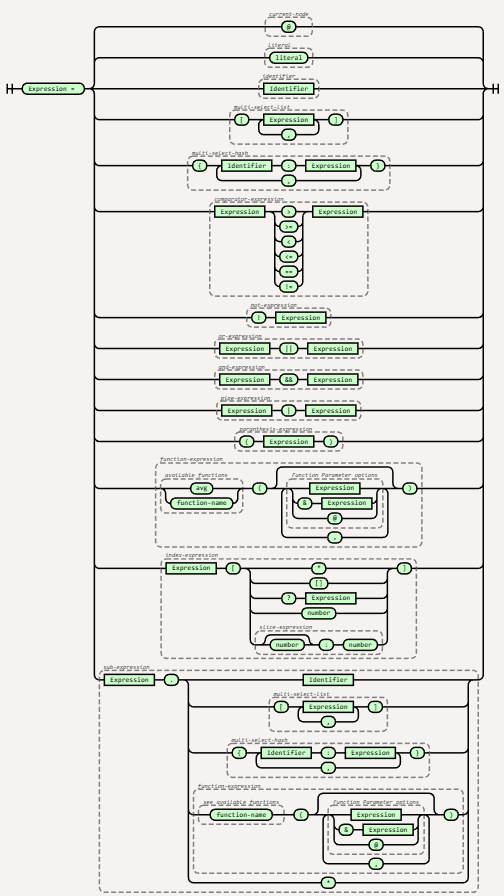
To make it easy to trace back to the original syntax document we’ve included groupings on the diagram that have names from the original speciofication.

Parts of the diagram make the expressions look rather simple, but you’ll note that it is possible for the sections to be iterative which allows for the expression to traverse a JSON object of undefined depth. But what can be really challenging is that an in many areas it is possible to nest expressions within expressions. Visually there is no simple way to represent the expression possibilities of this in a linear manner. Other than be clear about where the nesting can take place.


Share this:

  • Share on Facebook (Opens in new window) Facebook
  • Share on X (Opens in new window) X
  • Share on Reddit (Opens in new window) Reddit
  • Share on LinkedIn (Opens in new window) LinkedIn
  • Email a link to a friend (Opens in new window) Email
  • Share on WhatsApp (Opens in new window) WhatsApp
  • Print (Opens in new window) Print
  • Share on Tumblr (Opens in new window) Tumblr
  • Share on Mastodon (Opens in new window) Mastodon
  • Share on Pinterest (Opens in new window) Pinterest
  • Share on Bluesky (Opens in new window) Bluesky
Like Loading...

LogSimulator New Feature – Custom Targets with OCI Logging example

14 Friday Oct 2022

Posted by mp3monster in Cloud, development, General, logsimulator, Oracle, Technology

≈ Leave a comment

Tags

book, loggenerator, logging, logsimulator, OCI, Prometheus

Those who have been using my Logging in Action book will know that to help test the configuration of monitoring tools including Fluentd we have built a LogGenerator that can very easily play and replay logging events into a variety of destinations and formats. all written in Groovy to make the utility easy to run as a script and extend without needing to set up a proper Java development environment.

With the number of different destinations built into the script and the logic to load the source log events and format them the utility is getting rather large for a single file. Rather than letting it continue to grow as we add more destinations to pump log events too, I’ve extended the implementation so you can point to a Groovy file that implements the logic to send the log events. It only requires three simple methods to be implemented.

To demonstrate the feature we have created a custom extension and fully documented it. The extension allows you to send log events to the OCI Logging service. This includes an optional crude aggregation mechanism as sending individual log events is a little inefficient over REST. By doing this we can send synthetic or playback logs as if we’re an application in real-life to ensure that any alerting or routing for the logging works properly before we get anywhere production and do not need to run the application and induce error events.

Beyond this, we’re also thinking about creating a plugin to fire log events at Prometheus so we can send events using the Prometheus pushgateway. As a result, we can tune Prometheus’ configuration.

More improvements – refactoring the existing code

We will refactor the existing code to use the same approach which should make the code more maintainable, but the changes won’t stop the utility from working as it always has (so we won’t break out the existing output channels from the core).

We have also started to improve the code commenting – so hopefully it will make the code a bit more navigable.

Share this:

  • Share on Facebook (Opens in new window) Facebook
  • Share on X (Opens in new window) X
  • Share on Reddit (Opens in new window) Reddit
  • Share on LinkedIn (Opens in new window) LinkedIn
  • Email a link to a friend (Opens in new window) Email
  • Share on WhatsApp (Opens in new window) WhatsApp
  • Print (Opens in new window) Print
  • Share on Tumblr (Opens in new window) Tumblr
  • Share on Mastodon (Opens in new window) Mastodon
  • Share on Pinterest (Opens in new window) Pinterest
  • Share on Bluesky (Opens in new window) Bluesky
Like Loading...

Practical Steps when it comes to writing a technical book

11 Tuesday Oct 2022

Posted by mp3monster in Books, General, Technology

≈ 1 Comment

Tags

author, book, tips, writing

Following my article on Software Engineering Daily, here are some practical things that will help you if you’re considering taking on a technical book project.

Identifying a Publisher

While it is easy to self-publish today. The recognition comes from having worked with a traditional publisher as they have processes that ensure a level of quality. Not all publishers are equal, and some publishers are attributed with more prestige than others. In addition to this, some publishers are willing to take a risk on a subject and/or author. Have a look at the titles already published, and whether there are any publishers you can connect to.

When comes to contacting the publishers, most of their websites will have a page for recruiting authors. Some are easier to find than others. Here are a couple:

  • Packt
  • Manning
  • Pearson
  • APress

If, or when you get to talk to a publisher it is worth ensuring you understand how their editorial process works and what is expected from you? Plus what happens if you find yourself in the position of not being able to work to the original schedule. Day-to-day work can get in the way which you hadn’t expected.

Continue reading →

Share this:

  • Share on Facebook (Opens in new window) Facebook
  • Share on X (Opens in new window) X
  • Share on Reddit (Opens in new window) Reddit
  • Share on LinkedIn (Opens in new window) LinkedIn
  • Email a link to a friend (Opens in new window) Email
  • Share on WhatsApp (Opens in new window) WhatsApp
  • Print (Opens in new window) Print
  • Share on Tumblr (Opens in new window) Tumblr
  • Share on Mastodon (Opens in new window) Mastodon
  • Share on Pinterest (Opens in new window) Pinterest
  • Share on Bluesky (Opens in new window) Bluesky
Like Loading...

Contributing to Software Engineering Daily

10 Monday Oct 2022

Posted by mp3monster in General, Technology

≈ Leave a comment

Tags

blog, book, external, external publications, SE Daily, software engineering, writing

For a long time, I’ve tracked and read articles on Software Engineering Daily. We’ll day represents what is hopefully the first of many articles that we will write for them. The article is about the kind of people that make technical book authors, and the perception we have of authors – so if you’re interested check it out here.

Some more content on the subject of books …

  • What does it take to write a tech book?
  • Creating screenshots of application shells – easing the writing process
  • Practical Steps when it comes to writing a technical book

Share this:

  • Share on Facebook (Opens in new window) Facebook
  • Share on X (Opens in new window) X
  • Share on Reddit (Opens in new window) Reddit
  • Share on LinkedIn (Opens in new window) LinkedIn
  • Email a link to a friend (Opens in new window) Email
  • Share on WhatsApp (Opens in new window) WhatsApp
  • Print (Opens in new window) Print
  • Share on Tumblr (Opens in new window) Tumblr
  • Share on Mastodon (Opens in new window) Mastodon
  • Share on Pinterest (Opens in new window) Pinterest
  • Share on Bluesky (Opens in new window) Bluesky
Like Loading...

Is The 12 Factor App right about Logging?

05 Wednesday Oct 2022

Posted by mp3monster in development, Fluentd, General, Technology

≈ Leave a comment

Tags

12 Factor, 12 Factor App, conference, development, Grafana, JAX, logging, London, OpenSearch, Prometheus, Splunk, stdout

The 12 Factor App definition is now ten years old.  In the world of software that is a long time. So perhaps it’s time to revisit and review what it says.  As I have spent a lot of time around Logging – I’ve focussed on Factor 11 – Logging.

I have been fortunate enough to present at the hybrid JAX London conference on this subject. It was great to get out and see people at a conference rather than just with a screen and a chat console of online-only events.

You can see my presentation here:

Continue reading →

Share this:

  • Share on Facebook (Opens in new window) Facebook
  • Share on X (Opens in new window) X
  • Share on Reddit (Opens in new window) Reddit
  • Share on LinkedIn (Opens in new window) LinkedIn
  • Email a link to a friend (Opens in new window) Email
  • Share on WhatsApp (Opens in new window) WhatsApp
  • Print (Opens in new window) Print
  • Share on Tumblr (Opens in new window) Tumblr
  • Share on Mastodon (Opens in new window) Mastodon
  • Share on Pinterest (Opens in new window) Pinterest
  • Share on Bluesky (Opens in new window) Bluesky
Like Loading...

Interpreting Railroad diagrams

16 Friday Sep 2022

Posted by mp3monster in General, railroad diagrams, Technology

≈ 1 Comment

Tags

diagram, newbie, railroad, railroad diagram, syntax

Having previously blogged about being a fan of Railroad diagrams (here) as a means to communicate language syntax, I have been asked about some of the ways details should be represented. I’ve looked around and not actually found an easy-to-read for ‘newbies’ guide to reading railroad diagrams. A lot of content either focuses on the generator tools or how the representation compares to BNF (Backus Naur Form) – all very distracting. So, I thought as an advocate, I should help address the gap (the documentation with TabAkins tool does a good job of explaining things, but its focus is on the features provided rather than understanding the notation).

Reading Railroad Diagrams

The following table provides all the information to help you interpret the Railroad Diagrams, and create syntax representations.

  • If you’re only interested in understanding the notation, read just the first two columns.
  • If you want to see examples of how to create the diagram, then the 3rd column will help.

Note: Clicking on the diagrams will result in a bigger version of the image being displayed.

How to Interpret the RailroadRailroad RepresentationCode using tabakins tool
The start and end of an expression are shown with vertical bars.
The expression is read from left to right following a path defined by the line(s).
Diagram(
Terminal('This '),
Terminal(' is '),
Terminal(' a '),
Terminal(' mp3monster '),
Terminal(' blog ')
)
Larger diagrams may need to be read both across and down the page to make it sensibly fit a page like this.Diagram( Stack(
Terminal('This '),
Terminal(' is '),
Terminal(' a '),
Terminal(' mp3monster '),
Terminal(' blog '))
)
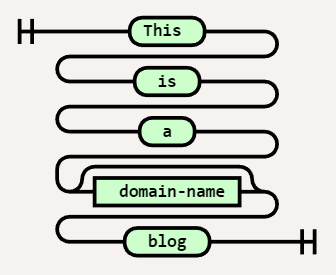
We can differentiate between literal values and ‘variables’ by shape. A square shape should denote a variable, and a lozenge represents a literal.
I have to admit to sometimes getting these the wrong way around, but as long as the notation is used consistently in an expression, it isn’t too critical. In this example, we have replaced mp3monster with the name of a variable called domain-name. So if I set the variable domain-name = mp3monster then I’d read the same result.
Diagram( Stack(
Terminal('This '),
Terminal(' is '),
Terminal(' a '),
NonTerminal(' domain-name'),
Terminal(' blog '))
)
We can make parts of an expression optional. This can be seen by following an alternate path around the optional element.
In this case, we’ve made the domain-name optional. Assuming domain-name = mp3monster, we could get either:
– This is a mp3monster blog OR
– This is a blog
Diagram( Stack(
Terminal('This '),
Terminal(' is '),
Terminal(' a '),
Optional(

NonTerminal(' domain-name')),
Terminal(' blog '))
)
We can represent optionality by having the flow split to multiple values. Those values could be either literal values or variables. In this case, we now have several possible names in the blog with the choices being mp3monster, phil-wilkins, cloud-native, or the contents of the variable domain-name. So the expression here could resolve to (assuming domain-name = something-else):
– This is a mp3monster blog OR
– This is a phil-wilkins blog OR
– This is a cloud-native blog OR
– This is a something-else blog
It is typical for the option most likely to be selected to be the value that is directly in line with the choice. Here that would mean the default would be phil-wilkins
Diagram( Stack(
Terminal('This '),
Terminal(' is '),
Terminal(' a '),
Choice(1,

' mp3monster',
' phil-wilkins ',
' cloud-native ',
NonTerminal('domain-name')),
Terminal(' blog '))
)
We can have variations on a choice where we can express the choice as being any of the options (one or more e.g. mp3monster and cloud-native) or all of the choices. These scenarios are differentiated by the additional symbols before and after the choice.
Diagram( Stack(
Terminal('This '),
Terminal(' is '),
Terminal(' a '),
MultipleChoice(1,

'any',' mp3monster',
' phil-wilkins ',
' cloud-native ',
NonTerminal('domain-name')),
Terminal(' blog '))
)
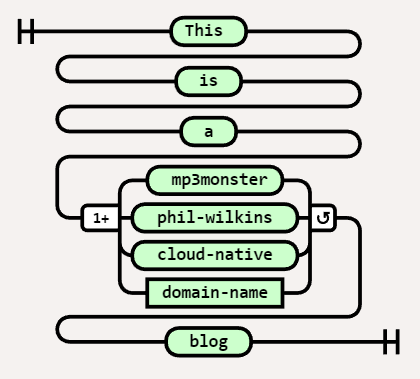
We can represent the looping with the inclusion of an additional literal(s) or variable(s) by having a second line from the right (exit) of a literal or variable and flowing back into the left (entry) of a literal or variable. Then in the loop of the flow below are the variable(s) or literal(s) that go around between each occurrence of the loop. If our variable was a list now i.e. domain-name = [‘ mp3monster’, ‘cloud-native’] then this would resolve to :
This is a mp3monster and cloud-native blog
Diagram( Stack(
Terminal('This '),
Terminal(' is '),
Terminal(' a '),
OneOrMore(

NonTerminal('domain-name'),
[' and '])),
Terminal(' blog ')
)
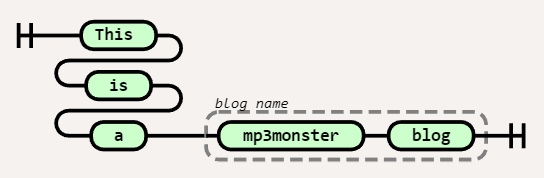
We can group literals and variables together with a label. These groupings are denoted with a dashed line and usually include some sort of label. In our example, we’ve grouped two literal values together and called that group the blog name.Diagram( Stack(
Terminal('This '),
Terminal(' is '),
Terminal(' a '),),
Group(Sequence(

Terminal(' mp3monster '),
Terminal(' blog ')),

['blog name'])
)

All of these constructs can be combined so you can do things like making choices optional, and iterate over multiple variables and literals.

Tips & Tricks to Consider

TipsRailroad RepresentationCode using tabakins tool
Sometimes the number of options in a choice can get impractically large to show in a Railroad diagram. One way to overcome this is to show the first and last options and an ellipsis.
We can then wrap it with a comment that directs the reader to the complete list of choices.
This way the diagram continues to be readable – the most valuable part of the diagram and easy to locate the specific fine details.
Diagram( Stack(
Terminal(‘This ‘),
Terminal(‘ is ‘),
Terminal(‘ a ‘),
Group(Choice(1,
‘ mp3monster’,
‘ … ‘,
‘ cloud-native ‘), [‘ See Section X for full list’]),
Terminal(‘ blog ‘))
)

Share this:

  • Share on Facebook (Opens in new window) Facebook
  • Share on X (Opens in new window) X
  • Share on Reddit (Opens in new window) Reddit
  • Share on LinkedIn (Opens in new window) LinkedIn
  • Email a link to a friend (Opens in new window) Email
  • Share on WhatsApp (Opens in new window) WhatsApp
  • Print (Opens in new window) Print
  • Share on Tumblr (Opens in new window) Tumblr
  • Share on Mastodon (Opens in new window) Mastodon
  • Share on Pinterest (Opens in new window) Pinterest
  • Share on Bluesky (Opens in new window) Bluesky
Like Loading...

Stop polling, Let’s go Streaming the podcast

15 Thursday Sep 2022

Posted by mp3monster in General, Podcasts

≈ Leave a comment

Tags

API, logrocket, podcast, podrocket, streaming

I was fortunate enough to be invited to join LogRocket‘s Podcast (PodRocket) to discuss some of the insights and considerations relating to API Streaming that I presented at a reference conference. To hear more go checkout :

If you’d like to see more from the presentation, go here.

Share this:

  • Share on Facebook (Opens in new window) Facebook
  • Share on X (Opens in new window) X
  • Share on Reddit (Opens in new window) Reddit
  • Share on LinkedIn (Opens in new window) LinkedIn
  • Email a link to a friend (Opens in new window) Email
  • Share on WhatsApp (Opens in new window) WhatsApp
  • Print (Opens in new window) Print
  • Share on Tumblr (Opens in new window) Tumblr
  • Share on Mastodon (Opens in new window) Mastodon
  • Share on Pinterest (Opens in new window) Pinterest
  • Share on Bluesky (Opens in new window) Bluesky
Like Loading...

CI/CD worker nodes as virtual machines or K8s Containers?

07 Wednesday Sep 2022

Posted by mp3monster in General

≈ Leave a comment

Tags

architecture, CICD, Containers, decision matrix, devops, jenkins, maven, reference architecture, stress test

When it comes to CI/CD deployments, something that doesn’t show very often in documentation is the pros and cons of running your worker nodes as containers in a Kubernetes environment or as (virtual) machines in a cloud environment.

Containerized CI/CD
Continue reading →

Share this:

  • Share on Facebook (Opens in new window) Facebook
  • Share on X (Opens in new window) X
  • Share on Reddit (Opens in new window) Reddit
  • Share on LinkedIn (Opens in new window) LinkedIn
  • Email a link to a friend (Opens in new window) Email
  • Share on WhatsApp (Opens in new window) WhatsApp
  • Print (Opens in new window) Print
  • Share on Tumblr (Opens in new window) Tumblr
  • Share on Mastodon (Opens in new window) Mastodon
  • Share on Pinterest (Opens in new window) Pinterest
  • Share on Bluesky (Opens in new window) Bluesky
Like Loading...

Decision Matrix aka ‘Stress Test’ as a vehicle to make decisions easier

02 Friday Sep 2022

Posted by mp3monster in General

≈ 2 Comments

Tags

Decision, decision matrix, factor, matrix, stress test, stressor, tree

We’ve all encountered decision trees at one time or another as a means to determine an answer based on a set of inputs. The problem with decision trees is that they are binary in nature. The answer is always yes or no.

From http://www.stodolkiewicz.com/2020/04/27/decision-trees-introduction/

But life is not binary. This is often best underlined by the classic joke of asking an architect what the right thing to do is, and you’ll get the answer ‘it depends‘. The art of being an architect is working out what the right trade-offs are when coming to a decision. This is fine, but to know all the factors (or trade-offs) that need to be considered requires a wealth of experience (a rare and expensive asset) or someone capturing these insights in a consumable manner that enables people who will understand how to use imparted wisdom, rather than try to blindly follow binary decisions.

This is where decision Matrices, or as I was introduced to them ‘Stress Tests’ – so called because the matrix is made up of a factor or ‘stressor’ are tested against one or more options. Each slot in the matrix can either be marked as yes/no or scored on the range (for example 1-5) on alignment to meeting the stressor. If you’re doing a product selection then the options are the different products. But equally the options could be an architectural pattern.

This is probably best illustrated. So the following Matrix looks at different programming languages against a range of different stressors. This isn’t a realistic case, but sufficient to help convey the idea. (The assessments in this matrix are not comprehensively researched, so feel free to argue)

JavaPythonRubyC++
Single binary for multiple OS and architectures554 11
Language evolves quickly to provide standardized libraries for common needs5543
Suitable for scripting and application development42541
Readily available skills453333
  1. Ruby has several variants such as JRuby, Ruby with a C core – this has the potential to impact
  2. Use of Shebang or overlaying with Groovy makes Java more usable as a scripting language
  3. Not so commonly taught in educational settings which typically favor Python and Java

As you can see to help use the matrix we can add elaboration notes. To use the matrix we simply determine which stressors are most important or not and then score the different options. So if I wanted to use the matrix to determine which language is most suitable for developing a deployment utility then we know from the use case performance is less critical, portability is important, and skills should outweigh language evolution. Based on that the answer should resolve to Python failing that Java would be good enough.

While our question and its outcome is fairly obvious, in more nuanced situations the stress test gives several benefits:

  • The decision process becomes transparent and easily communicated.
  • The hard work is in developing the stressors and researching the different options in terms of how they fit with stressors.
  • The matrix can be re-used, to help achieve other decisions. What if I was looking at the most suited solution for running data analytics that can maximize GPUs?

Through the use of the stress test we can translate the ‘it depends‘ to a more concrete but rationalized decision.

Share this:

  • Share on Facebook (Opens in new window) Facebook
  • Share on X (Opens in new window) X
  • Share on Reddit (Opens in new window) Reddit
  • Share on LinkedIn (Opens in new window) LinkedIn
  • Email a link to a friend (Opens in new window) Email
  • Share on WhatsApp (Opens in new window) WhatsApp
  • Print (Opens in new window) Print
  • Share on Tumblr (Opens in new window) Tumblr
  • Share on Mastodon (Opens in new window) Mastodon
  • Share on Pinterest (Opens in new window) Pinterest
  • Share on Bluesky (Opens in new window) Bluesky
Like Loading...

Blog content beyond by MP3Monster domain

19 Friday Aug 2022

Posted by mp3monster in General

≈ Leave a comment

Tags

blog, Blogging, devs, external, external publications, Medium, Oracle

My blogging activities have expanded a little bit further. Oracle staff (particularly those involved with Product Management) and the Ace community have been contributing to a Medium publication called Oracle Devs (go here). The content here is 1st rate, technically comprehensive, and from some exceptional technical people. So I’d recommend tracking it if you aren’t already and I feel very honored to have several posts already included, which can be found at:

Railroad diagrams for OCI Policies

Node (npm) package licensing

Those that follow me here, not o worry, this is the center of the universe for my blogging activity, and I will tie back anything that is unique to Medium o posts here.

In addition to that, I do also have a profile on the official Oracle Blog (here), and a range of posts have also been picked up via the PaaSCommuniy which haven’t been directly linked to my Oracle blog profile but can be found with this link

Share this:

  • Share on Facebook (Opens in new window) Facebook
  • Share on X (Opens in new window) X
  • Share on Reddit (Opens in new window) Reddit
  • Share on LinkedIn (Opens in new window) LinkedIn
  • Email a link to a friend (Opens in new window) Email
  • Share on WhatsApp (Opens in new window) WhatsApp
  • Print (Opens in new window) Print
  • Share on Tumblr (Opens in new window) Tumblr
  • Share on Mastodon (Opens in new window) Mastodon
  • Share on Pinterest (Opens in new window) Pinterest
  • Share on Bluesky (Opens in new window) Bluesky
Like Loading...
← Older posts
Newer posts →
    • About
      • Internet Profile
      • Music Buying
      • Presenting Activities
    • Books & Publications
      • Logging in Action with Fluentd, Kubernetes and More
      • Logs and Telemetry using Fluent Bit
      • Oracle Integration
      • API & API Platform
        • API Useful Resources
        • Useful Reading Sources
    • Mindmaps Index
    • Monster On Music
      • Music Listening
      • Music Reading
    • OpAMP explained: the control plane for observability agents
    • Oracle Resources
    • Useful Tech Resources
      • Fluentd & Fluent Bit Additional stuff
        • Logging Frameworks and Fluent Bit and Fluentd connectivity
        • REGEX for BIC and IBAN processing
      • Formatting etc
      • Java and Graal Useful Links
      • Official Sources for Product Logos
      • Python Setup & related tips
      • Recommended Tech Podcasts

    TOGAF 9

    Logs and Telemetry using Fluent Bit


    Logging in Action — Fluentd

    Logging in Action with Fluentd


    Oracle Ace Director Alumni

    Oracle Cloud Integration Book


    API Platform Book


    Oracle Dev Meetup London

    Blog Categories

    • App Ideas
    • Books
    • Enterprise architecture
    • General
      • ExternalWebPublications
      • LinkedIn
      • Website
    • Music
      • Music Resources
      • Music Reviews
    • Photography
    • Podcasts
    • Security
    • Technology
      • AI
      • APIs & microservices
      • chatbots
      • Cloud
      • Cloud Native
      • Dev Meetup
      • development
        • languages
      • drone
      • Fluent Observability
        • Fluentbit
        • Fluentd
        • OpAMP
      • logsimulator
      • mindmap
      • OMESA
      • Oracle
        • API Platform CS
          • tools
        • ITSO & OEAF
        • OIC – ICS
        • Oracle Cloud Native
        • OUG
      • railroad diagrams
      • TOGAF

    Enter your email address to subscribe to this blog and receive notifications of new posts by email.

    Join 2,619 other subscribers

    RSS

    RSS Feed RSS - Posts

    RSS Feed RSS - Comments

    October 2026
    M T W T F S S
     1234
    567891011
    12131415161718
    19202122232425
    262728293031  
    « Sep    

    Speaker Recognition

    Open Source Summit Speaker

    Twitter

    Tweets by mp3monster

    Meta

    • Create account
    • Log in
    • Entries feed
    • Comments feed
    • WordPress.com

    History

    Flickr Pics

    The real C4 LogoThe real C4 LogoBoxer Rebellion @ Brixton ElectricBoxer Rebellion @ Brixton Electric
    More Photos

    Meta

    • Create account
    • Log in
    • Entries feed
    • Comments feed
    • WordPress.com

    Social

    • View @mp3monster’s profile on Twitter
    • View philwilkins’s profile on LinkedIn
    • View mp3monster’s profile on GitHub
    • View mp3monster’s profile on Flickr
    • View mp3muncher’s profile on WordPress.org
    • View philmp3monster’s profile on Twitch
    Follow Phil (aka MP3Monster)'s Blog on WordPress.com

    Blog at WordPress.com.

    • Subscribe Subscribed
      Phil (aka MP3Monster)'s Blog
      Join 232 other subscribers

      Have a WordPress.com account? Log in now.

    • Phil (aka MP3Monster)'s Blog
      View site in Reader
      Manage subscriptionsSign upLog in
      Report this content
      Collapse this bar
    Loading Comments...

    You must be logged in to post a comment.

    Privacy & Cookies: This site uses cookies. By continuing to use this website, you agree to their use.
    To find out more, including how to control cookies, see here: Our Cookie Policy
    %d