• Home
  • Site Aliases
    • www.cloud-native.info
  • About
    • Background
    • Presenting Activities
    • Internet Profile
      • LinkedIn
    • About
  • Books & Publications
    • Log Generator
    • Logs and Telemetry using Fluent Bit
      • Fluent Bit book
      • Book Resources in GitHub
      • Fluent Bit Classic to YAML Format configurations
    • Logging in Action with Fluentd, Kubernetes and More
      • Logging in Action with Fluentd – Book
      • Fluentd Book Resources
      • Fluentd & Fluent Bit Additional stuff
    • API & API Platform
      • API Useful Resources
    • Oracle Integration
      • Book Website
      • Useful Reading Sources
    • Publication Contributions
  • Resources
    • GitHub
    • Oracle Integration Site
    • Oracle Resources
    • Mindmaps Index
    • Useful Tech Resources
      • Fluentd & Fluent Bit Additional stuff
      • Recommended Tech Podcasts
      • Official Sources for Product Logos
      • Java and Graal Useful Links
      • Python Setup & related stuff
  • Music
    • Monster On Music
    • Music Listening
    • Music Reading

Phil (aka MP3Monster)'s Blog

~ from Technology to Music

Phil (aka MP3Monster)'s Blog

Category Archives: Oracle

All things related to Oracle

Oracle iPaaS news

26 Sunday Jul 2015

Posted by mp3monster in General, Oracle, Technology

≈ 2 Comments

Tags

Cloud, demographics, integration, iPaaS, Oracle

On Friday I attended Estafet‘s UK leading 1st open session on Oracle Integration Cloud Service (ICS). A great session run by Phil McLoughlin from Estafet.It was good to hear people’s perspectives on the capability and value proposition.  The session included an update from the Director of Product Management James Allerton-Austin.  So aside from ICS having gone live, we can expect several more of the middleware services previously mentioned launched in the second half on 2015, including:

  • SOA Suite (possibly OSB as a discrete service)
  • Business App Developer
  • Node JS

The messaging around far faster cloud release cycles was reaffirmed again with cycles in 6-12 week time frame. For example support for REST based web services will be in the next update – so no more than a month or two from now.

In addition to this I’ve heard that if you want to have ODI in the cloud it is certified to run on the Java Cloud Service – this is no surprise given that until the full SOA cloud is available you can deploy SOA into JCS. The question is will there be a ODI cloud offering.

Share this:

  • Share on Facebook (Opens in new window) Facebook
  • Share on X (Opens in new window) X
  • Share on Pocket (Opens in new window) Pocket
  • Share on Reddit (Opens in new window) Reddit
  • Email a link to a friend (Opens in new window) Email
  • Share on WhatsApp (Opens in new window) WhatsApp
  • Print (Opens in new window) Print
  • Share on Tumblr (Opens in new window) Tumblr
  • Share on Mastodon (Opens in new window) Mastodon
  • Share on Pinterest (Opens in new window) Pinterest
  • More
  • Share on Bluesky (Opens in new window) Bluesky
  • Share on LinkedIn (Opens in new window) LinkedIn
Like Loading...

From AIA to SOA Suite 12c

10 Friday Jul 2015

Posted by mp3monster in General, Oracle, Technology

≈ Leave a comment

Tags

12c, AIA, AIA Foundation Pack, canonical model, OAGI, OER, Oracle, Oracle SOA Suite, PIP, SOA Suite, WLST

Oracle has elected to move away from offering AIA Foundation Pack in its current form. Many of the features offered are being offered in a different packaging – predominantly SOA 12c Core Extensions, and some of the tooling which has not been heavily used will not be available in 12c.

AIA 11g Foundation Pack then it will be replaced by Oracle SOA Suite 12c Core Extensions via a SOA Suite 12c upgrade process for those who have already licensed it. The key consideration is the changes in feature availability in on premise upgrades and the ability to exploit all the tooling particularly into the SOA cloud is unlikely in the future.

Based on this we would recommended that any capabilities not offered natively in 12c should be retired from use, to remove potential issues as a result of upgrading or adopting  a  lift and shift cloud strategy. There is 1 possible caveat to this in the form of utilising the AIA canonical model, more on this  below. The sections shows how AIA capabilities have been re-aligned and you might move forwards.

A lot of the UI features have moved to products such as the Oracle Enterprise Repository (OER 12c) as a result the retirement of the Lifecycle Workbench and a few features have been retired.

Reference Process Models

Reference Process Models, are more aligned to the process of solution analysis and design. The capabilities here can be obtained from other tooling. Separating out process models from a product that is more technically aligned makes sense. We would recommend you want to look at process models in a solution independent capability – particularly as your processes maybe split across platforms and products and even between on-premise and the cloud.

Personally I have seen little use of the top down business process models wrapped up by AIA outside of prepackaged PIPs where process models have been considered they have been examined by business architects before determining by the technologists the delivery approach.

Common Objects

The canonical model piece is lost in the transition to 12c. The canonical model is presented through a series of XML Schemas and HTML documentation, so could be packaged up and continued to be used irrespective of of the SOA versioning – subject to ensuring no licensing constraint on where the schemas are applied that might prevent them being used in the SOA cloud for example.

If there are to be constraints around carrying schemas forward then a strategy of migrating to another broad canonical model such as OAGI  would be recommended. OAGI is particularly appealing given it strongly influenced AIA’s model but also their specialist domains leverage it as base definitions for example HR Open Standards.

Composite Application Validation System (CAVS)

CAVS provided a means by which it is possible to build integration tests that exercise composite components. This component could be leveraged by any Continuous Integration infrastructure. We have done this in the past before Oracle’s significant progress in adopting Maven and Hudson.

This is now part of the SOA Suite Core Extensions pack.

AIA Error Handling Framework (AIA-EH) including Resubmission Feature and Logging

This provides the common error management framework that can be extended to provide automated error handling – for example delay for a period and retry. This one of the most valuable capabilities offered in terms of functionality as it provides a unified framework on which you can do basic error trapping and retry to far more complex advanced capabilities. As part of 12c this has been advanced as well.

This is now part of the SOA Suite Core Extensions pack.

AIA Deployment Plans

Deployment plans tooling has now gone as the deployment mechanism (AID) has also been dropped. More on this below.

XSL Mapping Analyzer & reporting(XMan)

This tool provided the means to identify and understand how mappings have been customised or extended from base. This has been superseded by the Mapping Editor tooling in 12c which offers a better approach to this activity.

AIA Installation Driver & AIA Installer properties

This capability wrapped up a series of smaller WLST based processes to deploy a PIP either licensed or custom PIP. As the concept of custom PIP has been dropped in favour of a collection of composites and other artefacts as would be applied if building using just SOA Suite. The capabilities use within Specsavers’ has in the past been shown to be mixed with some people preferring the SOA deployment approach rather than the wrapped up AIA mechanism.

PIP Auditor

The PIP auditor was provided AIA 11g as a means to perform a health check on the configuration of a PIP including custom PIPs. Whilst  it is possible also include this tool into a Continuous Integration process  aide quality management it requires a lot of work to break the lengthy report into more manageable  . However this was not heavily adopted, and also not known to be used manually either, therefore the impact of not continuing its use is negligible.

Framework & Methodology

Still applicable as this is simply a set of architectural approaches utilising Oracle Middleware products such as SOA Suite

Project Life Cycle Workbench including AIA Artefact Generator

As a design tool this has been deprecated. However from a Specsavers viewpoint this has minimal impact as the workbench has not been heavily used in this form (this includes AIA Artefact Generator) as the elements can be generated manually by SOA during the development process.

As the above diagram shows, the life cycle processes are all underpinned by the development process itself.

With respect to the deployment of artefacts such as composites,DVMs etc this is still available through standard SOA mechanisms such WLST. Viewing deployed artefacts can still be done through various management consoles.

Share this:

  • Share on Facebook (Opens in new window) Facebook
  • Share on X (Opens in new window) X
  • Share on Pocket (Opens in new window) Pocket
  • Share on Reddit (Opens in new window) Reddit
  • Email a link to a friend (Opens in new window) Email
  • Share on WhatsApp (Opens in new window) WhatsApp
  • Print (Opens in new window) Print
  • Share on Tumblr (Opens in new window) Tumblr
  • Share on Mastodon (Opens in new window) Mastodon
  • Share on Pinterest (Opens in new window) Pinterest
  • More
  • Share on Bluesky (Opens in new window) Bluesky
  • Share on LinkedIn (Opens in new window) LinkedIn
Like Loading...

Oracle IT Strategies and logging 

20 Saturday Jun 2015

Posted by mp3monster in General, ITSO & OEAF, Oracle, Technology

≈ Leave a comment

Tags

accreditation, arcchitecture, autonomics, BCS, Chaos Monkey, ITSO, Kubernetes, monitoring, Netflix, Open Group, semantics, TOGAF, TRM

So I have an objective to get myself certified as an Oracle Technical Architect. Although the training is only open to Oracle and Partners, the exam is open to all.  As you may have guessed from my blog posts I use a lot of Oracle technology. However the Technical Architect examination is based  largely on Oracle’s IT Strategies library, and usually referred to as ITSO. Before non-Oracle users switch off, the ITSO is actually built around presenting solid good solution agnostic practises, and only once that is laid out does the material overlay Oracle products. So at least 75% percent of the material applies regardless of the vendor (yes cynics will say the practises will naturally lead you to products – but hey someone has to be bad guy).  This actually makes it a worthwhile accreditation – as far as any accreditation can go (no I’ve not done a detailed comparison against Open Group’s Certified Architect – very expensive or the BCS accreditation – bound to BCS membership). TOGAF gives your framework, processes, means to communicate, and the ITSO does well at explaining the technical considerations and could be mapped onto the TOGAF Technical Reference Model (TRM) and Standards Information Base (SIB).

The point, I wanted to get across was in the ITSO is an element on Management and Monitoring (E16583-03 if you want the document reference on the Oracle Technology Network). It makes a lot of really good points about monitoring challenges such as bottom up approach where people monitor the parts of the full capability that they’re responsible for, rather than developing monitoring from a business perspective. The rationale for adopting the business based approach is explained (this is not to say you don’t go  into the technical measures & monitors of looking at your infrastructure, databases, services etc. But from the business approach you will capture the information to understand reporting from a user perspective which is how you’ll here about issues.  Through your detailed monitoring decomposition to get the right specific data points you can then look at correlation of monitoring data for root cause analysis, but also see and .

What the I think the document misses, or at least underemphasises is the ever increasing importance of the monitoring and logging of what is happening as systems and environments become ever more elastic and self managing, and have as IBM call it  autonomics. or self healing, self scaling characteristics. So consider trying to diagnose a problem when a user complains of intermittent performance issues, but you have Kubernetes or another tool scaling up your environment for a period and then back down.  Only through measuring from a business context will you able to understand when the user might perceive performance as an issue. Then with  excellent logging and audit data as to what components are doing at all levels – so services maybe behaving perfectly but your scaling mechanisms are scaling back too soon.

This leads to another consideration, for those organisations that absolutely committed to idea of self healing and proving in resilience production, as the famous Netflix Chaos Monkey does. You need to be able to correlate the monkey’s activities to what is happening in your environment. Has the monkey uncovered an issue that manifests in a manner you hadn’t expected and as a result your user see intermittent issues.

This all leads me to a rather good presentation from Jimmi Dyson at RedHat who showed the simple value of ensuring you can get semantic meaning from logging. As that means you and slice and dice the information to get understanding of what is happening and lead to root cause. In Oracle land Oracle Enterprise Manage (OEM) is ensuring the semantic understanding when it come to known products.
I’ve meandered a bit, so key points  consider ITSO or any other vendor equivalent for sources of good practise. Monitor and measure from a business perspective, but still ensure your collecting detailed semantically meaningful metrics.

Share this:

  • Share on Facebook (Opens in new window) Facebook
  • Share on X (Opens in new window) X
  • Share on Pocket (Opens in new window) Pocket
  • Share on Reddit (Opens in new window) Reddit
  • Email a link to a friend (Opens in new window) Email
  • Share on WhatsApp (Opens in new window) WhatsApp
  • Print (Opens in new window) Print
  • Share on Tumblr (Opens in new window) Tumblr
  • Share on Mastodon (Opens in new window) Mastodon
  • Share on Pinterest (Opens in new window) Pinterest
  • More
  • Share on Bluesky (Opens in new window) Bluesky
  • Share on LinkedIn (Opens in new window) LinkedIn
Like Loading...

Oracle SOA Components

20 Saturday Jun 2015

Posted by mp3monster in General, Oracle, Technology

≈ Leave a comment

Tags

Licensing, Oracle, products, SOA, SOA Suite

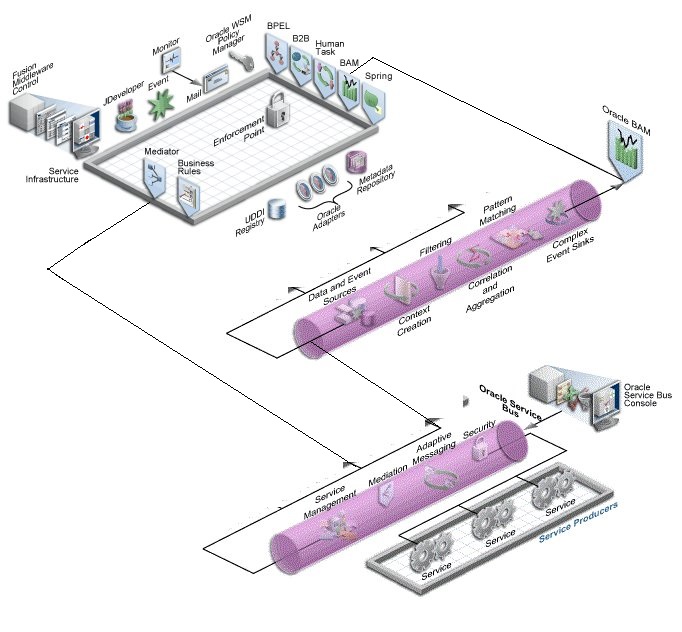
Understanding all the different elements available to you with Oracle SOA Suite can be a little tricky to say the least as the often the building blocks available are shown in diagrams like:

As shown in http://docs.oracle.com/cd/E28280_01/doc.1111/e10223/01_components.htm

They say a picture says a thousand words. But, those thousand words can omit some details.  Take this diagram for example, it only reflects the common elements in the main SOA server. But within the SOA license you also have Oracle Service Bus (OSB) and the Complex Event Processing (CEP) engine which run as separate servers.  Which means you’d see the following:

as shown in http://docs.oracle.com/cd/E28280_01/doc.1111/e10223/04_osb.htm

as shown in http://docs.oracle.com/cd/E28280_01/doc.1111/e10223/14_cep.htm

Oh, but hang on; we still haven’t got a representation of JMS, and Coherence.  JMS like CEP and OSB actually instantiates as a separate server as well.  So got a handle on everything now?  Well there is a little confusion still needing to be added to the mix.  The following diagram is commonly used showing interoperability with other products with separate licenses:

shown in http://docs.oracle.com/cd/E28280_01/doc.1111/e10223/507_eda.htm

Taking the above diagram at face value, you could interpret things as actually you don’t have the CEP capability as it is the key part of the Oracle Event Driven Architecture Suite.

I have merged together the diagrams to show the bulk of all the SOA stack that comes into the main SOA license. As you can see ….

gs_1

Share this:

  • Share on Facebook (Opens in new window) Facebook
  • Share on X (Opens in new window) X
  • Share on Pocket (Opens in new window) Pocket
  • Share on Reddit (Opens in new window) Reddit
  • Email a link to a friend (Opens in new window) Email
  • Share on WhatsApp (Opens in new window) WhatsApp
  • Print (Opens in new window) Print
  • Share on Tumblr (Opens in new window) Tumblr
  • Share on Mastodon (Opens in new window) Mastodon
  • Share on Pinterest (Opens in new window) Pinterest
  • More
  • Share on Bluesky (Opens in new window) Bluesky
  • Share on LinkedIn (Opens in new window) LinkedIn
Like Loading...

Oracle Cloud Integration – book

29 Friday May 2015

Posted by mp3monster in Books, Oracle

≈ Leave a comment

Tags

book, Cloud, demographics, integration, Oracle

We’re progressing with our Oracle Cloud Integration book idea now that we’ve had some publisher interest. 1st cycle around defining the book should be submitted in the next day or so.  Will starting to write the initial chapters very soon. Exciting times as they say.

Share this:

  • Share on Facebook (Opens in new window) Facebook
  • Share on X (Opens in new window) X
  • Share on Pocket (Opens in new window) Pocket
  • Share on Reddit (Opens in new window) Reddit
  • Email a link to a friend (Opens in new window) Email
  • Share on WhatsApp (Opens in new window) WhatsApp
  • Print (Opens in new window) Print
  • Share on Tumblr (Opens in new window) Tumblr
  • Share on Mastodon (Opens in new window) Mastodon
  • Share on Pinterest (Opens in new window) Pinterest
  • More
  • Share on Bluesky (Opens in new window) Bluesky
  • Share on LinkedIn (Opens in new window) LinkedIn
Like Loading...

Push Notifications with a bit of Node.js

16 Thursday Apr 2015

Posted by mp3monster in General, NodeJS Cloud, Oracle, Technology

≈ 1 Comment

Tags

API library, HelloWorld, javascript, JDeveloper, Node, node.js, npm, Oracle, prowl, push notifications

So I have written a couple of blogs about Push Notifications with a bit of Java (see here as the post that pulls all of this together). But this time we’re going to do something similar with Node.js. This blog entry is going to position us so we can then take a simple solution and push up to the cloud – as I use Oracle a lot then we’ll be looking at the Oracle cloud as a final step.

To start we need a local instance of node.js.  Given the fact it is a small footprint we can pretty much install anywhere.  So you’ll need to download Node.JS from the official site, and install it. I’m not going to walk through the installation guidance as it is well documented elsewhere (http://blog.teamtreehouse.com/install-node-js-npm-windows for example). You do want ensure you include the NPM capability (node.js packaging & deployment tool). Make sure that Node is on your path so we can reference the binary without a lots of file paths. You also want to ensure that node.js is up and running.

Next up is to the the Prowl API library that makes interacting with prowl simple and helps illustrate the deployment framework (NPM) used by node.js. So following the link from the Prowl website or go directly here  and download the library.  If you download the zip file as I did,  you’ll find it has a folder called node-prowl-master. You need to unpack this and rename to node-prowl.  and run the command

npm install node-prowl

When I first tried to deploy the Prowl API library then I did see an error. This isn’t the API but actually the Node.js installation (atleast on my Windows platform) as you can see:

installErrorI found googling using node.js and ENOENT showed up plenty of help to solve errors. In this situation the solution was purely to create the folder. Then re-running the action without problem.

When the npm command works you’ll see something like:

npm-install

So hopefully in addition to the prerequisites described in this earlier post we should have everything ready to progress.  So I’ve continued to use JDeveloper 12c, but using the general profile and set up a web solution project.  This does create a large directory structure given we’re producing some simple Javascript. But the structure is right for a proper development effort, and lazy habits form poor practises – so lets work with it.

With the project setup, we need craft a little JavaScript.  To we’re good to go – lets just try hello world, with a tiny twist, we’ll get the hostname using a Node library with this code:


// our very first node program

// get info about the OS
var os = require(‘os’);

// say hello world and include the hostname
console.log(“Hello world, we’re running on ” + os.hostname());

Before we do anything else, lets be a bit clever, to allow us to run our Node script within JDeveloper.  This can be done by adding a new Tool through the Tools –> External Tools … menu. Which will display the following screen:

external-tool-setup-0


Asa you can see in this image I have already selected New… and walked through the configuration screens, you’ll probably want to use a configuration similar to what I have in the following steps:

external-tool-setup-1

external-tool-setup-2 external-tool-setup-3

external-tool-setup-4

With this setup in JDeveloper with the Editor focus on our JavaScript, goto the Tools menu and you’ll see your Node entry. Just click on it. We’ll then see the results in the message window, as you can see here:

Hello World in JDeveloper

Alternatively in a command window you just need to run the command from the folder with the JavaScript (or include the path):

node helloworld.js

So lets take things up a notch and send our mobile device a message.  So using the following code, we can use the prowl-api and initiate a message:

var Prowl = require(‘node-prowl’); // pull in the prowl API we deployed with NPM earlier

var prowl = new Prowl(‘your-prowl-key-here‘); //setup your API key

var now = new Date();

// ready to send the message, passing a function reference to handle the response

var message = ‘hello mobile device, the time is ‘+ now.toUTCString();
prowl.push(message, ‘NodeJS App’, prowlReplyHandler);

//function to handle the response from the prowl API lib
function prowlReplyHandler ( err, remaining )
{

if( err )
{
var errorStr = err.message;
console.log( ‘I have an error ‘ + errorStr);
}
else
{
console.log( ‘I said:’ + message+ ‘; I have ‘ + remaining + ‘ calls available’ );
}

}

Note you’ll need to replace your-prowl-key-here in the above code with you genuine API key registered with the Prowl web app. Then we can run the application, and should see:

Node JS Calling Prowl

Our mobile device will show:

prowl-node-js-mobile


Next steps, in the next post – run through through a cloud hosting of node.js and extend the capability to be a simple service, which will mean packaging ourselves up and other exciting things.

Share this:

  • Share on Facebook (Opens in new window) Facebook
  • Share on X (Opens in new window) X
  • Share on Pocket (Opens in new window) Pocket
  • Share on Reddit (Opens in new window) Reddit
  • Email a link to a friend (Opens in new window) Email
  • Share on WhatsApp (Opens in new window) WhatsApp
  • Print (Opens in new window) Print
  • Share on Tumblr (Opens in new window) Tumblr
  • Share on Mastodon (Opens in new window) Mastodon
  • Share on Pinterest (Opens in new window) Pinterest
  • More
  • Share on Bluesky (Opens in new window) Bluesky
  • Share on LinkedIn (Opens in new window) LinkedIn
Like Loading...

New eBook offer from Oracle Press

12 Thursday Mar 2015

Posted by mp3monster in Books, Oracle, Oracle Press

≈ Leave a comment

Tags

books, database, ebook, Oracle, Oracle Press, Query, tuning

Oracle Press are offering the Quick Start Guide to Oracle Query Tuning for free at the moment – register for the book at http://books.mcgraw-hill.com/ebookdownloads/solarwinds/ 

Share this:

  • Share on Facebook (Opens in new window) Facebook
  • Share on X (Opens in new window) X
  • Share on Pocket (Opens in new window) Pocket
  • Share on Reddit (Opens in new window) Reddit
  • Email a link to a friend (Opens in new window) Email
  • Share on WhatsApp (Opens in new window) WhatsApp
  • Print (Opens in new window) Print
  • Share on Tumblr (Opens in new window) Tumblr
  • Share on Mastodon (Opens in new window) Mastodon
  • Share on Pinterest (Opens in new window) Pinterest
  • More
  • Share on Bluesky (Opens in new window) Bluesky
  • Share on LinkedIn (Opens in new window) LinkedIn
Like Loading...

Oracle Press – Free EBooks

05 Thursday Mar 2015

Posted by mp3monster in Books, General, Oracle, Technology

≈ Leave a comment

Tags

ebook, free, Oracle, Oracle Press, publications, UKOCN

So Oracle Press have been celebrating 20 years of publications.  As part of that celebration they have over the year offered a number of eBooks for free.  The UKOCN site have pulled a list of these free books together along with relevant links for request the ebooks – go checkout http://www.ukocn.com/article/oracle-press-free-copies – if this link doesn’t work (UKOCN maybe preventing deep links) then go to http://www.ukocn.com/ and visit articles, and you should see an article called “ORACLE PRESS FREE COPIES!”. at the time of writing this post this is on the homepage of listed articles.
“

Share this:

  • Share on Facebook (Opens in new window) Facebook
  • Share on X (Opens in new window) X
  • Share on Pocket (Opens in new window) Pocket
  • Share on Reddit (Opens in new window) Reddit
  • Email a link to a friend (Opens in new window) Email
  • Share on WhatsApp (Opens in new window) WhatsApp
  • Print (Opens in new window) Print
  • Share on Tumblr (Opens in new window) Tumblr
  • Share on Mastodon (Opens in new window) Mastodon
  • Share on Pinterest (Opens in new window) Pinterest
  • More
  • Share on Bluesky (Opens in new window) Bluesky
  • Share on LinkedIn (Opens in new window) LinkedIn
Like Loading...

Oracle Free EBook on Enterprise Mobility

26 Monday Jan 2015

Posted by mp3monster in Books, Oracle, Technology

≈ Leave a comment

Tags

ebook, enterprise, free, mobile, Oracle

Oracle a free Ebook about enterprise Mobility – it can be downloaded from https://blogs.oracle.com/imc/entry/free_oracle_special_edition_ebook1  The book focuses on the following areas:

  • Mobile Trends and Concepts
  • Mobile Architectures, Integration, Scalability, and Security
  • Exploring the Oracle Mobile Platform

Share this:

  • Share on Facebook (Opens in new window) Facebook
  • Share on X (Opens in new window) X
  • Share on Pocket (Opens in new window) Pocket
  • Share on Reddit (Opens in new window) Reddit
  • Email a link to a friend (Opens in new window) Email
  • Share on WhatsApp (Opens in new window) WhatsApp
  • Print (Opens in new window) Print
  • Share on Tumblr (Opens in new window) Tumblr
  • Share on Mastodon (Opens in new window) Mastodon
  • Share on Pinterest (Opens in new window) Pinterest
  • More
  • Share on Bluesky (Opens in new window) Bluesky
  • Share on LinkedIn (Opens in new window) LinkedIn
Like Loading...

Push Notifications with a Bit of Java

24 Saturday Jan 2015

Posted by mp3monster in Java Cloud, Oracle, Technology

≈ Leave a comment

Tags

12c, Apache Maven, archetype, Eclipse, IDE, IntelliJ, java, JDeveloper, jProwlAPI, maven, mvn, Oracle, Oracle Java Cloud, OTN, POM, prowl, ProwlAPI, sourceForge

So continuing from my previous posts:

  • Intro
  • Push Notifications Without Your Own Mobile App

We’re going to use the Prowl API and create the equivalent classic “Hello World” App using the push framework – but cutting out the need for Growl etc.  For this blog post we’re not going to use the Oracle Java Cloud as we need to see the code working locally and get ready to promote the code to the cloud.  Once we’ve got some code working we can look at setting up the Java Cloud environment, package and promote what we have here using our IDE into the cloud environment.
As we’re cutting Java code now – you can obviously use your own preferred IDE, I’m going to use JDeveloper 12c if for no other reason than it being a huge improvement on 11g (download here) and I’ve become somewhat disappointed with Eclipse.  Whilst talking about IDEs;  you should be aware that Oracle provide an Oracle Cloud SDK which integrates with a number of IDEs to make some of the interactions with the cloud straight forward.

The SDK provides Ant and Maven scripts to help the build and deploy process – so we will be using those later, plus command line tools to help manage other activities, a number of code examples and HTML documentation.  To setup the SDK you will need to unpack the file into a folder and add that folder into your PATH environment variables. The bundle includes a readme that contains just enough to show what is required to get unpacked and make the command line tools work.

To download from Oracle you will need to setup an Oracle Technology Network (OTN) account – so if you don’t have one now is the time to create one – there is no cost to this, we’re going to need

We could use the REST based API that is provided by the ProwlApp, but at least to start with we’re going to follow the approach using a library to make using the API very simple. By using the API provided on SourceForge (jProwlAPI). Using an API will allow us to show the use of 3rd party libraries in the cloud deployment but also follows some of the Oracle ideas of offering ‘adaptors’ to simplify integration.

So you need to download:

  • JDeveloper 12c – http://www.oracle.com/technetwork/developer-tools/jdev/downloads/index.html (if you want to use JDeveloper as shown)
  • The jProwlAPI from SourceForge
  • Oracle Cloud SDK

So with this downloaded we are going to:

Setup an new Maven based project (or copy my file structure into place and import) using a maven quickstart archtetype (org.apache.maven.archetypes:maven-archetype-quickstart) . We will probably need to modify this later to leverage the full cloud capable archetype. This will build your project environment and retrieve a bunch of plugins you might need.

Next lets take a peak inside of the jProwlAPI download. You’ll see an example bit of java that shows how to fire the API.  Rather than tinker with this we have created a small package and JUnit test as we would if writing a proper solution created with the maven archetype.

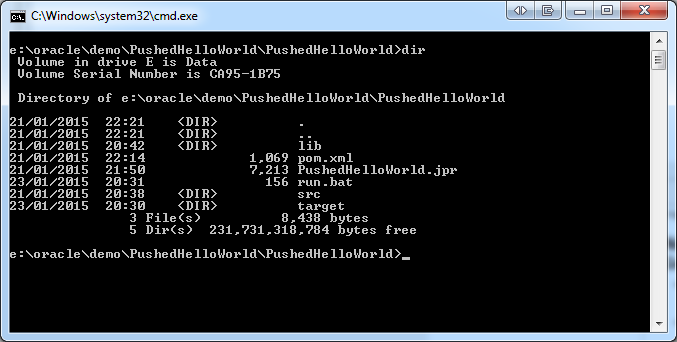
PushedHelloWorld directory structure

We also need to make the JProwlAPI jar file available to the project. So we use maven pattern, and create a folder called lib and copy the jar file into it. We then add the lib folder to project setup.


pushedhello-RunConfig

To be able to create the deployable artefact we need to load the jar file into the local repository, which we can do with a command line instruction (presuming maven is also available by your PATH variable).

mvn install:install-file -Dfile=./lib/JProwlAPI-0.5.jar -DgroupId=prowl -DartefactId=JProwlAPI -Dversion=12.1.3-0-0 -Dpackage=jar

We’ll come back to the command line in a bit, but within JDeveloper the code I have provided needs 1 change from yourself – replace the references to –YourAPIKey– in the run execute command and in the JUnit class with your own key.

JDEveloper 12c Run Config

In the the ProwlProcessor class I have included a man in method so we can just execute the class to see things working. So having done that we can then repeat by running the class via the JUnit test. You should see the same result. When we we’ve deployed or class to the cloud we can use the JUnit test to invoke the cloud.

ProwlProcessor - main method

The last step, within the IDE we have been compiling to get the class, but not creating a deployable jar file. We could do this with the IDE but we would also in a real development condition be creating artefacts via a Continuous Integration tooling which will effectively fire the maven command line like interface. So let’s do that to create the jar files, using the following command:

mvn clean package

You should then see a folder created if not already there and a jar file reflecting the values in the POM file, that we can see below.

JDeveloper 12C - view of a simple POM

So we have enough now we could in theory deploy a jar to a weblogic container and fire it from a Unit test. In the next post we’ll deploy and execute the unit test, and throw a crude front end into the mix.

Share this:

  • Share on Facebook (Opens in new window) Facebook
  • Share on X (Opens in new window) X
  • Share on Pocket (Opens in new window) Pocket
  • Share on Reddit (Opens in new window) Reddit
  • Email a link to a friend (Opens in new window) Email
  • Share on WhatsApp (Opens in new window) WhatsApp
  • Print (Opens in new window) Print
  • Share on Tumblr (Opens in new window) Tumblr
  • Share on Mastodon (Opens in new window) Mastodon
  • Share on Pinterest (Opens in new window) Pinterest
  • More
  • Share on Bluesky (Opens in new window) Bluesky
  • Share on LinkedIn (Opens in new window) LinkedIn
Like Loading...
← Older posts
Newer posts →

    I work for Oracle, all opinions here are my own & do not necessarily reflect the views of Oracle

    • About
      • Internet Profile
      • Music Buying
      • Presenting Activities
    • Books & Publications
      • Logging in Action with Fluentd, Kubernetes and More
      • Logs and Telemetry using Fluent Bit
      • Oracle Integration
      • API & API Platform
        • API Useful Resources
        • Useful Reading Sources
    • Mindmaps Index
    • Monster On Music
      • Music Listening
      • Music Reading
    • Oracle Resources
    • Useful Tech Resources
      • Fluentd & Fluent Bit Additional stuff
        • Logging Frameworks and Fluent Bit and Fluentd connectivity
        • REGEX for BIC and IBAN processing
      • Java and Graal Useful Links
      • Official Sources for Product Logos
      • Python Setup & related tips
      • Recommended Tech Podcasts

    Oracle Ace Director Alumni

    TOGAF 9

    Logs and Telemetry using Fluent Bit


    Logging in Action — Fluentd

    Logging in Action with Fluentd


    Oracle Cloud Integration Book


    API Platform Book


    Oracle Dev Meetup London

    Blog Categories

    • App Ideas
    • Books
      • Book Reviews
      • manning
      • Oracle Press
      • Packt
    • Enterprise architecture
    • General
      • economy
      • ExternalWebPublications
      • LinkedIn
      • Website
    • Music
      • Music Resources
      • Music Reviews
    • Photography
    • Podcasts
    • Technology
      • AI
      • APIs & microservices
      • chatbots
      • Cloud
      • Cloud Native
      • Dev Meetup
      • development
        • languages
          • java
          • node.js
          • python
      • drone
      • Fluentbit
      • Fluentd
      • logsimulator
      • mindmap
      • OMESA
      • Oracle
        • API Platform CS
          • tools
        • Helidon
        • ITSO & OEAF
        • Java Cloud
        • NodeJS Cloud
        • OIC – ICS
        • Oracle Cloud Native
        • OUG
      • railroad diagrams
      • TOGAF
    • xxRetired
    • AI
    • API Platform CS
    • APIs & microservices
    • App Ideas
    • Book Reviews
    • Books
    • chatbots
    • Cloud
    • Cloud Native
    • Dev Meetup
    • development
    • drone
    • economy
    • Enterprise architecture
    • ExternalWebPublications
    • Fluentbit
    • Fluentd
    • General
    • Helidon
    • ITSO & OEAF
    • java
    • Java Cloud
    • languages
    • LinkedIn
    • logsimulator
    • manning
    • mindmap
    • Music
    • Music Resources
    • Music Reviews
    • node.js
    • NodeJS Cloud
    • OIC – ICS
    • OMESA
    • Oracle
    • Oracle Cloud Native
    • Oracle Press
    • OUG
    • Packt
    • Photography
    • Podcasts
    • python
    • railroad diagrams
    • Technology
    • TOGAF
    • tools
    • Website
    • xxRetired

    Enter your email address to subscribe to this blog and receive notifications of new posts by email.

    Join 2,555 other subscribers

    RSS

    RSS Feed RSS - Posts

    RSS Feed RSS - Comments

    January 2026
    M T W T F S S
     1234
    567891011
    12131415161718
    19202122232425
    262728293031  
    « Nov    

    Twitter

    Tweets by mp3monster

    History

    Speaker Recognition

    Open Source Summit Speaker

    Flickr Pics

    Gogo Penguin at the BarbicanGogo Penguin at the BarbicanGogo Penguin at the BarbicanGogo Penguin at the Barbican
    More Photos

    Social

    • View @mp3monster’s profile on Twitter
    • View philwilkins’s profile on LinkedIn
    • View mp3monster’s profile on GitHub
    • View mp3monster’s profile on Flickr
    • View mp3muncher’s profile on WordPress.org
    • View philmp3monster’s profile on Twitch
    Follow Phil (aka MP3Monster)'s Blog on WordPress.com

    Blog at WordPress.com.

    • Subscribe Subscribed
      • Phil (aka MP3Monster)'s Blog
      • Join 233 other subscribers
      • Already have a WordPress.com account? Log in now.
      • Phil (aka MP3Monster)'s Blog
      • Subscribe Subscribed
      • Sign up
      • Log in
      • Report this content
      • View site in Reader
      • Manage subscriptions
      • Collapse this bar
     

    Loading Comments...
     

    You must be logged in to post a comment.

      Privacy & Cookies: This site uses cookies. By continuing to use this website, you agree to their use.
      To find out more, including how to control cookies, see here: Our Cookie Policy
      %d