
• Home
  • Site Aliases
    • www.cloud-native.info
  • About
    • Background
    • Presenting Activities
    • Internet Profile
      • LinkedIn
    • About
  • Books & Publications
    • Log Generator
    • Logs and Telemetry using Fluent Bit
      • Fluent Bit book
      • Book Resources in GitHub
      • Fluent Bit Classic to YAML Format configurations
    • Logging in Action with Fluentd, Kubernetes and More
      • Logging in Action with Fluentd – Book
      • Fluentd Book Resources
      • Fluentd & Fluent Bit Additional stuff
    • API & API Platform
      • API Useful Resources
    • Oracle Integration
      • Book Website
      • Useful Reading Sources
    • Publication Contributions
  • Resources
    • GitHub
    • Oracle Integration Site
    • Oracle Resources
    • Mindmaps Index
    • Useful Tech Resources
      • Fluentd & Fluent Bit Additional stuff
      • Recommended Tech Podcasts
      • Official Sources for Product Logos
      • Java and Graal Useful Links
      • Python Setup & related stuff
  • Music
    • Monster On Music
    • Music Listening
    • Music Reading

Phil (aka MP3Monster)'s Blog

~ from Technology to Music

Phil (aka MP3Monster)'s Blog

Category Archives: Oracle

All things related to Oracle

Container Registry – pushing and storing containers

12 Thursday May 2022

Posted by mp3monster in Cloud Native, General, Oracle, Oracle Cloud Native, Technology

≈ 2 Comments

Tags

container, development, Docker, Kubernetes, OCIR, OKE, Oracle, registry, Technology

A container registry is as essential as a Kubernetes service as you want to manage the deployable resources. That registry could be the public Docker repository or something else. In most people’s cases, the registry needs to be private as you don’t want to expose your product assets to potential external tampering. As a result, we need a service such as Oracle’s container registry OCIR.

The re of this blog is going to walk through how to push a container you’ve built into OCIR and a gotcha that can trip up users if you make assumptions about how the registry works.

Build container

Let’s assume you’re building your microservices locally or retrieving vetting 3rd party services for use. In both cases, you want to manually push your assets into OCIR manually rather than have an automated build pipeline do it for you.

To make it easier to see what is happening, we can exploit some code from Oracle’s Github repo (such as this piece being developed) or you could use the classic hello world container (https://github.com/whotutorials/docker-busybox-hello-world/blob/master/Dockerfile). For the rest of the post, we’ll assume it is the code developed for the Oracle Architecture Center-provided code.

docker build -t event-data-svc .

This creates a container locally, and we can see the container listed using the command:

docker images

Setup of OCIR

We need an OCIR to target so the easiest thing is to manually create an OCIR instance in one of the regions, for the sake of this illustration we’ll use Ashburn (short code is IAD). To help with the visibility we can put the registry in a separate compartment as a child of the root. Let’s assume we’re going to call the registry GraphQL. So before creating your OCIR set up the compartment as necessary.

fragment of the compartment hierarchy

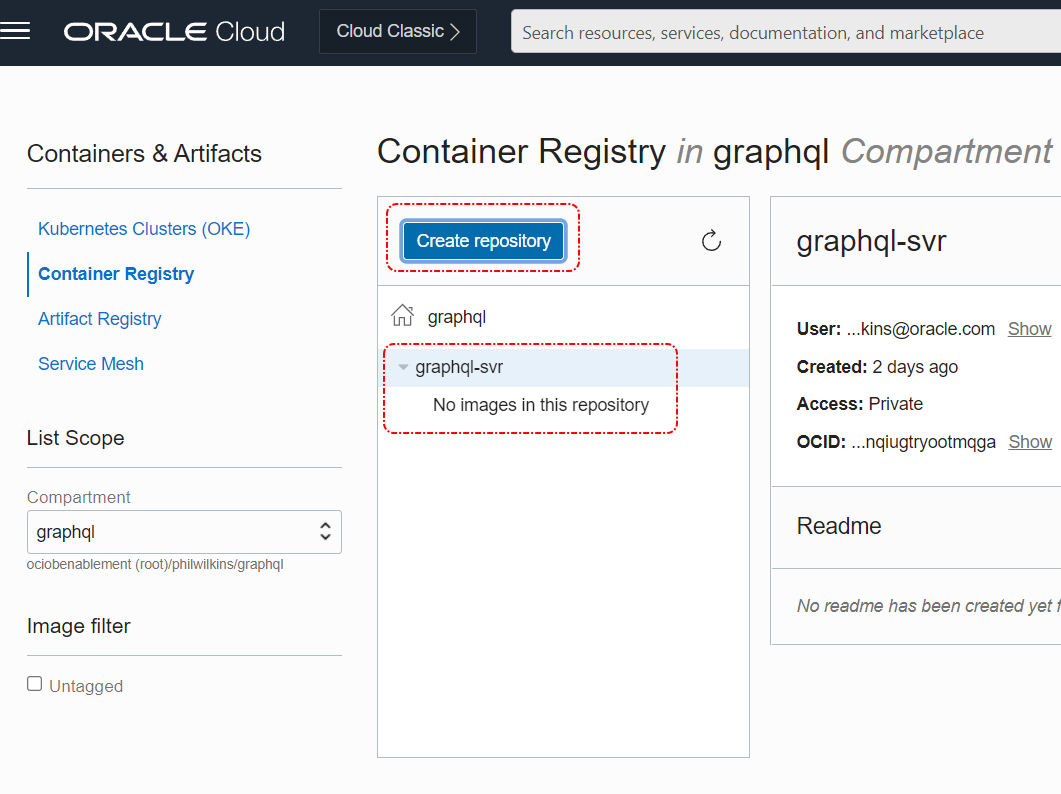
In the screenshot, you can see I’ve created a registry, which is very quick and easy in the UI (in the menu it’s in the Developer Services section).

The Oracle meu to navigate to the OCIR service
the UI to create a OCIR

Finally, we click on the button to create the specific OCIR.
Deployment…

Having created the image, and with a repo ready we can start the steps of pushing the container to OCIR.

The next step is to tag the created image. This has to be done carefully as the tag needs to reflect where the image is going using the formula <region name>/<tenancy name/<registry name>:<version>. All the registries will be addressed by <region short code>.ocir.io In our case, it would be iad.ocir.io.

docker tag graph-svr:latest iad.ocir.io/ociobenablement/graphql-svr:v0.1-dev

As you may have realized the tag being applied effectively tells OCI which instance of OCIR to place the container in. Getting this wrong can be the core of the gotcha previously mentioned and we’ll elaborate upon it shortly.

To sign in you’ll need an auth token as that is passed as the password. For simplicity, I’ve passed the token in the docker command, which Docker will warn you of as being insecure, and suggest it is passed in as part of a prompt. Note my token will have been changed by the time this is published. The username is built on the structure of <cloud tenancy name>/identitycloudservice/<username>. The identitycloudservice piece only needs to be included for your authentication is managed through IDCS, as is the case here. The final bit is the URI for the appropriate regional OCIR address, as we’ve used previously.

docker login -u ociobenablement/identitycloudservice/philip.wilkins@oracle.com -p XXXXXXXXXXX  iad.ocir.io

With hopefully a successful authentication response we can push the container. It is worth noting that the Docker authenticated connection will timeout which is why we’ve put everything in place before connecting. The push command is very simple, it is the tag name assigned to the artifact including the version number.

docker push iad.ocir.io/ociobenablement/graphql/graph-svr:v0.1-dev
OCIR with several versions of a container

Avoiding the gotcha

When we deal with repositories from Git to SVN or Apache Archiva to Nexus we work with a repository that holds multiple different assets with multiple versions of those assets. as a result, when we identify an asset uniquely we would expect to name things based on server/location, repository, asset name, and version. However, here each repository is designed for one type of asset but multiple versions. In reality, a Docker repository works in the same manner (but the extended path impact is different).

This means it becomes easy to accidentally define a tag with an extra element. Depending upon your OCI tenancy privileges if you get the path wrong, OCI creates a new root compartment container repository with a name that is a composite of the name elements after the tenancy and puts your artifact in that repository, not the one you expected.

We can address this in several ways, first and probably the best option is to automate the process of loading assets into OCIR, once the process is correct, it will remain correct. Another is to adopt a principle of never holding repositories at the root of a tenancy, which means you can then explicitly remove the permissions to create repositories in that compartment (you’ll need to explicitly grant the permissions elsewhere in the compartment hierarchy because of policy inheritance. This will result in the process of pushing a container to fail because of privileges if the tag is wrong.

Visual representation of structure differences

Repository Structure
Registry Structure

Condensed to a simple script

These steps can be condensed to a simple platform neutral script as follows:

docker build -t event-data-svc .
docker tag event-data-svc:latest iad.ocir.io/ociobenablement/event-data-svc:latest

docker login -u ociobenablement/identitycloudservice/philip.wilkins@oracle.com -p XXXXX  iad.ocir.io
docker push iad.ocir.io/ociobenablement/event-data-svc:latest

This script would need modifying for each container being built, but you could easily make it parameterized or configuration drive.

A Note on Registry Standards

Oracle’s Container Registry has adopted the Open Registries standard for OCIR. Open Registries come under the Linux Foundation‘s governance. This standard has been adopted by all the major hyperscalers (Google, AWS, Azure, etc). All the technical spec information for the standard is published through GitHub rather than the main website.

References

  • Push an Image to Oracle Cloud Infrastructure Registry
  • Notes about Repository Creation
  • Creating a Container Registry
  • Open Registries
  • Policies to Control Repository Access

Share this:

  • Click to share on Facebook (Opens in new window) Facebook
  • Click to share on X (Opens in new window) X
  • Click to share on Pocket (Opens in new window) Pocket
  • Click to share on Reddit (Opens in new window) Reddit
  • Click to email a link to a friend (Opens in new window) Email
  • Click to share on WhatsApp (Opens in new window) WhatsApp
  • Click to print (Opens in new window) Print
  • Click to share on Tumblr (Opens in new window) Tumblr
  • Click to share on Mastodon (Opens in new window) Mastodon
  • Click to share on Pinterest (Opens in new window) Pinterest
  • More
  • Click to share on Bluesky (Opens in new window) Bluesky
  • Click to share on LinkedIn (Opens in new window) LinkedIn
Like Loading...

Knowledge Resources from Oracle

05 Tuesday Apr 2022

Posted by mp3monster in Cloud, General, Oracle, Technology

≈ Leave a comment

Tags

documentation, knowledge, Oracle, resources

Before joining Oracle I used to typically refer to a couple of key resources from Oracle – docs.oracle.com, and occasionally developer.oracle.com and ateam-oracle.com. We’d obviously use cloud.oracle.com and the main oracle.com to be able to reference published stats, success references etc. Now I’m part of the company and working in the OCI product team with an outbound side of things, I needed to gem up on all the assets that exist. So that we can help contribute, and ensure that they are up to date etc. In doing so, the number of resources available is so much more than I’d realized.

Upon reflection, this may have been from the fact we didn’t drill down deeply enough, also in part that Capgemini has its own approaches and strategies as well.

This in part is linked to the organizational structures e.g. OCI Product Management’s outbound work overlaps with the Marketing Developer Relations, for example, something that is inevitable in an organization that provides such a diverse portfolio of products.

For my own benefit, and for others to exploit, the following table summarises the different areas of information. The nature of the content and – where content overlaps or is presented in different ways.

We’ve moved this content so it can be easily revised to here (and accessible from the site menu). But also available here …

oracle.com/goto/ …Domain AddressDescription
oracle.comThis is the commercial side of the Oracle content. But includes a landing page for a lot of Oracle knowledge/documentation.
docs.oracle.comThe home of the core Oracle documentation for all products.
/blogblogs.oracle.comThe members of this team are the ‘gurus’ of product applications. These cover a range of domains – structured in a similar way to blogs.oracle.com with different posts. These posts represent patterns and solutions to problems encountered by the team. How to, or not to implement things.
This can overlap with some blogs in so far as both product blogs and A-Team blogs may address how to leverage product features.
A-TeamDeveloper relations lead, which covers not only Oracle products but also the application of open source. By its very name, there is a strong emphasis on coding (rather than low-code) covering not just Java but .Net languages such as C#, Node, JavaScript, and so on.
There is some content overlap here with the Architectural Center, where Architecture Centre provides reference solutions.
/devdeveloper.oracle.comDeveloper relations lead, which covers not only Oracle products but also the application of open source. By its very name, there is a strong emphasis on coding (rather than low-code) covering not just Java, but .Net languages such as C#, Node, JavaScript, and so on.
There is some content overlap here with the Architectural Center, where Architecture Centre provides reference solutions.
/ref-archs
/playbooks
/deployed
docs.oracle.com/solutions
(AKA Architecture Center)
This is the Architecture Center which provides reference solutions. But these aren’t exclusive to the SaaS products (which would be easy to interpret). A lot of examples cover deploying and running open-source solutions on IaaS, for example, Drupal, WordPress, and Magento to name just a couple. A lot of these are backed up with scripts, Terraform, and code to achieve the deployment and configuration.
In addition to this, there are use cases of what customers have deployed into production (known as built and deployed).
docs.oracle.com/learn/This contains a lot of free tutorials and labs that can be taken a run to implement different things, from deploying a Python with Flask solution on Kubernetes to Creating USB Installation Media for Oracle Linux with Fedora Media Writer. As you can see from these examples, the tutorials cover both Oracle products and open source.
These resources interlink with the Architecture Centre and can overlap with developer.oracle.com.
/gh-devrelgithub.com/oracle-devrelThis contains the code artifacts developed by Developer Relations and the Architecture Center team. So covers Reference Architectures, tutorials, and Live Labs all freely available to use.
/gh-samplesgithub.com/oracle-samplesThis repository contains example solutions and Terraform logic developed by groups such as the A-Team.
/openopensource.oracle.comThis provides a catalog of links to the various open-source repositories available. This includes oracle-sample and devrel but also the many other projects including, but not limited to Helidon, Fn, Verrrazano, GraalVM, Apiary
/communitycommunity.oracle.com/hubThis is where a lot of the Q&A for Oracle Partners and users takes place. Community participation is gamified to encourage participation.
academy.oracle.comThis is really for the educational community (Universities, Colleges & Schools) and provides resources to take you from zero to certified skills for Java and Oracle Database.
education.oracle.comPrimarily for the formal Oracle certification resources, but there are some free training resources here as well.
/apexapex.oracle.comThis provides a catalog of links to the various open-source repositories available. This includes oracle-sample and devrel but also many other projects including, but not limited to Helidon, Fn, Verrrazano, GraalVM, Apiary
/gh-oraclegithub.com/oracleThis is the home for the majority of all Oracle free code, including the Open source projects such as Helidon, JET, Kubernetes Operators, and so on.
Helidon, Fn, and other source projectsAPEX has its own area of dedicated resources. This includes solutions, templates, other development resources, and community.
/youtubewww.youtube.com/oracleYouTube training videos. With multiple channels based on different technologies.
Java (OpenJDK and Oracle JDK)A number of Oracle open-source projects have their own independent web resources as well. Helidon includes additional technical resources.
The ones we know more about are :
Helidon, Fn, Verrrazano, GraalVM, Apiary
But it includes references to Java core language etc.
/paasPaaS CommunityManaged by Jurgen Kress (Prod Mgr for Oracle PaaS). It acts as an aggregator for contributions from the community and shares news about what is happening within Oracle to support customers and partners in the PaaS space.
Developer CommunityPartner site to the PaaS Community with a focus on more development activities around Weblogic, Helidon, etc.
Tutorials etc., relating to the use of Linux and related Cloud Native things such as Verrazano, OCNE (Kubernetes), etc.LunaOracle propel not just their main JDK /JRE, which has license constraints, but also Open JDK. With this comes a dedicated Developer zone as dev.java.
Oracle PodcastsPerhaps not access usable as documentation, how-to, etc. but Podcasts can yield a lot of broad picture insights. Oracle has a range of podcasts covering a diverse range of subjects. Not all podcasts are active at any one time. But the site provides a catalog and episode list.

Share this:

  • Click to share on Facebook (Opens in new window) Facebook
  • Click to share on X (Opens in new window) X
  • Click to share on Pocket (Opens in new window) Pocket
  • Click to share on Reddit (Opens in new window) Reddit
  • Click to email a link to a friend (Opens in new window) Email
  • Click to share on WhatsApp (Opens in new window) WhatsApp
  • Click to print (Opens in new window) Print
  • Click to share on Tumblr (Opens in new window) Tumblr
  • Click to share on Mastodon (Opens in new window) Mastodon
  • Click to share on Pinterest (Opens in new window) Pinterest
  • More
  • Click to share on Bluesky (Opens in new window) Bluesky
  • Click to share on LinkedIn (Opens in new window) LinkedIn
Like Loading...

GitHub Actions on OCI

29 Monday Nov 2021

Posted by mp3monster in development, General, Oracle, Technology

≈ Leave a comment

Tags

actions, Cloud, free, GitHub, OCI, Presentation, runners, slide

Today was the first run of some new presentation material looking at the use of GitHub Actions using Runners deployed on OCI Free Tier. The presentation was actually physical rather than virtual which was after 2 years of virtual presenting, rather refreshing. Not to mention the UKOUG hosted the event at the Oval Cricket ground, which made for an interesting venue. The example configuration is included in our GitHub OCI Utilities repository (as we use this solution to help validate and test our development work).

The presentation itself (which includes screenshots of the setup of a simple Action and runner) is here, note I have disconnected my Runners, but you will be able to see the Action configuration but if you try to trigger activity through my repository then nothing will happen.

GitHub Actions – using Free Oracle Cloud Infrastructure (OCI) from Phil Wilkins
Implementing GitHub Action Handlers (aka Runners) on OCI
Continue reading →

Share this:

  • Click to share on Facebook (Opens in new window) Facebook
  • Click to share on X (Opens in new window) X
  • Click to share on Pocket (Opens in new window) Pocket
  • Click to share on Reddit (Opens in new window) Reddit
  • Click to email a link to a friend (Opens in new window) Email
  • Click to share on WhatsApp (Opens in new window) WhatsApp
  • Click to print (Opens in new window) Print
  • Click to share on Tumblr (Opens in new window) Tumblr
  • Click to share on Mastodon (Opens in new window) Mastodon
  • Click to share on Pinterest (Opens in new window) Pinterest
  • More
  • Click to share on Bluesky (Opens in new window) Bluesky
  • Click to share on LinkedIn (Opens in new window) LinkedIn
Like Loading...

Presenting with Oracle, Flexagon and Heathrow Airport

11 Thursday Nov 2021

Posted by mp3monster in General, Oracle, Podcasts, Technology

≈ Leave a comment

Tags

Flexagon, Heathrow Airport, Oracle, webinar

We’re excited to be presenting on November 16th 4.30pm CET (3.30pm GMT). I hope you can join us by registering here

Heathrow rapidly moves to Oracle Cloud and connects with hybrid Integration.

The continuous delivery of constant small innovations can bring benefits faster without risks. Join us to hear how Capgemini’s Agile Innovation Platform (AIP) combined with Flexagon’s FlexDeploy DevOps platform enable this model of innovation and achieve tangible benefits to customers using the cloud capabilities and traditional on-premises ERP.

Phil Wilkins, Capgemini Integration Architect, and Dan Goerdt, President of Flexagon will describe how the combination are highly effective at delivering micro-innovation demonstrated through real-world customer results.

From this session, you will learn:

  • How the Agile Innovation Platform’s building blocks and templates allow development teams to reduce time to value.
  • How FlexDeploy brings unique benefits to both Open Source and Oracle-specific technologies.
  • What were the challenges solved and benefits gained by actual customers using AIP and FlexDeploy.
  • How Integration is the foundation of continuous delivery and innovation.

Share this:

  • Click to share on Facebook (Opens in new window) Facebook
  • Click to share on X (Opens in new window) X
  • Click to share on Pocket (Opens in new window) Pocket
  • Click to share on Reddit (Opens in new window) Reddit
  • Click to email a link to a friend (Opens in new window) Email
  • Click to share on WhatsApp (Opens in new window) WhatsApp
  • Click to print (Opens in new window) Print
  • Click to share on Tumblr (Opens in new window) Tumblr
  • Click to share on Mastodon (Opens in new window) Mastodon
  • Click to share on Pinterest (Opens in new window) Pinterest
  • More
  • Click to share on Bluesky (Opens in new window) Bluesky
  • Click to share on LinkedIn (Opens in new window) LinkedIn
Like Loading...

Automating OCI Tasks with OCI Python SDK #JoelKallmanDay

11 Monday Oct 2021

Posted by mp3monster in Cloud, development, General, Oracle, Oracle Cloud Native, Technology

≈ Leave a comment

Tags

#JoelKallmanDay, community, Joel Kallman, OCI, Oracle, python, SDK, Tim Hall

This isn’t the first time I’ve written about the Oracle Cloud SDK (check here), but it seems rather fitting, as some of the utilities I’ve been working on are open to the community, and #JoelKallmanDay is all about community. If you’d like to know more about #JoelKallmanDay then checkout Tim Hall’s blog here.

Oracle have provided a very rich API and then overlaid it with a number of SDKs in Python, Java etc. The SDKs immediately remove the work of creating connections and correct payloads. Taking the Python SDK for example, all I need to do is create a standard configuration file with all the necessary connection properties to my OCI instance. Then it’s simply a case of creating the correct Python object for the correct group of services wanted. Then it’s down to populating the object attributes. This is the illustration of exactly what a good SDK does. I can lean on my IDE to use the correct set and get operators. The code for establishing a connection is done for me.

What I’ve found most striking is the level of consistency in the methods provided by the SDK regardless of the service. This makes it very easy to develop functionality without needing to check every API before I can write any code. it would be easy to say, so what. But when you look at the breadth of the OCI services it becomes more impressive.

The convenience doesn’t end there. Rather than having to run your utilities from a local command line (Python means we’re pretty much OS agnostic), the Oracle Cloud shell is preconfigured with Python, OCI SDK, GitHub and FTP server and basic Linux text editors. The all amounts to the fact that you can use your scripts/tools from within the web UI of OCI. Edit your credentials file locally, push and pull any changes to the scripts from the shell and any Git repo such as GitHub.

With this insight, we just need to build that catalogue of accelerator tools to make those repetitive processes just a little easier. For example ensuring that when you tear down your manually created services all interlinked entities are deleted first (which can be troublesome with policies, groups, compartments and so on).

Share this:

  • Click to share on Facebook (Opens in new window) Facebook
  • Click to share on X (Opens in new window) X
  • Click to share on Pocket (Opens in new window) Pocket
  • Click to share on Reddit (Opens in new window) Reddit
  • Click to email a link to a friend (Opens in new window) Email
  • Click to share on WhatsApp (Opens in new window) WhatsApp
  • Click to print (Opens in new window) Print
  • Click to share on Tumblr (Opens in new window) Tumblr
  • Click to share on Mastodon (Opens in new window) Mastodon
  • Click to share on Pinterest (Opens in new window) Pinterest
  • More
  • Click to share on Bluesky (Opens in new window) Bluesky
  • Click to share on LinkedIn (Opens in new window) LinkedIn
Like Loading...

Integration Cloud or SOA Suite?

02 Thursday Sep 2021

Posted by mp3monster in Cloud, General, OIC - ICS, Oracle, Technology

≈ 2 Comments

Tags

ICS, integration, OIC, Oracle, SOA, SOA Suite

A periodic conversation I get involved is the the relationship between Oracle’s SOA Suite and Integration Cloud. We’ve long held a view based on our conversations with Oracle product management.

There is a formal statement of direction for SOA Suite available ….

Click to access fusion-middleware-statement-of-direction.pdf

The bottom line as we read it:

  • SOA Suite isn’t going to be scrapped and customers will not be forced onto Integration Cloud.
  • Future changes are going to be on making transitions easier to the cloud, and a customer decision to adopt OIC.
  • Releases will focus on keeping things up to date and aligned with the underlying technologies from Java 8 to Java 11 as a long term release of Java. WebLogic version updates.
  • We’ll see mechanisms to cloud deliver integrations as the primary focus.
Continue reading →

Share this:

  • Click to share on Facebook (Opens in new window) Facebook
  • Click to share on X (Opens in new window) X
  • Click to share on Pocket (Opens in new window) Pocket
  • Click to share on Reddit (Opens in new window) Reddit
  • Click to email a link to a friend (Opens in new window) Email
  • Click to share on WhatsApp (Opens in new window) WhatsApp
  • Click to print (Opens in new window) Print
  • Click to share on Tumblr (Opens in new window) Tumblr
  • Click to share on Mastodon (Opens in new window) Mastodon
  • Click to share on Pinterest (Opens in new window) Pinterest
  • More
  • Click to share on Bluesky (Opens in new window) Bluesky
  • Click to share on LinkedIn (Opens in new window) LinkedIn
Like Loading...

Another post on blogs.oracle.com

19 Monday Jul 2021

Posted by mp3monster in Cloud, General, Oracle, Technology

≈ Leave a comment

Tags

blog, OCI, Oracle

Just a quick post to say that I’ve had another post published over on Oracle’s blog site about Automating developer setup in Oracle Cloud Infrastructure. You can read it at: https://blogs.oracle.com/cloud-infrastructure/post/automating-developer-setup-in-oci

Share this:

  • Click to share on Facebook (Opens in new window) Facebook
  • Click to share on X (Opens in new window) X
  • Click to share on Pocket (Opens in new window) Pocket
  • Click to share on Reddit (Opens in new window) Reddit
  • Click to email a link to a friend (Opens in new window) Email
  • Click to share on WhatsApp (Opens in new window) WhatsApp
  • Click to print (Opens in new window) Print
  • Click to share on Tumblr (Opens in new window) Tumblr
  • Click to share on Mastodon (Opens in new window) Mastodon
  • Click to share on Pinterest (Opens in new window) Pinterest
  • More
  • Click to share on Bluesky (Opens in new window) Bluesky
  • Click to share on LinkedIn (Opens in new window) LinkedIn
Like Loading...

Oracle Cloud + GitHub Actions

05 Monday Jul 2021

Posted by mp3monster in Cloud, development, General, Oracle, Technology

≈ Leave a comment

Tags

@oracledevs, @soacommunity, actions, always free, arm, CICD, Cloud, flake8, free, GitHub, OCI, Oracle, pytest, python, unit test

While there is a deserved amount of publicity around the introduction of ARM compute onto OCI with the ARM Ampere CPU offering, and the amazing level of always free compute being provided (24GB of memory and 4 cores which can be used in any combination of servers). There have been some interesting announcements that perhaps haven’t drawn as much attention that they deserve. This includes OCI support for GitHub Actions, plus several new DevOps services and an Artifact Registry. We’ll comeback to the new services in another post. Today, let’s look at GitHub Actions.

Continue reading →

Share this:

  • Click to share on Facebook (Opens in new window) Facebook
  • Click to share on X (Opens in new window) X
  • Click to share on Pocket (Opens in new window) Pocket
  • Click to share on Reddit (Opens in new window) Reddit
  • Click to email a link to a friend (Opens in new window) Email
  • Click to share on WhatsApp (Opens in new window) WhatsApp
  • Click to print (Opens in new window) Print
  • Click to share on Tumblr (Opens in new window) Tumblr
  • Click to share on Mastodon (Opens in new window) Mastodon
  • Click to share on Pinterest (Opens in new window) Pinterest
  • More
  • Click to share on Bluesky (Opens in new window) Bluesky
  • Click to share on LinkedIn (Opens in new window) LinkedIn
Like Loading...

OraWorld – With Great APIs …

21 Monday Jun 2021

Posted by mp3monster in APIs & microservices, General, Oracle, Technology

≈ Leave a comment

Tags

API, OraWorld, Security

The latest edition of OraWorld is out which includes the second part of my part part articles relating to GraphQL and API Security. You can check it out at on page 22, along with lots of other great content here.

Share this:

  • Click to share on Facebook (Opens in new window) Facebook
  • Click to share on X (Opens in new window) X
  • Click to share on Pocket (Opens in new window) Pocket
  • Click to share on Reddit (Opens in new window) Reddit
  • Click to email a link to a friend (Opens in new window) Email
  • Click to share on WhatsApp (Opens in new window) WhatsApp
  • Click to print (Opens in new window) Print
  • Click to share on Tumblr (Opens in new window) Tumblr
  • Click to share on Mastodon (Opens in new window) Mastodon
  • Click to share on Pinterest (Opens in new window) Pinterest
  • More
  • Click to share on Bluesky (Opens in new window) Bluesky
  • Click to share on LinkedIn (Opens in new window) LinkedIn
Like Loading...

New and coming to a screen near you soon

31 Monday May 2021

Posted by mp3monster in Books, Fluentd, General, manning, Oracle, Technology

≈ Leave a comment

Tags

API, Fluentd, logging, Logging in Action, OCI, Oracle, OraWorld

Last night saw the final chapter of Logging in Action with Fluentd go back to my editor. The next step is that Chapter (and others I hope) will go to MEAP, so early readers not only get the final chapter, but also the raft of improvements we’ve made. Along with that, the manuscript goes for a full peers review. Once that’s back, its time for a round of edits as I address the feedback then into copy editing and Manning sign off review.

As you might have guessed, we’ve kept busy with an article in the 25th edition of OraWorld. This follows Part 1 talking about GraphQL with a look at considerations for API Security.

In addition to that we’re working on a piece around automation of OCI management activities such as setting up developers, allowing them a level of freedom to experiment without accidentally burning through all your credits by spinning up Exadata servers or 500 node Kubernetes clusters.

We might even have some time to write more about APIs and integration.

Share this:

  • Click to share on Facebook (Opens in new window) Facebook
  • Click to share on X (Opens in new window) X
  • Click to share on Pocket (Opens in new window) Pocket
  • Click to share on Reddit (Opens in new window) Reddit
  • Click to email a link to a friend (Opens in new window) Email
  • Click to share on WhatsApp (Opens in new window) WhatsApp
  • Click to print (Opens in new window) Print
  • Click to share on Tumblr (Opens in new window) Tumblr
  • Click to share on Mastodon (Opens in new window) Mastodon
  • Click to share on Pinterest (Opens in new window) Pinterest
  • More
  • Click to share on Bluesky (Opens in new window) Bluesky
  • Click to share on LinkedIn (Opens in new window) LinkedIn
Like Loading...
← Older posts
Newer posts →

    I work for Oracle, all opinions here are my own & do not necessarily reflect the views of Oracle

    • About
      • Internet Profile
      • Music Buying
      • Presenting Activities
    • Books & Publications
      • Logging in Action with Fluentd, Kubernetes and More
      • Logs and Telemetry using Fluent Bit
      • Oracle Integration
      • API & API Platform
        • API Useful Resources
        • Useful Reading Sources
    • Mindmaps Index
    • Monster On Music
      • Music Listening
      • Music Reading
    • Oracle Resources
    • Useful Tech Resources
      • Fluentd & Fluent Bit Additional stuff
        • Logging Frameworks and Fluent Bit and Fluentd connectivity
        • REGEX for BIC and IBAN processing
      • Java and Graal Useful Links
      • Official Sources for Product Logos
      • Python Setup & related tips
      • Recommended Tech Podcasts

    Oracle Ace Director Alumni

    TOGAF 9

    Logs and Telemetry using Fluent Bit


    Logging in Action — Fluentd

    Logging in Action with Fluentd


    Oracle Cloud Integration Book


    API Platform Book


    Oracle Dev Meetup London

    Blog Categories

    • App Ideas
    • Books
      • Book Reviews
      • manning
      • Oracle Press
      • Packt
    • Enterprise architecture
    • General
      • economy
      • ExternalWebPublications
      • LinkedIn
      • Website
    • Music
      • Music Resources
      • Music Reviews
    • Photography
    • Podcasts
    • Technology
      • AI
      • APIs & microservices
      • chatbots
      • Cloud
      • Cloud Native
      • Dev Meetup
      • development
        • languages
          • java
          • node.js
      • drone
      • Fluentbit
      • Fluentd
      • logsimulator
      • mindmap
      • OMESA
      • Oracle
        • API Platform CS
          • tools
        • Helidon
        • ITSO & OEAF
        • Java Cloud
        • NodeJS Cloud
        • OIC – ICS
        • Oracle Cloud Native
        • OUG
      • railroad diagrams
      • TOGAF
    • xxRetired
    • AI
    • API Platform CS
    • APIs & microservices
    • App Ideas
    • Book Reviews
    • Books
    • chatbots
    • Cloud
    • Cloud Native
    • Dev Meetup
    • development
    • drone
    • economy
    • Enterprise architecture
    • ExternalWebPublications
    • Fluentbit
    • Fluentd
    • General
    • Helidon
    • ITSO & OEAF
    • java
    • Java Cloud
    • languages
    • LinkedIn
    • logsimulator
    • manning
    • mindmap
    • Music
    • Music Resources
    • Music Reviews
    • node.js
    • NodeJS Cloud
    • OIC – ICS
    • OMESA
    • Oracle
    • Oracle Cloud Native
    • Oracle Press
    • OUG
    • Packt
    • Photography
    • Podcasts
    • railroad diagrams
    • Technology
    • TOGAF
    • tools
    • Website
    • xxRetired

    Enter your email address to subscribe to this blog and receive notifications of new posts by email.

    Join 2,555 other subscribers

    RSS

    RSS Feed RSS - Posts

    RSS Feed RSS - Comments

    December 2025
    M T W T F S S
    1234567
    891011121314
    15161718192021
    22232425262728
    293031  
    « Nov    

    Twitter

    Tweets by mp3monster

    History

    Speaker Recognition

    Open Source Summit Speaker

    Flickr Pics

    Gogo Penguin at the BarbicanGogo Penguin at the BarbicanGogo Penguin at the BarbicanGogo Penguin at the Barbican
    More Photos

    Social

    • View @mp3monster’s profile on Twitter
    • View philwilkins’s profile on LinkedIn
    • View mp3monster’s profile on GitHub
    • View mp3monster’s profile on Flickr
    • View mp3muncher’s profile on WordPress.org
    • View philmp3monster’s profile on Twitch
    Follow Phil (aka MP3Monster)'s Blog on WordPress.com

    Blog at WordPress.com.

    • Subscribe Subscribed
      • Phil (aka MP3Monster)'s Blog
      • Join 233 other subscribers
      • Already have a WordPress.com account? Log in now.
      • Phil (aka MP3Monster)'s Blog
      • Subscribe Subscribed
      • Sign up
      • Log in
      • Report this content
      • View site in Reader
      • Manage subscriptions
      • Collapse this bar
     

    Loading Comments...
     

    You must be logged in to post a comment.

      Privacy & Cookies: This site uses cookies. By continuing to use this website, you agree to their use.
      To find out more, including how to control cookies, see here: Our Cookie Policy
      %d