• Home
  • Site Aliases
    • www.cloud-native.info
  • About
    • Background
    • Presenting Activities
    • Internet Profile
      • LinkedIn
    • About
  • Books & Publications
    • Log Generator
    • Logs and Telemetry using Fluent Bit
      • Fluent Bit book
      • Book Resources in GitHub
      • Fluent Bit Classic to YAML Format configurations
    • Logging in Action with Fluentd, Kubernetes and More
      • Logging in Action with Fluentd – Book
      • Fluentd Book Resources
      • Fluentd & Fluent Bit Additional stuff
    • API & API Platform
      • API Useful Resources
    • Oracle Integration
      • Book Website
      • Useful Reading Sources
    • Publication Contributions
  • Resources
    • GitHub
    • Oracle Integration Site
    • Oracle Resources
    • Mindmaps Index
    • Useful Tech Resources
      • Fluentd & Fluent Bit Additional stuff
      • Recommended Tech Podcasts
      • Official Sources for Product Logos
      • Java and Graal Useful Links
      • Python Setup & related stuff
      • DevTips
  • Music
    • Monster On Music
    • Music Listening
    • Music Reading

Phil (aka MP3Monster)'s Blog

~ from Technology to Music

Phil (aka MP3Monster)'s Blog

Category Archives: Cloud

London Oracle Dev Meet-up gets Blockchained

08 Tuesday Oct 2019

Posted by mp3monster in Cloud, Dev Meetup, General, Technology

≈ 1 Comment

Tags

#OracleDeveloperMeetup, blockchain, demo, HyperLedger, Joost Volker, London, meetup, Oracle, Robert Van Molken, SDK

Whilst the weather may have put some off venturing out, not for our intrepid duo of presenters – Joost Volker (Oracle PM for a Blockchain) and Robert van Mölken Oracle Groundbreaker Ambassador and author of Blockchain Across a Oracle who both had to negotiate protesting farmers, traffic jams, flight delays (wrong kind of rain to land in London) and London’s rush hour traffic.

So, what was covered in the meet-up…

Continue reading →

Share this:

  • Share on Facebook (Opens in new window) Facebook
  • Share on X (Opens in new window) X
  • Share on Reddit (Opens in new window) Reddit
  • Email a link to a friend (Opens in new window) Email
  • Share on WhatsApp (Opens in new window) WhatsApp
  • Print (Opens in new window) Print
  • Share on Tumblr (Opens in new window) Tumblr
  • Share on Mastodon (Opens in new window) Mastodon
  • Share on Pinterest (Opens in new window) Pinterest
  • More
  • Share on Bluesky (Opens in new window) Bluesky
  • Share on LinkedIn (Opens in new window) LinkedIn
Like Loading...

Mastering FluentD configuration syntax

19 Thursday Sep 2019

Posted by mp3monster in Cloud, Fluentd, General, Technology

≈ Leave a comment

Tags

configuration, Fluentbit, Fluentd, google, GPC, monitoring, observability, OKE, slack

Getting to grips with FluentD configuration which describes how to handle logging event(s) it has to process can be a little odd (at least in my opinion) until you appreciate a couple of foundation points, at which point things start to click, and then you’ll find it pretty easy to understand.

It would be hugely helpful if the online documentation provided some of the points I’ll highlight upfront rather than throwing you into a simple example, which tells you about the configuration but doesn’t elaborate as deeply as may be worthwhile. Of course, that viewpoint may be born from the fact I have reviewed so many books I’ve come to expect things a certain way.

But before I highlight what I think are the key points of understanding, let me make the case getting to grips with FluentD.

Why master FluentD?

FluentD’s purpose is to allow you to take log events from many resources and filter, transform and route logging events to the necessary endpoints. Whilst is forms part of a standard Kubernetes deployment (such as that provided by Oracle and Azure for example) it can also support monolithic environments just as easily with connections working with common log formats and frameworks. You could view it as effectively a lightweight (particularly if you use FluentBit variant which is effectively a pared-back implementation) middleware for logging.

If this isn’t sufficient to convince you, if Google searches are a reflection of adoption, then my previous post reflecting upon Observability -London Oracle Developer Meetup shows a plot reflecting the steady growth.  This is before taking into account that a number of cloud vendors have wrapped Fluentd/fluentbit into their wider capabilities such as Google (see here).

Not only can you see it as middleware for logging it can also have custom processes and adapters built through the use of Ruby Gems, making it very extensible.

FluentD

Remember these points

and mastering the config should be a lot easier…

Continue reading →

Share this:

  • Share on Facebook (Opens in new window) Facebook
  • Share on X (Opens in new window) X
  • Share on Reddit (Opens in new window) Reddit
  • Email a link to a friend (Opens in new window) Email
  • Share on WhatsApp (Opens in new window) WhatsApp
  • Print (Opens in new window) Print
  • Share on Tumblr (Opens in new window) Tumblr
  • Share on Mastodon (Opens in new window) Mastodon
  • Share on Pinterest (Opens in new window) Pinterest
  • More
  • Share on Bluesky (Opens in new window) Bluesky
  • Share on LinkedIn (Opens in new window) LinkedIn
Like Loading...

Message Push Listener – Article Update

30 Saturday Dec 2017

Posted by mp3monster in Cloud, development, General, NodeJS Cloud, Technology

≈ Leave a comment

Tags

"Message Push Listener", article, AWS, Cloud, fn, Functions, google, IBM, JMS, Lambda, messaging, OpenWhisk, Oracle, OraWorld, serverless

When I first wrote about Oracle Messaging Cloud we used a service called WebScript.io to make it easy to demonstrate the Message Push Listener. WebScript was essentially what we better know as a Serverless or Functions oriented offering (that is we wrote pieces of code and deployed them without any consideration servers etc). Well as I prepared my demos for Messaging Cloud for the UK Oracle User Group Tech 17 Conference I discovered that WebScript is being shutdown in December 2017.

In the light of this news, I needto provide an alternate implementation for my Message Push Listener demo Google’s Cloud Functions.  Before I go into the Google implementation I thought it worth sharing how I landed on Google’s offering.

The Google Cloud Functions is a new service that has been launched with an interesting future. I had hoped to try using project Fn (Oracle’s open source serverless offering) but the cloud offering is not yet publicly available – although you can run Fn on any platform today if you’re prepared to invest in setting up the environment (defeating the point of serverless). I know some of Oracle’s Developer Champions have had a preview so it cant be too far away now. I’m sure when we get a chance to access the new Cloud Native Service announced which will include Fn we will revisit it. Before settling on Google we looked at several other offerings in the serverless space. Whilst this is not an exhaustive analysis it should help give a sense of the challenges and ease of adoption. If you search today on Serverless you’ll most commonly come across Auth0’s WebTask.io, AWS Lambda and IBM OpenWhisk (based on Apache OpenWhisk).

WebTask.io

I started with WebTask.io and it was very nearly a done deal, with a nice easy to work with Cloud Development Platform, integrated testing. Extensive support for Node.js and a number of standard frameworks to use with it such as Express available without doing anything.

Other languages are supported as well by WebTask.io. But as I’m trying to create a demo that warrants very little explanation of the Serverless platform we didn’t dig in to this area. Everything went swimmingly until I tried to setup external calls to my function. This became a headache as the security model whilst not overly complex (several ways to provide the REST call with authentication e.g. adding a key in the URI). The process of generating and associating the credentials was far from clear in the documentation.

AWS Lambda

I moved to look at AWS Lambda, this I just found horribly confusing to get started with. I have heard others saying that getting going isn’t straight forward. So I found myself giving up pretty quickly as the setting up wasn’t that clear. Whilst having used AWS with its IaaS capabilities which is both powerful, flexible and pretty easy to get to grips with if you understand basic ideas like virtual machines this didnt hold true fory Lambdas.

OpenWhisk

As for OpenWisk, we started to look at it, but getting a 404 error when trying to access the Editor following the IBM documentation didn’t inspire confidence. The was plenty of supoprting documentation which explains how OpenWhisk works.

openwhisk_flow_of_processing

The Execution framework for OpenWhisk

  1.  Ningx is used for SSL termination and forwarding appropriate HTTP calls to the next component
  2. Controller first disambiguates what the user is trying to do. It does so based on the HTTP method you use in your HTTP request. This is a Scala solution built using Akka & Spray. This includes ..
  3. Verification who you are (Authentication) against a CouchDB based identiy store.
  4. Once approved details of the Action to be executed is retrieved from the whisks database in CouchDB.
  5. With information on what to do, the action of service discovery is formed using Consul. Which tracks the available executors in the system. Those executors are called Invokers
  6. Kafka is then used to mitigate the demand pipeline from a failure by recording the request and the consumer (invoker) identified by Consul.
  7. The invoker is built using Scala and uses a Docker instance to run the Action which could be anything e.g. Node.js. The action is injected into the container to be processed.
  8. As the result is obtained by the Invoker, it is stored into the whisks database as an activation under the ActivationId. The whisks database lives in CouchDB.

In addition to the 404, as you can see we have a two step process to execute an action and return a respoinse. However the Message Push Listener initial challenge needs a call and response in a single step. So trying to massage this into a call and response is going to be challenging and a distraction from what we want to be conveying.

Using Google Functions

This brings us Back to Google, whilst the Cloud IDE is not as elegant or mature as WebTask it was sufficient and the security model wasn’t imposed. I liked the documentation when needed to refer back  to it, but to be honest it is pretty intuitive. You can’t fault the docs, to the point Google gave time over to explaining how to manage or avoid incurring costs.

Setting up, was very simple, and then once you’ve choosen your cloud services you get a dashboard like this:

Google CLoud mgmt

Google provides the idea of projects which allows you to group pieces together – such as related functions. Each project is name space separated. If we then navigate into a Functions project we get a view as follows:

Google cloud functionsAs you can see in the preceeding diagram I created two functions within a project called OMCS. From here you can create more functions in your project or drill into an individual function, as the following view shows:

Google Functiuons performance

An individual function provides you with several tabbed views overing the Gernal information  (as shown above) or Trigger, Source and Testing. We can see the other views in the following screenshots. The following screen shot shows the Functions Editor, as you can see it is fairly simple – but sufficient to do the job.
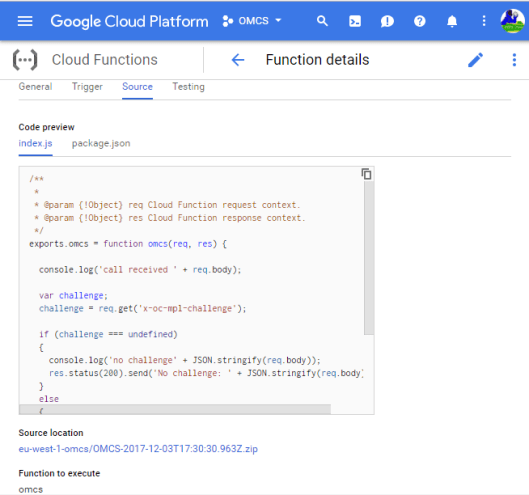
GoogleCloud-OMCS

Once saved, if valid the code will automatically get deployed, or you can work offline and then upload the code if you want to use a nice editor like Sublime.

with your code edited and saved, then the next step is to invoke it. This can be done with the next tab, or the details such as the URI can be copied and you can test from your preferred test tool such as SOAPUI, Postman and APIFortress.

Google functions Trigger

The testing view allows you 5o define input and output values, along with the outcomes. Personally I worked with SOAPUI.
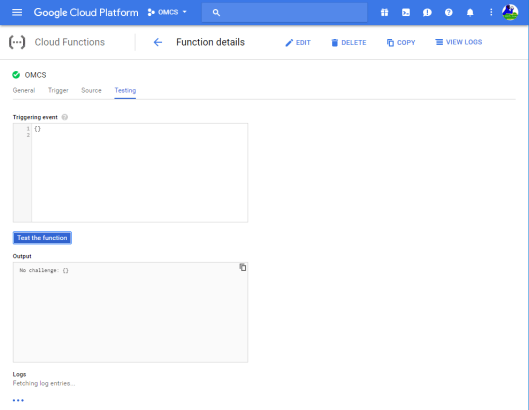
Google Functiuons Test

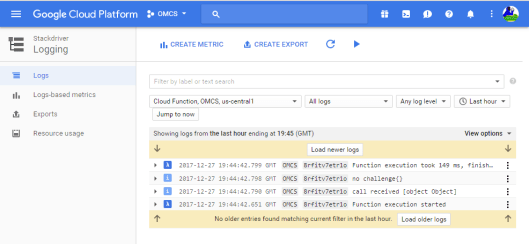
The important thing with running tests or diagnosing issues, is to be able to examine execution logs. In this area Google Functions is pretty feature rich with a solution that works in a style somewhat like the searching in Splunk (and I’m sure other log analytics tools) where you can drill into the logs and build log filters on the fly. The log view is shown in the next screenshot.
Gogole Functions Logging 2

as you can see tool looks pretty straight forward and uncomplicated to use, with freedom to adapt how you work to your preferred style. Based on my experience of using Project FN on my desktop – it is this simplicity I think we’ll see with the Cloud Native Platform from Oracle when it becomes available.

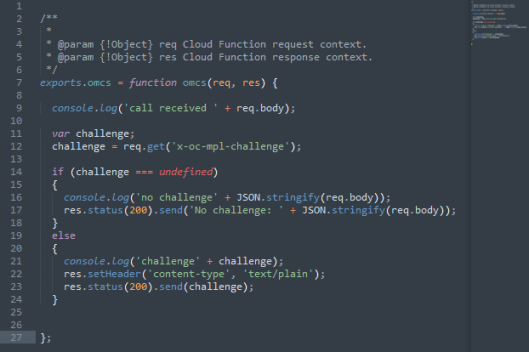
Finally, let’s take a look at the code in Google Functions code produced for this example:
code

conclusion

Google Code whilst its UI is a bit basic, it is easy to use and get started, certainly for using as a demo platform or perhaps for creating stubs, test and mock end points. Having been critical of the other offerings for security and it getting in the way of a simple illustration it is possible that the Google Functions may need some work in this area. I didn’t see anything that obviously integrated security features in easily.

Back to my Orginal Articles…

Just to tie back the impacted articles …

  • http://www.oraworld.org/home/ – Issues 6 & 7
  • http://www.oracle.com/technetwork/articles/cloudcomp/wilkins-ocms-3855268.html
  • https://www.youtube.com/watch?v=9Elf2DBisEU

Share this:

  • Share on Facebook (Opens in new window) Facebook
  • Share on X (Opens in new window) X
  • Share on Reddit (Opens in new window) Reddit
  • Email a link to a friend (Opens in new window) Email
  • Share on WhatsApp (Opens in new window) WhatsApp
  • Print (Opens in new window) Print
  • Share on Tumblr (Opens in new window) Tumblr
  • Share on Mastodon (Opens in new window) Mastodon
  • Share on Pinterest (Opens in new window) Pinterest
  • More
  • Share on Bluesky (Opens in new window) Bluesky
  • Share on LinkedIn (Opens in new window) LinkedIn
Like Loading...

More Articles Published Elsewhere

03 Monday Jul 2017

Posted by mp3monster in chatbots, Cloud, General, Oracle, Technology

≈ Leave a comment

Tags

API, article, blog, chatbots, integration, Leon Smiers, Luis Weir, Oracle, OTN, registries

So it has been a busy week in terms of seeing articles published that I’ve at least contributed to. It’s funny the gap between writing and publishing can be several weeks. So whilst we’re thinking about new things we see the twitter pickup etc or work several weeks old.

Anyway, first up was a contribution to Leon Smiers‘ blog on integrating chatbots. The latest in a series of excellent blog posts looking at  the capabilities a chatbot solution needs etc. The latest post is about integration, hence my contribution. My contributions to the blog series go back to the conversations Leon and I had whilst at the Oracle Partner event earlier this year. Since then, I have helped Leon by providing a critical eye and offering suggestions.

The big event, has been to have an article published on Oracle Technology Network(OTN). This is a bit of an honour as we where invited to write. My piece can be found at here. It is actually a part of a pair of articles written for OTN. With article was written by Luis Weir, and is the parent article about API management.

My article came about as a result several discussions with Luis whilst travelling to and from a client about the relationship between between microservice registries, load balancers and API Gateways. Particularly as API Gateways have a natural relationship with microservices. I’ll say no more, go read the article.

Share this:

  • Share on Facebook (Opens in new window) Facebook
  • Share on X (Opens in new window) X
  • Share on Reddit (Opens in new window) Reddit
  • Email a link to a friend (Opens in new window) Email
  • Share on WhatsApp (Opens in new window) WhatsApp
  • Print (Opens in new window) Print
  • Share on Tumblr (Opens in new window) Tumblr
  • Share on Mastodon (Opens in new window) Mastodon
  • Share on Pinterest (Opens in new window) Pinterest
  • More
  • Share on Bluesky (Opens in new window) Bluesky
  • Share on LinkedIn (Opens in new window) LinkedIn
Like Loading...

Journey to the Clouds with UKOUG

26 Sunday Mar 2017

Posted by mp3monster in Cloud, General, Technology

≈ Leave a comment

I recently along with several colleagues presented at the UKOUG event called Journey to the Cloud.  I thought I’d share the slides from the event. These reflect the genera technical strategic thinking and factors that need to be taken on board when adopting a cloud approach. Although these slides focus on an Oracle ecosystem, they could be easily adapted to any contentxt.


Share this:

  • Share on Facebook (Opens in new window) Facebook
  • Share on X (Opens in new window) X
  • Share on Reddit (Opens in new window) Reddit
  • Email a link to a friend (Opens in new window) Email
  • Share on WhatsApp (Opens in new window) WhatsApp
  • Print (Opens in new window) Print
  • Share on Tumblr (Opens in new window) Tumblr
  • Share on Mastodon (Opens in new window) Mastodon
  • Share on Pinterest (Opens in new window) Pinterest
  • More
  • Share on Bluesky (Opens in new window) Bluesky
  • Share on LinkedIn (Opens in new window) LinkedIn
Like Loading...

UKOUG Oracle Scene – Another Article Published

16 Wednesday Nov 2016

Posted by mp3monster in Cloud, General, Oracle, Technology

≈ Leave a comment

The latest edition of the UK Oracle User Group (UKOUG) Oracle Scene Journal is out now with another article from me, in addition to some great content from other contributors. This article builds upon and updates an article previously published in the Oracle Apps User Group about 18 months ago. We updated and republished as part of the run up to the UKOUG special Event in March next year which will be fully announced at the conference in a couple of weeks. You can see it here Oracle Scene Edition 62 – Journey to the Cloud


Share this:

  • Share on Facebook (Opens in new window) Facebook
  • Share on X (Opens in new window) X
  • Share on Reddit (Opens in new window) Reddit
  • Email a link to a friend (Opens in new window) Email
  • Share on WhatsApp (Opens in new window) WhatsApp
  • Print (Opens in new window) Print
  • Share on Tumblr (Opens in new window) Tumblr
  • Share on Mastodon (Opens in new window) Mastodon
  • Share on Pinterest (Opens in new window) Pinterest
  • More
  • Share on Bluesky (Opens in new window) Bluesky
  • Share on LinkedIn (Opens in new window) LinkedIn
Like Loading...

Open World – Key Messages

22 Thursday Sep 2016

Posted by mp3monster in Cloud, General, Oracle, Technology

≈ 1 Comment

As Oracle Open World comes to a close. What are the big take homes? Well I have to admit to not having been at OOW phyiscally this year, but tracking things from the UK. That sais from this vantage point …

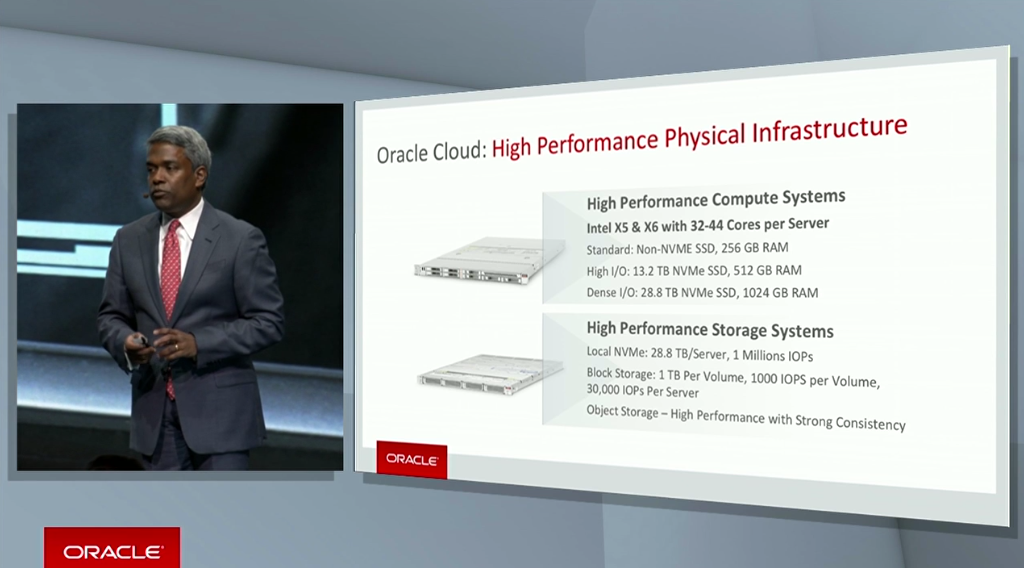
  • 2nd Generation IaaS. The announcements on the evolution of Oracle’s offfering bring some significant steps forward with multi data centre resilience within each region /geographical area. What isn’t clear is whether the resilience will be OOTB on all services, or a cost add at the IaaS and some of the PaaS services. But for SaaS I’d be expecting it to be part of the offering. Below are a couple of screen grabs from Thomas Kurian’s keynote to help convey the details …
Regions Around the World

Regions Around the World

Regions Linked

Regions Highly Permant Linkage

Data Centre Compute

Illustrative details of Data Centre nodes

IaaS Hardware and Platform Supported

IaaS Hardware and Platform Supported

The 2Gen IaaS is interesting because previously Oracle have underplayed the IaaS offering on the basis that it had been necessary to help pitch PaaS and SaaS. But this year with the new generation there seems to be a fair bit of detail on the IaaS make up to help convey and provide clarity of a robust underpinning in capacity, capability, power and security. Which aside from help sell more IaaS it should help reinforce the messaging on the higher order offerings about foundation strength.

  • The IaaS message also makes it easier to convey the message that Oracle cloud doesn’t have to mean Oracle software – it is just as capable with OpenSource tech. This had felt a little niche with the Java cloud services. It certainly appears that Oracle wants to take the fight if not to AWS certainly with Azure, Rackspace etc
  • Following this IaaS message is the cloud in your own data centre. Which addresses residency questions, but provides the cloud software stack and cloud financial models. What will be interesting is how the auditors (as anything likely to demand on-premise deployment is likely to have compliance needs and audit with it) are satisfied that despite Oracle maintaining all the cloud software remotely won’t represent an issue.
  • How the IaaS data centre level resiliency will impact the PaaS offerings is going to be very interesting as SOA providing high availability across multiple locations is not trivial.
  • We have also seen signs of far more dynamic elasticity being shown with examples of being able attach policies to a service to trigger scale up. It will be interesting to see if the ability to mix metered and unmetered resources has also improved. Presently they have to be run as discrete domains because of the pricing models involved.
  • More broadly Oracle are filling out their cloud portfolio and offerings are starting to be harmonised – but there is a long way to go, for example ICS and SOA CS don’t OOTB link to Log Analytics for example). But MySQL as a PaaS offering has crept up on me, with the smallest compute footprint being 24p an hour it is time to take notice.

Share this:

  • Share on Facebook (Opens in new window) Facebook
  • Share on X (Opens in new window) X
  • Share on Reddit (Opens in new window) Reddit
  • Email a link to a friend (Opens in new window) Email
  • Share on WhatsApp (Opens in new window) WhatsApp
  • Print (Opens in new window) Print
  • Share on Tumblr (Opens in new window) Tumblr
  • Share on Mastodon (Opens in new window) Mastodon
  • Share on Pinterest (Opens in new window) Pinterest
  • More
  • Share on Bluesky (Opens in new window) Bluesky
  • Share on LinkedIn (Opens in new window) LinkedIn
Like Loading...

Maintenance & Patching For SOA CS

30 Monday May 2016

Posted by mp3monster in Cloud, General, Oracle, Technology

≈ 1 Comment

Tags

Cloud, HA, Maintenance, Oracle, PaaS, patching, SOA, SOACS

When you’re using SOA Suite to run round the clock services you need to give a fair bit of thought to your deployment configuration so it becomes possible to perform rolling patches and other maintenance tasks not only to SOA itself but all the way down to the hardware – and at the low levels you have no control on the maintenance process.  Although it is very easy to think that the moment you’re using PaaS that these problems are taken care for you, life isn’t as simple as that.

Oracle cloud services typically go through a patching process once a month and usually within a defined 8 hour period on a Friday night. During this period you may lose the use of your servers as the maintenance is performed within a particular availability zone. In an ideal world this would be a rolling process so you don’t lose everything at once. If the maintenance window is used to to deploy SOA Suite patches then although you will be told of the maintenance window you actually wont have an outage, but post the maintenance window your cloud dashboard will have the option to apply the patches at a time that best suits you. Not only that the patch application process is smart enough to apply it in a rolling manner as the Weblogic nodes in the cluster will have information on each other which the patch mechanism can utilise.

So where is the problem.  It is very easy to forget that the PaaS platform is virtual, this means the virtualization platform being software will inevitably need patching whether that is for bug fixing,  addressing security requirements or adding new capabilities. These kinds of changes today will trigger a service shutdown. Let’s be honest when trying to balance a rolling change and maximise PaaS client density is going to create a monumentally complex problem, so simplicity and and speed of roll-out suggests a small outage is easier. So how do I therefore assure I can maintain a quality of service if I accept this as a necessity?


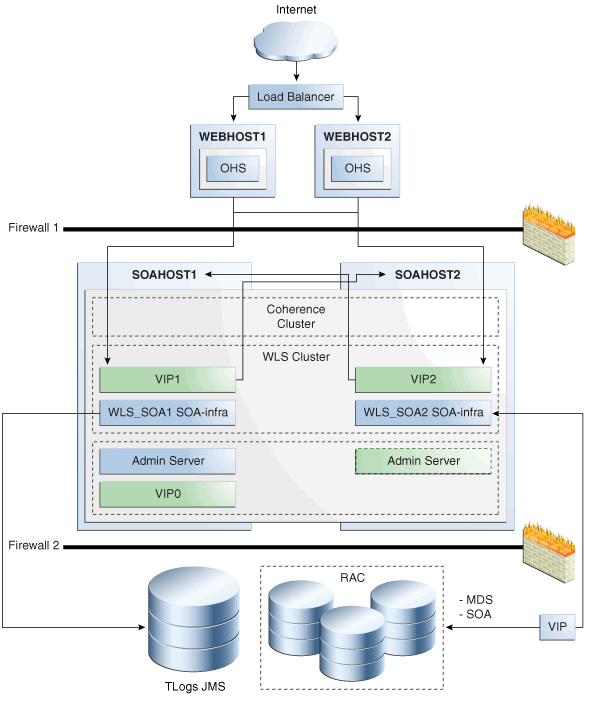
Well the answer is pretty much the same as  an on premise reference architecture.  Have SOA with its supporting databases running in a second availability zone that will have a different patch time. This is going to push up the cost as you’ll need a database with Dataguard. Assuming an active-passive model across your centres, as you approach the maintenance window you’ll get your load balancer to route work load to the second location and let the existing workload run dry on the servers due to go through the maintenance process. Then after the maintenance window you’ll reverse the process.

The current gotchya with this is that you pay for SOA by the month so you in effect have to run two clusters, although hour and daily models are coming.With the hourly model you can have the second availability zone ready for use by keeping the DB alive there, but only startup the SOA instances on the hourly rate when you know the maintenance window is going to occur and it is clear there will be an infrastructure impact.

The other sticky point, is presently as the period allocated is upto eight hours, your second centre needs to be running in a timezone with atleast 8 hours difference (allowing time to fail back). This would mean if you are using the Amsterdam or Slough locations your second location is going to West coast US or Asia Pacific once live later this year or Japan. All of which will present serious issues regarding personal data.

I have been told that some signficiant customers have accepted the situation on the basis the downtime in reality isn’t frequent and correlates to low business periods. But I suspect competition and customer demand will force this to change.

Share this:

  • Share on Facebook (Opens in new window) Facebook
  • Share on X (Opens in new window) X
  • Share on Reddit (Opens in new window) Reddit
  • Email a link to a friend (Opens in new window) Email
  • Share on WhatsApp (Opens in new window) WhatsApp
  • Print (Opens in new window) Print
  • Share on Tumblr (Opens in new window) Tumblr
  • Share on Mastodon (Opens in new window) Mastodon
  • Share on Pinterest (Opens in new window) Pinterest
  • More
  • Share on Bluesky (Opens in new window) Bluesky
  • Share on LinkedIn (Opens in new window) LinkedIn
Like Loading...
Newer posts →

    I work for Oracle, all opinions here are my own & do not necessarily reflect the views of Oracle

    • About
      • Internet Profile
      • Music Buying
      • Presenting Activities
    • Books & Publications
      • Logging in Action with Fluentd, Kubernetes and More
      • Logs and Telemetry using Fluent Bit
      • Oracle Integration
      • API & API Platform
        • API Useful Resources
        • Useful Reading Sources
    • Mindmaps Index
    • Monster On Music
      • Music Listening
      • Music Reading
    • Oracle Resources
    • Useful Tech Resources
      • Fluentd & Fluent Bit Additional stuff
        • Logging Frameworks and Fluent Bit and Fluentd connectivity
        • REGEX for BIC and IBAN processing
      • Formatting etc
      • Java and Graal Useful Links
      • Official Sources for Product Logos
      • Python Setup & related tips
      • Recommended Tech Podcasts

    Oracle Ace Director Alumni

    TOGAF 9

    Logs and Telemetry using Fluent Bit


    Logging in Action — Fluentd

    Logging in Action with Fluentd


    Oracle Cloud Integration Book


    API Platform Book


    Oracle Dev Meetup London

    Blog Categories

    • App Ideas
    • Books
      • Book Reviews
      • manning
      • Oracle Press
      • Packt
    • Enterprise architecture
    • General
      • economy
      • ExternalWebPublications
      • LinkedIn
      • Website
    • Music
      • Music Resources
      • Music Reviews
    • Photography
    • Podcasts
    • Technology
      • AI
      • APIs & microservices
      • chatbots
      • Cloud
      • Cloud Native
      • Dev Meetup
      • development
        • languages
          • java
          • node.js
          • python
      • drone
      • Fluentbit
      • Fluentd
      • logsimulator
      • mindmap
      • OMESA
      • Oracle
        • API Platform CS
          • tools
        • Helidon
        • ITSO & OEAF
        • Java Cloud
        • NodeJS Cloud
        • OIC – ICS
        • Oracle Cloud Native
        • OUG
      • railroad diagrams
      • TOGAF
    • xxRetired
    • AI
    • API Platform CS
    • APIs & microservices
    • App Ideas
    • Book Reviews
    • Books
    • chatbots
    • Cloud
    • Cloud Native
    • Dev Meetup
    • development
    • drone
    • economy
    • Enterprise architecture
    • ExternalWebPublications
    • Fluentbit
    • Fluentd
    • General
    • Helidon
    • ITSO & OEAF
    • java
    • Java Cloud
    • languages
    • LinkedIn
    • logsimulator
    • manning
    • mindmap
    • Music
    • Music Resources
    • Music Reviews
    • node.js
    • NodeJS Cloud
    • OIC – ICS
    • OMESA
    • Oracle
    • Oracle Cloud Native
    • Oracle Press
    • OUG
    • Packt
    • Photography
    • Podcasts
    • python
    • railroad diagrams
    • Technology
    • TOGAF
    • tools
    • Website
    • xxRetired

    Enter your email address to subscribe to this blog and receive notifications of new posts by email.

    Join 2,556 other subscribers

    RSS

    RSS Feed RSS - Posts

    RSS Feed RSS - Comments

    March 2026
    M T W T F S S
     1
    2345678
    9101112131415
    16171819202122
    23242526272829
    3031  
    « Feb    

    Twitter

    Tweets by mp3monster

    History

    Speaker Recognition

    Open Source Summit Speaker

    Flickr Pics

    Gogo Penguin at the BarbicanGogo Penguin at the BarbicanGogo Penguin at the BarbicanGogo Penguin at the Barbican
    More Photos

    Social

    • View @mp3monster’s profile on Twitter
    • View philwilkins’s profile on LinkedIn
    • View mp3monster’s profile on GitHub
    • View mp3monster’s profile on Flickr
    • View mp3muncher’s profile on WordPress.org
    • View philmp3monster’s profile on Twitch
    Follow Phil (aka MP3Monster)'s Blog on WordPress.com

    Blog at WordPress.com.

    • Subscribe Subscribed
      • Phil (aka MP3Monster)'s Blog
      • Join 234 other subscribers
      • Already have a WordPress.com account? Log in now.
      • Phil (aka MP3Monster)'s Blog
      • Subscribe Subscribed
      • Sign up
      • Log in
      • Report this content
      • View site in Reader
      • Manage subscriptions
      • Collapse this bar
     

    Loading Comments...
     

    You must be logged in to post a comment.

      Privacy & Cookies: This site uses cookies. By continuing to use this website, you agree to their use.
      To find out more, including how to control cookies, see here: Our Cookie Policy
      %d