• Home
  • Site Aliases
    • www.cloud-native.info
  • About
    • Background
    • Presenting Activities
    • Internet Profile
      • LinkedIn
    • About
  • Books & Publications
    • Log Generator
    • Logs and Telemetry using Fluent Bit
      • Fluent Bit book
      • Book Resources in GitHub
      • Fluent Bit Classic to YAML Format configurations
    • Logging in Action with Fluentd, Kubernetes and More
      • Logging in Action with Fluentd – Book
      • Fluentd Book Resources
      • Fluentd & Fluent Bit Additional stuff
    • API & API Platform
      • API Useful Resources
    • Oracle Integration
      • Book Website
      • Useful Reading Sources
    • Publication Contributions
  • Resources
    • GitHub
    • Oracle Integration Site
    • Oracle Resources
    • Mindmaps Index
    • Useful Tech Resources
      • Fluentd & Fluent Bit Additional stuff
      • Recommended Tech Podcasts
      • Official Sources for Product Logos
      • Java and Graal Useful Links
      • Python Setup & related stuff
  • Music
    • Monster On Music
    • Music Listening
    • Music Reading

Phil (aka MP3Monster)'s Blog

~ from Technology to Music

Phil (aka MP3Monster)'s Blog

Tag Archives: API

Notifications from Oracle API Platform Cloud Service

11 Monday Nov 2019

Posted by mp3monster in API Platform CS, General, Oracle, Technology, tools

≈ 2 Comments

Tags

API, Cloud, CS, IDCS, Notifications, nudge, Oracle, Owasp, platform, slack, utility

There are circumstances in which notifications from the Oracle API Platform CS could be seen as desirable.  For example, if you wish to ensure that the developers are defining good APIs and not accidentally implementing APIs that hit the OWASP Top 10 for APIs. Then you will probably configure things such that developer users can design the APIs, configure the policies, but only request an API to be deployed.

However, presently notifications through mechanisms such as email or via collaboration platforms such as Slack aren’t available.  But implementing a solution isn’t difficult.  For the rest of this blog we’ll explore how this might be implemented, complete with a Slack implementation.

Continue reading →

Share this:

  • Click to share on Facebook (Opens in new window) Facebook
  • Click to share on X (Opens in new window) X
  • Click to share on Pocket (Opens in new window) Pocket
  • Click to share on Reddit (Opens in new window) Reddit
  • Click to email a link to a friend (Opens in new window) Email
  • Click to share on WhatsApp (Opens in new window) WhatsApp
  • Click to print (Opens in new window) Print
  • Click to share on Tumblr (Opens in new window) Tumblr
  • Click to share on Mastodon (Opens in new window) Mastodon
  • Click to share on Pinterest (Opens in new window) Pinterest
  • More
  • Click to share on Bluesky (Opens in new window) Bluesky
  • Click to share on LinkedIn (Opens in new window) LinkedIn
Like Loading...

Handling Socket connectivity with API Gateway

30 Friday Aug 2019

Posted by mp3monster in API Platform CS, General, Oracle, Technology

≈ Leave a comment

Tags

API, event streams, gateway, OAuth, Oracle, Security, socket

At the time of writing the Oracle API Platform doesn’t support the use of Socket connections for handling API data flows. Whilst the API Platform does provide an SDK as we’ve described in other blogs and our book it doesn’t allow the extension of how connectivity is managed.

The use of API Gateways and socket-based connectivity is something that can engender a fair bit of debate – on the one hand, when a client is handling a large volume of data, or expects data updates, but doesn’t want to poll or utilize webhooks then a socket strategy will make sense. Think of an app wanting to listen to a Kafka topic. Conversely, API gateways are meant to be relatively lightweight components and not intended to deal with a single call to result in massive latency as the back-end produces or waits to forward on data as this is very resource-intensive and inefficient. However, a socket-based data transmission should be subject to the same kinds of security controls, and home brewing security solutions from scratch are generally not the best idea as you become responsible for the continual re-verification of the code being secure and handling dependency patching and mitigating vulnerabilities in other areas.

So how can we solve this?

As a general rule of thumb, web sockets are our least preferred way of driving connectivity, aside from the resource demand, it is a fairly fragile approach as connections are subject to the vagaries of network connections, which can drop etc. It can be difficult to manage state (i.e. knowing what data has or hasn’t reached the socket consumer). But sometimes, it just is the right answer. Therefore we have developed the following pattern as the following diagram illustrates.

API Protected Sockets

How it works …

The client initiates things by contacting the gateway to request a socket, with the details of the data wanted to flow through the socket. This can then be validated as both a legitimate request or (API Tokens, OAuth etc) and that the requester can have the data wanted via analyzing the request metadata.

The gateway works in conjunction with a service component and will if approved acquire a URI from the socket manager component. This component will provide a URL for the client to use for the socket request. The URL is a randomly generated string. This means that port scans of the exposed web service are going to be difficult. These URLs are handled in a cache, which ideally has a TTL (Time To Live). By using Something like Redis with its native TTL capabilities means that we can expire the URL if not used.

With the provided URL we could further harden the security by associating with it a second token.

Having received the response by the client, it can then establish the socket-based connection which gets routed around the API Gateway to the Socket component. This then takes the randomly-generated part of the URL and looks up the value in the cache, if it exists in the cache and the secondary token matches then the request for the socket is legitimate. With the socket connection having been accepted the logic that will feed the socket can commence execution.

If the request is some form of malicious intent such as a scan, probe or brute force attempt to call the URL then the attempt should fail because …

  • If the socket URL has never existed in or has been expired from the Cache and the request is rejected.
  • If a genuine URL is obtained, then the secondary key must correctly verify. If incorrect again the request is rejected.
  • Ironically, any malicious attack seeking to overload components is most likely to affect the cache and if this fails, then a brute access tempt gets harder as the persistence of all keys will be lost i.e. nothing to try brute force locate.

You could of course craft in more security checks such as IP whitelisting etc, but every-time this is done the socket service gets ever more complex, and we take on more of the capabilities expected from the API Gateway and aside from deploying a cache, we’ve not built much more than a simple service that creates some random strings and caches them, combined with a cache query and a comparison. All the hard security work is delegated to the gateway during the handshake request.

Thanks to James Neate and Adrian Lowe for kicking around the requirement and arriving at this approach with us.


Share this:

  • Click to share on Facebook (Opens in new window) Facebook
  • Click to share on X (Opens in new window) X
  • Click to share on Pocket (Opens in new window) Pocket
  • Click to share on Reddit (Opens in new window) Reddit
  • Click to email a link to a friend (Opens in new window) Email
  • Click to share on WhatsApp (Opens in new window) WhatsApp
  • Click to print (Opens in new window) Print
  • Click to share on Tumblr (Opens in new window) Tumblr
  • Click to share on Mastodon (Opens in new window) Mastodon
  • Click to share on Pinterest (Opens in new window) Pinterest
  • More
  • Click to share on Bluesky (Opens in new window) Bluesky
  • Click to share on LinkedIn (Opens in new window) LinkedIn
Like Loading...

Managing API Gateway Costs with Oracle API Platform

03 Wednesday Jul 2019

Posted by mp3monster in API Platform CS, APIs & microservices, General, Oracle, Technology

≈ 2 Comments

Tags

API, cost, gateway, Groovy, IDCS, Licensing, Oracle, scripting

The Oracle API Platform adopted an intelligent pricing model by basing costs on API call volumes and Logical gateway node groupings per hour. In our book about the API Platform (more here). We suggested that a good logical grouping would be to reflect the development, test, pre-production and production model. This makes it nice and easy to use gateway based routing to different environments without needing to change the API policy configuration as you promote your solution through environments.

We have also leveraged naming and Role/Group Based Access Controls to make it easy to operate the API Platform as a shared service, rather than each team having its own complete instance. In doing so the number of logical gateways needed is limited (I.e. not logical gateway divisions on per team models needed). Group management is very easy through the leveraging of Oracle’s Identity Cloud Service – which is free for managing users on the Oracle solutions, and also happens to a respected product in its own right.

Most organisations are not conducting development and testing 365 days a year, for 24 hours a day (yes in an ideal world prolonged soak and load tests would be run to help tease out cumulative issues such as memory leaks, but even then it isn’t perpetual). As a result, it would be ideal to not be using logical gateways for part of the day such as outside the typical development day, and weekends.

Whilst out of the out of hours traffic may drop to zero calls and we may even shutdown the gateway nodes, this alone doesn’t effectively reduce the number of logical gateways as the logical gateway aspect of the platform counts as soon as you create the logical group in the management portal. This in itself isn’t a problem as the API Platform drinks it’s own Champagne as the saying goes, and everything in the UI is actually available as a published REST endpoint. Something covered in the book, and in previous blog posts (for example Making Scripts Work with IDCS Deployed PaaS and Analytics and Stats for APIs). Rather than providing all the code, you can see pretty much all the calls necessary in the other utilities published.

Before defining the steps, there are a couple of things to consider. Firstly, the version of the API deployed to a specific logical gateway may not necessarily be the latest version (iteration) and when to delete the logical gateway this information is lost, so before deleting the logical gateway we should record this information to allow us to reinstate the logical gateway later.

As deleting logical gateways will remove the gateway from the system, when recreating the gateway we can use the same name, but the gateway is not guaranteed to get the same Id as before, as a result, we should when rebuilding always discover the Id from the name to be safe.

A logical gateway can not be deleted until all the physical nodes are reallocated, so we need to iterate through the nodes removing them. When it comes to reconnecting the nodes, this is a little more tricky as reconnecting the gateway appears to only be achievable with information known to the gateway node. Therefore the simplest thing is when bringing the node back online we take the information from the gateway-props.json file and run a script that determines whether the management tier knows about the node. If not then just re-run the create, start, join cycle., otherwise just run the start command.

As with the logical gateway, re-running the create, deploy, start cycle will result in the node having a new Id. This does mean that whilst the logical gateway name and even the node names will remain the same, the analytics data is likely to become unavailable, so you may wish to extract the analytics data. But then, for development and test, this data is unlikely to provide much long term value.

So based on this, our sequence for releasing the logical gateway needs to be…

  1. Capture the deployed APIs and the iteration numbers,
  2. Ideally shutdown the gateway node process itself,
  3. Delete all the gateway nodes from the logical gateway,
  4. Delete the logical gateway,

Recover would then be …

  1. Construct the logical gateway,
  2. Redeploy the APIs with the correct iteration numbers to the logical gateway using the recorded information- if no nodes are connected at this stage, the UI will provide a warning
  3. As gateway nodes, come back online, determine if it is necessary to execute the create, start, join or just start

Of course, these processes can be all linked to scheduling such as a cron job and/or server startup and shutdown processes.

Share this:

  • Click to share on Facebook (Opens in new window) Facebook
  • Click to share on X (Opens in new window) X
  • Click to share on Pocket (Opens in new window) Pocket
  • Click to share on Reddit (Opens in new window) Reddit
  • Click to email a link to a friend (Opens in new window) Email
  • Click to share on WhatsApp (Opens in new window) WhatsApp
  • Click to print (Opens in new window) Print
  • Click to share on Tumblr (Opens in new window) Tumblr
  • Click to share on Mastodon (Opens in new window) Mastodon
  • Click to share on Pinterest (Opens in new window) Pinterest
  • More
  • Click to share on Bluesky (Opens in new window) Bluesky
  • Click to share on LinkedIn (Opens in new window) LinkedIn
Like Loading...

Popping Up on the Net and more

28 Friday Jun 2019

Posted by mp3monster in APIs & microservices, Books, Dev Meetup, development, General, Oracle, Packt, Technology

≈ Leave a comment

Tags

API, blog, books, developer, interview, meetup, Oracle

It’s been a quiet month for this blog, but I’ve been pretty busy with a raft of other activities…

  • a recent article on our sister site – oracle-integration.cloud on  RPA.
  • I also appear in an interview with K21 Academy here.
  • 4186btedcpl._sx403_bo1204203200_Reviewing a new book on Enterprise API Management for Packt which we would very highly recommend if you want to understand the more Enterprise perspectives of adopting APIs, particularly if you’re considering APIs as a potential new revenue stream.
  • UK Oracle User Group committees for TechFest (having been reviewing the paper submissions it looks like it’s going to be an excellent conference in December) and Southern Summit (next week).
  • Just launched a number of sessions for the Oracle London Developer Meetup, with another to be announced soon (Blockchain) and potentially two more before the end of the year (we’re working on the speakers now).
ch-1
meetup-monitoring


Share this:

  • Click to share on Facebook (Opens in new window) Facebook
  • Click to share on X (Opens in new window) X
  • Click to share on Pocket (Opens in new window) Pocket
  • Click to share on Reddit (Opens in new window) Reddit
  • Click to email a link to a friend (Opens in new window) Email
  • Click to share on WhatsApp (Opens in new window) WhatsApp
  • Click to print (Opens in new window) Print
  • Click to share on Tumblr (Opens in new window) Tumblr
  • Click to share on Mastodon (Opens in new window) Mastodon
  • Click to share on Pinterest (Opens in new window) Pinterest
  • More
  • Click to share on Bluesky (Opens in new window) Bluesky
  • Click to share on LinkedIn (Opens in new window) LinkedIn
Like Loading...

API Security

01 Saturday Jun 2019

Posted by mp3monster in API Platform CS, APIs & microservices, General, Oracle, Technology

≈ Leave a comment

Tags

API, API Platform, api Security.io, Owasp, pen testing, SANS, Security

I’ve started to subscribe to the APISecurity.io newsletter. The newsletter includes the analysis of recent API based security breaches along with other useful API related news. Some of the details of the breaches make for interesting reading and provide some good examples of what not to do. It is rather surprising how regularly the lack of the application of good practises is, including:

  • Checking the payload is valid to the definition,
  • Checking the payload size to ensure it is in the expected bounds,
  • Use strong typing on the content received it will help validate the content and limit the chances of poisonous content like injected SQL,
  • owaspEnsuring the API has mitigation’s against the classic OWASP Top 10 – SQL Injection, poor authentication implementation.

More broadly, we see that people will recognise the need for applying penetration testing, and look to external organisations to perform the testing, when such work is commissioned the understanding of what the pen tester does is not understood by those logocommissioning the tests (SANS paper of security scoping), therefore know whether all the risks are checked. When you add to that, the temptation to keep such costs down resulting in the service provider not necessarily probing your APIs to the fullest extent. Not all penetration test services are equal, so simply working to a budget isn’t wise, yes there is a need for pragmatism, but only when you understand the cost/risk trade-off.

But also remember application logic and API definitions and the security controls in place change over time as do the discovery of new vulnerabilities on the stack you’re using, along with evolving compliance requirements. All meaning that a penetration test at the initial go-live is not enough and should be an inherent part of an APIs lifecycle.

cloudgs_apimgrWhen it comes to payload checks etc, products like Oracle’s API Platform make it easy to realise or provide out of the box checks for factors such as size limits, implementing payload checks, so better to use them.

If you ever need to be reminded that of why best practises are needed and should be implemented; a mindset of when not if a breach will happen will ensure you’re prepared and the teams are motivated to put the good practises in.

Share this:

  • Click to share on Facebook (Opens in new window) Facebook
  • Click to share on X (Opens in new window) X
  • Click to share on Pocket (Opens in new window) Pocket
  • Click to share on Reddit (Opens in new window) Reddit
  • Click to email a link to a friend (Opens in new window) Email
  • Click to share on WhatsApp (Opens in new window) WhatsApp
  • Click to print (Opens in new window) Print
  • Click to share on Tumblr (Opens in new window) Tumblr
  • Click to share on Mastodon (Opens in new window) Mastodon
  • Click to share on Pinterest (Opens in new window) Pinterest
  • More
  • Click to share on Bluesky (Opens in new window) Bluesky
  • Click to share on LinkedIn (Opens in new window) LinkedIn
Like Loading...

Integrating API Management with the rest of your Development Pipeline

30 Thursday May 2019

Posted by mp3monster in API Platform CS, APIs & microservices, General, OIC - ICS, Oracle, Technology

≈ Leave a comment

Tags

API, CI/CD, Flexagon, Flexdeploy, OIC, SOASuite

Oracle API Management keeps API policy configuration and management internalized for a number of reasons including security (after all you don’t want your security rules for APIs out in the open).  The Platform does provide simple versioning.  But you need to able to link the policies to the back end implementations – so the policy configuration is aligned to what is implemented. For example you don’t want the policy to accept parameters that your back end can’t handle in version 1, but does in version 2 of your solution. I have blogged about some of these considerations in the past here.

We have had the good fortune to sit and discuss the challenges of how API configurations could be managed with Flexagon. As a result of our input and from others Flexdeploy has a number of new features making the configuration management of APIs very easy. In addition to this is further simplifying gateway deployment processes. When combined with a very powerful CI/CD that can handle traditional development, microservices and development with integration products such as like SOA Suite and OIC a huge amount of flexibility is made available enabling configuration management, multi environment deployments.

cropped-flexagon_diagram_81816-01-1024x343

Flexagon have started a series of blogs on the subject – recommend checking them out – here.

Share this:

  • Click to share on Facebook (Opens in new window) Facebook
  • Click to share on X (Opens in new window) X
  • Click to share on Pocket (Opens in new window) Pocket
  • Click to share on Reddit (Opens in new window) Reddit
  • Click to email a link to a friend (Opens in new window) Email
  • Click to share on WhatsApp (Opens in new window) WhatsApp
  • Click to print (Opens in new window) Print
  • Click to share on Tumblr (Opens in new window) Tumblr
  • Click to share on Mastodon (Opens in new window) Mastodon
  • Click to share on Pinterest (Opens in new window) Pinterest
  • More
  • Click to share on Bluesky (Opens in new window) Bluesky
  • Click to share on LinkedIn (Opens in new window) LinkedIn
Like Loading...

Image

API Driven Architecture – back by demand

18 Monday Mar 2019

Tags

API, training

Screenshot 2019-03-18 01.29.11

Share this:

  • Click to share on Facebook (Opens in new window) Facebook
  • Click to share on X (Opens in new window) X
  • Click to share on Pocket (Opens in new window) Pocket
  • Click to share on Reddit (Opens in new window) Reddit
  • Click to email a link to a friend (Opens in new window) Email
  • Click to share on WhatsApp (Opens in new window) WhatsApp
  • Click to print (Opens in new window) Print
  • Click to share on Tumblr (Opens in new window) Tumblr
  • Click to share on Mastodon (Opens in new window) Mastodon
  • Click to share on Pinterest (Opens in new window) Pinterest
  • More
  • Click to share on Bluesky (Opens in new window) Bluesky
  • Click to share on LinkedIn (Opens in new window) LinkedIn
Like Loading...

Posted by mp3monster | Filed under APIs & microservices, General, Packt, Technology

≈ Leave a comment

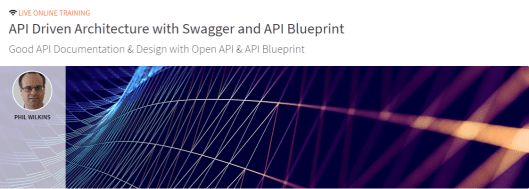
On Line Training – API Driven Architecture

15 Friday Feb 2019

Posted by mp3monster in General, Oracle, Packt, Technology

≈ Leave a comment

Tags

API, oreilly, Packt, Packt Publishing, training, video

In January we presented our 1st online training, looking at API Design and use of Apiary and Swagger. Things went well until near the end where for some reason voice and video dropped for no apparent reason. Our coordinator Lindsay kept the recording going and soon as we reconnected I continued the session and went through the Q&A.

So if you missed the end of the training, please do check back with the recording.

If you missed the training – we’ll be rerunning in March – go here.

For those on the training will have seen at the start of the training links to my social media profile, so happy to try to respond to any further questions.

We are also scheduled to run the session again in a month or so.

One of the questions received during the session I thought worth mentioning was when would Apiary support Open API 3.0. Well according to their blog very soon, looking forward to it as the OAS 3 does look a little cleaner.

Share this:

  • Click to share on Facebook (Opens in new window) Facebook
  • Click to share on X (Opens in new window) X
  • Click to share on Pocket (Opens in new window) Pocket
  • Click to share on Reddit (Opens in new window) Reddit
  • Click to email a link to a friend (Opens in new window) Email
  • Click to share on WhatsApp (Opens in new window) WhatsApp
  • Click to print (Opens in new window) Print
  • Click to share on Tumblr (Opens in new window) Tumblr
  • Click to share on Mastodon (Opens in new window) Mastodon
  • Click to share on Pinterest (Opens in new window) Pinterest
  • More
  • Click to share on Bluesky (Opens in new window) Bluesky
  • Click to share on LinkedIn (Opens in new window) LinkedIn
Like Loading...

API Caching with the Oracle API Platform

01 Friday Feb 2019

Posted by mp3monster in API Platform CS, APIs & microservices, General, Oracle, Technology

≈ 4 Comments

Tags

API, API-CS, cache-control, caching, Coherence, ehcache, forceResponse, Helidon, IETF, Oracle, proxy, Redis, RGC

We have been developing some advanced custom API policies for a client and in the process picked up on a few insights that didn’t even make into the API book. One of these policies is to provide an optimization around caching of API calls. The rest of this blog will talk about the tricks we have specifically applied to link an API Gateway to a caching mechanism and why.

Before I go into the details, I’d like to thank the Oracle product management team and particularly Glenn Mi at Oracle for their support getting through the deeper undocumented elements of the capabilities of the API Platform SDK.

Caching Options

Caching comes in may forms, and is motivated by varying reasons and not always the wanting the same behaviours. When getting into the subject of caching it is surprising how polarised people’s view points can be about which cache strategies are correct. The following diagram illustrates the diversity of caches that could appear in an end to solution solution.

Bringing together a caching technology in the Reverse Proxy model and an API Gateway makes a lot of sense. Data being provided to API consumers needs to be protected whether it comes from a cache or an active back-end system. At the same time you also want to exploit an API Gateway to provide analytics on API traffic, so any caching needs to be behind the gateway. But, if In front of an application layer then we can reduce the application workload.

When it comes to caching technology to partner with the gateway, there are a number of options available from Coherence to ehCache, memcache and Redis. We have avoided Coherence, whilst the gateway currently runs on a WebLogic server, we don’t want to need to unduly distort the performance profile and configuration of the Gateway by forcing a cache onto that server. In addition to which as Coherence is a licensed addition to WebLogic it raises difficult questions about licensing when deploying gateways (with gateways licensed based on logical groupings and API volumes but Coherence is licensed by OCPU). We also know that Oracle is moving towards having a micro-gateway which may mean we see the gateway engine moved onto something like Helidon (but this last point is my speculation).

We have elected to use Redis for several reasons –

  • Available as a PaaS service with several cloud providers (AWS & Azure) so no setup or management effort but can also be deployed on-premises,
  • Has an out of the box deployment that means cached entities can have a time to live (TTL) rather than needing to implement separate processes to expire cached values,
  • The ability to make it scale through clustering,
  • Cost

This caching model also allows us to optionally allow application development teams to push into the cache directly results. So rather than waiting on TTL the cache can be refreshed directly or even primed, rather than having to create fake requests to prime a cache.

Custom Policy

Continue reading →

Share this:

  • Click to share on Facebook (Opens in new window) Facebook
  • Click to share on X (Opens in new window) X
  • Click to share on Pocket (Opens in new window) Pocket
  • Click to share on Reddit (Opens in new window) Reddit
  • Click to email a link to a friend (Opens in new window) Email
  • Click to share on WhatsApp (Opens in new window) WhatsApp
  • Click to print (Opens in new window) Print
  • Click to share on Tumblr (Opens in new window) Tumblr
  • Click to share on Mastodon (Opens in new window) Mastodon
  • Click to share on Pinterest (Opens in new window) Pinterest
  • More
  • Click to share on Bluesky (Opens in new window) Bluesky
  • Click to share on LinkedIn (Opens in new window) LinkedIn
Like Loading...

UKOUG Conference 2018

04 Tuesday Dec 2018

Posted by mp3monster in API Platform CS, APIs & microservices, General, OIC - ICS, Oracle, Technology

≈ Leave a comment

Tags

API, apiary, conference, Microservices, monoliths, OUG, Tech18

With the start of December comes the UK Oracle User Group conference, or to be more precise the Independent UKOUG.  This year the conference is back in Blackpool, a slightly smaller venue than the ICC in Birmingham, but in many respects that made the event feel more vibrant and busy.

The user group also announced some of the changes it is making going forwards reflecting the changing needs of its members – SIGs being largely superseded by multi-stream single day events (Summits) with the Call for Papers for the first of these here.  A wider list of Oracle related Calls for Papers is available here.

Of course being a UKOUG Volunteer, I have been presenting and co-presenting.  The slides from my presentation sessions can be found at:

This was an abridged version of the an update on my presentation here 

My second presentation was a review of Oracle Integration Cloud, in which I presented some customer use cases of OCI  as part of a wider presentation on OIC by Sid Joshi. 

This was followed on the second day with two API based sessions, the first being a deep dive into custom API Policies on the Oracle API Platform.

The final session, was another short one looking at Apiary which was primarily a demo of what the solution can do.

On top of trying to keep up with my usual workload – a very hectic couple of days.

Share this:

  • Click to share on Facebook (Opens in new window) Facebook
  • Click to share on X (Opens in new window) X
  • Click to share on Pocket (Opens in new window) Pocket
  • Click to share on Reddit (Opens in new window) Reddit
  • Click to email a link to a friend (Opens in new window) Email
  • Click to share on WhatsApp (Opens in new window) WhatsApp
  • Click to print (Opens in new window) Print
  • Click to share on Tumblr (Opens in new window) Tumblr
  • Click to share on Mastodon (Opens in new window) Mastodon
  • Click to share on Pinterest (Opens in new window) Pinterest
  • More
  • Click to share on Bluesky (Opens in new window) Bluesky
  • Click to share on LinkedIn (Opens in new window) LinkedIn
Like Loading...
← Older posts
Newer posts →

    I work for Oracle, all opinions here are my own & do not necessarily reflect the views of Oracle

    • About
      • Internet Profile
      • Music Buying
      • Presenting Activities
    • Books & Publications
      • Logging in Action with Fluentd, Kubernetes and More
      • Logs and Telemetry using Fluent Bit
      • Oracle Integration
      • API & API Platform
        • API Useful Resources
        • Useful Reading Sources
    • Mindmaps Index
    • Monster On Music
      • Music Listening
      • Music Reading
    • Oracle Resources
    • Useful Tech Resources
      • Fluentd & Fluent Bit Additional stuff
        • Logging Frameworks and Fluent Bit and Fluentd connectivity
        • REGEX for BIC and IBAN processing
      • Java and Graal Useful Links
      • Official Sources for Product Logos
      • Python Setup & related tips
      • Recommended Tech Podcasts

    Oracle Ace Director Alumni

    TOGAF 9

    Logs and Telemetry using Fluent Bit


    Logging in Action — Fluentd

    Logging in Action with Fluentd


    Oracle Cloud Integration Book


    API Platform Book


    Oracle Dev Meetup London

    Blog Categories

    • App Ideas
    • Books
      • Book Reviews
      • manning
      • Oracle Press
      • Packt
    • Enterprise architecture
    • General
      • economy
      • ExternalWebPublications
      • LinkedIn
      • Website
    • Music
      • Music Resources
      • Music Reviews
    • Photography
    • Podcasts
    • Technology
      • AI
      • APIs & microservices
      • chatbots
      • Cloud
      • Cloud Native
      • Dev Meetup
      • development
        • languages
          • java
          • node.js
      • drone
      • Fluentbit
      • Fluentd
      • logsimulator
      • mindmap
      • OMESA
      • Oracle
        • API Platform CS
          • tools
        • Helidon
        • ITSO & OEAF
        • Java Cloud
        • NodeJS Cloud
        • OIC – ICS
        • Oracle Cloud Native
        • OUG
      • railroad diagrams
      • TOGAF
    • xxRetired
    • AI
    • API Platform CS
    • APIs & microservices
    • App Ideas
    • Book Reviews
    • Books
    • chatbots
    • Cloud
    • Cloud Native
    • Dev Meetup
    • development
    • drone
    • economy
    • Enterprise architecture
    • ExternalWebPublications
    • Fluentbit
    • Fluentd
    • General
    • Helidon
    • ITSO & OEAF
    • java
    • Java Cloud
    • languages
    • LinkedIn
    • logsimulator
    • manning
    • mindmap
    • Music
    • Music Resources
    • Music Reviews
    • node.js
    • NodeJS Cloud
    • OIC – ICS
    • OMESA
    • Oracle
    • Oracle Cloud Native
    • Oracle Press
    • OUG
    • Packt
    • Photography
    • Podcasts
    • railroad diagrams
    • Technology
    • TOGAF
    • tools
    • Website
    • xxRetired

    Enter your email address to subscribe to this blog and receive notifications of new posts by email.

    Join 2,555 other subscribers

    RSS

    RSS Feed RSS - Posts

    RSS Feed RSS - Comments

    January 2026
    M T W T F S S
     1234
    567891011
    12131415161718
    19202122232425
    262728293031  
    « Nov    

    Twitter

    Tweets by mp3monster

    History

    Speaker Recognition

    Open Source Summit Speaker

    Flickr Pics

    Gogo Penguin at the BarbicanGogo Penguin at the BarbicanGogo Penguin at the BarbicanGogo Penguin at the Barbican
    More Photos

    Social

    • View @mp3monster’s profile on Twitter
    • View philwilkins’s profile on LinkedIn
    • View mp3monster’s profile on GitHub
    • View mp3monster’s profile on Flickr
    • View mp3muncher’s profile on WordPress.org
    • View philmp3monster’s profile on Twitch
    Follow Phil (aka MP3Monster)'s Blog on WordPress.com

    Blog at WordPress.com.

    • Subscribe Subscribed
      • Phil (aka MP3Monster)'s Blog
      • Join 233 other subscribers
      • Already have a WordPress.com account? Log in now.
      • Phil (aka MP3Monster)'s Blog
      • Subscribe Subscribed
      • Sign up
      • Log in
      • Report this content
      • View site in Reader
      • Manage subscriptions
      • Collapse this bar
     

    Loading Comments...
     

    You must be logged in to post a comment.

      Privacy & Cookies: This site uses cookies. By continuing to use this website, you agree to their use.
      To find out more, including how to control cookies, see here: Our Cookie Policy
      %d