• Home
  • Site Aliases
    • www.cloud-native.info
  • About
    • Background
    • Presenting Activities
    • Internet Profile
      • LinkedIn
    • About
  • Books & Publications
    • Log Generator
    • Logs and Telemetry using Fluent Bit
      • Fluent Bit book
      • Book Resources in GitHub
      • Fluent Bit Classic to YAML Format configurations
    • Logging in Action with Fluentd, Kubernetes and More
      • Logging in Action with Fluentd – Book
      • Fluentd Book Resources
      • Fluentd & Fluent Bit Additional stuff
    • API & API Platform
      • API Useful Resources
    • Oracle Integration
      • Book Website
      • Useful Reading Sources
    • Publication Contributions
  • Resources
    • GitHub
    • Oracle Integration Site
    • Oracle Resources
    • Mindmaps Index
    • Useful Tech Resources
      • Fluentd & Fluent Bit Additional stuff
      • Recommended Tech Podcasts
      • Official Sources for Product Logos
      • Java and Graal Useful Links
      • Python Setup & related stuff
  • Music
    • Monster On Music
    • Music Listening
    • Music Reading

Phil (aka MP3Monster)'s Blog

~ from Technology to Music

Phil (aka MP3Monster)'s Blog

Tag Archives: book

Design of Web APIs – 2nd Edition

06 Monday Oct 2025

Posted by mp3monster in APIs & microservices, Books, General, Technology

≈ Leave a comment

Tags

API, API Evangelist, APIHandyman, AsyncAPI, book, development, OAS, Open API, practises, review, Swagger

When it comes to REST-based web APIs, I’ve long been an advocate of the work of Arnaud Lauret (better known as the API Handyman) and his book The Design of Web APIs. I have, with Arnaud’s blessing, utilized some of his web resources to help illustrate key points when presenting at conferences and to customers on effective API design. I’m not the only one who thinks highly of Arnaut’s content; other leading authorities, such as Kin Lane (API Evangelist), have also expressed the same sentiment. The news that a 2nd Edition of the book has recently been published is excellent. Given that the 1st edition was translated into multiple languages, it is fair to presume this edition will see the same treatment (as well as having the audio treatment).

Why 2nd Edition?

So, why a second edition, and what makes it good news? While the foundational ideas of REST remain the same, the standard used to describe and bootstrap development has evolved to address practices and offer a more comprehensive view of REST APIs. Understanding the Open API specification in its latest form also helps with working with the Asynchronous API specifications, as there is a significant amount of harmony between these standards in many respects.

The new edition also tackles a raft of new considerations as the industry has matured, from the use of tooling to lint and help consistency as our catalogue of APIs grows, to be able to use linting tools, we need guidelines on how to use the specification, and what we might want to make uniform nd ensure the divergence is addressed. Then there are the questions about how to integrate my API support / fit into an enriched set of documents and resources, such as those often offered by a developer portal.

However, the book isn’t simply a guide to Open API; the chapters delve into the process of API design itself, including what to expose and how to expose it. How to make the APIs consistent, so that a developer understanding one endpoint can apply that understanding to others. For me, the book shows some great visual tools for linking use cases, resources, endpoint definitions, and operations. Then, an area that is often overlooked is the considerations under the Non-Functional Requirements heading, such as those that ensure an API is performant/responsive, secure, supports compatibility (avoiding or managing breaking changes), and clear about how it will respond in ‘unhappy paths’. Not to mention, as we expand our API offerings, the specification content can become substantial, so helping to plot a way through this is excellent.

Think You Know API Design

There will be some who will think, ‘Hey, I understand the OpenAPI Specification; I don’t need a book to teach me how to design my APIs.’ To those, I challenge you to reconsider and take a look at the book. The spec shows you how to convey your API. The spec won’t guarantee a good API. The importance of good APIs grows from an external perspective – it’s a way to differentiate your service from others. When there is competition, and if your API is complex to work with, developers will fight to avoid using it. Not only that, in a world where AI utilizes protocols like MCP, having a well-designed, well-documented API increases the likelihood of an LLM being able to reason and make calls to it.

Conclusion

If there is anything to find fault with – and I’m trying hard, is it would be it would have been nice if it expanded its coverage a little further to Asynchronous APIs (there is a lot of Kafka and related tech out there which could benefit from good AsyncAPI material) and perhaps venture further into how we can make it easier to achieve natural language to API (NL2API) for use cases like working with MCP (and potentially with A2A).

  • Amazon UK
  • Amazon US
  • Manning Direct
  • Barnes & Noble

Share this:

  • Click to share on Facebook (Opens in new window) Facebook
  • Click to share on X (Opens in new window) X
  • Click to share on Pocket (Opens in new window) Pocket
  • Click to share on Reddit (Opens in new window) Reddit
  • Click to email a link to a friend (Opens in new window) Email
  • Click to share on WhatsApp (Opens in new window) WhatsApp
  • Click to print (Opens in new window) Print
  • Click to share on Tumblr (Opens in new window) Tumblr
  • Click to share on Mastodon (Opens in new window) Mastodon
  • Click to share on Pinterest (Opens in new window) Pinterest
  • More
  • Click to share on Bluesky (Opens in new window) Bluesky
  • Click to share on LinkedIn (Opens in new window) LinkedIn
Like Loading...

More Posts at The New Stack

12 Friday Sep 2025

Posted by mp3monster in Books, Fluentbit, Fluentd, manning, Technology

≈ Leave a comment

Tags

blog, book, development, ebook, logging, TheNewStack

With the publication of Logging Best Practices (for background to this, go here), more articles have been published through The New Stack, extending the original list we blogged about here.

The latest articles:

  • What To Know Before Building Fluent Bit Plugins With Go (21st November 25) NEW
  • How Are OpenTelemetry and Fluent Bit Related? (29th October 25)
  • A Guide To Fluent Bit’s Health Check API Endpoints (17th September 25)
  • Understanding Log Events: Why Context Is Key (11th September 25)
  • How to Evaluate Logging Frameworks: 10 Questions (21st August 25)
  • Using Logging Frameworks for Application Development (7th August 25)
  • Logging Best Practices: Defining Error Codes (18th July 25)

The previous list:

  • What’s Driving Fluent Bit Adoption? (26th June 25)
  • What Is Fluent Bit? (10th June 25)
  • What Are the Differences Between OTel, Fluent Bit and Fluentd? (8th July 25)
  • Fluent Bit, a Specialized Event Capture and Distribution Tool (30th May 25)

Share this:

  • Click to share on Facebook (Opens in new window) Facebook
  • Click to share on X (Opens in new window) X
  • Click to share on Pocket (Opens in new window) Pocket
  • Click to share on Reddit (Opens in new window) Reddit
  • Click to email a link to a friend (Opens in new window) Email
  • Click to share on WhatsApp (Opens in new window) WhatsApp
  • Click to print (Opens in new window) Print
  • Click to share on Tumblr (Opens in new window) Tumblr
  • Click to share on Mastodon (Opens in new window) Mastodon
  • Click to share on Pinterest (Opens in new window) Pinterest
  • More
  • Click to share on Bluesky (Opens in new window) Bluesky
  • Click to share on LinkedIn (Opens in new window) LinkedIn
Like Loading...

Microservices Patterns 2nd edition in the works

24 Sunday Aug 2025

Posted by mp3monster in Book Reviews, Books, General, manning, Technology

≈ Leave a comment

Tags

book, ebook, Microservices, Patterns, review

Back in 2018, Manning published Chris Richardson‘s Microservices Patterns book. In many respects, this book is the microservices version of the famous Gang of Four patterns book. The exciting news is that Chris is working on a second edition.

One key difference between the GoF book and this is that engaging with patterns like Inversion of Control, Factories, and so on isn’t impacted by considerations around architecture, organization, and culture.

While the foundational ideas of microservices are established, the techniques for designing and deploying have continued to evolve and mature. If you follow Chris through social media, you’ll know he has, in the years since the book’s first edition, worked with numerous organisations, training and helping them engage effectively with microservices. As a result, a lot of processes and techniques that Chris has identified and developed with customers are grounded in real practical experience.

As the book is in its early access phase (MEAP), not all chapters are available yet, so plenty to look forward to.

So even if you have the 1st edition and work with microservice patterns, the updates will, I think, offer insights that could pay dividends.

If you’re starting your software career or considering the adoption of microservices (and Chris will tell you it isn’t always the right answer), I highly recommend getting a copy, as with the 1st edition, the 2nd will become a must-read book.

Share this:

  • Click to share on Facebook (Opens in new window) Facebook
  • Click to share on X (Opens in new window) X
  • Click to share on Pocket (Opens in new window) Pocket
  • Click to share on Reddit (Opens in new window) Reddit
  • Click to email a link to a friend (Opens in new window) Email
  • Click to share on WhatsApp (Opens in new window) WhatsApp
  • Click to print (Opens in new window) Print
  • Click to share on Tumblr (Opens in new window) Tumblr
  • Click to share on Mastodon (Opens in new window) Mastodon
  • Click to share on Pinterest (Opens in new window) Pinterest
  • More
  • Click to share on Bluesky (Opens in new window) Bluesky
  • Click to share on LinkedIn (Opens in new window) LinkedIn
Like Loading...

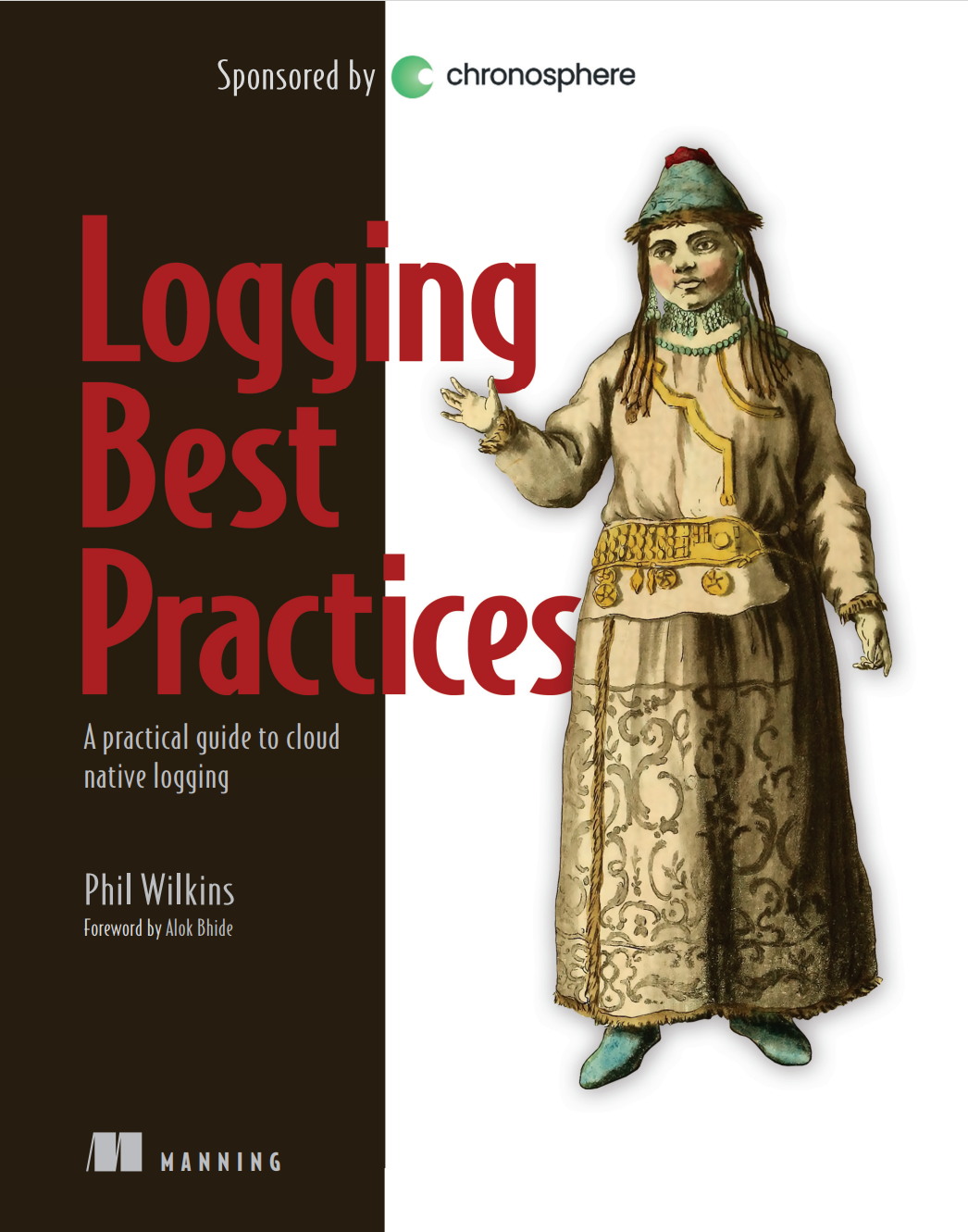
Logging Best Practices – a sort of new book

21 Thursday Aug 2025

Posted by mp3monster in Books, development, Fluentbit, Fluentd, General, Technology

≈ 1 Comment

Tags

book, books, ebook, reading, writing

So, there is a new book title published with me as the author (Logging Best Practices) published by Manning, and yes, the core content has been written by me. But was I involved with the book? Sadly, not. So what has happened?

Background

To introduce the book, I need to share some background. A tech author’s relationship with their publisher can be a little odd and potentially challenging (the editors are looking at the commerciality – what will ensure people will consider your book, as well as readability; as an author, you’re looking at what you think is important from a technical practitioner).

It is becoming increasingly common for software vendors to sponsor books. Book sponsorship involves the sponsor’s name on the cover and the option to give away ebook copies of the book for a period of time, typically during the development phase, and for 6-12 months afterwards.

This, of course, comes with a price tag for the sponsor and guarantees the publisher an immediate return. Of course, there is a gamble for the publisher as you’re risking possible sales revenue against an upfront guaranteed fee. However, for a title that isn’t guaranteed to be a best seller, as it focuses on a more specialized area, a sponsor is effectively taking the majority investment risk from the publisher (yes, the publisher still has some risk, but it is a lot smaller).

When I started on the Fluent Bit book (Logs and Telemetry), I introduced friends at Calyptia to Manning, and they struck a deal. Subsequently, Calyptia was acquired by Chronosphere (Chronosphere acquires Calyptia), so they inherited the sponsorship. An agreement I had no issue with, as I’ve written before, I write as it is a means to share what I know with the broader community. It meant my advance would be immediately settled (the advance, which comes pretty late in the process, is a payment that the publisher recovers by keeping the author’s share of a book sale).

The new book…

How does this relate to the new book? Well, the sponsorship of Logs and Telemetry is coming to an end. As a result, it appears that the commercial marketing relationship between Chronosphere and Manning has reached an agreement. Unfortunately, in this case, the agreement over publishing content wasn’t shared with the author or me, or the commissioning editor at Manning I have worked with. So we had no input on the content, who would contribute a foreword (usually someone the author knows).

Manning is allowed to do this; it is the most extreme application of the agreement with me as an author. But that isn’t the issue. The disappointing aspect is the lack of communication – discovering a new title while looking at the Chronosphere website (and then on Manning’s own website) and having to contact the commissioning editor to clarify the situation isn’t ideal.

Reading between the lines (and possibly coming to 2 + 2 = 5), Chronosphere’s new log management product launch, and presumably being interested in sponsoring content that ties in. My first book with Manning (Logging in Action), which focused on Fluentd, includes chapters on logging best practices and using logging frameworks. As a result, a decision was made to combine chapters from both books to create the new title.

Had we been in the loop during the discussion, we could have looked at tweaking the content to make it more cohesive and perhaps incorporated some new content – a missed opportunity.

If you already have the Logging in Action and Logs and Telemetry titles, then you already have all the material in Logging Best Practices. While the book is on the Manning site, if you follow the link or search for it, you’ll see it isn’t available. Today, the only way to get a copy is to go to Chronosphere and give them your details. Of course, suppose you only have one of the books. In that case, I’d recommend considering buying the other one (yes, I’ll get a small single-digit percentage of the money you spend), but more importantly, you’ll have details relating to the entire Fluent ecosystem, and plenty of insights that will help even if you’re currently only focused on one of the Fluent tools.

Going forward

While I’m disappointed by how this played out, it doesn’t mean I won’t work with Manning again. But we’ll probably approach things a little differently. At the end of the day, the relationship with Manning extends beyond commercial marketing.

  • Manning has a tremendous group of authors, and aside from writing, the relationship allows me to see new titles in development.
  • Working with the development team is an enriching experience.
  • It is a brand with a recognized quality.
  • The social/online marketing team(s) are great to interact with – not just to help with my book, but with opportunities to help other authors.

As to another book, if there was an ask or need for an update on the original books, we’d certainly consider it. If we identify an area that warrants a book and I possess the necessary knowledge to write it, then maybe. However, I tend to focus on more specialized domains, so the books won’t be best-selling titles. It is this sort of content that is most at risk of being disrupted by AI, and things like vibe coding will have the most significant impact, making it the riskiest area for publishers. Oh, and this has to be worked around the day job and family.

Share this:

  • Click to share on Facebook (Opens in new window) Facebook
  • Click to share on X (Opens in new window) X
  • Click to share on Pocket (Opens in new window) Pocket
  • Click to share on Reddit (Opens in new window) Reddit
  • Click to email a link to a friend (Opens in new window) Email
  • Click to share on WhatsApp (Opens in new window) WhatsApp
  • Click to print (Opens in new window) Print
  • Click to share on Tumblr (Opens in new window) Tumblr
  • Click to share on Mastodon (Opens in new window) Mastodon
  • Click to share on Pinterest (Opens in new window) Pinterest
  • More
  • Click to share on Bluesky (Opens in new window) Bluesky
  • Click to share on LinkedIn (Opens in new window) LinkedIn
Like Loading...

Fluent Bit Articles on TheNewStack – a Biproduct of a book sponsor?

12 Thursday Jun 2025

Posted by mp3monster in Books, Fluentbit, Fluentd, General, manning, Technology

≈ 1 Comment

Tags

author, book, books, Fluent Bit, manning, reading, The New Stack, TNS, writing

Like many developers and architects, I track the news feeds from websites such as The New Stack and InfoQ. I’ve even submitted articles to some of these sites and saw them published. However, in the last week, something rather odd occurred: articles in The New Stack (TNS) appeared, attributed to me, although I had no involvement in the publication process with TNS; yet, the content is definitely mine. So what appears to be happening?

To help answer this, let me provide a little backstory. Back in October and November last year, we completed the publication of my book about Fluent Bit (called Logs and Telemetry with a working title of Fluent Bit with Kubernetes), a follow-up from Logging In Action (which covered Fluent Bit’s older sibling, Fluentd). During the process of writing these books, I have had the opportunity to get to know members of the team behind these CNCF projects and consider them as engineering friends. Through several changes, the core team has primarily come to work for Chronosphere. To cut a long story short, I connected the Fluent Bit team to Manning, and they sponsored my book (giving them the privilege of giving away a certain number of copies of the book, cover branding, and so on).

It appears that, as part of working with Manning’s marketing team, authors are invited to submit articles and agree to have them published on Manning’s website. Upon closer examination, the articles appear to have been sponsored by Chronosphere, with an apparent reference to Manning publications. So somewhere among the marketing and sales teams, an agreement has been made, and content has been reused. Sadly, no one thought to tell the author.

I don’t in principle have an issue with this, after all, I wrote the book, and blog on these subjects because I believe enabling an understanding of technologies like Fluent Bit is valuable and my way of contributing to the IT community (Yes, I do see a little bit of money from sales, but the money-to-time and effort ratio works out to be less than minimum wage).

The most frustrating bit of all of this is that one of the articles links to a book I’ve not been involved with, and the authors of Effective Platform Engineering aren’t being properly credited. It turns out that Chronosphere is sponsoring Effective Platform Engineering (Manning’s page for this is here).

26th June Update – another article

The New Stack published another sponsored article – What’s Driving Fluent Bit Adoption? This one does feel like it has been ‘tweaked’.

2nd July Update – and more …

Another bit of the book on New Stack – What Is Fluent Bit?

8th July Update – and more …

Another bit of the book on New Stack – What Are the Differences Between OTel, Fluent Bit and Fluentd?

Other Posts …

If you’d like to see the articles and my bio now on The New Stack:

  • Fluent Bit Core Concepts
  • Specialized Event Capture and Distribution Tool
  • The New Stack Bio

Share this:

  • Click to share on Facebook (Opens in new window) Facebook
  • Click to share on X (Opens in new window) X
  • Click to share on Pocket (Opens in new window) Pocket
  • Click to share on Reddit (Opens in new window) Reddit
  • Click to email a link to a friend (Opens in new window) Email
  • Click to share on WhatsApp (Opens in new window) WhatsApp
  • Click to print (Opens in new window) Print
  • Click to share on Tumblr (Opens in new window) Tumblr
  • Click to share on Mastodon (Opens in new window) Mastodon
  • Click to share on Pinterest (Opens in new window) Pinterest
  • More
  • Click to share on Bluesky (Opens in new window) Bluesky
  • Click to share on LinkedIn (Opens in new window) LinkedIn
Like Loading...

Getting the best music gifts

21 Monday Apr 2025

Posted by mp3monster in Music, Music Resources

≈ 1 Comment

Tags

album, art, book, cd, Hifi, Music, news, records, rock, vinyl

Following on from my previous piece, I thought I’d cover additional music options that aren’t necessarily vinyl.

Not vinyl, but…

Super Deluxe Editions (SDE)

SDE produces Blu-ray versions of albums. These typically consist of high-quality audio mixes of the albums, along with surround sound audio mixes for an immersive sound experience. While not marketed as limited editions specifically, they appear to be produced in limited quantities, with pre-order volumes dictating the number of copies to be produced.

If you have an artist you like, an established rock or indie act that is about to reissue a successful album or release a new title with high expectations, it’s worth checking in with SDE if Blu-ray audio is of interest. To date, releases have been made available for Paul McCartney, Tears for Fears, Kraftwerk, Suede, Bob Dylan, and others.

Subscriptions

Many artists, particularly those who are not multi-million-selling artists, are exploring the use of subscription models through services such as Patreon and Bandcamp. It is possible to buy such subscriptions as gifts.

The subscription’s benefits vary from artist to artist, but they usually involve additional releases not available elsewhere. Examples of this include Thea Gilmore (a new song every month) and Peter Gabriel (previously unreleased recordings, versions of songs during their development, etc.).

Books

Books seem to be a growing area, not just in the form of biographies, but also in narratives about music collections, album artwork, and so on.

Aubrey ‘Po’ Powell – complete Hipgnosis Catalogue (I got my copy from Hypergallery)
Dust & Grooves is the best book I’ve seen on vinyl collecting

Some of these books, while substantial volumes, are getting very expensive. We have a signed copy of Aubrey Powell’s Complete Hipgnosis Catalogue (the group responsible for the art on all of Pink Floyd’s albums) from a couple of years ago for less than £50. The second volume of Dust & Grooves, released this year, costs £100 for a standard copy.

Some indie record stores are expanding to cover music-related books, such as Resident Music.

Kit

Aside from buying music, another option is resources to help care for a vinyl collection. There are some nice kits available, which bundle vinyl brushes, cleaning solutions, and more. But such kits have limited benefit. To provide proper care, consider a suitable vinyl cleaning machine. Good ones start at a couple of hundred pounds and are best purchased through a hi-fi dealer, such as Audio-T or Sevenoaks Sound and Vision. They typically use ironised water to gently wash the vinyl. Don’t suggest tap or typical bottled water as these will contain small impurities that dry into the grooves – the very thing you’re trying to avoid.

Better still, to minimize the problems of dust and dirt, is to store records within antistatic inserts. Have you ever noticed how brand-new vinyl can be challenging to remove from the inner sleeve? That’s static at play, and it also attracts dust and dirt into the grooves. The static will build up as you slide the vinyl in and out of the inner sleeves. So, putting the vinyl into an antistatic sleeve first removes that problem. Some record companies provide the albums in a paper inner sleeve, which is lined with an anti-static layer – Godwana Records do this. However, the inner sleeve is typically plain, without any printing (i.e., printed lyrics, musician details, or artist commentary).

Pro-Ject VC-E2 Vinyl Record Cleaner – from dealers like Audio-T

There are several brands available, but the best ones, which many people swear by, are Nagaoka RS-LP2 Anti-Static Record Sleeves, also referred to as Nagaoka No. 102. These usually come in packs of 50, and you can expect to pay £30 per pack.

If the records are not being stored in a nice soft-lined sturdy record case, then consider outer sleeves. This will help in several ways …

  • Reduces dust and dirt getting into the sleeve in the first place.
  • Reduces the potential for sleeve wear (corners and edges can show wear) as the records are slid in and out of shelves.
  • Reducing sun bleaching of the sleeve is the shelving that gets exposed to direct sunlight.
  • Replace the PVC packaging that records are shipped in, as it can cause the sleeve and record to tarnish over time due to plastic ‘off-gassing’ (a more detailed explanation can be found here). You want to replace that with Polyethylene (also known as polythene) sleeves.

These are pretty easy to source. Personally, I’ve dealt with Covers33 and found their products to be of good quality and well-priced. Remember, if you’re using sleeves for box sets, you’ll need larger sleeves, which are not always easy to obtain.

Artwork

Most people think of hanging original or limited, signed prints from artists or photographers, where the art was not created for a specific purpose, such as album sleeves. However, the art for album sleeves is no less of an artistic endeavour, and doesn’t have to be plastered with titles and other text. You can collect such art with limited-edition prints approved and signed by the artist and/or the musician. You can find this sort of thing at galleries such as Hypergallery or St Paul’s Gallery. If you go something like this, the picture needs to be framed appropriately and, importantly, has a certificate of authenticity.

Conclusion

These two posts started out as just sharing some brief thoughts, but have morphed into a bit of a monster. I hope you find them useful. As I wrote these two posts, a couple of pieces on HiFi Pig Magazine came to mind, which I thought were worth sharing as they do reflect aspects of the mind of vinyl music collectors:

  • Completitists: Gotta Catch ‘Em All?
  • Boxsets – Just Fancy Dust Collectors?

Share this:

  • Click to share on Facebook (Opens in new window) Facebook
  • Click to share on X (Opens in new window) X
  • Click to share on Pocket (Opens in new window) Pocket
  • Click to share on Reddit (Opens in new window) Reddit
  • Click to email a link to a friend (Opens in new window) Email
  • Click to share on WhatsApp (Opens in new window) WhatsApp
  • Click to print (Opens in new window) Print
  • Click to share on Tumblr (Opens in new window) Tumblr
  • Click to share on Mastodon (Opens in new window) Mastodon
  • Click to share on Pinterest (Opens in new window) Pinterest
  • More
  • Click to share on Bluesky (Opens in new window) Bluesky
  • Click to share on LinkedIn (Opens in new window) LinkedIn
Like Loading...

Fluent Bit v4 the big news

17 Thursday Apr 2025

Posted by mp3monster in Books, Fluentbit, General, Technology

≈ Leave a comment

Tags

book, CNCF, development, eBPF, Fluent Bit, logs, OpenTelemetry, processors, sampling, Security, Trace, zig

With the announcement of Fluent Bit v4 at Kubecon Europe, we thought it worthwhile to take a look at what it means, aside from celebrating 10 years of Fluent Bit.

Firstly, normally using Semantic Versioning would suggest likely breaking (or incompatible changes to use SemVer wording) changes. The good news is that, like all the previous version changes for Fluent Bit the numbering change only reflects the arrival of major new features.

This is good news for me as the author of Logs and Telemetry with Fluent Bit, as it means the book remains entirely relevant. The book obviously won’t address the latest features, but we’ll try to cover those here as supplemental content.

Let’s reflect upon the new features, their benefits, and their implications.

  • New features in Processors allowing:
    • Conditionality to be included.
    • Trace sampling.
  • More flexible support for TLS (v1.3, choosing ciphers to enable)
  • New language for custom plugins in the form of Zig

Security Improvements

While security for many is not something that will get most developers excited about, there are things here that will make a CSO (Chief Security Officer) smile. Any developer who knows implementing security behaviors because it is a good thing, rather than because you have been told to do it, makes a CSO happy, puts them in a good place, to be given some more lianency when there is a need to do something that would get the CSO hot under the collar. Given this, we can now win those points with CSOs by using new Fluent Bit configurations that control TLS versions (1.1 – 1.3) and ciphers to support in use.

But even more fundamental than that are the improvements around basic credentials management. Historically, credentials and tokens had to be explicit in a configuration file or referenced back to an environment variable. Now, such values can come from a file, and as a result, there is no explicitness in the configuration. File security can manage access and visibility of such details. This will also make credentials rotation a lot easier to implement.

Processor Improvements

The processor improvements are probably the most exciting changes. Processors allow us to introduce additional activities within the pipeline as part of a process such as an input, rather than requiring additional buffer fetch and return which we see in standard plugin operations.

Of course, the downside is that if the processor introduces a lot of effort, we can create unexpected problems, such as back pressure, for example, as a result of a processor working hard on an input.

The other factor that extending processors bring is that they are not supported in classic format, meaning that to exploit such formats, you do need to define your configuration using YAML. The only thing I’m not a fan of, is that the configuration for these features does make me think I’m having to read algorithms expressed with Backus Naur form (BNF).

Trace Sampling

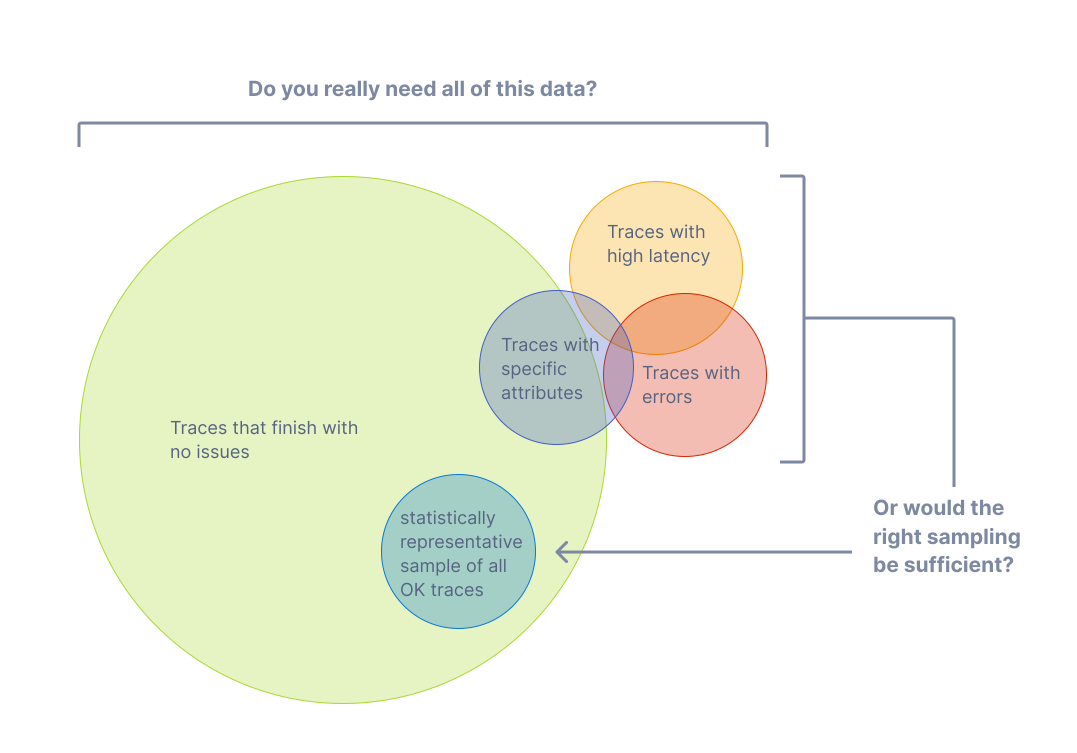
Firstly, the processors supporting OpenTelemetry Tracing can now sample. This is probably Fluent Bit’s only weakness in the Open Telemetry domain until now. Sampling is essential here as traces can become significant as you track application executions through many spans. When combined with each new transaction creating a new trace, traces can become voluminous. To control this explosion on telemetry data, we want to sample traces, collecting a percentage of typical traces (performance, latency, no errors, etc) and the outliers, where tracing will show us where a process is suffering, e.g., an end-to-end process is slowing because of a bottleneck. We can dictate how the sampling is applied based on values of existing attributes, the trace status, status codes, latencies, the number of spans, etc.

Conditionality in Processors

Conditionality makes it easier to respond to aspects of logs. For example, only when the logging payload has several attributes with specific values do we want to filter the event out for more attention. For example, an application reporting that it is starting up, and logs are classified as representing an error – then we may want to add a tag to the event so it can be easily filtered and routed to the escalation process.

Plugins with Zig

The enablement of Zig for plugin development (input, output and filters) is strictly an experimental feature. The contributors are confident they have covered all the typical use cases. But the innate flexibility supporting a language always represents potential edge cases never considered and may require some additional work to address.

Let’s be honest: Zig isn’t a well-known language. So, let’s start by looking briefly at it and why the community has adopted it for custom plugin development as an alternative to the existing options with Lua and WASM.

So Zig has a number of characteristics that align with the Fluent Bit ethos better than Lua and WASM, specifically:

  • It is a compiled rather than interpreted language, meaning that we reduce the runtime overheads of an interpreter or JIT compiler such as Lua and the proxy layer of WASM. This aligns to be very fast/minimal compute overhead to do its job, – ideal for IoT and minimising the cost of side-care container deployments.
  • The footprint for the Zig executable is very, very small—smaller than even a C-generated binary! As with the previous point, this lends itself to common Fluent Bit deployments.
  • The language definition is formally defined, compact, and freely available. This means you should be able to take a tool chain from anyone, and it is easy for specialist chip vendors to provide compilers.
  • Based on those who have tried, cross-compiling is far easier to deal with than working with GCC, MSVC, etc. Making it a lot easier to develop with the benefits we want from Go. Unlike Go – to connect to the C binary of Fluent Bit doesn’t require the use of a translation layer.

One of Zig’s characteristics that differs from C is its stronger typing and its approach of, rather than prescribing how edge cases are handled, e.g., null pointers, working to prevent you from entering those conditions.

Zig has been around for a few years (the first pre-release was in 2017, and the first non-pre-release was in August 2023). This is long enough for the supporting tooling to be pretty well fleshed out with package management, important building blocks such as the HTTP server, etc.

While asking a large enterprise with more conservative approaches to development (particularly when IT is seen as an overhead, and source of risk rather than a differentiator/revenue generator) to consider adopting Zig could be challenging compared to adopting, say Go. The different potential values here, make for some interesting potential.

Not Only, but Also

While we have made some significant advancements, each Fluent Bit release brings a variety of improvements in its plugins. For example, working with it with eBPF, HTTP output supports more compression techniques, such as Snappy and ZSTD, and Exit having a configurable delay.

The Plus version of library dependencies is being updated to exploit new capabilities or ensure Fluent Bit isn’t using libraries with vulnerabilities.

Additional resources

    • Chronosphere announcement

    • Announcement YouTube video

    • book
    • My links to technical resources – we’ve extended to include Zig related resources

Share this:

  • Click to share on Facebook (Opens in new window) Facebook
  • Click to share on X (Opens in new window) X
  • Click to share on Pocket (Opens in new window) Pocket
  • Click to share on Reddit (Opens in new window) Reddit
  • Click to email a link to a friend (Opens in new window) Email
  • Click to share on WhatsApp (Opens in new window) WhatsApp
  • Click to print (Opens in new window) Print
  • Click to share on Tumblr (Opens in new window) Tumblr
  • Click to share on Mastodon (Opens in new window) Mastodon
  • Click to share on Pinterest (Opens in new window) Pinterest
  • More
  • Click to share on Bluesky (Opens in new window) Bluesky
  • Click to share on LinkedIn (Opens in new window) LinkedIn
Like Loading...

Fluent Bit 3.2: YAML Configuration Support Explained

23 Monday Dec 2024

Posted by mp3monster in Fluentbit, General, Technology

≈ Leave a comment

Tags

book, Cloud, config, configuration, development, Fluent Bit, parsers, streams, stream_task, YAML

Among the exciting announcements for Fluent Bit 3.2 is the support for YAML configuration is now complete. Until now, there have been some outliers in the form of details, such as parser and streamer configurations, which hadn’t been made YAML compliant until now.

As a result, the definitions for parsers and streams had to remain separate files. That is no longer the case, and it is possible to incorporate parser definitions within the same configuration file. While separate configuration files for parsers make for easier re-use, it is more troublesome when incorporating the configuration into a Kubernetes deployment configuration, particularly when using a side-car deployment.

Parsers

With this advancement, we can define parsers like this:

Classic Fluent Bit

[PARSER]
    name myNginxOctet1
    format regex
    regex (?<octet1>\d{1,3})

YAML Configuration

parsers:
  - name: myNginxOctet1
    format: regex
    regex: '/(?<octet1>\d{1,3})/'

As the examples show, we swap [PARSER] for a parsers object. Then, each parser is an array of attributes starting with the parser name. The names follow a one-to-one mapping in most cases. This does break down when it comes to parsers where we can define a series of values, which in classic format would just be read in order.

Multiline Parsers

When using multiline parsers, we must provide different regular expressions for different lines. In this situation, we see each set of attributes become a list entry, as we can see here:

Classic Fluent Bit

[MULTILINE_PARSER]
  name multiline_Demo
  type regex
  key_content log
  flush_timeout 1000
  #
  # rule|<state name>|<regex>|<next state>
  rule "start_state" "^[{].*" "cont"
  rule "cont" "^[-].*" "cont"

YAML Configuration

multiline_parsers:
  - name: multiline_Demo
    type: regex
    rules:
    - state: start_state
      regex: '^[{].*'
      next_state: cont
    - state: cont
      regex: "^[-].*"
      next_state: cont

In addition to how the rules are nested, we have moved from several parameters within a single attribute(rule) to each rule having several discrete elements (regex, next_state). In addition to this, we have also changed the use of single and double quote marks.

If you want to keep the configurations for parsers and streams separate, we can continue to do so, referencing the file and name from the main configuration file. While converting the existing conf to a YAML format is the bulk of the work, in all likelihood, you’ll change the file extension to be .YAML will means you must also modify the referencing parsers_file reference in the server section of the main configuration file.

Streams

Streams follow very much the same path as parsers. However, we do have to be a lot more aware of the query syntax to remain within the YAML syntax rules.

Classic Fluent Bit

[STREAM_TASK]
  name selectTaskWithTag
  exec SELECT record_tag(), rand_value FROM STREAM:random.0;

[STREAM_TASK]
  name selectSumTask
  exec SELECT now(), sum(rand_value)   FROM STREAM:random.0;

[STREAM_TASK]
  name selectWhereTask
  exec SELECT unix_timestamp(), count(rand_value) FROM STREAM:random.0 where rand_value > 0;

YAML Configuration

stream_processor:
  - name: selectTaskWithTag
    exec: "SELECT record_tag(), rand_value FROM STREAM:random.0;"
  - name: selectSumTask
    exec: "SELECT now(), sum(rand_value) FROM STREAM:random.0;"
  - name: selectWhereTask
    exec: "SELECT unix_timestamp(), count(rand_value) FROM STREAM:random.0 where rand_value > 0;"

Note, it is pretty common for Fluent Bit YAML to use the plural form for each of the main blocks, although stream definition is an exception to the case. Additionally, both stream_processor and stream_task are accepted (although stream_task is not recognized in the main configuration file)..

Incorporating Configuration directly into the core configuration file

To support directly incorporating these definitions into a single file, we can lift the YAML file contents and apply them as root elements (i.e., at the same level as the pipeline, and service, for example).

Fluent Bit book examples

Our Fluent Bit book (Manning, Amazon UK, Amazon US, and everywhere else) has several examples of using parsers and streams in its GitHub repo. We’ve added the YAML versions of the configurations illustrating parsers and stream processing to its repository in the Extras folder.

Share this:

  • Click to share on Facebook (Opens in new window) Facebook
  • Click to share on X (Opens in new window) X
  • Click to share on Pocket (Opens in new window) Pocket
  • Click to share on Reddit (Opens in new window) Reddit
  • Click to email a link to a friend (Opens in new window) Email
  • Click to share on WhatsApp (Opens in new window) WhatsApp
  • Click to print (Opens in new window) Print
  • Click to share on Tumblr (Opens in new window) Tumblr
  • Click to share on Mastodon (Opens in new window) Mastodon
  • Click to share on Pinterest (Opens in new window) Pinterest
  • More
  • Click to share on Bluesky (Opens in new window) Bluesky
  • Click to share on LinkedIn (Opens in new window) LinkedIn
Like Loading...

Books Books Books

22 Tuesday Oct 2024

Posted by mp3monster in Books, General, Technology

≈ Leave a comment

Tags

book, books, development, ebook, FluentBit, manning, pbook, print, published, reading

Today we got the official notification that our book has been published …

Logs and Telemetry book - order option

As you can see, the eBook is now available. The print edition can be purchased from Thursday (24th Oct). If you’ve been a MEAP subscriber, you should be able to download the complete book. The book will start showing up on other platforms in the coming weeks (Amazon UK has set an availability date, and Amazon.com you can preorder).

There are some lovely review quotes as well:

A detailed dive into building observability and monitoring.

Jamie Riedesel, author of Software Telemetry
Extensive real-life examples and comprehensive coverage! It’s a great resource for architects, developers, and SREs.

Sambasiva Andaluri, IBM
A must read for anyone managing a critical IT-system. You will truly understand what’s going on in your applications and infrastructure.

Hassan Ajan, Gain Momentum

And there is more …

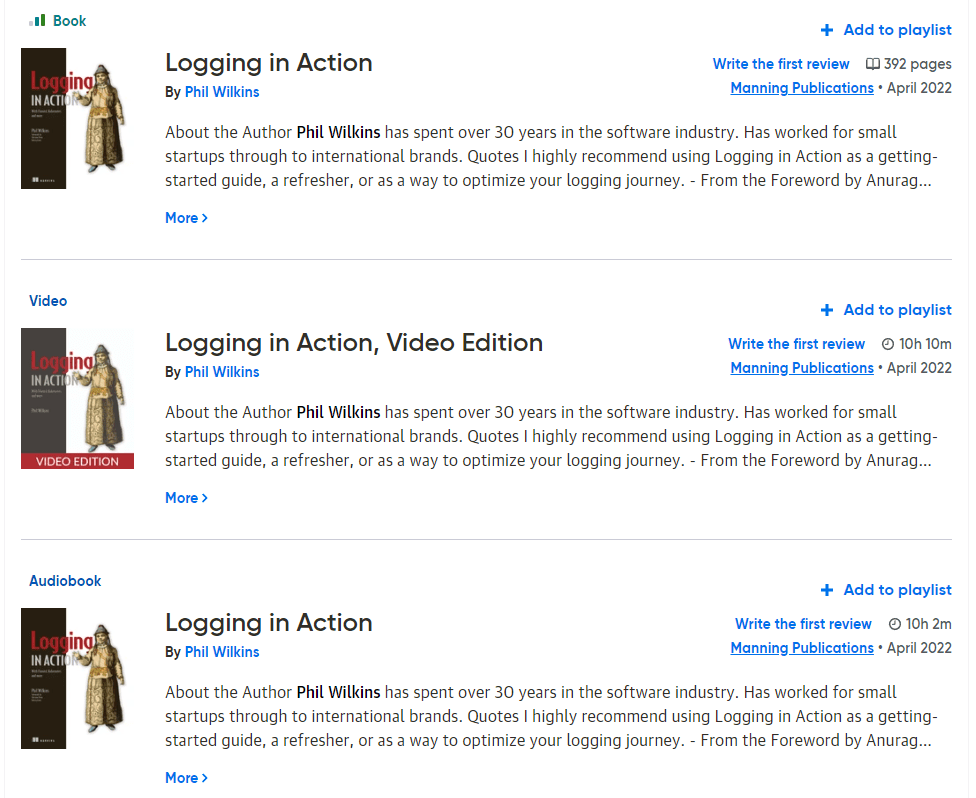
I hadn’t noticed until today, but the partner book Logging in Action, which covers Fluentd, is available in ebook and print as well as audio and video editions. As you can see, these are available on Manning and platforms like O’Reilly/Safari…

In Logging in Action you will learn how to:

Deploy Fluentd and Fluent Bit into traditional on-premises, IoT, hybrid, cloud, and multi-cloud environments, both small and hyperscaled
Configure Fluentd and Fluent Bit to solve common log management problems
Use Fluentd within Kubernetes and Docker services
Connect a custom log source or destination with Fluentd’s extensible plugin framework
Logging best practices and common pitfalls

Logging in Action is a guide to optimize and organize logging using the CNCF Fluentd and Fluent Bit projects. You’ll use the powerful log management tool Fluentd to solve common log management, and learn how proper log management can improve performance and make management of software and infrastructure solutions easier. Through useful examples like sending log-driven events to Slack, you’ll get hands-on experience applying structure to your unstructured data.

I have to say that my digital twin, who narrated the book, sounds pretty intelligent.

Update

Amazon UK is correct now, and has an availability date

Share this:

  • Click to share on Facebook (Opens in new window) Facebook
  • Click to share on X (Opens in new window) X
  • Click to share on Pocket (Opens in new window) Pocket
  • Click to share on Reddit (Opens in new window) Reddit
  • Click to email a link to a friend (Opens in new window) Email
  • Click to share on WhatsApp (Opens in new window) WhatsApp
  • Click to print (Opens in new window) Print
  • Click to share on Tumblr (Opens in new window) Tumblr
  • Click to share on Mastodon (Opens in new window) Mastodon
  • Click to share on Pinterest (Opens in new window) Pinterest
  • More
  • Click to share on Bluesky (Opens in new window) Bluesky
  • Click to share on LinkedIn (Opens in new window) LinkedIn
Like Loading...

shhh – Fluent Bit book has gone to the printers, and …

13 Sunday Oct 2024

Posted by mp3monster in Books, Fluentbit, General, manning, Technology

≈ Leave a comment

Tags

book, ebook, FluentBit, manning, webinar

I thought you might like to know that last week, the production process on the book (Logs and Telemetry with Fluent Bit, written with the working title of Fluent Bit with Kubernetes) was completed, and the book should be on its way to the printers. In the coming weeks, you’ll see the MEAP branding disappear, and the book will appear in the usual places.

If you’ve been brilliant and already purchased the book – the finished version will be available to download soon, and for those who have ordered the ‘tree’ media version – a few more weeks and ink and paper will be on their way.

As part of the promotion, we will be doing a webinar with the book’s sponsor, To register for their webinar – go to https://go.chronosphere.io/fluent-bit-with-kubernetes-meet-the-author.html

Share this:

  • Click to share on Facebook (Opens in new window) Facebook
  • Click to share on X (Opens in new window) X
  • Click to share on Pocket (Opens in new window) Pocket
  • Click to share on Reddit (Opens in new window) Reddit
  • Click to email a link to a friend (Opens in new window) Email
  • Click to share on WhatsApp (Opens in new window) WhatsApp
  • Click to print (Opens in new window) Print
  • Click to share on Tumblr (Opens in new window) Tumblr
  • Click to share on Mastodon (Opens in new window) Mastodon
  • Click to share on Pinterest (Opens in new window) Pinterest
  • More
  • Click to share on Bluesky (Opens in new window) Bluesky
  • Click to share on LinkedIn (Opens in new window) LinkedIn
Like Loading...
← Older posts

    I work for Oracle, all opinions here are my own & do not necessarily reflect the views of Oracle

    • About
      • Internet Profile
      • Music Buying
      • Presenting Activities
    • Books & Publications
      • Logging in Action with Fluentd, Kubernetes and More
      • Logs and Telemetry using Fluent Bit
      • Oracle Integration
      • API & API Platform
        • API Useful Resources
        • Useful Reading Sources
    • Mindmaps Index
    • Monster On Music
      • Music Listening
      • Music Reading
    • Oracle Resources
    • Useful Tech Resources
      • Fluentd & Fluent Bit Additional stuff
        • Logging Frameworks and Fluent Bit and Fluentd connectivity
        • REGEX for BIC and IBAN processing
      • Java and Graal Useful Links
      • Official Sources for Product Logos
      • Python Setup & related tips
      • Recommended Tech Podcasts

    Oracle Ace Director Alumni

    TOGAF 9

    Logs and Telemetry using Fluent Bit


    Logging in Action — Fluentd

    Logging in Action with Fluentd


    Oracle Cloud Integration Book


    API Platform Book


    Oracle Dev Meetup London

    Blog Categories

    • App Ideas
    • Books
      • Book Reviews
      • manning
      • Oracle Press
      • Packt
    • Enterprise architecture
    • General
      • economy
      • ExternalWebPublications
      • LinkedIn
      • Website
    • Music
      • Music Resources
      • Music Reviews
    • Photography
    • Podcasts
    • Technology
      • AI
      • APIs & microservices
      • chatbots
      • Cloud
      • Cloud Native
      • Dev Meetup
      • development
        • languages
          • java
          • node.js
      • drone
      • Fluentbit
      • Fluentd
      • logsimulator
      • mindmap
      • OMESA
      • Oracle
        • API Platform CS
          • tools
        • Helidon
        • ITSO & OEAF
        • Java Cloud
        • NodeJS Cloud
        • OIC – ICS
        • Oracle Cloud Native
        • OUG
      • railroad diagrams
      • TOGAF
    • xxRetired
    • AI
    • API Platform CS
    • APIs & microservices
    • App Ideas
    • Book Reviews
    • Books
    • chatbots
    • Cloud
    • Cloud Native
    • Dev Meetup
    • development
    • drone
    • economy
    • Enterprise architecture
    • ExternalWebPublications
    • Fluentbit
    • Fluentd
    • General
    • Helidon
    • ITSO & OEAF
    • java
    • Java Cloud
    • languages
    • LinkedIn
    • logsimulator
    • manning
    • mindmap
    • Music
    • Music Resources
    • Music Reviews
    • node.js
    • NodeJS Cloud
    • OIC – ICS
    • OMESA
    • Oracle
    • Oracle Cloud Native
    • Oracle Press
    • OUG
    • Packt
    • Photography
    • Podcasts
    • railroad diagrams
    • Technology
    • TOGAF
    • tools
    • Website
    • xxRetired

    Enter your email address to subscribe to this blog and receive notifications of new posts by email.

    Join 2,555 other subscribers

    RSS

    RSS Feed RSS - Posts

    RSS Feed RSS - Comments

    December 2025
    M T W T F S S
    1234567
    891011121314
    15161718192021
    22232425262728
    293031  
    « Nov    

    Twitter

    Tweets by mp3monster

    History

    Speaker Recognition

    Open Source Summit Speaker

    Flickr Pics

    Turin Brakes Acoustic Tour 24 @ The Maltings FarnhamTurin Brakes Acoustic Tour 24 @ The Maltings FarnhamTurin Brakes Acoustic Tour 24 @ The Maltings FarnhamTurin Brakes Acoustic Tour 24 @ The Maltings Farnham
    More Photos

    Social

    • View @mp3monster’s profile on Twitter
    • View philwilkins’s profile on LinkedIn
    • View mp3monster’s profile on GitHub
    • View mp3monster’s profile on Flickr
    • View mp3muncher’s profile on WordPress.org
    • View philmp3monster’s profile on Twitch
    Follow Phil (aka MP3Monster)'s Blog on WordPress.com

    Blog at WordPress.com.

    • Subscribe Subscribed
      • Phil (aka MP3Monster)'s Blog
      • Join 233 other subscribers
      • Already have a WordPress.com account? Log in now.
      • Phil (aka MP3Monster)'s Blog
      • Subscribe Subscribed
      • Sign up
      • Log in
      • Report this content
      • View site in Reader
      • Manage subscriptions
      • Collapse this bar
     

    Loading Comments...
     

    You must be logged in to post a comment.

      Privacy & Cookies: This site uses cookies. By continuing to use this website, you agree to their use.
      To find out more, including how to control cookies, see here: Our Cookie Policy
      %d