• Home
  • Site Aliases
    • www.cloud-native.info
  • About
    • Background
    • Presenting Activities
    • Internet Profile
      • LinkedIn
    • About
  • Books & Publications
    • Log Generator
    • Logs and Telemetry using Fluent Bit
      • Fluent Bit book
      • Book Resources in GitHub
      • Fluent Bit Classic to YAML Format configurations
    • Logging in Action with Fluentd, Kubernetes and More
      • Logging in Action with Fluentd – Book
      • Fluentd Book Resources
      • Fluentd & Fluent Bit Additional stuff
    • API & API Platform
      • API Useful Resources
    • Oracle Integration
      • Book Website
      • Useful Reading Sources
    • Publication Contributions
  • Resources
    • GitHub
    • Oracle Integration Site
    • Oracle Resources
    • Mindmaps Index
    • Useful Tech Resources
      • Fluentd & Fluent Bit Additional stuff
      • Recommended Tech Podcasts
      • Official Sources for Product Logos
      • Java and Graal Useful Links
      • Python Setup & related stuff
  • Music
    • Monster On Music
    • Music Listening
    • Music Reading

Phil (aka MP3Monster)'s Blog

~ from Technology to Music

Phil (aka MP3Monster)'s Blog

Tag Archives: Cloud

Analytics and Stats for APIs

05 Friday Oct 2018

Posted by mp3monster in API Platform CS, General, Oracle, Technology, tools

≈ 3 Comments

Tags

API, CLI, Cloud, Groovy, monetization, Oracle, reporting, stats, util

NOTE:This utility needs revamping to support IDCS for more see Making Scripts Work with IDCS Deployed PaaS

The Oracle API Platform provides the means to examine statistics and slice and dice the numbers by application, gateway, duration and so on resulting in visually appealing graphical representations.  The way the analytics works means you can book mark specific views, so you can return the same report view with the relevant features as often as you like.  However, presently there is no data export option.

The question why would I want to export the information comes down to several possible use cases, all of which relate to cost management.  The API Platform will eventually have all the desired data views, but now something to help address the following:

  • money-tization, we can see which consumer has been using the services by how much and then send the data to a companies accounting systems to invoice the users
  • Ability to examine demand and workload over time to create a projection of the likely infrastructure – to achieve this the API statistics need to be overlaid with infrastructure and performance details so we can extrapolate API growth against server workload.

To address these kinds of requirements, we have taken advantage of the fact the API Platform has drunk its own Champagne as they say and made many of the analytics querying APIs publicly available.  As with the other API Platform tools, the logic has been written in Groovy, and freely available for use – we’ve covered the code through a Create Common license.

Tool includes a range of parameters to allow the data retrieved into a CSV file having filtered in a number of different ways – which logical gateways to examine, which API or Application(s) to report on.  Finally, just to help some basic stats are produced with a count of logical gateways, API calls, APIs defined and Application definitions. The first three factors inform your cloud costs. Together the stats can help Oracle understand your use case. Note that the parameters which impact the CSV generation can also materially impact the reporting numbers.

Parameters:

The 1st three values must always be provided and in the order shown here

  1. user name to access the source management cloud
  2. password for the source management cloud
  3. The server address without any attributes e.g. https://1.2.3.4

All the following values are optional

  • -h or -help – provides this information
  • -g – Logical gateway to retrieve numbers from e.g. production or development. using ALL with this parameter will result in ALL gateways being examined
  • -f – the file to target the CSV data should be written to. If not set then the default of
  • -t – indicates whether the data provided should be taken from an APPS perspective or from an API view by passing either APPS | API
  • -d – will get script to report more information about what is happening
  • -p – reporting period which is defined by a number as follows:
    • 0 – Last 365 days – data is given as per month
    • 1 – Last 30 days – this is the default if no information is provided – data is given as per day
    • 2 – Last 7 days – data is given as per day
    • 3 – Last day – data is given as per hour

NB – still testing the utility at this moment – will remove this comment once happy

Share this:

  • Click to share on Facebook (Opens in new window) Facebook
  • Click to share on X (Opens in new window) X
  • Click to share on Pocket (Opens in new window) Pocket
  • Click to share on Reddit (Opens in new window) Reddit
  • Click to email a link to a friend (Opens in new window) Email
  • Click to share on WhatsApp (Opens in new window) WhatsApp
  • Click to print (Opens in new window) Print
  • Click to share on Tumblr (Opens in new window) Tumblr
  • Click to share on Mastodon (Opens in new window) Mastodon
  • Click to share on Pinterest (Opens in new window) Pinterest
  • More
  • Click to share on Bluesky (Opens in new window) Bluesky
  • Click to share on LinkedIn (Opens in new window) LinkedIn
Like Loading...

API Developer Podcast

23 Monday Jul 2018

Posted by mp3monster in API Platform CS, Books, General, Oracle, Podcasts, Technology

≈ Leave a comment

Tags

API, Cloud, developer, Oracle, podcast

The authors of the API Platform book, got to record an Oracle Developer Podcast together in support of the book – the recording can be here at here or at here

As ever, thanks to Bob Rhubart for giving us this opportunity.


Share this:

  • Click to share on Facebook (Opens in new window) Facebook
  • Click to share on X (Opens in new window) X
  • Click to share on Pocket (Opens in new window) Pocket
  • Click to share on Reddit (Opens in new window) Reddit
  • Click to email a link to a friend (Opens in new window) Email
  • Click to share on WhatsApp (Opens in new window) WhatsApp
  • Click to print (Opens in new window) Print
  • Click to share on Tumblr (Opens in new window) Tumblr
  • Click to share on Mastodon (Opens in new window) Mastodon
  • Click to share on Pinterest (Opens in new window) Pinterest
  • More
  • Click to share on Bluesky (Opens in new window) Bluesky
  • Click to share on LinkedIn (Opens in new window) LinkedIn
Like Loading...

Implementing API Platform Book extract

19 Tuesday Jun 2018

Posted by mp3monster in API Platform CS, Books, Packt, Technology

≈ Leave a comment

Tags

API, book, Cloud, extract, Packt

An extract of our new book Implementing API Platform has been made available by the publishers Packt here. Of course you could enjoy all the content by buying the book directly from Packt (go here) or from book retails such as Amazon (here).

Share this:

  • Click to share on Facebook (Opens in new window) Facebook
  • Click to share on X (Opens in new window) X
  • Click to share on Pocket (Opens in new window) Pocket
  • Click to share on Reddit (Opens in new window) Reddit
  • Click to email a link to a friend (Opens in new window) Email
  • Click to share on WhatsApp (Opens in new window) WhatsApp
  • Click to print (Opens in new window) Print
  • Click to share on Tumblr (Opens in new window) Tumblr
  • Click to share on Mastodon (Opens in new window) Mastodon
  • Click to share on Pinterest (Opens in new window) Pinterest
  • More
  • Click to share on Bluesky (Opens in new window) Bluesky
  • Click to share on LinkedIn (Opens in new window) LinkedIn
Like Loading...

Lessons in Oracle Cloud Password Management

07 Monday May 2018

Posted by mp3monster in General, Oracle, Technology

≈ 2 Comments

Tags

APIP CS, Cloud, DaaS, Oracle, password, Security

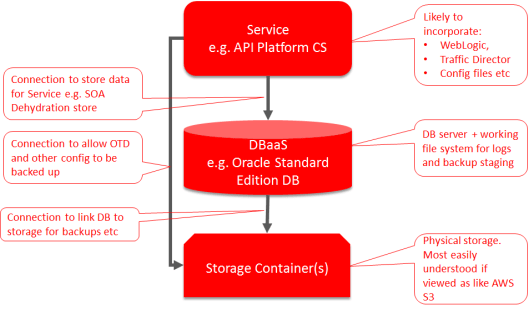
Oracle Cloud is growing and maturing at a tremendous rate if the breadth of PaaS capabilities is any indication.  However, there are a few gotchas out there, that can cause some headaches if they get you. These typically relate to processes that impact across different functional areas. A common middleware stack (API CS, SOA CS, OIC etc) will look something like the following:

cloudPassword

As the diagram shows when you build the cloud services, the layers get configured with credentials to the lower layers needed (although Oracle have in the pipeline the Oracle managed version of many services where this is probably going to be hidden from us). Continue reading →

Share this:

  • Click to share on Facebook (Opens in new window) Facebook
  • Click to share on X (Opens in new window) X
  • Click to share on Pocket (Opens in new window) Pocket
  • Click to share on Reddit (Opens in new window) Reddit
  • Click to email a link to a friend (Opens in new window) Email
  • Click to share on WhatsApp (Opens in new window) WhatsApp
  • Click to print (Opens in new window) Print
  • Click to share on Tumblr (Opens in new window) Tumblr
  • Click to share on Mastodon (Opens in new window) Mastodon
  • Click to share on Pinterest (Opens in new window) Pinterest
  • More
  • Click to share on Bluesky (Opens in new window) Bluesky
  • Click to share on LinkedIn (Opens in new window) LinkedIn
Like Loading...

Message Push Listener – Article Update

30 Saturday Dec 2017

Posted by mp3monster in Cloud, development, General, NodeJS Cloud, Technology

≈ Leave a comment

Tags

"Message Push Listener", article, AWS, Cloud, fn, Functions, google, IBM, JMS, Lambda, messaging, OpenWhisk, Oracle, OraWorld, serverless

When I first wrote about Oracle Messaging Cloud we used a service called WebScript.io to make it easy to demonstrate the Message Push Listener. WebScript was essentially what we better know as a Serverless or Functions oriented offering (that is we wrote pieces of code and deployed them without any consideration servers etc). Well as I prepared my demos for Messaging Cloud for the UK Oracle User Group Tech 17 Conference I discovered that WebScript is being shutdown in December 2017.

In the light of this news, I needto provide an alternate implementation for my Message Push Listener demo Google’s Cloud Functions.  Before I go into the Google implementation I thought it worth sharing how I landed on Google’s offering.

The Google Cloud Functions is a new service that has been launched with an interesting future. I had hoped to try using project Fn (Oracle’s open source serverless offering) but the cloud offering is not yet publicly available – although you can run Fn on any platform today if you’re prepared to invest in setting up the environment (defeating the point of serverless). I know some of Oracle’s Developer Champions have had a preview so it cant be too far away now. I’m sure when we get a chance to access the new Cloud Native Service announced which will include Fn we will revisit it. Before settling on Google we looked at several other offerings in the serverless space. Whilst this is not an exhaustive analysis it should help give a sense of the challenges and ease of adoption. If you search today on Serverless you’ll most commonly come across Auth0’s WebTask.io, AWS Lambda and IBM OpenWhisk (based on Apache OpenWhisk).

WebTask.io

I started with WebTask.io and it was very nearly a done deal, with a nice easy to work with Cloud Development Platform, integrated testing. Extensive support for Node.js and a number of standard frameworks to use with it such as Express available without doing anything.

Other languages are supported as well by WebTask.io. But as I’m trying to create a demo that warrants very little explanation of the Serverless platform we didn’t dig in to this area. Everything went swimmingly until I tried to setup external calls to my function. This became a headache as the security model whilst not overly complex (several ways to provide the REST call with authentication e.g. adding a key in the URI). The process of generating and associating the credentials was far from clear in the documentation.

AWS Lambda

I moved to look at AWS Lambda, this I just found horribly confusing to get started with. I have heard others saying that getting going isn’t straight forward. So I found myself giving up pretty quickly as the setting up wasn’t that clear. Whilst having used AWS with its IaaS capabilities which is both powerful, flexible and pretty easy to get to grips with if you understand basic ideas like virtual machines this didnt hold true fory Lambdas.

OpenWhisk

As for OpenWisk, we started to look at it, but getting a 404 error when trying to access the Editor following the IBM documentation didn’t inspire confidence. The was plenty of supoprting documentation which explains how OpenWhisk works.

openwhisk_flow_of_processing

The Execution framework for OpenWhisk

  1.  Ningx is used for SSL termination and forwarding appropriate HTTP calls to the next component
  2. Controller first disambiguates what the user is trying to do. It does so based on the HTTP method you use in your HTTP request. This is a Scala solution built using Akka & Spray. This includes ..
  3. Verification who you are (Authentication) against a CouchDB based identiy store.
  4. Once approved details of the Action to be executed is retrieved from the whisks database in CouchDB.
  5. With information on what to do, the action of service discovery is formed using Consul. Which tracks the available executors in the system. Those executors are called Invokers
  6. Kafka is then used to mitigate the demand pipeline from a failure by recording the request and the consumer (invoker) identified by Consul.
  7. The invoker is built using Scala and uses a Docker instance to run the Action which could be anything e.g. Node.js. The action is injected into the container to be processed.
  8. As the result is obtained by the Invoker, it is stored into the whisks database as an activation under the ActivationId. The whisks database lives in CouchDB.

In addition to the 404, as you can see we have a two step process to execute an action and return a respoinse. However the Message Push Listener initial challenge needs a call and response in a single step. So trying to massage this into a call and response is going to be challenging and a distraction from what we want to be conveying.

Using Google Functions

This brings us Back to Google, whilst the Cloud IDE is not as elegant or mature as WebTask it was sufficient and the security model wasn’t imposed. I liked the documentation when needed to refer back  to it, but to be honest it is pretty intuitive. You can’t fault the docs, to the point Google gave time over to explaining how to manage or avoid incurring costs.

Setting up, was very simple, and then once you’ve choosen your cloud services you get a dashboard like this:

Google CLoud mgmt

Google provides the idea of projects which allows you to group pieces together – such as related functions. Each project is name space separated. If we then navigate into a Functions project we get a view as follows:

Google cloud functionsAs you can see in the preceeding diagram I created two functions within a project called OMCS. From here you can create more functions in your project or drill into an individual function, as the following view shows:
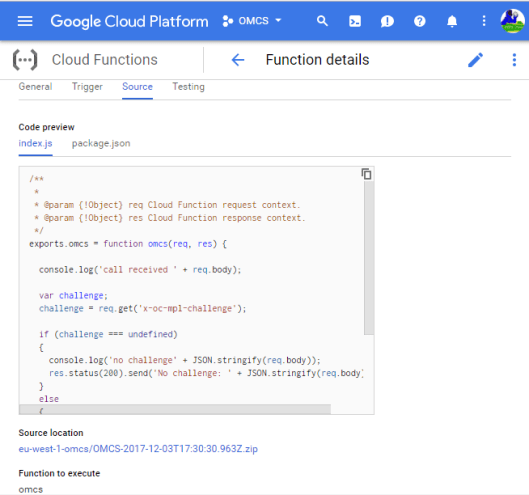
Google Functiuons performance

An individual function provides you with several tabbed views overing the Gernal information  (as shown above) or Trigger, Source and Testing. We can see the other views in the following screenshots. The following screen shot shows the Functions Editor, as you can see it is fairly simple – but sufficient to do the job.

GoogleCloud-OMCS

Once saved, if valid the code will automatically get deployed, or you can work offline and then upload the code if you want to use a nice editor like Sublime.

with your code edited and saved, then the next step is to invoke it. This can be done with the next tab, or the details such as the URI can be copied and you can test from your preferred test tool such as SOAPUI, Postman and APIFortress.

Google functions Trigger

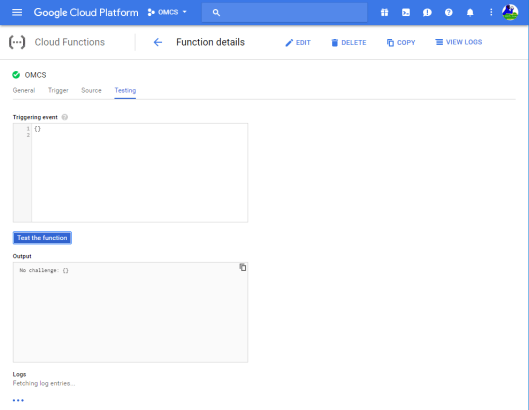
The testing view allows you 5o define input and output values, along with the outcomes. Personally I worked with SOAPUI.

Google Functiuons Test

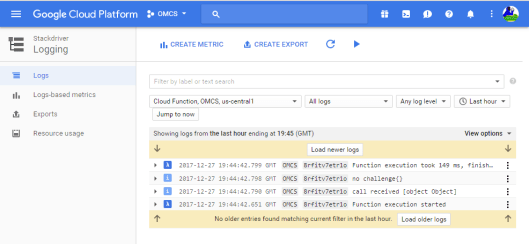
The important thing with running tests or diagnosing issues, is to be able to examine execution logs. In this area Google Functions is pretty feature rich with a solution that works in a style somewhat like the searching in Splunk (and I’m sure other log analytics tools) where you can drill into the logs and build log filters on the fly. The log view is shown in the next screenshot.

Gogole Functions Logging 2

as you can see tool looks pretty straight forward and uncomplicated to use, with freedom to adapt how you work to your preferred style. Based on my experience of using Project FN on my desktop – it is this simplicity I think we’ll see with the Cloud Native Platform from Oracle when it becomes available.

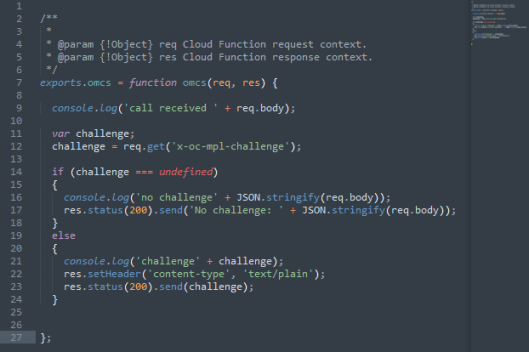
Finally, let’s take a look at the code in Google Functions code produced for this example:

code

conclusion

Google Code whilst its UI is a bit basic, it is easy to use and get started, certainly for using as a demo platform or perhaps for creating stubs, test and mock end points. Having been critical of the other offerings for security and it getting in the way of a simple illustration it is possible that the Google Functions may need some work in this area. I didn’t see anything that obviously integrated security features in easily.

Back to my Orginal Articles…

Just to tie back the impacted articles …

  • http://www.oraworld.org/home/ – Issues 6 & 7
  • http://www.oracle.com/technetwork/articles/cloudcomp/wilkins-ocms-3855268.html
  • https://www.youtube.com/watch?v=9Elf2DBisEU

Share this:

  • Click to share on Facebook (Opens in new window) Facebook
  • Click to share on X (Opens in new window) X
  • Click to share on Pocket (Opens in new window) Pocket
  • Click to share on Reddit (Opens in new window) Reddit
  • Click to email a link to a friend (Opens in new window) Email
  • Click to share on WhatsApp (Opens in new window) WhatsApp
  • Click to print (Opens in new window) Print
  • Click to share on Tumblr (Opens in new window) Tumblr
  • Click to share on Mastodon (Opens in new window) Mastodon
  • Click to share on Pinterest (Opens in new window) Pinterest
  • More
  • Click to share on Bluesky (Opens in new window) Bluesky
  • Click to share on LinkedIn (Opens in new window) LinkedIn
Like Loading...

A busy 25 hours at UKOUG Conference

05 Tuesday Dec 2017

Posted by mp3monster in General, OIC - ICS, Oracle, Technology

≈ Leave a comment

Tags

Cloud, conference, integration, messaging, OIC, OIC - ICS, OMESA, OraWorld, OUG, PushListener, WebScript

I’ve just come to the end of a very busy 25 hours at the UK Oracle User Group (UKOUG) Conference in Birmingham. Four presentations – interestingly the same subject area, that of Oracle Integration Cloud (OIC) / Integration Cloud Service (ICS) started and ended the day.  Between this we also covered some approaches to start working towards Microservices in a Monolith World and Oracle Messaging Cloud.

Below are the presentations on the Microservices and ICS/OIC. The piece on Oracle Messaging Cloud was largely demo based, so rather than sharing the presentation slides, which won’t tell you too much. The best way to find out about this is to read the 2 articles about the capability in the OraWorld magazine (issues 6 & 7). With issue 7 perfectly timed by becoming available in the last couple of days.

With the Oracle Messaging Cloud article, there is one word of caution. When the article was written and submitted I used a free cloud service (which using contemporary terminology we’d describe as Serverless) called WebScript.io.  The WebScript piece served to make it easy to consume the webservice calls illustrating the PushListener feature.  This service however is being closed down – a shame as it was an elegantly simple solution.  Given this I am currently working on a blog post which will show how another services can take the place of WebScript.io; whilst not finalised, this maybe Google Cloud Functions.

If this wasn’t enough we also squeezed in the keynote presentations, a meeting with several other contributors to OMESA (Open Modern Enterprise Software Architecture) , a lunch conversation with our Publisher (Packt) and several other Oracle book authors, Oracle Ace dinner (great food with a lot of brilliant & friendly people), some very valuable incidental conversations and some work for a customer.

Microservices in a Monolith World

Look at Oracle Integration Cloud – its relationship to ICS. Customer use Cases an Insight into why ICS

Share this:

  • Click to share on Facebook (Opens in new window) Facebook
  • Click to share on X (Opens in new window) X
  • Click to share on Pocket (Opens in new window) Pocket
  • Click to share on Reddit (Opens in new window) Reddit
  • Click to email a link to a friend (Opens in new window) Email
  • Click to share on WhatsApp (Opens in new window) WhatsApp
  • Click to print (Opens in new window) Print
  • Click to share on Tumblr (Opens in new window) Tumblr
  • Click to share on Mastodon (Opens in new window) Mastodon
  • Click to share on Pinterest (Opens in new window) Pinterest
  • More
  • Click to share on Bluesky (Opens in new window) Bluesky
  • Click to share on LinkedIn (Opens in new window) LinkedIn
Like Loading...

UKOUG Tech16 Presentation Slides, Apex & Oracle Cloud

15 Thursday Dec 2016

Posted by mp3monster in General, Oracle, Technology

≈ Leave a comment

Tags

APEX, Cloud, Oracle, OUG, tech16

My presentation for UKOUG Tech 16 can be seen by following the link – Introduction to SOA CS. or see below   It was a tremendous 4 days (if you include the Tech stream’s Super Sunday).  If you are a UKOUG member and didn’t make it to the conference I’d look out for the material to be become available.

Whilst I’m not a big Apex fan (stitching business logic into the persistence layer feels wrong to a middleware person), i did attend the keynote session which covered Apex’s history and future direction, and there are some very exiciting things coming and if everything materialises as I understand it then some big steps to getting developers engaged with Oracle cloud offerings.

Oracle has done a lot of work on the middleware layer with apps container (using common Docker configurations without needing to worry about Docker), Kafka, Node.js and others to engage developers and provide the means to offer a polyglot microservices platform that is not just attractive to  the traditional Oracle customer base but also those wanting the middle ground of supported open source. What Oracle are missing is the means to get developers trying the technology and being creative with it. Amazon and Red Hat have got this by offering limited footprints for a long time. Oracle offer 30 day trials which is fine to do a project sponsored PoC. But to hook grass roots users you need a lengthy period where people in spare time can built some cool/geeky solutions.

Now this maybe down to the fact that Oracle cloud is built on their Exa machines with clever on silicon security features, and Oracle can’t manufacture it quick enough. Whereas other cloud providers work with largely commodity components. But if they want to challenge Amazon as Ellison says they need to change this.


Share this:

  • Click to share on Facebook (Opens in new window) Facebook
  • Click to share on X (Opens in new window) X
  • Click to share on Pocket (Opens in new window) Pocket
  • Click to share on Reddit (Opens in new window) Reddit
  • Click to email a link to a friend (Opens in new window) Email
  • Click to share on WhatsApp (Opens in new window) WhatsApp
  • Click to print (Opens in new window) Print
  • Click to share on Tumblr (Opens in new window) Tumblr
  • Click to share on Mastodon (Opens in new window) Mastodon
  • Click to share on Pinterest (Opens in new window) Pinterest
  • More
  • Click to share on Bluesky (Opens in new window) Bluesky
  • Click to share on LinkedIn (Opens in new window) LinkedIn
Like Loading...

OTN Appreciation Day : OMCS Push Listeners

11 Tuesday Oct 2016

Posted by mp3monster in General, Oracle, Technology

≈ Leave a comment

Tags

#ThanksOTN, Appreciation Day, Cloud, Cloud Service, integration, JMS, messaging, Messaging CS, OMCS, Oracle, oracle-base, OTN, Push Listener, Technology Network

The background to this post, and the OTN Appreciation Day can be seen at Oracle-Base.

Oracle Messaging Cloud Service (OMCS) is I think an overlooked gem of Oracle iPaaS portfolio.  I say this as it offers a JMS 1.1 compliant Java library but at the same time provides a means through which integration through REST APIs can be performed.  This means it is possible to pretty transparently connect legacy JMS based integrations with new REST based products.  The magic sauce (and therefore my favourite feature) is the concept of the Push Listener. Through the REST API it is possible to register a REST URL as a target for queues and topics to have messages sent to. Once registered when a message appears on the queue or topic it will get passed on as a REST call. Whilst is is possible to do with with a little bit of Java code. the Push Listener simplifies the job to a REST call with a bit of XML configuration.

There is one small challenge that makes the integration completely transparent to the recipient of the PushListener today, and that is it currently demands that authentication process take place on initial contact. This is not a complicated or challenging thing to address, but does require a tiny bit of code to address.

Share this:

  • Click to share on Facebook (Opens in new window) Facebook
  • Click to share on X (Opens in new window) X
  • Click to share on Pocket (Opens in new window) Pocket
  • Click to share on Reddit (Opens in new window) Reddit
  • Click to email a link to a friend (Opens in new window) Email
  • Click to share on WhatsApp (Opens in new window) WhatsApp
  • Click to print (Opens in new window) Print
  • Click to share on Tumblr (Opens in new window) Tumblr
  • Click to share on Mastodon (Opens in new window) Mastodon
  • Click to share on Pinterest (Opens in new window) Pinterest
  • More
  • Click to share on Bluesky (Opens in new window) Bluesky
  • Click to share on LinkedIn (Opens in new window) LinkedIn
Like Loading...

New Kid on the Block and others

12 Monday Sep 2016

Posted by mp3monster in General, Oracle

≈ Leave a comment

Tags

Cloud, journal, OIC - ICS, Oracle Scene, oracle-integration.cloud, OUG

So no new blog entries as I have been busy publishing elsewhere, with the Oracle User Group we appear in the latest edition of the Oracle Scene Journal:

UKOUG Scene Issue 61

click on the image to open the journal properly

We also have a submission in for the November edition, which will be published before the user group’s Tech 16 conference – which I will be presenting at.

UKOUG Tech 16

We have been posting a lot on our website that supports the book – oracle-integration.cloud. Lots of useful references to supporting resources, and some blog posts providing supporting information (and more in the pipeline). Not to mention with pressing on with the last couple of chapters.

Then finally a webinar, the first in a series for the UKOUG about adopting cloud – details at – http://www.ukoug.org/events/ukoug-applications-journey-to-cloud-webinar-1/. The webinar was recorded and the presentation that went with it are accessible if you are a UKOUG member.

Share this:

  • Click to share on Facebook (Opens in new window) Facebook
  • Click to share on X (Opens in new window) X
  • Click to share on Pocket (Opens in new window) Pocket
  • Click to share on Reddit (Opens in new window) Reddit
  • Click to email a link to a friend (Opens in new window) Email
  • Click to share on WhatsApp (Opens in new window) WhatsApp
  • Click to print (Opens in new window) Print
  • Click to share on Tumblr (Opens in new window) Tumblr
  • Click to share on Mastodon (Opens in new window) Mastodon
  • Click to share on Pinterest (Opens in new window) Pinterest
  • More
  • Click to share on Bluesky (Opens in new window) Bluesky
  • Click to share on LinkedIn (Opens in new window) LinkedIn
Like Loading...

Implementing Oracle Integration Cloud Service – Gone Alpha

13 Saturday Aug 2016

Posted by mp3monster in Books, General, Oracle, Packt, Technology

≈ Leave a comment

Tags

alpha, book, Cloud, OIC - ICS, Oracle, Packt

alpha-logoWe have taken our book on ICS into Packt Publishing’s Alpha programme so that if you order the book now – you can see the chapters as soon as they have received editorial approval and the complete final book will be made available to you as soon as we’re have addressed all the feedback, made any final improvements we have identified once we have completed the book’s draft.

img_0282-1The book can be found on the Packt website – here

Details about the Authors from Packt can be seen at:

  • Phil Wilkins
  • Robert  van Mölken

Share this:

  • Click to share on Facebook (Opens in new window) Facebook
  • Click to share on X (Opens in new window) X
  • Click to share on Pocket (Opens in new window) Pocket
  • Click to share on Reddit (Opens in new window) Reddit
  • Click to email a link to a friend (Opens in new window) Email
  • Click to share on WhatsApp (Opens in new window) WhatsApp
  • Click to print (Opens in new window) Print
  • Click to share on Tumblr (Opens in new window) Tumblr
  • Click to share on Mastodon (Opens in new window) Mastodon
  • Click to share on Pinterest (Opens in new window) Pinterest
  • More
  • Click to share on Bluesky (Opens in new window) Bluesky
  • Click to share on LinkedIn (Opens in new window) LinkedIn
Like Loading...
← Older posts
Newer posts →

    I work for Oracle, all opinions here are my own & do not necessarily reflect the views of Oracle

    • About
      • Internet Profile
      • Music Buying
      • Presenting Activities
    • Books & Publications
      • Logging in Action with Fluentd, Kubernetes and More
      • Logs and Telemetry using Fluent Bit
      • Oracle Integration
      • API & API Platform
        • API Useful Resources
        • Useful Reading Sources
    • Mindmaps Index
    • Monster On Music
      • Music Listening
      • Music Reading
    • Oracle Resources
    • Useful Tech Resources
      • Fluentd & Fluent Bit Additional stuff
        • Logging Frameworks and Fluent Bit and Fluentd connectivity
        • REGEX for BIC and IBAN processing
      • Java and Graal Useful Links
      • Official Sources for Product Logos
      • Python Setup & related tips
      • Recommended Tech Podcasts

    Oracle Ace Director Alumni

    TOGAF 9

    Logs and Telemetry using Fluent Bit


    Logging in Action — Fluentd

    Logging in Action with Fluentd


    Oracle Cloud Integration Book


    API Platform Book


    Oracle Dev Meetup London

    Blog Categories

    • App Ideas
    • Books
      • Book Reviews
      • manning
      • Oracle Press
      • Packt
    • Enterprise architecture
    • General
      • economy
      • ExternalWebPublications
      • LinkedIn
      • Website
    • Music
      • Music Resources
      • Music Reviews
    • Photography
    • Podcasts
    • Technology
      • AI
      • APIs & microservices
      • chatbots
      • Cloud
      • Cloud Native
      • Dev Meetup
      • development
        • languages
          • java
          • node.js
      • drone
      • Fluentbit
      • Fluentd
      • logsimulator
      • mindmap
      • OMESA
      • Oracle
        • API Platform CS
          • tools
        • Helidon
        • ITSO & OEAF
        • Java Cloud
        • NodeJS Cloud
        • OIC – ICS
        • Oracle Cloud Native
        • OUG
      • railroad diagrams
      • TOGAF
    • xxRetired
    • AI
    • API Platform CS
    • APIs & microservices
    • App Ideas
    • Book Reviews
    • Books
    • chatbots
    • Cloud
    • Cloud Native
    • Dev Meetup
    • development
    • drone
    • economy
    • Enterprise architecture
    • ExternalWebPublications
    • Fluentbit
    • Fluentd
    • General
    • Helidon
    • ITSO & OEAF
    • java
    • Java Cloud
    • languages
    • LinkedIn
    • logsimulator
    • manning
    • mindmap
    • Music
    • Music Resources
    • Music Reviews
    • node.js
    • NodeJS Cloud
    • OIC – ICS
    • OMESA
    • Oracle
    • Oracle Cloud Native
    • Oracle Press
    • OUG
    • Packt
    • Photography
    • Podcasts
    • railroad diagrams
    • Technology
    • TOGAF
    • tools
    • Website
    • xxRetired

    Enter your email address to subscribe to this blog and receive notifications of new posts by email.

    Join 2,555 other subscribers

    RSS

    RSS Feed RSS - Posts

    RSS Feed RSS - Comments

    January 2026
    M T W T F S S
     1234
    567891011
    12131415161718
    19202122232425
    262728293031  
    « Nov    

    Twitter

    Tweets by mp3monster

    History

    Speaker Recognition

    Open Source Summit Speaker

    Flickr Pics

    Gogo Penguin at the BarbicanGogo Penguin at the BarbicanGogo Penguin at the BarbicanGogo Penguin at the Barbican
    More Photos

    Social

    • View @mp3monster’s profile on Twitter
    • View philwilkins’s profile on LinkedIn
    • View mp3monster’s profile on GitHub
    • View mp3monster’s profile on Flickr
    • View mp3muncher’s profile on WordPress.org
    • View philmp3monster’s profile on Twitch
    Follow Phil (aka MP3Monster)'s Blog on WordPress.com

    Blog at WordPress.com.

    • Subscribe Subscribed
      • Phil (aka MP3Monster)'s Blog
      • Join 233 other subscribers
      • Already have a WordPress.com account? Log in now.
      • Phil (aka MP3Monster)'s Blog
      • Subscribe Subscribed
      • Sign up
      • Log in
      • Report this content
      • View site in Reader
      • Manage subscriptions
      • Collapse this bar
     

    Loading Comments...
     

    You must be logged in to post a comment.

      Privacy & Cookies: This site uses cookies. By continuing to use this website, you agree to their use.
      To find out more, including how to control cookies, see here: Our Cookie Policy
      %d