So we’ve been busy working on our OpAMP solution. We’ve made a number of enhancements since we labelled the code v0.4 back in April. For this post, we’ll look at the features added and where we’re looking next.
There has been a lot of feature development, particularly in support of working with Fluent Bit (and to a degree Fluentd).
Standalone or OpAMP server plugin for editor
We started building the Configuration Editor as a standalone capability. The thinking was that we would refactor it into the OpAMP server once we were happy with the functionality and had progressed far enough. But, as we saw this come together, it occurred to me that both deployments are good, as part of the OpAMP server, seeing the configuration being used is handy, but having a freestanding editor (without worrying about the connectivity to communicate with agents) is also a real use case.
So we have created the setup, where if the OpAMP is told to look for the Editor via the definition of Python endpoints in the configuration and it is deployed, it will be incorporated into the server. If the editor isn’t provided (deployed, or not identified in the configuration it isn’t offered in the navigation.
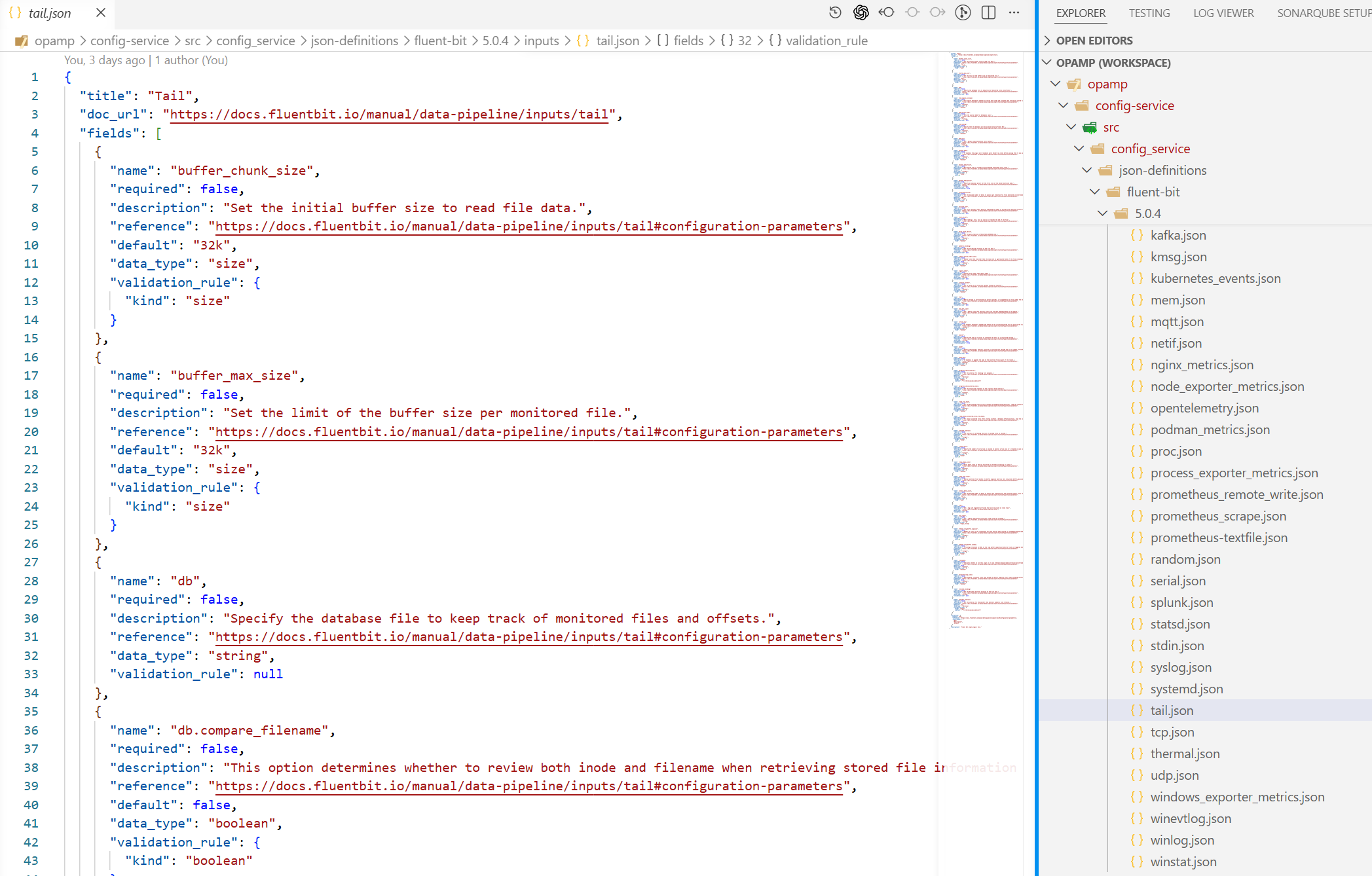
The editor is completely configuration-driven through JSON, so it only requires extending the JSON to support custom plugins or to enhance the validation rules (e.g., adding a REGEX to how a particular parameter is set). This far outweighs the current Dry run checks.
The configuration is considerable, so we refactored the structure to make it far easier to work with, and created some code that can mine Fluent Bit’s GitHub to generate an initial clean set of JSON docs. Of course these need an eyeballing to ensure they’re correct.
Catalog viewer
The catalogue viewer is a natural extension of the editor and leverages the way we tag configuration files with version details in the editor. The catalogue viewer has a configuration which tells it where to look for candidate files. These are then listed with the metadata.
The catalogue viewer presents all the identified files, which, when selected, if it knows about the config editor, will open the editor with the file. Otherwise, it opens a simple view of the file.
The catalogue viewer works in the same way as the editor in terms of authentication.
CLI
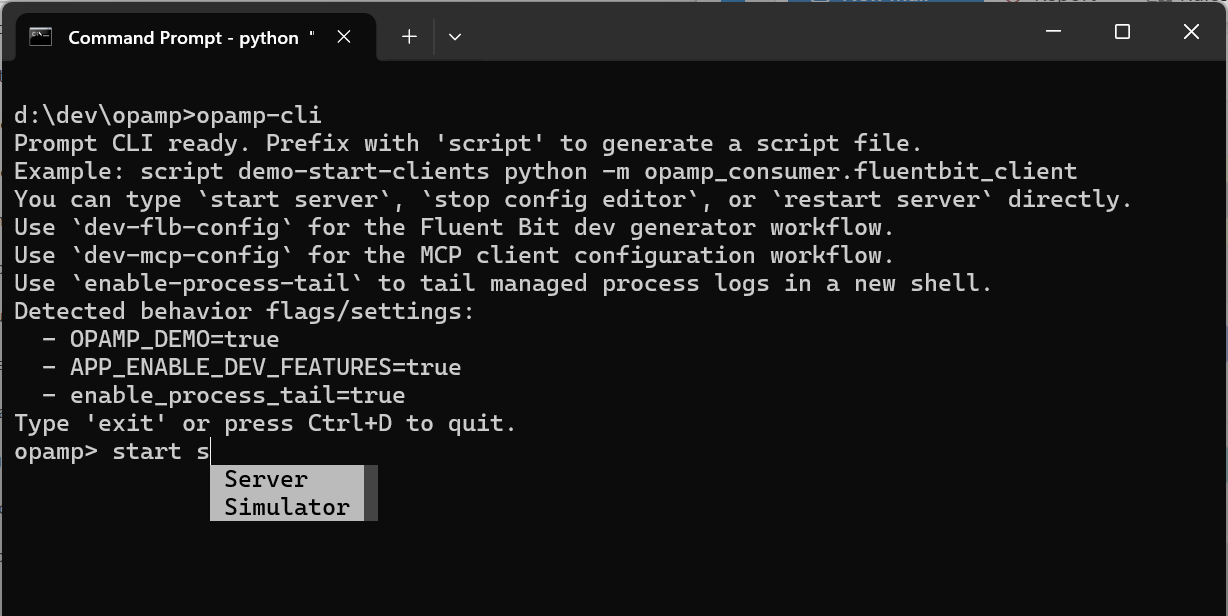
A Command Line tool maybe and odd choice of feature, but we found ourselves creating more and more scripts to support Windows and Bash shells with commonality. So we elected to leverage some frameworks to help reduce the ongoing effort required to maintain them. The utility can be used to generate the command, if you wanted embed the process of starting or stopping a process into the host OS.
Agent as Supervisor or observer
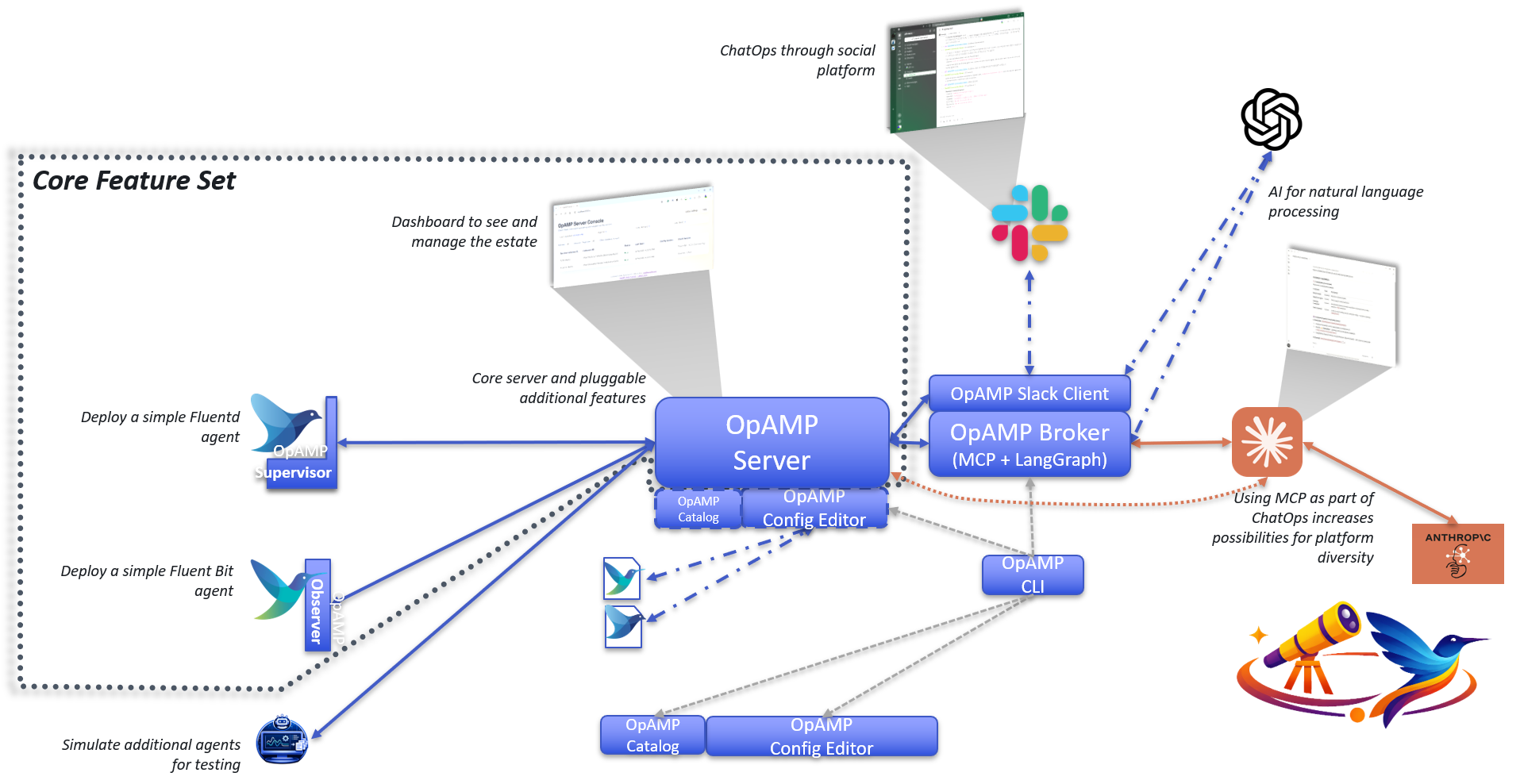
The OpAMP documentation suggests that the agent logic is embedded, or wrapped with a supervisor, with the inference that the agent forks the application process. This means that introducing the OpAMP would be invasive. There is a noninvasive variant of the Supervisor that we’ve called Observer. Here, the agent know how to identify the key process by examining the host’s processes. Then tasks such as restarting require an understanding of how to get the OS to trigger, for example, if the service is known to init.d in Linux, we can use the service command.
Architecture view
MCP and Slack for ChatOps
We’ve got the Slack foundations progressed, so we can use natural language VIA langgraph to then work with MCP, which exposes a subset of API capabilities. We’ve developed both the main server and the Broker to support the MCP endpoints, with the Broker acting as a proxy to the regular Server APIs. This means if we want the MCP to be usable from outside our network, then we can separate the Broker and Agent into separate networks so that the wider set of endpoints the server provides aren’t exposed.
But if you don’t want that the MCP endpoint can be switched on.
What next …
Config deployment
We have started to address the foundations of managing configuration deployment (for example, if our Catalogue Service is used with the Server, it can be used to select the configuration files to deploy.
Part of config deployment is understanding what is deployed, so we have developed some strategies for versioning Fluent Bit and Fluentd, and I think it will translate to other configuration files (at least into the Observability space).
What we haven’t done is fully implement the process. So we’ll focus on that
E2E Testing
There is a lot of functionality here now, including tests with Playwright, but we really need to extend it to provide end-to-end tests in a clean environment that is set up from the various pip and wheel files.
Deployment Artefact access
We also want to start making these artefacts easier to retrieve, such as pulling the Wheel or PIP files from GitHub or PyPi.
I’ve written a bit about AI in the development process; this has been driven largely by my own experiences, colleagues’ experiences, and blog content from people I trust. So I thought it would be worthwhile to validate my perspectives against those who are more in the know on the subject. So here is my review of the book Vibe Engineering by Tomasz Lelek and Artur Skowroński.
The book opens with a very clear differentiation between vibe coding and vibe engineering (which approximates to what I’ve previously called AI-assisted development). Not only are the key conceptual differences outlined, but the consequences of vibe coding into production are also really driven home …
teams that skip the transition from prototype to engineered artifact consistently report higher defect density, longer incident resolution, and faster architectural decay
The book also shares some real horror stories of blindly trusting LLMs, particularly in operational contexts.
The crucial challenges of vibe coding beyond ideation, PoC, and possibly MVP are brilliantly distilled. Code will do something, but is it right? Is it safe? Will it scale? Can we maintain it?
Tomasz and Artur outline a form of debt called trust debt. Where we have trusted the LLM, and it accumulates issues, particularly with NFRs that are not managed and paid down, it will seriously bite, just as tech debt does. The difference is that tech debt is more readily appreciated and generally easier to understand.
debt is a direct byproduct of the dump-and-review culture. This approach uses AI to generate a large slab of code, opens a pull request, and implicitly offloads responsibility for verification to the reviewer. It’s classic diffusion of responsibility: the presence of the AI (“the model wrote it”) and a reviewer (“someone will check it”) dilutes the author’s ownership of quality
Current approaches to this kind of development can very easily lead to the issues that Human-Machine Interface researchers talk about as automation complacency and the out-of-the-loop problem
The book also highlights interesting parallels, such as those in autonomous vehicle accidents. The consequences may not be as spectacular or as tragic (today), but they can be just as harmful, given that code affects every little aspect of our lives and the decisions we make. It is only a matter of time before it is influenced by vibed code. How long before pressure and a failure to comprehend vibe coding vs vibe engineering creeps into mission-critical development?
Once the consequences and challenges are called out, the book takes us on a journey to illustrate how to better approach vibe development, specifically through defining what a successful outcome should be. The brilliantly simple thing here is that the two approaches are demonstrated with multiple different LLMs using the same prompt.
While the book provides brilliantly illustrated proofs for how to better approach vibing (moving from coding to engineering), Tomasz and Artur point out that this alone is not enough; we need to lean into broader process improvements and leverage good engineering practices.
This first chapter then sets everything up that follows, taking on a journey of re-engineering a solution. Illustrating how to prompt to extract from an existing solution the details that can then be fed as prompts to generate a new solution.
The narrative progresses through considerations such as context compression, then leverages tools to enable the LLM to take on significant tasks, such as UI design, by giving it the information it needs to work out and create React components with a consistent look and feel.
The books reveal some really good ideas that allow things to be developed far more efficiently, for example, rather than expecting the LLM to scan through code, exposing the Language Server, which provides a lot of today’s IDE smarts, such as navigation through the call chain in an application. Exposing the LSP as an MCP tool offers the LLM an efficient and more reliable approach to analysing code.
If you want to follow along and test the points that the book makes, you’re not going to need to fork out masses on LLM tokens; the authors are very clear that the cost to repeat the exercises can be done within free/trial service tiers.
Conclusion
I don’t want to spoil your enjoyment of reading the book by revealing its secrets here. But there is a lot of great content, which means that, with some adjustments to how the LLM is prompted and some setup, it becomes possible to significantly reduce that trust debt.
If you’re heading down the road of vibe-based development, I would highly recommend digging into this book. We’re already making some further refinements to our processes. The changes needed to transition from vibe coding to vibe engineering won’t be shocking to those with a software engineering background. But their adoption is likely to pay back significantly.
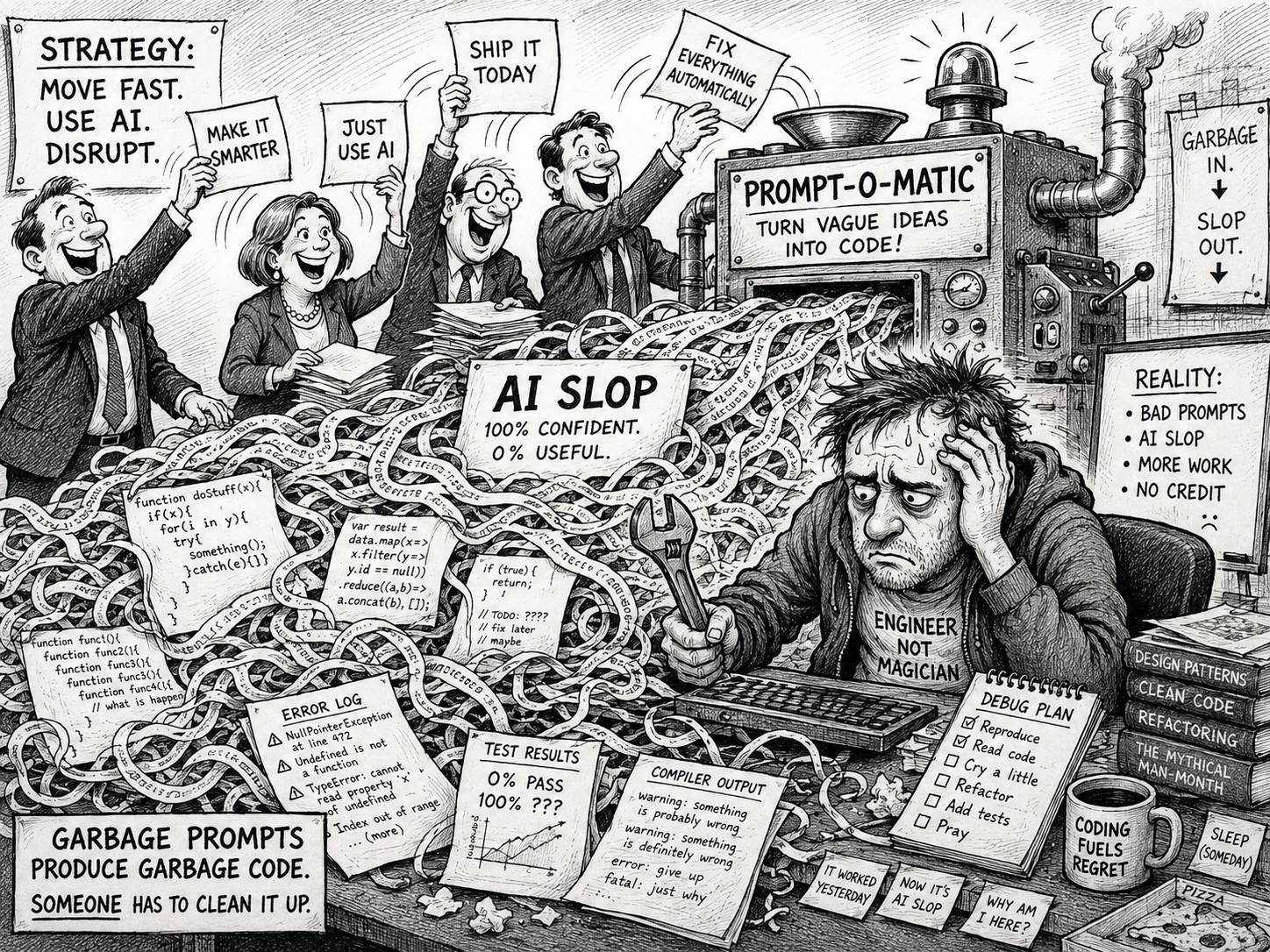
There are a lot of posts on various platforms about how AI is generating ‘slop’, and it is actually costing a lot of time to take what was generated and put it right. Cleaning up after AI is something people are even incorporating into their online biographies. On the other hand, others indicate they’re getting good results. So what is the reality? I think what we’re seeing is a combination of factors, but there is a healthy dose of human behaviour amplifying the issue.
There is no getting around how well a publicly available foundation AI can perform, depending on the availability of content for training. Providing simple Python logic, which has been asked for with clear precision and expressed clearly, is likely to yield positive results – that’s simply a function of the amount of accessible content on the web. If you asked an AI to generate formal method notations like Z or VDM – good luck.
But when we see what, on the surface, looks good, it is easy to be taken in and start to trust the LLM. Combine that with several other factors:
Humans, by our nature, will tend to minimise effort (or, if you want to be crass with language, lazy). You can see this through things like UX design principles that advocate avoiding ‘cognitive load‘ and ‘choice overload’ (the idea that we can only cope with so much information in working memory, going beyond that, we are more likely to make mistakes or need to apply more cognitive effort), through to George Kingsley Zipf’s Human Behavior and the Principle of Least Effort.
When we hand a task to an AI, the way LLMs work means that it will seek to provide an answer, rather than say sorry, can’t get an answer (if we did that, then the principle of least effort would explain why we’d give up with it). So we’re going to get a result, whereas the non-LLM route means we won’t see its incorrect until we’ve finished. When it comes to coding, the LLM is unlikely to make the coding errors we can make as humans, but the code it produces may not be as elegant or efficient, may not address all the edge cases, and may even miss the problem we want to solve. But the outcome will be executable.
Next issue is the quality of prompting: as humans, we have (generally) good long-term memory, and even if we forget specifics, we build a strong contextual understanding that we use. But the LLM doesn’t have this; it doesn’t know whether we’re trying an idea out or writing code that needs to be bombproof and extremely scalable. We have to define that very explicitly. If we’re working with a new or junior developer, we understand that we shouldn’t make these assumptions and will seek verbal and nonverbal feedback if there are issues with clarity or expectations.
When building things manually, each step we take to create the solution (whether that’s code or a PowerPoint) is slower, and we have more time to evaluate what we want to do, how we want to do it, and why we want to do things a particular way. In some respects, the LLM approach is like code reviewing. For a proper review, the reviewer is going to walk through each line of code and evaluate it – a process that can be lengthy. But under time pressure, what often happens is we’ll take a 1st fast pass to look for the ‘bad smells’ and pick up on any obvious issues. Then zero in on the bad smells, or at least the worst ones, and look more closely. But the time pressure, knowing the tooling we have to help eliminate issues, and the mental effort to quickly understand a lot of code take their toll. This, to varying degrees, is exactly what happens with LLM artefacts, except that the rate at which code can be properly reviewed is now a real issue relative to the rate of generation.
Commerce has always been about either innovating to compete or doing things more quickly and cheaply. That pressure has grown as technology has advanced, creating the potential to do more. As a result, it is not surprising to see that pressure results in code being generated, even if that is likely to drive an unwitting accumulation of technical debt that will bite in the years to come. Furthermore, recognising poor-quality code takes experience. Which means expensive engineers. It is possible to appreciate that a non-technical person can generate a basic desktop utility using ChatGPT.
As you can see, there are plenty of things we, as humans, can do to mitigate ‘AI slop’ and get AI delivering value, quality, and velocity.
Conclusion
The bottom line here is an issue of expectation. We wouldn’t be so harsh as to ask someone with dyscalculia to produce a company’s accounts using only a pencil and paper. Another way to look at it, you’d not ask an unqualified accountant to do your tax return. But that is often what is happening, Someone with dyscalculia could easily ‘hallucinate’ the numbers. An unqualified person is not going to know all the rules needed to complete a tax return well enough to minimise tax exposure.
to err is human; to persist in error is diabolical
Saint Augustine
It is human to make mistakes, and poorly directing (or training) an LLM is certainly an error. But we know this is possible, so we should consider what the code is for and take appropriate steps to mitigate it, working to improve how prompts are given and how context is provided to enable better outcomes.
What is clear to me is that ‘AI slop’ isn’t going away soon, and that as engineers, we have to get better at prompting to get the best code we can from an LLM. While it would be nice to think that the industry will realise that LLMs are not a panacea, and you still need those expensive engineers to prompt an LLM so that they don’t generate unnecessary reams of low-grade, brittle code.
The question really has to be, who is going to build an LLM model and agents that can pre-screen code and call out AI ‘slop’, saving code reviewers (particularly those who are looking after the open-source solutions on which so many of us depend). If Anthropic’s Mythos finds 20-year-old bugs, we should be able to help protect open-source projects from low-quality, poorly prompted AI-generated code.
Something that vendors like Microsoft have been really good at is reducing the friction on getting started – from simplifying installations with MSI files and defaulted options through to very informative error messages in Excel when you’ve got a function slightly wrong. Apple is another good example of this; while no two Android phones are the same, my experience is that setting up an iPhone is just so much easier than setting up an Android phone. It is also the setup/configuration where most friction comes from.
Open-Source Software (OSS), as a generalisation, tend to be a bit weaker at minimising friction – this comes from several factors:
When OSS is part of a business model, vendors can reduce that friction, making their enhanced version more attractive.
OSS contributors are typically focused on the core problem space and are usually close enough to the fine details to not need those fancy features to keep the rest of us out of trouble.
The expectation is that tools to make configuration easy are embedded in the application, making it heavier, when the aim is to keep things as light as possible.
Occasionally, a little bit of intellectual snobbery can creep in
The common challenge
The issue that I have observed is that we often go through cycles of working with a technology. For example, you’re building a microservice. Chances are, you’ll start writing and running it locally, without worrying about containerization. Once you’re pretty happy with things, you’ll Dockerize the service, start testing it locally, and then you’ll be ready to deploy it to a cluster. Now you’ll need your YAML. It may well be weeks since you last looked at Helm charts. You end up cutting and pasting your last configuration. But now you need to use another feature of Helm, can you remember the exact settings for the feature. So now you’re trawling the net for documentation, and then it takes several tries to get it right.
AI may well step in to help developers in this area, where solutions and products are well-documented. But with the wrong model or insufficient detail in the prompt, it’s easy to make a mistake. Personally, I’d turn to AI when it becomes necessary to trawl code to better understand the configuration and its behaviour, and to set options.
Experimental Solution
Solution – well, that depends upon the configuration syntax. We have been experimenting with RJSF (React JSON Schema Form), which provides a React-based UI that can be dynamically driven by a JSON schema and validate data with AJV (an alternative stack considered would have been around JSON Forms).
{
"type":"object",
"title":"Dummy",
"properties":{
"name":{
"type":"string",
"const":"dummy",
"title":"Plugin"
},
"copies":{
"type":"integer",
"description":"Number of messages to generate each time messages are generated.",
The above fragment shows part of the Schema definition for the Dummy plugin for Fluent Bit.
By then creating a schema that defines the different plugins, attributes, etc., we can drive validation and menu items easily in the UI. Admittedly, the config file is significant given all the plugins and configuration options, but it is a fair price to pay for a UI that validates the data. Establishing the schema to start with, we’ve covered it through scripting the retrieval and scraping of the Fluent Bit pages, which are pretty consistent in structure.
We have added some custom elements into the definition, for example, x-doc-reference, which allows us to extend the React components to provide features such as a link back to the original documentation as you select attributes or plugins.
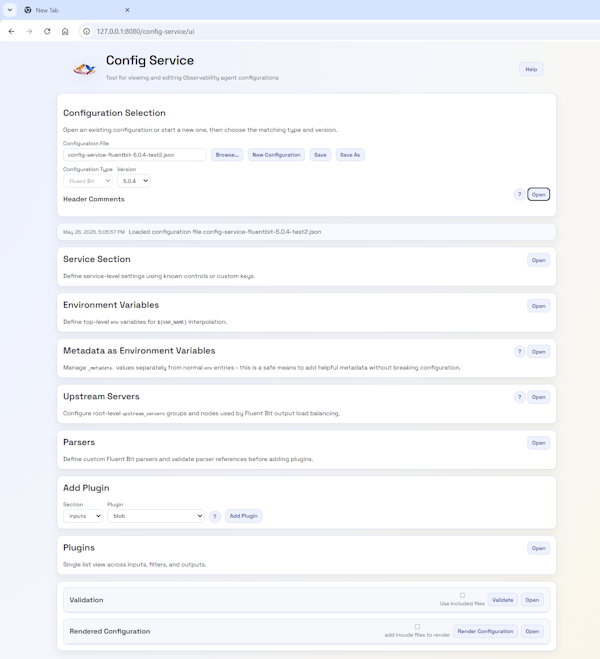
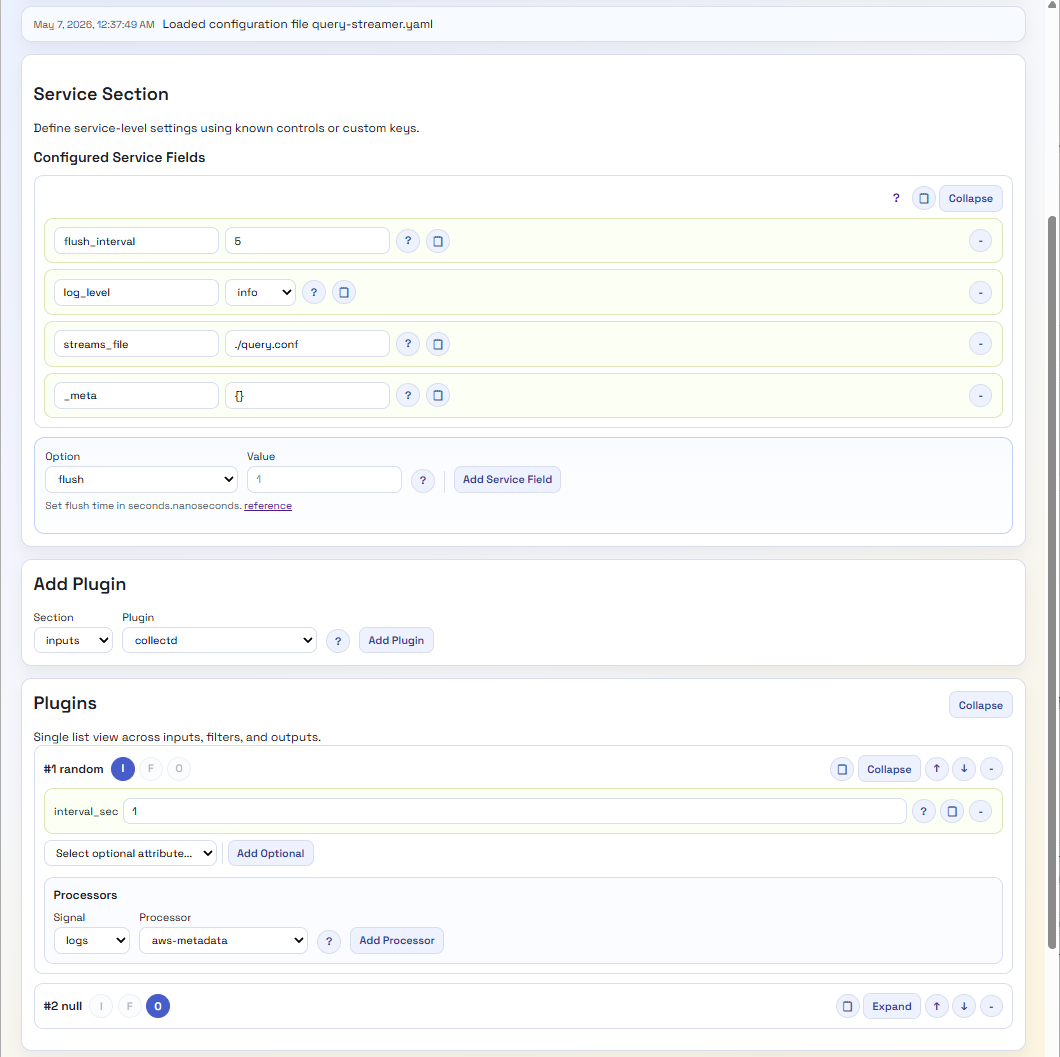
As a result, we very quickly have a UI that can look like this:
A lot easier to view and tweak, with no need to hunt for valid options. Even if we want more information, we’re just a button click away from the open-source data. Perhaps we should provide a version that hyperlinks to the Manning Live Books on Fluent Bit, etc.
There are a few other factors to consider; for example, Fluent Bit configuration is YAML, not JSON, which can be easily resolved given the relationship between the two standards. Then there are processors that can embed Lua code or a SQL-like syntax. As we’ve chosen to provide a Python backend, we’ve addressed this by providing REST endpoints which can query out of the JSON the code or SQL and perform validation using the Python Lua Parser, and the SQL syntax can be addressed using the Lark library for processing the SQL, as the syntax is simple enough to define and maintain the syntax.
Outstanding Gaps for Fluent Bit
We still need to address several features that Fluent Bit has, specifically:
Environment variables
Includes
These issues should be straightforward to overcome, although dynamically including the included elements into the UI view elements can be done. The challenge is: if any changes need to go into something that has been included, how do we push them back to the included file? Particularly if there are multiple layers of inclusion.
What about Fluentd?
Fluentd configuration isn’t JSON-based notation, but it is structured. So, to apply the same mechanism, we’ll need to define a schema and a mapping mechanism. The tricky part of the schema is that Fluentd supports nesting plugins, since the way pipelines are defined for routing differs. While JSON schema will enable this with constructs such as anyOf, oneOf, object nesting, and bounded object arrays, the structure will be more complex.
The second challenge will be the transformer/renderer, so we don’t introduce issues from having to escape and unescape characters, since JSON Schema is stricter about character use.
Then What?
Well, if we get this going, we’ll probably incorporate the capability into our OpAMP project and maybe create a build that lets the configuration tool run independently. Lastly, perhaps we should look to see if we can make the different layers a little more abstract, so we can plug in editors for other configurations, such as OTel Collectors or the ELK Stack.
As a bonus, perhaps transform the Schema into a quick reference web document?
As a Manning author, I am fortunate to see the books in their MEAP (early-release state). If you have a Manning online subscription or have already ordered a copy, you’ll have this privilege as well.
I’ve been reading the MEAP copy of Enterprise RAG by Tyler Suard. At the point of writing, there are still 4 more chapters to come. But, of the first 6 chapters, I have to say, I’ve been impressed. With an open, conversational writing style, it makes for an engaging read (I may be biased here, as this is the writing style I prefer).
The book also challenges assumptions and preconceptions about what RAG needs to be. This starts with differentiation between how RAG is typically described and the needs of an enterprise-grade implementation.
While the book leans into Microsoft Azure to illustrate the development of an enterprise-class solution, much of what has been demonstrated could be implemented with any cloud vendor, and if you’re prepared to put in the effort, then completely open-source.
My recommendation: unless you already have business-wide RAG solutions that are well adopted in production, this book is worth taking a look at. Even for the more knowledgeable/experienced, there are some nicely teased out nuggets of insight.
RAG vs Enterprise RAG?
Within the first couple of pages, Tyler addresses the immediate question of what distinguishes Enterprise RAG from a normal RAG. Here, the issue is elegantly laid out in the classic challenge in engineering books: do you focus on the technical functions and ideas, or on the broader challenges of using these technologies? The key here is to separate Enterprise RAG and what Tyler refers to as Naive RAG. He is tackling the difference between the basic technical mechanics of RAG and how to make RAG work at scale within enterprises, as well as the risks, challenges, and benefits of doing so. This is not to say that one approach or another is right or wrong.
In many respects, as you read through, you want to say, ‘duh, that’s obvious‘, and it is once called out. But so many AI-related projects don’t succeed because we overlook these ‘obvious’ things. AI interaction is often embodied in free text interactions, so we can’t configure the UI into showing English, Spanish, French … UI elements- but not everyone has the same native language as the developers, so we forget to allow for this. This is just one of the multitude of things that get called out.
Walking through the chapters
After setting the scene, the book’s chapters are structured to follow the development process, starting with the AI equivalent of test-driven development (TDD) for Chapter 2. The ‘evals’, the evaluation of defined questions and expected results, and how this can be done given LLMs’ non-deterministic outcomes. This, of course, gives us a framework against which we can validate the RAG and prompting process.
Chapter 3 focuses on preparing the data so it can be retrieved and fed to the LLM to answer the question; here, Tyler challenges the working assumption that the data must come from a vector database. The argument made is that for the most effective RAG process, the most effective (relevant and accurate) data is needed; how the data is obtained is secondary to the effectiveness of the data. A vector database may be the right way to source data, but don’t get locked into that thinking. Having made this point, the book does adopt Azure AI Search, which combines vector search with other techniques to deliver the best results (such as using semantic, keyword and ranking techniques). In open source terms, this is like creating a hybridisation of OpenSearch and Vector search.
Chapter 4 takes us into the data retrieval logic and prompt augmentation, now that we have searchable data. This focuses on the use of the Autogen open source framework (sponsored by Microsoft). In many respects, this is the key chapter in terms of logic, as it shows how the framework is used, with multiple agents working in a swarm.
Chapter 5 moves into the non-functional considerations of deployment and scaling, and ensuring that the solution will work under pressure. Such considerations are as important to an enterprise-scale use case as the functional behaviour. While the chapter covers approaches to automation and testing, I was hoping for more. The approaches described are good for getting things moving, but there are enterprise strategy considerations that could at least be called out, such as PII and more advanced credential management. The last point, which I think is a more significant gap, is Observability; the book talks only of logging. No mention of tracing, the measuring of token consumption, etc.
Chapter 6, the last one currently available, is definitely back on track, addressing one of the key considerations: how do we set and manage user expectations? Is my solution addressing expectations? How well is the solution performing? With conventional apps, the very UI layout and labels, as well as menus, help set expectations. If a search doesn’t give you a means to filter by an attribute, you know the result will include things with values for that attribute that aren’t relevant. But AI use cases are typically textual conversations, with no visual cues indicating the limits of an interaction. There are products that can be integrated into web apps that make it easy to track and measure user actions. But with a simple chat panel, that won’t yield much insight. This means we should provide the means to indicate satisfaction (or lack of, and why). This is what the chapter goes into, illustrating how you could shape expectations,
There are some areas I’d like to see addressed, but it is possible, and based on the chapter titles, they will likely be addressed.
an informal noun referring to the mood, atmosphere, or aura produced by a particular person, thing, or place that is sensed or felt
This is deeply at odds with the idea of software engineering, where the OED describes engineering as:
the activity of applying scientific and mathematical knowledge to the design, building, and control of structures, machines, systems, and processes
While there is a place for vibing – to explore and help test ideas, when it comes to enterprise solutions with icy, typically have large footprints, or will grow to have large footprints and high data volumes, therefore need a more disciplined approach to ensure all those non-functional considerations can be addressed, and sustained. Put it another way, would you take an artesian approach to building and maintaining a petrochemical refinery?
This is why I try to separate the idea of vibe coding from a more disciplined AI-assisted development. A name that doesn’t roll off the tongue well, but conveys the idea that the engineer is in control and can impose discipline to drive the NFRs.
Hopefully, this also helps address nuance, which is often missing in discussions about the use of AI in software engineering, which is definitely polarising viewpoints (like many things today).
Spec-driven development
Spec Driven Development (SDD) is a growing topic in the A.I. assisted development space, and growing as a reflection of the fact that LLMs are improving rapidly, best illustrated at the moment with Mythos. The basis of SDD is to help drive consistency, structure, sustainability and rigour into the AI dev process (back to vibe coding). Consistency and structure allow us to start to easily agentify or tool aspects of development.
Getting a consistent, clear explanation of what constitutes SDD isn’t necessarily straightforward, but the best definition is in an article by Birgitta Böckeler on Martin Fowler’s website. The article dives into not just a basic explanation, but also characterises the differing approaches. The article teased out three versions of the idea, which paraphrasing are:
Spec First – very much like the old-fashioned, here are the requirements that are used to generate a first iteration of the code base. Then subsequent refinements, improvements and general evolution are introduced through successive direct code changes, and/or direct prompting of the LLM to modify different pieces, and add functionality.
Spec Anchored – the Spec is retained for ongoing reference and maintained.
Spec as Source – we don’t really care bout the code, we want a change, we only edit the spec. Code is almost a form of conversation memory, which prevents the LLM from recreating from scratch and producing an answer that looks a bit different, potentially resulting in API names that differ, etc.
This evolution, particularly as people move or are pushed by leadership fearing losing a competitive edge through perceived lower development velocity, increasingly towards a spec-only approach, left me thinking about the agile manifesto and its declaration:
‘we value working code over documentation‘.
While this still has to be true, as ultimately, working code delivers the value. But the heading for the documentation has to be clear, concise, and sized for LLMs’ working documentation, as that is how we get to working code. This isn’t just to bash out some instructions and unleash the LLM; it does need to be refined and iterated on (in many ways, just like a book). We should prompt the LLM to seek clarification rather than let it make assumptions. Furthermore, we need the documentation to be accurate because an LLM will exhibit childlike trust, and if it is working with misaligned content, you’re in a 50/50 position. Unleashing an LLM on your codebase may lead to the wrong outcome. Perhaps, we need to extend the Agile manifesto, with a statement like:
we value correct, accurate, clear and concise documentation over any documentation
In other words, when using an LLM in your development context, it is better to get the LLM to reverse engineer the code to create documentation of your current state (even if that is at the price of losing the original context, design ideals, requirements, etc.) than to allow the LLM to see inaccurate and poor documentation. If this new principle is true, then we need to move away from Spec first to atleast Spec anchored approach.
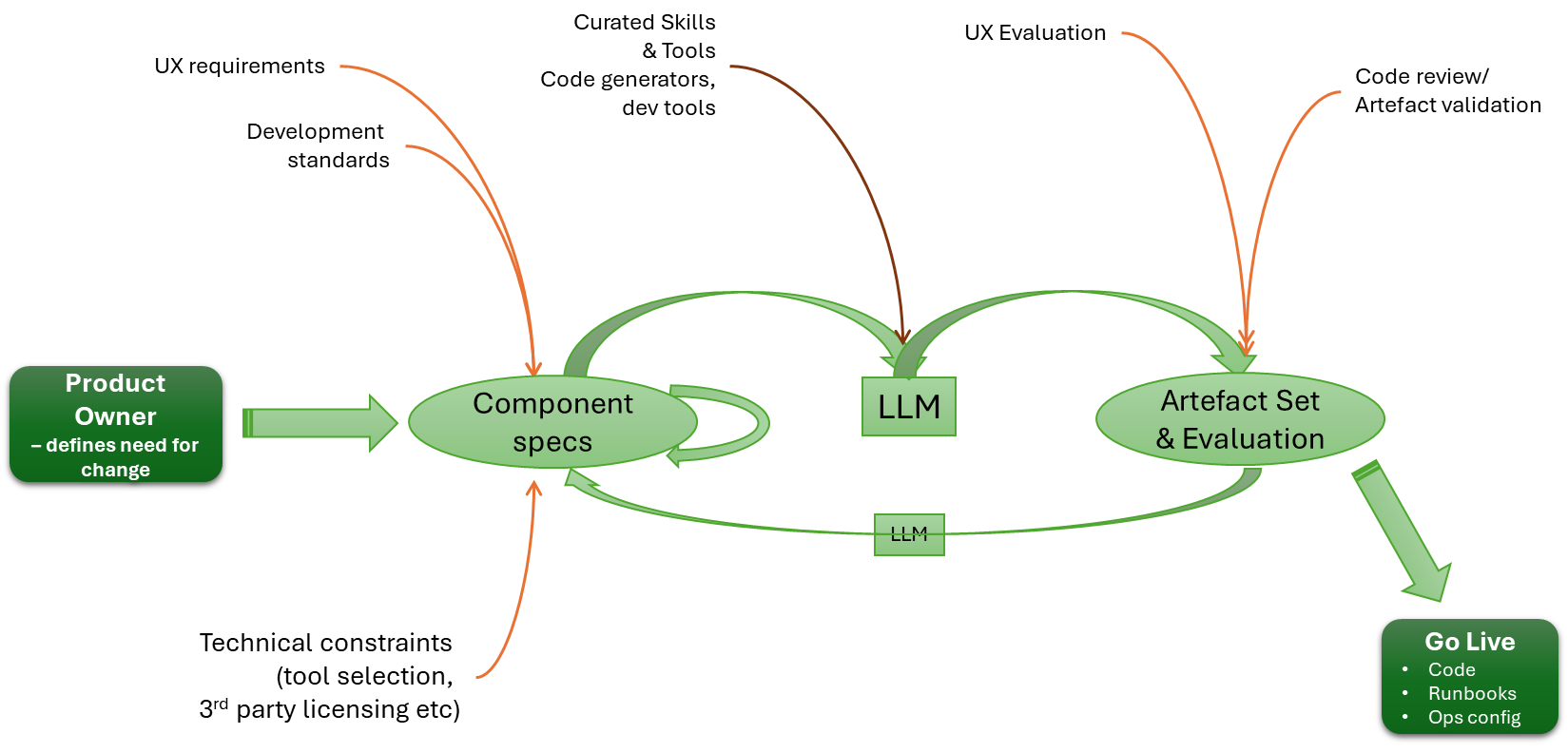
Given this, we should see the heart of an engineering process looking something like:
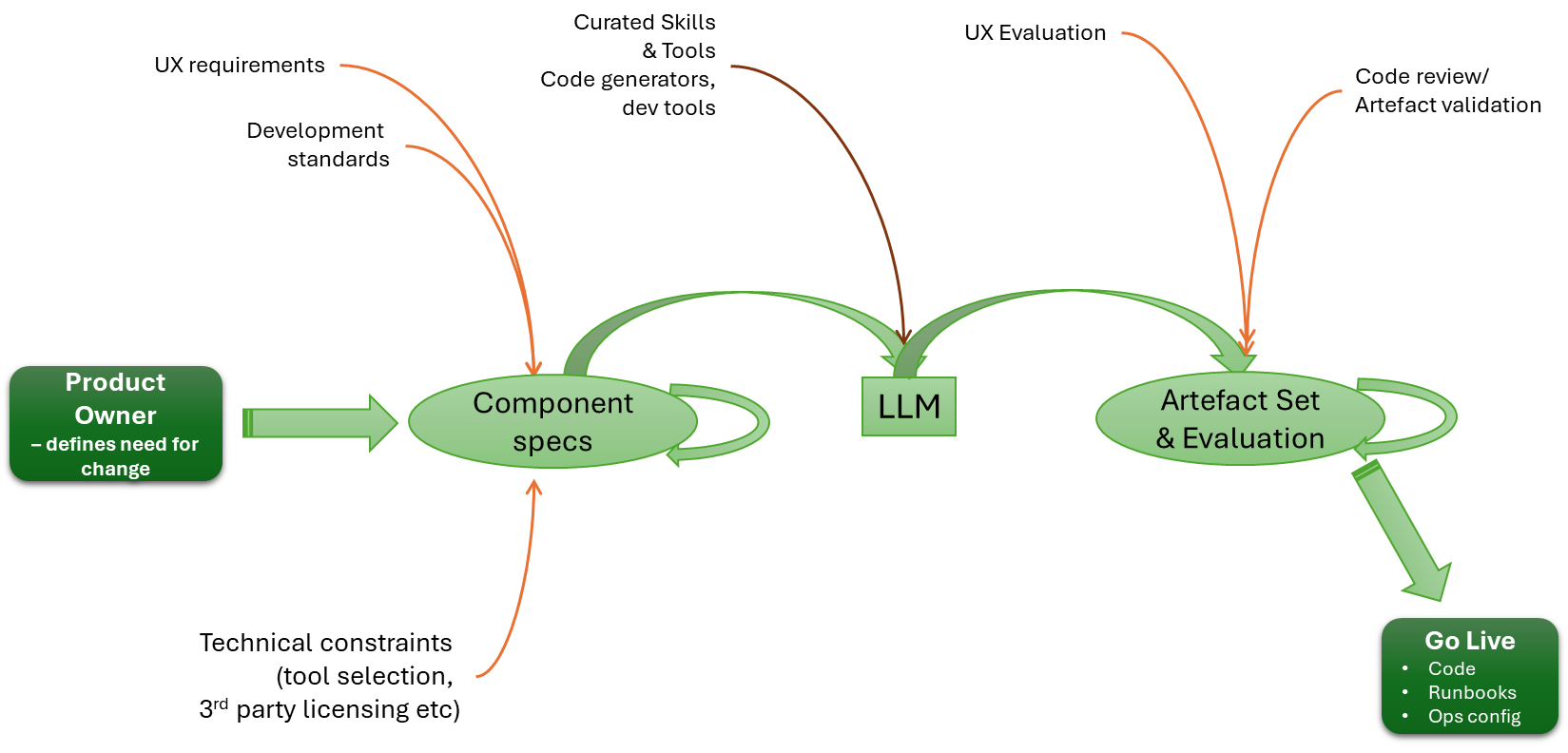
This is what we should expect with a Spec Anchored or Spec as Source. Whereas with Spec First, the return flow will never happen.With Spec First, our process is more like this: once the code for the first iteration is generated, we just iterate on it.
I think one of the challenges with the view of everything is that, as the Spec lead, there is an expectation that, to do it, we go from a very high-level definition straight to code. The reality is that we need the process to be more human-like. We use the LLM to take requirements and drive a high-level design. We then use the LLM to break the HLD into multiple LLDs. Importantly, we iterate on the process, until the decomposition of detail is right. The LLM cycle focuses on just one output at a time. We can certainly then use the LLM to determine consistency and integrity across all the LLDs.
From Requirements to Architectural Views
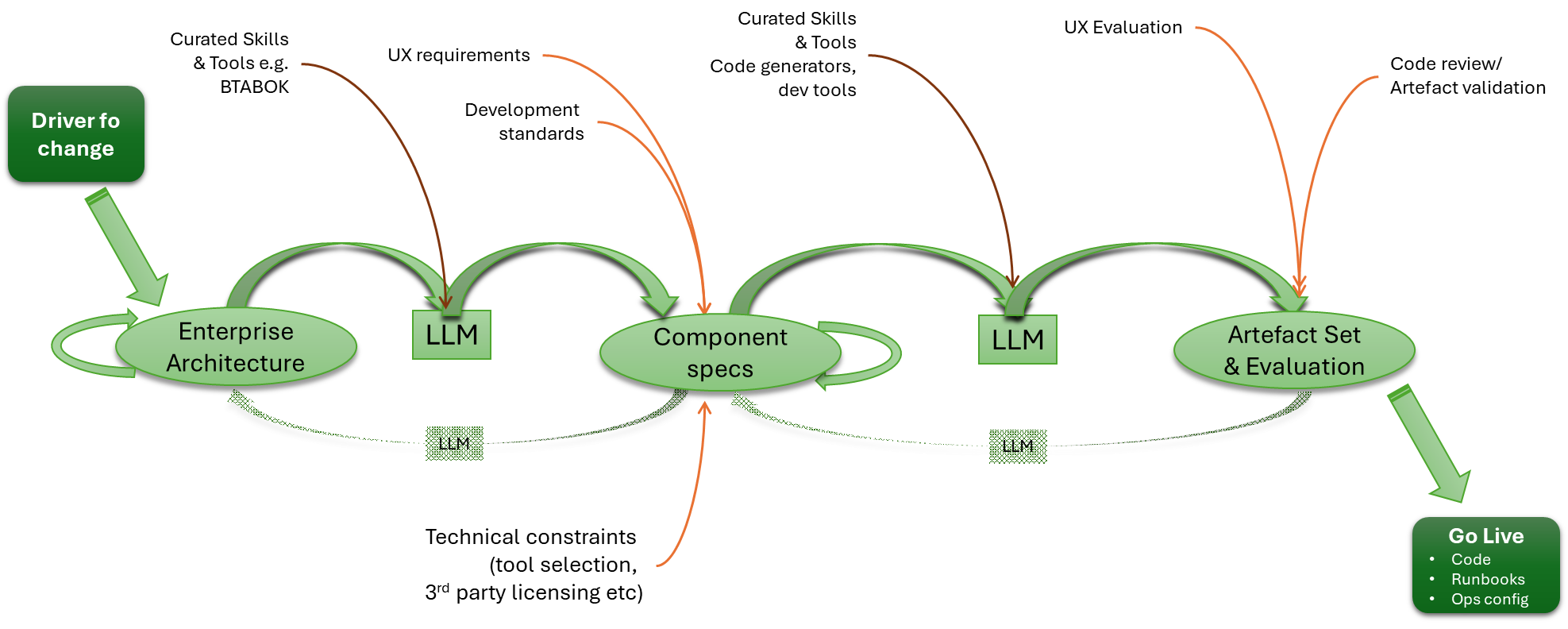
There is a natural extension to this. If we are to swing back to a document-led approach (albeit with a very different journey from document to working code), could we see increased adoption of TOGAF and other architectural frameworks? Many in the past have used such frameworks as part of the argument as to why things should be code first, as often the framework artefacts are seen as the end, rather than the process and techniques as a means to an end (i.e. we do architecture, therefore I must create a large document set, rather than we do architecture to ensure we get the details we need from code correct).
Certainly, using an LLM to help with the creation and maintenance of architectural views, including making it easier to search for and address inconsistencies across different viewpoints, without necessarily needing very prescriptive, complex, and expensive toolsets.
The document flow if we start with architectural frameworks, from Zachman, TOGAF, C4 etc. Note the return flow needed for Spec Anchored or Spec as Source is rarely happens.
A step in this direction may well be projects such as Common Architecture Language Model (CALM), which is supported by the Fintech Open Source Foundation (FINOS), a child organisation of the Linux Foundation. While I haven’t investigated CALM very deeply, the essence is to define the architectural building blocks in a structured manner, which means that, from the definitions, more detailed diagrams can be generated and AI can be used to analyse the artefacts, etc. This sounds like a potential stepping stone between the organisation/enterprise models of Zachman and TOGAF, which aim to describe how both businesses operate and the underlying technology.
Could we see a time when docs and code stay aligned?
My experience has shown that when a spec has been involved in the process, it has exhibited the characteristics of the Spec First approach, and that the most consistently accurate documents are the user manuals, purely because they have to be created from what the code does. But such documents aren’t meant to tell you about the inner workings of a solution. This is true to the point that organisations have abandoned their architectural models, as they can’t be trusted as an as-is reflection and must start from scratch.
But to achieve the value of Spec Anchored or Spec as Source, we have to ensure that the feedback loop is working: the LLM feeds a backup stream with any changes, and downstream inputs, such as the impact of tool selection, can shift the solution. While the feedback loop should be a lot easier, it still requires commitment and effort to ensure that flow happens (certainly, since it is typically not a regularly practised behaviour).
Flies in the ointment
Trying to drive even a Spec Anchored philosophy is going to be difficult if the LLMs aren’t so great at generating quality code, or quality low-level designs that lead to the code generation. These factors are going to be dependent on choice of LLM being used, how the LLM is prompted, and most crucially the target programming languages (A.I. Codex does well with Python and Java, but I doubt it would make a good job of something like Erlang or Lisp).
The second problem is that there is a common error of people wanting to jump in and cut code (or documents), which often comes from:
Rather than stopping to ask the question, has this problem been solved before, and in a way I can leverage? We plough on creating new unproven code.
The view that the only place where a solution can come from is within the engineering team.
While it will be easy to blame the LLM for problems coming from these actions, are very much human.
Conclusion
As we’ve worked through much of this picture, the irony is that, in many respects, we’re no further forward. We can still make the same mistakes (failing to work through the NFRs properly, failing to define what should happen when something is wrong – aka ‘unhappy paths’, which make recovery simpler). We just have coding and document writing speed shift from 30-40Hz (the speed of a keyboard warrior) to GHz. The same problems can occur because influential decisions are still human (and remember, LLMs are, at their heart, just a computational representation of common thinking (wisdom of crowds, you might say) and therefore still vulnerable).
Going faster means mistakes happen more quickly, and uncorrected mistakes create more mess. To use an analogy, if you crash a car into a wall at 10mph, you’ll damage the bodywork, but it won’t be catastrophic. For many men, the biggest damage will be to the ego. You have the same crash at 100mph, and the outcome will be fatal. While the ability (or lack of) to absorb the energy is what will be the killer, it is actually the fact that you no longer have the time to think and change direction that is the true cause.
Perhaps what we should be seeking from AI is not to get to the end faster, but to use the acceleration to create time to consider what it is we want to achieve and how we continue building on our long-term, more sustainable achievements. This isn’t anti-agile. But it is anti ‘fail fast, fail frequently’ which has been a conflation of ideas without full understanding, and becoming more regularly challenged (like this Forbes Article)
The software industry’s current upheavals due to AI are showing signs of unexpected and unintended victims, one of which is open-source software. Open-source foundations run very deep, from Linux to web and app servers, and even to key cryptography technologies.
While there are commercially funded open source efforts, such as chunks of Kubernetes, depending upon which reports you look at, 10-30% of the effort comes from individuals providing their own personal time for free. But we’re seeing a number of threats growing on this…
The number of maintainers is small on some projects. A really good example of this is the Nginx Ingress controller for Kubernetes, which is now no longer being maintained, not because it isn’t needed, but because no one was willing to step up to the plate with their own time or provide salaried engineers. This has triggered something of an outcry (see here, for example).
As this article Microsoft execs warn agentic AI is hollowing out the junior developer pipeline shows, AI-assisted development risks harming the flow of development skills. The issue is that if all junior engineers primarily rely on AI to code and test functionality, the hard-earned experience that teaches you what is good, bad, and where the pitfalls are, they will not gain. Meaning, the skills needed to understand and maintain very large codebases won’t be as strong.
GitHub has argued (here) that AI in development has made it easier for people to get involved and contribute to open-source initiatives, and I’d agree it makers it easier. The challenge, I think, is less an issue of ease than of mindset. I would argue that it is the motivation to contribute and the satisfaction of having contributed that drives open-source contributions, but this is at risk of being undermined (papers such as On Developers’ Personality in Large-scale Distributed Projects indicate open-source contributors tend towards a personality profile, which maybe more suspectable to issues that can lead them to disengage (Connection Between Burnout and Personality Types in Software Developers). While not concrete, overload OSS contributors, and they’re more likely to disengage from contributing.
AI slop, as a result of using a poor coding model, or poor prompting, is showing us that, unwittingly (or through deliberate maliciousness we are seeing pull requests that are buggy, or junk being created at ever faster rates. This puts more work on the core developers to just manage PRs, as described in AI is burning out the people who keep open source alive (another such article at CNCF – Sustaining open source in the age of generative AI). Not to mention even worse actions, such as that described in An AI Agent Published a Hit Piece on Me. This sort of thing will affect people’s willingness to be involved, even when their time is being paid for by a company. This concern is such that InfoWorld reported GitHub are considering the ability to restrict PR velocity (see here).
Another side effect, with the ‘AI arms war’, increases pressure within organisations to adapt, or accelerate as a result of AI expectations. Those donating personal time are less likely to find time to support open-source initiatives, as their focus will be very much on staying secure in their day jobs.
There is no single or simple solution. But that doesn’t mean there aren’t things we can do to help. Some immediate possibilities include:
better messaging about what makes up and propels open-source initiatives beyond commercial contributions. This can help counter the perception that organisations like the CNCF appear to be leaning into large commercial organisations and following open-source business models. But that isn’t the case, and even in the commercial setup, the teams aren’t necessarily that large.
I’m not an advocate of the dual licensing model, as it can create uncertainty in user communities and potential adopters of technologies. This uncertainty can drive disruptive changes; we’ve seen this with OpenSearch and ElasticSearch, OpenELA fork of Linux, among others. It can also hamper early-stage startups. But we can do something: a low-cost entry into CNCF that can help finance the not-for-profit development setups. Use the PR process to help collect metrics and recognise organisations that contribute even a little through PRs, biasing that recognition toward projects with limited support. Not to mention recognising contributors and committers individually (just as CNCF and Linux Foundation provide recognition to conference speakers).
Companies employing early years engineers should implement initiatives that require some development work to be performed without AI assistance and use performance tooling. Yes, this means a short-term drop in productivity, but one thing my years in the industry and training have taught me is that understanding how things work under the hood makes it easier to address problems and recognise ‘bad smells’. Understanding this, helps understand how solutions can scale.
Perhaps University courses could consider awarding credits to students who support important open-source projects, or allow a level of contribution to count toward coursework. This sort of thing would also open up the open-source world a lot more. I, for one, would give credit to a graduate who has contributed to a reputable open-source initiative.
There is on thing I am certain of, though, it is the leadership and sponsors of organisations such as CNCF, Linux Foundation, Apache, Open Source Initiative that can influence the situation the most, and it is in everyone’s interest that when open-source components have to be folded that there is atleast an easier off-ramp, than the 6 months given to switch from using something like NGINX Ingress Controller.
Time to share a short update on our OpAMP project to support Fluent Bit and Fluentd in a supervisor model. We’ve just put a V0.3 label on the GitHub repo (https://github.com/mp3monster/fluent-opamp). The trigger for this has been the refactoring so that the framework on the client side is as reusable as possible for both Fluentd and Fluent Bit (the benefit of implementing Opamp using a supervisor model)
As OpAMP defines what happens between the Client and Server rather than how the client, server and agent must behave as well as the protocol we’ve introduced some features not mandated by the standard but can be delivered using the OpAMP framework. Such as shutting the agent down completely.
The following sections summarize what has recently been incorporated.
What’s New in Our OpAMP Supervisor Stack
Over the last set of releases, we focused on three areas that matter in day-to-day operations:
Better multi-agent support through a cleaner client architecture for both Fluent Bit and Fluentd.
Optional bearer-token authentication that can be enabled in production and disabled for fast local development and tests.
Clear, predictable rules for when a client sends a full state refresh back to the server.
This post is a walkthrough of what changed and why.
Client Architecture Refactor: Fluent Bit and Fluentd as First-Class Implementations
We restructured the consumer so Fluent Bit and Fluentd are now explicit concrete implementations built on a shared abstract client.
Why this matters
Before this work, behavior could drift toward Fluent Bit defaults in places where Fluentd needed different handling. The new structure makes those differences deliberate and visible.
What we changed
Shared logic is centralised in a typical abstract client and reusable mixins.
Fluent Bit remains the default implementation with shared runtime behaviour.
Fluentd overriding functionality for Fluentd-specific behaviour, including:
monitor agent config parsing from fluentd.conf/YAML
monitor agent endpoint usage for version and health
Fluentd-specific health parsing and service type handling
Operational improvements
We’ve created scripts to make it easy to get things started quickly. The startup scripts were standardized:
scripts/run_fluentbit_supervisor.sh|cmd
scripts/run_fluentd_supervisor.sh|cmd
scripts/run_all_supervisors.sh|cmd
Optional Bearer-Token Authentication (With a Fast Disable Switch)
We added optional bearer-token auth for the UI and MCP end points in the server. The OPAMP spec points to different authentication strategies that need to be addressed. For bearer-token-managed endpoints (where you can direct the server to do things that are potentially much more harmful), the design goal is to keep development and unit testing simple, so we have some controllable modes..
Modes
Authentication is controlled by environment variables:
disabled (default): no auth checks.
static: bearer token checked against a configured shared token.
jwt: JWT bearer validation via JWKS (for example with Keycloak).
Why this model works
Production can enforce auth with static or JWT validation.
Local development and endpoint unit tests can run with auth disabled, avoiding unnecessary test harness complexity.
The same app can move between dev/staging/prod by environment configuration, without code changes.
Protected endpoints
Protection is prefix-based (for example /tool, /sse, /messages, /mcp) and configurable.
This means teams can gradually expand the scope of protection over time by updating path prefixes, rather than doing an all-or-nothing rollout.
Auth observability
Authorisation rejections are logged with mode, method, path, source, and reason, making failed requests easier to troubleshoot.
Full-State Refresh Rules: More Predictable and Easier to Reason About
A major part of OpAMP behavior is deciding when to send compact updates versus a fuller state snapshot. We now fully observe the approach defined by OpAMP, but also have explicit controller-driven rules to provide robustness to the solution.
Core mechanism
The client tracks reporting flags for optional outbound sections, such as:
agent_description
capabilities
custom_capabilities
health
If a flag is set, that section is included on send. After inclusion, the flag resets. Controllers determine when those flags are re-enabled for a future full refresh.
Controller strategies
We support three controller types:
AlwaysSendre-enable all report flags after each successful send.
SentCount: re-enable all report flags after N successful sends (fullResendAfter).
TimeSend: re-enable all report flags after a configured elapsed interval.
Important behaviour detail
Controller updates happen after a successful send. This means a controller schedules what the next message should include; it does not mutate the already-transmitted message.
Server-driven override
If the server sets ReportFullState in ServerToAgent.flags, the client immediately re-enables all reporting flags so the next outbound message contains full reportable state.
This gives operators a direct way to request state re-synchronization when needed.
Security + Developer Experience Balance
A recurring theme in this work was avoiding “security vs usability” tradeoffs:
Auth can be strict in production.
Auth can be disabled in local/test workflows.
Endpoint protection scope is configurable and incremental.
Rejection logging is explicit for troubleshooting.
That same principle guided client behavior:
Shared behavior is centralized.
Agent-specific behavior is explicit where required.
Full refresh rules are deterministic and configurable.
What This Enables Next
This foundation makes the next iterations easier:
extending JWT/IdP deployment patterns (for example, broader Keycloak automation)
adding more agent variants with fewer regressions
improving configuration and rollout safety for mixed Fluent Bit + Fluentd estates
If you’re running both Fluent Bit and Fluentd, this release should make the platform easier to operate, easier to secure, and easier to reason about under change.
There’s a growing narrative that Agentic AI and “vibe coding” (AI-assisted development is probably a better term) signal the end of SaaS, what some are calling ‘SaaS-pocalyse‘, as reflected by share price drops with some SaaS vendors.
The reality is more nuanced. SaaS vendors are being pulled in multiple directions:
Pressure to invest heavily in AI to accelerate productivity and efficiency
Fear of disruption from AI-native startups
Uncertainty over whether AI is a bubble
Broader economic caution from customers, given the wider economic disruption
Net result: share prices have been dropping rapidly. But importantly, this doesn’t necessarily reflect a collapse in demand—particularly among larger vendors. As Jakob Nielsen has suggested, what we’re more likely to see is commodification (see here) not collapse.
Jakob also pointed out AI is really disrupting approaches to UX, both in how users might approach apps and how user experience is designed.
So what happens to SaaS?
There are a few things emerging I believe …
Vendors incorporating AI into products as they drive to provide more clear value than vibe coding/home brewing your own solution. A route that Oracle have been taking with the Fusion SaaS products.
Emphasis on mechanisms to make it easier for customers to add their differentiators to the core product.
Some vendors are likely to retrench into pure data-platform thinking. But a lot of businesses don’t buy platforms (a platform buy is an act of faith that it can enable you to address a problem); many want to buy a solution to a problem, not a platform, and another 6 months of not knowing if there will be a fix.
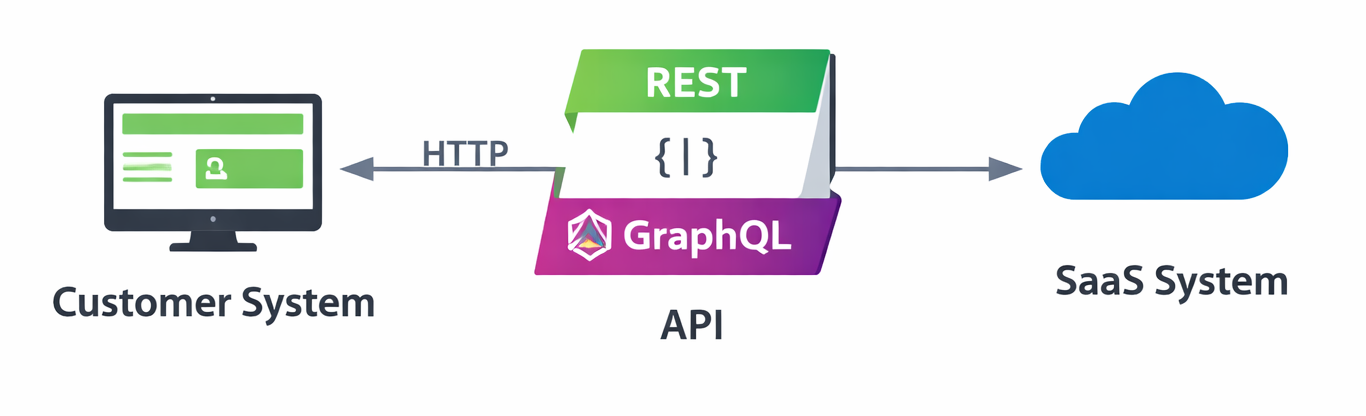
So what does this mean for APIs?
Well, APIs are becoming ever more important, but in one of several ways:
Classic API value
Having good APIs with all the support resources will make it easier to bolt on customer differentiators, as a good API (not just well coded) from design to documentation, SDKs, etc., will mean that it will be easier for AI to vibe code, or to use it agentically through MCP, etc.
You’ll need the APIs even more, since they are the means by which you protect data, IP, and/or your data moat, as some have described it.
The other approach, if people retrench SaaS to a more Platform approach, is the risk of just exposing the underlying database. If you’ve worked with an organisation that has an old-school ERP (for example, E-Business Suite) where you’re allowed legitimate access to the schema, you will probably have seen one or more of the following problems:
Unable to upgrade because the upgrade changes the underlying schema, which might break an extension
There are so many extensions that trying to prove that nothing will be harmed by an upgrade is a monumental job of testing – not only on a functional level, but also performance etc. what we have also seen as once people are on this slippery slope, the fear to stop and change tack is too much, often too politically challenging, to hard to make the ROI case.
Feature velocity on the solution slows down because the vendor has to be very careful to ensure changes are unlikely to break a deployment. Completely undermining the SaaS value proposition.
Bottom line, these issues all revolve around the fact that, because someone is using an application schema directly, there is an impediment to change (a few examples are here). As an aside, vendors like Oracle have long provided guidance on tailoring products such as CEMLIs.
There is an argument that some may make here, that making your extensions agentic will solve that, but there are flaws to that argument we’ll come back to.
APIs to ensure data replication
The alternative approach is to provide data replication, batches if you’re old school or streaming for those who want almost immediate data to match data states. In doing so, the SaaS solution now has the freedom (within certain limits) to change its data model. We just have to ensure we can continue to meet the replication contract. This is what Fusion Data Intelligence does, and internally, there are documents that Oracle Fusion applications must adhere to. While this documentation is not a conventional API, it has all the relevant characteristics.
Using APIs for data replication doesn’t always register with people. Which is probably why, despite the popularity of technologies like Kafka, Asynchronous APIs don’t have the impact of the Open API Spec. But the transition of data from one structure to a structure that clients can access and depend upon, not to change, is still a contract.
In the world of Oracle, we would do this using a tool such as GoldenGate (Debezium is an example of an open-source product). Not only are we sharing the data, but we’re also not exposing data that might represent or illustrate how unique IP is achieved, or that is very volatile as a result of ongoing feature development.
There be dragons
Let’s step back for a moment and look at the big picture that is driving things. We want the use of AI and LLMs as they give us speed because we’re able to do things with a greater level of inherent flexibility and speed. That speed essentially comes from entrusting the LLM with the execution details, which means accepting non-determinism as the LLM may not apply the same sequence of steps every time the request is made. At the same time, any system (and particularly software) is only of help if it yields predictable in outcomes. We expect (and have been conditioned) to see consistency, if I give this input, I get this outcome – black box determinism if you like.
So, how can we achieve that deterministic black box? Let’s take a simplistic view of a real-world scenario. A hospital is our system, our deterministic behaviour expectations is sick and hurt people go in, and the system outputs healed and well people. Do we want to know how things work inside the black box? Beyond knowing the process is affordable, painless, caring and quick, then not really.
So how does a hospital do this? We invest heavily in training the tools (medical staff, etc.). We equip them with clearly understood, purposeful services (a theatre, patient monitors, and data on medications with clearly defined characteristics). The better the hospital understands how to use the services and data, the better the output. We can change how a hospital works, through its processes, training and equipment. Executed poorly, and we’ll see an uptick in problems
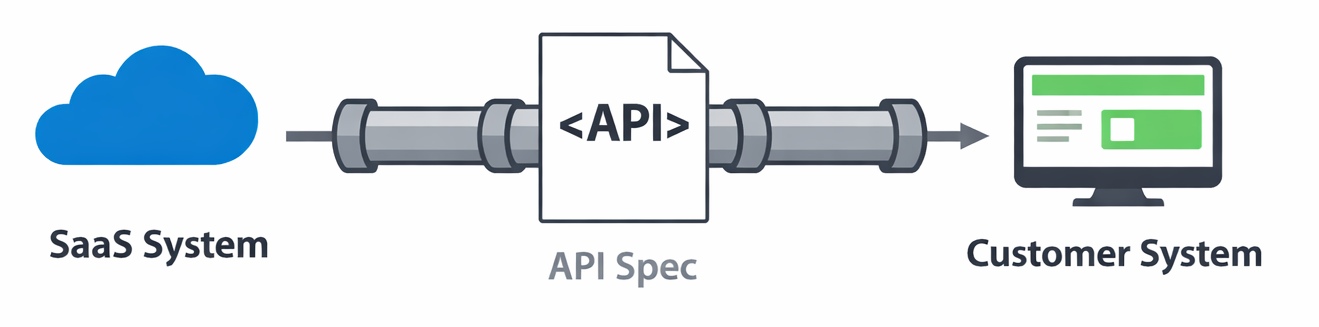
There is no escaping the fact that providing any API requires thought. Letting your code dictate the API can leave you boxed into a corner with a solution that can’t evolve, and even small changes to the API specification can break your API contract and harm people’s ability to consume it.
It is true that an LLM prompt can be tolerant of certain changes. But, it cuts both ways, poor API changes (e.g attributes and descriptions mismatching, attribute names are too obscure to extract meaning) can result in the LLM failing to interpret the intent from the provider side, or worse the LLM has been producing the expected results, but for unexpected reasons, as a result of small changes this may cause the LLM to start getting it wrong.
This leads to the question of what this means for application APIs? It’s an interesting question, and it’s easy to jump to the assumption that APIs aren’t needed. But, in that direction lie dragons, as the expression goes.
If we approach things from an API first strategy, the API and its definition are less susceptible to change, whether the API definition is implemented using an agent, vibe coded or traditionally developed, the contract will give us some of that determinism.
APIs further benefits
With the challenges and uncertainties mentioned in the world of SaaS, having good APIs can offer additional value, aside from the typical integration value, a good API Gateway setup, and if customers are vibe coding their own UIs from your APIs you’ll be able analyse patterns of usage which will still give some clues as to customer use cases, and which parts of the product are most valuable, just as good UI embedded analytics and trace data can reveal.
Final thought
If there is an existential threat to SaaS, it won’t be solved by abandoning structure. It will be addressed by:
making data accessible
enabling extension
and doubling down on well-designed APIs
In an agentic world, APIs aren’t obsolete. They’re the thing that stops everything from falling apart.
With KubeCon Europe happening this week, it felt like a good moment to break cover on this pet project.
If you are working with Fluent Bit at any scale, one question keeps coming up: how do we consistently control and observe all those edge agents, especially outside a Kubernetes-only world?
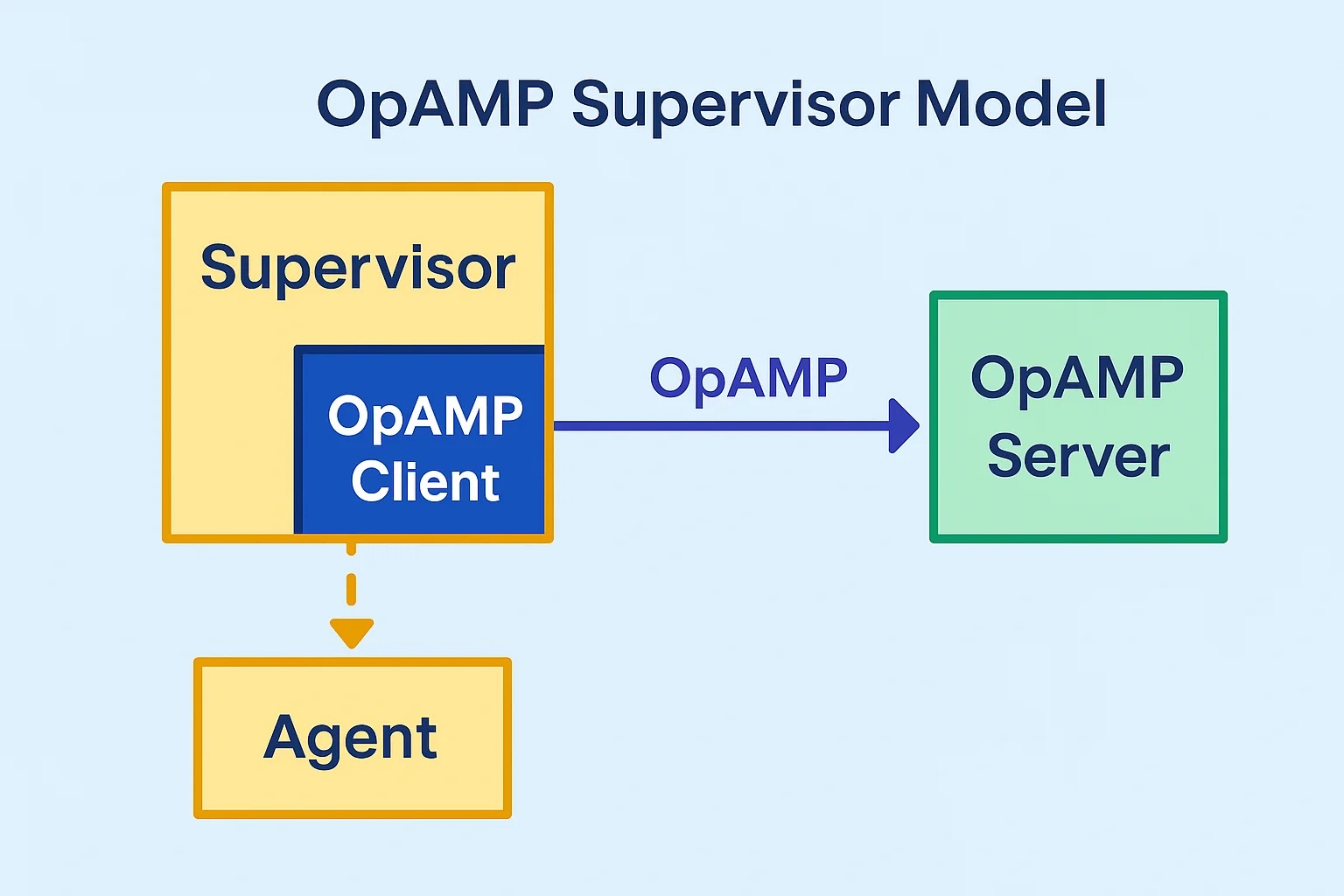
This is exactly the problem the OpAMP specification is trying to solve. At its core, OpAMP defines a standard contract between a central server and distributed agents/supervisors, so status, health, commands, and config-related interactions follow one protocol instead of ad-hoc integration per tool.
That is where this project sits. We’re implementing the OpAMP specification to support Fluent Bit (and later Fluentd).
In this implementation, we have:
a provider (the OpAMP server), and
a consumer acting as a supervisor to manage Fluent Bit deployments.
Right now, we are focused on Fluent Bit first. That is deliberate: it keeps scope practical while we validate the framework. The same framework is being shaped so it can evolve to support Fluentd as well.
The provider/server is the control plane endpoint. It tracks clients, accepts status, queues commands, and returns instructions using OpAMP payloads over HTTP or WebSocket.
The consumer/supervisor handles the local execution and reporting. It launches Fluent Bit, polls local health/status endpoints, sends heartbeat and metadata to the provider, and handles inbound commands (including custom ones). The server and supervisor can be deployed independently, which is important for real-world rollout patterns.
Because they follow the OpAMP protocol model, clients and servers can be interchanged with other OpAMP-compliant implementations (although we’ve not yet tested this aspect of the development).
Together, they give us a manageable, spec-aligned path to coordinating distributed Fluent Bit nodes without hard-coding one-off control logic into every environment.
Deployment options and scripts
There are a few practical ways to get started quickly:
Deploy just the server/provider using scripts/run_opamp_server.sh (or scripts/run_opamp_server.cmd on Windows).
Deploy just the client/supervisor using scripts/run_supervisor.sh (or scripts/run_supervisor.cmd on Windows).
Run both components either together in a single environment or independently across different hosts.
The scripts will set up a virtual environment and retrieve the necessary dependencies.
If you want an initial MCP client setup as part of your workflow, there are helper scripts for that too:
mcp/configure-codex-fastmcp.sh and mcp/configure-codex-fastmcp.ps1
mcp/configure-claude-desktop-fastmcp.sh and mcp/configure-claude-desktop-fastmcp.ps1
Server screenshots
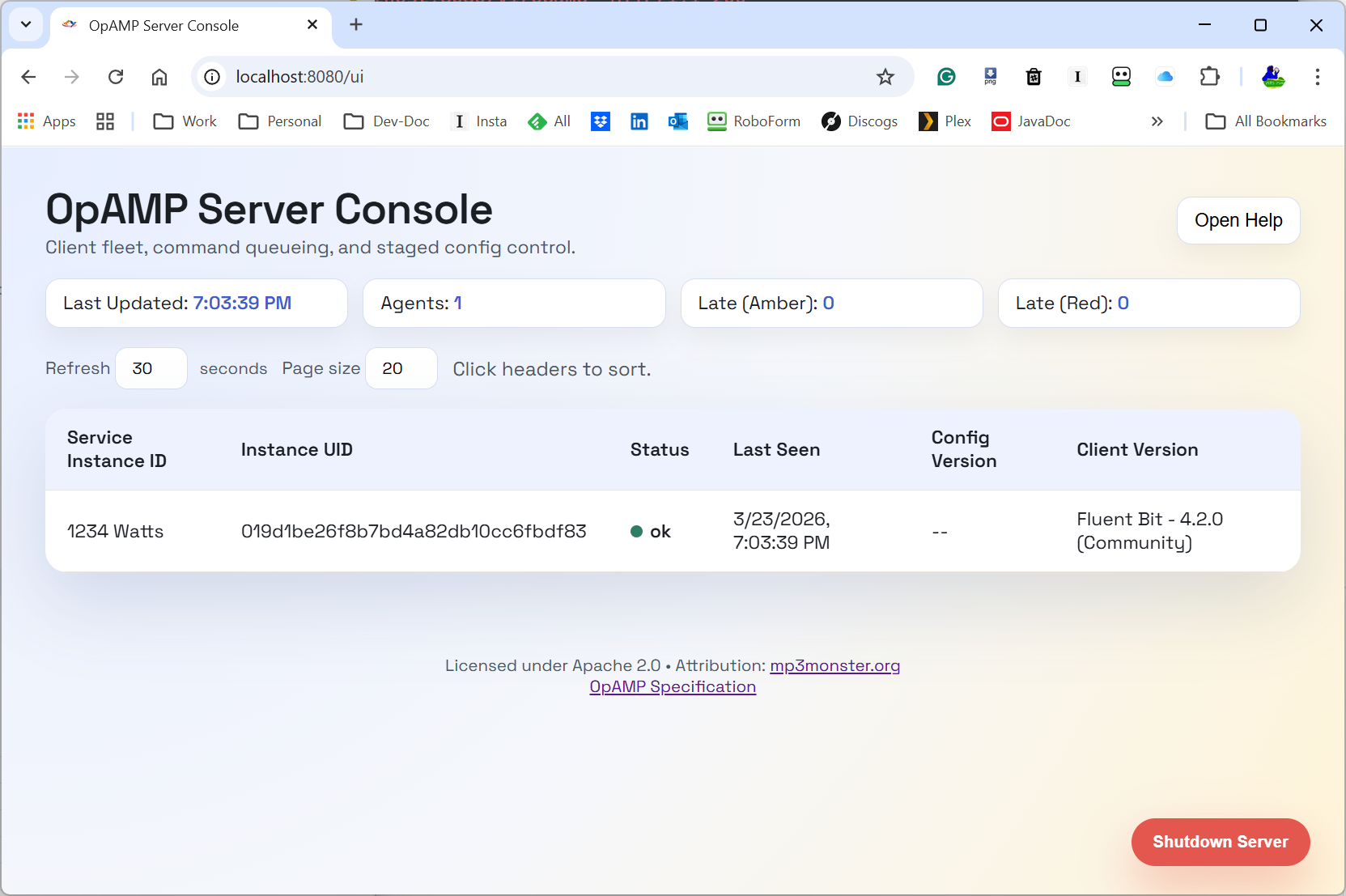
Here is a first server view we can include in the post:
The Server Console with a single Agent
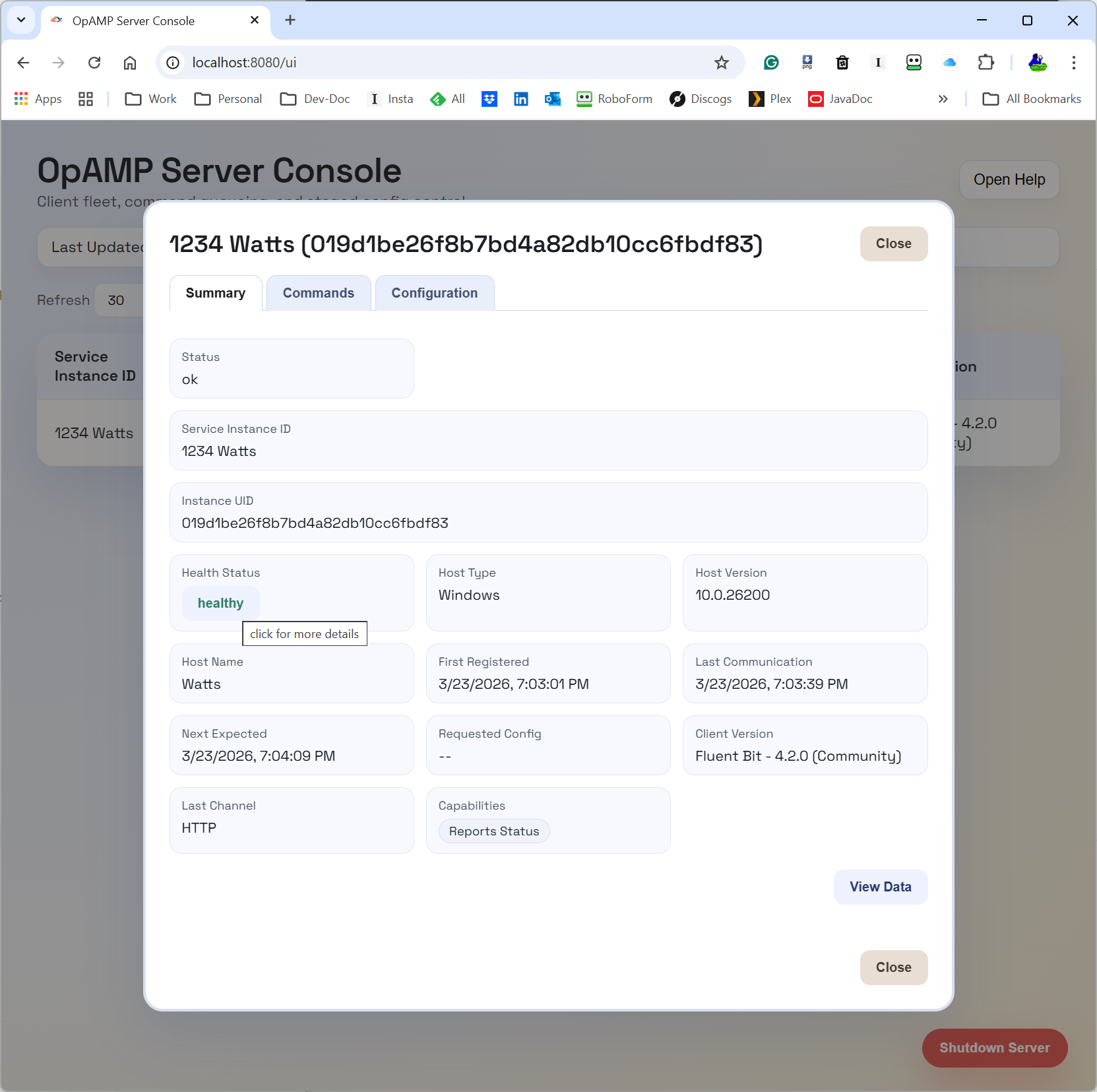
The UI is still evolving, but this gives a concrete picture of the provider side control plane we are discussing.
What the OpAMP server (provider) does
The provider is responsible for the shared view of fleet state and intent.
Today it provides:
OpAMP transport endpoints (/v1/opamp) over HTTP and WebSocket.
API and UI endpoints to inspect clients and queue actions.
In-memory command queueing per client.
Emission of standard command payloads (for example, restart).
Emission of custom message payloads for custom capabilities.
Discovery and publication of custom capabilities supported by the server side command framework.
Operationally, this means we can queue intent once at the server and let the next client poll/connection cycle deliver that action in protocol-native form.
What the supervisor (consumer) does for Fluent Bit
The supervisor is the practical glue between OpAMP and Fluent Bit:
Starts Fluent Bit as a local child process.
Parses Fluent Bit config details needed for status polling.
Polls Fluent Bit local endpoints on a heartbeat loop.
Builds and sends AgentToServer messages (identity, capabilities, health/status context).
Receives ServerToAgent responses and dispatches commands.
Handles custom capabilities and custom messages through a handler registry.
So for Fluent Bit specifically, the supervisor gives us a way to participate in OpAMP now, even before native in-agent OpAMP support is universal.
And to be explicit: this is the current target. Fluentd support is a planned evolution of this same model, not a separate rewrite.
Where ChatOps fits
ChatOps is where this gets interesting for day-2 operations.
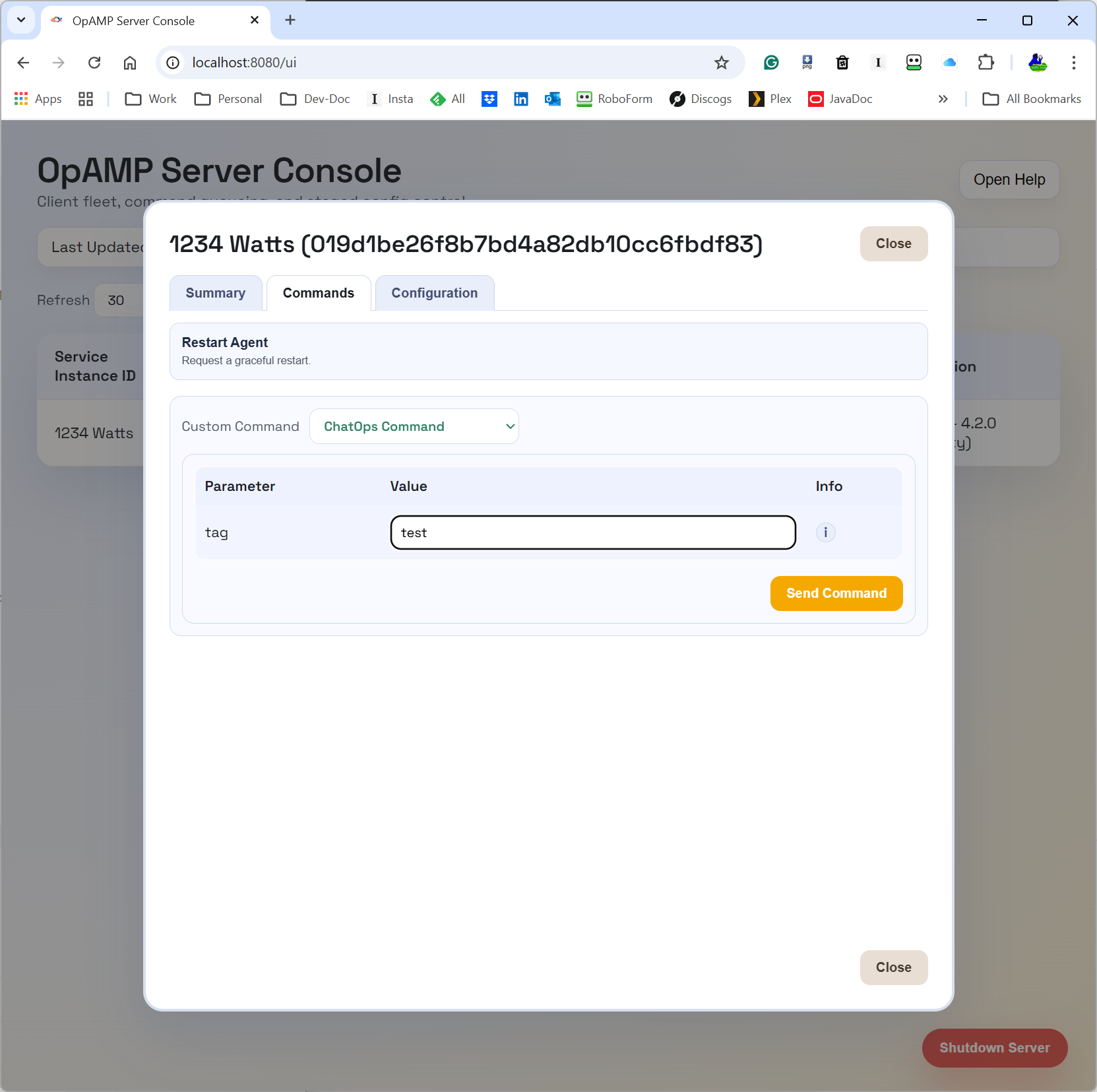
In this implementation, ChatOps commands are carried as OpAMP custom messages (custom capability org.mp3monster.opamp_provider.chatopcommand). The provider queues the custom command, and the supervisor’s ChatOps handler executes it by calling a local HTTP endpoint on the configured chat_ops_port.
That gives us a cleaner control path:
Chat/user intent can go to the central server/API.
The server routes to the right node through OpAMP.
The supervisor performs the local action and can return failure context when local execution fails.
This is a stronger pattern than directly letting chat tooling call every node individually, and it opens the door to better auditability and policy controls around who can trigger what.
Reality check: we are still testing
This is important: we are still actively testing functionality.
Current status is intentionally mixed:
Core identity, sequencing, capabilities, disconnect handling, and heartbeat/status pathways are in place.
Some protocol fields are partial, todo, or long-term backlog.
Custom capabilities/message pathways are implemented as a practical extension point and are still being hardened with test coverage and real-world runs.
So treat this as a working framework with proven pieces, not a finished all-capabilities implementation.
What is coming next (based on docs/features.md)
Near-term priorities include:
stricter header/channel validation,
heartbeat validation hardening,
payload validation against declared capabilities,
server-side duplicate websocket connection control behaviour.
Broader roadmap themes include:
authentication/security model for APIs and UI,
persistence in the provider,
richer UI controls for node/global polling and multi-node config push,
certificate and signing workflows,
packaging improvements.
And yes, a key strategic direction is evolving the framework abstraction so it can support Fluentd in due course, not only Fluent Bit. Some feature areas (like package/status richness) make even more sense in that broader collector ecosystem.
Why this matters
OpAMP gives us a standard envelope for control-plane interactions; the server/supervisor split gives us pragmatic deployment flexibility; and ChatOps provides a human-friendly control surface.
Put together, this becomes a useful pattern for managing telemetry agents in real environments where fleets are mixed, rollout velocity matters, and “just redeploy everything” is not always an option.
If you are evaluating this right now, the right mindset is: useful today, promising for tomorrow, and still under active verification as we close feature gaps.



You must be logged in to post a comment.