• Home
  • Site Aliases
    • www.cloud-native.info
  • About
    • Background
    • Presenting Activities
    • Internet Profile
      • LinkedIn
    • About
  • Books & Publications
    • Log Generator
    • Logs and Telemetry using Fluent Bit
      • Fluent Bit book
      • Book Resources in GitHub
      • Fluent Bit Classic to YAML Format configurations
    • Logging in Action with Fluentd, Kubernetes and More
      • Logging in Action with Fluentd – Book
      • Fluentd Book Resources
      • Fluentd & Fluent Bit Additional stuff
    • API & API Platform
      • API Useful Resources
    • Oracle Integration
      • Book Website
      • Useful Reading Sources
    • Publication Contributions
  • Resources
    • GitHub
    • Oracle Integration Site
    • Oracle Resources
    • Mindmaps Index
    • Useful Tech Resources
      • Fluentd & Fluent Bit Additional stuff
      • Recommended Tech Podcasts
      • Official Sources for Product Logos
      • Java and Graal Useful Links
      • Python Setup & related stuff
      • DevTips
  • Music
    • Monster On Music
    • Music Listening
    • Music Reading

Phil (aka MP3Monster)'s Blog

~ from Technology to Music

Phil (aka MP3Monster)'s Blog

Category Archives: development

API payload design getting the semantics right

14 Wednesday Dec 2022

Posted by mp3monster in APIs & microservices, development, General, Technology

≈ Leave a comment

Tags

API, Design, OAGI, OASIS, OMG, payload, semantics, TMForum

One area of API design that doesn’t get discussed much is the semantics of the payload. That is, the names we give our attributes and elements for the values being communicated. When developing single-use APIs (usually for client applications), this is unlikely to be an issue as the team(s) involved are likely to know each other and are able to interact and resolve clarity issues easily enough (although getting the semantics right makes this easier particularly in the long term). But when it comes to providing reusable endpoints, we may know the early adopters but are unlikely to interact with consumers beyond that unless there is a problem.

This makes getting the semantics right somewhat harder. How do we know if our early adopters represent the wider customer base (internally and externally)? Conversely, if we simply use our own company terminology, how do we know that it is representative of the wider user base? It isn’t unusual for organizations to develop their own variations of a term or apply assumed meaning. Even simple things, a ‘post code’ element of an address, other parts of the world use ‘zip codes’ or PINS are they the same? Perhaps if we said ‘postal code,’ we break the direct specific country associations with ‘post code.’ We can overcome these issues by providing a dictionary of meanings and lengthy explanations. Using the right term goes beyond simply understanding the data value; it will infer specific formatting and potential application behaviors. Taking our postcode/zip code example. In the UK data is published, which means it is possible to easily validate a postcode against the address line and vice versa. In fact, in the UK to get something delivered, you only need the property number and the postcode. A US 5-digit zipcode can’t do that. For that precision, the ZIP+4 needs to be used.

If we can address these issues, then life becomes easier for us in maintaining the information and for consumers in not needing to look up the details. The question is how can we be sure of using semantics that is consistent across our APIs and widely understood and, when necessary, already documented, so we don’t have to document the information again?

Read more: API payload design getting the semantics right

Public Data Models

There is a shortcut to some of these problems. Many industries have agreed on data models for different industries. The bodies such as OASIS, OMG, and others are developed and maintained by multiple organizations. As a result, there is a commonality in the meaning achieved. So if you align with that meaning, then use that semantic. Not only can the naming of attributes become easier, but any documentation can be simplified to reference the published definitions. in most cases, these standards are publicly available as it promotes the widest adoption – one of the goals of developing such models. But there are some pitfalls to be mindful of using this approach:

  • Sometimes rather than arrive at a universal definition, the models will accommodate structural variations or aliased names – as a result, they may not necessarily be helpful to you.
  • The more well-known models are internationalized. If you have no intent to support international needs and not expecting to have international consumers, then the naming may not align with localized conventions.
  • If you use the semantics provided, ensure your data abides by the meaning. For example, don’t use ‘shipping address’ if you’re not shipping anything.
  • Don’t slavishly copy the data models provided – the model may not be intended for API use cases. At the same time, it doesn’t stop you from asking why the data in the model is there and whether your users may want such data (and whether it makes sense for you to provide that information).

Predefined APIs

Some organizations, such as TMForum have taken the public data model to the next step and provided predefined API specifications. This is ideal where you’re following industry standards and providing standardized/common services that aren’t a differentiator but need to be offered as part of doing business.

Data Catalogs

Larger, data-mature organizations will keep some form of Data Catalog. These catalogs are often held to help understand compliance needs, such as where personal data is held, how data issues can impact data accuracy and integrity, etc. It is possible that metadata may also be kept to address the semantic meaning of data or reference the definitions. Such information is used to help inform any data cleansing that may be needed. This offers a potentially good source of information for internal API use cases.

Vendor Led

If your business is delivery/service focussed so that your unique value isn’t in IT processes but perhaps something that the company manufactures or a specialist service such as consulting in a specific industry, then it is possible that the majority of your systems are SaaS or COTs based. If your business has opted to focus on a particular vendor, e.g., Oracle or SAP, for most services, then vendor-led data models are a possibility. These vendors are often involved with public data model development, so they won’t be too divergent in most situations – but awareness of differences is necessary, but as both models should be internally consistent, the differences will also be consistent. This approach will give you better alignment and reduce the chances of needing to address any divergence. The downside of this is a change of direction on strategic vendors can create additional work going forward as the alignment is disrupted. More work will be needed to map from your naming and semantics to the new core, and attempts to move away from the selected model to try to realign semantics with a new core will potentially create breaking changes for API consumers.

Don’t Forget

Regardless of the approach taken, there are some very simple but critical rules that will keep you in a good place:

  • Don’t use your underlying storage data models – this is a well-documented API anti-pattern.
  • Consistency of language across your APIs, regardless of whether they are internal or external, is important.

Information Sources

Regardless of approach – be careful not to lock your API semantics and data model to that of the storage layer – these can change and even create breaking changes that you shouldn’t expose to your users. Some sources to consider.

  • OAGIS – covers a broad variety of business data domains. Some ERP suppliers have used this as a foundation for their application data models.
  • OASIS – covers many industries
  • TMForum APIs
  • ARTS (formally hosted by NRF now with the OMG). The full OMG standards catalog.
  • GS1 – lots here on shipping, supply chain, and product tracking

Some more reading on the subject:

  • http://mlwiki.org/index.php/Semantic_Domains
  • https://www.w3.org/TR/vocab-dcat-2/

Share this:

  • Share on Facebook (Opens in new window) Facebook
  • Share on X (Opens in new window) X
  • Share on Reddit (Opens in new window) Reddit
  • Email a link to a friend (Opens in new window) Email
  • Share on WhatsApp (Opens in new window) WhatsApp
  • Print (Opens in new window) Print
  • Share on Tumblr (Opens in new window) Tumblr
  • Share on Mastodon (Opens in new window) Mastodon
  • Share on Pinterest (Opens in new window) Pinterest
  • More
  • Share on Bluesky (Opens in new window) Bluesky
  • Share on LinkedIn (Opens in new window) LinkedIn
Like Loading...

OCI Notifications through the LogSimulator

04 Friday Nov 2022

Posted by mp3monster in development, General, logsimulator, Oracle, Technology

≈ Leave a comment

Tags

events, loggenerator, logsimulator, Notifications, OCI, open-source, Oracle, tool

We’ve been busy putting together a number of Oracle Architecture Center assets over the last week. This has included building LogSimulator extensions that can either be run in a very simple manner using just a single file, but limited in the payloads that can be sent to OCI (if you take the appropriate custom file from the LogSimulator you do need to make one minor tweak. But the code has also been added to the Oracle GitHub repository here in a manner that doesn’t require the full tool. There of course a price to pay for the simplified implementation. This comes in the form of the notifications being sent and received being hardwired into the code rather than driven through the insulator’s configuration options.

The decoupling has been done by implementing the interface for the custom methods in a class without the implements declaration, and then we extend the base class and apply the implements declaration at that level.

While notifications could take log events, it is more suited to JSON payloads. But as the simulator can tailor the content being sent using some formatting, it does not care if the provided events to send are pre-formatted as JSON objects making it an easy tool to test the configuration of OCI Notifications.

Unit testing as well

In addition to the new channel, as previously mentioned we have been making some code improvements. To support that we have started to add unit tests, and double checking code will compile under Java. To keep the dependencies down we’re making use of Java assert statements rather than a pretty JUnit. But the implementation ideas are very similar. As the tests use Java asserts the use of asserts does need to be enabled in the command line; for example:

Groovy test.groovy -enableasserts

Share this:

  • Share on Facebook (Opens in new window) Facebook
  • Share on X (Opens in new window) X
  • Share on Reddit (Opens in new window) Reddit
  • Email a link to a friend (Opens in new window) Email
  • Share on WhatsApp (Opens in new window) WhatsApp
  • Print (Opens in new window) Print
  • Share on Tumblr (Opens in new window) Tumblr
  • Share on Mastodon (Opens in new window) Mastodon
  • Share on Pinterest (Opens in new window) Pinterest
  • More
  • Share on Bluesky (Opens in new window) Bluesky
  • Share on LinkedIn (Opens in new window) LinkedIn
Like Loading...

JMESPath is represented using Railroad diagrams

31 Monday Oct 2022

Posted by mp3monster in development, General, railroad diagrams, Technology

≈ Leave a comment

Tags

AWS, Azure, diagrams, JMESPath, OCI, railroad, syntax

JMESPath is a mature syntax for traversing and manipulating JSON objects. The syntax is also supported with multiple language implementations available through GitHub (and other implementations exist). As a result, it has been very widely adopted; just a few examples include:

  • Azure CLI
  • AWS CLI and Lambda
  • Oracle Cloud WAF
  • Splunk

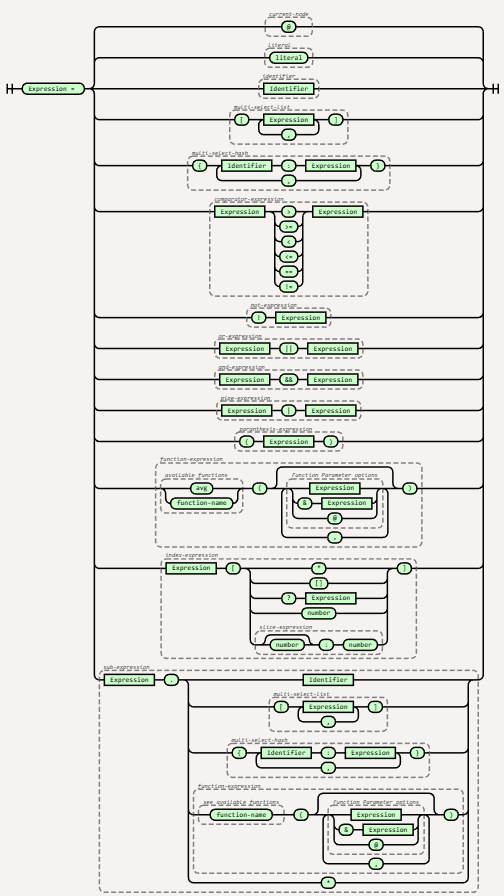
As the syntax is very flexible and recursive in its use following the documented notation can be a little tricky to start with. So following the syntax can be rather tricky. The complete definition runs to 97 lines, of which 32 lines focus on the syntactical structure. The others describe the base types such as numbers, characters, accepted escaped characters, and so on. Nothing wrong with this, as the exhaustive definition is necessary to build parsers. But for the majority of the time it is those 32 lines that we need to understand.

As the expression goes – ‘a picture says a thousand words’, there might not be a thousand words, but there is enough to suggest a visual representation will help. Even if the visual only helps us traverse the use of the detailed syntax. So we’ve use our favoured visual representation – the railroad diagram and the tool produced by Tab Akins to create the representation. We’ve put the code and created images for the syntax in my GitHub repository here, continuing the pattern previously adopted.

Here is the resulting diagram …

To make it easy to trace back to the original syntax document we’ve included groupings on the diagram that have names from the original speciofication.

Parts of the diagram make the expressions look rather simple, but you’ll note that it is possible for the sections to be iterative which allows for the expression to traverse a JSON object of undefined depth. But what can be really challenging is that an in many areas it is possible to nest expressions within expressions. Visually there is no simple way to represent the expression possibilities of this in a linear manner. Other than be clear about where the nesting can take place.

Share this:

  • Share on Facebook (Opens in new window) Facebook
  • Share on X (Opens in new window) X
  • Share on Reddit (Opens in new window) Reddit
  • Email a link to a friend (Opens in new window) Email
  • Share on WhatsApp (Opens in new window) WhatsApp
  • Print (Opens in new window) Print
  • Share on Tumblr (Opens in new window) Tumblr
  • Share on Mastodon (Opens in new window) Mastodon
  • Share on Pinterest (Opens in new window) Pinterest
  • More
  • Share on Bluesky (Opens in new window) Bluesky
  • Share on LinkedIn (Opens in new window) LinkedIn
Like Loading...

LogSimulator New Feature – Custom Targets with OCI Logging example

14 Friday Oct 2022

Posted by mp3monster in Cloud, development, General, logsimulator, Oracle, Technology

≈ Leave a comment

Tags

book, loggenerator, logging, logsimulator, OCI, Prometheus

Those who have been using my Logging in Action book will know that to help test the configuration of monitoring tools including Fluentd we have built a LogGenerator that can very easily play and replay logging events into a variety of destinations and formats. all written in Groovy to make the utility easy to run as a script and extend without needing to set up a proper Java development environment.

With the number of different destinations built into the script and the logic to load the source log events and format them the utility is getting rather large for a single file. Rather than letting it continue to grow as we add more destinations to pump log events too, I’ve extended the implementation so you can point to a Groovy file that implements the logic to send the log events. It only requires three simple methods to be implemented.

To demonstrate the feature we have created a custom extension and fully documented it. The extension allows you to send log events to the OCI Logging service. This includes an optional crude aggregation mechanism as sending individual log events is a little inefficient over REST. By doing this we can send synthetic or playback logs as if we’re an application in real-life to ensure that any alerting or routing for the logging works properly before we get anywhere production and do not need to run the application and induce error events.

Beyond this, we’re also thinking about creating a plugin to fire log events at Prometheus so we can send events using the Prometheus pushgateway. As a result, we can tune Prometheus’ configuration.

More improvements – refactoring the existing code

We will refactor the existing code to use the same approach which should make the code more maintainable, but the changes won’t stop the utility from working as it always has (so we won’t break out the existing output channels from the core).

We have also started to improve the code commenting – so hopefully it will make the code a bit more navigable.

Share this:

  • Share on Facebook (Opens in new window) Facebook
  • Share on X (Opens in new window) X
  • Share on Reddit (Opens in new window) Reddit
  • Email a link to a friend (Opens in new window) Email
  • Share on WhatsApp (Opens in new window) WhatsApp
  • Print (Opens in new window) Print
  • Share on Tumblr (Opens in new window) Tumblr
  • Share on Mastodon (Opens in new window) Mastodon
  • Share on Pinterest (Opens in new window) Pinterest
  • More
  • Share on Bluesky (Opens in new window) Bluesky
  • Share on LinkedIn (Opens in new window) LinkedIn
Like Loading...

Is The 12 Factor App right about Logging?

05 Wednesday Oct 2022

Posted by mp3monster in development, Fluentd, General, Technology

≈ Leave a comment

Tags

12 Factor, 12 Factor App, conference, development, Grafana, JAX, logging, London, OpenSearch, Prometheus, Splunk, stdout

The 12 Factor App definition is now ten years old.  In the world of software that is a long time. So perhaps it’s time to revisit and review what it says.  As I have spent a lot of time around Logging – I’ve focussed on Factor 11 – Logging.

I have been fortunate enough to present at the hybrid JAX London conference on this subject. It was great to get out and see people at a conference rather than just with a screen and a chat console of online-only events.

You can see my presentation here:

Continue reading →

Share this:

  • Share on Facebook (Opens in new window) Facebook
  • Share on X (Opens in new window) X
  • Share on Reddit (Opens in new window) Reddit
  • Email a link to a friend (Opens in new window) Email
  • Share on WhatsApp (Opens in new window) WhatsApp
  • Print (Opens in new window) Print
  • Share on Tumblr (Opens in new window) Tumblr
  • Share on Mastodon (Opens in new window) Mastodon
  • Share on Pinterest (Opens in new window) Pinterest
  • More
  • Share on Bluesky (Opens in new window) Bluesky
  • Share on LinkedIn (Opens in new window) LinkedIn
Like Loading...

Demo Fluentd using Ubuntu with optional inclusion of OpenSearch and OCI Log Analytics

17 Wednesday Aug 2022

Posted by mp3monster in Cloud, development, Fluentd, General, Oracle, Technology

≈ Leave a comment

Tags

Cloud, demo, Fluentd, GitHub, Log Analytics, log simulator, OCI, OpenSearch, Oracle, Ubuntu

One of the areas I present publicly is the use of Fluentd. including the use of distributed and multiple nodes. As many events have been virtual it has been easy to demo everything from my desktop – everything is set up so I can demo things very easily. While doing this all on one machine does point to how compact and efficient Fluentd is as I can run multiple instances concurrently it does undermine distributed capabilities somewhat.

Add to that I now work for Oracle it makes sense to use OCI resources. With that, I have been developing the scripts to configure Ubuntu VMs to set up the demo environments installing Ruby, Fluentd, and various gems needed and pulling the relevant configurations in. All the assets can be found in the GitHub repository https://github.com/mp3monster/logging-demos. The repository readme includes plenty of information as well.

While I’ve been putting this together using OCI, the fact that everything is based on Ubuntu should mean it can be run locally on VMs, WSL2, and adaptable for MacOS as well. The environment has been configured means you can still run on Ubuntu with a single node if desired.

Additional Log Destinations

As the demo will typically be run on OCI we can not only run the demo with a multinode setup, we have extended the setup with several inclusion files so we can utilize OCI services OpenSearch and OCI Log Analytics. If you don’t want to use these services simply replace the contents of several inclusion files including files with the contents of the dummy_inclusion.conf file provided.

Representation of the Demo setup

The configuration works by each destination having one or two inclusion files. The files with the postfix of label-inclusion.conf contains the configuration to direct traffic to the respective service with a configuration that will push log events at a very high frequency to the destination. The second inclusion file injects the duplication of log events to each service. The inclusion declarations in the main node Fluentd config file references an environment variable that should provide the path to the inclusion file to use. As a result, by changing the environment variable to point to a dummy file it becomes possible o configure out the use of one of the services. The two inclusions mean we can keep the store declarations compact and show multiple labels being used. With the OpenSearch setup, we have a variant of the inclusion file model where the route inclusion can reference the logic that we would use in the label directly within the sore declaration.

The best way to see the use of the inclusions is to experiment with setting the different environment variables to reference the different files and then using the Fluentd dry-run feature (more on this in the book).

Setup script

The setup script performs a number of tasks including:

  • Pulling from Git all the resources needed in terms of configuration files and folders
  • Retrieving the necessary plugins against the possibility of their use.
  • Setting up the various environment variables for:
    • Slack token
    • environment variables to reference inclusion files
    • shortcut environment variables and aliases
    • network (IP) address for external services such as OpenSearch
  • Setting up a folder for OCI tokens needed.
  • Setting up temp folders to be used by OCI Plugins as a file-based cache.

Using OpenSearch

OpenSearch setup is documented in a tutorial here, and a Reference Architecture at the time of writing there isn’t a one-click deploy Terraform available in the Oracle Reference Architecture library on GitHub.

Currently, the setup for OpenSearch means manually adding the node1 index into the configuration.

Useful Links:

  • https://opensearch.org/
  • https://docs.oracle.com/en/solutions/oci-opensearch-application-search/#GUID-C968ACCC-2E79-4C88-A466-F9DF2503E920
  • https://www.opensearch.org/blog/technical/2022/02/getting-started-with-fluentd-and-opensearch/?utm_source=pocket_mylist

Log Analytics

Feeding the log analytics service is a more complex process to set up as the feeds need to have metadata about the events being ingested. The downside is the configuration effort is greater, but the payback is that it becomes easier to extract meaningful information quickly because the service has a greater understanding of the content. For example, attributing the logs to a type of source means the predefined or default log formats are immediately understood, and maximum meaning can be retrieved from the log event.

Going to OCI Log Analytics does cut out the need for the Connections hub, which would allow rules and routing to be defined to different OCI services which functionally can help such as directing log events to PagerDuty.

Useful Links

  • https://docs.oracle.com/en/solutions/oci-opensearch-log-analytics/index.html#GUID-9A3E3E7A-C899-4D43-8DA0-4BA7FA3E44ED
  • https://docs.oracle.com/en/cloud/paas/management-cloud/logcs/install-output-plug.html
  • https://docs.oracle.com/en/learn/oci_logging_analytics_fluentd/index.html

Demo Enhancements to come

There are a few things we’re planning to do with the demo:

  • Create a terraform script to perform all the environment setup
  • Integrate the configuration script into the terraform
  • Provide some simple dashboard insights for OpenSearch – currently, this is all manual
  • Basic setup for OCI Log Analytics

Share this:

  • Share on Facebook (Opens in new window) Facebook
  • Share on X (Opens in new window) X
  • Share on Reddit (Opens in new window) Reddit
  • Email a link to a friend (Opens in new window) Email
  • Share on WhatsApp (Opens in new window) WhatsApp
  • Print (Opens in new window) Print
  • Share on Tumblr (Opens in new window) Tumblr
  • Share on Mastodon (Opens in new window) Mastodon
  • Share on Pinterest (Opens in new window) Pinterest
  • More
  • Share on Bluesky (Opens in new window) Bluesky
  • Share on LinkedIn (Opens in new window) LinkedIn
Like Loading...

Streaming APIs

05 Friday Aug 2022

Posted by mp3monster in APIs & microservices, development, General, Technology

≈ 1 Comment

Tags

API, architecture, code, GraphQL, gRPC, Oracle, streaming, subscriptions

Yesterday I was fortunate enough to participate in the Dev Innovation summit part of the World Festival virtual conference.

The presentation took a look at how Streaming APIs offer an alternative to API polling and the considerations needed when adopting streaming.

Continue reading →

Share this:

  • Share on Facebook (Opens in new window) Facebook
  • Share on X (Opens in new window) X
  • Share on Reddit (Opens in new window) Reddit
  • Email a link to a friend (Opens in new window) Email
  • Share on WhatsApp (Opens in new window) WhatsApp
  • Print (Opens in new window) Print
  • Share on Tumblr (Opens in new window) Tumblr
  • Share on Mastodon (Opens in new window) Mastodon
  • Share on Pinterest (Opens in new window) Pinterest
  • More
  • Share on Bluesky (Opens in new window) Bluesky
  • Share on LinkedIn (Opens in new window) LinkedIn
Like Loading...

Node (npm) package licensing

05 Tuesday Jul 2022

Posted by mp3monster in development, General, node.js, Technology

≈ Leave a comment

Tags

code, developer, development, Licensing, node.js, package, Technology

When building Node solutions, even if you’re not going to publish the code to a public repository you’re likely to be using package.json to declare the dependencies for your app. Doing this makes it easier to build and deploy a utility. But if you’re conversant with several languages there is a tendency to just adapt your existing skills to work with others. The downside of this is small tooling nuances can catch you off guard and consume time while figuring them out. The workings of packages with NPM (as shown below) is one possible case.

{
  "name": "graph-svr",
  "version": "1.0.0",
  "description": "packages needed for this service",
  "main": "index.js",
  "type": "module",
  "scripts": {
    "start": "node index.js"
  },
  "dependencies": {
    "@graphql-tools/graphql-file-loader": "^7.3.11",
    "@graphql-tools/load-files": "^6.5.4",
    "@graphql-tools/schema": "^8.3.10",
    "@graphql-yoga/node": "^2.4.1",
    "apollo-datasource-rest": "^3.5.2",
    "apollo-server": "^3.6.7",
    "graphql": "^16.4.0",
    "graphql-tools": "^8.2.8"
  },
  "author": "Phil Wilkins",
  "license": "MIT"
}

If you create the package.json using npm init to create the initial version of the file, it is fairly common to set values to default. In the case of the license, this is an ISC license. This is easily forgotten. The problem here is twofold:

  • Does the license set reflect the constraints of the dependencies and their licenses
  • Does the default license reflect the position you want?

Looking at the latter point first, This is important as organizations have matured (and tooling greatly improved) when it comes to understanding how open source licensing can impact. This is particularly important for any organizations leveraging open source as part of their revenue generating activities either ‘as a service’ but also selling software solutions. If you put the wrong license here the license checking tools often protecting code repositories may reject your code, even in internal only use cases (yes this tripped me up).

To help overcome this issue you can install a tool that will analyze the dependencies and optionally their dependencies and report back on your license exposure. This tool is called license-report. Once installed (npm install -g license-report) we just need to point the tool to the package.json file. e.g. license-report package.json. We can make the results a lot more consumable by outputting the content in a number of formats. For example a simple text value:

From this, you could set your license declaration in package.json or validate that your preferred license won’t conflict,

Share this:

  • Share on Facebook (Opens in new window) Facebook
  • Share on X (Opens in new window) X
  • Share on Reddit (Opens in new window) Reddit
  • Email a link to a friend (Opens in new window) Email
  • Share on WhatsApp (Opens in new window) WhatsApp
  • Print (Opens in new window) Print
  • Share on Tumblr (Opens in new window) Tumblr
  • Share on Mastodon (Opens in new window) Mastodon
  • Share on Pinterest (Opens in new window) Pinterest
  • More
  • Share on Bluesky (Opens in new window) Bluesky
  • Share on LinkedIn (Opens in new window) LinkedIn
Like Loading...

Apollo GraphQL – some pointers

16 Thursday Jun 2022

Posted by mp3monster in development, General, languages, node.js, Technology

≈ 2 Comments

Tags

API, code, development, GraphQL, javascript, node.js, Technology

I’ve designed a variety of GraphQL schemas and developed microservice backends. But not done much with configuring the Apollo implementation of a GraphQL server until recently. This may reflect the fact my understanding of JavaScript doesn’t extend into the world of Node.JS as much as I’d like (the problem with being a multi-language developer is you’re likely to find your way around many languages but never be a master of one). Anyway, the following content is about the implementation within a GraphQL server part of a solution. It may be these pointers are just for my benefit you might find them helpful as well.

Read more: Apollo GraphQL – some pointers

To make it easy to reference the code, we’ve added entries (n) into the code, where n is a number. This is not part of the code. But there to make the different lines referenceable. Where code should go but is not relevant to the point being made I’ve added ellipsis (…)

Dynamic loading and server configuration

import { ApolloServer } from 'apollo-server';
import { loadFilesSync } from '@graphql-tools/load-files';
import { resolvers } from './resolvers.js';   (1)
import ProviderInternalAPI from './ProviderInternalAPI.js'; (1)
import EventsInternalAPI from './EventsInternalAPI.js';  (1)
const server = new ApolloServer({
  debug : true,    (2)
  typeDefs: loadFilesSync('./schema.graphql'),   (3)
  resolvers,
  dataSources: () => {
    return {
      eventsInternalAPI: new EventsInternalAPI(),    (4)
      providerInternalAPI: new ProviderInternalAPI() (4)
      pro
    };
  }});

There is the potential to dynamically load the resolvers rather than importing each JavaScript file as we see on lines (1). The mechanics to do this is documented here. It would be cool if an opinionated implementation was provided. As shown by (3) we can take a independent schema file being loaded. The Apollo example approach for this didn’t seem to work for us, although both approaches make use of graphql-tools in a synchronous manner.

We can switch on debugging (2) for the GraphQL server, although the level of information published doesn’t appear to be significant. Ideally this setting is changed for production.

Defining the resolvers

The prefix for each resolver (1) must correlate to the name in the schema of the mutator or query (not the type as you would expect with Java). Often we don’t need all the parameters for the resolver. The documentation describes replacing each unused parameter with one or more underscores (i.e _, __ ). The underscore denoting the field not in use. However we can satisfy the indication of not being used, but keep the meaning of each position by using the underscore then a name (i.e. _parent, _args ) as shown in (2).

By taking the response into a variable (3) we can optionally log it. Trying to return using invocation line would result in the handler object rather than the payload itself. By taking the result into a variable we can log the content if desired and return the content.

The use of the backward quote is a node feature. It allows us to incorporate variables into a string by referencing it within ${} (4).

We need to supply the GraphQL server with instances with a layer of code that will interact with the resolvers. We can instantiate the instances in the declaration. The naming of the object is important (4) to the resolver.js (declarations).

import { useLogger } from "@graphql-yoga/node";
...
latestEvent (1): async (_parent, _args, { dataSources }, _info) (2)   => {
      if (log) { console.log("resolvers - get latest event"); }
      let responseValue = await dataSources.eventsInternalAPI.getLatestEvent(); (3)
      if (log) { console.log(`(4)  Resolver response for latest event:\n ${responseValue}`); }
      return responseValue;
    },

Resolver declarations

 Query: {  ...
 },
  
Mutation: {...
},
  Event: {  (1)
    providers: (event, args, { dataSources }, info) => {
      if (log) { console.log(`going to locate ${event.sources}`) }
      let responseValue = await (2) dataSources.providerInternalAPI.getProviders(event.sources);
      return responseValue;
    }

To handle the use of resolvers within a larger resolver we need to declare the resolution outside of the Query and Mutator blocks (but inside the whole declaration block)(1). The name provided needs to match the parent entity that the query resolver contributes to.

To then provide values from the outer resolution we need to prover to the chained resolution use the naming as represented in the GraphQL schema as shown by (2). The GraphQL engine will resolve the mapping values.

Web resolver URL

  // GET
  async getProvider(code) {
    console.log("getProvider (%s) directing to %s",code,this.baseURL);
    return this.get(`provider?code=${code} (1)`);
  }

The URL parameters need to be appended to the base URL path for the parent class to use in the invocation as shown by (1). The Apollo examples showed a setter option but we didn’t see the URI being addressed properly. This approach produces the relevant requirement.

Share this:

  • Share on Facebook (Opens in new window) Facebook
  • Share on X (Opens in new window) X
  • Share on Reddit (Opens in new window) Reddit
  • Email a link to a friend (Opens in new window) Email
  • Share on WhatsApp (Opens in new window) WhatsApp
  • Print (Opens in new window) Print
  • Share on Tumblr (Opens in new window) Tumblr
  • Share on Mastodon (Opens in new window) Mastodon
  • Share on Pinterest (Opens in new window) Pinterest
  • More
  • Share on Bluesky (Opens in new window) Bluesky
  • Share on LinkedIn (Opens in new window) LinkedIn
Like Loading...

Securing credentials in Fluentd configurations

07 Tuesday Jun 2022

Posted by mp3monster in development, Fluentd, General, manning, Technology

≈ Leave a comment

Tags

Conjur, env vars, environment variables, Fluentd, Hashicorp, open source, Ruby, secrets, Security, slack, token, Vault

When configuring Fluentd we often need to provide credentials to access event sources, targets, and associated services such as notification tools like Slack and PagerDuty. The challenge is that we don’t want the credentials to be in clear text in the Fluentd configuration.

Using Env Vars

In the Logging In Action with Fluentd book, we illustrated how we can take the sensitive values from environment variables so the values don’t show up in the configuration file. But, we’ve seen regularly the question of how secure is this, can’t the environment variable be seen by everyone on that machine?

The answer to this question comes down to having a deeper understanding of how environment variables work. There is a really good explanation here. The long and short of it is that environment variables can only be seen by the process that creates the variable and any child process will receive a copy of the parent’s variables.

This means that if we create the variable in a shell, only that shell and any processes launched by that shell can see the environment variable. So as long as we don’t set variables up as part of a system-level configuration then we already have a level of security. So we could wrap the start of Fluentd with a script that sets the environment variables needed. Then everything launches that script.

An even better way?

Continue reading →

Share this:

  • Share on Facebook (Opens in new window) Facebook
  • Share on X (Opens in new window) X
  • Share on Reddit (Opens in new window) Reddit
  • Email a link to a friend (Opens in new window) Email
  • Share on WhatsApp (Opens in new window) WhatsApp
  • Print (Opens in new window) Print
  • Share on Tumblr (Opens in new window) Tumblr
  • Share on Mastodon (Opens in new window) Mastodon
  • Share on Pinterest (Opens in new window) Pinterest
  • More
  • Share on Bluesky (Opens in new window) Bluesky
  • Share on LinkedIn (Opens in new window) LinkedIn
Like Loading...
← Older posts
Newer posts →

    I work for Oracle, all opinions here are my own & do not necessarily reflect the views of Oracle

    • About
      • Internet Profile
      • Music Buying
      • Presenting Activities
    • Books & Publications
      • Logging in Action with Fluentd, Kubernetes and More
      • Logs and Telemetry using Fluent Bit
      • Oracle Integration
      • API & API Platform
        • API Useful Resources
        • Useful Reading Sources
    • Mindmaps Index
    • Monster On Music
      • Music Listening
      • Music Reading
    • Oracle Resources
    • Useful Tech Resources
      • Fluentd & Fluent Bit Additional stuff
        • Logging Frameworks and Fluent Bit and Fluentd connectivity
        • REGEX for BIC and IBAN processing
      • Formatting etc
      • Java and Graal Useful Links
      • Official Sources for Product Logos
      • Python Setup & related tips
      • Recommended Tech Podcasts

    Oracle Ace Director Alumni

    TOGAF 9

    Logs and Telemetry using Fluent Bit


    Logging in Action — Fluentd

    Logging in Action with Fluentd


    Oracle Cloud Integration Book


    API Platform Book


    Oracle Dev Meetup London

    Blog Categories

    • App Ideas
    • Books
      • Book Reviews
      • manning
      • Oracle Press
      • Packt
    • Enterprise architecture
    • General
      • economy
      • ExternalWebPublications
      • LinkedIn
      • Website
    • Music
      • Music Resources
      • Music Reviews
    • Photography
    • Podcasts
    • Technology
      • AI
      • APIs & microservices
      • chatbots
      • Cloud
      • Cloud Native
      • Dev Meetup
      • development
        • languages
          • java
          • node.js
          • python
      • drone
      • Fluent Observability
        • Fluentbit
        • Fluentd
        • OpAMP
      • logsimulator
      • mindmap
      • OMESA
      • Oracle
        • API Platform CS
          • tools
        • Helidon
        • ITSO & OEAF
        • Java Cloud
        • NodeJS Cloud
        • OIC – ICS
        • Oracle Cloud Native
        • OUG
      • railroad diagrams
      • TOGAF
    • xxRetired
    • AI
    • API Platform CS
    • APIs & microservices
    • App Ideas
    • Book Reviews
    • Books
    • chatbots
    • Cloud
    • Cloud Native
    • Dev Meetup
    • development
    • drone
    • economy
    • Enterprise architecture
    • ExternalWebPublications
    • Fluent Observability
    • Fluentbit
    • Fluentd
    • General
    • Helidon
    • ITSO & OEAF
    • java
    • Java Cloud
    • languages
    • LinkedIn
    • logsimulator
    • manning
    • mindmap
    • Music
    • Music Resources
    • Music Reviews
    • node.js
    • NodeJS Cloud
    • OIC – ICS
    • OMESA
    • OpAMP
    • Oracle
    • Oracle Cloud Native
    • Oracle Press
    • OUG
    • Packt
    • Photography
    • Podcasts
    • python
    • railroad diagrams
    • Technology
    • TOGAF
    • tools
    • Website
    • xxRetired

    Enter your email address to subscribe to this blog and receive notifications of new posts by email.

    Join 2,617 other subscribers

    RSS

    RSS Feed RSS - Posts

    RSS Feed RSS - Comments

    May 2026
    M T W T F S S
     123
    45678910
    11121314151617
    18192021222324
    25262728293031
    « Apr    

    Twitter

    Tweets by mp3monster

    History

    Speaker Recognition

    Open Source Summit Speaker

    Flickr Pics

    Boxer Rebellion @ Brixton ElectricBoxer Rebellion @ Brixton ElectricBoxer Rebellion @ Brixton ElectricBoxer Rebellion @ Brixton Electric
    More Photos

    Social

    • View @mp3monster’s profile on Twitter
    • View philwilkins’s profile on LinkedIn
    • View mp3monster’s profile on GitHub
    • View mp3monster’s profile on Flickr
    • View mp3muncher’s profile on WordPress.org
    • View philmp3monster’s profile on Twitch
    Follow Phil (aka MP3Monster)'s Blog on WordPress.com

    Blog at WordPress.com.

    • Subscribe Subscribed
      • Phil (aka MP3Monster)'s Blog
      • Join 229 other subscribers
      • Already have a WordPress.com account? Log in now.
      • Phil (aka MP3Monster)'s Blog
      • Subscribe Subscribed
      • Sign up
      • Log in
      • Report this content
      • View site in Reader
      • Manage subscriptions
      • Collapse this bar

    Loading Comments...

    You must be logged in to post a comment.

      Privacy & Cookies: This site uses cookies. By continuing to use this website, you agree to their use.
      To find out more, including how to control cookies, see here: Our Cookie Policy
      %d