• Home
  • Site Aliases
    • www.cloud-native.info
  • About
    • Background
    • Presenting Activities
    • Internet Profile
      • LinkedIn
    • About
  • Books & Publications
    • Log Generator
    • Logs and Telemetry using Fluent Bit
      • Fluent Bit book
      • Book Resources in GitHub
      • Fluent Bit Classic to YAML Format configurations
    • Logging in Action with Fluentd, Kubernetes and More
      • Logging in Action with Fluentd – Book
      • Fluentd Book Resources
      • Fluentd & Fluent Bit Additional stuff
    • API & API Platform
      • API Useful Resources
    • Oracle Integration
      • Book Website
      • Useful Reading Sources
    • Publication Contributions
  • Resources
    • GitHub
    • Oracle Integration Site
    • Oracle Resources
    • Mindmaps Index
    • Useful Tech Resources
      • Fluentd & Fluent Bit Additional stuff
      • Recommended Tech Podcasts
      • Official Sources for Product Logos
      • Java and Graal Useful Links
      • Python Setup & related stuff
      • DevTips
  • Music
    • Monster On Music
    • Music Listening
    • Music Reading

Phil (aka MP3Monster)'s Blog

~ from Technology to Music

Phil (aka MP3Monster)'s Blog

Category Archives: Technology

Why do I have an Ace logo on my website?

19 Monday Aug 2019

Posted by mp3monster in General, Oracle

≈ Leave a comment

Tags

Ace, ACED, Ground Breaker, MVP, Oracle

For the observant, you’ll have noticed that I have a logo on the left side of my site saying Oracle Ace. Periodically I get asked what is it, what does it mean, and for those who are less involved in the Oracle community probably don’t know what it means.

What

Most developers will probably have encountered the idea of Java Champions or perhaps Microsoft MVPs (Most Valued Professional). All of these badges and other large vendors such as SAP have comparable ones are a recognition of individuals outside of the organisation (in this case Oracle) who do a lot to support the community and wider technology ecosystem.

These contributions vary but typically take the form activities such as writing blogs/articles/books, answering questions on StackOverflow and other community sites where questions are raised and answered by experts. Organising and/or presenting at conferences.

This is the content helps bridge the gap between the standard guidance, documentation, white papers that the vendors will produce and real-world practical experience.

Whilst you, in theory, you don’t have to be an expert to be part of these advocacy programmes, the reality is to communicate the meaningful value you need to have a level of experience and understanding that is more than the majority. I know a number of people in the Ace community who would deny being experts, and the only thing that differentiates them from everyone else is being willing to stand up and share what they have learnt. I would say that inevitably they are experts, as the processes and resource (at least for Aces inevitably enable that development of expertise as I will try to illustrate shortly).

But before we progress, let me quickly summarise the advocacy communities that Oracle support …

  • 9928f94d6fb7bc0024781fa68e0bc571_400x400Java Champions – these are people working in the pure Java ecosystem
  • Oracle Ace’s – within this community we have three tiers of Ace and which tier reflects the amount of time actively involved in the Ace programme and how much you contribute. So you start out as …
    • Ace Associate progressing to
    • ace-logoAce then a at the top are a smaller community of
    • Ace Directors

Ace’s generally focus on Oracle’s mainstream products from the database to Middleware like WebLogic and Apps

  • obga_badgeThe final group are Groundbreaker Ambassadors – this group are comparable to Ace Directors and actually progress through the Associate and Ace accreditation. But rather than focus on more traditional Oracle offerings this group tend to work with what could be described as modern app dev tech from Microservices and APIs to Blockchain.

Why?

Why get involved in such a community? Whilst I can only speak for myself, I suspect some of my motivators hold true for others, for me, it’s about…

  • The is a strong sense of community amongst the Aces and obviously an inbuilt common interest. Given we often encounter each other at conferences etc, it makes it a lot easier socially when attending conferences. Stuck for a coffee conversation? Go say hello to someone you already know.
  • The value in knowledge and experience is in the sharing of that information, and you can’t beat the sense of validation when someone says – thank you, that really helped me.
  • Talking to other Aces means you may pick up useful insights. Certainly, the Ace community are encouraged to develop relationships with Oracle product management (to be nominated for Ace Director / Groundbreaker Ambassador you need the sponsorship of a product manager).
  • These insights will further your knowledge which makes the day job easier. It becomes easier to influence Oracle when it comes to having features or priorities set that are of interest.
  • Some employers and customers put a value on the Ace recognition as
    • there is the implicit expertise
    • gives indirect channels to product management
    • track record of sharing and enabling others
  • …so it creates some extra career opportunities or a foot up. If you look at eProseed’s website you’ll see that they are very proud to employ a lot of Ace Directors.

Expertise

Coming back to the point of expertise, as you develop within the community, the chances of learning from others increases, but developing relationships with product management means getting to hear about what’s next etc as well as getting to hear the product managers and their thinking. In fact, Ace Directors and Groundbreakers have dedicated briefing sessions and additional access that provides further insight into the product, strategy and direction. These relationships can start to create a virtuous circle of knowledge accumulation.

Biased?

Carrying the badge of a vendor, and obviously contributing to a vendor’s community carries the risk of being perceived as not being independent/impartial or perhaps understanding the wider landscape. But having been part of the community, this is deeply inaccurate. The community members I know take pride in being professional which usually means being clearly impartial and appreciating the wider IT landscape in which they specialize. Being an Ace doesn’t mean you only know Oracle products, many Ace’s in the integration and development space are often also certified on the Azure or AWS platforms for example. What you won’t find is an Ace publicly calling Oracle out, but then with the access afforded/acquired into the organisation means where there are concerns/challenges/issues they are communicated through the relationships developed and this input appears to be taken very seriously.

Benefits

When it comes to benefits, there are some, but I wouldn’t want people to think that it will ‘pay’ for the level of effort put in. The benefits are very much in the realm of acknowledgement for the contributions made. So yes, we get a few goodies – nice polo shirt with the community logo and the alike. Engraved glassware acknowledging your progress to Ace. The real reward for me is the community and having opportunities to share insights and a bit of acknowledgement of the effort invested, everything else is a bonus.

Share this:

  • Share on Facebook (Opens in new window) Facebook
  • Share on X (Opens in new window) X
  • Share on Reddit (Opens in new window) Reddit
  • Email a link to a friend (Opens in new window) Email
  • Share on WhatsApp (Opens in new window) WhatsApp
  • Print (Opens in new window) Print
  • Share on Tumblr (Opens in new window) Tumblr
  • Share on Mastodon (Opens in new window) Mastodon
  • Share on Pinterest (Opens in new window) Pinterest
  • More
  • Share on Bluesky (Opens in new window) Bluesky
  • Share on LinkedIn (Opens in new window) LinkedIn
Like Loading...

London Oracle Developer Meetup – OIC Patterns and more

09 Tuesday Jul 2019

Posted by mp3monster in Dev Meetup, drone, General, Oracle, Technology

≈ 2 Comments

Tags

developer, drone, meetup, OIC, Oracle

This Meetup was put together quickly as it presented an opportunity to align with other events happening in the Oracle offices. Despite the relatively short notice we a turn out that really made great use of our speaker – Sid Joshi who walked through the Enterprise Level patterns supported by Oracle’s Integration Cloud (OIC) including a demo showing how PaaS4SaaS worked using Service Cloud and OIC making use of VBCS and integration (formerly ICS) parts of the API Platform.

As with all the meet-ups we allow the discussions to flow freely. So, the conversation probed different aspects of OIC. So with the follow up on Several Capgemini use cases of OIC that have won the team awards.

Photo 08-07-2019, 19 15 44
Photo 08-07-2019, 19 15 09
Photo 08-07-2019, 19 19 00

You can see these use cases here. Sid’s presentation is available AppIntegrationPatterns_MeetUp. Additional resources can also be obtained from https://oracle-integration.cloud

As the conversation has focused on OIC and the use cases rather than our ongoing Drones with APIs stories, I have had an interesting follow on discussion about the application of drones.  The drone story has many threads.  The initial driver for the work on the drone has been about bringing something interesting and distinctive to the meetup.  The drone is very tangible, and the source of amusement which makes the meetups a lot more fun.

Continue reading →

Share this:

  • Share on Facebook (Opens in new window) Facebook
  • Share on X (Opens in new window) X
  • Share on Reddit (Opens in new window) Reddit
  • Email a link to a friend (Opens in new window) Email
  • Share on WhatsApp (Opens in new window) WhatsApp
  • Print (Opens in new window) Print
  • Share on Tumblr (Opens in new window) Tumblr
  • Share on Mastodon (Opens in new window) Mastodon
  • Share on Pinterest (Opens in new window) Pinterest
  • More
  • Share on Bluesky (Opens in new window) Bluesky
  • Share on LinkedIn (Opens in new window) LinkedIn
Like Loading...

Dev Meetup – another drone to the fleet

03 Wednesday Jul 2019

Posted by mp3monster in Dev Meetup, drone, General

≈ Leave a comment

Tags

Dev Meetup, drone

Want to join the Lisbon Oracle Developer Meetup? https://t.co/vVmq3zWjCg For Meetups across Europe please visit https://t.co/WyBwAjcsOF Thanks to @mp3monster to contribute the drone idea 😉 pic.twitter.com/D8jIWYrAK7

— Developer Community (@wlscommunity) June 27, 2019

Always great to see our crazy ideas take root.

Share this:

  • Share on Facebook (Opens in new window) Facebook
  • Share on X (Opens in new window) X
  • Share on Reddit (Opens in new window) Reddit
  • Email a link to a friend (Opens in new window) Email
  • Share on WhatsApp (Opens in new window) WhatsApp
  • Print (Opens in new window) Print
  • Share on Tumblr (Opens in new window) Tumblr
  • Share on Mastodon (Opens in new window) Mastodon
  • Share on Pinterest (Opens in new window) Pinterest
  • More
  • Share on Bluesky (Opens in new window) Bluesky
  • Share on LinkedIn (Opens in new window) LinkedIn
Like Loading...

Managing API Gateway Costs with Oracle API Platform

03 Wednesday Jul 2019

Posted by mp3monster in API Platform CS, APIs & microservices, General, Oracle, Technology

≈ 2 Comments

Tags

API, cost, gateway, Groovy, IDCS, Licensing, Oracle, scripting

The Oracle API Platform adopted an intelligent pricing model by basing costs on API call volumes and Logical gateway node groupings per hour. In our book about the API Platform (more here). We suggested that a good logical grouping would be to reflect the development, test, pre-production and production model. This makes it nice and easy to use gateway based routing to different environments without needing to change the API policy configuration as you promote your solution through environments.

We have also leveraged naming and Role/Group Based Access Controls to make it easy to operate the API Platform as a shared service, rather than each team having its own complete instance. In doing so the number of logical gateways needed is limited (I.e. not logical gateway divisions on per team models needed). Group management is very easy through the leveraging of Oracle’s Identity Cloud Service – which is free for managing users on the Oracle solutions, and also happens to a respected product in its own right.

Most organisations are not conducting development and testing 365 days a year, for 24 hours a day (yes in an ideal world prolonged soak and load tests would be run to help tease out cumulative issues such as memory leaks, but even then it isn’t perpetual). As a result, it would be ideal to not be using logical gateways for part of the day such as outside the typical development day, and weekends.

Whilst out of the out of hours traffic may drop to zero calls and we may even shutdown the gateway nodes, this alone doesn’t effectively reduce the number of logical gateways as the logical gateway aspect of the platform counts as soon as you create the logical group in the management portal. This in itself isn’t a problem as the API Platform drinks it’s own Champagne as the saying goes, and everything in the UI is actually available as a published REST endpoint. Something covered in the book, and in previous blog posts (for example Making Scripts Work with IDCS Deployed PaaS and Analytics and Stats for APIs). Rather than providing all the code, you can see pretty much all the calls necessary in the other utilities published.

Before defining the steps, there are a couple of things to consider. Firstly, the version of the API deployed to a specific logical gateway may not necessarily be the latest version (iteration) and when to delete the logical gateway this information is lost, so before deleting the logical gateway we should record this information to allow us to reinstate the logical gateway later.

As deleting logical gateways will remove the gateway from the system, when recreating the gateway we can use the same name, but the gateway is not guaranteed to get the same Id as before, as a result, we should when rebuilding always discover the Id from the name to be safe.

A logical gateway can not be deleted until all the physical nodes are reallocated, so we need to iterate through the nodes removing them. When it comes to reconnecting the nodes, this is a little more tricky as reconnecting the gateway appears to only be achievable with information known to the gateway node. Therefore the simplest thing is when bringing the node back online we take the information from the gateway-props.json file and run a script that determines whether the management tier knows about the node. If not then just re-run the create, start, join cycle., otherwise just run the start command.

As with the logical gateway, re-running the create, deploy, start cycle will result in the node having a new Id. This does mean that whilst the logical gateway name and even the node names will remain the same, the analytics data is likely to become unavailable, so you may wish to extract the analytics data. But then, for development and test, this data is unlikely to provide much long term value.

So based on this, our sequence for releasing the logical gateway needs to be…

  1. Capture the deployed APIs and the iteration numbers,
  2. Ideally shutdown the gateway node process itself,
  3. Delete all the gateway nodes from the logical gateway,
  4. Delete the logical gateway,

Recover would then be …

  1. Construct the logical gateway,
  2. Redeploy the APIs with the correct iteration numbers to the logical gateway using the recorded information- if no nodes are connected at this stage, the UI will provide a warning
  3. As gateway nodes, come back online, determine if it is necessary to execute the create, start, join or just start

Of course, these processes can be all linked to scheduling such as a cron job and/or server startup and shutdown processes.

Share this:

  • Share on Facebook (Opens in new window) Facebook
  • Share on X (Opens in new window) X
  • Share on Reddit (Opens in new window) Reddit
  • Email a link to a friend (Opens in new window) Email
  • Share on WhatsApp (Opens in new window) WhatsApp
  • Print (Opens in new window) Print
  • Share on Tumblr (Opens in new window) Tumblr
  • Share on Mastodon (Opens in new window) Mastodon
  • Share on Pinterest (Opens in new window) Pinterest
  • More
  • Share on Bluesky (Opens in new window) Bluesky
  • Share on LinkedIn (Opens in new window) LinkedIn
Like Loading...

Mastering Distributed Tracing – book review

29 Saturday Jun 2019

Posted by mp3monster in Books, Fluentd, General, Technology

≈ 4 Comments

Tags

CNCF, Jaeger, monitoring, open tracing, Tracing

So recently we have been working on ‘knowing what I don’t know’ when it comes to Open Tracing and how such tech may intersect with traditional logging and the use of FluentD.

As part of that, I have read the Packt book Mastering Distributed Tracing written by Yuri Shkuro who has been key in the OpenTracing API and Jaeger and is the technical lead for Uber’s tracing team.

Whilst I have a good relationship with Packt, the fact they published the book is pretty much coincidental.

Understanding tracing over traditional logging is very important when moving into the world of microservices and reactive frameworks such as Node.js where threads are picked up and put down, you don’t know where and when the next service in a solution will pick up the next related activity. When you add to this solutions are more polyglot than ever – not only in the sense of different languages that may be used but a more diverse source of middle features e.g. historically you’d probably use JMS based messaging if you’re a Java developer and MSMQ for .net. Now you may be using AWS SNS as easily as Kafka. This means the mechanisms for passing and tracing events through these services need to be more unifying than ever.

Complexity of Observability

Continue reading →

Share this:

  • Share on Facebook (Opens in new window) Facebook
  • Share on X (Opens in new window) X
  • Share on Reddit (Opens in new window) Reddit
  • Email a link to a friend (Opens in new window) Email
  • Share on WhatsApp (Opens in new window) WhatsApp
  • Print (Opens in new window) Print
  • Share on Tumblr (Opens in new window) Tumblr
  • Share on Mastodon (Opens in new window) Mastodon
  • Share on Pinterest (Opens in new window) Pinterest
  • More
  • Share on Bluesky (Opens in new window) Bluesky
  • Share on LinkedIn (Opens in new window) LinkedIn
Like Loading...

Popping Up on the Net and more

28 Friday Jun 2019

Posted by mp3monster in APIs & microservices, Books, Dev Meetup, development, General, Oracle, Packt, Technology

≈ Leave a comment

Tags

API, blog, books, developer, interview, meetup, Oracle

It’s been a quiet month for this blog, but I’ve been pretty busy with a raft of other activities…

  • a recent article on our sister site – oracle-integration.cloud on  RPA.
  • I also appear in an interview with K21 Academy here.
  • 4186btedcpl._sx403_bo1204203200_Reviewing a new book on Enterprise API Management for Packt which we would very highly recommend if you want to understand the more Enterprise perspectives of adopting APIs, particularly if you’re considering APIs as a potential new revenue stream.
  • UK Oracle User Group committees for TechFest (having been reviewing the paper submissions it looks like it’s going to be an excellent conference in December) and Southern Summit (next week).
  • Just launched a number of sessions for the Oracle London Developer Meetup, with another to be announced soon (Blockchain) and potentially two more before the end of the year (we’re working on the speakers now).
ch-1
meetup-monitoring


Share this:

  • Share on Facebook (Opens in new window) Facebook
  • Share on X (Opens in new window) X
  • Share on Reddit (Opens in new window) Reddit
  • Email a link to a friend (Opens in new window) Email
  • Share on WhatsApp (Opens in new window) WhatsApp
  • Print (Opens in new window) Print
  • Share on Tumblr (Opens in new window) Tumblr
  • Share on Mastodon (Opens in new window) Mastodon
  • Share on Pinterest (Opens in new window) Pinterest
  • More
  • Share on Bluesky (Opens in new window) Bluesky
  • Share on LinkedIn (Opens in new window) LinkedIn
Like Loading...

API Security

01 Saturday Jun 2019

Posted by mp3monster in API Platform CS, APIs & microservices, General, Oracle, Technology

≈ Leave a comment

Tags

API, API Platform, api Security.io, Owasp, pen testing, SANS, Security

I’ve started to subscribe to the APISecurity.io newsletter. The newsletter includes the analysis of recent API based security breaches along with other useful API related news. Some of the details of the breaches make for interesting reading and provide some good examples of what not to do. It is rather surprising how regularly the lack of the application of good practises is, including:

  • Checking the payload is valid to the definition,
  • Checking the payload size to ensure it is in the expected bounds,
  • Use strong typing on the content received it will help validate the content and limit the chances of poisonous content like injected SQL,
  • owaspEnsuring the API has mitigation’s against the classic OWASP Top 10 – SQL Injection, poor authentication implementation.

More broadly, we see that people will recognise the need for applying penetration testing, and look to external organisations to perform the testing, when such work is commissioned the understanding of what the pen tester does is not understood by those logocommissioning the tests (SANS paper of security scoping), therefore know whether all the risks are checked. When you add to that, the temptation to keep such costs down resulting in the service provider not necessarily probing your APIs to the fullest extent. Not all penetration test services are equal, so simply working to a budget isn’t wise, yes there is a need for pragmatism, but only when you understand the cost/risk trade-off.

But also remember application logic and API definitions and the security controls in place change over time as do the discovery of new vulnerabilities on the stack you’re using, along with evolving compliance requirements. All meaning that a penetration test at the initial go-live is not enough and should be an inherent part of an APIs lifecycle.

cloudgs_apimgrWhen it comes to payload checks etc, products like Oracle’s API Platform make it easy to realise or provide out of the box checks for factors such as size limits, implementing payload checks, so better to use them.

If you ever need to be reminded that of why best practises are needed and should be implemented; a mindset of when not if a breach will happen will ensure you’re prepared and the teams are motivated to put the good practises in.

Share this:

  • Share on Facebook (Opens in new window) Facebook
  • Share on X (Opens in new window) X
  • Share on Reddit (Opens in new window) Reddit
  • Email a link to a friend (Opens in new window) Email
  • Share on WhatsApp (Opens in new window) WhatsApp
  • Print (Opens in new window) Print
  • Share on Tumblr (Opens in new window) Tumblr
  • Share on Mastodon (Opens in new window) Mastodon
  • Share on Pinterest (Opens in new window) Pinterest
  • More
  • Share on Bluesky (Opens in new window) Bluesky
  • Share on LinkedIn (Opens in new window) LinkedIn
Like Loading...

Integrating API Management with the rest of your Development Pipeline

30 Thursday May 2019

Posted by mp3monster in API Platform CS, APIs & microservices, General, OIC - ICS, Oracle, Technology

≈ Leave a comment

Tags

API, CI/CD, Flexagon, Flexdeploy, OIC, SOASuite

Oracle API Management keeps API policy configuration and management internalized for a number of reasons including security (after all you don’t want your security rules for APIs out in the open).  The Platform does provide simple versioning.  But you need to able to link the policies to the back end implementations – so the policy configuration is aligned to what is implemented. For example you don’t want the policy to accept parameters that your back end can’t handle in version 1, but does in version 2 of your solution. I have blogged about some of these considerations in the past here.

We have had the good fortune to sit and discuss the challenges of how API configurations could be managed with Flexagon. As a result of our input and from others Flexdeploy has a number of new features making the configuration management of APIs very easy. In addition to this is further simplifying gateway deployment processes. When combined with a very powerful CI/CD that can handle traditional development, microservices and development with integration products such as like SOA Suite and OIC a huge amount of flexibility is made available enabling configuration management, multi environment deployments.

cropped-flexagon_diagram_81816-01-1024x343

Flexagon have started a series of blogs on the subject – recommend checking them out – here.

Share this:

  • Share on Facebook (Opens in new window) Facebook
  • Share on X (Opens in new window) X
  • Share on Reddit (Opens in new window) Reddit
  • Email a link to a friend (Opens in new window) Email
  • Share on WhatsApp (Opens in new window) WhatsApp
  • Print (Opens in new window) Print
  • Share on Tumblr (Opens in new window) Tumblr
  • Share on Mastodon (Opens in new window) Mastodon
  • Share on Pinterest (Opens in new window) Pinterest
  • More
  • Share on Bluesky (Opens in new window) Bluesky
  • Share on LinkedIn (Opens in new window) LinkedIn
Like Loading...

API Platform – Plans & Subscriptions

15 Wednesday May 2019

Posted by mp3monster in API Platform CS, General, Oracle, Technology

≈ 2 Comments

Tags

APIs, applications, entitlement, Plans, Subscription

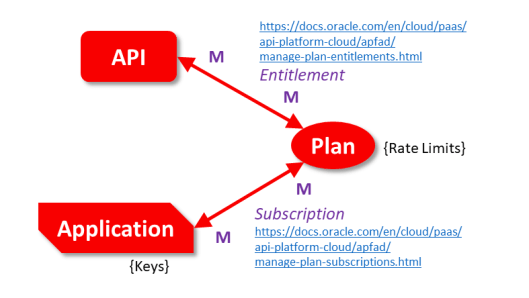
When it comes to Plans and Subscriptions on the Oracle API Platform we have a very flexible set of relationships. When it comes to checking the relationships to ensure a configuration is correct and that the impact of changing a plan or subscription is clear.  I end up having to draw a little diagram, which always leaves me second-guessing myself about which way the linkages are. So I created a quick aide memoir, particularly given the unfortunate fact that Oracle’s online documentation isn’t great for diagrams.

If the diagram helps me, then perhaps it can help others, so here it is:

API-Plan - Entitlement

I’ve also attached the original PowerPoint document so it can be modified, enhanced if you want to – API-Plan – Entitlement.

Share this:

  • Share on Facebook (Opens in new window) Facebook
  • Share on X (Opens in new window) X
  • Share on Reddit (Opens in new window) Reddit
  • Email a link to a friend (Opens in new window) Email
  • Share on WhatsApp (Opens in new window) WhatsApp
  • Print (Opens in new window) Print
  • Share on Tumblr (Opens in new window) Tumblr
  • Share on Mastodon (Opens in new window) Mastodon
  • Share on Pinterest (Opens in new window) Pinterest
  • More
  • Share on Bluesky (Opens in new window) Bluesky
  • Share on LinkedIn (Opens in new window) LinkedIn
Like Loading...

Everything As Code – Article for PTK

01 Wednesday May 2019

Posted by mp3monster in General, Oracle, OUG, Technology

≈ 2 Comments

Tags

article, Capgemini, EverythingAsCode, IaaS, OUG, PTK

PTK 2019-04-30.pngPTK (Pass The Knowledge) is the new name for the Independent UK Oracle User Group‘s journal, previously known as Oracle Scene.  Yesterday saw the 1st release under its new name, and I’m proud to say that I have an article included called Everything as Code.

Not only that,  it is great to see the journal includes the appearance of one of my Oracle Team colleagues at Capgemini – Amy Simpson-Grange (here).

The magazine features the approach trialled in the last issue of Oracle Scene where the Journal was split in two – one half focusing on Oracle Applications and Applications Technology and the other on Oracle core technologies i.e PaaS, IaaS, Database, Infrastructure etc.  it also just happens that Amy appears in one half, and I in the other.

One thing that hasn’t changed is the high quality of articles that reflect the diversity of Oracle’s portfolio and community – covering things like Women In IT, Conversational AI, Sanjeevan Bala from Channel 4 discussing the use of Data Science, Database Security and Table Scans.

Share this:

  • Share on Facebook (Opens in new window) Facebook
  • Share on X (Opens in new window) X
  • Share on Reddit (Opens in new window) Reddit
  • Email a link to a friend (Opens in new window) Email
  • Share on WhatsApp (Opens in new window) WhatsApp
  • Print (Opens in new window) Print
  • Share on Tumblr (Opens in new window) Tumblr
  • Share on Mastodon (Opens in new window) Mastodon
  • Share on Pinterest (Opens in new window) Pinterest
  • More
  • Share on Bluesky (Opens in new window) Bluesky
  • Share on LinkedIn (Opens in new window) LinkedIn
Like Loading...
← Older posts
Newer posts →

    I work for Oracle, all opinions here are my own & do not necessarily reflect the views of Oracle

    • About
      • Internet Profile
      • Music Buying
      • Presenting Activities
    • Books & Publications
      • Logging in Action with Fluentd, Kubernetes and More
      • Logs and Telemetry using Fluent Bit
      • Oracle Integration
      • API & API Platform
        • API Useful Resources
        • Useful Reading Sources
    • Mindmaps Index
    • Monster On Music
      • Music Listening
      • Music Reading
    • Oracle Resources
    • Useful Tech Resources
      • Fluentd & Fluent Bit Additional stuff
        • Logging Frameworks and Fluent Bit and Fluentd connectivity
        • REGEX for BIC and IBAN processing
      • Formatting etc
      • Java and Graal Useful Links
      • Official Sources for Product Logos
      • Python Setup & related tips
      • Recommended Tech Podcasts

    Oracle Ace Director Alumni

    TOGAF 9

    Logs and Telemetry using Fluent Bit


    Logging in Action — Fluentd

    Logging in Action with Fluentd


    Oracle Cloud Integration Book


    API Platform Book


    Oracle Dev Meetup London

    Blog Categories

    • App Ideas
    • Books
      • Book Reviews
      • manning
      • Oracle Press
      • Packt
    • Enterprise architecture
    • General
      • economy
      • ExternalWebPublications
      • LinkedIn
      • Website
    • Music
      • Music Resources
      • Music Reviews
    • Photography
    • Podcasts
    • Technology
      • AI
      • APIs & microservices
      • chatbots
      • Cloud
      • Cloud Native
      • Dev Meetup
      • development
        • languages
          • java
          • node.js
          • python
      • drone
      • Fluent Observability
        • Fluentbit
        • Fluentd
        • OpAMP
      • logsimulator
      • mindmap
      • OMESA
      • Oracle
        • API Platform CS
          • tools
        • Helidon
        • ITSO & OEAF
        • Java Cloud
        • NodeJS Cloud
        • OIC – ICS
        • Oracle Cloud Native
        • OUG
      • railroad diagrams
      • TOGAF
    • xxRetired
    • AI
    • API Platform CS
    • APIs & microservices
    • App Ideas
    • Book Reviews
    • Books
    • chatbots
    • Cloud
    • Cloud Native
    • Dev Meetup
    • development
    • drone
    • economy
    • Enterprise architecture
    • ExternalWebPublications
    • Fluent Observability
    • Fluentbit
    • Fluentd
    • General
    • Helidon
    • ITSO & OEAF
    • java
    • Java Cloud
    • languages
    • LinkedIn
    • logsimulator
    • manning
    • mindmap
    • Music
    • Music Resources
    • Music Reviews
    • node.js
    • NodeJS Cloud
    • OIC – ICS
    • OMESA
    • OpAMP
    • Oracle
    • Oracle Cloud Native
    • Oracle Press
    • OUG
    • Packt
    • Photography
    • Podcasts
    • python
    • railroad diagrams
    • Technology
    • TOGAF
    • tools
    • Website
    • xxRetired

    Enter your email address to subscribe to this blog and receive notifications of new posts by email.

    Join 2,616 other subscribers

    RSS

    RSS Feed RSS - Posts

    RSS Feed RSS - Comments

    April 2026
    M T W T F S S
     12345
    6789101112
    13141516171819
    20212223242526
    27282930  
    « Mar    

    Twitter

    Tweets by mp3monster

    History

    Speaker Recognition

    Open Source Summit Speaker

    Flickr Pics

    Boxer Rebellion @ Brixton ElectricBoxer Rebellion @ Brixton ElectricBoxer Rebellion @ Brixton ElectricBoxer Rebellion @ Brixton Electric
    More Photos

    Social

    • View @mp3monster’s profile on Twitter
    • View philwilkins’s profile on LinkedIn
    • View mp3monster’s profile on GitHub
    • View mp3monster’s profile on Flickr
    • View mp3muncher’s profile on WordPress.org
    • View philmp3monster’s profile on Twitch
    Follow Phil (aka MP3Monster)'s Blog on WordPress.com

    Blog at WordPress.com.

    • Subscribe Subscribed
      • Phil (aka MP3Monster)'s Blog
      • Join 228 other subscribers
      • Already have a WordPress.com account? Log in now.
      • Phil (aka MP3Monster)'s Blog
      • Subscribe Subscribed
      • Sign up
      • Log in
      • Report this content
      • View site in Reader
      • Manage subscriptions
      • Collapse this bar
     

    Loading Comments...
     

    You must be logged in to post a comment.

      Privacy & Cookies: This site uses cookies. By continuing to use this website, you agree to their use.
      To find out more, including how to control cookies, see here: Our Cookie Policy
      %d