In addition, if you want to see the presentation and hear us discuss the solution and explain how it works, we recorded part of the presentation dry run, which can be heard here (Demo) and here (Code overview).
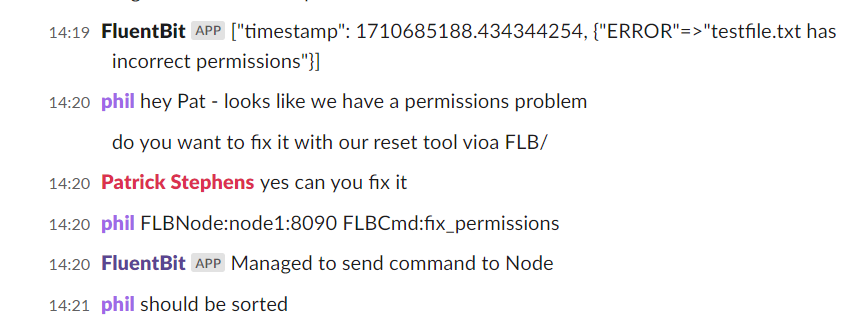
I couldn’t be in Paris in person, so Patrick took the job of presenting in Paris, we tried to enable my remote participation but had audio issues. Hopefully, you’ll see the recording of Pat’s physical presentation here. But I did manage to collaborate in the demo:
This means that the original repo I mentioned can be viewed as a beta or upstream version (it’s cluttered with some generated code from Helidon, which we will eventually get around to exploiting and making the utility a native binary executable).
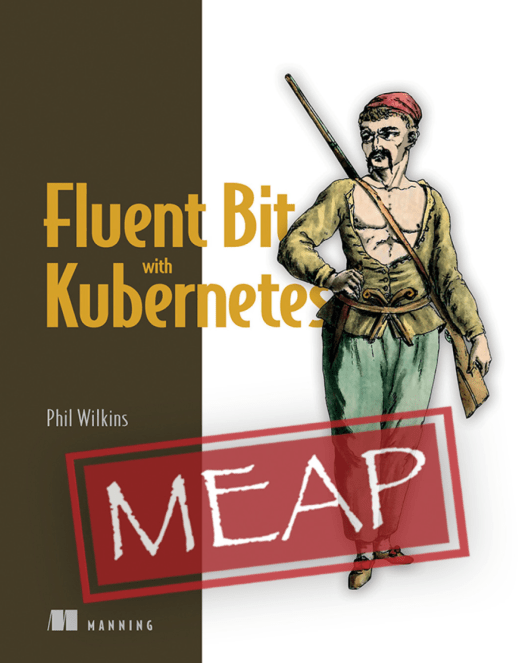
A quick update on the book – very early this morning or late last night (depending on your perspective), we sent our development editor the final chapter of the Fluent Bit with Kubernetes book. There is still a way to go before we’re completed (with multiple reviews to happen, appropriate edits to be made, copy editing, etc. Still, it is an important milestone from an author’s perspective.
For the keen readers who have signed up for the MEAP (Manning Early Access Programme) of the book, I can confirm that the editorial team (preparation for eBook and website formatting, checking the edits to address the Technical Editor and Development Editor haven’t introduced any obvious issues) are working on the preparation of Chapter 7 – so that should be available soon. When this chapter is available, the content covering all the foundational aspects of Fluent Bit will be available. The remaining chapters reflect the advanced features.
When it comes to observability, particularly logs, and traces, there is a historical tendency to process things in a batch manner or even only once the need to determine the root cause of an outage, often only using something in the metrics to indicate something might not be right. This misses a real opportunity given Fluent Bit can capture observability events in near real-time, whether that is a log, metric, or trace indicating something unhealthy; why not present the issue to those performing an ops role as soon as it is recognized by Fluent Bit. Not once the data is processed by a back end?
While we have solutions like PagerDuty, they tend to be integrated with back-end event analytics tools. Fluent Bit can talk to social channels such as Slack – so why not direct critical events to Slack and interact with the Ops team more directly. After all, if we’re told quickly about an imminent issue or as soon after something wrong occurs, the impact and effort involved in remediation and recovery are smaller. This is the basis of a presentation that Patrick Stephens (from Chronosphere and a committer to the Fluent Bit project) and I have put together. Patrick will be leading the session at the Cloud Native Rejekts conference in Paris (the ‘b side’ to Kube Con Europe), which takes place on the two days before Kubecon itself.
The session looks at the idea of what has been called ChatOps, why and how it can bring value, facilitated with a demo of using Fluent Bit to detect and share an event with Fluent Bit and also pick up and handle directions from the Ops team in the Slack channel.
We hope you’ll see from the session why we think the approach is worthy of consideration and how the potential security considerations can be mitigated. The MVP code is currently here but may, in due course, actually be migrated to the Fluent repos here.
We’ve bundled readme content and scripts to build and help test the additional functionality created to facilitate part of the operation.
We don’t want to spoil the presentation, so we won’t share too much. But it’ll also be worth checking with the blog, seeing as we’ll record a video and eventually record a session explaining the MVP’s ins and outs.
anyone tracking the Fluent Bit with Kubernetes book progress will be pleased to know that several more chapters are being made available via MEAP (Early Access Program). This includes additional appendices.
We’re hoping to have the first draft of the final two chapters completed in the next couple of weeks so they can start the editorial and go into the peer review process. This includes chapters on extending Fluent Bit through WebAssembly and the Go language with an example of a multi-purpose DB input and output capability.
The exciting news is that Manning have released several more chapters of our Fluent Bit with Kubernetes book into the MEAP (Manning Early Access Program) – which means about two-thirds of the book is now available in MEAP form.
We’ve also been beefing up the supporting and related information on this website – as we can’t get everything into the book – for the static pages, the most relevant are here and here, and the blog post content can be seen here.
The sample configurations are in our GitHub repo here, and additional demos can be found here. We’ve got a pretty cool demo being built, which takes Fluent Bit into the world of ChatOps (and it isn’t just sending notifications) – it will eventually become visible in the repo – but to see it sooner, keep an eye out for our conference presentations.
The hyper scaler cloud vendors all offer Logging and monitoring capabilities. But they tend to focus on supporting their native services. If you’re aware of Oracle’s Cloud (OCI) messaging, then you’ll know that there is a strong recognition of the importance of multi-cloud. This extends not only to connecting apps across clouds but also to be able to observe and manage cloud-spanning solutions. Ultimately, most organizations want to headline observability-related views of their solutions.
Late last year, I presented these ideas, illustrating the ideas with the use of Fluent Bit and OCI’s Observability and Management products to visualize and analyze what is happening. I finally found the time to write how the very basic demo was built from a clean sheet over on the Oracle Devs blog on Medium.
This also highlights the fact that the Fluent Bit book, while I believe, once completed, will be through, can’t cover everything – and certainly not build end-to-end use cases like the Oracle Observability & Management example. To help address this, the book includes an appendix of helpful additional information, some of which I have included here, along with other content that we encounter – all of which can be found at Fluentd & Fluent Bit Additional stuff.
With the Christmas holidays happening, things slowed down enough to sit and catch up on some reading – which included reading Cloud Observability in Action by Michael Hausenblas from Manning. You could ask – why would I read a book about a domain you’ve written about (Logging In Action with Fluentd) and have an active book in development (Fluent Bit with Kubernetes)? The truth is, it’s good to see what others are saying on the subject, not to mention it is worth confirming I’m not overlapping/duplicating content. So what did I find?
Cloud Observability in Action by Michael Hausenblas
Cloud Observability In Action has been an easygoing and enjoyable read. Tech books can sometimes get a bit heavy going or dry, not the case here. Firstly, Michael went back to first principles, making the difference between Observability and monitoring – something that often gets muddied (and I’ve been guilty of this, as the latter is a subset of the former). Observability doesn’t roll off the tongue as smoothly as monitoring (although I rather like the trend of using O11y). This distinction, while helpful, particularly if you’re still finding your feet in this space, is good. What is more important is stepping back and asking what should we be observing and why we need to observe it. Plus, one of my pet points when presenting on the subject – we all have different observability needs – as a developer, an ops person, security, or auditors.
Next is Michael’s interesting take on how much O11y code is enough. Historically, I’ve taken the perspective – that enough is a factor of code complexity. More complex code – warrants more O11y or logging as this is where bugs are most likely to manifest themselves; secondly, I’ve looked at transaction and service boundaries. The problem is this approach can sometimes generate chatty code. I’ve certainly had to deal with chatty apps, and had to filter out the wheat from the chaff. So Michael’s approach of cost/benefit and measuring this using his B2I ratio (how much code is addressing the business problems over how much is instrumentation) was a really fresh perspective and presented in a very practical manner, with warnings about using such a measure too rigidly. It’s a really good perspective as well if you’re working on hyperscaling solutions where a couple of percentage point improvements can save tens of thousands of dollars. Pretty good going, and we’re only a couple of chapters into the book.
The book gets into the underlying ideas and concepts that inform OpenTelemetry, such as traces and spans, metrics, and how these relate to Observability. Some of the classic mistakes are called out, such as dimensioning metrics with high cardinality and why this will present real headaches for you.
As the data is understood, particularly metrics you can start to think about how to identify what normal is, what is abnormal, or an outlier. That then leads to developing Service Level Objectives (SLOs), such as an acceptable level of latency in the solution or how many errors can be tolerated.
The book isn’t all theory. The ideas are illustrated with small Go applications, which are instrumented, and the generated metrics, traces, and logs. Rather than using a technology such as Fluentd or Fluent Bit, Michael starts by keeping things simple and directly connecting the gathering of the metrics into tools such as Prometheus, Zipkin, Jaeger, and so on. In later chapters, the complexity of agents, aggregators, and collectors is addressed. Then, the choices and considerations for different backend solutions from cloud vendor-provided services such as OpenSearch, ElasticSearch, Splunk, Instana and so on. Then, the front-end visualization of the data is explored with tools such as Grafana, Kibana, cloud-provided tools, and so on.
As the book progresses, the chapters drill down into more detail, such as the differences and approaches for measuring containerized solutions vs. serverless implementations such as Lambda and the kinds of measures you may want. The book isn’t tied to technologies typically associated with modern Cloud Native solutions, but more traditional things like relational databases are taken into account.
The closing chapters address questions such as how to address alerting, incident management, and implementing SLOs. How to use these techniques and tools can help inform the development processes, not just production.
So I would recommend the book, if you’re trying to understand Observability (regardless of a cloud solution or not). If you’re trying to advance from the more traditional logging to a fuller capability, then this book is a great guide, showing what, why, and how to evaluate the value of doing so.
To come back to my opening question. The books have small points of overlap, but this is no bad thing, as it helps show how the different viewpoints intersect. I would actually say that the Observability in Action shows how the wider landscape fits together, the underlying value propositions that can help make the case for implementing a full observability solution. Then, Logging in Action and the new book, Fluent Bit with Kubernetes, give you some of the common context, and we drill into the details of how and what can be done with Fluent Bit and Fluentd. All Manning needs now is content to deep dive into Prometheus, Grafana, Jaeger, and OpenSearch to provide an end-to-end coverage of first principles to the art of the possible in Observability.
I also have to thank Michael for pointing his readers and sections of Logging in Action that directly relate and provide further depth into an area.
It’s been a busy time on the book front. With the book going into the Manning Early Access Program (MEAP). Since then, we have got three more chapters ready, and we’re waiting for the Manning Technical Editor to come back on the content. Once that feedback is addressed, we go into another peer review round, and the chapters will be added to the MEAP edition.
The peer review process is insightful and helps drive improvements to the content, as the reviewers are deeply informed – after all, some of them coded the functionality I’m writing about. So, the comments and questions that come back deserve careful consideration.
It isn’t just more chapters; the appendices have been moving forward, and we should see the first two appendices in the MEAP content soon.
If that isn’t enough for you – as we developed Chapter 8 (probably ready for Manning by the New Year) and worked on the appendices, we identified content that doesn’t neatly fit the book, so we’ve incorporated that content on this blog and in other places (we’re expecting a blog to be published early in the New Year here). We’ve created a page on this website to help collect together content here, and you can see all the blog content here.
But there is plenty of work still to be done, as Fluent Bit supports both YAML and classic configuration formats. We have focussed on the classic format in the book as more people use that at the moment. But, eventually, the YAML format will become more dominant, so we’re providing the YAML equivalent configurations for all the examples. These need to be finalized and checked.
We think Chapter 9 will come quickly, but the final chapter will take time, as we’re expecting the peer review feedback to land as we start Chapter 10. But there is also a lot more effort involved in the final chapter. Then, it’s another peer review round.
We’ve recently had several pieces published on other websites, so I thought we should link them together.
Here is a short piece on Ubuntu security on OCI here.
Another here (DZone) on the use of Solace for multi-cloud messaging.
We’re expecting another article to appear here in the New Year as well. Plus, the book is moving along at a very nice pace – we’ve got a separate post for that.
On the book front – watch out for the Manning and Packt festive promotions.
I’ve written about how railroad syntax diagrams (see here) are great for helping write code (or configuration files). Following the track through the diagram will give you the correct statement syntax, and generally, the diagrams don’t require you to jump around like BNF or eBNF representations.
As you may have seen, I’m currently writing a book on Fluent Bit, and guess what? We’re on the Stream Processor chapter. Looking broaching the use of syntax, it just felt right to have a railroad diagram. As the diagram is fairly large, it won’t print well, so here are the diagrams.
The master content is in GitHub here. If you want a quick reference to how the diagrams work, check here.
Stream Processor Configuration
Fluent Bit Stream Processor Configuration Syntax
While Fluent Bit’s core syntax is pretty straightforward, the syntax for the stream processing is a bit more complex, with a strong resemblance to SQL. As SQL is declarative in nature and can contain iterative and nested elements, RailRoad diagrams can really help.
The original BNF definition of the Stream SQL syntax is here.
Fluent Bit Configuration RailRoad Diagrams
When it comes to the core configuration files, RailRoad diagrams aren’t as effective because the configuration is more declarative in nature. But we’ve tried to capture the core essence here. The only issue is that representing things like the use of @include, which can show up in most parts of the file – arent so easy, and a list of attributes for each possible standard plugin would make the diagram enormously large and unwieldy.
Fluent Bit Classic Format Configuration
We know there are gaps in the current diagrams, which will be addressed. Including:
YAML format
@include
We should show that environment variables can be references as attributes
A better way to show the required indentation and line separation







 Phil (aka MP3Monster)'s Blog
You must be logged in to post a comment.